Revista Brasileira de Anestesiologia 219 Vol. 59, No 2, Março-Abril, 2009
Rev Bras Anestesiol INFORMAÇÃO CLÍNICA
2009; 59: 2: 219-222 CLINICAL REPORT
RESUMO
Belém LS, Inácio CAC — Bloqueio Atrioventricular de 2° Grau do Tipo I Mobitz após Aplicação de Penicilina Benzatina. Relato de Caso.
JUSTIFICATIVA E OBJETIVOS: O bloqueio atrioventricular de 2° grau do tipo I de Mobitz é observado como alteração transitória na presença de infarto de parede inferior ou de intoxicação medica-mentosa. O objetivo desse relato foi apresentar caso de bloqueio atrioventricular de 2° grau tipo I de Mobitz após aplicação de pe-nicilina benzatina.
RELATO DO CASO: Paciente apresentou síncope e sudorese após aplicação de penicilina benzatina. Ao exame físico apresen-tava-se sudoreico, bradicárdico e com ritmo irregular. Foi realizado eletrocardiograma (ECG) que mostrava bloqueio atrioventricular de 2° grau do tipo I de Mobitz. Administrou-se atropina 0,5 mg por via venosa. Após uma hora foi repetido o ECG que apresentava traça-do normal. Paciente permaneceu seis horas assintomático e en-tão recebeu alta.
CONCLUSÕES: O bloqueio atrioventricular de 2° grau do tipo I de Mobitz surgiu após aplicação de penicilina benzatina.
Unitermos: COMPLICAÇÕES, Cardíaca: disritmia, bloqueio atrioventricular; DROGAS: penicilina benzatina.
SUMMARY
Belém LS, Inácio CAC — Second Degree Atrioventricular Block Mobitz Type I after Administration of Benzathine Penicillin. Case Report.
BACKGROUND AND OBJECTIVES: Second degree atrioventri-cular block Mobitz type I is seen as a transitory change in the pre-sence of inferior wall myocardial infarction or drug intoxication. The objective of this report was to present a case of second degree
atrioventricular block Mobitz type I after administration of benza-thine penicillin.
CASE REPORT: The patient had a syncopal episode and sudoresis after administration of benzathine penicillin. On physical exam, he presented diaphoresis, bradycardia, and irregular heart rate. The electrocardiogram (ECG) showed second degree atrioventricular block Mobitz type I. Intravenous atropine, 0.5 mg, was administered. An ECG done one hour later was normal. The patient remained asymptomatic and, and after six hours he was discharged.
CONCLUSIONS: The patient developed second degree atrioventri-cular block Mobitz type I after the administration of benzathine penicillin.
Key words: COMPLICATIONS, Cardiac: arrhythmia, atrioventricular block; DRUGS: benzathine penicillin.
INTRODUÇÃO
O bloqueio atrioventricular de 2° grau (BAV 2°) está presen-te quando alguns impulsos atriais deixam de ser conduzi-dos aos ventrículos. O BAV 2° do tipo I Mobitz está presente quando há um aumento progressivo do intervalo PR antes do bloqueio do impulso atrial, sendo, normalmente, o mais longo PR aquele que antecede a onda P bloqueada e o mais curto aquele que ocorre após o batimento bloqueado 1.
Frequentemente esse tipo de bloqueio é observado como alteração transitória na presença de infarto da parede infe-rior ou de intoxicação medicamentosa, particularmente digi-tal, betabloqueadores e, às vezes, antagonistas dos canais de cálcio. Esse tipo de bloqueio também pode ser observa-do em indivíduos normais com tônus vagal exacerbaobserva-do. Embora o BAV 2° do tipo I de Mobitz possa evoluir para blo-queio atrioventricular total, isso é incomum, exceto no con-texto do infarto agudo do miocárdio da parede inferior. Entretanto, mesmo quando isso acontece, o bloqueio atrioventricular é geralmente bem tolerado porque o marca-passo de escape surge, com frequência, no feixe de His proximal, propiciando ritmo estável 2.
RELATO DO CASO
Paciente do sexo masculino, 34 anos, solteiro e presidiário, foi transferido ao hospital em virtude de episódio de síncope e sudorese fria após a aplicação de duas injeções de
pe-Bloqueio Atrioventricular de 2° Grau do Tipo I Mobitz após
Aplicação de Penicilina Benzatina. Relato de Caso*
Second Degree Atrioventricular Block Mobitz Type I after Administration
of Benzathine Penicillin. Case Report
Lúcia de Sousa Belém1, Cristiano Aparecido Cavalcante Inácio2
*Recebido (Received from) do Hospital de Messejana Dr. Carlos Alberto Studart Gomes, Fortaleza, CE
1. Médica — Residência em Cardiologia.
2. Acadêmico de Medicina da Universidade Estadual do Ceará
Apresentado (Submitted) em 26 de julho de 2008
Aceito (Accepted) para publicação em 19 de dezembro de 2008
Endereço para correspondência (Correspondence to): Dra. Lúcia de Sousa Belém
Tr José Onofre, 23 — Pq Santo Antônio 60763-790 Fortaleza, CE
E-mail: [email protected]
Revista Brasileira de Anestesiologia 221 Vol. 59, No 2, Março-Abril, 2009
SECOND DEGREE ATRIOVENTRICULAR BLOCK MOBITZ TYPE I AFTER ADMINISTRATION OF BENZATHINE PENICILLIN. CASE REPORT
O paciente foi diagnosticado corretamente com bloqueio atrioventricular de 2° grau do tipo I de Mobitz após adminis-tração de penicilina benzatina e tratado conforme rotina para o caso. Após um período de seis horas assintomático rece-beu alta.
Second Degree Atrioventricular Block
Mobitz Type I after Administration of
Benzathine Penicillin. Case Report
Lúcia de Sousa Belém, M.D.; Cristiano Aparecido Cavalcante Inácio
INTRODUCTION
Second-degree atrioventricular (AV) block is present when some atrial impulses fail to be conducted to the ventricles. Second-degree AV block Mobitz type I is associated with progressive increase in PR interval before the blockade of the atrial impulse and, usually, the PR interval preceding the blocked P wave is the longest and the one after the blocked beat is the shortest 1.
Frequently, this type of block is seen as a transitory change in the presence of an inferior wall myocardial infarction or drug intoxication, especially digitalis, β-blockers, and,
occa-sionally, calcium channel blockers. This type of block can also be observed in normal individuals with increased vagal tonus. Although second-degree AV block Mobitz type I could evolve to complete AV block, this is rare, except in the pre-sence of an acute inferior wall myocardial infarction. However, even when this occurs, the AV block is usually well tolerated because the escape pacemaker takes over with the frequen-cy determined by the proximal Hiss bundle, providing a stable rhythm 2.
CASE REPORT
A male patient, 34 years old, a prison inmate, was transferred to the hospital due to syncope and diaphoresis after the administration of two injections of benzathine penicillin at the presidium hospital where he was hospitalized to treat tu-berculosis.
The patient had had other injections of benzathine penicillin in other occasions without complications. He was being treated for tuberculosis for four months with rifampin and iso-niazid. He denied atopy as a child. He was a drug user, but stated that had not used drugs for the past year, the period he had been imprisoned.
On physical exam, his appearance was regular, he was diaphoretic, mucous membranes were pink, hydrated, with an irregular radial pulse at 40 bpm, and respiratory rate of 20. Auscultation of the heart revealed decreased heart sounds,
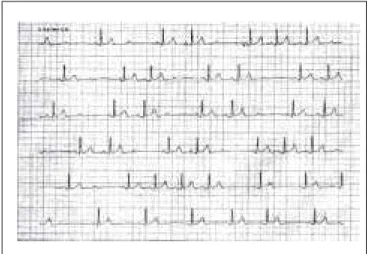
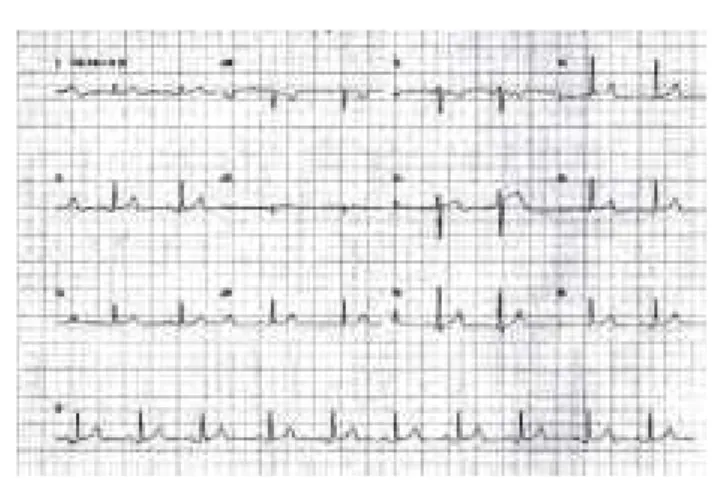
B1 and B2, irregular rhythm, without murmurs. The remai-ning of the physical exam showed no abnormalities. After admission to the hospital, a 12-lead electrocardiogram (Figure 1) with a long DII (Figure 2) showed second degree
atrioventricular block Mobitz type I.
Intravenous atropine, 0.5 mg, was administered.
After one hour, the patient was asymptomatic and a new electrocardiogram was normal (Figure 3).
After a six-hour observation period during which the patient remained asymptomatic, he was discharged from the hospital.
DISCUSSION
Second degree AV block Mobitz type I can be seen by digi-talis intoxication, acute infection (rheumatic fever), electrolyte imbalance, acute phase of an inferior wall myocardial infarction (usually transitory), after cardiac surgery in normal
Figure 1 – 12-Lead Electrocardiogram
222 Revista Brasileira de Anestesiologia Vol. 59, No 2, Março-Abril, 2009 BELÉM AND INÁCIO
hearts (manipulation of normal hearts, substitution of calcified aortic valves), and during sleep (especially in the elderly and athletes) 3,4.
A review of the literature did not show any reports of second-degree AV block Mobitz type I after the administration of benzathine penicillin.
Progression to complete AV block is rare, and a stable es-cape rhythm can be expected. Therefore, treatment is usually conservative and guided by the ventricular response. However, patients with heart disease have a less favorable evolution, although this most likely reflects the extension and severity of the baseline disease and not the AV block itself 5.
When the patient is asymptomatic, treatment is expectant. In the acute phase of an inferior wall myocardial infarction, intravenous atropine (0.5 to 1 mg) can be used if necessary (bradycardia with hypotension and deterioration of the hemodynamic parameters) to reestablish the AV conduction. Rarely, patients with second-degree AV block Mobitz type I need permanent pacemaker 6.
In the present case, the symptomatic second-degree AV block Mobitz type I seemed to be caused by the administration of benzathine penicillin.
The patient was diagnosed with second-degree AV block Mobitz type I after the administration of benzathine penicillin and treated accordingly. After remaining asymptomatic for six hours, the patient was discharged.
REFERÊNCIAS — REFERENCES
01. Carneiro EF — O Eletrocardiograma 10 Anos depois. Rio de Ja-neiro, Livraria Enéas Ferreira, 1997;375.
02. Braunwald E, Kasper DL, Fauci AS et al. — Harrison Medicina Interna, 16ª ed. Rio de Janeiro, McGraw-Hill, 2006;1403. 03. Timerman A, Sousa JEMR, Piegas LS — Urgências
Cardiovas-culares, 2ª ed. São Paulo, Savier, 1996;87-88.
04. Braunwald E — Heart Disease: A Textbook of Cardiovascular Medicine, 7ª ed. Philadelphia, W.B. Saunder, 2005;690.
05. Hurst JW — O Coração: Artérias e Veias, 6ª Ed. Rio de Janeiro, Guanabara Koogan, 1990;355.
06. Cheitlin MD, Sokolow M, McIlroy MB — Clinical Cardiology, 6ª ed. London, Prentice-Hall, 1993;143.
RESUMEN
Belém LS, Inácio CAC — Bloqueo Atrioventricular de 2º Grado Tipo Mobitz I después de la Aplicación de Penicilina Benzatina. Relato de Caso.
JUSTIFICATIVA Y OBJETIVOS: El bloqueo atrioventricular de 2° grado del tipo I de Mobitz es observado como una alteración tran-sitoria en la presencia de infarto de la pared inferior o de intoxi-cación medicamentosa. El objetivo de este relato fue presentar un caso de bloqueo atrioventricular de 2° grado tipo I de Mobitz después de la aplicación de penicilina benzatina.
RELATO DEL CASO: Paciente que presentó síncope y sudoración después de la aplicación de penicilina benzatina. En el examen fí-sico sudaba, estaba bradicárdico y con ritmo irregular. Fue reali-zado el electrocardiograma (ECG) que mostraba un bloqueo atrioventricular de 2° del tipo I de Mobitz. Se le administró atropina 0,5 mg por vía venosa. Después de una hora, fue repetido el ECG que presentaba un trazado normal. El paciente permaneció seis horas asintomático y entonces recibió el alta.
CONCLUSIONES: El bloqueo atrioventricular de 2° grado del tipo I de Mobitz surgió después de la aplicación de la penicilina ben-zatina.