Techniques
Julian Stevenson1*., James R. Krycer1,2
*., Lisa Phan1
, Andrew J. Brown1*
1School of Biotechnology and Biomolecular Sciences, The University of New South Wales, Sydney, New South Wales, Australia,2Diabetes and Obesity Program, Garvan Institute of Medical Research, Sydney, New South Wales, Australia
Abstract
The precise assembly of specific DNA sequences is a critical technique in molecular biology. Traditional cloning techniques use restriction enzymes and ligation of DNAin vitro, which can be hampered by a lack of appropriate restriction-sites and
inefficient enzymatic steps. A number of ligation-independent cloning techniques have been developed, including polymerase incomplete primer extension (PIPE) cloning, sequence and ligation-independent cloning (SLIC), and overlap extension cloning (OEC). These strategies rely on the generation of complementary overhangs by DNA polymerase, without requiring specific restriction sites or ligation, and achieve high efficiencies in a fraction of the time at low cost. Here, we outline and optimise these techniques and identify important factors to guide cloning project design, including avoiding PCR artefacts such as primer-dimers and vector plasmid background. Experiments made use of a common reporter vector and a set of modular primers to clone DNA fragments of increasing size. Overall, PIPE achieved cloning efficiencies of,95% with few manipulations, whereas SLIC provided a much higher number of transformants, but required additional steps. Our data suggest that for small inserts (,1.5 kb), OEC is a good option, requiring only two new primers, but performs poorly for larger inserts. These ligation-independent cloning approaches constitute an essential part of the researcher’s molecular-tool kit.
Citation:Stevenson J, Krycer JR, Phan L, Brown AJ (2013) A Practical Comparison of Ligation-Independent Cloning Techniques. PLoS ONE 8(12): e83888. doi:10.1371/journal.pone.0083888
Editor:Jean Peccoud, Virginia Tech, United States of America
ReceivedOctober 1, 2013;AcceptedNovember 8, 2013;PublishedDecember 23, 2013
Copyright:ß2013 Stevenson et al. This is an open-access article distributed under the terms of the Creative Commons Attribution License, which permits unrestricted use, distribution, and reproduction in any medium, provided the original author and source are credited.
Funding:This work was supported by the National Health and Medical Research Council (1008081, www.nhmrc.gov.au/); and the National Heart Foundation of Australia (G11S5757, http://www.heartfoundation.org.au). The funders had no role in study design, data collection and analysis, decision to publish, or preparation of the manuscript.
Competing Interests:The authors have declared that no competing interests exist.
* E-mail: [email protected] (AJB); [email protected] (JS); [email protected] (JRK)
.These authors contributed equally to this work.
Introduction
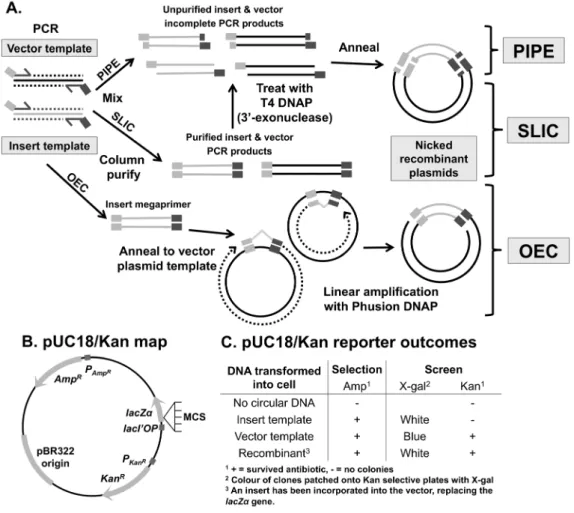
The precise assembly of specific DNA sequences is a critical technique in molecular biology. Traditional cloning makes use of restriction enzymes and ligation of DNA in vitro. Restriction endonuclease digestion and ligation increase the complexity of cloning projects, for example by requiring selection of appropriate restriction-sites and inefficient ligation steps. Consequently, several ligation-independent cloning (LIC) methods have since been developed that are simpler, faster, and highly efficient. These strategies rely on the generation of DNA fragments with single-stranded complementary ends to allow directional cloning of any insert, independent of restriction enzymes andin vitroligation. The most effective and convenient methods include polymerase incomplete primer extension (PIPE) cloning [1], sequence and ligation-independent cloning (SLIC) [2], and overlap extension cloning (OEC) [3,4] (Figure 1). In this study, we will compare these cloning strategies.
All three techniques amplify the gene of interest by polymerase chain reaction (PCR). The 39 ends of the PCR primers are template-specific, whilst the 59ends incorporate tails specific for the cloning junction.
PIPE relies on the observation that a significant portion of PCR products are incomplete, having 39-recessed ends [1], particularly in the absence of a final extension step. SLIC uses a brief
treatment of purified PCR products with the 39R59 exonuclease activity of T4 DNA polymerase to generate a higher proportion of recessed ends [2,5]. Cloning is possible due to the complementary 59ends of the insert and vector fragments. These are analogous to the much shorter ‘sticky ends’ generated by restriction enzymes. After mixing, these single-stranded overhangs anneal and can be efficiently ligatedin vivoafter transformation by the bacterial DNA recombination and repair machinery.
In contrast, OEC has two rounds of amplification. Firstly, the insert is PCR-amplified using primers with 59ends complementary to the target site in a circular destination vector. The 39ends of this product (‘megaprimer’) can consequently anneal and amplify the destination vector by overlap extension. This yields a nicked plasmid that is repaired after transformation. A variant of the OEC strategy is utilised by the commonly used QuikChange site-directed mutagenesis kit (Agilent Technologies).
Materials and Methods
Primer combinations
Primer sequences are listed in Table S1 in File S1. Gene accession numbers and plasmid vector backbones are listed in Table S2 in File S1. The pUC18/Kan reporter vector (Figure 1B) was prepared using PIPE cloning. The vector backbone of pUC18 was obtained by PCR with primers pUC18–F and pUC18–R, and the kanamycin resistance cassette from pEGFP-C1 (Clontech) with primers KanR-in-pUC-F and KanR-in-pUC-R. The complete pUC18/Kan vector DNA sequence is included as a text file in Supporting Information (File S2).
A 24 bp FLAG epitope insertion (84 bp fragment) was achieved through PIPE or SLIC with primers pUC18-F and FLAG-pUC18-R to amplify pUC18/Kan. The 85 bp FLAG megaprimer for OEC was prepared through 40 uL thermal cycling of the primers alone, with 4mM pUC18-overlap-F and FLAG-pUC18-overlap-R with 16HF Buffer, 0.8 U of Phusion Hot Start II High-Fidelity DNA Polymerase (New England Biolabs) and cycling conditions: (98uC 30 s, 63uC 30 s, 72uC 1 min)65.
The pUC18/Kan vector backbone was amplified with primers pUC18-L30-F and pUC18-L30-R, which are the reverse comple-ment of the common 59-tails of the insert primers. A 350 bp fragment (Gluc) was amplified from FLAG-hLXRb-hGluc(1) [6] with primers Gluc-pUC18-F and BGH-pUC18-R. LXRb(1.4 kb) was similar amplified with primers pUC18-F and LXRb-pUC18-R. A 2.2 kb sequence (AR) from pTK-AR-V5 [6] was obtained with primers AR-pUC18-F and AR-pUC18-R. SRC-1 (4.3 kb) was amplified with primers pUC18-F and SRC1-pUC18-R from pCR3.1-SRC1 [7]. 1.4 kb Insig-1 and 4.3 kb SCAP fragments were obtained with primers T7-pUC18-F and BGH-pUC18-R from pCMV-Insig-1-Myc or pCMV-SCAP respectively [8].
PCR
PCR was performed in 50mL reactions using 0.5 ng of template, 0.5mM forward and reverse primers, 5% DMSO, HF Buffer and 1 U of the non-strand displacing enzyme Phusion Hot Start II High Fidelity DNA polymerase, and cycling conditions: Figure 1. Principles of polymerase incomplete primer extension (PIPE) cloning, sequence and ligation-independent cloning (SLIC) and overlap extension cloning (OEC).(A) In PIPE, incomplete extension during PCR generates 39-recessed ends. In SLIC, purified PCR products are treated with T4 DNA polymerase (DNAP) so that the exonuclease activity will increase the proportion of recessed ends. In both these techniques, by amplifying vector and insert with primers containing complementary 59-tails and mixing the products, the overhangs can anneal and are joinedin vivoafter transformation intoE. coli.In OEC, the insert PCR product acts a megaprimer to generate a nicked plasmid by overlap extensionin vitroin a
second round of amplification. The nicks are also repairedin vivo. For all techniques, a DpnI digestion step is included to remove plasmid template (not shown). (B) Design of the reporter vector, encoding resistance for ampicillin and kanamycin, and the alpha-fragment of beta-galactosidase. (C) Colonies from ampicillin plates were patched onto kanamycin/X-gal plates to distinguish recombinants from unwanted insert vector or empty pUC18/Kan background colonies.
98uC 3 min, (98uC 30 s, 63uC 30 s, 72uC 3 min for products .1.5 kb or 1 min for,1.5 kb)630.
Reaction products were column purified using a QIAquick PCR purification or gel extraction kit (Qiagen) and quantified by spectroscopy.
PIPE cloning
0.025 pmol of vector and 0.0625 pmol insert purified products (2.5:1 insert:vector ratio) were digested for 3 hr at 37uC with 10 U of DpnI in 10mL CutSmart Buffer (NEBuffer 4.1/0.1 mg/mL BSA), diluted 1:1 with 16 HF buffer (to control for buffer composition between purified and unpurified products, as 16HF buffer halved transformation efficiency), and 2mL used to transform 18mL of XL10 Gold ultracompetent cells (Agilent Technologies) according to manufacturer’s instructions.
SLIC
DpnI digested purified PIPE products were incubated at 25uC for 5 min with 0.75 U of T4 DNA polymerase, immediately placed on ice for 10 min, diluted 1:1 with ice-cold 16HF Buffer, and 2mL used for transformation as described above.
OEC
20mL OEC reactions were performed using 10–250 fmol of insert product 284 bp: 250 fmol (12.5 nM); 350 bp: 100 fmol (5 nM); 1.4 kb: 25 fmol (1.25 nM); 4.3 kb: 10 fmol (0.5 nM) - as megaprimer and 25 ng of pUC18/Kan vector template with 5% DMSO, 0.4 U of Phusion Hot Start II High Fidelity DNA polymerase, and cycling conditions: 72uC 5 min (to blunt the megaprimer), 98uC 3 min, (98uC 30 s 63uC 30 s 72uC 3 min) 630. 5mL fractions were diluted 1:1 with CutSmart Buffer (to control for buffer and assist DpnI activity), digested for 3 hr at 37uC with 20 U of DpnI, and 2mL used for transformation as described above.
Colony counting and screening
Serial dilutions of transformation mixture were spread onto ampicillin selective plates to allow counting of the number of colony forming units (CFU), adjusted to account for total volume, and rounded to 3 significant figures. 40 colonies were picked and streaked onto kanamycin selective plates in the presence of X-gal/ IPTG to identify recombinants. For one replicate experiment of each set, colonies were also tested by colony PCR across the cloning junctions or sequenced to validate the blue/white screening.
specific primers had the same 30 bp 59-tail – this modular design allowed replacement of the multiple-cloning site of pUC18/Kan with a collection of inserts. This allows simple identification of the type of plasmid in each colony – insert plasmid, vector plasmid or desired recombinant plasmid – as the insert plasmids lack kanamycin resistance, and the vector plasmid template contains undisrupted lacZa. Hence, bacteria were first plated onto
ampicillin plates and then patched onto kanamycin selective plates in the presence of IPTG for blue/white colony screening. Thus, positive colonies are white and resistant to both ampicillin and kanamycin (Figure 2C), whilst blue colonies possess pUC18/ Kan and Kan-sensitive colonies possess insert-containing plasmids.
Generation of nicked vector plasmid reduces PIPE cloning efficiency
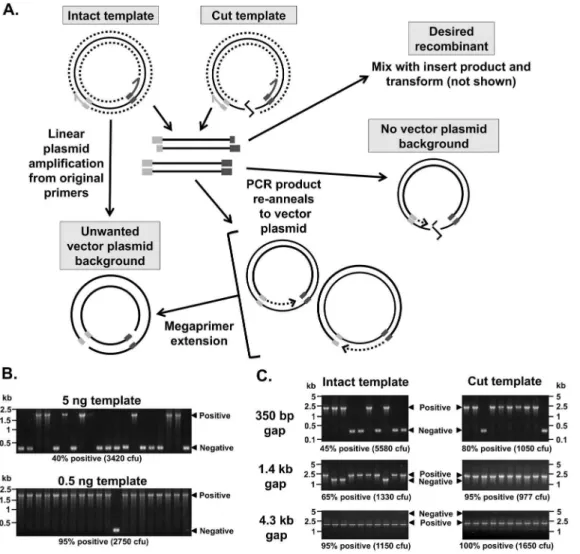
We began our optimisation with PIPE. After first transforming the DpnI-digested vector PCR product alone we observed a significant number of blue (empty pUC18/Kan) colonies, but no colonies without the PCR (data not shown). Given that DpnI only digests methylated DNA, this indicates that vector plasmid is being generated during the PCR. This can occur because extension of the vector primers all the way around the plasmid template can regenerate the empty vector plasmid (Figure 2A). Note that this is linear amplification, generating less product in contrast to the desired PCR product between the primers, which is amplified exponentially by PCR. However, the vector PCR products can also re-anneal to the vector and extend analogously to the megaprimers in OEC, although this appeared to be less important, as addition of three 59 non-template thymidines to the vector primers did not affect cloning efficiency (data not shown). Nevertheless, these situations can generate nicked copies of the vector in vitro that will escape DpnI digestion (Figure 2A). This leads to unwanted vector background colonies.
To confirm this mechanism, we hypothesised that nicked vector background should be reduced by 1) increasing the gap between the 59 ends of the vector primers, or 2) cutting the template in between the vector primers (Figure 2). To test this, we replaced 350 bp, 1.4 kb, or 4.3 kb inserts in pUC18/Kan (i.e. different gap sizes) with the same 2.2 kb insert. The insert primer 59 vector overhangs were complementary to the vector backbone, indepen-dent of the pre-existing insert sequences. This allows us to determine PIPE cloning efficiency – the proportion of successful recombinants - based on insert size differences using colony PCR. This was performed with or without linearising the vector using PstI. We found that both increasing the gap and linearisation reduced background (Fig 2C). However, because these strategies restrict the utility of PIPE-cloning, we sought a more flexible solution. We reasoned that reducing the template should dilute out the background – since the complete vector is linearly amplified, it is more dependent on template concentration and thus a lower template concentration would favour PCR amplification of the desired product. Accordingly, PIPE cloning efficiency increased from approximately 40% to greater than 95% when using ten-fold less template (Figure 2B), with similar results for insertion of the
proportion of recessed ends and thus more clones. However, PIPE cloning efficiency did not increase using equal amounts of DNA product taken from 25 to 40 PCR cycles (Table S4 & S5 in File S1). We maintained subsequent reactions at 35 cycles to ensure that good product yields are achieved, particularly for difficult templates or inefficient primers. PIPE cloning tolerated a wide range of insert:vector molar ratios for a range of insert sizes (Table S6 in File S1), with an optimum of 2.5:1, similar to previously reported values for SLIC [2,5].
We made use of a one-tube version of SLIC [5,9]. For a convenient volume of T4 polymerase (0.75 U/0.25mL), the highest efficiency was observed after 5–10 min treatment at 25uC, although 5 min was most robust (Table S7 in File S1), followed by immediate incubation on ice to halt the reaction.
OEC uses linear amplification, generating less product than the exponential amplification in PCR. We consequently used 25 ng of template for OEC, 50-fold higher than for the PCR-based PIPE and SLIC. This required doubling the concentration of DpnI to account for the increased template. The effectiveness of OEC was dependent upon megaprimer concentration, with the optimum being inversely proportional to megaprimer size: high concentra-tions of small insert and vice versa (Table S8 in File S1). Thus concentrations of ,25–50 fmol (1.25–2.5 nM) were optimal for products .1.5 kb, ,50–100 fmol (2.5–5 nM) ,1.5 kb, and ,100–300 fmol (5–15 nM) ,350 bp. This is likely due to the increasing propensity of larger products to anneal to themselves rather than to the plasmid template. We observed more kanamycin-sensitive colonies when the megaprimer was originally prepared from insert PCRs with higher template (5 ng). This is likely to be insert-vector background from the insert PCR, and was removed by reducing the template amount to 0.5 ng (Table S9 in File S1). Increasing the number of cycles of overlap extension gave progressively more colonies, without clearly increasing cloning efficiency (Table S10 in File S1). Hence 30 thermal cycles were used for comparisons to the other techniques.
be end-filled - during the 5 min, 72uC step at the start of the overlap extension reaction - and cloned.
Direct comparison
To directly compare the effectiveness of the different cloning strategies, the reporter vector and different inserts were first amplified and purified, then fed into PIPE, SLIC and OEC with equivalent amounts of DNA using the optimised protocols (as described in the Materials and Methods). Reaction products were diluted with either HF buffer or NEBuffer to control for transformation buffer composition, as the Phusion 16HF PCR buffer halved transformation efficiency (data not shown). The amount of DNA (25 fmol vector and 62.5 fmol insert) used for transformation was equivalent to that of unpurified PIPE cloning from a single pair of PCRs. 24 bp, 350 bp, 1.4 kb and 4.3 kb fragments were chosen to gauge the effect of increasing size on cloning efficiency for each strategy.
The 24 bp insertion is a special case due to its small size, in that PIPE and SLIC used a single primer pair of reverse design for PCR – with 39 ends complementary to the vector and 59-tails containing the entire insert – thus requiring only one PCR, such that the product anneals to itself to form a circular product. For very small inserts, using two primer sets to amplify vector and insert would be wasteful and very inefficient for PIPE and SLIC. The standard insert primer design was used for OEC, with annealing and 39end-filling of partially overlapping primers alone to first prepare the insert megaprimer.
PIPE consistently performed well, yielding hundreds of colonies with close to 100% cloning efficiency (Tables 1, S6 and S10). Addition of T4 DNA polymerase exonuclease treatment for SLIC increased the number of transformants by ,4–100 fold for all inserts, retaining the high efficiency.
OEC yielded very high numbers of transformants for the 24 bp (84 bp megaprimer) insertion, with close to 100% efficiency. Moderate to high efficiencies were also observed for the 350 bp insertion. Colony number fell proportionally as insert size increased, which was associated with a corresponding decline in cloning efficiency (Table 1). Cloning efficiencies and colony numbers were far more variable for larger fragments, reflecting lower robustness of OEC compared to the other LIC techniques (Table S8–S11 in File S1).
Discussion
Ligation-independent cloning techniques can be used to introduce DNA fragments into cloning vector plasmids quickly, cheaply, and with high efficiency. Anything that can be amplified by PCR can be introduced into any position of any vector of choice in a single cloning step without unwanted additional
nucleotides, so called ‘scarless cloning’. We observed that PIPE worked very well with limited manipulations, as long as the template concentration was kept to a minimum to avoid overlap extension vector background. SLIC consistently achieved the highest efficiencies and number of transformants, but required additional resources. OEC worked well for smaller fragments, but was less effective for larger fragments. It was also very vulnerable to the presence of primer-dimers.
The methods compared here work either through the gener-ation of complementary single-stranded overhangs for in vivo homologous recombination (PIPE, SLIC) or by generating a nicked plasmid in vitro by overlap extension (OEC). This can require the design of new primers with longer complementary tail sequences than used for restriction cloning, but the time savings and increased robustness outweigh these nominal costs, even for routine applications. Modular primers can also be designed to allow parallel cloning of a gene into different vectors with identical linkers [10], as well as inserting different genes with the same 59 -tails into the same vector, as in this study.
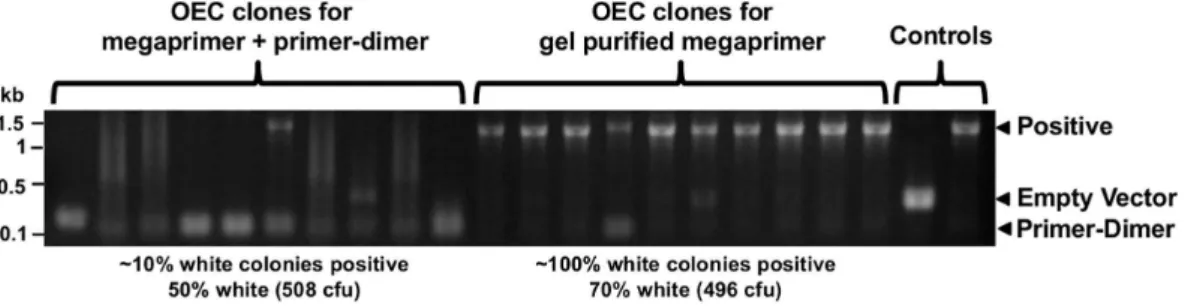
The identical insert primer design also allowed the use of the same PCR product with the three different techniques. This can enable rescue of a failed cloning attempt using a different strategy Figure 3. OEC does not tolerate primer-dimers.Megaprimer and primer-dimer contaminant or 1.4 kb LXR megaprimer alone were gel purified and used for OEC. Ten white colonies for each were screened by PCR across the cloning junctions.
doi:10.1371/journal.pone.0083888.g003
Table 1.Direct comparison of PIPE, SLIC and OEC for various insert sizes.
Insert
Sizea Technique
Cloning
Efficiency Colonies Fold Increaseb
85 bp PIPE 100% 1560 1
SLIC 100% 15800 10
OEC 95% 15100 10
350 bp PIPE 98% 176 1
SLIC 98% 18500 105
OEC 90% 9200 52
1.4 kb PIPE 95% 705 1
SLIC 100% 2760 4
OEC 73% 1450 2
4.3 kb PIPE 100% 309 1
SLIC 100% 6420 21
OEC 45% 251 1
See main text for details.
aSingle representative experiments are shown for FLAG (85 bp), Gluc (350 bp),
Insig-1 (1.4 kb), and SCAP (4.3 kb).
bThe increase in colonies relative to PIPE is shown.
long (,30 bp) target-vector-tail sequences in the primers to allow stable annealing, whereas PIPE and SLIC can work well with overhangs of,15 bp, allowing synthesis of shorter primers [1,2,5]. Purification of the insert PCR is recommended for OEC, but for smaller inserts, a wide range of megaprimer concentrations are tolerated, safely allowing use of a small fraction of unpurified PCR product as megaprimer (Table S12 in File S1 and data not shown). PIPE cloning is generally simpler and robustly performs well, at the cost of requiring a second primer pair.
For cloning projects where vector primers are already available or higher efficiencies are desired to clone inserts greater than 1.5 kb, PIPE is usually the best choice, achieving high efficiencies for a wide range of gene sizes [1] (Table 1 and Table S11 in File S1). Unpurified PIPE PCR products can be used for transforma-tion directly after DpnI treatment, making it extremely fast, especially useful for high-throughput cloning projects [1]. This simple approach is the mainstay LIC technique in our laboratory and our default choice for any fragment size (See protocols in File S3). However, purification to remove inhibitory buffer compo-nents and concentrate the DNA provides better results (Table S12 in File S1 and data not shown). If PIPE cloning fails or a greater number of transformants are required, such as for library construction, then SLIC is superior, typically increasing the number of transformants by more than 5-fold in one step after purification, DpnI and T4 exonuclease treatment. SLIC is also effective after combining purified fragments without quantification (Table S12 in File S1). SLIC can also be performed using restriction enzyme-cleaved plasmid, minimising primer design at the cost of additional manipulations over PIPE [2,5,9].
SLIC has the advantage that it can be used to assemble multiple insert fragments in a single cloning step, particularly with addition of recombinant RecA to enhance annealing in vitro, albeit with reduced efficiency compared to single-fragment cloning [2]. This can also be achieved with high efficiency using the Gibson method
[11], which uses similar primer design to PIPE and SLIC, but involves use of a 59exonuclease, DNA ligase and DNA polymerase in vitro to join previously generated PCR fragments. This has proved to be particularly useful for synthetic biology projects requiring assembly of very large DNA fragments. However, for single fragment insertion, we do not believe that the increased resources required are justified when PIPE and SLIC robustly achieve high efficiencies. However, Gibson assembly [11] can prove a highly effective alternative when even SLIC fails (Figure 4). A number of commercial cloning kits make use of site-specific recombination, requiring special vectors and costly proprietary enzymes, such as the GatewayH system (Life Technologies). Heterostagger or mixed PCR cloning only requires primers and polymerase to precisely engineer recessed ends similar to PIPE and SLIC [2,12]. Although very effective, it is also costly as it requires double the number of PCRs and primers used in SLIC, and long denaturing and annealing steps, without performing better [2].
We found that PIPE, SLIC and OEC were also very efficient for site-directed mutagenesis. PIPE or SLIC are optimal for large deletions [1,10], and extremely effective for substitutions or small insertions like epitope tags (Table 1). However, to create point mutations we routinely use an alternative two-stage cycling strategy similar to OEC, adapted from QuikChange [13,14]. It uses one mutagenic primer and a shorter pre-existing one, often a sequencing primer, to create a megaprimer by PCR, which then generates the mutant plasmid by overlap extension. This normally provides adequate efficiencies at minimal expense.
The LIC techniques tested in this study can be highly efficient and technically simple, but can be compromised by problems such as nicked vector plasmid background, cloning of primer-dimers and amplification of non-specific PCR products. However, these can be overcome through careful design, checking PCR products, and taking additional measures accordingly. Primer-dimers and non-specific products are only likely to be a problem if visible on the agarose gel or with a Bioanalyzer. However, nicked copies of the vector are often below the limit of detection, yet can still generate significant unwanted background (data not shown). Vector background colonies are generated when the vector plasmid templates are amplified rather than just the insert, or desired vector-backbone product (Figure 2). This potential problem is most relevant to PIPE, due to a relatively low number of transformants. The simplest effective method to reduce this background for PIPE is to use less template. If that fails or if greater robustness is desired, a restriction enzyme can be used to first cut the template outside of the primer binding sites. Increasing Figure 4. Technique selection flowchart for a new cloning
project.The number of fragments, their size, primer availability and the presence of primer-dimers will determine the optimal cloning strategy. See main text for details.
doi:10.1371/journal.pone.0083888.g004
Primer Pairs 2 2 1
Purification Optional Yes Yesb
Thermal Cycling Rounds 1 1 2
T4 Treatment Step No Yes No
See main text for details.
aOnly 1 primer pair is required for SLIC if cleaved plasmid vector is used. bOptional for small megaprimers (
,500 bp).
the gap between the primers was also beneficial for our pUC18/ Kan reporter, likely due to the difficulty of amplifying larger products in their entirety. We have previously observed higher efficiencies when replacing genes rather than PIPE cloning into an empty vector [6]. Using a vector containing an existing insert of distinguishable size can be particularly beneficial if it includes the lethalccdBgene to select against vector background [1].
Non-specific PCR products and primer-dimers can be an important problem. Primer-dimers had little effect on PIPE or SLIC, likely due to their small size, such that they would lack the 59-tails required for single-strand annealing and recombination. However, even low concentrations of primer-dimer are of concern for OEC, since cloning is extremely efficient for very small inserts, which clone preferentially. Primer-dimers could be removed by gel extraction or through pre-incubation with T4 polymerase to digest primer-dimer. Larger non-specific products will also compete with the desired insert in PIPE and SLIC, reducing cloning efficiency, which may require gel extraction. In our experience, these non-specific products can also be reduced through design of longer 39 ends, increasing annealing temperatures, and reducing primer concentration. To avoid the requirement for gel extraction or PCR optimisation, alternative primer design can be used for Quick and Clean Cloning [9], a more specific variant of SLIC. This involves designing longer primers for one of the cloning junctions where the vector overhang is complementary to the region within the target insert PCR product, rather than insert primer. The resulting fragments can still be joined because short (,20 bp) ends of non-complementary sequence adjacent to the desired sequence are removed and successful recombination can
occurin vivo, as long as the internal complementary sequence is single-stranded [2,9].
Ligation-independent cloning approaches constitute an essential part of the biomedical researcher’s molecular-tool kit. With the extremely high fidelity of modern polymerases and availability of modular vector-specific primers, we find that ligation-independent methods are preferable even for simple subcloning projects. Due to their robustness, speed and low cost, they may largely supplant restriction enzyme and ligation-dependent cloning in many laboratories.
Supporting Information
File S1 Supporting Figure and Tables. (PDF)
File S2 pUC18/Kan Reporter Vector Sequence. (TXT)
File S3 Supporting Protocols. (PDF)
Acknowledgments
We thank the members of the Brown lab for critically reviewing the manuscript.
Author Contributions
Conceived and designed the experiments: JS JRK. Performed the experiments: JS JRK LP. Analyzed the data: JS JRK LP AJB. Wrote the paper: JS JRK. Supervised the project: AJB.
References
1. Klock HE, Koesema EJ, Knuth MW, Lesley SA (2008) Combining the polymerase incomplete primer extension method for cloning and mutagenesis with microscreening to accelerate structural genomics efforts. Proteins 71: 982– 994.
2. Li MZ, Elledge SJ (2007) Harnessing homologous recombination in vitro to generate recombinant DNA via SLIC. Nat Methods 4: 251–256.
3. Bryksin AV, Matsumura I (2010) Overlap extension PCR cloning: a simple and reliable way to create recombinant plasmids. Biotechniques 48: 463–465. 4. Unger T, Jacobovitch Y, Dantes A, Bernheim R, Peleg Y (2010) Applications of
the Restriction Free (RF) cloning procedure for molecular manipulations and protein expression. J Struct Biol 172: 34–44.
5. Jeong JY, Yim HS, Ryu JY, Lee HS, Lee JH, et al. (2012) One-step sequence-and ligation-independent cloning as a rapid sequence-and versatile cloning method for functional genomics studies. Appl Environ Microbiol 78: 5440–5443. 6. Krycer JR, Brown AJ (2011) Cross-talk between the androgen receptor and the
liver X receptor: implications for cholesterol homeostasis. J Biol Chem 286: 20637–20647.
7. Jenster G, Spencer TE, Burcin MM, Tsai SY, Tsai MJ, et al. (1997) Steroid receptor induction of gene transcription: a two-step model. Proc Natl Acad Sci U S A 94: 7879–7884.
8. Yabe D, Brown MS, Goldstein JL (2002) Insig-2, a second endoplasmic reticulum protein that binds SCAP and blocks export of sterol regulatory element-binding proteins. Proc Natl Acad Sci U S A 99: 12753–12758. 9. Thieme F, Engler C, Kandzia R, Marillonnet S (2011) Quick and clean cloning:
a ligation-independent cloning strategy for selective cloning of specific PCR products from non-specific mixes. PLoS One 6: e20556.
10. Gill S, Stevenson J, Kristiana I, Brown AJ (2011) Cholesterol-dependent degradation of squalene monooxygenase, a control point in cholesterol synthesis beyond HMG-CoA reductase. Cell Metab 13: 260–273.
11. Gibson DG, Young L, Chuang RY, Venter JC, Hutchison CA 3rd, et al. (2009) Enzymatic assembly of DNA molecules up to several hundred kilobases. Nat Methods 6: 343–345.
12. Tillett D, Neilan BA (1999) Enzyme-free cloning: a rapid method to clone PCR products independent of vector restriction enzyme sites. Nucleic Acids Res 27: e26.
13. Sanchis J, Fernandez L, Carballeira JD, Drone J, Gumulya Y, et al. (2008) Improved PCR method for the creation of saturation mutagenesis libraries in directed evolution: application to difficult-to-amplify templates. Appl Microbiol Biotechnol 81: 387–397.