Van Gorp, Mazanek and Rose (Eds.):
Fifth Transformation Tool Contest (TTC 2011)
EPTCS 74, 2011, pp. 237–252, doi:10.4204/EPTCS.74.21
c
E. Kalnina, A. Kalnins, A. Sostaks, J. Iraids, E. Celms This work is licensed under the
Creative Commons Attribution License.
This paper describes the solution of Hello World transformations in MOLA transformation language. Transformations implementing the task are relatively straightforward and easily inferable from the task specification. The required additional steps related to model import and export are also de-scribed.
1
Introduction
In this paper we describe the solution to Hello World case [6] for TTC 20111contest, implemented in MOLA model transformation language. The core task and all optional extensions are implemented. The SHARE image of solution is also provided. [2]
The ”Hello World” task can be implemented in MOLA in a very straightforward way. We describe in the paper the basic principles of the solution. Before that, the situation with metamodels is described in some details, namely, how the metamodels are imported and extended and what implications this creates for source model import and target model export. The whole solution process using MOLA is briefly described as well.
2
MOLA Environment
MOLA [5] is a graphical transformation language developed at the University of Latvia. It is based on traditional concepts among transformation languages: pattern matching and rules defining how the matched pattern elements should be transformed. The formal description of MOLA and also the MOLA tool can be downloaded in [1].
A MOLA program transforms an instance of a source metamodel (defined in the MOLA metamod-elling language - MOLA MOF, close to EMOF) into an instance of a target metamodel.
Rulecontains a declarative pattern that specifies instances of which classes must be selected and how they must be linked. Pattern in a rule is matched only once. The action part of a rule specifies which matched instances must be changed and what new instances must be created. The instances to be included in the search or to be created are specified using class elements in the MOLA rule. The traditional UML instance notation (instance name:class name) is used to identify a particular class element. Class elements may contain constraints and attribute assignments defined using simple OCL-like expressions. Additionally, the rule contains association links between class elements. Class elements matched in one rule may be referenced in another one using the reference element (prefixed with the ”@” symbol).
In order to iterate through a set of the instances MOLA provides theforeach loopstatement. The loophead is a special kind of a rule that is used to specify the set of instances to be iterated over. The pattern of theloopheadis given using the same pattern mechanism used by an ordinary rule, but with an additional important construct. It is theloop variable- the class element that determines the execution of the loop. The foreach loop is executed for each distinct instance that corresponds to the loop variable and satisfies the constraints of the pattern. In fact, the loop variable plays the same role as an iterator in classical programming languages. The execution order in MOLA is specified in a way similar to UML activity diagrams. MOLA has an Eclipse-based graphical development environment (MOLA tool [1], incorporating all the required development support. A transformation in MOLA is compiled via the low-level transformation language L3 [3] into an executable Java code which can be run against a runtime repository containing the source model. For this case study Eclipse EMF is used as such a runtime repository, but some other repositories can be used as well (e.g. JGraLab [4]).
3
General Principles of Hello World Solution with MOLA
The transformation development in MOLA starts with the development of metamodels. The MOLA tool has a facility for importing existing metamodels, in particular, in EMF (Ecore) format. Though MOLA metamodelling language (MOLA MOF) is very close to EMOF, and consequently Ecore, there are some issues to be solved. The current version of MOLA requires all metamodel associations to be navigable both ways (this permits to perform an efficient pattern matching using simple matching algorithms). Since a typical Ecore metamodel has many associations navigable one way, the import facility has to extend the metamodel. Another issue is the variable coding of references to primitive data types.
Metamodel import facilities in MOLA are able to perform all these adjustments automatically. This way the provided metamodels were imported into MOLA tool.
In some tasks for transformation development in MOLA additional metamodel elements are required, for example, in migration tasks to store relations between the source and target models. These meta-model elements have to be added manually. In the migration tasks, these are the associations between node classes in different graph encodings. Then the transformation itself (MOLA procedures) can be developed. The key features of transformations are described in the next section. The development ends with MOLA compilation.
Since the metamodels have been modified during import, the original source model does not con-form directly to the metamodel in the repository, mainly due to added association navigability. Therefore a source model import facility is required. MOLA execution environment (MOLA runner) includes a generic model import facility, which automatically adjusts the imported model to the modified meta-model. Now the transformation can be run on the meta-model. Similarly, a generic export facility auto-matically strips all elements of the transformed model which does not correspond to the original target metamodel. Thus a transformation result is obtained which directly conforms to the target metamodel. (For an inplace transformation the source and target metamodels coincide, as a result nothing has to be stripped.) The transformation user is not aware of these generic import and export facilities, he directly sees the selected source model transformed.
4
MOLA Transformations for Hello World
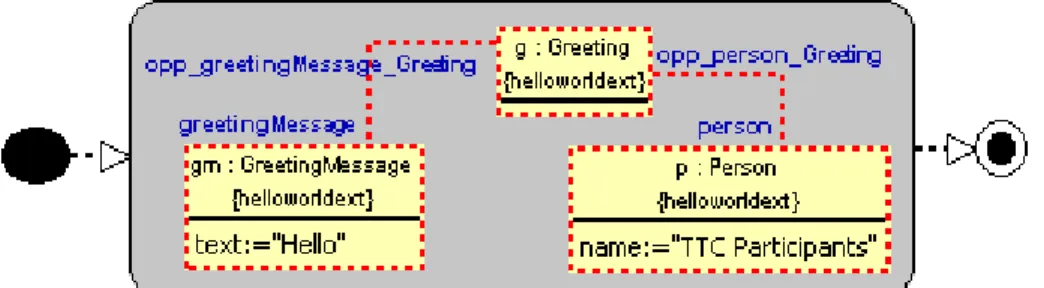
Figure 1: Solution of extended greeting creation task.
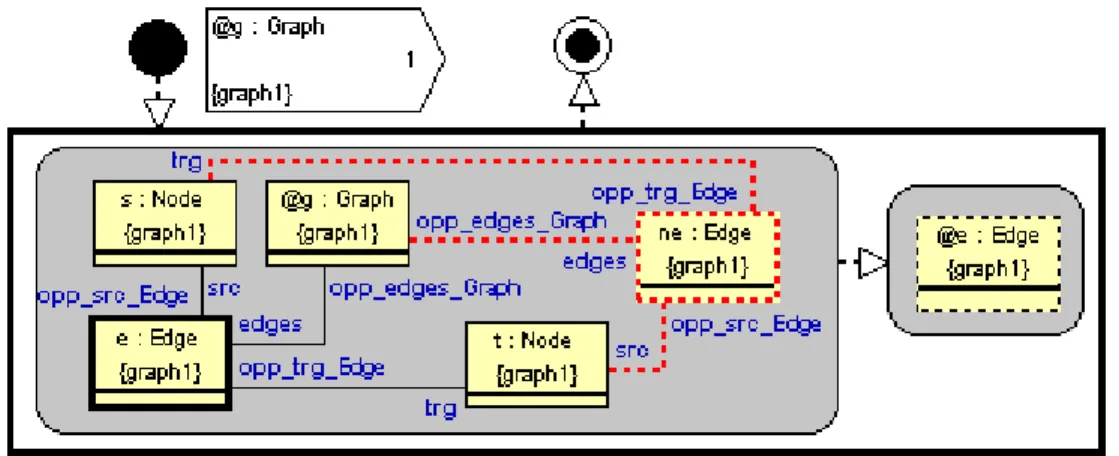
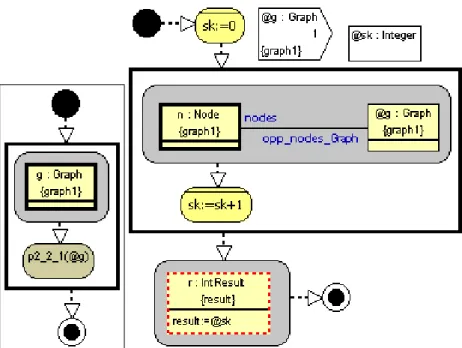
Figure 2: Two MOLA procedures: iteration through graphs on the left and transformation counting looping edges in a graph on the right.
instance diagram given in the task specification. Solution of the second subtask is presented in Figure 1. The grey rounded rectangle represents a MOLA rule. Class elements with red dashed border represent instance creation (similarly for association links).
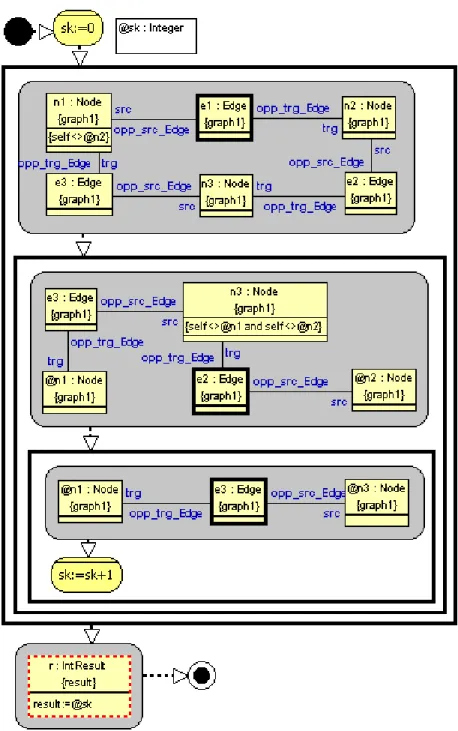
The only counting task processed differently is the circle counting. In MOLA there are two loop types: the foreach loop and while loop (rule + appropriate control flow). In the while loop, to ensure only distinct matches, an explicit marking of the already found matches (using a NAC construct) is required. This requires usage of temporary metamodel elements to solve the task. An alternative is to use three nested foreach loops since multiple loop variables are not supported in MOLA. For details of both solutions see the appendix. To improve usability of MOLA in similar cases we could introduce a foreach loop with multiple loop variables. In this case the execution semantics would be similar to the one with nested loops.
Figure 3: Transformation reversing edges in a graph.
The next task is to reverse edges in a graph. We propose to solve this task by adding a new reversed edge and removing the existing edge. This transformation is shown in Figure 3.
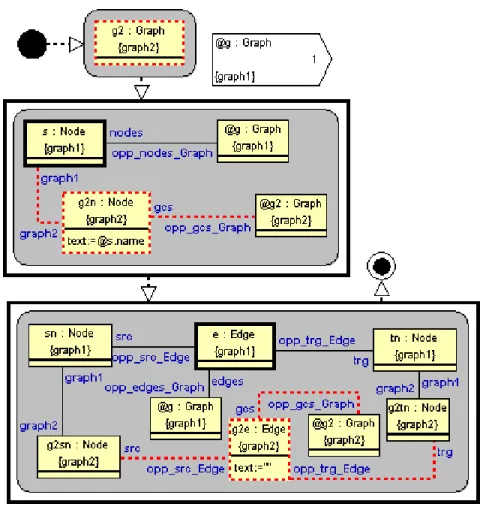
For model migration tasks additional temporary metamodel elements typically are required in MOLA. In this case it is sufficient to have an association between nodes in different graph encodings. After that the transformation is quite straightforward. At first we migrate nodes and then edges. Figure 4 shows the transformation.
The last group of tasks is deletion tasks. They are straightforward - the element to be deleted is found and then deleted.
We have also solved all optional tasks. However during the workshop it came up that we have misunderstood the task ”insertion of transitive edges”. The complete set of transformation procedures with short description is given in the appendix.
5
Conclusions
This case study has been quite appropriate to be implemented in MOLA. It confirms the assertion that simple tasks can be solved in a straightforward and easy readable way in MOLA. In most cases the basic part of the task is performed by one rule (or loophead). The used patterns have a natural form similar to what would appear in typical graph transformation languages. However, a natural solution of the circle counting task would require an even more powerful foreach loop feature in MOLA - a loophead with three loop variables.
Figure 4: Model migration transformation. Migrates graph from encodinggraph1to encodinggraph2.
References
[1] MOLA pages. Available athttp://mola.mii.lu.lv.
[2] SHARE demo related to the paper Saying Hello World with MOLA - A Solution to the TTC 2011 Instructive Case. Available at http://is.ieis.tue.nl/staff/pvgorp/share/?page= ConfigureNewSession&vdi=XP-TUe_TTC11_MOLA.vdi.
[3] Janis Barzdins, Audris Kalnins, Edgars Rencis & Sergejs Rikacovs (2008):Model Transformation Languages and their Implementation by Bootstrapping Method. In Arnon Avron, Nachum Dershowitz & Alexander Rabinovich, editors: Pillars of Computer Science,LNCS4800, Springer, pp. 130–145, doi:10.1007/978-3-540-78127-1.
[4] Steffen Kahle (2006):JGraLab: Konzeption, Entwurf und Implementierung einer Java-Klassenbibliothek f¨ur TGraphen. Diplomarbeit, University of Koblenz-Landau, Institute for Software Technology.
[5] Audris Kalnins, Janis Barzdins & Edgars Celms (2004): Model Transformation Language MOLA. In: Pro-ceedings of MDAFA 2004, Linkoeping, Sweden, pp. 14–28, doi:10.1007/11538097 5.
Appendix A
In this appendix the complete set of transformation sources will be described.
The Hello World task consists of several small tasks. Therefore we have created one project with a package (compilation unit) for each sub-task. Content of the transformation project can be seen in Figure 5. Each package contains a solution of one sub-task. ”pX Y” means that the sub-task was defined in section X.Y of the case description. In some sections several sub tasks have been defined. In this case the third digit is used to describe the sub-task order in section. Optional sub-tasks are marked using ” o”. For one task two solutions are provided, the alternative solution is marked using ” a”.
Figure 5: Structure of Hello World transformation project.
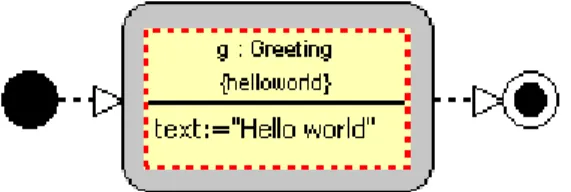
Greeting transformations are given in Figure 6, Figure 7 and Figure 8. For these taks the transfor-mation logic is described using one MOLA rule (grey rounded rectangle). In the first two tasks it is only required to create elements (marked with red dashed lines). In the third task an instance of class ”StringResult” is created, if the pattern (elements with black solid lines) in MOLA rule is matched.
Figure 6: Transformation creating constant Greeting instance.
Figure 7: Transformation creating constant Greeting instance with references.
Figure 8: Model to text transformation creating greeting message.
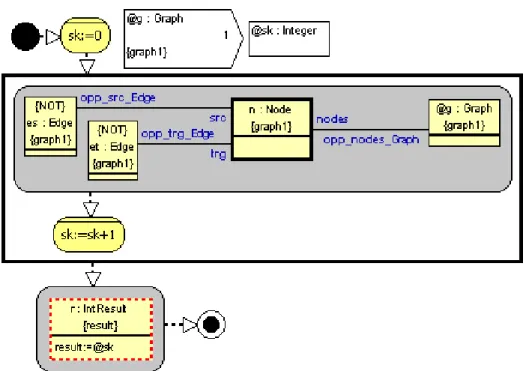
The transformation counting isolated nodes is given in Figure 11. In MOLA the counting is implemented using an integer counter and a foreach loop where the counter is increased. A MOLA variable (white rectangle) of type integer is used as a counter. To modify the values of counter text statements (yellow rounded rectangles) are used. Finaly to save the counting result in the resulting model a MOLA rule creating an instance of class ”IntResult” is used.
For all these tasks it was required to count elements in a graph. However it was not defined whether the model contains only one graph or multiple. For transformations to work properly when there is more than one graph in a model we provide the graph to be processed as a parameter. Therefore we use another MOLA procedure where we iterate through all graphs in a model (using a foreach loop) and from here we call the transformation (using call statment) procesing the current graph. An example of such transformation is given on the left side of Figure 9. (The only thing that changes is the called procedure.) If there is always only one graph in a model this step could be omitted. The same could be said also about transformations in Figure 15 - 20.
The next task was to count circles consisting of three nodes. The solution of this task is different from the previous one because we want to find all different circles. In this case one loop variable is not sufficient and as a result, several loops are required.
Figure 9: Transformation counting nodes in a graph.
Figure 11: Transformation counting isolated nodes in a graph.
how many circles this edge is used. Adding the second and third loop we count all circles consisting of different edges 3 times as required in the task specification.
If we know that there are no multi-graphs then the last loop can be omitted, because the existence of the third edge is already validated by patterns in the first and second loop. However in this case it is probably easier to understand if nodes are used as loop variables, but for that again three loops are needed.
Solution of this task is quite lengthy, however if we add temporary classes it is possible to create a shorter and more elegant solution. We extend the metamodel by adding a temporary class ”Circle” and connecting it to the class ”Edge”. The metamodel extension is shown on bottom of Figure 13. If such extended metamodel is used then we can simply write a MOLA rule looking for circles and marking the found circles: connecting all edges of a circle to a new instance of the ”Circle” class. To ensure that each circle is found exactly once a NOT constraint (an equivalent to NAC in graph transformation languages) is used stating that this circle hasn’t been marked previously. As in this solution we don’t care about the order of edge finding, the loop counter is increased by 3, to ensure that each circle has been counted three times. This solution is given in Figure 13.
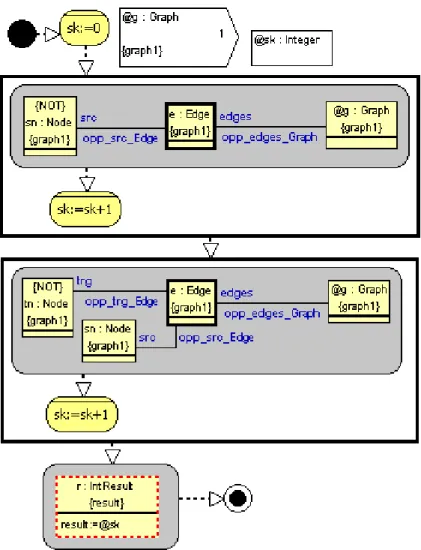
Next was an optional task to count dangling edges. The solution is given in Figure 14. In this case two loops are used. The first one counts edges without a source. To ensure that edges without source and without target are counted only once the second loop counts only edges with a source and without target. The next task we consider is edge reversing. We selected a solution where a new reverted edge is created and the old edge is deleted (delete is marked using a black dashed line). The solution is displayed in Figure 15. Actually a shorter solution in MOLA is possible; however it is not supported by the current version of MOLA tool.
Figure 14: Solution of optional task: counting of dangling edges.
Figure 16: Model migration transformation. Migrates graph from encodinggraph1to encodinggraph2.
The last mandatory transformation is deletion of the node named ”n1”. This transformation is very straightforward (see Figure 18). We try to find such node using a MOLA pattern and if it is found we delete it. The deletion is represented by a black dashed line. In the extension it was required to delete all incident edges as well. The solution of extension is given in Figure 19. In this case at first the node is found, then all outgoing edges are deleted, after that all incoming edges are deleted and finally the node itself is deleted.
Figure 17: Solution of optional model migration task. Migrates graph from encodinggraph1to encoding
graph3.