SLAUGHTER VALUE OF PIGS CARCASSES AS RELATED TO COLIPASE GENOTYPE
(CLPS) CONSIDERING RYR1 GENE EFFECT
WARTOŚĆ RZEŹNA TUSZ ŚWIŃ W ZALEŻNOŚCI OD GENOTYPU KOLIPAZY (CLPS) Z
UWZGLĘDNIENIEM ODDZIAŁYWANIA GENU RYR1
Hanna JANKOWIAK, Wojciech KAPELAŃSKI, Milena BIEGNIEWSKA
Department of Pig Breeding, University of Technology and Life Sciences in Bydgoszcz, Mazowiecka 28, 85-084 Bydgoszcz, Poland, Tel. +48 052 374 97 48, [email protected]
Manuscript received: November 26, 2008; Reviewed: December 8, 2008; Accepted for publication: December 11, 2008
ABSTRACT
The experiment was carried out on 110 3-breed crossbreds fatteners [♂ Pietrain x (♀ Polish Large White x Polish Landrace)]. Pigs were reared in standard conditions and slaughtered at an average body weight of 105 kg. Gene polymorphism was determined with the PCR-RFLP procedure (CLPS/DdeI and RYR1/HinPI). One day post-slaughter, the right carcass-sides were dissected and evaluated using the methods applied for the Polish Pig Testing Station (SKURTCh). The study evaluated the slaughter value of carcasses depending on colipase genotype (CLPS) with infl uence of major gene RYR1. Colipase gene differentiated carcass lean content only in RYR1CC pigs and in all
pigs the neck weight as well as its tissue composition in RYR1CTpigs. Moreover, signifi cant infl uence of major gene
(RYR1T) on quantitative traits was confi rmed.
KEY WORDS: pigs, colipase gene, RYR1 gene, carcass quality
STRESZCZENIE
Badaniem objęto 110 tuczników, mieszańców 3-rasowych [♂ Pietrain x (♀Wielka Biała Polska x Polska Biała Zwisłoucha). Zwierzęta utrzymywane były w ujednoliconych warunkach i ubijane przy zbliżonej masie ciała, około 105 kg. Polimorfi zm genów został określony przy użyciu metody PCR-RFLP (CLPS/DdeI i RYR1/HinPI). Dzień po uboju, prawe półtusze poddano dysekcji i ocenie zgodnie z metodyką opracowaną dla polskich Stacji Kontroli Użytkowości Rzeźnej Trzody Chlewnej. Ocenie poddano wartość rzeźną tusz w zależności od genotypu kolipazy (CLPS), uwzględniając przy tym wpływ genu głównego RYR1. Gen kolipazy istotnie różnicował zawartość mięsa w tuszy tylko u tuczników o genotypie RYR1CC oraz u wszystkich świń masę karkówki i jej skład tkankowy u świń
RYR1CT. Ponadto, potwierdzono wpływ genu głównego na cechy ilościowe tusz.
STRESZCZENIE SZCZEGÓŁOWE
Celem pracy było określenie wartości rzeźnej tusz świń w zależności od polimorfi cznych form genu kolipazy (CLPS) z uwzględnieniem wpływu genu głównego RYR1. Badaniem objęto 110 mieszańców 3-rasowych [♂ Pietrain x (Wielka Biała Polska x Polska Biała Zwisłoucha). W celu określenia genotypu kolipazy oraz genu podatności świń na stres w czasie trwania tuczu od zwierząt pobrano krew. Identyfi kacji polimorfi zmu genu CLPS dokonano metodą PCR-RFLP przy zastosowaniu endonukleazy DdeI według metody Baskina i Pompa [1]. Natomiast mutacji genu receptora ryanodiny (RYR1T)
przy użyciu enzymu restrykcyjnego HinPI [4]. Uboju tuczników dokonywano przy masie ciała ok. 105 kg. Po 24 godzinnym wychłodzeniu tusz, prawe półtusze poddano szczegółowej ocenie zgodnie z metodyką opracowaną dla polskich Stacji Kontroli Użytkowości Rzeźnej Trzody Chlewnej [8]. Wykonano pomiary grubości słoniny grzbietowej w pięciu miejscach, pomiar powierzchni przekroju polędwicy oraz dokonano szczegółowego rozbioru wyrębów podstawowych na poszczególne elementy tkankowe (mięso, skórę ze słoniną oraz kości). Na podstawie dysekcji określono mięsność tusz. Uzyskane wyniki opracowano statystycznie wykorzystując program komputerowy STATISTICA 5.5 PL [9]. W badanej populacji mieszańców 3-rasowych wystąpiły wszystkie trzy genotypy kolipazy, a najliczniej reprezentowany był genotyp heterozygotyczny (frekwencja 0.56). Genotypy homozygotyczne wystąpiły w mniejszości: 0.34 (AA) i 0.10 (BB). Badana populacja mieszańców okazała się także zróżnicowana pod względem frekwencji genotypów RYR1, stwierdzono także wszystkie trzy jego formy (RYR1CC, RYR1CTCTCT, RYR1TT). Najwięcej badanych
zwierząt wykazało genotyp RYR1CTCTCT (n=56), a najmniej
genotyp RYR1TT (n=21) (tabela 1).
Analiza wyników zestawionych w podgrupach (genotyp CLPS x genotyp RYR1) wskazuje na większą zawartość
mięsa w tuszach zwierząt o genotypie BB względem AA w grupie zwierząt odpornych na stres (RYR1CC); P≤0,05
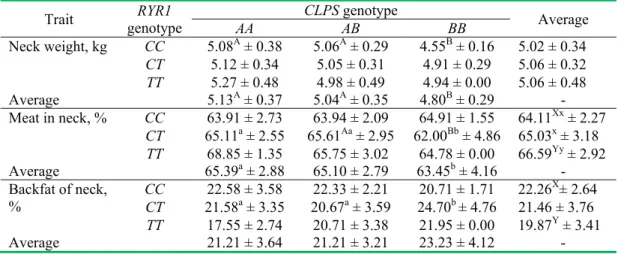
(tabela 2). Wykazano też wpływ polimorfi zmu genu kolipazy na skład tkankowy karkówki oraz jej masę. Zwierzęta o genotypie AA oraz AB charakteryzowały się większą masą karkówki (odpowiednio: 5.13 kg i 5.04 kg) w stosunku do grupy BB (4.80 kg), (P≤0,01) (tabela 3). Wyższą zawartością mięsa w tym wyrębie cechowały się zwierzęta z grupy AA (65.39%) niż zwierzęta z grupy BB (63.45%) (tabela 3). Analizując relacje między oddziaływaniem genu kolipazy i genu RYR1 wykazano wpływ genotypu kolipazy na umięśnienie i otłuszczenie karkówki tylko u świń heterozygot względem genu RYR1 (tabela 3). Ponadto potwierdzono statystycznie istotny wpływ genotypu RYR1TTTTTT na zawartość mięsa w tuszy
oraz na wielkość powierzchni oka polędwicy (tabela 2) jak również na zawartość mięsa w karkówce (tabela 3).
INTRODUCTION
During the last two decades, several genes having a main effect on important production traits have been detected in farm livestock. Genes reported to have a major affect are called major genes. Examples for major genes in pig production are the pig stress susceptibility gene (RYR1) and the RN- gene infl uence on meat quality and
the estrogen receptor locus (ESR) affecting litter size in pigs.
Moreover, exist also genes defi ned as being candidate. Polymorphism of candidate genes and their connections with commercial traits of breeding pigs is intensively studied in many laboratories on the world. One of the candidate genes is colipase gene (CLPS). The CLPS gene was located in the area of chromosome 7 [1] and considered a candidate gene for QTL affecting carcass fatness in pigs [10, 3].
During the study described in this paper we used the
Table 1. Frequency of particular genotypes of CLPS and RYR1 gene in testing fattener groups Tabela 1 Rozk�ad genotypów CLPS oraz RYR1 w badanej grupie tuczników
RYR1 genotype AA CLPS AB genotype BB Total
CC frequency number 0.30 10 0.61 20 0.09 3 1.00 33
CT frequency number 0.39 22 0.50 28 0.11 6 1.00 56
TT frequency number 0.29 6 0.67 14 0.04 1 1.00 21
polymerase chain reaction (PCR) and RFLP to identify CLPS and RYR1 gene polymorphisms in crossbred pig populations with the aim of estimating the relationship between genotypes CLPS and slaughter value considering RYR1 gene effect.
MATERIAL AND METHODS
The experiment was carried out on 110 crossbreds fatteners [♂ Pietrain x (♀ Polish Large White x Polish Landrace)]. Pigs were reared in standard conditions. In the course of fattening period blood samples were taken from the vena cava to test – tube with EDTA*K3 and
freeze at -20ºC. Determination of the colipase genotype was performed using the PCR-RFLP method with DdeI restriction enzyme [1] and RYR1/HinPI genotypes were identifi ed with the method of Fujii et al. [4]. The fatteners were slaughtered at an average body weight of 105 kg. One day post-slaughter, the right carcass-sides were dissected and evaluated using the methods applied for the Polish Pig Testing Station (SKURTCh) [8]. Thickness of the backfat was measured in fi ve points: above the shoulder, between the last thoracic vertebra and the fi rst lumbar vertebra and at the level of sacral vertebra – I, II, III. Major cuts were divided into tissue elements: meat, skin with backfat and bones. Lean content of carcasses was determined on the basis of dissection.
Calculated were arithmetic means and their standard deviations. Two-way analysis of variance was performed using Duncan’s test. STATISTICA 5.5 PL packet [9] was used.
RESULTS AND DISCUSSION
Table 1 shows the frequency of genotypes CLPS and RYR1 genes. In whole crossbreds fatteners detected three genotypes of the CLPS/DdeI gene. Genotype AB was more frequent (0.56) than genotype AA (0.56) and BB (0.10). Similar frequency of genotypes colipase gene was obtained by Kurył et al. [7]. The least numerous was the homozygous BB (9.08% of research population) and the most numerous was heterozygous AB (57.27%). In investigations by Blicharski et al. [2] genotype AA was more frequent (69.80%) than BB genotype (2.01%) in pure breed Polish Large White populations.
Studied population of crossbred’s fatteners was also differed as regards to RYR1 gene. Three genotypes – RYR1CC, RYR1CTCTCT and RYR1TTTTTT – were identifi ed within
tested populations. The most numerous were animals of RYR1CTCTCT (n=56) and the least those of genotype RYR1TT
(n=21). Identifi cation all genotypes of CLPS and RYR1 genes was profi table and make possible detailed analysis.
The main data traits connected with slaughter usability were presented on table 2. The percentage content of meat in carcasses at subgroups (CLPS genotype x RYR1 genotype) was higher in free of RYR1TTT (RYR1CC)
animals with the BB genotype of CLPS than AA, P≤0.05. There is a signifi cant infl uence of major gene (RYR1) polymorphism on the quantitative traits. Higher meatiness was obtain at RYR1TTTTTT (55.16%) group than
animals from least two groups (RYR1CTCTCT 51.87% and
RYR1CC 50.74%), P≤0.05. Similar results show Kortz
Table 2. Slaughter value of carcasses in relation to the CLPS and RYR1 genotypes Tabela 2 Warto�� rze�na tusz w zale�no�ci od genotypów CLPS orazRYR1
Trait genotype RYR1 AA CLPS genotype AB BB Average
Carcass lean
content, % CC 49.36
a± 4.73 50.98 ± 2.93 53.76b ± 1.93 50.74X ± 3.62
CT 51.49 ± 2.80 52.60 ± 3.36 49.87 ± 2.67 51.87X ± 3.30
TT 55.74 ± 2.37 54.62 ± 3.24 59.13 ± 0.00 55.16Y ± 3.05
Average 51.60 ± 3.85 52.53 ± 3.54 51.96 ± 3.81 -
Loin eye area, cm2 CC 41.71 ± 5.40 41.12 ± 3.63 42.70 ± 3.27 41.44Xx ± 4.12
CT 43.13 ± 5.32 44.59 ± 6.33 41.42 ± 4.28 43.67y ± 5.77
TT 48.77 ± 3.65 45.49 ± 4.35 54.40 ± 0.00 46.85Yy ± 4.57
Average 43.63 ± 5.51 43.67 ± 5.40 43.10 ± 5.36 -
Backfat thickness (average of 5 measurements), cm
CC 2.92 ± 0.38 3.07 ± 0.43 2.93 ± 0.48 3.01x ± 0.41
CT 3.00 ± 0.44 2.88 ± 0.54 3.26 ± 0.87 2.97x ± 0.55
TT 2.49 ± 0.26 2.75 ± 0.55 3.24 ± 0.00 2.70y ± 0.50
Average 2.90 ± 0.43 2.91 ± 0.52 3.16 ± 0.70 -
et al. [6] and Kapelański et al. [5]. Moreover, carcasses fatteners with RYR1TTTTTT (46.85 cm2) genotype had higher
loin eye area and also thinner backfat thickness (2.70 cm) in comparison with other groups (P≤0.01; P≤0.05). Table 3 presents weight of neck and tissue content depending on colipase and RYR1 genotype. A signifi cant effect of the colipase gene polymorphism was demonstrated with regard to these traits. Animals of AA and AB genotype showed higher weight neck (5.13 kg and 5.04 kg, respectively) in comparison with BB group (4.80 kg); P≤0.01. Higher content of meat in this cut had animals from AA group (65.39%) than animals from BB group (63.45%). According to research carried out by Kurył et al. [7], CLPS/DdeI genotype infl uenced signifi cantly the weight of neck, neck with shoulder and also meat of neck.
Received results were analyzed in subgroups. Higher weight of neck had animals of AA and AB genotype in comparison with animals CLPS/BB in group of fattening pigs of RYR1CC, P≤0.01. Meat content in neck was higher
in AB genotype animals (65.61%) and AA (65.11%) than BB (62.00%) only in animals RYR1CTCTCT group. Interesting
it seems to be that the animals with arrangement of genotypes TT AA shows about 7% more meat in neck and less fat in this cut than animals with CT BB genotype (P≤0.01).
The stress susceptibility gene polymorphism differentiated signifi cantly the proportion of meat and fat in neck. Animals from RYR1TT group (66.59%) were
characterized by larger content of meat in this cutting than animals from remaining two groups (RYR1CC 64.11%
and RYR1CTCTCT 65.03%), and also lower fat content in neck
(respectively: 19.87%, 21.46% and 22.64%).
Table 3. Weight of neck and tissue content depending on CLPS and RYR1 genotypes Tabela 3 Masa i sk�ad tkankowy karkówki w zale�no�ci od genotypów CLPS orazRYR1
Trait genotype RYR1 AA CLPS genotype AB BB Average
Neck weight, kg CC 5.08A ± 0.38 5.06A ± 0.29 4.55B ± 0.16 5.02 ± 0.34
CT 5.12 ± 0.34 5.05 ± 0.31 4.91 ± 0.29 5.06 ± 0.32
TT 5.27 ± 0.48 4.98 ± 0.49 4.94 ± 0.00 5.06 ± 0.48
Average 5.13A ± 0.37 5.04A ± 0.35 4.80B ± 0.29 -
Meat in neck, % CC 63.91 ± 2.73 63.94 ± 2.09 64.91 ± 1.55 64.11Xx ± 2.27
CT 65.11a ± 2.55 65.61Aa ± 2.95 62.00Bb ± 4.86 65.03x ± 3.18
TT 68.85 ± 1.35 65.75 ± 3.02 64.78 ± 0.00 66.59Yy ± 2.92
Average 65.39a ± 2.88 65.10 ± 2.79 63.45b ± 4.16 -
Backfat of neck,
% CC 22.58 ± 3.58 22.33 ± 2.21 20.71 ± 1.71 22.26
X± 2.64
CT 21.58a ± 3.35 20.67a ± 3.59 24.70b± 4.76 21.46 ± 3.76
TT 17.55 ± 2.74 20.71 ± 3.38 21.95 ± 0.00 19.87Y ± 3.41
Average 21.21 ± 3.64 21.21 ± 3.21 23.23 ± 4.12 -
Within rows means bearing different letter are related to CLPS genotypes; a, b at P�0.05; A, B at P�0.01; Within column means bearing different are related to RYR1 genotypes; x, y at P�0.05; X, Y at P�0.01
Summarizing, the results of presented work obtained on a population of three-breed [P x (PLW x PL)] crossbred porkers, demonstrated a signifi cant relation between the polymorphism in CLPS gene and the some important production traits. Interesting it seems to be that the polymorphism of CLPS gene infl uence on carcass lean content only in animals of genotype CC/RYR1 but it should be treated as introductory information because of different number of genotypes in subgroup.
REFERENCES
[1] Baskin L.C., Pomp D., Rapid communication: Mapping of porcine colipase gene to chromosome 7 using linkage analysis, J. Anim. Sci. (1998) 76: 1241-1242.
[2] Blicharski T., Kurył J., Pierzchała M., Relationship between polymorphism at loci colipase and leptin and most important fattening and slaughter traits in pigs with special reference to intramuscular fat – a review, Prace and Mat. Zoot., Zesz. Spec. (2004) 15: 41-46 (In Polish).
[3] Demeure O., Renard Ch., Yerle M., Faraut T., Riquet J., Robic A., Schiex T., Rink A., Milan D., Rearranged gene order between pig and human in a QTL region on SSC 7, Mamm. Genome (2003) 14: 71-80.
[4] Fujii J., Otsu K., Zorzatto F., De Leon S., Khanna V.K., Weiler J.E., O’Brien P.J., MacLennan D.H., Identyfi cation of a mutation in porcine ryanodine receptor associated with malignant hyperthermia. Science (1991) 253: 448-451.
carcass lean content. Ann. Anim. Sci., Suppl., (2002) 2: 301-304.
[6] Kortz J., Szaruga R., Kapelański W., Kurył J., Rybarczyk A., Natalczyk-Szymkowska W., Effect of RYR1 genotype on carcass leanness and pork quality. Electr. J. Pol. Agric. Universities (2003) Vol.6, Issue 2.
[7] Kurył J., Pierzchała M., Kapelański W., Bocian M., Grajewska S., Polymorphism of GH, LEP, COL, LIPE genes in choosen breeds of pigs breeded in Poland and his infl uence on quality of carcass, XIV Conf. PTG – Poznań (2001) 63 (In Polish).
[8] Różycki M., Procedures applied for slaughter performance in testing station (In: Breeding State and Pig Evoluation Results. National Institute of Husbandry, Kraków 1996, XIV) (1996) 69-82 (In Polish).
[9] STATISTICA 5.5 PL (2000).