PRODUCTION
Shiping Wei1*, James Hurley2, Zhenglong Jiang1,Siwen Wang1, Yuanyuan Wang1
1
School of Marine Sciences, China University of Geosciences, 29 Xueyuan Rd., Beijing 100083, China; 2Department of Plant
Pathology and Microbiology, Texas A & M University, 2132 TAMU, College Station TX77843, USA.
Submitted: November 27, 2010; Returned to authors for corrections: August 06, 2011; Approved: January 16, 2012.
ABSTRACT
The use of the filamentous fungus, Ashbya gossypii, to improve riboflavin production at an industrial scale is
described in this paper. A riboflavin overproducing strain was isolated by ultraviolet irradiation. Ten minutes
after spore suspensions of A. gossypii were irradiated by ultraviolet light, a survival rate of 5.5% spores was
observed, with 10% of the surviving spores giving rise to riboflavin-overproducing mutants. At this time
point, a stable mutant of the wild strain was isolated. Riboflavin production of the mutant was two fold higher
than that of the wild strain in flask culture. When the mutant was growing on the optimized medium,
maximum riboflavin production could reach 6.38 g/l. It has even greater promise to increase its riboflavin
production through dynamic analysis of its growth phase parameters, and riboflavin production could reach
8.12 g/l with pH was adjusted to the range of 6.0-7.0 using KH2PO4 in the later growth phase. This mutant
has the potential to be used for industrial scale riboflavin production.
Key words: Riboflavin; Ashbya gossypii; Ultraviolet irradiation; Medium optimization
INTRODUCTION
Riboflavin, also called vitamin B2, is an essential
compound in living organisms, including microorganisms,
plants and mammals. It serves as the precursor of flavin
mononucleotide (FMN) and flavin adenine dinucleotide
(FAD), which are required as electron-accepting
oxidoreductases (14, 19). It is widely used in the food
enrichment, pharmaceutical and feed supplement industries.
Riboflavin can be produced by chemical synthesis or by
microbial fermentation. Riboflavin for therapeutic purposes is
still made by chemical synthesis, but since the market is being
driven by heightened interest in utilizing renewable resources
and their corresponding cost reductions, riboflavin is
increasingly produced by specialized microorganisms (7, 16,
22). Currently, industrial riboflavin production by microbial
fermentation generates approximately 6×10⁶ kg annually (20).
Riboflavin is produced by many microorganisms,
including bacteria, yeasts and molds (2, 16). Ashbya gossypii, a
filamentous fungus, is currently used in industry for the
production of riboflavin (16). About 30% of the world
industrial riboflavin output, which is greater than 1.25×10⁶ kg,
Wei, S. et al. A. gossypii for riboflavin production
is produced by direct fermentation with this fungus (1, 17).
Over the past several decades, great efforts have been made to
enhance riboflavin production and develop better production
media. Many different methods have been used to improve the
productivity of the wild strain, such as UV irradiation (6, 11,
14), chemical-induced mutagenesis (20), antimetabolite
mutagenesis (13, 19) and metabolic engineering approaches (5,
18).
Numerous studies have been conducted to improve
riboflavin productivity by utilizing different substrates (2, 8, 9,
20). Riboflavin overproduction by A. gossypii can be achieved
by using glucose, sucrose, fructose, maltose, mannose, or
glycerol as the carbon sources; however, oils, such as corn oil
and soybean oil, are superior (2). In addition to the carbon
source, commercial fermentations employ a crude nitrogen
source, with enzymatic digests of collagenous proteins being
the most effective. Also, yeast extracts have been shown to be
essential in stimulating riboflavin overproduction from A.
gossypii (12). Corn steep liquor was found to be a very
satisfactory substitute for yeast extract as it is abundantly
available at low cost (2). Utilization of waste products to
produce riboflavin have been reported (3, 11), with yields as
high as 8.7 g/l riboflavin when activated bleaching earth
containing rapeseed oil was added to the culture.
The objective of this work was isolation of an UV-induced
mutant strain overproducing riboflavin. The UV-induced
mutant can synthesize riboflavin both earlier and more
prolifically than the wild strain. By dynamic characterization of
this mutant in an optimized medium, there is still great
potential to increase riboflavin production by adjusting the
parameters during fermentation, thus allowing this mutant to
serve as an industrial strain for riboflavin production.
MATERIALS AND METHODS
Strain, media and cultivation conditions
Ashbya gossypii ATCC 10895 was used as the wild type
strain. Stock culture was grown at 28°C on solid slant medium
(SSM) containing (per liter) 10 g glucose, 3 g malt extract, 5 g
peptone, 3 g yeast extract and 15 g agar (pH 6.9). After 4 days
of cultivation, the agar slants were stored at 4 °C until further
analysis. Spore producing liquid medium (SPLM) consisted of
(per liter) 10 g glucose, 1 g thiamine, 5 g yeast extract and 5 g
Tween 80 (pH 6.8). The mutant screening medium (MSM)
consisted of (per liter) 20 g glucose, 5 g yeast extract and 15 g
agar (pH 7.2). The preliminary seed medium (PSM) consisted
of (per liter) 20 g glucose, 10 g corn steep liquor (North China
Pharmaceutical Co. Ltd., China) and 5 g peptone (pH 6.8), and
the second seed medium (SSM) consisted of (per liter) 6 g
glucose, 10 g corn steep liquor, 5 g gelatin (Beijing Chemical
Reagent Co., China) and 10 g soybean oil (Shandong Luhua
Co. Ltd., Laiyang, China) (pH 6.8). The riboflavin production
medium (RPM) contained (per liter): 30 g corn steep liquor, 15
g osseocolla (Beijing Zhijiao Plant), 40 g soybean oil, 2 g NaCl
and 1 g KH2PO4 (pH 6.8).
All the seed cultures were incubated at 28 °C on a rotary
shaker (HNY-200B, Honour Instrument Factory, Jiangsu,
China) at 150 rpm for 36 h in 250 ml Erlenmeyer flasks
containing 15 ml RPM medium. For riboflavin production in
flask cultures, 0.3 ml of the preliminary seed culture was
inoculated into 15 ml of SSM medium, and 1 ml of the second
seed culture was inoculated into 500 ml Erlenmeyer flasks
containing 100 ml of RPM medium. The culture was incubated
at 28 °C on a rotary shaker at 200 rpm for 7 days.
Spore preparation, UV irradiation and mutant screening For preparation of spores, following 4 days of cultivation
on SSM media, mycelia of A. gossypii were collected by
adding 1 ml sterilized water. The suspended mycelia were
inoculated into a 250 ml Erlenmeyer flask with 100 ml SPLM
medium. This inoculation culture was incubated at 28 °C in a
stationary manner. After 5 days of incubation, the spores were
collected by filtering through three layers of lens paper and
A Petri dish containing 10 ml of spore suspension was
stirred at 60 rpm and exposed to UV light (254 nm) at a
distance of 30 cm from the UV lamp (15 W, Brightek
Optoelectronic Co., Ltd., Shenzhen, China). 100 µl of spore
suspension was removed at every 5 or 10 min and plated on the
MSM media. The colony-forming units were counted after 5
days incubation at 28 °C to determine the percentage of
survival of A. gossypii spores at each time point. 20 colonies
were randomly chosen at each time point and their riboflavin
producing potential was compared with A. gossypii ATCC
10895 using the RPM media to determine the ratio of positive
mutants. The optimized UV irradiation dose was used to
generate a mutant library, and the preliminary screening of
candidate positive mutants was based on the intensity of yellow
color produced by colonies on the MSM medium. The second
screening was performed using 500 ml Erlenmeyer flasks
containing 100 ml RPM medium and incubated with shaking at
28 °C for 7 days.
Optimization of riboflavin production medium
The riboflavin production medium was optimized using a
three factor and three level L9(33) orthogonal design (Table. 1).
Levels of factor A (corn steep liquor) were 20 g/l, 30 g/l and 40
g/l; levels of factors B (osseocolla) were 15 g/l, 25 g/l and 30
g/l; and levels of factor C (soybean oil) were 4 g/l, 4.5 g/l and 5
g/l. A total of 9 experimental runs were performed in 500 ml
Erlenmeyer flasks containing 100 ml medium incubated with
shaking at 28 °C for 7 days, with three replicates for every
experimental run. The more important factors and most
effective levels were determined based on the orthogonal
analysis and subjected to further tests of riboflavin production.
The optimized concentrations of the three aforementioned
components were combined and subjected to flask tests of
riboflavin production. In order to further increase the riboflavin
production, fed-batch fermentation was employed by adding 10
g soybean oil on the fifth and the sixth day based on the
optimized medium.
Analytical methods
The riboflavin concentration was measured according to
the method described by Tanner et al (21) with modifications.
Before sampling, the culture broth was mixed thoroughly and 2
ml of culture broth was drawn and mixed well with 1 ml of
HCl buffer (pH 2.0). The mixture was treated at 100 °C for 30
min, and then centrifuged at 10000 g for 5 min. A 0.5ml
aliquot of the supernatant was removed and diluted to 100 ml
with sterilized water. The diluted supernatant was subjected to
riboflavin analysis. The absorbance of the diluted supernatant
was monitored by a Photofluorometer 930 (Kexiao Co., Ltd.,
Hangzhou, China), with riboflavin concentration being
calculated from the calibration curve. Fluorometric analyses
matched well with those values obtained microbiologically and
spectrophotometrically (10, 20, 21).
In order to determine the correlation of riboflavin
production to the parametric changes during the growth phase
of A. gossypii, parameters such as biomass, pH, free amino
nitrogen and reduced sugar were monitored at constant time
intervals. Biomass was determined gravimetrically by
obtaining 10 ml aliquots of culture broth at each time point.
The culture was centrifuged at 10000 g for 5 min, the pellet
mycelia was weighed to determine the ratio of mycelia to
volume of the culture, and the supernatant was used to analyze
free amino nitrogen and reduced sugar. Free amino nitrogen
was determined by the formaldehyde method (4), and reduced
sugar was determined by the Fehling method (15).
RESULTS AND DISCUSSION
Effect of UV irradiation on survival of A. gossypii spores and riboflavin-overproducing mutants
UV irradiation on the spore suspension of A. gossypii
lasted a total of 60 min. The survival of colonies was
ascertained after 5 days incubation at 28°C. Fig. 1 shows the
effect of UV irradiation time on the survival of A. gossypii
Wei, S. et al. A. gossypii for riboflavin production
decreased dramatically with only 5.5% surviving the UV
treatment. After 10 minutes, only a few colonies appeared on
the MSM media plates with these colonies being more resistant
to the UV radiation.
The percentage of riboflavin-overproducing mutants
increased with the time of UV irradiation up to 10 min, with
the percentage as high as 10%. After this time point, the
percentage of riboflavin-overproducing mutants tended to
decline with increasing UV irradiation time (Fig. 1). For every
time point, most mutants were negative riboflavin producing
when compared with the wild type strain. We chose the UV
irradiation time of 10 min to generate a mutant library
containing 2996 mutants, which was screened to identify
riboflavin-overproducing mutants.
0 5 10 15 20 25 30 35 40 45 50 55 60 Times (min) 0 10 20 30 40 50 60 70 80 90 100 Su rv ia l o f sp o re s (% ) 0 2 4 6 8 10 12 Po si ti ve mu ta n ts ( % )
Survial of spores Positive mutant
Figure 1. Effect of ultraviolet irradiation on survival of spores and positive mutation of A. gossypii.
Isolation and screening of riboflavin-overproducing mutants
A total of 2996 mutants were grown on MSM media and
compared with respect to their yellow coloration. 125 of them
had intense yellow colors and were chosen as the candidates
for riboflavin-overproducing mutants. Following the second
screening on RPM media, a mutant designated as ATCC
10895-32 was identified as the top riboflavin producer.
Riboflavin production of ATCC 10895-32 was dynamically
compared with that of the wild strain at different time points
(Fig. 2). The mutant strain synthesized riboflavin at an earlier
stage than the wild strain, and riboflavin production of the
mutant strain was also higher than that of the wild strain at all
sampling times. Riboflavin production by ATCC 10895-32 at 8
d was 4.48 g/l, a 42% increase compared to the wild strain on
the RPM media.
UV irradiation usually generates point mutations, which
are easily recovered in natural conditions. To determine
whether or not ATCC 10895-32 was a stable mutant, the
mutant strain was subjected to twenty successive transfers, and
50 colonies were randomly isolated to compare their riboflavin
production. There was no significant change in the riboflavin
production among them, suggesting that the isolated mutant
strain can be used as a candidate potential riboflavin
overproducer.
0 1 2 3 4 5 6 7 8
Times (days) 0 1 2 3 4 5 Ri bof la vi n c onc en tr at io n ( g /l ) Wild strain Mutant strain
Optimization of the riboflavin production medium for the
A. gossypii 10895-32 strain
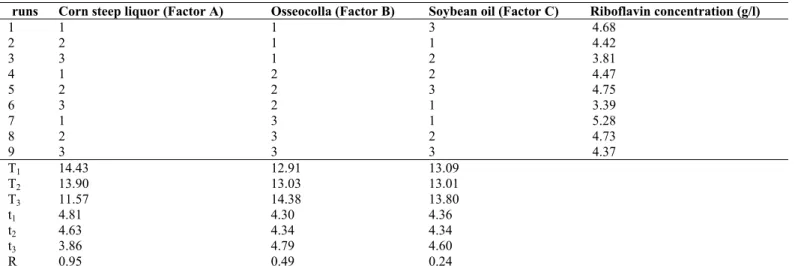
Out of all the components in the riboflavin production
medium, corn steep liquor, osseocolla and soybean oil were the
most crucial factors for riboflavin production (19). L9(33)
orthogonal design experiments were performed to determine
the factors’ optimal concentrations. The combined effects of
the three components on the riboflavin concentration are shown
in Table 1. The results were analyzed by the standard
orthogonal design analysis. From the data of R (R=Max ti -
Min ti.), it shows that corn steep liquor has the largest effect
and soybean oil has the smallest effect on riboflavin
production. This means riboflavin production was greatest
when level 1 of corn steep liquor, level 3 of osseocolla and
level 3 of soybean oil were used (Fig. 3). The optimal
combination of media for riboflavin production is corn steep
liquor 20 g/l, osseocolla 25 g/l and soybean oil 50 g/l, with the
other parts comprising the media being NaCl 2 g/l and KH2PO4
1 g/l (pH 6.8). This indicated that a higher riboflavin
production could be expected when the optimized medium is
used.
Based on the optimized medium, we made a slight change
in the components of this medium for consideration in
industrial utilization. Özbas and Kutsal (5) reported that
oxygen was a very important factor for riboflavin
overproduction. More oil being added to the medium in the
beginning may affect the oxygen uptake of A. gossypii, so the
initial amount of oil in optimized medium was decreased by 10
g/l, with this omitted amount being later added to the media by
feeder. Osseocolla was used at 25 g/l and 30 g/l (Table 2).
Fed-batch culture is often used in industrialized
fermentation to increase production. We observed that little
soybean oil was left during the latter growth phage of ATCC
1895-32. Soybean oil was putatively the limiting factor for
further riboflavin synthesis. For the purpose of further
increasing riboflavin, 10 g soybean oil was fed on the fourth or
the fifth day based on the optimized medium. The result shows
that the riboflavin production of fed batch culture was
increased by 5%-8% in comparison with that of non-fed batch
culture (Table 2). The riboflavin concentration could reach
6.25 g/l when 10 g soybean oil was added on the fourth day.
However, riboflavin concentration did not increase
significantly when another 10 g soybean oil was fed on the
fifth day, probably because the other components of the
medium had become depleted, or non-appropriate
environmental factors (pH, etc.) restricted riboflavin
overproduction.
Table 1. Optimization of riboflavin production medium by L9(33) orthogonal design
runs Corn steep liquor (Factor A) Osseocolla (Factor B) Soybean oil (Factor C) Riboflavin concentration (g/l)
1 1 1 3 4.68
2 2 1 1 4.42
3 3 1 2 3.81
4 1 2 2 4.47
5 2 2 3 4.75
6 3 2 1 3.39
7 1 3 1 5.28
8 2 3 2 4.73
9 3 3 3 4.37
T1 14.43 12.91 13.09
T2 13.90 13.03 13.01
T3 11.57 14.38 13.80
t1 4.81 4.30 4.36
t2 4.63 4.34 4.34
t3 3.86 4.79 4.60
R 0.95 0.49 0.24
Wei, S. et al. A. gossypii for riboflavin production
Table 2. Effect of quantity of soybean oil-fed on riboflavin production
Notes: Each medium contains 2 g/l NaCl and 1 g/l KH2PO4 except for the above components. Riboflavin was assayed on the seventh day.
1 2 3
Levels 3.8
4 4.2 4.4 4.6 4.8 5
A
v
e
rag
e r
ib
o
fl
av
in
c
o
nc
e
n
tr
a
ti
o
n
(
g
/l
)
Factors
Corn steep lequor Ossecolla
Soybean oil
Figure 3. Correlation between riboflavin production and the levels of corn steep liquor, osseocolla and soybean oil.
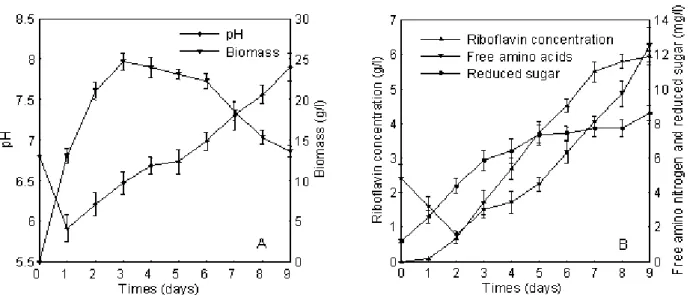
Dynamic characterization of A. gossypii 10895-32 in the optimized medium
To determine the correlation of riboflavin production with
the metabolic parameter changes during the growth phase of A.
gossypii ATCC 10895-32, the parameters, pH, biomass, free
amino nitrogen and reduced sugar, were monitored daily. The
pH quickly dropped from the initial pH of 6.8 to 5.9 on the first
day after inoculation. Relatively less riboflavin was
synthesized during this period. The growth of A. gossypii was
beginning to reach the log phase after pH reached 6.47 on the
third day (Fig. 4A). The rise in pH signals the initial phase of
riboflavin production (2). When the pH was rising in the range
of pH 6.47 to 7, A. gossypii was in the stationary phase and the
riboflavin was oversynthesized. When the pH climbed from 7.0
to 7.9, the mycelia were lysed and the biomass of A. gossypii
declined, which caused the riboflavin synthesis to stop (Fig. 4A
and Fig. 4B). Tanner et al (3) and Özbas et al (5) reported that
the pH was as low as 4.5 in the first 24 to 36 hours, and that the
best riboflavin yields was obtained when the pH was in the
range of 6.0 to 7.0. With the continuous consumption of
nutrients in the medium, the pH can reach as high as 8.5, and
subsequent riboflavin synthesis is negligible or absent.
The metabolic parameters, free amino nitrogen and
reduced sugar, were assayed during the growth phase of A.
gossypii. As free amino nitrogen dramatically decreased in the
first two days, we presumed that A. gossypii quickly used the
free amino nitrogen to synthesize its own structure because of
sustained growth of A. gossypii. Subsequently, the released free
amino nitrogen levels rose along with the reduced sugar levels.
Especially in the later growth phase, the released free amino
nitrogen increased rapidly, which was believed to have
contributed to the rise in pH (2). Since both free amino
nitrogen and reduced sugar were continuously released during
the growth phase, they were available for riboflavin
overproduction. However, the alkaline pH caused mycelial
lysis and the riboflavin synthesis was terminated. Based on the
analysis of dynamic characterization of A. gossypii 10895-32 in
Components of media Soybean oil fed
Runs Corn steep liquor (g/l)
Osseocolla (g/l)
Soybean oil (g/l)
Oil fed on 4th day (g/l)
Oil fed on 5th day (g/l)
Riboflavin concentration (g/l)
1 20 25 40 __ __ 5.44±0.09
2 20 25 40 10 __ 5.72±0.15
3 20 25 40 10 10 5.82±0.21
4 20 30 40 __ __ 5.89±0.12
5 20 30 40 10 __ 6.25±0.23
the optimized medium, we performed a new experiment with
the pH adjusted to the range of 6.0-7.0 using KH2PO4 in the
later growth phase, riboflavin production was increased to 8.12
g/l.
In summary, we used the most effective method of UV
irradiation to generate a stable mutant strain. Through the
optimization of its medium and characterization of its growth,
enhanced riboflavin production was observed. This strain
constitutes an excellent candidate for use in industrialized
fermentation for riboflavin production.
Figure 4. Dynamic analysis of riboflavin production and metabolic parameters of the fermentation process.
ACKNOWLEDGEMENTS
The authors acknowledge Professor Paul deFigueiredo of
the Department of Plant Pathology and Microbiology at Texas
A&M University for making a critical reading and revision of
this paper. This research was supported by “the Fundamental
Research Funds for the Central Universities”.
REFERENCES
1. Bigelis, R. (1989). Biotechnology--Industrial products of biotechnology: application of gene technology, VCH, Weinheim, p243.
2. Demain, A.L. (1972). Riboflavin oversynthesis. Annu. Rev. Microbiol.
26 369-388.
3. Ertrk E.; Erkmen O.; Öner, M.D. (1998). Effects of various supplements on riboflavin production by Ashbya gossypii in whey. J. Environ. Eng. Sci. 22 (2) 371-376.
4. European Brewing Commission. (1972). Method for the determination of free amino nitrogen. Brauwissenschaft. 8 (1) 250.
5. Jiménez, A.; Santos, M. A.; Pompejus, M.; Revuelta, J.L. (2005). Metabolic Engineering of the Purine Pathway for Riboflavin Production in Ashbya gossypii. Appl. Environ. Microbiol. 71 (10) 5743–5751. 6. Maresma, B.G.; Castillo, B.G.; Fernández, R.C.; da Silva, E.S.;
Maiorano, A.E.; de Andrade Rodrigues M.F. (2010). Mutagenesis of
Aspergillus oryzae IPT301 to improve the production of -fructofuranosidase. Braz. J. Microbiol. 41 (1) 186-195.
7. Martens, J.H.; Barg, H.; Warren, M.J.; Jahn, D. (2002). Microbial production of vitamin B2. Appl. Microbiol. Biotechnol. 58 (3) 275–285. 8. Özbas, T.; Kutsal, T. (1986). Comparative study of riboflavin production
from two microorganisms: Eremothecium ashbyii and Ashbya gossypii.
Enzyme. Microb. Technol. 8 (10) 593-596.
9. Özbas, T.; Kutsal, T. (1991). Effects of growth factors on riboflavin production by Ashbya gossypii. Enzyme. Microb. Technol. 13 (7) 594-596.
10. Park, E.Y.; Ming, H. (2004). Oxidation of rapeseed oil in waste activated bleaching earth and its effect on riboflavin production in culture of
Wei, S. et al. A. gossypii for riboflavin production
11. Park, E.Y.; Zhang, J.H.; Tajima, S.; Dwiarti, L. (2007). Isolation of
Asybya gossypii mutant for an improved riboflavin production targeting for biorefinery technology. J. Appl. Microbiol. 103 (2) 468-476. 12. Robbins, W.J.; Schmidt, M.B. (1939). Preliminary experiments on biotin.
Bull. Torrey. Botan. Club. 66 (3) 139-150.
13. Schmidt, G.; Stahmann, K.P.; Sahm, H. (1996). Inhibition of purified isocitrate lyase identified itaconate and oxalate as potential antimetabolites for the riboflavin overproducer Ashbya gossypii.
Microbiology. 142 (2) 411-417.
14. Stahmann, K.P.; Jr, H.N.A.; Althöfer, H.; Revuelta, J.L.; Monschau, N.; Schlüpen C.; Gätagens, C.; Wiesenburg A.; Schlösser, T. (2001). Riboflavin overproduced during sporulation of Ashbya gossypii, protects its hyaline spores against ultraviolet light. Environ. Microbiol. 3 (9), 545-550.
15. Shi, J.; Yang J.; Meng, Q.; Yang, Y.; Ma, Y.; Zhang, L. (2006). Evaluation of reducing sugar and glucose fermentation process control.
Food and Fermentation Industries. 32 (10) 165-166.
16. Stahmann K.P.; Revuelta J.L.; Seulberger H. (2000). Three biotechnical processes using Ashbya gossypii, Candida famata, or Bacillus subtilis
compete with chemical riboflavin production. Appl. Microbiol.
Biotechnol. 53 (5) 509-516.
17. Stahmann, K.P.; Kupp, C.; Feldmann, S.D.; Sahm, H. (1994). Formation and degradation of lipid bodies found in the riboflavin-producing fungus
Ashbya gossypii. Appl. Microbiol. Biotechnol. 42 (1) 121-127.
18. Sugimoto T.; Kanamasa, S.; Kato, T.; Park, E. Y. (2009). Importance of malate synthase in the glyoxylate cycle of Ashbya gossypii for the efficient production of riboflavin. Appl. Microbiol. Biotechnol. 83 (3) 529-539.
19. Sugimoto T.; Morimoto, A.; Nariyama, M.; Kato, T.; Park, E.R. (2009). Isolation of an oxalate-resistant Ashybya gossypii strain and its improved riboflavin production. J. Ind. Microbiol. Biotechnol. 37 (1) 57-64. 20. Tajima S.; Itoh, Y.; Sugimoto, T.; Kato, T.; Park, E. Y. (2009). Increases
in riboflavin production from activated bleaching earth by a mutant strain of Ashbya gossypii. J. Biosci. and Bioeng. 108 (4) 325-329.
21. Tanner, F.W.; Vojnovich, C.; Lanen, J.M.V. (1949). Factors affecting riboflavin production by Ashbya gossypii. J. Bacteriol. 58 (6) 737-745. 22. Vandamme, E.J. (1992). Production of vitamins, coenzymes and related
biochemicals by biotechnological processes. J. Chem. Technol. Biotechnol. 53 (4) 313–327.