VARIOUS PHYSIO-CHEMICAL CONDITIONS
Daljit Singh Arora*, Priyanka Chandra
Microbial Technology Laboratory, Department of Microbiology, Guru Nanak Dev University, Amritsar-143005, India.
Submitted: April 29, 2009; Approved: March 16, 2010.
ABSTRACT
The objective of this work was to screen fungi isolated from soil of different areas of Punjab, India for
antioxidant activity by dot blot assay and around 45% of fungal isolates demonstrated antioxidant potential.
Two selected strains of Aspergillus spp (Aspergillus PR78 and Aspergillus PR66) showing quantitatively
best antioxidant activity by DPPH assay were further tested for their reducing power, ferrous ion and nitric
oxide ion scavenging activity, FRAP assay and total phenolic content. Different physio-chemical
parameters were optimized for enhancement of the activity. This revealed stationary culture grown for 10
days at 25 oC at pH 7 to be the best for antioxidant activity. Sucrose in the medium as carbon source resulted in highest antioxidant activity. Sodium nitrate, yeast extract, and peptone were good sources of
nitrogen but sodium nitrate was the best among these. The extraction of the broth culture filtrates with
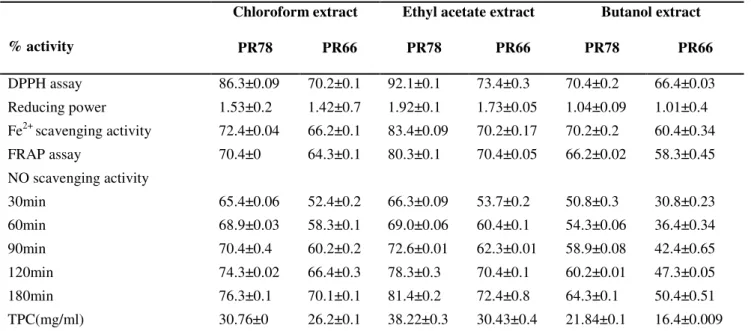
different solvents revealed ethyl acetate extract to possess the best antioxidant activity. The activity as
expressed by ethyl acetate extract of Aspergillus PR78 was equally effective as that of commonly used
antioxidant standard, ascorbic acid.
Key words: Antioxidant potential; Aspergillus; Dot blot assay; DPPH assay; FRAP assay; Reducing power; Soil fungi.
INTRODUCTION
Biotechnology consists in the use of cellular systems for
the development of processes and products holding economical
and social relevance to humankind. The fungi are of great
biotechnological interest in the fermentative processes that
culminate in the production of secondary metabolites (19).
Filamentous fungi produce a diverse array of secondary
metabolites, the small molecules that are not necessary for
normal growth or development (11). Secondary metabolites
have a tremendous impact on society and are exploited for
their antibiotics and pharmaceutical activities such as
anticancer, antitumor, immuno-stimulatory, and antioxidants
(6). The polyphenolic compounds are the secondary
metabolites commonly found in plants, mushrooms and fungi
and have been reported to possess multiple biological effects
such as anti-inflammatory, antiarteriosclerotic, antitumor,
antimutagenic, anticarcinogenic, antibacterial and cardio
protective actions including antioxidant activity (15).
Free radicals are implicated in the pathogenesis of various
human diseases such as arteriosclerosis, cancer, diabetes
mellitus, liver injury, inflammation, skin damages, coronary
Arora, D.S. and Chandra, P. Antioxidant potential of Aspergillus isolates
heart diseases, and arthritis (17). Antioxidants serve as the
defensive factor against free radicals in the body. Synthetic
antioxidants such as butylated hydroxyanisole (BHA),
butylated hydroxytoluene (BHT) and tert-butylhydroquinone
(TBHQ) are usually used as food additives by the food
industry to prevent lipid peroxidation. However, their
application has been limited because of possible toxic and
carcinogenic components formed during their degradation. In
view of these health concerns finding safer, more effective and
economic natural antioxidants is highly desirable (13). A
number of plants and mushrooms (fruiting body) are
commonly known to produce antioxidants but there are few
reports on lower fungi (21). These include Penicillium
roquefortii, Aspergillus candidus, Mortierella, Emericella
falconensis, Acremonium, Colletotrichum gloeosporioides
(21), Mycelia sterilia (17), Antrodia camphorata (23),
Chaetomium sp., Cladosporium sp., Torula sp., Phoma sp. etc (9). A lot more fungi still needs to be explored as the
production, downstream processing of actual bioactive
phytochemicals from plants is quite tougher as compared to
microbes. Keeping above in mind the present study was
planned to screen and expand the spectrum of fungi having
antioxidant potential and to optimize the culture conditions to
enhance the activity.
MATERIALS AND METHODS
Experimental
Fungi were isolated from soils of different regions of
Punjab. The fungal isolates so obtained were maintained by
regular subculturing on yeast extract glucose agar (YGA)
slants and stored at 4o C. The cultures were also preserved in 10% glycerol at -70oC. The isolated fungi were grown on YGA plates for 6-7 days from which two discs (8mm) of fungal
mycelia were used to inoculate 25 ml Czapek dox’s broth
(sucrose 3%, sodium nitrate 0.2%, K2HPO4 0.1%, magnesium
sulphate 0.05%, potassium chloride 0.05%, ferrous sulphate
0.001%). After incubation of 10 days at static conditions (25
o
C), the culture broth of each fungus was filtered through
Whatman filter paper no.1 and the filtrate so obtained was used
for different assay procedures.
Screening of the soil fungi for antioxidant activity by dot-blot 1,1-diphenyl -2-picryl hydrazyl (DPPH) assay
Initially, all the 113 fungi isolated from soil were
screened for their antioxidant activity according to dot blot
DPPH rapid staining method (8). Drops taken from ten days
grown fungal cultures were spotted onto TLC plates (Silica gel
60 F254) with the help of micro capillary and allowed to dry for
3 min. The staining of silica gel TLC plates was carried out by
placing them upside down for 10 sec in 0.4 mM DPPH
solution. The excess solution was removed with a blotting
paper and the plates were air-dried. Stained silica layers
revealed a purple background with white spots indicating
radical scavenging capacity of the organisms. The intensity of
the white color depends upon the amount and nature of radical
scavengers present in the sample. Ascorbic acid was taken as
the standard and distilled water was taken as negative control.
Quantitative assay for DPPH free radicals scavenging activity
The scavenging activity for DPPH free radicals was
measured according to Zhao et al. (29). An aliquot of 1 ml of
0.1 mM DPPH solution in ethanol and 0.5 ml of extract were
mixed. The mixture was shaken vigorously and allowed to
reach a steady state at room temperature for 30 min.
Decolourization of DPPH was determined by measuring the
decrease in absorbance at 517 nm, and the DPPH radical
scavenging effect was calculated according to the following
equation:
% scavenging rate = [1-(A1 -A2)/ A0] x 100
Where A0 represents the absorbance of the control and A1
represents the absorbance of extract, A2 represents the
absorbance without DPPH.
Determination of antioxidant activity by reducing power measurement
according to Chang et al. (5). An aliquot of 0.5 ml extract was
added to 0.1 ml of 1% potassium ferricyanide. After incubating
the mixture at 50 oC for 30 min, during which ferricyanide was reduced to ferrocyanide, it was supplemented with 0.1 ml of
1% trichloroacetic acid and 0.1% FeCl3, and left for 20 min.
Absorbance was read at 700 nm to determine the amount of
ferric ferrocyanide (Prussian blue) formed. Higher absorbance
of the reaction mixture indicates higher reducing power of the
sample.
Determination of antioxidant activity by ferric reducing antioxidant power (FRAP) assay
FRAP assay was carried out according to Othman et al. (20) by monitoring the reduction of Fe3+- tripyridyl triazine (TPTZ) to blue colored Fe2+-TPTZ. The FRAP reagent was prepared by mixing 300 mM acetate buffer (pH 3.6), 10 mM
TPTZ and 20 mM ferric chloride in a ratio of 10:1:1. The
reaction mixture containing 2 ml of FRAP reagent, 0.5 ml of
extract and 1 ml of distilled water was incubated for 10 min
and the absorbance measured at 593 nm. Antioxidant potential
of the sample was compared with the activity of 0.5 ml stock
solution of 1mg/ml FeSO4.
Determination of ferrous ion scavenging (metal chelating) activity
The chelating activity of the extracts for ferrous ions was
measured according to Zhao et al. (29). The reaction mixture
containing 0.5 ml of extract, 1.6 ml of deionized water, 0.05 ml
of FeCl2 (2mM) and 0.1 ml of ferrozine (5mM) was incubated
at 40 oC for 10 min and the absorbance measured at 562 nm. The chelating activity was calculated as:
Chelating rate = [1-(A1 -A2)/ A0] x 10
Where A0 represents the absorbance of the control and A1
represents the absorbance of extract, A2 represents the
absorbance without FeCl2 .
Determination of nitric oxide (NO) scavenging activity Nitric oxide production from sodium nitroprusside was
measured according to Kang et al. (10). An equal amount (6
ml) of sodium nitroprusside (5mM) solution was mixed with 6
ml of extract and incubated at 25 oC for two and half hours. After every half an hour, 0.5 ml of the reaction mixture was
mixed with an equal amount of Griess reagent (1%
sulphanilamide, 2% phosphoric acid, and 0.1%
napthylethylene diamine dihydrochloride) and absorbance was
taken at 546 nm and compared with absorbance of 1mg/ml of
standard solution (sodium nitrite) treated in the same way with
Griess reagent.
Determination of total phenolic content (TPC)
The total polyphenolic content was determined
colorimetrically using the Folin-Ciocalteau (FC) method
according to Singleton et al. (22) with some modifications. Test sample (0.5 ml) was mixed with 0.2 ml of FC reagent and
allowed to stand for 10 min to which 0.6 ml of 20% sodium
carbonate was added and mixed completely. The reaction
mixture was incubated at 40o C for 30 min. Absorbance of the reaction mixture was measured at 765 nm. Gallic acid was
taken as standard.
Optimization of physio-chemical and nutritional parameters
To optimize the physio-chemical and nutritional
parameters to express the best antioxidant potential, both the
organisms were grown at different temperature and pH values,
static as well as shaking conditions. Time profile for
antioxidant potential was monitored by assaying the
antioxidant activity by different procedures on every 5th day upto 30 days of growth under static conditions.
Effect of carbon and nitrogen sources
To find the best carbon source, sucrose in the Czapek
dox’s medium was replaced with different sugars (glucose,
maltose, lactose, and starch) while to work out the best
nitrogen source, sodium nitrate was replaced with different
nitrogen sources (yeast extract, peptone, malt extract, and
casein) at same concentration i.e. 3% and 0.2 %, respectively.
Thermostability of antioxidant bioactivity
Arora, D.S. and Chandra, P. Antioxidant potential of Aspergillus isolates
for antioxidant activity, it was subjected to 40oC, 60oC, 80oC, 100oC for one hr and the heat treated broth was then assayed for the residual antioxidant activity.
Effect of different organic solvents
To work out the best organic solvent for extraction of
bioactive component, the culture broth was treated with
different solvents viz petroleum ether, chloroform, ethyl acetate
and butanol. Solvents extracted components were then
evaporated to dryness in vaccuo and the resulting solids were
reconstituted in methanol to get five times concentrated stock.
Then this stock was checked for their antioxidant potential by
various assays.
Statistical analysis
All the tests were performed in triplicate. The results are
expressed as mean ± SD values. Pearson’s correlation
coefficient was also analyzed. p value less than 0.05 was
considered statistically significant.
RESULTS
Rapid screening of antioxidant activity by dot blot assay Antioxidant capacity of fungal extracts was detected
semi-quantitatively by a rapid DPPH staining method. This method
is typically based on the inhibition of the accumulation of
oxidized products, since the generation of free radicals is
inhibited by the addition of antioxidants and scavenging of the
free radicals shifts the end point. The appearance of a white
color spot against purple background is of much screening
value for the evaluation of antioxidant potential of the
organism. Out of 113 fungal isolates, 51 showed white colored
spot against purple background. The intensity of white color
was however variable for different organisms. The two best
strains selected on the basis of quantitative DPPH assay and
identified as Aspergillus were selected for further studies and
quantification.
Comparison of antioxidant potential by different quantitative methods
The different assay procedures demonstrated both
Aspergillus spp. to possess potent antioxidant potential while
Aspergillus PR78 was better in comparison to Aspergillus
PR66. The DPPH radicals are widely used to investigate the
scavenging activities and both the organisms showed a good
scavenging effect on DPPH radicals but Aspergillus PR78
(82.77 %) was significantly stronger scavenger than
Aspergillus PR66 (68.26%). In order to examine the reducing
power of two organisms the reduction of Fe3+ to Fe2+ was carried out by culture extracts of 2 organisms, whereas
Aspergillus PR78 (1.36) exhibited strong reducing power than
Aspergillus PR66 (1.09). Similarly Aspergillus PR78 and
Aspergillus PR66 demonstrated effective ferric ion reduction
based on FRAP assay. Aspergillus PR78 was more effective
than Aspergillus PR66 and gave reduction rate of 64.2% and
52.22%, respectively. In addition, the chelating activities for
ferrous ion were assayed for both Aspergillus spp. Aspergillus
PR78 and Aspergillus PR66 chelated 68.23% and 53.03% of ferrous ion, respectively. Nitric oxide ion scavenging is also
essential with other scavenging activity as NO is a very
reactive ion and results showed that both the strains exhibited
inhibition of formation of NO. The percentage rate of
scavenging nitric oxide ion for Aspergillus PR78 and
Aspergillus PR66 are 64.4% and 51.32%, respectively.
Total phenolic content
The TPC of Aspergillus extracts have been expressed as
gallic acid equivalent (GAE) i.e. mg gallic acid /100 ml
culture. TPC are known to be responsible for antioxidant
activity and both the Aspergillus spp. possessed high TPC,
which is positively correlated with their antioxidant potential.
The TPC of Aspergillus PR78 (16.74 mg/ml) was higher than
Aspergillus PR66 (13.05 mg/ml).
Antioxidant activity under different physio-chemical conditions
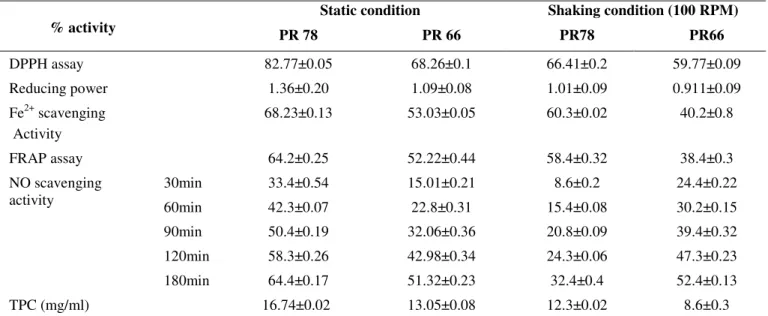
Effect of shaking condition: The experiments carried out to see the effect of shaking at different RPM demonstrated
static culture to give better antioxidant yield in comparison to
activity with increase in RPM. Thus, further optimization was
carried out under static condition (Table 1).
Effect of growth period: The antioxidant potential measured by different assay procedures was best expressed on
10th day, which subsequently declined up to 30 days (Fig 1).
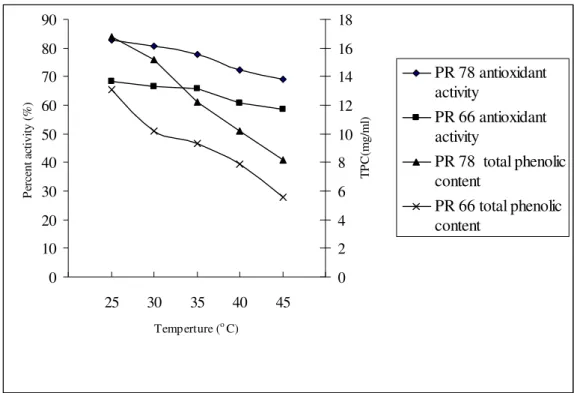
Effect of temperature and pH: The antioxidant potential with different assay procedures demonstrated the best activity
at 25oC (Fig 2) and between pH 5-7. No activity could be detected at extreme pH values (2, 3, 10, 11, and 12) by any of
the methods (Fig 3).
Table 1. Effect of shaking on antioxidant potential of two Aspergillus spp.
RPM-revolution per minute; DPPH-1.1-diphenyl -2-picryl hydrazyl; FRAP- Ferric reducing antioxidant power; NO-nitric oxide; TPC-total phenolic content
0
20
40
60
80
100
5
10
15
20
25
30
Days
P
er
ce
n
t
ac
ti
v
it
y
(%
)
0
5
10
15
20
T
P
C
(m
g
/m
l)
PR 78 antioxidant activity
PR 66 antioxidant activity
PR 78 total phenolic content
PR 66 total phenolic content
Figure 1. Antioxidant activity and total phenolic content of two Aspergillus spp grown as static culture during different incubation periods.
Static condition Shaking condition (100 RPM) % activity
PR 78 PR 66 PR78 PR66
DPPH assay 82.77±0.05 68.26±0.1 66.41±0.2 59.77±0.09
Reducing power 1.36±0.20 1.09±0.08 1.01±0.09 0.911±0.09
Fe2+ scavenging Activity
68.23±0.13 53.03±0.05 60.3±0.02 40.2±0.8
FRAP assay 64.2±0.25 52.22±0.44 58.4±0.32 38.4±0.3
30min 33.4±0.54 15.01±0.21 8.6±0.2 24.4±0.22
60min 42.3±0.07 22.8±0.31 15.4±0.08 30.2±0.15
90min 50.4±0.19 32.06±0.36 20.8±0.09 39.4±0.32
120min 58.3±0.26 42.98±0.34 24.3±0.06 47.3±0.23
NO scavenging activity
180min 64.4±0.17 51.32±0.23 32.4±0.4 52.4±0.13
Arora, D.S. and Chandra, P. Antioxidant potential of Aspergillus isolates
0 10 20 30 40 50 60 70 80 90
25 30 35 40 45
Temp erture (o C)
P
er
ce
n
t
ac
ti
v
it
y
(
%
)
0 2 4 6 8 10 12 14 16 18
T
P
C(
m
g
/m
l)
PR 78 antioxidant
activity
PR 66 antioxidant
activity
PR 78 total phenolic
content
PR 66 total phenolic
content
Figure 2. Effect of temperature on antioxidant activity and total phenolic content of two Aspergillus spp grown as static culture.
0
10
20
30
40
50
60
70
80
90
2
3
4
5
6
7
8
9
10
11
12
pH
P
e
rc
e
n
t
a
c
ti
v
it
y
(%
)
0
2
4
6
8
10
12
14
16
18
T
P
C
(m
g
/m
l)
PR 78 antioxidant activity
PR 66 antioxidant activity
PR 78 total phenolic content
PR 66 total phenolic content
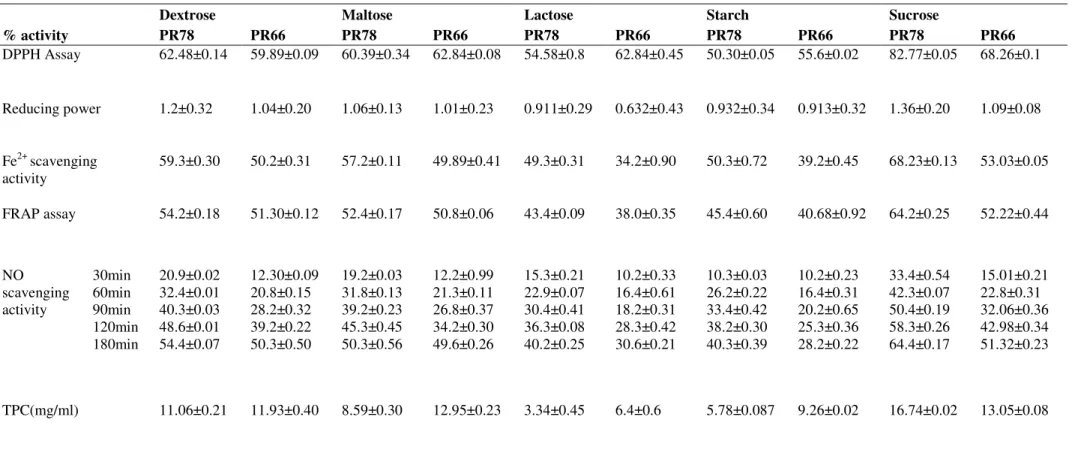
Effect of carbon and nitrogen sources: The antioxidant activity was best expressed in sucrose as carbon source (Table
2) and the order of activity under various other carbon sources
was as follows sucrose>dextrose>maltose>lactose>starch.
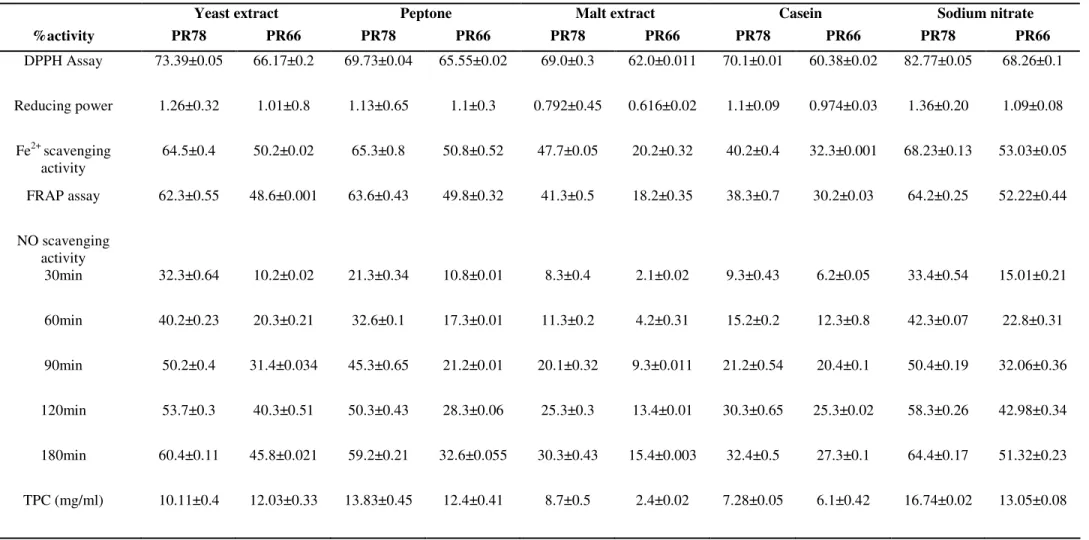
Similarly sodium nitrate was best among inorganic as well as
organic nitrogen sources. Though peptone and yeast extract
were also good source of nitrogen. The order of various
nitrogen sources showing activity was as follows sodium
nitrate>yeast extract>peptone>casein>malt extract (Table 3).
Thermostability of antioxidant bioactivity: Thermostability of the active components in the culture filtrate
responsible for antioxidant activity was checked and found to
be relatively thermostable. The antioxidant activity decreased
with the increase of heat exposure. At 40oC the activity decreased by only 3-27% in both the organisms, while at 100
o
C it suffered a maximum loss of 50 % in its activity (Fig 4).
Effect of different organic solvents: The extraction with different solvents revealed ethyl acetate to be the best solvent
to elute the components responsible for antioxidant potential
that was followed by chloroform and butanol extract.
Petroleum ether extracts did not show any activity. The activity
exhibited by the broth extracted in different solvents indicates
that there may be many components with different polarities
present in the broth (Table 4).
DISCUSSION
Vast diversity of microbes remain untapped for
structurally diverse metabolites possessing highly valuable
bioactivities including antioxidant activity (18). In the present
study, 45 percent of soil fungal isolates demonstrated their
antioxidant potential to variable levels. Qualitative test proved
successful for bulk screening of samples though quantitative
analysis revealed the differential ability of such fungi. Based
on these observations the two best strains of Aspergillus spp
were selected for further studies. Aspergillus PR78 was found
to have overall better antioxidant activity than Aspergillus
PR66. The yield of bioactive metabolite can sometime be
substantially increased by the optimization of physical and
chemical factors used for the growth of microbes; a good
understanding of the role of these factors in the biosynthesis of
metabolites may lead to better exploitation (28).
The comparative analysis of the data obtained for two
Aspergillus spp for their antioxidant potential assayed by
different methods demonstrated static culture conditions to be
more suitable as compared to shake flask. It might be attributed
to low amount of phenolic compounds produced under shaking
conditions, which have been held responsible for antioxidant
activity of fungi. This supports the earlier contention of various
researchers who have used static conditions (7) or low RPM
(between 100 to 150 RPM) (9, 12, 25). The optimum period of
incubation for antioxidant potential of the isolates was found to
be 10 day and subsequent decline in bioactivity could be due to
the exhaustion of nutrients available for the fungi.
Alternatively, may be due to the degradation of secondary
metabolites (phenolic compounds) already produced by fungi
as also revealed from the decline in the amount of phenolic
content.
The comparison of antioxidant potential in the culture
extract obtained from two fungi grown at different
temperatures 25o C revealed to be the optimum for both the organisms, which correlate positively with their phenolic
content. No activity was detected at pH extremes, which was
optimally best between the pH 5-7. The present results
corroborate the previous studies in which there was no
bioactivity at pH extremes (14). This may be due to delayed
metabolite production caused by delayed mycelial growth or
due to a reduced production of bioactive metabolites under
such pH conditions. This shows that pH of the growth medium
can also significantly effect the production of secondary
metabolites. The pH is related to permeability characteristics of
the cell wall and membrane, thus affect either ion uptake or
Arora, D.S. and Chandra, P. Antioxidant potential of Aspergillus isolates
Table 2. Effect of various carbon sources on antioxidant potential of two Aspergillus spp.
Dextrose Maltose Lactose Starch Sucrose
% activity PR78 PR66 PR78 PR66 PR78 PR66 PR78 PR66 PR78 PR66
DPPH Assay 62.48±0.14 59.89±0.09 60.39±0.34 62.84±0.08 54.58±0.8 62.84±0.45 50.30±0.05 55.6±0.02 82.77±0.05 68.26±0.1
Reducing power 1.2±0.32 1.04±0.20 1.06±0.13 1.01±0.23 0.911±0.29 0.632±0.43 0.932±0.34 0.913±0.32 1.36±0.20 1.09±0.08
Fe2+ scavenging activity
59.3±0.30 50.2±0.31 57.2±0.11 49.89±0.41 49.3±0.31 34.2±0.90 50.3±0.72 39.2±0.45 68.23±0.13 53.03±0.05
FRAP assay 54.2±0.18 51.30±0.12 52.4±0.17 50.8±0.06 43.4±0.09 38.0±0.35 45.4±0.60 40.68±0.92 64.2±0.25 52.22±0.44
NO scavenging activity
30min 60min 90min 120min 180min
20.9±0.02 32.4±0.01 40.3±0.03 48.6±0.01 54.4±0.07
12.30±0.09 20.8±0.15 28.2±0.32 39.2±0.22 50.3±0.50
19.2±0.03 31.8±0.13 39.2±0.23 45.3±0.45 50.3±0.56
12.2±0.99 21.3±0.11 26.8±0.37 34.2±0.30 49.6±0.26
15.3±0.21 22.9±0.07 30.4±0.41 36.3±0.08 40.2±0.25
10.2±0.33 16.4±0.61 18.2±0.31 28.3±0.42 30.6±0.21
10.3±0.03 26.2±0.22 33.4±0.42 38.2±0.30 40.3±0.39
10.2±0.23 16.4±0.31 20.2±0.65 25.3±0.36 28.2±0.22
33.4±0.54 42.3±0.07 50.4±0.19 58.3±0.26 64.4±0.17
15.01±0.21 22.8±0.31 32.06±0.36 42.98±0.34 51.32±0.23
TPC(mg/ml) 11.06±0.21 11.93±0.40 8.59±0.30 12.95±0.23 3.34±0.45 6.4±0.6 5.78±0.087 9.26±0.02 16.74±0.02 13.05±0.08
Table 3. Effect of various nitrogen sources on antioxidant potential of two Aspergillus spp.
Yeast extract Peptone Malt extract Casein Sodium nitrate
%activity PR78 PR66 PR78 PR66 PR78 PR66 PR78 PR66 PR78 PR66
DPPH Assay 73.39±0.05 66.17±0.2 69.73±0.04 65.55±0.02 69.0±0.3 62.0±0.011 70.1±0.01 60.38±0.02 82.77±0.05 68.26±0.1
Reducing power 1.26±0.32 1.01±0.8 1.13±0.65 1.1±0.3 0.792±0.45 0.616±0.02 1.1±0.09 0.974±0.03 1.36±0.20 1.09±0.08
Fe2+ scavenging activity
64.5±0.4 50.2±0.02 65.3±0.8 50.8±0.52 47.7±0.05 20.2±0.32 40.2±0.4 32.3±0.001 68.23±0.13 53.03±0.05
FRAP assay 62.3±0.55 48.6±0.001 63.6±0.43 49.8±0.32 41.3±0.5 18.2±0.35 38.3±0.7 30.2±0.03 64.2±0.25 52.22±0.44
NO scavenging activity
30min 32.3±0.64 10.2±0.02 21.3±0.34 10.8±0.01 8.3±0.4 2.1±0.02 9.3±0.43 6.2±0.05 33.4±0.54 15.01±0.21
60min 40.2±0.23 20.3±0.21 32.6±0.1 17.3±0.01 11.3±0.2 4.2±0.31 15.2±0.2 12.3±0.8 42.3±0.07 22.8±0.31
90min 50.2±0.4 31.4±0.034 45.3±0.65 21.2±0.01 20.1±0.32 9.3±0.011 21.2±0.54 20.4±0.1 50.4±0.19 32.06±0.36
120min 53.7±0.3 40.3±0.51 50.3±0.43 28.3±0.06 25.3±0.3 13.4±0.01 30.3±0.65 25.3±0.02 58.3±0.26 42.98±0.34
180min 60.4±0.11 45.8±0.021 59.2±0.21 32.6±0.055 30.3±0.43 15.4±0.003 32.4±0.5 27.3±0.1 64.4±0.17 51.32±0.23
TPC (mg/ml) 10.11±0.4 12.03±0.33 13.83±0.45 12.4±0.41 8.7±0.5 2.4±0.02 7.28±0.05 6.1±0.42 16.74±0.02 13.05±0.08
Arora, D.S. and Chandra, P. Antioxidant potential of Aspergillus isolates
0 20 40 60 80 100
40 60 80 100
Temperature (oC)
L
o
s
s
i
n
a
c
ti
v
it
y
(
%
)
PR 78 PR 66
Table 4. Effect of extraction with different solvents on antioxidant potential of two Aspergillus spp.
DPPH-1.1-diphenyl -2-picryl hydrazyl; FRAP- Ferric reducing antioxidant power; NO-nitric oxide; TPC-total phenolic content
Table 5. Comparison between different antioxidant assays as represented by correlation coefficient (r). DPPH assay Reducing
power
TPC Fe2+
scavenging activity
FRAP assay
Reducing power 0.744
TPC 0.614 0.903
Fe2+ scavenging activity 0.784 0.951 0.772
FRAP assay 0.742 0.972 0.945 0.933
NO scavenging activity 0.71 0.981 0.959 0.919 0.996
DPPH-1.1-diphenyl -2-picryl hydrazyl; FRAP- Ferric reducing antioxidant power; NO-nitric oxide; TPC-total phenolic content
Chloroform extract Ethyl acetate extract Butanol extract
% activity PR78 PR66 PR78 PR66 PR78 PR66
DPPH assay 86.3±0.09 70.2±0.1 92.1±0.1 73.4±0.3 70.4±0.2 66.4±0.03
Reducing power 1.53±0.2 1.42±0.7 1.92±0.1 1.73±0.05 1.04±0.09 1.01±0.4
Fe2+ scavenging activity 72.4±0.04 66.2±0.1 83.4±0.09 70.2±0.17 70.2±0.2 60.4±0.34
FRAP assay 70.4±0 64.3±0.1 80.3±0.1 70.4±0.05 66.2±0.02 58.3±0.45
NO scavenging activity
30min 65.4±0.06 52.4±0.2 66.3±0.09 53.7±0.2 50.8±0.3 30.8±0.23
60min 68.9±0.03 58.3±0.1 69.0±0.06 60.4±0.1 54.3±0.06 36.4±0.34
90min 70.4±0.4 60.2±0.2 72.6±0.01 62.3±0.01 58.9±0.08 42.4±0.65
120min 74.3±0.02 66.4±0.3 78.3±0.3 70.4±0.1 60.2±0.01 47.3±0.05
180min 76.3±0.1 70.1±0.1 81.4±0.2 72.4±0.8 64.3±0.1 50.4±0.51
TPC(mg/ml) 30.76±0 26.2±0.1 38.22±0.3 30.43±0.4 21.84±0.1 16.4±0.009
Figure 4. Thermostability of antioxidant potential and
total phenolic content of
In consonance with earlier studies (26), sucrose proved to
be the most promising carbon source to produce bioactive
compounds. This explains that a fungal sp may have the ability
to utilize a particular carbon source for vegetative growth but
may not be able to use it for production of specialized
structural molecules. Similarly, sodium nitrate was best
nitrogen source among all organic as well as inorganic nitrogen
sources, thus indicating that availability of easily utilizable
carbon and nitrogen sources promote primary metabolism and
feeding with more slowly metabolizable compounds may lead
to the formation of secondary products. Nitrogen sources other
than sodium nitrate showed lesser activity. This also proves
that Czapek dox’s medium is most effective for metabolite
production responsible for antioxidant activity. In fact culture
media, have a major impact on the growth of microbes and the
production of microbial products. As far as parameters are
concerned there is usually a dilemma between achieving
maximal growth rates and maximal bioactivity because
conditions that allow fast cell growth could be unfavorable to
metabolite production. This shows that the growth medium can
also have a significant effect on secondary metabolites and
enhancement of secondary metabolites can only be achieved
through systematic manipulation of parameters.
Thermostability studies on filtrate demonstrated that
metabolites responsible for antioxidant activity are quite stable
at 40oC. Of the different organic solvents extraction tried, ethyl acetate extracts showed best activity correlating with high
phenolic content followed by chloroform and butanol extract.
Our observations with ethyl acetate extracts are in consonance
with the earlier studies (26, 27). Further, the results of ethyl
acetate extracts were quite comparable with activity of ascorbic
acid (96.7 %), BHA (95.1%) and alpha tocopherol (94.7%).
The bioactive components may differ in their solubility
depending on the extractive solvents used.
Previous studies reveal phenolic compounds to be the
major antioxidants of medicinal plants, mushrooms, essential
oils, spices, fruits, and vegetables (16). The interest in the
phenolic compounds has increased tremendously due to their
prominent free radical scavenging activity, attributed to their
redox properties, which allow them to act as reducing agents or
hydrogen atom donor (2). The importance of phenolic contents
has been endorsed from the present observation of their high
content in soil fungi and their antioxidant activity is quite
comparable with antioxidant potential of many mushrooms as
well as medicinal plants.
The comprehensive evaluation of antioxidant activity of
natural products using different tests has been shown to be
important in assessing antioxidant activity of endogenous
compounds. Though it is imperative for researchers to have a
convenient, fast, and universal method for overall
quantification of antioxidant efficiency of the natural products,
however, such a test has yet to be developed. To measure the
total antioxidant potential using a single assay procedure seems
to be rather unrealistic, yet there are numerous published
methods claiming to measure total antioxidant activity in vitro
(24).
Thus, to validate the reliability of different methods, the
correlation between the different assay procedures is necessary.
Previous studies have shown the linear correlation between
total phenolic content and antioxidant activity. In this study
too, total phenolic content of fungi correlated well with the
antioxidant activity. Plotting total phenolic content versus
DPPH scavenging activity gave a positive correlation
(r=0.614) between these two parameters indicating the
bioactive potential of phenolic compounds which helps to
neutralize the free radical character of purple color DPPH
either by transfer of electron or hydrogen atom to yellow
colored diamagnetic molecule (4).
Similarly a positive correlation was found (r=0.903)
between phenolic content and reducing power where the
phenolic compounds in the extracts act as reductones that
inhibit lipid peroxidation by donating a hydrogen atom thereby
terminating the free radical chain reaction. Moreover, this
reducing potential may be due to the di-monohydroxy
substitution in the aromatic ring that possesses potent hydrogen
donating ability (3).
Nitric oxide exhibits a numerous range of beneficial
Arora, D.S. and Chandra, P. Antioxidant potential of Aspergillus isolates
neurotransmission, killing microorganisms, and tumor cells
and other homeostatic mechanisms. High levels of nitric oxide
have been described in a variety of patho-physiological
processes including various forms of circulatory shock,
inflammation, and carcinogenesis (1). As evident from studies
phenolic compounds present in the extracts are able to
scavenge nitric oxide ion as the correlation between them is
positive(r=0.959).
Results of FRAP assay are also positively
correlated(r=0.945) with phenolic content showing the latter to
have the reducing potential to react with ferric tripyridyl
triazine (Fe3+ -TPTZ) complex and producing blue colored ferrous tripyridyl triazine (Fe2+ -TPTZ). Generally the reducing properties are associated by breaking the free radical chain
through donating a hydrogen atom (20).
Phenolic compound present in the extracts also showed
the chelating activity of metals, as the transition metals such as
ferrous ion can stimulate lipid peroxidation by generating
hydroxyl radicals through Fenton reaction and accumulate lipid
peroxidation by decomposing lipid hydroxyl peroxide into
peroxyl and alkoxyl radicals therefore drive the chain reaction
of lipid peroxidation. The chelating activity for ferrous ion was
assayed by the inhibition of formation of red colored ferrozine
and ferrous complex as observed in present studies using both
the fungal extracts (29). The correlation between the phenolic
content and chelating activity of metals was also
positive(r=0.772)
The over all positive correlation can be seen between the
phenolic content and antioxidant capacity (Table 5). As the
total phenolics increases, the antioxidant capacity of the extract
from both the Aspergillus spp also increases, indicating that
phenolic compound in the extracts are able to scavenge DPPH,
ferrous and nitric oxide ion and have reducing potential in
addition to their ability to chelate metals such as iron. This
indicates that the phenolic content of Aspergillus sp extracts
can act as potent antioxidants. These fungi may provide easier
set up for production and purification of natural antioxidants as
compared to higher plants. The present study demonstrated
potential of soil fungi to have antioxidant activity similar to
plants and mushrooms thus further highlighting their
significance as new sources of natural antioxidants.
REFERENCES
1. Abas, F.; Lajs, N.H.; Israf, D.A.; Khoziroh, S.; Kalsom, Y.U. (2006). Antioxidant and nitric oxide inhibition activities of selected Malay traditional vegetables. Food Chem., 95, 566-573.
2. Amarowicz, R.; Pegg, R.B.; Moghaddam, P.R.; Barl, B.; Weil, J.A. (2004). Free radical scavenging capacity and antioxidant activity of selected plants species from the Canadian prairies. Food Chem., 84, 551-562.
3. Benzie, I.F.; Strain, J.J. (1999). Ferric reducing antioxidant power assay: direct measure of total antioxidant activity of biological fluids and modified version for simultaneous measurement of total antioxidant power and ascorbic acid concentration. Method Enzymol., 299, 15-27. 4. Bounatirou, S.; Smiti, S.; Miguel, M.G.; Falerio, L.; Rejeb, M.N.;
Neffati, M.; Casto, M.M.; Figueiredo, A.C.; Barroso, J.G.; Pedro, L.G. (2007). Chemical composition, antioxidant and antibacterial activities of the essential oils isolated from Tunisian Thymus capitatus Hoff. et link. Food Chem., 105, 146-155.
5. Chang, L.W.; Yen, W.J.; Huang, S.C.; Duh, P. D. (2002). Antioxidant activity of sesame coat. Food Chem., 78, 347-354.
6. Fox, E.M.; Howlett, J.B. (2008). Secondary metabolism: regulation and role in fungal biology .Curr. Opin. Microbiol., 11, 1-7.
7. Harper, K.; Arif, A.; Ford, E.J.; Strobel, G.A.; Porco Jr, J.A.; Tomar, D.P.; Oneill, K.L.; Heider, E.M.; Grant, D.M., (2003). Pestacin: a 1,3-dihydro isobenzofuran from Pestalotiopsis micropora possessing antioxidant and antimycotic activities. Tetrahedron, 59, 2471-2476. 8. Huang, D.J.; Chen, H.J.; Hou, W. C.; Lin, C.D.; Lin, Y.H. (2006). Sweet
potato (Ipomoea batatas [L.] Lam ‘Tainong 57’) storage root mucilage with antioxidant activities in vitro. Food Chem., 98, 774-781.
9. Huang, W.Y.; Cai, Y.Z.; Hyde, K.D.; Corke, H.; Sun, M. (2007). Endophytic fungi from Nerium oleander L (Apocynaceae): main constituents and antioxidant activity. World J. Microbiol. Biotechnol., 23, 1253-1263.
10. Kang, K.S.; Yokozawa, T.; Kim, H.Y.; Park, J.H. (2006). Study on the nitric oxide scavenging effects of Gingseng and its compound. J. Agric. Food. Chem., 54, 2558-2562.
11. Lucas, E.M.F.; De Castro, M.C.M.; Takahashi, J.A. (2007). Antimicrobial properties of sclerotiorin, isochromophilone vi and pencolide, metabolites from a Brazilian Cerrado isolate of Penicillium sclerotiorum van beyma. Brazilian J. Microbiol., 38,785-789.
12. Malpure, P.P.; Shah, A.S.; Juvekar, A.R. (2006). Antioxidant and anti-inflammatory activity of extract obtained from Aspergillus candidus MTCC 2202 broth filtrate. Indian J. Exp. Biol., 44, 468-473.
vitro models. Food Chem., 94, 520-528.
14. Miao, L.; Kwong, T.F.N.; Qian, P.Y. (2006). Effect of culture conditions on mycelial growth, antibacterial activity, and metabolite profiles of the marine-derived fungus Arthrinium c.f. saccharicola. Appl. Microbiol. Biotechnol., 72, 1063-1073.
15. Miller, M. J.; Diplock, A. T.; Rice-Evans, C.A. (1995). Evaluation of the total antioxidant activity as a marker of the deterioration of apple juice on storage. J. Agric. Food Chem., 43, 1794-1801.
16. Mokbel, M. S.; Hashinaga, F. (2006). Evaluation of the antioxidant activity of extracts from Buntan (Citrus grandis Osbeck) fruit tissues. Food Chem., 94, 529-534.
17. Moon, B.S.; Ryoo, I.J.; Yun, B. S.; Bae, K.S.; Lee, K.D.; Yoo, I.D.; Kim, J.P. (2006). Glyscavins A,B and C, new phenolic glycoside antioxidants produced by a fungus Mycelia sterilia F020054. J. Antibiot., 59, 735-739.
18. Motta, A.S.; Cladera-Olivera, F.; Brandelli, B. (2004). Screening for antimicrobial activity among bacteria isolated from the Amazon basin. Braz. J. Microbiol., 35, 307-310.
19. Nogurira, M.A.; Diaz, G.; Andriali, W.; Faiconi, A.F.; Stangarlin, S.R. (2006). Secondary metabolism from Diplodia maydis and Sclerotium rolfsi with antibiotic activity. Braz. J. Microbiol., 37, 14-16.
20. Othman, A.; Ismail, A.; Ghani, N.A.; Adenan, I. (2007). Antioxidant capacity and phenolic content of cocoa beans.Food Chem., 100, 1523-1530.
21. Rios, M.F.; Pajan, C.M.G.; Galan, R.H.; Sanchez, A.J.M.; Callado, I.G.
(2006). Synthesis and free radical scavenging activity of a novel metabolite from the fungus Colletotrichum gloeosporioides. Bioorg. Med. Chem. Lett., 16, 5836-5839.
22. Singleton, V.L.; Ortofehr, R.; Lamuela-Raventos, R.M. (1999). Analysis of total phenols and other oxidation substrate and antioxidants by means of Folin-Ciocalteau reagent. Methods Enzymol., 299,152-178.
23. Song, T.Y.; Yen, G.C. (2002). Antioxidant properties of Antrodia camphorata in submerged culture. J. Agri. Food Chem., 50, 3322-3327. 24. Sultana, B.; Anwar, F.; Przybylski, R. (2007). Antioxidant activity of
phenolic components present in barks of Azadirachta indica, Terminalia arjuna, Acacia nilotica and Eugenia jambalana Lam.trees. Food Chem., 104, 1106-1114.
25. Yen, G.C.; Lee, C.A. (1996). Antioxidant activity of extracts from molds. J.Food Prot., 59, 1327-1330.
26. Yen, G.C.; Chang, Y.C. (1999). Medium optimization for the production of antioxidants from Aspergillus candidus. J. Food Prot., 62, 657-661. 27. Yen, G.C.; Chang, Y.C.; Sheu, F.; Chiang, H.C. (2001). Isolation and
characterization of antioxidants compounds from Aspergillus candidus broth filtrate. J. Agri. Food Chem., 49, 1426-1431.
28. Yhu, Z.; Pan, J.; Qiu, J.; Guan, X. (2008). Optimization of nutritional requirements for mycelial growth and sporulation of entomogenous fungus Aschersonia aleyrodis webber. Braz. J. Microbiol., 39,770-775. 29. Zhao, G.R.; Xiang, Z.J.; Ye, T.X.; Yaun, J.Y.; Guo, X.Z. (2006).