URINARY SYMPTOMS IN PARKINSON’S DISEASE
Prevalence and associated factors
Raimundo Nonato Campos-Sousa
1, Elizabeth Quagliato
2,
Benedito Borges da Silva
1, Reynaldo Mendes de Carvalho Jr.
1,
Suilane Coelho Ribeiro
3, Daniel França Mendes de Carvalho
3ABSTRACT - - - - - The authors present a cross-sectional study involving 61 patients with idiopathic Parkinson’s disease (PD) who were consecutively examined and compared to a control group with 74 subjects. Only patients who fulfilled the standard diagnostic criteria for PD and whose brain magnetic resonance imaging was normal were included. The objective of the study was to evaluate the prevalence of inferior urinary tract symptoms in PD and to study the possible association between clinical factors to urinary dysfunction. ln the patient group, 39.3% presented urinary symptoms when compared to 10.8% in the control group. All symptomatic patients presented irritative symptoms. The most common irritative symptom PD was nocturia, followed by frequency and urinary incontinence. Around 25% of the patients presented functional obstructive symptoms determined by the disease. The most frequent obstructive symptom was incomplete emptying of the bladder. Only the age of the patients and control group were correlated with urinary dysfunction.
KEY WORDS: Parkinson’s disease, urinary symptoms, autonomic symptoms.
Prevalência e fatores associados aos sintomas urinários na doença de P Prevalência e fatores associados aos sintomas urinários na doença de P Prevalência e fatores associados aos sintomas urinários na doença de P Prevalência e fatores associados aos sintomas urinários na doença de P Prevalência e fatores associados aos sintomas urinários na doença de Parkinsonarkinsonarkinsonarkinsonarkinson
RESUMO - Trata-se de estudo clínico transversal, envolvendo 61 pacientes com doença de Parkinson idiopática (DP) examinados consecutivamente e comparados a 74 indivíduos do grupo controle. Foram incluídos apenas pacientes com DP que preencheram os critérios de diagnóstico estabelecidos. A ressonância magnética do encéfalo e a ultra-sonografia da próstata foram utilizadas como critérios de exclusão. O objetivo do estudo foi avaliar a prevalência de sintomas do trato urinário inferior na DP e verificar associações entre sexo, idade e fatores clínicos às disfunções urinárias. Sintomatologia urinária foi encontrada em 39,3% dos parkinsonianos e 10,8% do grupo controle. Todos os pacientes sintomáticos apresentavam sintomas irritativos e 25% destes tinham sintomas obstrutivos. A sintomatologia urinária não estava associada ao sexo, duração e gravidade da doença, hipotensão postural e sintomas ortostáticos, assim como com os sinais cardeais e tratamento com a levodopa.
PALAVRAS-CHAVE: doença de Parkinson, sintomas urinários, sintomas autonômicos.
Neurological Outpatient Clinic of CISLA-SUS. Teresina Piauí. 1Adjunct Professor of Neurology Federal University of Piauí, Teresina PI, Brasil
(CCS- UFPI); 2Adjunct Professor of Neurology, State University of Campinas (UNICAMP), Campinas SP, Brasil; 3Medical Student ,CCS-UFPI.
Received 1 July 2002, received in final form 21 January 2003. Accepted 27 January 2003
Dr. Raimundo Nonato Campos-Sousa - - - - - Rua Artur Vasconcelos 289/sul - 64001-450 Teresina PI - Brasil. E-mail: [email protected]
The presence of autonomic alterations in Parkin-son’s Disease (PD) could influence the diagnosis and prognosis of the disease. In 1817, James Parkinson reported the presence of autonomic signs such as sudoresis, urinary and gastrointestinal symptoms1. The lower urinary tract symptoms (LUTS) are classified in irritative and obstructive symptoms. In the irritative group, there are frequency, urgency and nocturia which are caused by hyperactivity of the bladder due to detrusor hyperreflexia. Incomplete emptying, intermittence, weak urinary stream and hesitation
PD5.The frequency of urinary symptoms in patients with PD revised by Araki and Kuno varied from 37 to 70%3. The distortions in these studies include pro-blems in selecting patients, inclusion of patients with other forms of parkinsonism, the identification of urinary symptoms and the use of medication such as levodopa3,6. Bladder hyperactivity in PD patients can be explained by the removal of inhibitory effects exerted by dopamine neurons, originated in the “pars compacta” of the substantia nigra and mediated by D1 receptors, on the urinary reflex6,7.The presence of Lewy bodies in the autonomic nervous system of patients with advanced PD can explain urinary sphincter dysfunction and rare cases of hyporeflexia of the detrusor muscle3.
LUTS can be measured by using the score scale of the American Urological Association (AUA – 7). This scale is a questionnaire of 7 items which was developed to measure the severity of LUTS among men who have prostate hypertrophy8. It quantifies the urinary symptoms and has correlation with urodynamic findings even in patients without prostate alteration or in females. It can also measure and differentiate the irritative and obstructive symptoms8,9. Patients who have total scores ≥ 8 or irritative scores ≥ 4 and obstructive scores ≥ 5 are considered symptomatic8.
The objective of this study was to analyze the prevalence of LUTS in PD and to study the possible association of sex, age and clinical factors to urinary disorders.
METHOD
The study was comprised of 61 patients selected from 169 patients with PD who were attended consecutively at the neurological outpatient clinic of Lineu Araujo – SUS Teresina – PI. The control group (74 subjects) was made up of spouses, family and caretakers. Only patients with idiopathic PD who fulfilled the criteria for the established diagnosis were included. Secondary parkinsonism and other types of degenerative parkinsonism were excluded. A brain MRI was done on all participants as exclusion cri-teria. Patients with dementia, early or severe postural insta-bility, men with prostate hypertrophy or previous prosta-tectomy and pelvic surgery in women were also excluded. All of the patients were examined after being off levodopa or other dopaminergic medication for 15 hours.
The Unified Parkinson’s Disease Rating Scale (UPDRS) and the Hoehn-Yahr scale were used for neurological eva-luation. The urinary symptoms were evaluated by AUA-7 scale, which was applied with assistance of the same exa-miner (RNCS).
An analytic and observational cross-sectional study was conducted. For descriptive analysis, frequency tables, position and dispersion measurements were used. For the
study of association between the variables, the Pearson correlation test was used. The statistic T of Student and the variance analysis (ANOVA) were used to compare the mean scores between the groups. The exact Fisher test was used to study the proportions. The significance level used was 5%.
RESULTS
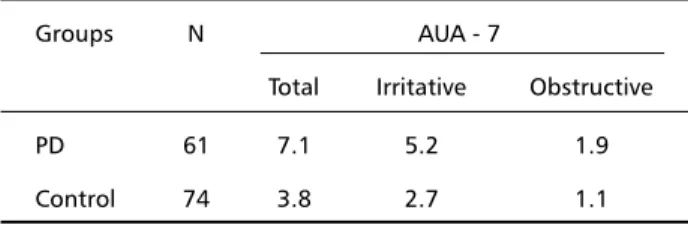
Sex difference and age --- In the patient group 31 (50.8%) were male and 30 (49.2%) female, in the control group 31 (41.9%) were male and 43 (58.1%) female. A significant difference between total (p=0.529) irritative (p=0.94) and obstructive (p=0.053) mean urinary scores for men and women with PD was not observed (Table 1). In Table 2, the mean urinary scores were compared between wo-men with PD and wowo-men in the control group and a significant difference between total (p<0.001), obs-tructive and irritative mean urinary scores was ob-served. The average age of the group of patients (PD) was 59.6 years. For men, the ages varied from 36 to 77 years with the mean age of 57 and for women the ages varied from 40 to 82 years with mean age of 62 years. In the symptomatic group the ages varied from 40 to 77 years, with mean age of 62.2 years. In the control group the average of age was 59.3 years.
In the PD group a correlation between age and total urinary scores (r=0.351; p=0.0027) and between age and irritative urinary scores (r=0.348; p = 0.0029) was observed. There was no correlation between age and obstructive symptoms (r= 0.197; p= 0.0635). For the control group there was a clear correlation between age and total urinary scores (r= 0.46; p<0.001).
Table 1. Mean urinary scores (AUA-7) between the groups.
Groups N AUA - 7
Total Irritative Obstructive
PD 61 7.1 5.2 1.9
Control 74 3.8 2.7 1.1
Table 2. Mean urinary scores (AUA-7) between women groups.
Women N AUA - 7
Groups Total Irritative Obstructive
Control 43 3.1 2.5 0.6
Comparing groups - There was a significant diffe-rence between total (p<0.0001) irritative (p<0.0001) and obstructive (p<0.0001) mean urinary scores of PD patients and control group. In the group of pa-tients studied, we found 24 papa-tients with total uri-nary scores ≥ 8, corresponding to 39.3% of the to-tal. All of the symptomatic patients had irritative symptoms and 25% of them also had obstructive symptoms.
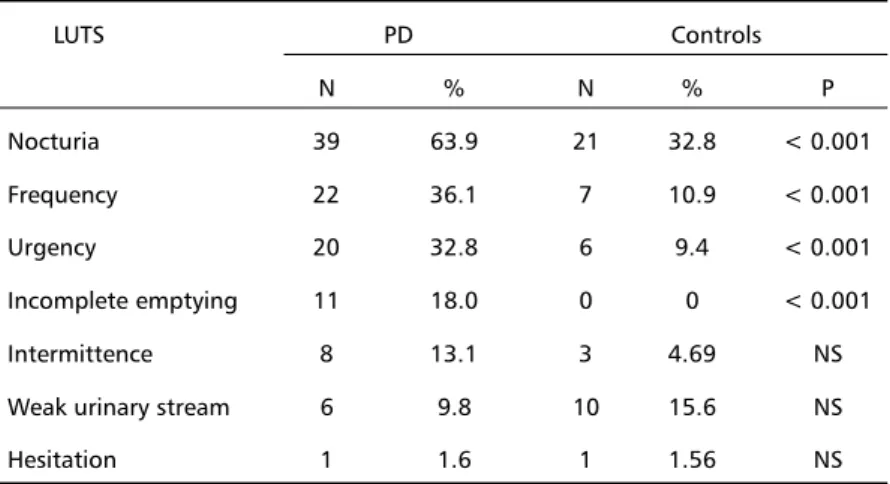
In Table 3 there were significant differences bet-ween nocturia (p<0.001), diurnal frequency (p<0.001), urgency (p<0.001), and incomplete voi-ding (p<0.001), when the patients group was com-pared to the control group.
Duration and severity - - - The duration of PD varied from 3 months to 20 years, with mean of 4.9 years and median of 3 years. In the symptomatic patients, the duration of disease varied from 1 to 11 years with mean of 4.5 years. No association between the duration of the disease and total (r=-0.004; p=0.48), irritative and obstructive urinary scores was observed. The severity of PD in the sample studied was mea-sured by using the UPDRS scores. The UPDRS total scores varied from 12 to 98 with mean of 45.8, me-dian of 41 and standard deviation of 22. Among the group of symptomatic patients, the mean total sco-res was 51.6 while in the non-symptomatic group the mean was 42. No significant difference between the mean total scores (p=0.097) of symptomatic and non-symptomatic PD patients was observed. In Table 4, the mean scores of the cardinal motor symptoms (UPDRS) were distributed between patients with and without urinary symptoms. No difference was obser-ved in the mean motor scores of tremor (p=0,255), rigidity (p=0,255) and akinesia (p=0,229) between patients with or without symptoms. In Table 5, the mean scores of each section (UPDRS) of PD patients
with and without urinary symptoms were compared and no significant difference between the mean scores for sector I-mental health, behavior and hu-mor (p=0.73), sector II-daily activities (p=0.86) and sector III- motor functions (p=0.119) was observed. No correlation between the total points of the UPDRS and the total urinary scores (r=0.14; p=0.136) was observed. The possible associations of each cardinal motor symptom with total urinary scores were also studied: tremor (r=0.062; p=0.315); rigidity (r=0.044; p=0.367) and akinesia (r=0.069; p=0.296). No correlation between the motor cardi-nal symptoms and urinary symptoms was found.
Orthostatic symptoms and postural hypotension --- Significant difference between the mean total uri-nary scores of PD patients with or without orthostatic symptoms (p=0.948) and with or without postural hypotension (p=0.76) was not observed.
Table 5. Distribution of mean UPDRS scores between symptomatic and non-symptomatic patients.
PD patients UPDRS
Sector I Sector II Sector III
Symptomatic 1.83 12.62 37.2
Non-symptomatic 1.73 9.27 31.08 Table 4. Mean motor scores (UPDRS) between symptomatic and non-symptomatic PD patients.
Patients Cardinal symptoms Tremor Rigidity Akinesia
Symptomatic 6.67 6.45 18.80
Non- symptomatic 5.56 5.51 16.30 Table 3. Prevalence of urinary symptoms between the groups.
LUTS PD Controls
N % N % P
Nocturia 39 63.9 21 32.8 < 0.001
Frequency 22 36.1 7 10.9 < 0.001
Urgency 20 32.8 6 9.4 < 0.001
Incomplete emptying 11 18.0 0 0 < 0.001
Intermittence 8 13.1 3 4.69 NS
Weak urinary stream 6 9.8 10 15.6 NS
Arterial hypertension - - - Total (p=0.080), irritative (p=0.084) and obstructive (p=0.352) urinary scores between hypertensive and normotensive PD patients were compared and no difference was observed.
Levodopa - - - There was no significant difference among total (p=0.831), irritative (p=0.473) and obstructive (p=0.377) mean urinary scores of patients who were treated with levodopa and those treated without levodopa.
DISCUSSION
The identification, in the initial phase of parkin-sonism, of autonomic symptoms such as urinary symptoms could influence the diagnosis, treatment efficacy and life quality. However, there have been few studies done on the prevalence of LUTS in pa-tients included with established criteria for PD diag-nosis from neurological clinics. The majority of the urological studies on PD evaluated patients that had been sent to urological outpatient clinics with LUTS, which biased the selection. The treatment of urinary symptoms in PD patients is sometimes unsuccessful because LUTS could have neurological origin or be a result of drugs such as levodopa or dopaminergic agents and, particularly in men, it could be associated with structural factors like prostate hypertrophy3,10,11.
When we compared the mean urinary scores bet-ween the PD patients and control group the preva-lence of urinary dysfunction determined by PD was significant. In this study, the symptomatic patient was 39.3% against 10.8% of non-symptomatic pa-tients. All the symptomatic patient had irritative symptoms and 25% of them also had obstructive symptoms. The prevalence of symptomatic patients in past studies varied from 27% to 75%3,10,12. This variation probably occurs due to the bias selection in urological clinics11,13 or inclusion of other kinds of parkinsonism3. Lemack et al. related that patients with PD would have more contact with physicians, which could influence the questionnaire answers10. As the control group was made up of spouses, family and caretakers they had the same health information and the same access to health care.
The PD group urinary scores were compared by gender and no significant difference between total and irritative AUA-7 scores was noted. This suggests that LUTS were not related to sex, which is in agree-ment to previous studies3,10. There was no significant difference between mean obstructive scores for both women and men in the same groups. The prevalence of obstructive symptoms in men caused by prostate and urethral disease could difficult the evaluation
of the results in PD patients5. Probably this was not observed in the groups studied because men with prostate hypertrophy and previous prostatectomy were excluded. To avoid this kind of distortion wo-men, both from PD and control group, were com-pared and there was significant difference. This rein-forces the evidence that urinary dysfunction either irritative or obstructive are related to the disease12. Obstructive urinary symptoms could be explained by sphincter and/or somatic pelvic muscle dysfunction. Galloway reported that the bradykinetic external sphincter was responsible for the obstructive symp-toms14. More recently this opinion was questioned by Myers et al.15. In the PD group a correlation bet-ween age and total and irritative scores was obser-ved. In the control group, total, irritative and obs-tructive urinary scores were strongly associated with age. In cross-sectional studies such as this, we can only infer that urinary dysfunction is age-associated and not an age effect13 .
In the sample studied the duration of PD was not correlated with its severity, specifically motor symp-toms severity. There was no association between du-ration and urinary symptoms. These facts could be explained by different ages at the onset of the disease according to Diamond et al.16. By using UPDRS, it was possible to quantify severity and clinical aspects of the disease such as mental state, daily life activity and motor function. Only daily life activity was weakly associated with total urinary symptoms. No difference was observed in the mean total scores of the UPDRS, between symptomatic and non-symp-tomatic patients suggesting that urinary symptoms were not correlated with severity of the disease. Araki et al. whose studies were based on the Hoenh-Yahr scale and urodynamic methods concluded that urinary function could become progressively worse with PD deterioration3.
The possible correlation between the presence of autonomic symptoms and LUTS in the patients with PD was studied. The variables studied were the presence of symptoms when in orthostatic position such as: dizziness, blurred vision, syncope and pos-tural hypotension. The presence of these autonomic symptoms studied separately in PD patients was not correlated to urinary symptoms. The urinary scores of hypertensive and normotensive PD patients were compared, and no significant difference was observed, which agrees with the study of Koskimaki et al.17.
two or more drugs such as levodopa, anticholinergic agents and dopaminergic agonistics, could potenti-ally cause LUTS, which limits the possibility of studying the role of each one separately3,11.
CONCLUSION
Lower urinary tract symptoms were prevalent in 39% of the patients in our study. All the symptomatic patients presented irritative symptoms and 25% also presented functional obstructive symptoms. The most frequent irritative symptoms were nocturia followed by frequency and urinary urgency. The most frequent obstructive symptom was incomplete emptying. Sex, duration and severity of the disease, autonomic symptoms represented by postural hypotension and orthosthatic symptoms, the cardi-nal symptoms (tremor, bradykinesia and rigidity) and levodopa treatment were not associated with urinary symptoms.
REFERENCES
1. Parkinson J. Definition, history and illustrative Cases. In Parkinson J. An essay on the shaking palsy. London: Sherwood Neely, 1817. 2. Chai T C, Steers WD. Neurophysiology of micturition and continence .
Urol Clin N Am 1996;23:221–223.
3. Araki I, Kuno S. Assessment of voiding dysfunction in Parkinson’s disease by the International Prostate Symptom Score. J Neurol Neurosurg Psychiatry 2000;68:429–433.
4. Weinberger MW. Differential diagnosis of urinary incontinence. In Ostergard DR, Bent AE. Urogynecology and urodynamics, theory and practice. Baltimore: Williams & Wilkins, 1996:83-89.
5. Martins JR, D‘Ancona CA, Disfunção vesical no idoso. In Rodrigues Netto JR, Wroclawski ER. Urologia: fundamentos para o clínico. São Paul: Ed.Sarvier, 2001:132-135.
6. Singer C, Weiner WJ. Autonomic dysfunction in men with Parkinson disease. Eur Neurol 1992;32:134-140.
7. Yoshimura N, Mizuta E, Yoshida O, Kuno S. Therapeutic effects of dopamine D1/D2 receptor agonists on detrusor hiperreflexia in MPTP-lesioned parkinsonian cynomolgus monkeys. T J Pharmacol and Exp Therap. 1998; 286: 228-233.
8. Barry MJ, Fowler FJ, O’leary MP, et al. The American Urological Association symptom index for benign prostatic hyperplasia. Urol 1992;148:1549-1557.
9. Rhodes T, Gyrman JC, Jacobsen S J, Guess H A, Hanson K, Lieber MM. Does the mode of questionnaire administration affect the reporting of urinary symptoms? Urology 1995;46:341-345.
10. Lemack GE, Dewey RB, Questionnaire-based assessment of bladder dysfunction in patients with mild to moderate Parkinson’s disease. Urology 2000;56:250-254.
11. Sakakibara R, Shinotoh H, Uchiayama T. Questionnaire-based assessment of pelvic organ dysfunction in Parkinson’s disease. Auton Neurosci 2001;92:76-85.
12. Pavlakis AJ, Siroky MB, Goldstein I, Krane R. Neurourologic findings in Parkinson’s disease. J Urol 1983;192:80–83.
13. Gray R, Stern G, Malone Lee J. Lower urinary tract dysfunction in Parkinson’s disease: changes related to age and not disease. Age and Ageing 1995;24:499-504.
14. Galloway NT. Urethral sphincter abnormalities in parkinsonism. Br J Urol 1983;55:691-693.
15. Myers DL, Arya LA, Friedman JH. Is urinary incontinence different in women with Parkinson’s disease? Int Urogynecol 1999;10:188-191. 16. Diamond SG, Markam CH, Hoehn MM, Mcdowell SH, Muenter MB.
Effect of age at onset on progression and mortality in PD. Neurology 1989;39:1187-1190.