*Correspondence: Kajal Ghosal. Department of Pharmaceutical Technology, Jadavpur University, Raja S. C. Mullick Road, Kolkata - 700 032, West Bengal – India. E-mail: [email protected]
A
vol. 47, n. 4, oct./dec., 2011
Alginate/hydrophobic HPMC (60M) particulate systems:
New matrix for site-specific and controlled drug delivery
Kajal Ghosal
*, Sarbani Dey Ray
Dr. B. C. Roy College of Pharmacy and Allied Health Sciences, Durgapur, India, Department of Pharmaceutical Technology, Jadavpur University, India
This study aimed to obtain site-speciic and controlled drug release particulate systems. Some particulates were prepared using different concentrations of sodium alginate (Na-Alg) alone and others were formulated using different proportions of Na-Alg with hydroxypropyl methylcellulose (HPMC) stearoxy ether (60M viscosity grade), a hydrophobic form of conventional HPMC, using diclofenac potassium (DP) by ion-exchange methods. Beads were characterized by encapsulation eficiency, release proile, swelling, and erosion rate. The suitability of common empirical (zero-order, irst-order and Higuchi) and semi-empirical (Ritger-Peppas and Peppas-Sahlin) models was studied to describe the drug release proile. The Weibull model was also studied. Models were tested by non-linear least-square curve itting. A general purpose mathematical software (MATLAB) was used as an analysis tool. In addition, instead of the widely used linear itting of log-transformed data, direct itting was used to avoid any sort of truncation or transformation errors. The release kinetics of the beads indicated a purely relaxation-controlled delivery, referred to as case II transport. Weibull distribution showed a close it. The release of DP from Na-Alg particulates was complete in 5-6 hours, whereas from Na-Alg hydrophobic HPMC particulate systems, release was sustained up to 10 hours. Hydrophobic HPMC with Na-Alg is an excellent matrix to formulate site-speciic and controlled drug release particulate systems.
Uniterms: Drugs/release particulate systems. Drugs/release proile. Hydroxypropyl methylcellulose stearoxy ether. Sodium alginate. Direct itting. Case II transport. Beads/characterization. Beads/release kinetics.
Este estudo teve como objetivo a obtenção de sistemas particulados para a liberação controlada de fármacos em sítios de ação especíicos. Algumas partículas foram preparadas utilizando-se diferentes concentrações de alginato de sódio (Na-Alg) e outras foram formuladas por diferentes proporções de Na-Alg com estearoxílico
éter de hidroxipropilmetilcelulose (HPMC) (grau de viscosidade 60M), uma forma hidrofóbica do convencional HPMC, utilizando o diclofenaco de potássio (DP) por métodos de troca iônica. Os grânulos foram caracterizados pela eiciência de encapsulação, peril de liberação, inchaço e taxa de erosão. A adequação de diferentes modelos empíricos (de ordem zero, primeira ordem e Higuchi) e semi-empíricos (Ritger-Peppas e Peppas-Sahlin) foi estudada para descrever o peril de liberação do fármaco. O modelo de Weibull também foi estudado. Os modelos foram testados através de ajuste não linear de curva pelo método dos mínimos quadrados. O software matemático MATLAB foi utilizado como ferramenta de análise matemática. Além disso, em vez do método de ajuste linear de dados transformados, foi utilizado o ajuste direto para evitar qualquer tipo de erro de truncamento ou de transformação. A cinética de liberação dos grânulos indicou liberação controlada puramente pelo processo de relaxamento, referida como transporte caso II. A distribuição de Weibull apresentou bom ajuste. A liberação do DP a partir de partículas de Na-Alg foi concluída em 5-6 horas, enquanto que a partir de sistemas particulados de Na-Alg HPMC hidrofóbico, a liberação foi mantida por até 10 horas. O HPMC hidrofóbico com Na-Alg é uma excelente matriz para a formulação de sistemas particulados para a liberação controlada de fármacos em sítios de ação especíicos.
INTRODUCTION
The use of biodegradable polysaccharides has
gained wide acceptance in the development of controlled
drug delivery systems. Over the past few decades, natural biodegradable polysaccharides such as pectin, guar gum, chitosan, carrageenans, sodium alginate (Na-alginate),
hydroxypropyl methylcellulose (HPMC), agar and gellan gum have been widely used (Kulkarni et al. 2001; Sri -amornsak, et al. 2004). These polymers can be exploited in
various ways in the formulation of targeted and controlled drug delivery as they have different derivatizable groups, a wide range of molecular weight, and varying chemi -cal composition. These polymers are also -called smart
materials. They can change their volume in contact with external media and form a viscous layer which serves as a protective barrier against water inlux and drug eflux
in solution (Sinha, Rohera 2002). Thus, immediate drug release is prevented, and a sustained drug release rate can be achieved. A number of studies have investigated the use of hydrogel beads as a multiparticulate system for
site-speciic and controlled drug delivery. Hydrogel beads
have many advantages over single-unit systems, such as uniform dispersion in the gastrointestinal (GI) tract, more uniform drug absorption, less inter- and intra-individual variability, and most importantly, targeted and controlled drug delivery. The methods for bead preparation are easily performed and reproducible. The polymers and carriers
used in the preparation are nontoxic, readily available, and relatively non-expensive. Among various polymers, Na-alginate (Acikgoz et al. 1995; Gursoy, Cevic 2000; Be -lyaeva et al. 2005) stands as the polymer of choice for bead preparation. It is a natural bioerodible polyacid and the
only polymer (Gacesa 1988; Smidsrd, Skjak-Bræk 1990;
Shu, Zhu 2002) that has a unique property of gel formation in the presence of multivalent cations, such as calcium
ions and aluminum ions in aqueous media, which takes
place mainly at junctions in the G-G sequence rich chain
region known as the ‘egg box junctions’. Bead formation is
obtained by incorporation of the drug into a gel dispersion
system, and the hydrophilic colloids (Gonzalez-Rodrıguez
et al. 2002) then interact with polyvalent metal ions to
form insoluble colloidal complexes (calcium alginate), droplets that will precipitate in bead form. This system is
generally formed by ionotropic cross-linking of natural biodegradable polysaccharides, but the resulting calcium alginate bead is usually very permeable, making it very
dificult to control drug release for a prolonged period of time (Lin, Ayres 1992; Østberg et al. 1994; Ferreira,
Almeida 2004). This problem can be minimized by mix
-ing alginate with other polymers such as pectin, chitosan,
ethylcellulose, and Eudragit®. This is a useful
combina-tion due to modiicacombina-tions made to the original formulacombina-tion
of highly permeable calcium alginate beads. Conventional
hydrophilic HPMC is a very useful polymer in the prepara -tion of controlled drug delivery formula-tions (Das, Ahmed
2007; Ganesh et al. 2008). A hydrophobic form of HPMC
is currently available and has been modiied from con
-ventional HPMC by inserting a long-chain alkyl group.
Various hydrophobic groups are generally inserted into the conventional polymer backbone to modify drug release for
improved therapeutic activity, and this hydrophobicity will certainly modify drug release. In our recent paper, we have shown the ability of a modiied hydrophobic HPMC poly -mer (Ghosal et al. 2010) to form a high-viscosity hydrogel using a very small amount of material. In our present study,
we extend the investigation by using this newly modiied polymer in combination with Na-alginate to form beads
and to check the sustainability of the therapeutic effect
obtained from this new matrix. Generally, alginate beads
start to dissolve above (Sabnis et al. 1997) pH 7; thus, drug
release will bypass the gastric environment, and direct contact of the drug with the gastric mucosa is prevented. Diclofenac potassium (DP) was chosen as a model drug. DP, a nonsteroidal anti-inlammatory drug (NSAID), is widely used because of its strong analgesic, antipyretic and anti-inlammatory effects (Escribanoa et al. 2003;
Sintov, Botner 2006; Sanna et al. 2009). DP is available on the market as injections, oral sustained-release tablets,
and topical formulations. Although DP has been shown
to be one of the best tolerated NSAIDs, gastropathy
oc-curs following oral administration, and because of its short biological half-life (1-2 hours), the drug has to be administered frequently. DP is poorly soluble (Lin, Kao 1991; Fernandez-Hervas et al. 1998) in water and acidic
pH, but rapidly soluble in alkaline pH. Thus, an attempt was made to formulate hydrogel beads containing alginate and hydrophobic HPMC (60M) in different ratios for controlled release in alkaline pH, which would eliminate
the need for multiple dosing, thereby increasing patient compliance and decreasing the occurrence of adverse ef-fects in the stomach. Release characteristics in different
pH ranges, entrapment eficiency, polymer morphology, swelling capacity and erosion were investigated.
In this study, we compared these modified beads with bead formulations of alginate alone. Additionally, we aimed to perform some of the theoretical approaches describing drug release through the matrix. The drug is
often released via molecular diffusion through the porous
HPMC is added, drug release may be mainly dominated by swelling, with very slow erosion and destruction of the polymer. Thus, a retarded drug release can be expected. For this purpose, we examined whether these two types of beads would show a Fickian type or anomalous diffu
-sion type of release proile by applying the Ritger-Peppas equation, which helps to get a release exponent that char
-acterizes the mechanism of drug release. An extension of the power-law model was also applied to obtain the frac -tion of drug released by diffusion alone (Peppas, Sahlin
1989). This equation provides information on the relative contributions of drug diffusion and polymer relaxation to
overall drug release. The equations most commonly used for in vitro data analysis are the Higuchi equation and
zero-order kinetics. Residuals were plotted against time
to obtain further insight into the data to assess the
good-ness of it of the models. The Weibull distribution model was also included. This model alone cannot describe
the kinetic properties of the drug, but it can describe the
curve in terms of shape parameter (Leticia et al. 2004).
Linear transformation methods were deliberately avoided,
because in these methods, values are calculated mainly from log-transformed data, instead of original data, and
approximation errors may accumulate over time, thereby interfering with the analysis.
MATERIAL AND METHODS
The following materials were obtained from the
indicated suppliers and used as received: DP (IP grade)
was kindly donated by M/S Kontest Chemicals, Kolkata, India. Hydrophobic HPMC or HPMC stearoxy ether (60 M viscosity grade) was kindly donated by Daido Chemical Corporation, Tokyo, Japan. Na-alginate (low viscosity; viscosity of 2% solution at 25 °C, 250 cps), calcium chloride hexahydrate, anhydrous disodium hydrogen phosphate, and potassium dihydrogen phosphate were purchased from Merck, India. Other chemical reagents were obtained at the highest purity level available from
the manufacturers.
Methods
Analytical method
About 100 mg of DP was accurately weighed, trans
-ferred into a l00-mL volumetric flask and dissolved in methanol; 10 mL of this solution was then transferred into a 100-mL volumetric lask. Different primary standards were prepared to generate a calibration curve, which was obtained by measuring their absorbance at 275 nm with
an ultraviolet-visible (UV-vis) spectrophotometer. DP
concentration was calculated using the linear regression
equation of the calibration curve. When a standard drug
solution (2 μg/mL) was assayed repeatedly (n = 6), mean
standard error (accuracy) and residual standard deviation
(precision) were found to be 0.4% and 0.6%, respectively.
Preparation of beads
DP (2.0% w/v) was added to aqueous solutions
of varying proportions of Na-alginate and hydrophobic
HPMC and stirred until complete dissolution. This so
-lution was dropped using a hypodermic syringe (20 G)
into a second solution, containing a saturated solution of
calcium chloride (3% w/v). Microspheres were formed
immediately and left in the original solution for 30 min to
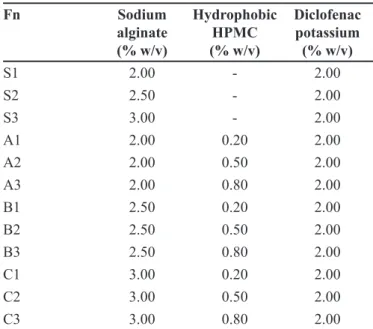
ensure internal geliication. The microspheres were then iltered, washed and dried at room temperature. The whole preparation process was carried out at room temperature. Table I shows bead composition.
Characterization of diclofenac potassium-loaded alginate and modified hydrophobic HPMC alginate-based hydrogel beads
• Particle size determination
After drying at 37 °C for 48 hours, a sieving method
using USP standard sieves (Jain et al. 2007) was used to measure the mean diameter of the dried beads. Shape pa-rameters (such as area, perimeter, shape factor, and
equiva-lent circular diameter) were calculated to characterize DP beads (Gonzalez-Rodrıguez et al., 2002). The equivalent
circular diameter (ECD) was calculated as follows:
ECD=2√A/π
where A is the area of the closed boundary of the particle. Shape factor is used to measure object complex
-ity, namely contour complexity. The greater the variation
of the contour, the higher the shape factor parameter. The
value of shape factor (s) is determined as follows:
s=L2/4 πA
where L is the perimeter and A is the area of the closed
boundary of the particle.
• Entrapment eficiency
of beads by UV-vis spectrophotometry at 275 nm. This is
the actual amount of drug entrapped in the beads.
Entrap-ment eficiency (EE) was calculated using the following
formula:
EE = b X 100/a
b = actual amount of drug present in bead. a = theoretical amount of drug in bead.
• Swelling capacity
Beads were placed in a watch glass, and distilled water was added. Initial bead weight (W0) and bead weight
at different time points (Wt) were measured. The swelling
capacity of the individual beads was estimated as the ratio of weight at different time points to initial bead weight
(Wt/W0). The beads were handled carefully to avoid losses. Diameters were measured by the sieving method using
USP standard sieves(Ebube et al., 1997). Each experiment
was done in triplicate.
• Erosion studies
The dried beads were weighed and placed in a dis -solution basket (Srinatha et al., 2008; Rao et al., 1988; Yotsuyanagi et al., 1991), followed by dissolution in phos
-phate buffer (pH 7.4) at 50 rpm. After a 1-hour interval, the beads were removed from the basket and oven-dried at 50 °C. The water was removed, and the beads were weighed. The beads were then placed back in the basket. This process lasted 10 hours. Erosion study was performed using the following formula:
wo =Initial bead weight, w1 = weight after drying.
•Release tests (Lin, Ayres 1992):
Drug release profiles of DP-containing
formula-tions with an accurately weighed amount of beads were obtained using USP dissolution apparatus II (Shimadzu 1202 UV VIS-spectrophotometer). The study conditions were: a stirring speed of 50 rpm and 900 mL of dissolution
medium at 37±0.2 ºC. The simulation of GI transit
condi-tions was achieved by changing the pH of the dissolution medium at different time intervals. For the irst 2 hours, pH of the dissolution medium was buffered at pH 1.2 (HCl/ NaCl, to mimic the gastric district). The pH was then raised
to 6.4 (phosphate buffer) and maintained at this value for another 2 hours. Finally, a slightly higher pH (7.4) was used up to 6 hours. At predetermined intervals, a 3-mL aliquot was withdrawn and replaced with fresh dissolu
-tion medium. The withdrawn samples were iltered and analyzed spectrophotometrically at 275 nm. All samples were measured in triplicate, and the results were expressed
as the percentage of drug released.
• Release kinetics study
DP release from beads was studied by various math
-ematical models. These models were applied taking into account the amount of drug released from 1 to 10 hours at
different intervals as determined in release studies in vitro.
Zero-order linear equation, Higuchi square root of time equation and Weibull model were used to describe the
kinetics of drug release from different formulations, and
Ritger-Peppas’ power-law equation and Peppas-Sahlin’s weighted sum of non-linear time function (semi-empirical kinetic equations) were used only for the first 60% of
drug released to denote the type of diffusion and fraction of drug release due to Fickian diffusion, respectively.
All model-itting analyses were performed by non-linear direct itting through minimization of the sum of squared residuals (SSR). A general purpose mathematical software (MATLABTM) was used as an analysis tool.
Three equations employed in this study, zero-order model, Higuchi square root equation and Ritger-Peppas model, are widely used due to their simplicity and appli
-cability (Li et al., 2006).
The mathematical expressions for the semi-empiri
-cal models are as follows:
(1)
(2) (3) (4)
where Qt is the cumulative percentage amount of drug released at time t, Q0 is the initial amount of drug in gel,
K0, KH, KRP, K1, K2 are release rate constants, and C0, CH are the respective y-intercepts in the absorbance vs. time
curve. Ritger-Peppas and Peppas-Sahlin models were used speciically to explore release mechanisms and the fraction
of drug release (due to diffusion), respectively. During
the Ritger-Peppas model itting, we obtained the value of the release exponent n, which conveys information on
and n = 1 indicates a purely relaxation-controlled delivery,
which is referred to as case II transport. When the value
of n is intermediate, it indicates an anomalous behavior (non-Fickian kinetics corresponding to coupled diffusion/
polymer relaxation). A value of n > 1 indicates super case II kinetics. Based on the Peppas-Sahlin model, the fraction of drug release
(4)
due to diffusion at a given instant of time t can be calcu-lated from (4) if K1 and K2 values are available.
Regarding statistical models, the underlying idea behind the use of statistical distribution in the modeling of drug release is to match the cumulative distribution
func-tion (CDF) of a particular distribufunc-tion with the cumulative drug release; the underlying random variable (RV) being
time t. CDF expressions in terms of RV are summarized
as follows:
Weibull distribution: (5)
Although linear itting of log-transformed data is widely used, direct itting was used here to avoid trunca
-tion or transforma-tion errors. The goodness of fit was based on value of the regression coeficient (r2) and SSR.
• Stability test
For stability testing, the beads were kept at differ -ent temperature conditions, such as room temperature,
8±1°C (refrigerator temperature), and 30±2°C (condition
for accelerated stability testing). Accelerated stability
testing was performed at 75±5% relative humidity (RH). The samples were withdrawn at different time intervals (0, 1, and 3 months). Physical stability of the samples was determined by visual inspection. Chemical stability studies were carried out by measuring drug content and release proile.
• Data and statistical analysis
The steady-state release rate was calculated from the
slope of the linear plot of the % cumulative drug released as a function of time (t, hours).
Data are presented as mean ± standard deviation
(SD). Statistical comparisons were made using the Student
t test. The level of signiicance was set p < 0.05. Data were
analyzed using MS-excel software.
RESULTS AND DISCUSSION
Particle size
The spherical shape of alginate beads was obtained by using a Na-alginate concentration above 1.5%. Beads
are generally found to remain spherical even after
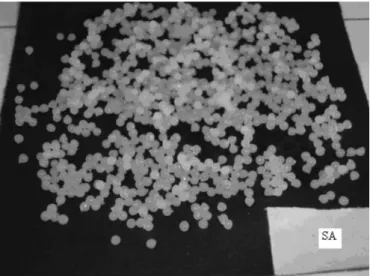
dry-ing. In this study, all beads prepared with Na-alginate alone exhibited a spherical shape, and after addition of hydrophobic HPMC, no change was observed in their macroscopic features (Figures 1 and 2). Figures 1 and 2 clearly show that beads prepared with Na-alginate alone and Na-alginate/hydrophobic HPMC were spherical in
shape.
FIGURE 1 - Spherical shape of beads prepared with sodium
alginate (SA) alone.
As described in Table II, the resulting beads were smaller, with ECD ranging from 3.24 to 4.04 mm. There was no signiicant variation in particle size among the dif
-ferent formulations. The beads shrank upon drying, which
generally occurs due to cross-linking of the polymer, and
the drug entrapped within this cross-link is released in a retarded manner. Shape factors are generally used when studying a multiparticulate system. The beads, which are highly irregular in shape, exhibited large shape factor values, often ranging from 0.708 to 0.853. These shape
factor values show that the beads achieved a spherical shape. Area and perimeter were within 9.07-12.81 mm2 and 9.00-10.90 mm, respectively. An average of six read
-ings was recorded (mean ± SD).
Entrapment efficiency
Entrapment eficiency is an important parameter for
beads and generally depends on curing time in the
coagula-tion luid (calcium chloride solucoagula-tion). The drug can diffuse into the luid, and higher curing time means higher drug
diffusion into the fluid. As a result, the amount of drug entrapped in the beads decreases. In this study, curing time
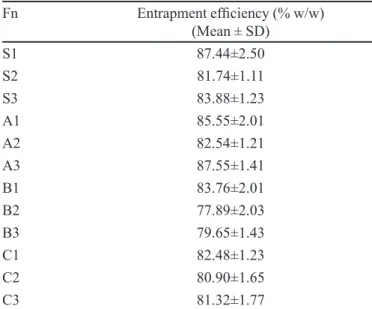
(30 min) was the same for all beads, and the average amount of drug entrapped in the beads was about 78-87% (Table III). An average of six readings was recorded (mean ± SD).
Swelling capacity
The swelling proile of hydrophobic HPMC/Na-al
-ginate beads and beads with Na-al-ginate alone in distilled water is shown in Table IV. When phosphate buffer is used, the swelling rate of beads cannot be estimated because of very quick erosion. When immersed in distilled water, Na-alginate beads immediately begin to swell, recover
-ing their initial spherical shape. On the other hand, cross-linked hydrophobic HPMC/Na-alginate beads initially exhibit a more rapid diameter increase, which slows down after 15 min, while keeping their shape. Water uptake increases with time, leading to an initial loss of spherical shape within 3 hours. The swelling rate of beads tended to decrease as the concentration of hydrophobic HPMC
TABLE I - Composition of different formulations used for preparation of diclofenac potassium microspheres
Fn Sodium
alginate (% w/v)
Hydrophobic HPMC (% w/v)
Diclofenac potassium (% w/v)
S1 2.00 - 2.00
S2 2.50 - 2.00
S3 3.00 - 2.00
A1 2.00 0.20 2.00
A2 2.00 0.50 2.00
A3 2.00 0.80 2.00
B1 2.50 0.20 2.00
B2 2.50 0.50 2.00
B3 2.50 0.80 2.00
C1 3.00 0.20 2.00
C2 3.00 0.50 2.00
C3 3.00 0.80 2.00
Fn = formulation, HPMC = hydroxypropyl methylcellulose.
TABLE II - Shape parameters of the different formulations
Formulation Area (mm2) Perimeter (mm) Shape Shape factor ECD (mm)
S1 9.07 ± 0.01 9.82 ± 0.09 spherical 0.846 ± 0.12 3.40 ± 0.11
S2 9.33 ± 0.02 10.00 ± 0.16 spherical 0.853 ± 0.11 3.45 ± 0.16
S3 8.23 ± 0.03 9.00 ± 0.21 spherical 0.783 ± 0.14 3.24 ± 0.12
A1 12.62 ± 0.01 11.02 ± 0.11 spherical 0.708 ± 0.12 4.01 ± 0.22
A2 10.39 ± 0.02 10.10 ± 0.19 spherical 0.782 ± 0.21 3.64 ± 0.18
A3 12.52 ± 0.01 11.00 ± 0.21 spherical 0.769 ± 0.19 4.00 ± 0.08
B1 9.33 ± 0.02 10.01 ± 0.15 spherical 0.855 ± 0.16 3.45 ± 0.10
B2 12.69 ± 0.11 11.00 ± 0.12 spherical 0.759 ± 0.17 4.02 ± 0.12
B3 12.81 ± 0.09 11.05 ± 0.22 spherical 0.759 ± 0.18 4.04 ± 0.11
C1 12.50 ± 0.10 10.90 ± 0.119 spherical 0.757 ± 0.19 3.99 ± 0.20
C2 9.07 ± 0.07 9.65 ± 0.21 spherical 0.817 ± 0.16 3.40 ± 0.12
C3 9.89 ± 0.03 9.69 ± 0.09 spherical 0.756 ± 0.15 3.55 ± 0.17
TABLE III -Entrapment eficiency of microspheres
Fn Entrapment eficiency (% w/w)
(Mean ± SD)
S1 87.44±2.50
S2 81.74±1.11
S3 83.88±1.23
A1 85.55±2.01
A2 82.54±1.21
A3 87.55±1.41
B1 83.76±2.01
B2 77.89±2.03
B3 79.65±1.43
C1 82.48±1.23
C2 80.90±1.65
C3 81.32±1.77
Fn = formulation; SD = standard deviation.
TABLE IV - Swelling characteristics of sodium alginate (Na-alginate) beads and hydrophobic hydroxypropyl methylcellulose (HPMC)/Na-alginate beads
Fn Swelling rate
(Mean ± SD)
Regression
coeficient (r2)
S1 19.32 ± 0.01 0.9804
A1 18.56 ± 0.01 0.9901
A2 15.01± 0.03 0.9802
A3 10.09 ± 0.02 0.99921
Fn = formulation,SD = standard deviation.
increased due to strong interaction between two oppositely charged polymers. Incorporation of hydrophobic HPMC prolonged the swelling properties of beads, because hy
-drophobic HPMC provided higher viscosity levels than
Na-alginate, thus preventing a quick loss of the initial
spherical shape. The swelling rate of beads was obtained from the slope of the relationship between % swelling
capacity and time. This relationship provided good linear-ity (r2 > 0.98) when assessed by linear regression analysis (Table IV). In this study, we compared swelling capacity between Na-alginate beads (S1) and Na-alginate/hydro
-phobic HPMC beads (from A1 to A3). Average swelling capacity of six beads was shown (mean ± SD). The swell
-ing rate of Na-alginate beads is 19.32, and as the polymer content in formulation increases (S3>S2>S1), the swell
-ing rate decreases (10.09<15.01<18.56). The presence of hydrophobic HPMC in the beads maintained swelling for
a longer time than Na-alginate alone.
Erosion studies
Results are plotted in Figure 3. In erosion tests
run in phosphate buffer (pH 7.4), both types of beads exhibited an initial increase in volume. Na-alginate beads started to erode signiicantly at 30-45 min, losing their spherical shape after 120-180 min, whereas the
cross-linked formulations kept their shape throughout the test
(50% integrity after 4 hours). This feature was also ob -served throughout the drug release tests and is probably the main cause underlying the prolonged release of the drug from the beads.
Release tests
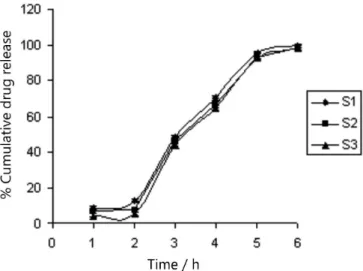
Drug release proiles of beads are shown in Figures 4, 5, 6, and 7. Alginate is insoluble in acidic pH. At low pH, the number of positively charged ions is high, and they reduce the electrical repulsion between the nega
-tively charged alginate molecules (Gonzalez-Rodrıguez
et al., 2002). Alginate is protonated into the insoluble form of alginic acid. Thus, penetration of dissolution
luid through the polymer is hindered, and the percentage
of drug released due to diffusion through the polymer
network was minimal at pH 1.2 for all beads. Initial drug release (up to 12%) may be attributed to the leaching of the drug on the bead outer surface. When pH is increased, drug release increases up to 100%. Deprotonation of al
-ginic acid occurs at higher pH values. It will draw luid into the beads, which swell and burst apart. Thus, drug release rate increases at basic pH. Three types of hydro
-gel beads were formulated using 2.0, 2.5 and 3.0% w/v
concentrations of Na-alginate alone. All beads released
the drug within 6 hours. As the polymer concentration
increased, diffusional resistance to drug release also
in-FIGURE 3 - % weight loss of different hydrogel beads due to
creased, which, in turn, decreased drug release. It is clear
that as the polymer content in the formulation increases
(S3>S2>S1), % cumulative drug release at a 6-hour in
-terval (98.57<98.67<99.69) decreases.
Combination of alginate and hydrophobic HPMC
produced a sustained effect on drug release in the
formu-lations. Conventional HPMC was combined with a small amount of a long-chain alkyl group to obtain HPMC stearoxy ether. This modified hydrophobic HPMC has
a higher positive charge due to the presence of a long-chain alkyl group. Na-alginate is a polyanionic polymer.
Carboxylate groups are present on the Na-alginate chain. Positively charged groups of hydrophobic HPMC strongly interact with alginate and diclofenac ions, thus reducing both swelling and release – probably due to protonation of carboxylated groups from Na-alginate.
In this study, different combinations of alginate and
hydrophobic HPMC beads were prepared. Na-alginate concentration was ixed at 2.0, 2.5 and 3.0% w/v, and 0.2, 0.5 and 0.8% hydrophobic HPMC were added to prepare A1 to C3 formulations (total of 9 formulations). Addition of hydrophobic HPMC was shown to sustain drug release for a longer period of time (for A1, A2 and A3, 7 hours; for B1, B2, B3, 8 hours; and for C1, C2 and C3, 10 hours). The alginate/hydrophobic HPMC combination provided
an alternative system for controlling the release of DP in
bead form. This study also showed, as observed in Figures 5, 6, and 7, that as the polymer content in the combined
formulation increases, % cumulative drug release at a
6-hour interval decreases. Although the amount of hydro
-phobic HPMC used (0.2, 0.5, and 0.8% w/v) is very low, it can retard drug release for a long period of time. High viscosity was obtained due to the hydrophobic interaction of the long-chain alkyl group, and based on Fick’s law of
diffusion, it may be inferred that as the viscosity of the formulation increases, molecular diffusivity (diffusion
coeficient) and % release also decrease.
FIGURE 4 -Comparative results of in vitro release proile of
hydroxypropyl methylcellulose (HPMC) with sodium alginate
(SA)-based diclofenac beads.
FIGURE 5 - Comparative results of in vitro release proile of
hydroxypropyl methylcellulose (HPMC) with sodium alginate
(SA)-based diclofenac beads.
FIGURE 6 - Comparative results of in vitro release proile of
hydroxypropyl methylcellulose (HPMC) with sodium alginate
(SA)-based diclofenac beads.
FIGURE 7 - Plot of % cumulative drug release vs. time (in
Release kinetics study
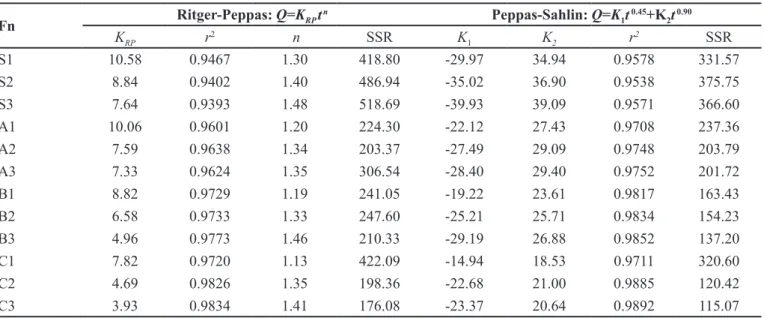
As observed in Table V, the correlation coeficient
(r2) and SSR for zero-order ranged from 0.9527 to 0.9876 and from 141.28 to 384.53, respectively, demonstrating that drug release follows zero-order kinetics. The correla
-tion coeficient and SSR for Higuchi equa-tion ranged from 0.9262 to 0.9671 and from 287.93 to 544.82, respectively; however, it was not possible to conclude that drug release
is totally based on diffusion. In order to obtain a clearer
view of the release process, the Ritger-Peppas model was used. Table VI shows that the highest r2 values (ranging from 0.9393 to 0.9834) and lowest SSR values (ranging from 176.08 to 518.69) were obtained from this model, meaning that the best release pattern can be analyzed by
this model. This model yielded n values that were higher
than 1, which may be regarded as super case II kinetics arising from a reduction in the attractive forces between polymer chains. In this study, drug release was dependent on the relaxation rate of polymer chains. At higher pH, deprotonation of alginic acid weakens the extent of inter
-action, and polymers within the microsphere are found in the relaxed form. Addition of hydrophobic HPMC leads
to a greater retarded release due to increased
concentra-TABLE V - Parameter and correlation coeficients for zero-order equation, Higuchi equation, and Weibull distribution
Fn Zero-order: Q = KO + C Higuchi: Q = KH t
0.5 + C Weibull distribution:
log [ln (1/1-m)] = β log (t) – log(a).
K0 C r
2 SSR K
H C r
2 SSR a β r2 SSR
S1 20.74 -16.83 0.9574 334.94 71.68 -73.63 0.9332 438.62 42.18 2.92 0.9879 0.0096
S2 21.05 -20.46 0.9527 384.53 72.55 -77.76 0.9348 530.40 55.31 3.05 0.9841 0.0129
S3 21.60 -24.05 0.9558 377.98 74.40 -82.76 0.9262 544.82 73.70 3.22 0.9865 0.0115
A1 16.78 -12.67 0.9713 232.77 61.88 -64.67 0.9568 269.52 28.37 2.34 0.9882 0.0096
A2 16.79 -16.54 0.9746 206.12 61.50 -67.78 0.9573 346.07 36.56 2.39 0.9804 0.0158
A3 16.85 -17.41 0.9756 199.23 61.79 -68.98 0.9509 318.94 35.70 2.36 0.9766 0.0191
B1 14.43 -11.18 0.9820 160.77 56.01 -60.39 0.9633 287.93 31.66 2.20 0.9906 0.0084
B2 14.72 -15.70 0.9828 159.74 56.77 -65.16 0.9517 354.92 49.66 2.40 0.9889 0.0103
B3 14.72 -18.64 0.9826 161.35 56.42 -67.40 0.9500 463.11 67.94 2.51 0.9842 0.0147
C1 11.43 -9.11 0.9712 320.29 48.75 -55.77 0.9671 364.83 49.88 2.22 0.9979 0.0024
C2 11.70 -15.02 0.9876 141.49 49.15 -61.13 0.9552 511.82 94.26 2.45 0.9940 0.0069
C3 11.27 -15.74 0.9867 141.28 47.27 -59.96 0.9505 526.01 94.25 2.38 0.9895 0.0111
Fn = formulation, Q = % cumulative amount of release, t = time in hours, K0 = zero-order constant, C = intercept, KH = Higuchi constant, m = accumulated fraction of the drug; β = shape parameter; a = scale parameter, r2 = regression coeficient, SSR = sum
of squared residuals.
tion and viscosity. According to the Peppas-Sahlin model, a negative value of K1 was obtained (Table V), which can
be reported as an insigniicant effect of Fickian diffusion on drug release compared to the relaxation process.
The Weibull distribution cannot describe drug re-lease kinetics, but it can describe the curve in terms of applicable parameters. As the value for shape parameter
(β) was higher than 1, plots should be “S” shaped with an upward curvature. The values for β, r2, SSR and a are
described in Table V. The Weibull distribution gave a good
it for the data when explaining in vitro release proile, as r2 (0.9766- 0.9906) had the highest and SSR (0.0024-0.0191) the lowest values.
STABILITY STUDY
Stability testing was performed at different tempera
-tures and conditions. However, no signiicant reduction was observed in the percentage of drug retained in the formulations. Likewise, there was no signiicant difference in drug release proile between samples stored at 2-8°C
and at room temperature. Because DP is a light-sensitive
CONCLUSION
A new matrix using Na-alginate and hydrophobic HPMC was prepared and used in the controlled release of
diclofenac. We demonstrated that it is possible to prepare
diclofenac-loaded beads with high encapsulation effi
-ciency and high swelling capacity. The method developed
is simple, fast and reproducible. A remarkable delay in
the release of diclofenac was observed for Na-alginate HPMC beads. This matrix also offered a degree of protec -tion against premature drug release in simulated upper GI
transit conditions. Matrix swelling induced by phosphate
buffer did not lead to complete destruction of Na-alginate
HPMC beads, which results in prolonged retention of the drug within the polymer matrix.
ACKNOWLEDGEMENTS
The authors wish to thank Daido Chemical Corpora -tion and Kontest Chemicals, Kolkata, India, for providing
hydrophobic HPMC and DP, respectively, as gift samples.
We also offer sincere thanks to Mr. Aniruddha Chandra, Mrs. Nita Mondal and other colleagues for their different kinds of help during research studies.
REFERENCES
ACIKGOZ, M.; KAS, H.S.; HASCELIK, Z.; MILLI, U.; HINCAL, A.A. Chitosan microspheres of diclofenac sodium, II: in vitro and in vivo evaluation. Pharmazie, v.50,
p.275-277, 1995.
BELYAEVA, E.; VALLE, D.D.; NEUFELD, R.J.; PONCELET,
D. New approach to the formulation of hydrogel beads by
emulsiication/ thermal gelation using a static mixer. Chem Eng. Sci., v.59, p.2913-2920, 2004.
BENNETT, N.; PAPICH, M.G.; HOENIG, M.; FETTMAN, M.J.; LAPPIN, M.R. Evaluation of transdermal application of glipizide in a pluronic lecithin gel to healthy cats. Am. J. Vet. Sci., v.66, p.581-588, 2005.
DAS, M.K.; AHMED, A.B. Formulation and ex vivo evaluation of rofecoxib gel for topical application. Acta Pol. Pharm.,
v.64, p.461-467, 2007.
EBUBE, N.K., HIKAL, A.H.; WYANDT, C.M.; BEER, D.C; MILLER, L.G.; JONES, A.B. Sustained release of acetaminophen from heterogeneous matrix tablets: inluence of polymer ratio, polymer loading, and co- active
on drug release. Pharm. Dev. Technol., v.2, p.161-170, 1997.
ESCRIBANOA, E.; CALPENA, A.C.; QUERALT, J.; OBACHA, R.; DOMENECHA, J. Assessment of diclofenac
permeation with different formulations: anti-inlammatory
study of a selected formula. Eur. J. Pharm. Sci., v.9,
p.203-210, 2003.
FERNANDEZ-HERVAS, M.J.; HOLGADO, M.A.; FINI, A.; FELL, J.T. In vitro evaluation of alginate beads of a diclofenac salt. Int. J. Pharm., v.163, p.23-34, 1998.
TABLE VI - Parameter and correlation coeficients for Ritger-Peppas and Peppas-Sahlin models
Fn Ritger-Peppas: Q=KRPt
n Peppas-Sahlin: Q=K
1t 0.45+K
2t 0.90
KRP r
2 n SSR K
1 K2 r
2 SSR
S1 10.58 0.9467 1.30 418.80 -29.97 34.94 0.9578 331.57
S2 8.84 0.9402 1.40 486.94 -35.02 36.90 0.9538 375.75
S3 7.64 0.9393 1.48 518.69 -39.93 39.09 0.9571 366.60
A1 10.06 0.9601 1.20 224.30 -22.12 27.43 0.9708 237.36
A2 7.59 0.9638 1.34 203.37 -27.49 29.09 0.9748 203.79
A3 7.33 0.9624 1.35 306.54 -28.40 29.40 0.9752 201.72
B1 8.82 0.9729 1.19 241.05 -19.22 23.61 0.9817 163.43
B2 6.58 0.9733 1.33 247.60 -25.21 25.71 0.9834 154.23
B3 4.96 0.9773 1.46 210.33 -29.19 26.88 0.9852 137.20
C1 7.82 0.9720 1.13 422.09 -14.94 18.53 0.9711 320.60
C2 4.69 0.9826 1.35 198.36 -22.68 21.00 0.9885 120.42
C3 3.93 0.9834 1.41 176.08 -23.37 20.64 0.9892 115.07
Fn = formulation, KRP= Ritger-Peppas constant, K1, K2 = Peppas-Sahlin constant, r2 = regression coeficient, SSR = sum of squared
FERREIRA-ALMEIDA, P.; ALMEIDA, A.J.; Cross-linked alginate-gelatine beads: a new matrix for controlled release
of pindolol. J. Control. Release, v.97, p.431-439, 2004.
GACESA, P. Alginate. Carbohydr. Polym., v.8, p.161-182, 1988.
GANESH, S.; RADHAKRISHNAN, M.; RAVI, M.;
PRASANNAKUMAR, B.; KALYANI, J. In vitro
Evaluation of the Effect of Combination of Hydrophilic and Hydrophobic Polymers on Controlled Release from Zidovudine Matrix Tablets. Indian J. Pharm. Sci., v.70,
p.461-465, 2008.
GHOSAL, K.; RAJABALAYA, R.; CHAKRABORTY, S.;
NANDA, A. Formulation and Characterization of both
Hydrophilic and Hydrophobic HPMC based Hydrogels
containing Diclofenac Potassium. Latin Am. J. Pharm.,
v.29, p.1137-1143, 2010.
GONZALEZ-RODRIGUEZ, M.L.; HOLGADO, M.A.; SANCHEZ-LAFUENTE, C.; RABASCO, A.M.; FINI, A.
Alginate/chitosan particulate systems for sodium diclofenac release. Int. J. Pharm., v.232, p.225-234, 2002.
GURSOY, A.; CEVIK, S. Sustained release properties of alginate microspheres and tabletted microspheres of Diclofenac sodium. J. Microencapsul., v.17, p.565-575, 2000.
JAIN, S.K.; JAIN, A.; GUPTA, Y.; AHIRWAR, M. Design and development of hydrogel beads for targeted drug delivery to the colon. AAPS PharmSciTech., v.8, p.E1-E8, 2007.
KULKARNI, A.R.; SOPPIMATH, K.S.; AMINABHAVI, T.M.;
RUDZINSKI, W.E. In vitro release kinetics of cefadroxil,
loaded sodium alginate interpenetrating network beads. Eur. J. Pharm. Biopharm., v.51, p.127-133, 2001.
LETICIA, S.K., ORTEGA, G.G.; MAYORGA, P.; BASSANI, V.L. Mathematical evaluation of in vitro release proiles of hydroxypropylmethylcellulose matrix tablets containing carbamazepine associated to b-cyclodextrin. Eur. J. Pharm. Biopharm., v.58, p.177-179, 2004.
LI, S.; SHEN, Y.; LI, W.; HAO, X.A. common profile for polymer-based controlled release and its logical interpretation to general release process. J. Pharm. Pharm. Sci., v.9, p.238-244, 2006.
LIN, S.Y.; KAO, Y.H. Tablet formulation study of spray-dried
sodium diclofenac enteric-coated microcapsules. Pharm. Res., v.8, p.919-924, 1991.
LIN, S.Y.; AYRES, J.W. Calcium alginate beads as core
carriers of 5-aminosalcylic acid. Pharm. Res., v.9,
p.1128-1131,1992.
ØSTBERG, T.; LUND, E.M.; GRAFFNER, C. Calcium alginate matrices for oral multiple unit administration: IV. Release charateristics in different media. Int. J. Pharm., v.112,
p.241-248, 1994.
PEPPAS, N.A.; SAHLIN, J.A. A simple equation for the description of solute release III. Coupling of diffusion and
relaxation. Int. J. Pharm., v.57, p.169-172, 1989.
RAO, R.K.V.; PADMALATHA DEVI, K.; BURI, P. Cellulose
matrices for zero-order release of soluble drugs. Drug Dev. Ind. Pharm., v.14, p.2299-2320, 1988.
SABNIS, S.; REGE, P.; BLOCK, L.H. Use of chitosan in compressed tablets of diclofenac sodium: inhibition of drug release in an acidic environment. Pharm. Dev. Technol., v.2,
p.243-255, 1997.
SANNA, V.; PEANA, A.T.; MORETTI, M.D.L. Effect of
vehicle on diclofenac sodium permeation from new topical
formulations: in vitro and in vivo studies. Curr. Drug Dev.,
v.6, p.93-100, 2009.
SHU, X.J.; ZHU, K.J. The release behavior of brilliant blue from calcium–alginate gel beads coated by chitosan: the preparation method effect. Eur. J. Pharm. Sci., v.53,
p.193-201, 2002.
SINHA, D.R.; ROHERA, B.D. Comparative evaluation of rate
of hydration and matrix erosion of HEC and HPC and study
of drug release from their matrices. Eur. J. Pharm. Sci., v.16,
p.193-199, 2002.
SINTOV, A.C.; BOTNER, S. Transdermal drug delivery using microemulsion and aqueous systems: Influence of skin storage conditions on the in vitro permeability of diclofenac from aqueous vehicle systems. Int. J. Pharm., v.311,
p.55-62, 2006.
SRIAMORNSAK, P.; THIRAWONG, N.; PUTKHACHORN,
S. Morphology and buoyancy of entrapped calcium pectinate gel beads. AAPS J., v.6, p.1-7, 2004.
SRINATHA, A.; PANDIT, J.K.; SINGHA, S. Ionic cross-linked
chitosan beads for extended release of ciproloxacin: in vitro characterization. Indian J. Pharm. Sci., v.70, p.16-21, 2008.
YOTSUYANAGI, T.; YOSHIOKA, I.; SEGI, N.; IKEDA, K.
Acid-induced and calcium-induced gelation of alginic acid:
Bead formation and pH dependent swelling. Chem. Pharm. Bull., v.39, p.1072-1074, 1991.
Received for publication on 07th September 2010