www.bjorl.org
Brazilian
Journal
of
OTORHINOLARYNGOLOGY
ORIGINAL
ARTICLE
Efferent
inhibition
of
otoacoustic
emissions
in
preterm
neonates
夽
Renata
Mota
Mamede
Carvallo
a,∗,
Seisse
Gabriela
Gandolfi
Sanches
b,c,
Silvia
Maria
Ibidi
d,e,
Jordana
Costa
Soares
c,
Alessandra
Spada
Durante
f,gaSpeechTherapyCourse,FaculdadedeMedicina,UniversidadedeSãoPaulo(FM-USP),SãoPaulo,SP,Brazil
bDepartmentofPhysicalTherapy,SpeechTherapyandOccupationalTherapy,FaculdadedeMedicina,UniversidadedeSãoPaulo
(FM-USP),SãoPaulo,SP,Brazil
cRehabilitationSciences,FaculdadedeMedicina,UniversidadedeSãoPaulo(FM-USP),SãoPaulo,SP,Brazil dFaculdadedeMedicina,UniversidadedeSãoPaulo(FM-USP),SãoPaulo,SP,Brazil
eUnitofNeonatology,UniversityHospital,FaculdadedeMedicina,UniversidadedeSãoPaulo(FM-USP),SãoPaulo,SP,Brazil fSpeechTherapyCourse,MedicalSciencesSchool,SantaCasadeMisericórdiadeSãoPaulo,SãoPaulo,SP,Brazil
gExperimentalPathophysiology,FaculdadedeMedicina,UniversidadedeSãoPaulo(FM-USP),SãoPaulo,SP,Brazil
Received10March2014;accepted23October2014 Availableonline22July2015
KEYWORDS
Prematureinfant; Hearing;
Newborninfant; Spontaneous otoacoustic emissions; Auditorypathways
Abstract
Introduction:Abnormalitiesinauditoryfunctionofnewbornsmayoccurnotonlybecauseof pretermbirth,butalsofromtheuseofmedicationsandfromdiseasesrelatedtoprematurity.
Objective: Toanalyzetheinhibitoryeffectfromstimulationoftheolivocochlearefferent sys-temontransientevokedotoacousticemissionsinpretermneonates,comparingthesedatawith thosefromfull-termneonates.
Methods:This was a prospective, cross-sectional, contemporary cohort study with 125 neonates,pooledintotwogroups:full-term(72full-termneonates,36femalesand36males, bornat37---41weeksofgestationalage);andpreterm(53neonates,28malesand25females, bornat≤36weeksofgestationalage,evaluated atthe correctedgestationalageof37---41 weeks).Otoacousticemissionswererecordedusinglinearandnonlinearclick-evokedstimuli, withandwithoutcontralateralstimulation.
Results:Theinhibitoryeffectoftheefferentpathwayinotoacousticemissionswasdifferent (p=0.012)between groups, andameanreductionof1.48dB SPLinfull-term birthsandof 1.02dBSPLinpretermbirthswasobservedforthenon-linearclick-evokedstimulus.
夽 Pleasecitethisarticleas:CarvalloRMM,SanchesSGG,IbidiSM,SoaresJC,DuranteAS.Efferentinhibitionofotoacousticemissionsin pretermneonates.BrazJOtorhinolaryngol.2015;81:491---497.
∗Correspondingauthor.
E-mail:[email protected](R.M.M.Carvallo).
http://dx.doi.org/10.1016/j.bjorl.2015.07.008
Conclusion:Theresultssuggestareducedinhibitoryeffectoftheolivocochlearefferentsystem onotoacousticemissionsinpretermneonates.
© 2015Associac¸ãoBrasileira de Otorrinolaringologiae CirurgiaCérvico-Facial. Publishedby ElsevierEditoraLtda.Allrightsreserved.
PALAVRAS-CHAVE
Prematuro; Audic¸ão; Recém-nascido; Emissõesotoacústicas espontâneas;
Viasauditivas
Inibic¸ãoeferentedasemissõesotoacústicasemneonatosprematuros
Resumo
Introduc¸ão:Alterac¸õesnafunc¸ãoauditivaderecém-nascidosprematurospodemocorrernão sódevidoaonascimentoantecipado,mas tambémpelousodemedicamentosepordoenc¸as relacionadasàprematuridade.
Objetivo:Analisaroefeitoinibitóriodaestimulac¸ãodosistemaeferenteolivococlearsobre aamplitudedasemissõesotoacústicasevocadastransientesemrecém-nascidosprematuros, comparandoessesdadosaosderecém-nascidosatermo.
Método: Estudoprospectivo,decoortecontemporâneacomcortetransversal,com125 recém-nascidos,distribuídosemdoisgrupos:atermo(72recém-nascidosatermo,36femininoe36 masculino,nascidosentre37-41semanasdeidadegestacional),epretermo(53recém-nascidos, 28masculinoe25feminino,nascidoscomidadegestacional≤36semanasavaliadosentre37-41 semanasdeidadegestacionalcorrigida).Asemissõesotoacústicas foramregistradasapartir deestímuloscliquelinearesenãolineares,comesemestimulac¸ãocontralateral.
Resultados: Oefeitoinibitóriodaviaeferentenasotoemissõesfoidiferente(p=0,012)entreos grupos,sendoobservadaumareduc¸ãomédiade1,48dBSPLnosnascimentosatermoe1,02dB SPLnogrupopretermoparaoestímulocliquenão-linear.
Conclusão:Osresultadossugeremefeitoinibitóriodosistemaeferenteolivococlearreduzido sobreasemissõesotoacústicasemrecém-nascidosprematuros.
©2015Associac¸ãoBrasileira deOtorrinolaringologiaeCirurgiaCérvico-Facial.Publicadopor ElsevierEditoraLtda.Todososdireitosreservados.
Introduction
Preterm newborns are at risk of changes in auditory function1thatoccurin amannerinverselyproportionalto
gestationalage;hearingloss is observedin approximately 7%ofinfantswithgestationalage<33weeks.2
Theimpairedauditoryfunctionmayresultnotonlyfrom pretermbirth,whicharrests theprocessofnatural devel-opment,but alsofromtheuseof certainmedicationsand diseases related to prematurity. Therefore, studies seek-ingtofindincreasinglyfar-reachingprocessestominimize hearingcomplicationsarisingfromprematurityandaiminga betterqualityoflifethroughappropriateinterventionsare needed.
Hearing screening of newborns has been carried out throughtheanalysisofotoacousticemissions(OAE),a non-invasive, quick procedure that evaluates the function of outer hair cells of the cochlea. The presence of normal responses in an OAE test is a strong predictor of a full hearingfunction.TheprocedureofOAEsuppressionallows forafunctionalinvestigationoftheefferentolivocochlear system,whichplaysanimportantroleinauditory informa-tion processing. The function of the efferent system can beassessedby analyzing OAEwhen theseareanalyzed in the presence of a simultaneous ipsilateral, contralateral, orbilateralnoise.3,4Thedeterminationofthecontralateral
inhibition ofOAE,alsoknownastheOAEsuppression,is a non-invasiveandobjectivemethodtoevaluatetheefferent olivocochlearsystem; theactive,nonlinear, micromechan-ical properties of outer hair cells of the cochlea; and moregenerally,theintegrityofthebrainstem.4,5Thereare
few studies evaluating the inhibitory effectof the effer-ent pathway on OAE in newborns.6---13 In a recent study
involving school-aged children (8---10 yearsold), OAE sup-pression was found less robustly in preterm vs. full-term children.14Therefore,theaimofthisstudywastoevaluate
theinhibitoryeffectofnoiseontransientevoked otoacous-tic emissions (TEOAE) by linear or nonlinear click-evoked stimulationinpretermnewborns.
Methods
Subjects
Studyparticipantscompliedwiththefollowinginclusion criteria: presence of TEOAE in both ears, in a noise-free condition and in the ‘‘QuickScreen’’ mode with general reproducibilityabove50%and,fromnecessity,withspecific reproducibilityinfrequencybands≥70%for2,3,and4kHz. Forinclusioninthisstudy,inadditiontothereproducibility criterion,duringtheTEOAEevaluationthenewbornneeded topresent a signal to noise ratio ≥6dB at the frequency bandsof1.5,2,3,and4kHz,andasignaltonoiseratio≥3dB at1kHz.OnlyTEOAEtestswithprobestability≥70%were considered.Thenoiseadjustmentcontrolwaspositionedat itsminimumvalue.Therejectionlevelwasadjustedupto 6MPaor49.5dBSPL.
In ordertomaintainsample homogeneity,abalancein the proportion of female and maleinfants was provided. A total of 125 infants, all born in the maternity ward of the Teaching Hospital of USP were evaluated, after their allocationintotwogroups:
1. Full-term group: Comprised 72 full-term newborns (36 boysand 36 girls) without hearing risk indicators. The meanweightatbirthwas3240±320g,themeanApgar score was 9±1, and the mean gestational age was 38.6±1 weeks. For participants of this group, TEOAE collectionoccurredbetween48and72hoflife. 2. Pretermgroup:Comprised53preterminfants(28males
and 25 females). The average weight at birth was 1491±471g,the meanApgar scorewas6±2,and the meangestationalagewas32.6±2.6weeks.For partici-pantsofthisgroup,theevaluationwasperformedwith thecorrectedgestationalagebetween37and41weeks oflife,topreventthecombinedeffectofmaturation.
Procedure
Allnewbornswereevaluatedintheirnaturalsleep,during the postpartum hospital stay, in a quiet but acoustically-untreatedenvironment.
Otoacousticemissioncapture
Thisstudy usedtheILO292/ECHOPORTPLUSOtodynamics Analyser linked toa notebook, allowing OAE capture and FastFourierTransform(FFT)analysis.Boththestimulation toevokeotoacousticemissionsandthecontralateral acous-ticstimulationwereelicitedbythedevice,throughTESNS-8 insertionprobes.
Otoacousticemissionswerecollectedin‘‘Quickscreen’’ modeandtheresultsofthesewereusedwiththesoleaim toascertaintheinclusioncriteria.Astotheinhibitoryeffect research,ananalysiswindowcollectionof4---20ms(i.e.,the standardanalysisprotocol)wasused.
Thus,thefollowingorder/formresponseswereobtained: nonlinearclick-evokedTEOAEwithout contralateralnoise, 100stimulus/responsescans;nonlinearclick-evokedTEOAE with contralateral noise, another 100 stimulus/response scans.Toobtaintheinhibitoryeffectoflinearclick-evoked TEOAE, a different protocol was used. Captures with and without contralateral noise were alternately and automaticallyobtained:each setof tenstimulus-response scanningcaptureswithoutcontralateralnoisewascollected
inalternation withten scanningcaptures inthe presence of contralateral noise in an automated procedure, until reaching 200 scans (100 in each mode, with or without the presence of contralateral stimulation).At the end of this automatic collection, the equipment displayed the totalresponseof100scansobtainedwithoutcontralateral noise in a separate screen from those scans collected in the presence of contralateral noise. The procedure was repeatedinthesameorderforthesecondeartobetested. In all collections, an analysis window of 4---20ms was used.The level of intensity ofbroadband clickwas main-tained between 60---65dB SPL peq with 100 recordings collected,bothforlinearandnon-linearclick-evoked stim-ulation under conditions with and without contralateral noise.The contralateralsuppressorstimulusappliedwasa whitenoise,presentedat60---65dBSPL.
For each stimulation mode (linearand nonlinear), the inhibitoryeffectwascalculatedbysubtractingtheresponse obtainedinthe‘‘with noise’’conditionfromtheresponse obtainedinthe‘‘withoutnoise’’condition.
Asforthestatisticalanalysisofourdata,exploratory sta-tisticaltechniques wereusedthroughmeasures ofcentral tendencyandananalysisofvariancewithrepeated meas-ures(ANOVA).
The0.05significancelevel(5%)wasadopted.
Results
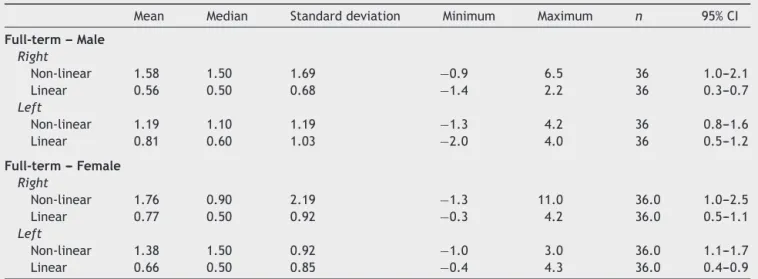
The test resultsof TEOAE areshown inFig. 1.There was nostatistical difference between the following variables: rightandleftears(p>0.05)regardlessofthestimulusused (linearornonlinearclick-evokedstimulus),gender,presence orabsenceofcontralateralstimulation,orgroup(full-term orpretermneonates).
Inthepretermgroup,theresponsesobtainedwith non-linearclick-evokedstimuliinfemaleinfantswerestronger, although without statistical difference(Fig. 1). However, there was a significant difference between genders for responses obtained with linear click-evoked stimuli, and femalesagainshowedstrongerresponses(p<0.05).
As fortheinhibitory effectoftheefferentpathway on otoacousticemissions(Tables1and2),therewasno signif-icantdifferencebetweengendersandears,bothforlinear asfornonlinearstimuli.
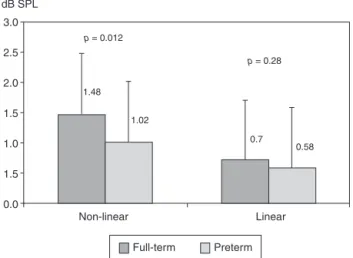
AsshowninFig.2,asignificantdifferencebetween full-termandpretermgroupswasnotedonlyfornonlinear click-evokedstimulation(p=0.012).
Discussion
TheinhibitoryeffectoftheefferentpathwayinTEOAEwas lowerinthepretermgroupcomparedtothefull-termgroup, whennonlinearclick-evokedstimuliwereused(p=0.012); nosignificantdifferencewasobservedbetweenfull-termvs. pretermgroupsforlinearclick-evokedstimuli(p=0.28).
A
30
20
10
0
–10
B C D
Full-term male Preterm male
Preterm female Full-term female
E F G H A
30
20
10
0
B C D E F G H
A
40
30
20
10
0
B C D E F G H A
40
30
20
0
B C D E F G H
10
Figure1 Responselevelsoftransientevokedotoacousticemissions(TEOAE;dBSPL)forlinearandnon-linearclick-evokedstimulus presentedat60dBSPL,bygender,ear,andpresenceofcontralateralnoise,forfull-termandpretermgroups.(A)Rightearnonlinear click-evokedstimuluswithcontralateralnoise;(B)rightearnonlinearclick-evokedstimuluswithoutcontralateralnoise;(C)rightear linearclick-evokedstimuluswithcontralateralnoise;(D)rightearlinearclick-evokedstimuluswithoutcontralateralnoise;(E)left earnonlinearclick-evokedstimuluswithcontralateralnoise;(F)leftearnonlinearclick-evokedstimuluswithoutcontralateralnoise; (G)leftearlinearclick-evoked stimuluswithcontralateralnoise;(H)leftearlinearclick-evokedstimuluswithoutcontralateral noise.Comparison between rightand left earwithno difference(p>0.05); Comparisonbetween genres: amplitudefor linear click-evokedstimulusstrongerforfemalegender(p<0.05).
Thus,itissuggestedthat,overtime,theweakest suppres-sioneffectobservedinpreterm-bornchildren’sgroupcould beassociatedwithadifficultyinthehearingabilityforsound sourcelocalizationandperformanceinauditory discrimina-tiontasks,aswellaswithauditoryprocessingdisorders,16---18
learningproblems,19,20andspeech.21Therefore,the
identi-ficationofaminimalor non-inhibitoryeffectonnewborns wouldact asa markerfor risk ofhearing disorderand its consequences,suggestingaclosermonitoringofthis popu-lation.
Consideringprematurityasariskfactorforauditory neu-ropathy,apost-mortemhistologicalstudyonpreterminfants (26---36weeks)revealedahigheroccurrenceofchangesin histopathologicalpattern of innerhair cells,compared to acontrolgroup.22 Theoretically,theauthorsattributedthe
probablecauseofneuropathyinpreterminfantstoa selec-tiveloss ofinnerhair cells. Theauthors alsoarguethat a probableoccurrenceofotoacousticemissionsinthesecases mayberelatedtothepreservationofthecochlearamplifier system,includingthevascularstria,thusallowingthe func-tioningoftheouterhaircellmechanism.22Theexistenceof
thisconditionisjustonemorefactorinfavorofevaluation oftheefferentsysteminpreterminfants.
Table1 InhibitoryeffectofefferentTEOAEwithlinearandnonlinearclicks(dBSPL)forfull-termneonates.
Mean Median Standarddeviation Minimum Maximum n 95%CI
Full-term---Male
Right
Non-linear 1.58 1.50 1.69 −0.9 6.5 36 1.0---2.1
Linear 0.56 0.50 0.68 −1.4 2.2 36 0.3---0.7
Left
Non-linear 1.19 1.10 1.19 −1.3 4.2 36 0.8---1.6
Linear 0.81 0.60 1.03 −2.0 4.0 36 0.5---1.2
Full-term--- Female
Right
Non-linear 1.76 0.90 2.19 −1.3 11.0 36.0 1.0---2.5
Linear 0.77 0.50 0.92 −0.3 4.2 36.0 0.5---1.1
Left
Non-linear 1.38 1.50 0.92 −1.0 3.0 36.0 1.1---1.7
Linear 0.66 0.50 0.85 −0.4 4.3 36.0 0.4---0.9
TEOAE,transientevokedotoacousticemissions.
Inhibitoryeffectwithnostatisticaldifferencebetweengendersforlinear(p=0.85)and non-linear(p=0.48)click-evokedstimulus. Inhibitoryeffectwithnostatisticaldifferencebetweenearsforlinear(p=0.64)andnonlinear(p=0.15)click-evokedstimulus.
Table2 EfferentinhibitoryeffectofTEOAEwithlinearandnonlinearclicks(dBSPL)forpretermneonates.
Mean Median Standarddeviation Minimum Maximum n 95%CI
Full-term---Male
Right
Non-linear 1.02 0.75 1.15 −1.4 3.7 24.0 0.6---1.5
Linear 0.51 0.40 0.49 −0.2 1.9 24.0 0.3---0.7
Left
Non-linear 0.96 0.90 1.29 −2.2 4.3 24.0 0.4---1.5
Linear 0.81 0.60 0.70 0.0 2.5 22.0 0.5---1.1
Full-term---Female
Right
Non-linear 1.34 0.90 1.30 −0.4 4.0 28.0 0.9---1.8
Linear 0.53 0.30 0.68 −0.3 2.8 27.0 0.3---0.8
Left
Non-linear 0.75 0.80 0.93 −1.2 3.9 28.0 0.4---1.1
Linear 0.51 0.30 1.06 −0.4 5.1 27.0 0.1---0.9
TEOAE,transientevokedotoacousticemissions.
Inhibitoryeffectwithnostatisticaldifferencebetweengendersforlinear(p=0.81)and non-linear(p=0.39)click-evokedstimulus. Inhibitoryeffectwithnostatisticaldifferencebetweenearsforlinear(p=0.44)andnonlinear(p=0.13)click-evokedstimulus.
in full-term and preterm infants attest to the occur-rence of this effect,11,12 observed in preterm infants
from 32 weeks of gestational age on, reaching inhibitory effect values similar to those of adults from 37 weeks of gestational age.12 However, in this study the
differ-encebetween preterm vs. control groups persisted, even after the precautionary measure of performing the eval-uation of preterm infants at their corrected gestational age.
Other studies7,9,23,24 described the presence of an
inhibitory effect with 1---2dB SPL of mean suppression, whichagrees withthefindings ofthisstudyfor non-linear stimuli.Thebalanceinabsenceofinhibitoryeffect propor-tionbetween full-term vs.preterm groups (Fig.1)agrees withthefindingof anotherstudy,10 inwhich an inhibitory
effectwasnotpresentinallindividualsstudied.Inneonates,
itismorelikelythattheabsencesofaninhibitoryeffectare relatedtomaturationalprocesses.6,8,9,11,12
The comparison between linear and non-linear stimuli was adopted in order to get a functional profile of the efferenthearingpathwayoffull-termandpreterminfants, when these neonates were submitted to linear and non-linear click-evoked stimuli. Many studies have adopted linear click-evoked stimuli to verify the inhibitory effect of theefferent pathway in otoacoustic emissions.16,17,19,24
Thejustificationforthischoiceisexplainedbythefactthat thenonlinearclick,by itspresentation form,reducesthe interferenceof thestimulus,alsoeliminatingpartsofthe response.Conversely,thelinearclickfavorstheverification oftheinhibitoryeffectinTEOAE,enablinganevaluationof theresponse asa whole.4 This study observed a stronger
Full-term dB SPL
Preterm Linear Non-linear
3.0
p = 0.012
p = 0.28
1.48
0.7 0.58 1.02
2.5
2.0
1.5
1.0
1.5
0.0
Figure 2 Efferent inhibitory effect: comparison between full-termvs.pretermnewbornsforlinearandnon-linear click-evokedstimuli(mean±SD).
stimulation;these data differ fromthose found in litera-ture.Thedifferenceinmodeofcollection,oreveninterms ofanalysis,mayjustifythisoccurrence.
Thepresent studyhascertainlimitations,includingthe fact that the results with linear click-evoked stimulation werenotanalyzedinthe8---18mswindow,which,according to the literature, could also show an increased suppres-sion effect. However, in both types of stimulation used (linear and nonlinear clicks) the analysis was carried out inthesameresponsewindow(4---20ms). Furthermore,the measurefor suppressionofthelinearclickwasperformed with an alternating presentation of white noise at every setof tenstimulus-response scans.Inhibitory effect mea-surementsobtainedthroughalternatecollectionsgenerally tendtopresentloweramplitudeoftheinhibitoryeffect.25
However, with respect to the non-linear click, a collec-tionwithout the contralateralnoise in 100 full scans was performed,followedbya collectionof100 scanswiththe contralateralnoise. Thisformofresponseacquisitionmay have influenced the final result, suggesting that perhaps evenalternate collection(with and without noise) at 10-scanintervalsisnotactuallysuitableforthisinvestigation. Studiesemployingthesamestimulusin differentformsof presentationcouldbetteraddressthisquestion.
ResponseamplitudeofTEOAEwithout contralateralstimulation
The factthat pretermneonates hadrisk factorsfor hear-ing impairment did not affect the integrity of cochlear responses, since all infants showed OAE at appropriate levelsfortheirage.Thedistributionoftheresultsof otoa-coustic emission response levels analyzed in the overall responserevealed,inthestudysample,certain homogene-ityinresponseforbothgroups,withastandarddeviationof thesamemagnitudeinthedifferentmeasures.Onaverage, responselevelswereevaluatedbetween15.09and17.21dB SPLformaleneonatesandbetween16.25and19.24dBSPL forfemaleneonates,eventhoughthesevariableswere mea-suredwithastimulusatalowerintensitylevelthanusually
utilized, indicating anormal cochlear functionin preterm infants. The click intensity at 60dB peak-equivalent was chosenbasedonprevious studiesinhumans,3,10,26inorder
to eliminate the possibility of involvement of middle ear mechanismswhendeterminingtheinhibitoryeffect.
Thefactthattherewasnostatisticaldifferencebetween full-termvs.pretermgroups,withrespecttotheresponse level of TEOAE, agrees with the literature.13 A gender
difference in the responses of TEOAE was observed; this differencewashigher in full-termfemale neonates, com-paredtomale neonatesof the samegroup, whenusing a nonlinearstimulation.Forthepretermgroup,morerobust responses for female neonates were noted, compared to maleresponses,thoughthislatterdifferencewasnot signif-icant.Mostoftheliteraturealsoshowsatendencytohigher amplitudesofOAEinfemaleneonatepopulations.6---8,10
How-ever, somestudies withdifferentsamplingproceduresdid notshowthistendency.13,27,28
Conclusion
Theresultsofthisstudyrevealareducedinhibitoryeffect ofolivocochlear systeminpreterminfants, whenassessed byTEOAEwithnonlinearclick-evokedstimulation.Thus,in viewoftheinvolvementofefferentpathwaysintheauditory stimulusprocessingtasks,theauthorsemphasize theneed formonitoringtheauditoryskillsofpreterminfantsearlyin theirlife.Futurelongitudinalstudieswouldallowabetter analysisoftheimpactofthisreducedinhibitory effecton communicationdevelopment.
Funding
ThisstudywasfundedbytheFundac¸ãodeAmparoàPesquisa doEstadodeSãoPaulo(FAPESP;GrantNo.01/09605-5).
Conflicts
of
interest
Theauthorsdeclarenoconflictsofinterest.
References
1.SoleimaniF,Zaheri F,AbdiF.Long-termneurodevelopmental outcomes after preterm birth. Iran Red Crescent Med J. 2014;16:e17965,http://dx.doi.org/10.5812/ircmj.17965. 2.BradfordBC, Baudin J, Conway MJ, Hazell JW, StewartAL,
ReynoldsEO1.Identificationofsensoryneuralhearinglossin verypreterminfantsbybrainstemauditoryevokedpotentials. ArchDisChild.1985;60:105---9.
3.Hood LJ, Berlin CI, Hurley A, Cecola RP, Bell B. Contralat-eralsuppressionoftransient-evokedotoacousticemissionsin humans:intensityeffects.HearRes.1996;101:113---8.
4.GuinanJJ.Olivocochlearefferents:anatomy,physiology, func-tion,andthemeasurementofefferenteffectsinhumans.Ear Hear.2006;27:589---607.
5.BerlinCI,HoodLJ,WenH,SzaboP,CecolaRP,RigbyP,etal. Contralateralsuppressionofnon-linearclick-evoked otoacous-ticemissions.HearRes.1993;71:1---11.
7.DuranteAS,CarvalloRMM.Contralateralsuppressionof otoa-cousticemissioninneonates.IntJAudiol.2002;41:211---5.
8.DuranteAS, Carvallo RMM. Contralateral suppression of lin-ear and nonlinear transient evoked otoacousticemissions in neonatesatriskforhearingloss.JCommunDis.2008;41:70---83.
9.Morlet T, Hamburger A, Kuint J, Ari-Even Roth D, Gartner M,Muchnik C,etal. Assessmentofmedialolivocochlear sys-tem function in pre-term and full-term newborns using a rapidtestoftransientotoacousticemissions.ClinOtolaryngol. 2004;29:183---90.
10.Ryan S, Piron JP. Functional maturation of the medial olivocochlear system in human neonates. Acta Otolaryngol. 1994;114:485---9.
11.Gkoritsa E, Korres S, Segas I, Xenelis I, Apostolopoulos N, Ferekidis E. Maturation of the auditory system 2.Transient otoacousticemission suppression as an index of the medial olivocochlearbundlematuration.IntJAudiol.2007;46:277---86.
12.ChabertR,GuittonMJ,AmramD,UzielA,PujolR,Lallemant JG,etal.Earlymaturationofevokedotoacousticemissionsand medialolivocochlearreflexinpretermneonates.PediatrRes. 2006;59:305---8.
13.GkoritsaE,KorresS,PsarommatisI,TsakanikosM, Apostolopou-losN,FerekidisE.Maturationoftheauditorysystem1.Transient otoacousticemissionsasanindexofinnerearmaturation.Int JAudiol.2007;46:271---6.
14.DuranteAS,MarianoS,deSouzaPiresM,PachiP.School-age outcomesinpretermchildrenbornwithriskfactorsforhearing loss:contralateralsuppressionoftransientevokedotoacoustic emissions.AudiolNeurotolExtra.2012;2:1---8.
15.GalloJ,DiasKZ,PereiraLD,AzevedoMF,SousaEC.Avaliac¸ão doprocessamentoauditivoemcrianc¸asnascidaspré-termo.J SocBrasFonoaudiol.2011;23:95---101.
16.MuchnikC,RothDA,Othman-JebaraR, Putter-KatzH, Shab-taiEL,HildessheimerM.Reducedmedialolivocochlearbundle systemfunctioninchildrenwithauditoryprocessingdisorders. AudiolNeurotol.2004;9:107---14.
17.SanchesSGG,CarvalloRMM.Contralateralsuppressionof tran-sientevoked otoacousticemissionsin childrenwithauditory processingdisorder.AudiolNeurotol.2006;11:366---72.
18.Yalc¸inkaya F, Yilmaz ST, Muluk NB. Transient evoked otoa-coustic emissions and contralateral suppressions in children withauditorylisteningproblems.AurisNasusLarynx.2010;37: 47---54.
19.Garinis AC, Glattke T, Cone-Wesson BK. TEOAE suppression in adults with learning disabilities. Int J Audiol. 2008;47: 607---14.
20.AngeliML,Almeida CI,SensPM.Estudocomparativoentreo aproveitamentoescolardealunosdeescolade1◦graueteste
deinibic¸ãodasemissõesotoacústicastransientes.BrazJ Otorhi-nolaryngol.2008;74:112---7.
21.ClarkeEM,AhmmedA,ParkerD,AdamsC.Contralateral sup-pression of otoacoustic emissions in children with specific languageimpairment.EarHear.2006;27:153---60.
22.Amatuzzi M, Liberman MC, Northrop C. Selective innerhair cell loss in prematurity: a temporal bone study of infants fromaneonatalintensivecareunit.JAssocResOtolaryngol. 2011;12:595---604.
23.DeCeulaerG,YpermanM,DaemersK,VanDriesscheK,Somers T, Offeciers F, et al. Contralateral suppression of transient evokedotoacousticemissions:normativedataforaclinicaltest set-up.OtolNeurotol.2001;22:350---5.
24.GuinanJJJr.Cochlearefferentinnervationandfunction.Curr OpinOtolaryngolHeadNeckSurg.2010;18:447---53.
25.Sanches SGG [Dissertac¸ão] Efeito de supressão das emis-sões otoacústicas transientes em crianc¸as com distúrbio do processamentoauditivo.SãoPaulo:FaculdadedeMedicina, Uni-versidadedeSãoPaulo;2003.
26.VeuilletE,Duverdy-BertholonF,ColletL.Effectofcontralateral acousticstimulationonthegrowthofclick-evokedotoacoustic emissionsinhumans.HearRes.1996;93:128---35.
27.ColletL,VeuilletE,BeneJ,MorgonA.Effectsofcontralateral whitenoiseonclick-evokedemissionsinnormaland sensorineu-ral ears:towards anexploration ofthemedial olivocochlear system.Audiology.1992;31:1---7.