DOI: http://dx.doi.org/10.1590/1516-1439.325214
Materials Research. 2015; 18(Suppl. 1): 44-48 © 2015
*email: [email protected], [email protected]
1. Introduction
Bulk metallic glasses (BMGs) have several superior mechanical properties, including large elastic limits, high strengths, high hardness, and high corrosion resistance1. However,
their applications are limited by falling catastrophically on one dominant shear upon uniaxial load at room temperature2,3.
To alleviate this problem, many studies have been done recently to enhance their plasticity4-10 by various methods
such as introduction of a second phase, introduction of shear bands, and control of free volume.
With low density and special structures imparting high plasticity, foams based on BMGs have attracted much attention11,12. The foams can be fabricated by using different
methos such as mixing the melt with hydrated B2O3 in BMGs13,
or holding it under pressurized hydrogen14; or by iniltration
of the melt between packed crystals of NaCl salts which can then be leached out in water or acid solution15. It has been
shown that dispersing pores in metallig glasses can greatly improve their plasticity. However, the reason why the pores can improve plasticity is not clear on the atomic scale.
In this study, we remove Cu atoms from Zr70Cu30 MG via molecular dynamics simulations in order to form pores. Molecular dynamics simulations can eficiently achieve the process on the atomic scale. It was found that the forming pores can improve the glass plasticity signiicantly during uniaxial compression test.
2. Theoretical Model and Calculation Details
We introduce pores in Zr70Cu30 MG by removing Cu atoms. ZrCu was discovered to be a binary bulk MG16.
Since binary alloys are easier to model than alloys which with more elements, it makes ZrCu an attractive MG to study theoretically. The simulations are carried out using
the embedded atom method (EAM) potential17 supplied in
LAMMPS. The dimension of the model structures used in the calculations are 27.5 nm × 5.5 nm × 55 nm, respectively in x, y and z direction, the structures contain approximately 500 000 atoms. We irst equilibrated these models with 3D periodic boundary conditions (PBCs) at 2000K, which is above the melting point of these amorphous alloys, for 1 ns. The models were then cooled at an MD cooling rate of 1 K/ps to 50 K at zero external pressure (NPT ensemble, i.e., constant number, constant pressure, and constant temperature). In order to distinguish the original Zr70Cu30, we adopt Zr70 to stand for processed sample. Afterward, a constant and uniaxial strain rate of 1×10⁻⁷ fs–1 is used at the temperature of
50 K by moving the rigid atoms at one end along the z axis, while keeping the rigid atoms at the other end unchanged. It is worth mentioning that we take the low temperature (50 K) as simulation temperature to highlight the material responses upon mechanical activation and prevent the annihilation of free volume by thermal activations18.
3. Result and Discussion
3.1. Pair distribution function
To conirm the glassy nature, we adopt pair distribution function (PDF) to describe the structure. Figure 1a shows the PDF of Zr70 and Zr70Cu30 specimen. It is obviously observed that the structure of the specimen is unaffected by the removing Cu atoms, keeping the amorphous structure suggested by splitting in the second peak of the PDF. Figure 1b shows various proportions of voronoi polyhedron (VP) coordination number, which are around Zr. It can be seen that they satisfy the Gaussian distribution, and the main VP coordination number of Zr70 is 11, while that of Zr70Cu30 is 14, indicating the bigger free space in Zr70 specimen.
Effects of Forming Pores on Mechanical Property of Zr
70Cu
30Metallic Glass
Shidong Fenga, Pengfei Yua, Fengli Zhaoa, Likun Gaoa, Na Xua, Gong Lia,b,
Mingzhen Maa, Li Qia*, Riping Liua
aState Key Laboratory of Metastable Materials Science and Technology, Yanshan University, Qinhuangdao, 066004, P. R. China
bDepartment of Materials Science and Engineering, The University of Tennessee, Knoxville, Tennessee, 37996, USA
Received: September 9, 2014; Revised: September 30, 2015
Effects of forming pores in Zr70Cu30 metallic glass on the deformation behaviour is investigated through molecular dynamics simulations. The formation of pores leads to only a small reduction in strength, but dramatically enhanced plasticity in compression. The large plasticity of glass is attributed to the large effective free space induced by forming pores. It can also promote formation of crystalline phases in the amorphous matrix during deformation. Simulation reproduces the images of the evolution of pores in the metallic glass. The simulation results are in good agreement with experimental results.
3.2. Effective free space
In order to further characterizing the increased free space, we calculated the content of each VP, whose content is more than 5%, and the corresponding volume of VP, as shown in Table 1. In order to be more comparable, we propose a parameter:
N
e i i
i 1
1
V V P
N =
= ∑ × (1)
where VE stands for the effective free space, N stands for the total types of VP, VI is the volume of polyhedra type i, PI is the content of polyhedra type i. The VE of Zr70 is 2.16, while that of Zr70Cu30 is 1.71. We can see that after forming pores, the effective free space gets larger, and atoms have more free volume. Compared with that of the original Zr70Cu30 MG, about 26.3% extra free space is introduced by forming pores.
3.3. Stress-strain curves
Figure 2 presents the compressive stress-strain curves for Zr70 and Zr70Cu30 MGs. Compressive stress-strain curves are strongly affected by forming pores. For Zr70Cu30 MG, the stress reaches 1.5 GPa and then suddenly drops. The sudden drops are caused by the formation of shear bands (SBs). However, for Zr70 MG, the curve does not appear sudden drop. The results demonstrate that the deformability and stability of samples produced with forming pores is signiicantly enhanced as compared to original samples, and it has been achieved without much degradation of strength.
3.4. Atomic shear strain
To better understand the mechanism of improved plasticity, systems compressed by 7% strain with atoms colored by the local value of the deviatoric shear strain ηI
MISSEs, corresponding to Zr
70 and Zr70Cu30 MGs were
observed in Figure 319. The forming porosity force the
proliferation of shear bands (SBs) below the overall failure stress. Not only the quantity of SBs in (b) is more than that in (a) but also the distribution of SBs in (b) is more scattered than that in (a). Figure 3a shows the directions of Figure 1. (a) The PDF of Zr70 MG. (b) Various proportions of voronoi polyhedron (VP) coordination number, which are around Zr.
Table 1. The content of each voronoi polyhedron (VP), and the corresponding volume of VP.
VP index of Zr70 Percent % Volume (A
3) VP index of Zr
70Cu30 Percent % Volume (A 3)
(0,2,8,1) 8.87 29.38 (0,1,10,2) 7.69 21.73
(0,3,6,2) 6.20 29.76 (0,1,10,3) 5.53 21.91
(0,3,6,3) 6.67 29.91 (0,2,8,4) 9.77 22.17
(0,4,4,2) 6.17 31.02 (0,3,6,4) 9.54 22.06
(0,4,4,3) 8.07 30.32 (0,3,6,5) 6.21 22.41
Feng et al.
46 Materials Research
the SBs are mainly 45° and 135°, while the directions of SBs in (b) are not very clear. The multishear-band pattern is usually observed in the multiaxial stress state such as that in the indentation or notched samples20. In the present
study, it is realized that the deformation proceeds under the uniaxial stress mode. These differences suggest that after forming porosity, amount of SBs generate at these locations in the following uniaxial compression deformation process. The shear-band pattern is affected by the pores acting as stress concentrators. It was found that the shear bands branch and highly intersect with each other in the sample prepared by forming porosity. The high density of shear bands with the extensive interaction and branch of shear bands is closed related with plasticity enhancement, relecting the good deforming ability of Zr70 MG. In contrast, the Zr70Cu30 MG is easy to form strain location in the compressive deformation process. With increasing strain, two major SBs penetrates the system, as shown in (a). Importantly, the simulation result is in very good agreement with the experimental results21,22.
Wang et al.21 explained multiplication shear band formation
resulting from forming porosity contributes to the improved plasticity. The difference is obviously at the composition, deformation temperature and straining conditions. However, the fact that forming porosity which prevents stress localization is well agreed between the experiment and simulation. As a
result, the initiation and propagation of a major SB that cause catastrophic shear fracture will be avoided.
In all, the large effective free space could be induced by forming pores. The nucleation of multiple shear bands owes to the large amount of randomly distributed free space, together with the branch and interaction of the shear bands, directly results in the enhancement of plastic deformation. The large amount of free space also leads to the increase of the mobility of atoms. The high mobility of atoms due to the large amount of free space remits the shear local deformation.
3.5. Common neighbor analysis
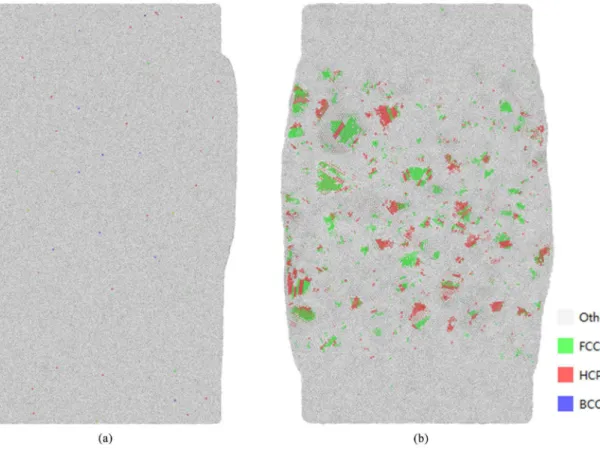
Figure 4 shows the common neighbor analysis (CNA) for Zr70 and Zr70Cu30 MGs when strain is 7%. We can easily see that there formed the FCC and HCP crystals in Zr70 MG. One of the effective approaches for enhancing plasticity is the fabrication of materials consisting of an amorphous matrix with one or more crystalline phases23-25. In the process of
deformation, grain nucleates and mergers induced by stress. It is analogical to crystallization by annealing. The main difference is the external cause, meaning the stress and temperature. Pores formed by removing Cu atoms are stress concentrators, and this forces atoms around pores generating crystallization. The second phase induced by porosity can effectively stabilize against the shear localization and propagation of critical shear bands upon loading.
Figure 3. Systems compressed by 7% strain with atoms colored by the local value of the deviatoric shear strain ηIMISSEs, corresponding
4. Conclusions
The effect of forming pores on the plasticity of Zr70Cu30 metallic glasses was studied. Simulation reproduces the images of the evolution of pores in the metallic glass. Our results indicate that forming porosity in Zr70Cu30 metallic glasses can enhance the glass plasticity signiicantly. The enhancement of plasticity is attributed to large amount of randomly distributed free space. And it can also promote forming crystalline
phases in amorphous matrix. The simulation results are in good agreement with experimental results.
Acknowledgements
We thank Shaopeng Pan from Peking University for helpful program analysis. This work was supported by the National Basic Research Program of China (2013CB733000) and the National Natural Science Foundation of China (51271161 and 51271162).
Figure 4. The CNA structure analysis for (a) Zr70Cu30 and (b) Zr70 MGs when strain is 7%.
References
1. Wang WH. The elastic properties, elastic models and elastic perspectives of metallic glasses. Progress in Materials Science. 2012; 57(3):487-656. http://dx.doi.org/10.1016/j. pmatsci.2011.07.001.
2. Pekarskaya E, Kim CP and Johnson WL. In situ transmission electron microscopy studies of shear bands in a bulk metallic glass based composite. Journal of Materials Research. 2001; 16(9):2513-2518. http://dx.doi.org/10.1557/JMR.2001.0344.
3. Li G, Wang YY, Liaw PK, Li YC and Liu RP. Electronic structure inheritance and pressure-induced polyamorphism in lanthanide-based metallic glasses. Physical Review Letters. 2012; 109(12):125501. http://dx.doi.org/10.1103/ PhysRevLett.109.125501. PMid:23005956.
4. Wang WH. Metallic glasses: family traits. Nature Materials. 2012; 11(4):275-276. http://dx.doi.org/10.1038/nmat3277. PMid:22437786.
5. Zeng Q, Sheng HW, Ding Y, Wang L, Yang WG, Jiang JZ, et al. Long-range topological order in metallic glass. Science. 2011; 332(6036):1404-1406. http://dx.doi.org/10.1126/science.1200324. PMid:21680837.
6. Wang ZT, Pan J, Li Y and Schuh CA. Densification and strain hardening of a metallic glass under tension at room temperature. Physical Review Letters. 2013; 111(13):135504. http://dx.doi. org/10.1103/PhysRevLett.111.135504. PMid:24116793.
7. Chen MW. Mechanical behavior of metallic glasses: microscopic understanding of strength and ductility. Annual Review of Materials Research. 2008; 38(1):445-469. http://dx.doi. org/10.1146/annurev.matsci.38.060407.130226.
Feng et al.
48 Materials Research
9. Schuh CA and Nieh TG. A nanoindentation study of serrated flow in bulk metallic glasses. Acta Materialia. 2003; 51(1):87-99. http://dx.doi.org/10.1016/S1359-6454(02)00303-8.
10. Feng SD, Qi L, Li G, Zhao W and Liu RP. Effects of pre-introduced shear origin zones on mechanical property of ZrCu metallic glass. Journal of Non-Crystalline Solids. 2013; 373-374(1):1-4. http://dx.doi.org/10.1016/j.jnoncrysol.2013.03.041.
11. Brothers AH and Dunand DC. Ductile bulk metallic glass foams. Advanced Materials. 2005; 17(4):484-486. http://dx.doi. org/10.1002/adma.200400897.
12. Brothers AH, Scheunemann R, DeFouw JD and Dunand DC. Processing and structure of open-celled amorphous metal foams. Scripta Materialia. 2005; 52(4):335-339. http://dx.doi. org/10.1016/j.scriptamat.2004.10.002.
13. Schroers J, Veazey C and Johnson WL. Amorphous metallic foam. Applied Physics Letters. 2003; 82(3):370. http://dx.doi. org/10.1063/1.1537514.
14. Wada T and Inoue A. Formation of porous Pd-based bulk glassy alloys by a high hydrogen pressure melting-water quenching method and their mechanical properties. Materials Transactions. 2004; 45(8):2761-2765. http://dx.doi.org/10.2320/ matertrans.45.2761.
15. Wada T and Inoue A. Fabrication, thermal stability and mechanical properties of porous bulk glassy Pd-Cu-Ni-P alloys. Materials Transactions. 2003; 44(10):2228-2231. http://dx.doi. org/10.2320/matertrans.44.2228.
16. Wang D, Li Y, Sun BB, Sui ML, Lu K and Ma E. Bulk metallic glass formation in the binary Cu-Zr system. Applied Physics Letters. 2004; 84(20):4029-4031. http://dx.doi.org/10.1063/1.1751219.
17. Cheng YQ, Sheng HW and Ma E. Atomic level structure in multicomponent bulk metallic glass. Physical Review Letters. 2009; 102(24):245501. http://dx.doi.org/10.1103/ PhysRevLett.102.245501. PMid:19659024.
18. Cheng YQ, Cao AJ, Sheng HW and Ma E. Local order influences initiation of plastic flow in metallic glass: effects of alloy
composition and sample cooling history. Acta Materialia. 2008; 56(18):5263-5275. http://dx.doi.org/10.1016/j.actamat.2008.07.011.
19. Shimizu F, Ogata S and Li J. Theory of shear banding in metallic glasses and molecular dynamics calculations. Materials Transactions. 2007; 48(11):2923-2927. http://dx.doi.org/10.2320/ matertrans.MJ200769.
20. Antoniou A, Bastawros AF, Lo CCH and Biner SB. Deformation behavior of a zirconium based metallic glass during cylindrical indentation: in situ observations. Materials Science and Engineering A. 2005; 394(1-2):96-102. http://dx.doi.org/10.1016/j. msea.2004.11.031.
21. Wang H, Li R, Wu Y, Chu XM, Liu XJ, Nieh TG, et al. Plasticity improvement in a bulk metallic glass composed of an open-cell Cu foam as the skeleton. Composites Science and Technology. 2013; 75:49-54. http://dx.doi.org/10.1016/j. compscitech.2012.11.017.
22. Yang D-H, Shang-Run Y, Hui W, Ai-Bin M, Jing-Hua J, Jian-Qing C, et al. Compressive properties of cellular Mg foams fabricated by melt-foaming method. Materials Science and Engineering A. 2010; 527(21-22):5405-5409. http://dx.doi. org/10.1016/j.msea.2010.05.017.
23. Hays CC, Kim CP and Johnson WL. Microstructure controlled shear band pattern formation and enhanced plasticity of bulk metallic glasses containing in situ formed ductile phase dendrite dispersions. Physical Review Letters. 2000; 84(13):2901-2904. http://dx.doi.org/10.1103/PhysRevLett.84.2901. PMid:11018971.
24. Fan C, Ott RT and Hufnagel TC. Metallic glass matrix composite with precipitated ductile reinforcement. Applied Physics Letters. 2002; 81(6):1020. http://dx.doi.org/10.1063/1.1498864.