ISSN 1517-7076 artigo e-11840, 2017
Autor Responsável: Alessandra L. de Lemos Data de envio: 19/07/2016 Data de aceite: 27/10/2016
10.1590/S1517-707620170002.0173
Biocomposites reinforced with natural
fibers:thermal, morphological and
mechanical characterization
Alessandra Luiza de Lemos1, Pamela Galera Prestes Pires1, 2, Marcelo Lopes de Albuquerque1, Vagner Roberto Botaro2, Jane Maria Faulstich de Paiva2 , Nei Sebastião Domingues Junior1
1ArtecolaQuímica SA, Campo Bom, RS
,
Brasile-mail: [email protected]; [email protected]; [email protected]; [email protected]
2
Programa de Pós-graduação em Ciência dos Materiais – UFSCar – Campus Sorocaba/SP e-mail: [email protected]; [email protected]
ABSTRACT
This study evaluates the thermal, morphological and mechanical behavior of polypropylene (PP) composite with different natural fibers. The fibers used were wood, sugarcane, bamboo, babassu, coconut and kenaf with and without coupling agent. The thermal, morphological and mechanical properties were evaluated, and a composite PP+GFPP (glass fiber) was used as reference. The interaction at the interface fiber-polymer ma-trix was studied by scanning electron microscopy (SEM) at the fractured surface of the composites, as ex-pected the presence of maleic anhydride (MA) as coupling agent increasedthe interaction at the interface. The influence of natural fiber in the degree of crystallinity of the composites was evaluated by DSC analysis. The samples of PP+GFPP and PP+(PP-MA)+WF (wood flour) showed better temperature stability. PP+GF also presented superior flexural modulus. The thermal dynamic mechanical behavior was evaluated by DMA, a decrease in storage modulus with increasing temperature was observed, the PP+GF and the composite con-taining maleic anhydride and sugarcane fiber showed higher modulus. The natural fiber biocomposites stud-ied, consistently presented lower flexural modulus and tensile strength than the reference composite, with and without the use of coupling agent. As expected the use of natural fibers lowered the density compared to the reference material.
Keywords: fibers; biocomposites; properties; polypropylene; DMA.
1. INTRODUCTION
The growing interest in products with lower environmental impact makes the use of natural fibers as reinforc-ing agents a viable technical alternative. The use of bio-sourced materials is increasreinforc-ing in an attempt to re-duce the amount of thermoplastic polymers from non-renewable sources. Some environmental advantages over glass fiber are biodegradability, recyclability, reduced environmental impact, CO2 capture, lower density
an-hydride as coupling agent. And, as a reference a glass fiber composite was used.
2. MATERIALS AND METHODS
The natural fibers used were: wood flour (Pinus Ellioti), sugarcane (Saccharum spp), bamboo, babassu (Orbignya phalerata), coconut and kenaf, without any prior surface treatment and neither were dried in an oven. The natural fibers used are residues from agroindustrial processes. The homopolymer polypropylene employed in this work was a commercial grade PP. Its melt flow index (MFI) was 3.5 g/10 min (230ºC, 2.16kg). The coupling agent (CA) used was grafted copolymer of polypropylene with maleic anhydride (PP-g-MA), MFI of 200 g/10 min (190ºC, 2.16 kg). The reference composite was glass fiber-reinforced polypro-pylene (40% glass fiber + 60% PP – w/w - GFPP) produced by Petropol (Petrotene A3 G40 PRTA011 PH366) and MFI of11 g/10 min. The composition for the studied composites are shown in Table 1.
Table 1: Composition of composites (% - w/w) reinforced with wood flour (WF), sugarcane (SC), bamboo (BB), babassu (BS), coconut (CC) and kenaf (KF) fibers.
Sample hPP PP-g-MA Natural Fiber Glass Fiber
PP + GFPP 60 - - 40
PP + WF 60 - 40 -
PP + (CA) + WF 54 6 40 -
PP + SC 60 - 40 -
PP + BB 60 - 40 -
PP + BS 60 - 40 -
PP + (CA) + BS 54 6 40 -
PP + CC 60 - 40 -
PP + KF 60 - 40 -
The particles of wood flour, sugarcane and babassu were separated using an automatic vibratory sieve shaker. The particle size distributions of the fibers were determined with a sieve separation (Bertel). The de-vice was equipped with the following sieves (in order from the largest to the smallest): 35, 45, 60, 80, 170 and 325 mesh, respectively. Natural fiber (20 g) was placed on top of the 35 mesh sieve and the amount of fiber on each sieve after 20 minutes under vibration was determined gravimetrically. The calculated particle size distributions are listed in Table 2.
Table 2: Particle size distribution (%) of the natural fibers.
Sieve WF SC BB BS CC KF
35 mesh (500 µm) 2.44 12.18 27.61 27.40 39.80 51.05
45 mesh (354 µm) 34.14 22.51 32.41 37.26 41.64 20.54
60 mesh (250 µm) 30.25 28.05 26.24 22.57 9.39 13.11
80 mesh (178 µm) 25.47 17.55 9.45 7.84 3.64 7.74
170 mesh (89 µm) 6.70 14.43 3.99 4.24 1.62 5.60
325 mesh (45 µm) 1.00 5.16 0.15 0.69 1.35 1.96
Background 0.00 1.12 0.15 0.00 2.56 0.00
Mixtures were processed on a double screw extruder (25 mm diameter and L/D: 44), with temperature profile of 100º to 185ºC, screw speed of 290 rpm, output of 15 kg/h, and cut in the “pellets form”. The spec-imens test were prepared by injection molding (CDC 250/50 - Battenfeld) at temperature profile of 180º to 195ºC and pressure of 80 bar for mechanical and thermal tests.
Tensile testing was performed in accordance with EN ISO 527 using an Emic machine (Model DL 500 BF). Test speed was 5 mm/min and 5000N load cell. Flexural testing was performed in accordance with EN ISO 178, test speed was 10 mm/min. Charpy impact testing was performed in accordance with EN ISO 179. The heat deflection temperature (HDT) was performed in accordance with EN ISO 75 in Ceast Vicat/HDT Junior (model 6910). The Vicat softening temperature test was made in the same with heat de-flection temperature (HDT) equipment with EN ISO 306. Density measurements were performed in accord-ance with EN ISO 1183-A.
A Perkin Elmer, model Jade, differential scanning calorimeter was used to analyze the specific heat, the crys-tallization temperature and the crystallinity of the samples. The measurements consist of: heating from 25ºC up to 200ºC, cooling back to 25°C and heating again up to 200ºC, with heating and cooling rate of 10ºC/min. The degree of crystallinity (Xc) was determined from the exothermic and the endothermic peaks with Eq. (1), considering melting fusion (ΔHºf) with isotatic PP 100% crystalline of 165 J/g [1].
Xc = ∆H° p ci
∆H° x 100 (1)
The composites were analyzed using a Dynamic Mechanical Analysis (DMA) Q800 TA Instruments. As parameters were utilized 1Hz for frequency, with heating rate of 2ºC/min and a temperature range of 30 to 150ºC. The mode utilized was three point bending. The dimensions of specimens were: 4 x 10 x 64 mm (thickness x cross-sections x length).
3. RESULTS AND DISCUSSION
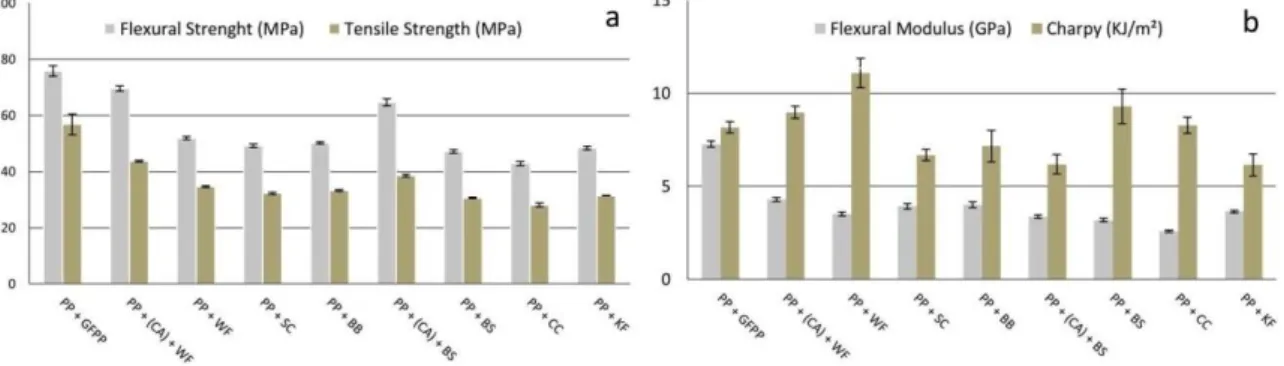
Composites with natural fibers and grafted polypropylene (PP-g-MA) as coupling agent showed the highest results both for tensile strength and flex modulus, PP+(CA)+WF and PP+(CA)+FBS (Figure 1). The pres-ence of coupling agent in these composites, compared with the same material without CA, confirm the supe-rior interaction between the matrix and the reinforcing fiber at the composite’s interface. This treated inter-face allowed the matrix to transfer the loaded tension to the reinforcing component by chemical interaction or mechanical anchoring [4]. The micrographs show (Figure 3) the absence of empty spaces between the fiber and the matrix, pointed out by the arrows in white, confirming the results evaluation.
The composite PP+GFPP, showed the best results in tensile strength and flexural modulus, Figure 1-a, compared to the polypropylene composites with natural fibers regardless of the presence or not of the cou-pling agent. SPINACÉ et al. [2] and ETAATI et al. [11] also observed this behavior, once natural fibers are usually less resistant than glass fibers. Although the composites with natural fibers have lower mechanical properties when compared to glass fiber composite, the difference is relatively small, for instance the wood fiber composite with coupling agent (PP+(CA)+WF) showed Flexural modulus of 69.56 MPa versus 75.78 MPa for the reference composite (PP+GFPP). Coconut fiber had a higher percentage of its fibers with larger particle size, Table 2, this could contributed to the lower results for the PP+CC composite, Figure 1-a. There is a lack of adhesion between the coconut fiber and the polypropylene, as can be seen in Figure 3-1d, in addi-tion to that the shape of the fiber being relatively spherical does not help the interacaddi-tion at the interface, which can also be seen in Figure 3-1d.
The composite reinforced with bamboo fiber showed elastic modulus 14% higher than PP+WF, by analyzing the micrograph of the composite PP+BB, Figure 3-1a, it can be concluded that this result is associ-ated with the interface filler/polymer matrix. It can be seen a great mechanical anchoring between the fiber and the matrix, which is probably related to the high surface roughness of the fiber.
Figure 1: Mechanical results from: a) tensile strength and flexural; and b) Charpy´s impact fracture energy and flexural modulus for PP composites reinforced with fibers.
composites, including composite PP+GFPP is higher, they are less rigid, as shown by the modulus of elastici-ty in Figure 1-b, and absorb more impact energy.
Similar behavior was encountered by GOMES et al. [14] comparing banana fiber with glass fiber in high density polyethylene matrix; and, SANTOS et al. [12] compared curauá fiber with glass fiber in Poly-amide-6 matrix. The lower modulus of elasticity was obtained by natural fiber composites without additives PP+BS and PP+CC, being the lowest result obtained by the composite PP+BS attributed to poor adhesion of the babassu fibers to the polypropylene matrix, as can be observed in Figure 3-1b, from which the fiber could be easily removed. This poor adhesion was also reported by CARVALHO et al.[17] in a study with polypro-pylene composites reinforced with babassu fibers. In case of PP+CC composite the observed lower module is related to weak interaction at the interface, the shape relatively spherical of the fiber does not contribute for reinforcement. The addition of rigid fillers to the polymer matrix tends to produce more rigid and less re-sistant materials. In general the elastic modulus of all the composites with natural fibers showed lower me-chanical properties when compared to reference material (PP+GFPP), Figure 1-b. The transfer of the applied stress can be hampered by the presence of discontinuous short fibers dispersed in the polymeric matrix, thus reducing tension supported by the composite [2, 12-13].
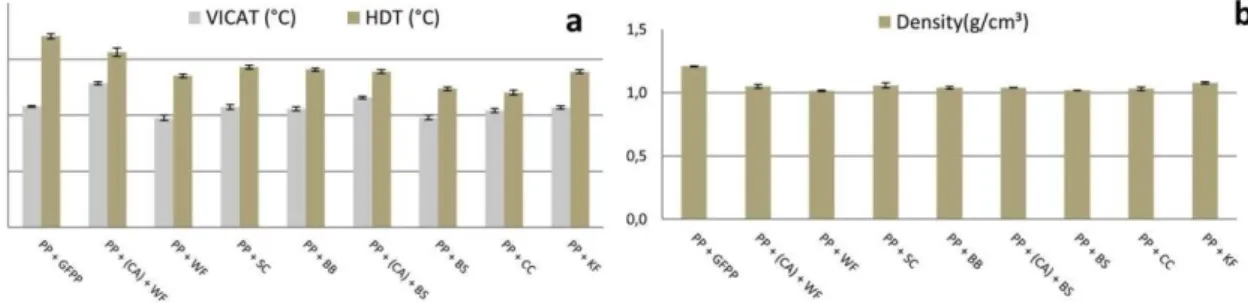
The bamboo fiber composite (PP+BB) showed interesting results in relation to the modulus of elastici-ty because, although not contain maleic anhydride in the composition, the modulus of elasticielastici-ty approached the modulus of elasticity of the wood flour composite with coupling agent (PP+(CA)+WF). In the Figure 2-a are showed the results obtained for the thermal behavior of composites. The higher Vicat softening point was found to the composite with compatibilized wood fibers (PP+(CA)+WF) followed by the composite with compatibilized babassu fiber (PP+(CA)+BS), largely because of the interface treatment, the composite PP+GFPP showed similar softening temperature. The highest HDT value was achieved by PP+GFPP, show-ing that the natural fibers reduced heat deflection temperature when compared to glass fiber reinforced com-posite.
Regarding the natural fibers composites, the PP+(CA)+WF was second highest to the glass fiber. As can be seen in Figure 2-b, the composite with glass fiber, PP+GFPP, has higher density than the composites reinforced by natural fibers, that are, on average, 14% lighter. Among the composites with natural fibers, PP+KF composite showed higher density and the composite PP+WF and PP+BS had the lowest densities. In a study of a composite polyamide-6 reinforced with curaua fiber relative to a composite with the same matrix reinforced with glass fiber [15] also observed this behavior, which is explained by the higher density glass fiber compared natural fibers [16].
Figure 2: a) Heat deflection temperatures and Vicat softening temperatures; and, b) density for PP composites reinforced with fibers.
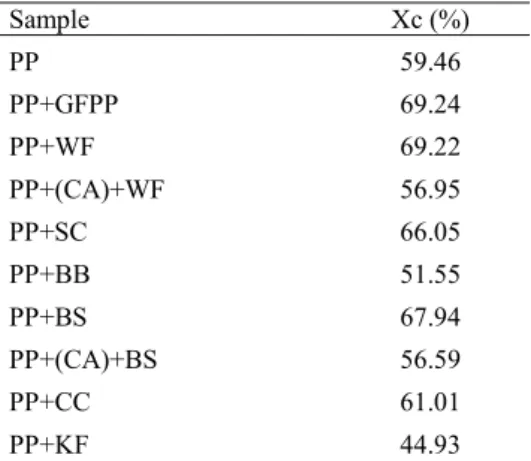
Table 3: Crystallinity degree (Xc) for PP composites reinforced with fibers.
Sample Xc (%)
PP 59.46
PP+GFPP 69.24
PP+WF 69.22
PP+(CA)+WF 56.95
PP+SC 66.05
PP+BB 51.55
PP+BS 67.94
PP+(CA)+BS 56.59
PP+CC 61.01
PP+KF 44.93
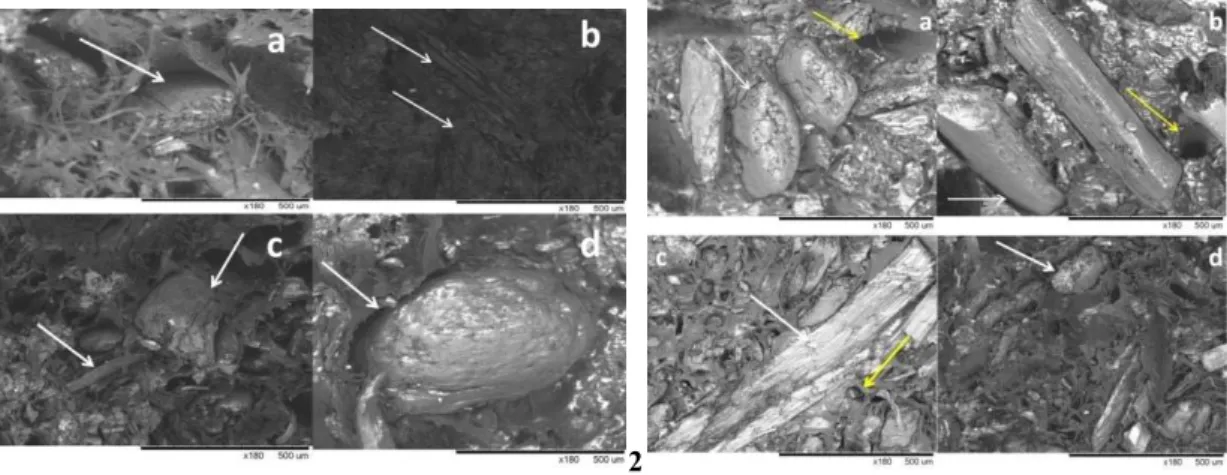
In micrograph of the fractured surface by tensile the composite PP+WF, Figure 3-1a, it’s possible to observe void spaces (indicated by the arrow) between the fiber and the matrix, showing that despite a me-chanical anchoring, there is a weak adhesion at the interface between the two phases (matrix and reinforce-ment) because the polypropylene matrix is non-polar and the fiber is polar. The presence of maleic anhydride coupling agent (CA), caused a chemical interaction between the wood fiber and polypropylene, which gave a good adhesion between the phases. Figure 3-1b, shows the absence no void spaces between the fiber and the matrix, indicating good adhesion at PP+(CA)+WF composite’s interface. The voids spaces between the fiber and the matrix, indicated by the arrows in Figure 3-1c, show that there is a weak interaction at the interface only due to mechanical anchoring among the sugarcane fiber and the matrix. Coconut fiber has a different format from the other fibers studied, as can be seen in the photomicrograph of Figure 3-1d, the coconut fiber is relatively spherical, which explains the thermal and mechanical strength results for the PP+CC composite; also voids between the coconut fiber and the polypropylene matrix are observed.
The composite PP+40% bamboo fiber although not contain a coupling agent in its formulation, showed almost no voids between fiber and matrix, Figure 3-2a (white arrow). This is probably related to the high surface roughness of bamboo fiber that allows the mechanic interlocking with the matrix. The cavity shown by the yellow arrow in Figure 3-2a is derived from the pull out of fibers during the tensile test. The composite interface explains the good results obtained by the composite PP+BB in thermal resistance and mechanical tests.
The babassu fiber, different from all other fibers studied, does not have a surface with high roughness, resulting in a weak contact surface between the fiber and the matrix, in addition to not having chemical inter-actions between the phases due to different nature of the fiber and the polymer matrix. The cavity indicated by the yellow arrow in Figure 3-2b is also originated of the pull out of the fibers during the tensile test. The lack of interaction fiber / matrix explains the results of the composite PP+BS in thermal resistance and me-chanical tests and how easy is manually removing the fiber of the matrix.
1 2
Figure 3: SEM surface composites with fibers at 180x magnification rates: 1 - (a) PP + WF, (b) PP + (CA) + WF, (c) PP + SC and (d) PP + CC; and, 2 - (a) PP + BB, (b) PP + BS, (c) PP + (CA) + BS and (d) PP + KF.
The composite PP+40% glass fiber, as well as composites with vegetable fibers without additives with maleic anhydride, had voids between the glass fiber and the polypropylene matrix, Figure 4 (yellow arrow), indicating the lack of chemical interaction between fiber and matrix, i.e., the only interaction is due to me-chanical anchoring. Thermal resistance and meme-chanical tests for this composite showed the best results, with the exception of Charpy impact and density because, although there is a poor fiber/matrix interface, the fiber glass supports larger loads when compared to the natural fiber.
Figure 4: SEM PP + GFPP at 400x magnification.
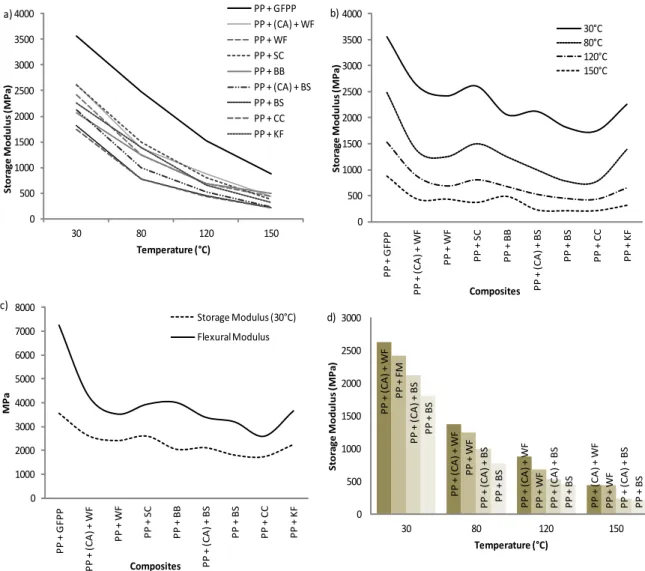
Figure 5 shows the results of dynamic mechanical thermal analysis (DMTA). With increasing temper-ature there is a decrease in storage modulus for all the composites as expected and also observed by ETAATI
et al [11], PANAITESCU et al [20] and ROSARIO et al [21]. Independent of the temperature, composite PP + GFPP showed higher storage modulus than all other composites including the ones with coupling agent, Figure 5-a and Figure 5-b, such result was expected due to the reinforcing fiber. Considering the composites without additives, material with sugarcane fiber showed the best results for three (30°C, 80°C and 120°C) of four temperatures selected for this analysis (30°C, 80°C, 120°C and 150°C).
Figure 5: a) and b) Storage Modulus x temperature: All composites; c) Comparison: Flexural Modulus x Storage Modu-lus; d) Comparison Storage Modulus: Composites with and without coupling agent.
4.
CONCLUSIONSThe thermal, mechanical and morphological performances of the composites reinforced with natural fibers are lower than the glass fiber reinforced composite, but in some cases the difference is not significant. The use of coupling agent in composites with natural fibers brought gains in both thermal properties as in me-chanical property and can expand the applications of these composites in the automotive industry. Each stud-ied fiber type provides different properties to their respective composite that can guide their selection and usage. The composites with coconut fiber, babassu fiber and wood fiber can be used in applications where impact resistance is an important item because, showed the best performance. In applications where thermal resistance is critical, the composite with polypropylene, coupling agent and wood flour may be an alternative, because results are similar to the glass fiber composite. The density is still an advantage of using natural fi-bers as reinforcing agents in composites, meaning weight reduction for the parts, and less fuel consumption for vehicles. The results opened a great number of possibilities for using these materials in various applica-tions depending on the required properties.
5. ACKNOWLEDGEMENTS
The authors are grateful to FINEP, Kraton Polymers LLC, Federal Universityof São Carlos (UFSCar/Campus Sorocaba)and Artecola Quimica S.A. by providing raw-materials and analysis.
6. BIBLIOGRAPHY
[1] BECKER, D., KLEINSCHMIDT, A. C., BALZER, P. S., et al., “Influência da Sequência de Mistura do
PP-MA nas Propriedades dos Compósitos de PP e Fibra de Bananeira”, Polímeros, v. 21, n. 1, pp. 7 – 12, 0 500 1000 1500 2000 2500 3000 3500 4000 P P + G F P P P P + ( C A ) + W F P P + W F P P + S C P P + B B P P + ( C A ) + B S P P + B S P P + C C P P + K F S to ra g e M o d u lu s (M P a ) Composites 30°C 80°C 120°C 150°C P P + ( C A ) + W F P P + ( C A ) + W F P P + ( C A ) + W F P P + ( C A ) + W F P P + F M P P + W F P P + W F P P + W F P P + ( C A ) + B S P P + ( C A ) + B S P P + ( C A ) + B S P P + ( C A ) + B S P P + B S P P + B S P P + B S P P + B S 0 500 1000 1500 2000 2500 3000
30 80 120 150
S to ra g e M o d u lu s (M P a ) Temperature (°C) d) 0 500 1000 1500 2000 2500 3000 3500 4000
30 80 120 150
S to ra g e M o d u lu s (M P a ) Temperature (°C)
PP + GFPP PP + (CA) + WF PP + WF PP + SC PP + BB PP + (CA) + BS PP + BS PP + CC PP + KF a) 0 1000 2000 3000 4000 5000 6000 7000 8000 P P + G F P P P P + ( C A ) + W F P P + W F P P + S C P P + B B P P + ( C A ) + B S P P + B S P P + C C P P + K F M P a Composites
Storage Modulus (30°C) Flexural Modulus c)
Fev.2011
[2] SPINACÉ, M. A. S., JANEIRO, L. G., BERNARDINO, F. C., et al.,“Poliolefinas reforçadas com fibras
vegetais curtas: sisal × curauá”, Polímeros, v. 21,n. 3, pp. 168 – 174, Jun. 2011
[3] SILVA, R., HARAGUCHI, S. K., MUNIZ, E.C., et al., “Aplicações de fibras lignocelulósicas na química de polímeros e em compósitos”, Química Nova, v. 32, n. 3, pp. 661 – 671, Abr. 2009
[4] CORREA, C.A., FONSECA, C.N.P., NEVES, S., et al.,“Compósitos Termoplásticos com Madeira”, Po-límeros, v.13, n.3, pp. 154 – 165, Set. 2003
[5] JOHN, M. J., BELLMANN, C., ANANDJIWALAA, R. D., “Kenaf–polypropylene composites: Effect of amphiphilic coupling agent on surface properties of fibres and composites”, Carbohydrate Polymers, v. 82, n.3, pp. 549 – 554, Oct. 2010
[6] FIDELIS, M. E. A., PEREIRA, T. V. C., GOMES, O. F. M., et al.,“The effect of fiber morphology on the
tensile strength of natural fibers”, J Mater Res Technol.,v. 2, n. 2, pp. 149-157, Jun. 2013
[7] LEMOS, A. L., MARTINS, R. M., “Desenvolvimento e caracterização de compósitos poliméricos à base de poli (ácido lático) e fibras naturais”, Polímeros, v. 24, n. 2, pp. 190 – 197, Abr. 2014
[8] FARUK, O., BLEDZKI, A. K., FINK, H.-P., et al., “Progress report on natural fiber reinforced composites”, Macromolecular Materials and Engeneering, v. 299, n. 1, pp. 9-26, Jan. 2014
[9] SOBCZAK, L., LANG, R. W., HAIDER, A., “Polypropylene composites with natural fibers and wood – General mechanical property profiles”, Composites Science and Technology, v.72, n. 5, pp. 550 – 557, Mar. 2012
[10] DICKSON, A. R., EVEN, D., WAMES, J. M., et al., “The effect of reprocessing on the mechanical properties of polypropylene reinforced with wood pulp, flax or glass fibre”, Composites: Part A, v. 61, pp. 258 – 267, Jun. 2014
[11] ETAANI, A., PATHER, S., FENG, Z., et al.,“The study of fibre/matrix bond strength in short hemp polypropylene composites from dynamic mechanical analysis”, Composites: Part B, v. 62, 19 – 28, Jun. 2014 [12] SANTOS, E. F., MORESCO, M., ROSA, S. M. L., et al.,“Extrusão de Compósito de PP com Fibras
Curtas de Coco: feito da Temperatura e Agentes de Acoplamento”, Polímeros, v. 20, n. 3, pp. 215 – 220, Out.
2010
[13] HUDA, S., REDDY, N., YANG, Y.,“Ultra-light-weight composites from bamboo strips and polypro-pylene web with exceptional flexural properties”, Composites: Part B, v. 43, N. 3, pp. 1658 – 1664, Apr. 2012
[14] GOMES, T. S., VISCONTE, L. L. Y.,PACHECO, E. B. A. V.,“Substituição de fibra de vidro por fibra de bananeira em compósitos de polietileno de alta densidade. Parte 1. Avaliação mecânica e térmica”, Polí-meros, v. 23, n. 2, pp. 206 – 211, Fev. 2013
[15] SANTOS, P. A., SPINACÉ, M. A. S., FERMOSELLI, K. K. G., et al.,“Efeito da forma de
processamen-to e do tratamenprocessamen-to da fibra de curauá nas propriedades de compósiprocessamen-tos com poliamida-6”, Polímeros: Ciência e Tecnologia, v. 19, n. 1, pp. 31 – 39, 2009
[16] KHALIL, H.P.S.A., BHAT, I.U.H., JAWAID, M., et al.,“Bamboo fibre reinforced biocomposites: A
review”, Materials and Design, v. 42, pp. 353-368, Dec. 2012
[17] CARVALHO, L. H., ALVES, T. S., PORTO, L. S., et al, “Desempenho e Caracterização de Compósitos
Polímero/Fibra de Babaçu”, Congresso Plastshow, São Paulo, Brasil, 06-09 Abril 2010
[18] LUZ, S.M., DEL TIO, J., ROCHA, G. J. M., et al., “Cellulose and cellulignin from sugarcane bagasse
reinforced polypropylene composites: Effect of acetylation on mechanical and thermal properties”, Compo-sites: Part A, v. 39, n. 9, pp. 1362 – 1369, Sep. 2008
[19] SOCCALINGAME, L., BOURMAUD, A., PERRIN, D., et al., “Reprocessing of wood flour reinforced
polypropylene composites: Impact of particle size and coupling agent on composite and particle properties”,
Polymer Degradation and Stability, v. 113, pp. 72 – 85, Mar. 2015
[20] PANAITESCU, D.M., VULUGA, Z., GHIUREA, M., et al.,“Influence of compatibilizing system on
morphology, thermal and mechanical properties of high flow polypropylene reinforced with short hemp fi-bres”, Composites: Part B, v. 69, pp. 286 – 295, Feb. 2015
[21] ROSÁRIO, F., PACHEKOSKI, W.M., SILVEIRA, A. P.J, et al.,“Resíduo de Sisal como reforço em