DOI: http://dx.doi.org/10.1590/1980-5373-MR-2016-1035
Materials Research. ©
Spark Plasma Sintering of a Hard Metal Powder Obtained from Hard Metal Scrap
Angélica da Cunha dos Santosa, Ana Lúcia Diegues Skuryb, Angelus Giuseppe Pereira da Silvab*
Received: December 12, 2016; Accepted: February 12, 2017
Spark plasma sintering is used to consolidate a WC-Co powder produced from milled discharged hard metal cutting inserts. The powder was mixed to 10%wt Co powder and spark plasma sintered (SPS) under 80Mpa pressure, at 1200ºC with heating rate of 160ºC/min. A reference alloy was prepared with a commercial WC powder and 10%wt. Co under the same conditions. The structures of both alloys were investigated by means of scanning electron microscopy and Vickers hardness. The results show structures with densities and hardness at the same level. SPS can be used to produce hard metal pieces directly from scrap powder without any prior chemical and thermal treatment.
Keywords: Hard metal, spark plasma sintering, hard metal scrap
* e-mail: [email protected]
1. Introduction
Hard metal scrap is the denomination of hard metal pieces like cutting inserts, drill bits etc, made of hard metal, after discharged. Until 2005, the hard metal manufacturers just collected the worn parts from their customers. After the elevation of costs of the raw materials, they started to process the scrap to recover part of the valuable elements in to reintroduce them in the production line. Presently, around 20% of all raw materials used in the manufacturing of hard metal pieces are estimated to come from scrap recycling 1.
The hard metal scrap powder does not have controlled characteristics, such as composition. It results from milling
of hard metal pieces of diferent products used in distinct
applications that are collected. Not only Co, W, WC can be recovered, but also Ta, Nb, Ni, Ti etc. The most used recycling route nowadays is the Zinc Recycling Process (ZRP).
In the ZRP the hard metal scrap in immersed in a liquid
zinc bath. The zinc atoms difuse into the hard metal binder
to form a lower density alloy. The hard metal pieces bloat and crack. In the following, zinc is vacuum distilled. The bloated pieces now become sponge-like. The material now is milled to produce a powder with the same composition of the original scrap. The ZRP has low energetic cost, does not produce chemical by-products (zinc is reused), and does not need dedicated nor large facilities to be used. Its main disadvantage is that the scrap must be pre-selected to avoid
the presence of unwanted elements in the inal powder 2,3.
SPS is a consolidation technique that uses simultaneous temperature and pressure to consolidate a powder. Heating is produced by the passage of an electric current through
the sintering piece or the die. Heating rates from hundreds to thousands of grades per minutes are reached, depending on the equipment’s power. In short times, high densities have been reported with the use of SPS in hard to sinter materials 4-6. Although the presence of plasma has never
been demonstrated, this denomination is still used to identify the technique 7.
Hard metal is conventionally consolidated under
low vacuum by liquid phased sintering, although for ine grained alloys most part of the densiication occurs below
the temperature of liquid formation. Nevertheless, liquid phase sintering is necessary to reduce porosity and promote homogeneity 8. The higher temperatures to sinter in presence
of liquid causes WC grain growth, depleting some mechanical properties. Another point that has to be observed in hard metal
sintering is its carbon content, which can be inluenced by
the sintering atmosphere and the initial carbon gross content of the carbide powder. The alloy’s carbon content must be inside a certain interval that depends on the binder content to avoid precipitation of unwanted phases that negatively
inluence the mechanical properties 9.
The literature reports SPS of hard metal under diferent conditions of pressure, heating rate, inal temperature, dwelling
time, alloy composition and grain size 10-13. Both solid and
liquid state sintering were investigated. The reports point that
high inal densities and little or none grain coarsening obtained
at lower temperatures and shorter times in comparison to other sintering techniques are characteristics of SPS.
2. Materials and methods
Two alloys were prepared and spark plasma sintered. The
irst alloy, named REF, was prepared with a commercial WC a Instituto Federal Fluminense, R. Dr. Siqueira, 273, Parque Tamandaré, Campos dos Goitacazes, RJ,
Brazil
b Laboratório de Materiais Avançados - LAMAV, Universidade Estadual do Norte Fluminense, Av.
Santos et al.
2 Materials Research
powder (mean particle size of 5.65µm) and 10%wt. commercial Co powder (particle size below 53µm). The second alloy,
named REC, was prepared with a WC-Co powder produced
by milling of hard metal scrap. The particle size is below 53
µm. 10%wt. of the same Co powder as used in alloy REF
was added to this WC-Co powder. The powders were mixed by hands to avoid any particle reduction and/or deformation. The powder mixtures were placed inside a graphite die with cylindrical cavity with diameter of 15mm. A graphite foil is used to avoid the contact between the samples and the die parts.
The SPS machine presses the die punches with 80MPa pressure. A pulsating electric current passes through the die and the powders, heating the mixture at a rate of 160°C/ mim, up to 1200. The dwell time is 5 minutes. After that
the electric current is switched of, the pressure is relieved
and the sample cools in the furnace.
The sintered pieces are disc with diameter of 15mm and thickness of around 3mm. After sintering the residues of the graphite foil are removed with a sandpaper and the density is measured by the Archimedes’ technique. In the case of
alloy REF, the theoretical density was determined by the rule of mixture. In the case alloy REC, the theoretical density
could not be calculated because the density of the WC-Co powder from hard metal scrap is unknown. However, the theoretical density of this alloy is likely lower than that of
alloy REF, since the cobalt content is the sum of 10%wt
commercial Co powder and the Co content of the powder
recycled from scrap, which is unknown. Therefore, the REC alloy is richer in binder than REF alloy.
The samples were sectioned, embedded and polished for
observation by SEM. The Vickers hardness was measured.
3. Results and discussion
Table 1 shows the measurements of density and hardness
for both alloys, REC and REF.
The relative density of alloy REF attained 99%. This is indication of high densiication of the structure in spite
of the short sintering time and the absence of liquid in the structure. Conventionally sintered hard metals (pressureless and liquid phased sintered) reaches relative density in order of 86%, if sintered at 1275ºC and the grain sized of the carbide phase is under 1µm. At this temperature, liquid is about to be formed 8. Therefore, the high density attained by SPS,
under the mentioned conditions, show that the technique is indeed able to densify structures at low temperatures in short times, as reported in literature.
Both alloys have the same hardness level, if the dispersion
is considered. At irst, this could look unexpected, since alloy REC is richer in binder. Therefore, should be softer. Nevertheless, other factors inluence hardness. For example, iner carbide powder, and the presence of harder phases,
such as alumina and cubic carbides, as likely in unselected hard metal scrap, could improve hardness.
Table 1: Vickers Hardness and density of alloys REF and REC
sintered at 1200ºC for 5 minutes, and heating rate of 160ºC/min. value in brackets is a relative density.
Alloy Vickers Hardness, GPa Density, g/cm³ (%)
REF 13,68±2,01 14,43 (99,3)
REC 14,30±0,64 13,73
Figures 1-4 exhibit SEM micrographs of the sintered structure of alloy REF.
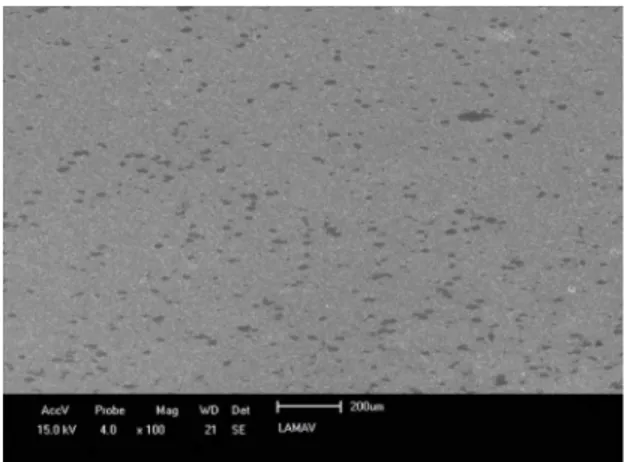
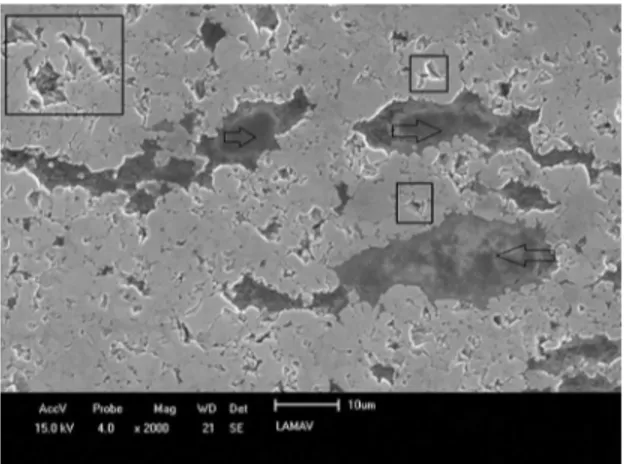
The Co powder is much coarser than the WC powder. The technique used to mix the powders does not have enough energy to fragment hard agglomerates nor primary particles, or even to strain the Co particles. In Figure 1, homogeneously distributed darker spots are seen throughout the structure. They are Co particles. This shows that the mixture was able to disperse the phases without particle fragmentation. The Co particles are elongated and aligned, as seen in Figure 2. (pointed by arrows). The elongation of the particles is caused by the compression under heating used in SPS. Then, elongation occurs in the direction orthogonal to the pressing direction. Some large pores are seen in places distant from the Co particles (in the rectangles drawn on the
Figure 1. Structure of alloy REF. The distribution of Co particles
throughout the structure is seen.
Figure 2. Structure of alloy REF. Elongated and aligned Co particles
3 Spark Plasma Sintering of a Hard Metal Powder Obtained from Hard Metal Scrap
Figures 5-7 Exhibit SEM micrographs of the structure of alloy REC. In Figure 5, the elongated and aligned Co particles (darker gray shades) are seen as in alloy REF. The contours
of large and brighter particles are also seen. They are the particles of the WC-Co powder, the hard metal scrap powder.
Figure 3. Structure of alloy REF. Pores (in squares) and elongated
Co particles are shown.
Figure 4. Structure of alloy REF. Region far from a Co particles.
Boundaries of WC Grains with some Co binder and pores are seen.
image). Figure 3 shows in detail the elongated Co particles (arrows) and the pores (rectangles).
The images of the structure show that most of the Co phase is concentrated and not in contact with the WC particles as it happens in hard metals conventionally sintered, in which Co plays the role of binder of the WC particles, forming WC-Co agglomerates.
Figure 4 exhibits a magniied image of the contours of the
WC particles. Darker regions can be seen in some contours, indicated by arrows. It is Co that reached these places through
surface difusion or dispersion of very small fragments of
Co during the mixture. Therefore, although most of the Co phase is locally placed, there is a small volume that acts as a binder of the WC particles. Small but numerous pores are seen in the contours of the WC particles. These pores are left due to absence of binder in such regions.
The image of the structure conirms the high value of
density measured for the sample. It is noticed that the outline of the WC particles resembles that of the original particles
in shape and size. Therefore, no signiicant grain coarsening
took place during sintering. This is another characteristic related to the SPS technique.
Figure 5. Structure of alloy REC. Elongated and aligned Co particles
and particles of the WC-Co powder.
Figure 6. Structure of alloy REC. The matching of the contours of
WC-Co and Co particles is shown.
Figure 6 shows how the WC-Co recycled particles are disposed in the structure. The particles of commercial Co and the hard metal scrap arrange themselves in such a way to eliminate the empty space that originally separates the particles. However, in some cases, the contours do not match perfectly and empty spaces (pores) are left.
The powder of hard metal scrap is produced by milling
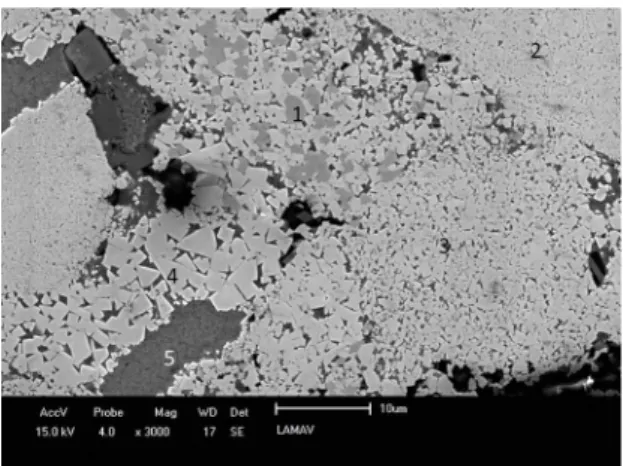
of hard metal pieces of diferent characteristics such as alloys of diferent composition and grain size distribution. This diference can be seen in Figure 7, in which WC-Co particles
are shown. The regions marked with numbers 2, 3 and 4 are
particles of alloys made of WC powders of diferent grain sizes, ine, median and coarse, respectively. The particle
Santos et al.
4 Materials Research
2. Freemantle CS, Sacks N, Topic M, Pineda-Vargas CA. Impurity characterization of zinc-recycled WC-6wt.% Co cemented carbides. International Journal of Refractory Metals and Hard
Materials. 2014;44:94-102.
3. Lassner E, Schubert WD. Tungsten: Properties, Chemistry,
Technology of the Element, Alloys, and Chemical Compounds.
New York: Springer Science; 1999.
4. Tokita M. Mechanism of spark plasma sintering. In: Proceedings of the International Symposium on Microwave, Plasma and
Thermomechanical Processing of Advanced Materials; 1997;
Osaka, Japan. p. 69-76.
5. Munir ZA, Anselmi-Tamburini U, Ohyanagi M. The efect of electric current and pressure on the synthesis and consolidation of materials: A review of the spark plasma sintering method.
Journal of Materials Science. 2006;41(3):763-777.
6. Dupuy AD. Modeling and Experimental Studies of Densiication
Rates in Current Activated Densiication. [Masters Thesis]. Riverside: University of California; 2011.
7. Hulbert DM, Anders A, Anderson J, Lavernia EJ, Mukherjee AK. A discussion of the presence of plasma in spark plasma sintering. Scripta Materialia. 2009;60(10):835-838.
8. Da Silva AGP. Study on sintering and grain growth of WC-based
hard metals. [Doctoral Thesis]. Vienna: Institut für Chemisch
Technologie Anorganischer Stofe, Technische Universitaet Wien; 1996.
9. Schubert WD, Fugger M, Wittmann B, Useldinger R. Aspects of sintering of cemented carbides with Fe-based binders.
International Journal of Refractory Metals and Hard Materials.
2015;49:110-123.
10. Huang SG, Li L, Vanmensensel K, Van Der Biest O, Vleugels J. VC, Cr3C2 and NbC doped WC-Co cemented carbides prepared by pulsed electric current sintering. International
Journal of Refractory Metals and Hard Materials.
2007;25(5-6):417-222.
11. Kim HC, Oh DY, Shon IJ. Sintering of nanophase WC-15vol.%Co hard metals by rapid sintering process.
International Journal of Refractory Metals and Hard
Materials. 2004;22(4-5):197-203.
12. Sivaprahasam D, Chandrasekar SB, Sundaresan R. Microstructure and mechanical properties of nanocrystalline WC-12Co consolidated by spark plasma sintering.
International Journal of Refractory Metals and Hard
Materials. 2007;25(2):144-152.
13. Bonache V, Salvador MD, Fernández A, Borrell A. Fabrication of full density near-nanostructured cemented carbides by combination of VC/Cr3C2 addition and consolidation by SPS and HIP technologies. International Journal of Refractory
Metals and Hard Materials. 2011;29(2):202-208.
Figure 7. Structure of alloy REC. Particles of the WC0Co powder
with diferent characteristics such as grain size and composition.
indicate. The region marked with 5 is likely a fragment of a cermet of a coating of hard metal piece.
The contours of the particles are clear. In some places,
the match of the contours of diferent particles is not perfect
and pores are left, but in most cases, the match is perfect. The
presence of few and small pores conirm the high density
measured for this alloy.
Alloy REC is as hard as alloy REF in spite of its higher
Co content. The reason could be the presence of harder phases, such as hard coatings, cubic carbides and particles
with ine WC grain size.
4. Conclusions
Sintering of a WC-Co powder obtained by milling of hard metal scrap by spark plasma is able to densify structures near full density with hardness comparable to another made of commercial WC and Co powders. SPS of recycled powders of hard metal scrap can be used to produce hard metal pieces without the mixture with commercial WC powder. The structures can be produced by solid state sintering in short times without grain coarsening.
5. Acknowledgements
The authors acknowledge CAPES and FAPERJ for the inancial support.