Universidade de Aveiro 2012
Departamento de Economia, Gestão e Engenharia Industrial
Alexander
Alexandrovitch
Kharlamov
Abordagem Analítica à Segmentação da Cadeia de
Abastecimento
Analytical approach towards supply chain
segmentation
Universidade de Aveiro 2012
Departamento de Economia, Gestão e Engenharia Industrial
Alexander
Alexandrovitch
Kharlamov
Abordagem Analítica à Segmentação da Cadeia de
Abastecimento
Analytical approach towards supply chain
segmentation
Dissertação apresentada à Universidade de Aveiro para cumprimento dos requisitos necessários à obtenção do grau de Mestre em Engenharia e Gestão Industrial, realizada sob a orientação científica do Doutor Luís Miguel Domingues Fernandes Ferreira, Professor Auxiliar do Departamento de Economia, Gestão e Engenharia Industrial da Universidade de Aveiro e co-orientação da Doutora Janet Godsell, Senior Lecturer na Cranfield School of Management, Cranfield University.
"Ideas are like fish.
If you want to catch little fish, you can stay in the shallow water. But if you want to catch the big fish, you've got to go deeper.
Down deep, the fish are more powerful and more pure. They're huge and abstract. And they're very beautiful."
o júri
Presidente Prof.a Doutora Ana Maria Pinto de Moura
Professora Auxiliar, Universidade de Aveiro
Prof. Doutor Cristóvão Silva
Faculdade de Ciências e Tecnologia da Universidade de Coimbra
Prof. Doutor Luis Miguel Domingues Fernandes Ferreira
Professora Auxiliar, Universidade de Aveiro
Prof.a Doutora Janet Godsell
agradecimentos A tese é só um documento formal que reflecte uma pequena parte de um extraordinário caminho de descoberta – da ciência, das pessoas e da identidade própria. Tudo isto converge numa dimensão comum, o tempo.
Assim, reconhecendo que não há nada mais precioso que o tempo, estou eternamente em dívida perante todas as pessoas que mo ofereceram, tornando o meu esforço possível.
Dr Luís Ferreira, por tudo, um sincero obrigado.
Dr Janet Godsell por ter encontrado valor em mim, oferecendo-me a possibilidade de continuar a evoluir.
E ainda:
Família directa, pela educação e apoio incondicional.
Rui Pires, lembrando-me todos os dias que a ignorância é o fim. Paulo Leal, cedendo os dados para o caso de estudo.
E à todos aqueles que ficaram privados da minha atenção ao longo deste exercício egoísta.
palavras-chave Cadeia de abastecimento; Segmentação da cadeia de abastecimento; Estratégia de cadeia de abestecimento; Estudo bibliometrico;
Estudo empírico; Bens de grande consumo; Procura
resumo O tema da definição de estratégia da cadeia de abastecimento está a ganhar importância e não existe uma estratégia ideal. Consequentemente, de forma a ganhar vantagem competitiva sustentável as organizações devem escolher as estratégias de abastecimento mais adequadas tendo em conta as características quer da procura quer dos produtos alinhando a oferta com a procura.
Para a definição do foco da tese, é feito um estudo bibliometrico da literatura. De seguida, definiu-se uma sequência de passos para a segmentação da cadeia de abastecimento e sua consequente aplicação num caso de estudo, uma empresa alimentar B2B. O estudo exploratório contribui com uma série de ideias originais: Uma nova variável de classificação é proposta, uma análise de produtos com base nos componentes comuns, e finalmente, uma nova abordagem às compras baseada nas características da procura. Tudo isto permite uma abordagem prática à segmentação ao longo de toda a cadeia de abastecimento.
keywords Supply chain management; Supply chain segmentation; Supply chain strategy; Bibliometric study; Empirical study; Fast moving consumer goods; Demand; Profiling
Abstract Segmented supply chain strategy is becoming an eminent topic, and “one size does not fit all”. Consequently, in order to achieve sustainable competitive advantage, companies must select the best matching supply chain strategy concerning product and demand characteristics matching supply with demand. To define the focus of the thesis a bibliometric approach on literature is used. Next, a roadmap for supply chain segmentation is defined and applied on a single case study, a B2B food company. The exploratory study contributes with a number of original insights: A new classification variable, product analysis based on common raw components, and finally, a new insight on sourcing based on demand characteristics. This research enables a practical approach on supply chain segmentation at both ends.
i
Table of Contents
1 Introduction ... 1 1.1 Chapter outline ... 1 1.2 Thesis statement ... 1 1.3 Problem statement ... 1 1.4 Background ... 2 1.5 Research Questions ... 5 1.6 Contribution ... 5 1.7 Thesis outline ... 8 1.8 Chapter summary ... 9 2 Literature Review ... 11 2.1 Chapter outline ... 11 2.2 Introduction ... 12 2.3 Methodology ... 14 2.4 Underpinning definitions ... 152.4.1 Definition of supply chain... 15
2.4.2 Definition of strategy ... 15
2.4.3 Definition of supply chain strategy ... 15
2.4.4 Definition of segmentation ... 16
2.5 Research segments – Bibliometric approach ... 16
2.5.1 Bibliometric approach methodology ... 17
2.5.2 The big picture: Supply chain strategy intellectual structure ... 17
2.5.3 The research focus ... 21
2.6 Research papers classification... 25
ii
2.7.1 Classification variables ...29
2.7.2 Classification variable categorization ...32
2.7.3 DWV3 - Most recurrent variables ...34
2.8 Supply chain configurations and tailored practices ...35
2.9 Conclusion ...39
2.10 Chapter summary ...40
3 Supply Chain Segmentation Roadmap ...41
3.1 Chapter outline ...41
3.2 Introduction ...41
3.3 Supply chain strategy based on segmentation ...42
3.3.1 Roadmap ...43
3.4 Chapter summary ...46
4 Case Study ...47
4.1 Chapter outline ...47
4.2 Introduction – Why is the particular case interesting? ...47
4.3 Step-by-step segmentation...49
4.3.1 Step 1 – Context Analysis ...49
4.3.2 Step 2 – Portfolio Analysis ...54
4.3.3 Step 3 – Demand and product segmentation...57
4.3.4 Step 4 – Client analysis and segmentation...72
4.3.5 Step 5 – Conceptual Strategy building ...77
4.3.6 Step 6 – Matching segments with supply chain ‘tailored practices’ ...87
4.4 Chapter summary ...94
5 Conclusion and Future Research ...95
5.1 Chapter outline ...95
5.2 Introduction ...95
iii 5.4 Conclusion ... 98 5.5 Thesis critique ... 100 5.6 Future research ... 100 5.7 Thesis summary ... 102 6 References ... 103 7 Appendix... 109
iv
Appendices
Appendix 1: Matlab script for proximity matrix building ... 109
Appendix 2: Plot of the references on the keyword "supply chain strategy/strategies" ... 110
Appendix 3: The 244 references of the "big picture" on the subject of "SC strategy" ... 111
Appendix 4: Research focus contributions ... 121
Appendix 5: Research focus proximity matrix ... 122
Appendix 6: Box plot for the complexity of SKUs (number of components) ... 123
Appendix 7: Histogram of the SKU number of components ... 123
Appendix 8: Ward's method dendrogram on the SKU's clustering ... 124
Appendix 9: Dendrogram for client clustering ... 125
Appendix 10: Detailed clustering client list ... 126
Appendix 11: Client clustering plot... 127
Appendix 12: Example of high volume demand - Low and high variability ... 128
Appendix 13: Example of low volume demand - Low & high variability ... 128
v
Table of Figures
Figure 1: Chapter 1 structure ... 1
Figure 2: SC drivers ... 4
Figure 3: Key bodies of literature ... 4
Figure 4: Literature review summary... 6
Figure 5: Demand driven SC logic followed in the proposed roadmap ... 6
Figure 6: Thesis practical part main contributions ... 7
Figure 7: Thesis design ... 8
Figure 8: Chapter 2 structure ... 11
Figure 9: Research evolution ... 14
Figure 10: Number of articles per year from 1997 to 2012 (total of 326)... 18
Figure 11: Most cited contributions ... 19
Figure 12: MDS plot of 244 articles (keyword "supply chain strategy”) ... 20
Figure 13: Bi-dimensional plot representative of the selected references in this work. ... 21
Figure 14: Classification variables categorization ... 32
Figure 15: Chapter 3 structure ... 41
Figure 16: Strategy definition logic ... 42
Figure 17: Supply chain segmentation concept: Cost to serve vs. degree of generalisation ... 42
Figure 18: Supply Chain Segmentation model roadmap step-by-step. ... 43
Figure 19: Roadmap cyclic nature ... 46
Figure 20: Chapter 4 structure ... 47
Figure 21: Porter's five forces governing competition in an industry (Porter, 1979)... 49
Figure 22: Normal ordering process of a regular SKU ... 50
Figure 23: Company's SIPOC representation... 51
Figure 24: Illustration of demand amplification through supply chain tiers ... 51
Figure 25: Annual revenue per client ... 52
Figure 26: Annual production, orders and client altered deliveries (normalised) ... 53
Figure 27: Portfolio organization and the selected segment of products ... 55
Figure 28: Proximities transformation plot and number of components histogram ... 56
Figure 29: Portfolio representation and its final application ... 57
Figure 30: Categorisation of the classification variables ... 59
vi
Figure 32: SKU Order correction ratio & Variability ...67
Figure 33: SKU segmentation 3D plot ...67
Figure 34: SKU segmentation doted scatter plot ...68
Figure 35: Revenue of each cluster ...70
Figure 36: Raw material Variability/Volume plot ...71
Figure 37: Demand Pareto analysis: Type A & Type B clients ...73
Figure 38: Client Clustering: Bubble size proportional to variety of SKU per client ...74
Figure 39: Revenue by client’s segment - #clients vs. %sales ...75
Figure 40: Sum of volume & variability plot for client clusters (bubble - order changeability) ...76
Figure 41: Strategic Cube (H: High; G: Good; B: Bad) ...78
Figure 42: Strategic Cube - The most critical sectors: Unpredictable high volume ...79
Figure 43: Strategic Cube - The best sector: Steady and certain high volume ...80
Figure 44: Strategic Cube - More common sectors: Low volume ...81
Figure 45: Strategic Cube - The 2nd best sector: Steady and well managed ...82
Figure 46: Strategic Cube - High variability demand...82
Figure 47: Strategic Cube - Predictable demand ...83
Figure 48: Strategic Cube - High order changeability ...84
Figure 49: Raw component portfolio segmentation concept ...85
Figure 50: Demand driven total supply chain concept ...86
Figure 51: Portfolio MDS plot of SKUs using a linear proximity transformation ...87
Figure 52: SKU Segments obtained ...88
Figure 53: SKU segment - revenue vs. variety ...92
Figure 54: Client segment - revenue vs. variety ...93
vii
Table of Tables
Table 1: Research questions ... 5
Table 2: Key journals ... 20
Table 3: Research papers classification and type of industry ... 25
Table 4: Critical activities and contextual factors (adapted from Harland et al., (2004)) ... 30
Table 5: Classification variables considered among literature contributions ... 31
Table 6: Supply chain configurations and literature contributions ... 38
Table 7: Last year scenario and the installed production capacity ... 52
Table 8: Classification variable selection – Demand ... 60
Table 9: Classification variable selection - Demand & SKU ... 61
Table 10: Classification variable selection – SKU ... 62
Table 11: Classification variable selection - Process & SKU ... 63
Table 12: Classification variable selection – Process ... 64
Table 13: Segment characteristics ... 69
Table 14: Key components... 71
Table 15: Demand classification variables ... 72
Table 16: Clients' clusters centroids ... 74
Table 17: Process-based metrics (SAP AG) (adapted) ... 86
Table 18: Product segment strategy matching... 89
Table 19: Client segment strategy matching ... 90
Table 20: Source segment strategy matching... 91
Table 21: SKU Segment prioritisation ... 92
viii
Acronyms
B2B – Business to Business B2C – Business to Customer BOM - Bill of Materials BTO – Build to Order
DWV3 – Life Cycle Duration, Time Window for Delivery, Variety, Volume, Variability
EDI – Electronic Data Interchange ETO – Engineer to Order
FMCG – Fast Moving Consumer Goods MDS – Multidimensional Scaling MFS – Manufacture from Stock MQ – Market Qualifiers
MTF – Make to Forecast MTO – Make to Order MTS – Make to Stock OW – Order Winners SC – Supply Chain
SCM – Supply Chain Management SKU – Stock Keeping Unit
1
1 Introduction
“In fact the opposition of instinct and reason is mainly illusory. Instinct, intuition, or insight is what first leads to the beliefs which subsequent reason confirms or confutes; but the confirmation, where it is possible, consists, in the last analysis, of agreement with other beliefs no less instinctive. Reason is a harmonising, controlling force rather than a creative one. Even in the most purely logical realms, it is insight that first arrives at what is new.”
Bertrand Russell (1914), in Our Knowledge of the External World
1.1 Chapter outline
Figure 1: Chapter 1 structure
As illustrated in Figure 1 the structure of the present chapter starts with the thesis statement – being the position towards the problem which is defined next in section 1.3. After, it is given the background to that problem as well as the research questions in scope of this study. It is then presented the actual contribution of this thesis. Closing the chapter is the thesis formal organization and a brief chapter summary underlining the key ideas.
1.2 Thesis statement
This thesis focuses on the topic of “analytical approach towards supply chain segmentation”. Facing different clients, different suppliers and different products, companies must develop different supply chain strategies (Fisher, 1997).
1.3 Problem statement
Companies and particularly supply chains (SCs) are going towards a more challenging market due to various reasons: markets are evolving; clients are becoming more and more demanding and unpredictable; product variety is rising; time windows are shrinking; and error tolerance is decreasing day-by-day. As a result, SCs compete with others SCs, rather than
1.3 Problem statement 1.4 Background 1.5 Research questions 1.6 Contribution 1.7 Thesis outline 1.2 Thesis statement 1.8 Chapter summary
2
simply between firms (Christopher, et al., 2009; Cunningham, 1990). So, it is critical that companies focus on proper SC strategies development.
First of all, “What is the right SC?” It is worth to say that there is no perfect solution, nor even, an ideal paradigm that could fit all cases: - Firstly, “one size does not fit all” (Shewchuck, 1998); secondly, “achieving the global optimum within a SC does not necessary lead to a win-win situation” (Porter, 1985); and finally, “companies that seek blindly to achieve solely efficiency most likely will fall” (Lee, 2004). Consequently, managers are struggling for solutions and this particular field can be considered as being immature as many firms did not even reached the supply chain management on its full concept. However, in the academic world, supply and demand mismatch is not a new problem (Vitasek, et al., 2003; Fisher, 1997; Jahns, et al., 2009; Godsell, et al., 2011; Whitten, et al., 2012) and the concern on proper SC strategy is even older (Porter, 1985; Oliver & Webber, 1982; Harland, et al., 1999; Frohlich & Westbrook, 2001; Lee, 2002; Christopher & Towill, 2002).
So, concerning the competitive world we are living in, managers are now facing a greatest challenge ever due to the market evolution and actual worldwide economic crises which do not forgive poor performing SCs based on incorrect strategies. On one hand this can be regarded as a negative factor, but on the other hand, it is a great window of opportunity for empirical research because practitioners (in spite of survival) are, more than ever, receptive to new ideas about how improving their SCs (if not, they should be), as these are possible the basis for endurance and ultimately to success (Jahns, et al., 2009). As well as, most of the actual management is system 1, as being the intuition or “gut-feeling” driven; which is most of the times unconscious, fast and emotional; in contrast, system 2 is conscious, effortful, slow and based on rules (Stanovich & West, 2000).
At last, the research problem is supply and demand mismatch. Because on one hand, SC strategy is often adopted rather than adapted as there is a general tendency to develop “paradigm driven” SCs and companies often generalise products overlooking clients’ need differences. This leads to an internal “one-size-must-fit-all” what causes poor SC performance.
1.4 Background
SC management is becoming more and more critical to remain competitive in the market (Gattorna & Walters, 1996; Jahns, et al., 2009). Consequently, the problematic of the "right" SC has been alive for a while and after some decades of research there are already many conceptual models and frameworks (Harland, et al., 2004; Jüttner, et al., 2010; Godsell, et al., 2011; Payne & Peters, 2004; Christopher, et al., 2009; Christopher & Towill, 2002;
Mason-3 Jones, et al., 2000; Schnetzler, et al., 2007; Giannakis & Croom, 2004; Christopher & Towill, 2001). One of the first clear references on the problematic (and one of the most cited articles) is Fisher's (1997) seminal work "What is the right SC?” Later, Naylor et al. (1999) suggested the integration of the lean/agile paradigms into the total SC strategy. Then, going to higher conceptual levels, Lee (2004) published the well-known article "Triple-A SC" stating that the SC strategy should be developed in spite of adaptability, agility and alignment. Thus, these contributions possibly are the best foundation of differentiated (segmented) SC strategies and as further publications suggest, have inspired many people to go deeper (Selldin & Olhager, 2007; Whitten, et al., 2012; Godsell, et al., 2011; Qi, et al., 2011).
Firstly, one of the bottom-lines in the literature is that matching customer requirement with product characteristics and ensuring delivery should be one of the greatest concerns for the management (Li & O'Brien, 2001; Aitken, et al., 2003; Holweg, 2005; Demeter, et al., 2006; Payne & Peters, 2004). Therefore, it is important to align SC strategy and products classification variables accordingly to the target market (Christopher & Towill, 2002; Payne & Peters, 2004; Qi, et al., 2009). SC market orientation is more and more necessary what requires classification variables identification (Fisher, 1997; Frohlich & Westbrook, 2001; Schnetzler, et al., 2007). On this idea, Christopher and Towill (2000; 2002) and other authors created models by considering dominant classification variables using a set of variables such as duration of life-cycle, lead-time, volume, variety and variability (Childerhouse, et al., 2002; Vitasek, et al., 2003; Cigolini, et al., 2004) known as DWV3 (Christopher & Towill, 2000).
Secondly, SC dependence of product and market characteristics is clear (Fisher, 1997; Lamming, et al., 2000; Godsell, et al., 2011). For example, one way of distinguishing products is regarding its functional or innovative nature (Fisher, 1997) best matched by different SC configurations: physically efficient SCs for functional products and market-responsive SCs for the innovative ones. Following the same principle, Lamming (2000) expanded the Fisher’s model (1997) by considering the product uniqueness and complexity, while Lee (2002) focused the analysis on supply and demand uncertainty, which is one of the main issues in SC management (Simangunsong, et al., 2011).
Finally, as SC is dependent on customer requirements, market and product characteristics, these may be considered as the three possible drivers of SC. (Figure 2)
4
Figure 2: SC drivers
In summary, this leads towards differentiated SCs which are based on segmentation. Mostly due to the link between SC processes with product life cycles and the business strategy (Hayes & Wheelwright, 1979; Hayes & Wheelwright, 1984), life-cycle and SC strategy (Aitken, et al., 2003) , and finally integration of SC strategy and marketing (Jüttner, et al., 2010). This outlines the three bodies of literature which should be used to approach SC segmentation and all three must be aligned with the business strategy (Oliver & Webber, 1982; Gattorna, 1998; Porter, 1985). Finally, this suggests that SC segmentation is based on SC management, SC processes and finally marketing. (Figure 3)
Figure 3: Key bodies of literature
The identified research gaps are the lack of empirical (quantitative) studies on the problem and poor conceptual alignment between parallel research segments, the intellectual structure of the SC strategy topic is so far unknown (the big picture). Additionally, regarding “SC segmentation” in particular, Scopus SciVerse search reveal only fifteen matches (in any field) which is an evidence of this specific topic immaturity.
Supply
Chain
Customer requirements Product characteristics Market characteristicsSupply Chain
Management
Marketing
SC Process
5
1.5 Research Questions
Facing the above mentioned problem, the main research question is:
“What is the most appropriate approach for implementing supply chain segmentation to enable better alignment of demand and supply in a FMCG context?”
To answer this question, it is necessary: a) to create/identify a framework; b) to collect the pool of classification variables; c) set up a set of methods for its analysis; d) to discuss whether quantitative research is better than qualitative for the case, or maybe both are reasonable; and finally, e) to discuss which are the classification variables that are useful for the specific case. Thus, this thesis is intended to empirically explore SC segmentation through quantitative and qualitative approaches, analysing the numerous developed concepts and qualitative empirical studies, seeking to identify a new combined approach towards the supply and demand mismatch.
Research questions
RQ1. What are the main supply chain strategy paradigms?
RQ2. What is the main stream of research on differentiated supply chain strategies? RQ3. Which classification variables are used for supply chain segmentation?
Table 1: Research questions
Finally, besides the main research question, a number of secondary research questions stand up listed in Table 1. Further work will be developed towards an answer to each of the research questions.
1.6 Contribution
This work is meant to approach first through literature review followed by an exploratory case study on the problem of:
“What is the most appropriate approach for implementing supply chain segmentation to enable better alignment of demand and supply in a FMCG context?”
Before the above mentioned research question full formulation, the generic question on how to choose the best SC strategy arose. The review objective was to outline the so far evolution of this topic (state of the art), highlighting the main stream, the key research gaps and to provide insights on further research. The application of the bibliometric approach on this particular topic is novel, laying foundations for further bibliometric analysis in order to complete the intellectual structure of the topic, i.e., “the big picture”. The second bibliometric review structures and organises the main stream of research highlighting the bridge between SC management and supply network management. Finally, another contribution of the
6
literature review is the gathering of SC classification variables through the literature used to classify SCs, finishing with the comparison and alignment of various contributions using three main SC paradigms. (Figure 4)
Figure 4: Literature review summary
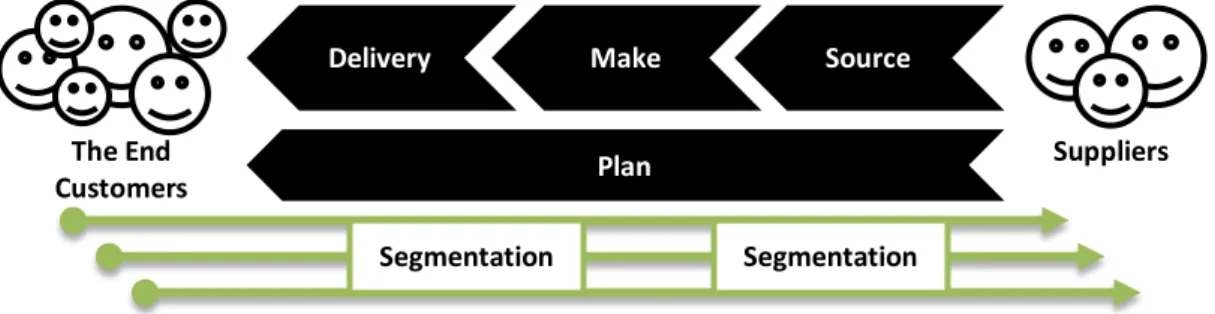
The second part is mostly of conceptual nature. For the case study approach, a down-top (Baker, 2003) roadmap is proposed based on various contributions focused on the end customer as the key driver of the SC illustrated in the Figure 5. Are then defined the necessary key steps to perform the raw components, products and clients segmentation as well as the respective managerial suggestions to build the differentiated SC strategy and segment prioritisation based on revenue and variety. In addition, the multidimensional scaling is applied as a method to infer whether postponement and late differentiation are suitable, addressing the product common components.
Figure 5: Demand driven SC logic followed in the proposed roadmap
The third part concerns the empirical exploratory research based on a case study which is particularly interesting because it addresses several secondary research gaps: Firstly, the B2B segmentation is an immature field (Blocker & Flint, 2007; Steenkamp, 2005) requiring empirical research; secondly, the SC segment instability is one of the major issues (Blocker & Flint, 2007) and this particular approach focuses on demand equalisation and instability
Literature Review “SC Strategy”
“SC Paradigms” “What is the right supply chain
for your products”
Bibliometric Approach
Main research Stream id. SC classification variables id.
SC main paradigms id. Research gaps id. “Supply & Demand Mismatch”
The End
Customers Suppliers
Delivery Make Source
Plan
Segmentation Segmentation
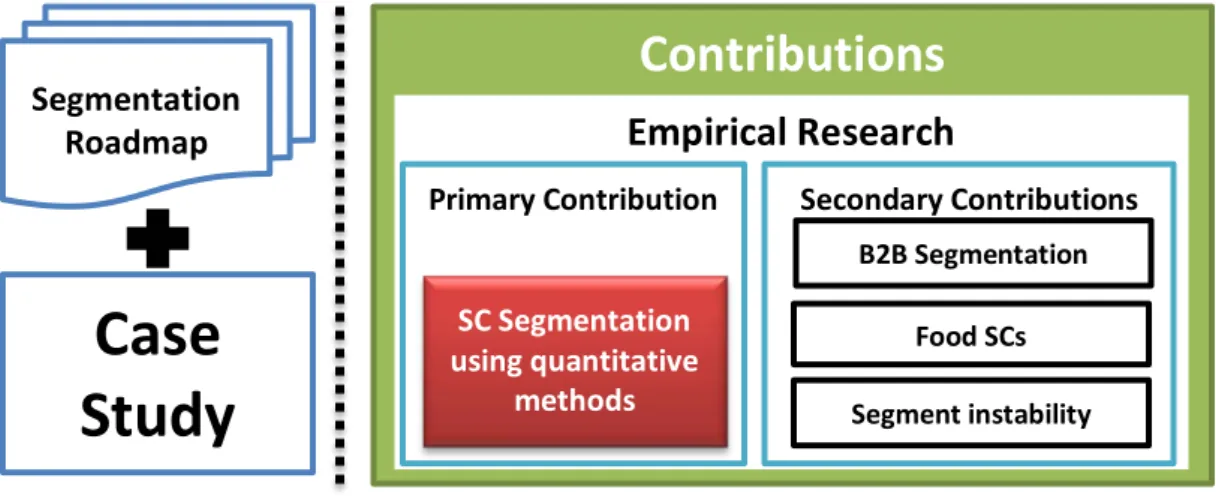
7 buffering by matching the proper SC ‘tailored practices’ (Lapide, 2006) on the instable segments; finally, the overall problem of food SCs is poorly developed and regarded as one of the most difficult to manage (Ronga, et al., 2011), and this research proposes a practical roadmap focused on several food SC particularities. (Figure 6)
Figure 6: Thesis practical part main contributions
In particular regarding segmentation through the empirical research, several hypotheses arise. First, segmentation enables better setting of service standards as different segments require different targets and require different management addressing the cost to serve. Second, it enables better match between customer expectations and what company is willing and capable of providing. Third, it provides ground for negotiation of service standards with customers. Fourth, it is also found to be an enriched alternative to the Pareto tool for client prioritisation, reflecting not only profitability, but reducing the client variety making management easier. Finally, it is proposed a new segmentation concept on procurement based on the client’s demand which segments the components as key and specific, either stable or variable, suggesting different SC ‘tailored practices’ (Lapide, 2006) for each segment which is an alternative to the price driven portfolio approaches focused on the bargain power balance described by Kraljic (1983).
As a conclusion, this study also suggested that SC segmentation is essential for agile, aligned, and adaptable SCs described by Lee (2004) due to its extension through the whole SC, possibility of re-segmentation enabling real-time adaptability retaining the needed level of agility by not falling into strict paradigms. As well as, it is a move towards the merging of system 1 and system 2 thinking, thus enabling more rational managerial decisions.
Finally, several further research recommendations are made, as this research only scuffed the tip of the iceberg on the new-born topic of segmented SCs.
Case
Study
Segmentation
Roadmap
Contributions
Empirical Research
Secondary Contributions B2B Segmentation Food SCs Segment instability Primary Contribution SC Segmentation using quantitative methods8
1.7 Thesis outline
This thesis has a logical evolutionary design illustrated in Figure 7.
Figure 7: Thesis design
First, the question is set based on a primary literature review further supported by a profounder literature review in section 2 which allowed a better insight on the current state of the art. Consequently, several research ‘gaps’ were identified which justified further developments.
It is then defined a SC segmentation roadmap in section 3, which purpose is to outline the essentials for a generic approach on SC segmentation. The proposed roadmap is an outcome of a critical approach on the reviewed body of literature.
The case study is structured following the defined roadmap. The empirical application main objective is to criticise and draw up a set of possibilities, proposed tools as well as result interpretation. The value of this chapter is not the possible company’s benefits, as those are secondary, but the exploratory walkthrough of the defined roadmap and testing ideas which are the foundation of this thesis. This approach based on empirical exploratory research is because SC segmentation is a nascent field, for example, a search on “SC segmentation”
5. Conclusion & Future research
Contribution Conclusion Future research
4. Case study: FMCG B2B Company Quantitative & qualitative approach 3. Supply Chain Segmentation Roadmap
2. Literature review
SC Paradigms Classification variables Frameworks
Question:
“What is the most appropriate approach for implementing supply chain segmentation to enable better alignment of demand and supply in a FMCG context?”
9 keyword in Scopus SciVerse database revealed only fifteen matches (in any field), which is an evidence of this specific topic immaturity.
This is a single instrumental case concerning a business-to-business (B2B) food company operating in Europe and North Africa. The company was particularly interesting because it is a specialised company, which grew too fast, producing fruit composites integrated into dairy products (core business). Predominantly B2B, it suffers great demand variability due to the bullwhip effect (Forrester, 1961) regarding its position in the chain. It works on a pure make-to-order basis with no forecasting, producing over one thousand unique products, each engineered exclusively for only one client following very strict quality requirements (typical to B2B food industry) and short time-windows (due to the product perishability). Faced with the company’s initial challenge for improving forecast accuracy, the suggestion was the broader concept of SC segmentation because the previous literature review converged on it as a possible way of approaching supply and demand mismatch.
The thesis closes with its contributions, conclusion and further research recommendations. This can be regarded as the most important part of the work as it states the key critiques and lessons learned from this particular case of research, giving practical directions for future research.
1.8 Chapter summary
This section core function is to define the scope, organisation and contribution of the present thesis. The need for differentiated supply chains is now clear as well as it gives the reader the basis for understating the underlining reasons of its organisation.
Before the detailed analysis of literature which does converge on the foundations of the need and means of achieving differentiated SC strategy (Fisher, 1997), it is stated that as one size no longer fits all (Shewchuck, 1998), analysis on product, demand and supply characteristics is critical (Christopher & Towill, 2002; Godsell, et al., 2011; Lee, 2002). Thus, it is about “how to” choose the right supply chain strategy and not about strategy itself. Being this research focused on three key bodies of literature: marketing, SC management and SC processes – the specific focus is the customer, as being the ultimate reason for supply chain existence, what suggest demand driven studies consequently converging on segmentation applied to SCs. To support and close one of the identified gaps in literature, an exploratory empirical study is carried on. It is meant to address the identified gap in literature regarding the lack of quantitative studies. These hold a strong focus on system-one thinking in management, as
10
being the intuitive one. This makes evident the need towards system-two (Stanovich & West, 2000), as being the objective and analytical approach towards decisions.
11
2 Literature Review
“A stupid man's report of what a clever man says is never accurate, because he unconsciously translates what he hears into something that he can understand.”
Bertrand Russell (1945) in A History of Western Philosophy
2.1 Chapter outline
Figure 8: Chapter 2 structure
As illustrated in Figure 8, the following chapter is one of the most extensive and important of this thesis. It defines the theoretical background of the identified problem as well as lays the foundation for the practical case study. Following the 2.2 introduction providing a more complete insight on the literature, it is then explained the adapted methodology for the review of literature.
Firstly, in order to align the understanding behind the core concepts underlying this thesis, section 2.4 underpinning definitions defines: what is supply chain and supply chain management; what is strategy and in particular, SC strategy; and finally, what is segmentation in scope of management.
Secondly, Section 2.5 is meant to define the body of literature defining the key contributions on this matter, using a bibliometric approach described in section 2.5.1, two different points of view are analysed: 2.5.2 the ‘big picture’ and the 2.5.3 specific research focus.
Thirdly, it is then analysed the nature of the focus research papers in section 2.6, in particular its nature as being conceptual or/and either quantitative or qualitative, as well as its focus
2.2 Introduction
2.3 Methodology 2.4 Underpinning definitions
2.5 Research segments
2.6 Research paper classification 2.7 Product and market oriented SCs
2.8 SC Configurations
2.10 Chapter summary
2.4.1 SC / SCM 2.4.2 Strategy 2.4.3 SC Strategy 2.4.4 Segmentation
2.5.1 Bibliometric approach methodology 2.5.2 The ‘big picture’ 2.5.3 The research focus
2.9 Conclusion
12
sector. This converges on a specific types of SCs, product and market oriented SCs (2.7) which are characterised by a number of classification variables (2.7.1) as well as its categorisation (2.7.2), closing with the most recurrent set of variables named DWV3 widely applied to many different sectors. Finally, three dominant SC paradigms are described in section 2.8, as well as the comparison of various literature contributions regarding the three main paradigms: lean, agile and leagile.
Finally, follows the 2.9 conclusion which bolds the probable research gaps, further research needs and some final thoughts regarding the topic. Closing the chapter come a brief summary about the core ideas essential for the following chapter.
2.2 Introduction
SC management is becoming more and more critical to remain competitive in the market (Gattorna & Walters, 1996). Matching customer requirement with product characteristics and ensuring delivery should be one of the greatest concerns for the management (Li & O'Brien, 2001; Aitken, et al., 2003; Holweg, 2005; Demeter, et al., 2006; Payne & Peters, 2004).
Therefore, it is important to align SC strategy and products classification variables accordingly to the target market (Christopher & Towill, 2002; Payne & Peters, 2004). There is no such thing as a “one-size-fits-all” SC strategy (Shewchuck, 1998), thus strong market orientation is more and more necessary in order to identify classification variables (Fisher, 1997; Frohlich & Westbrook, 2001; Schnetzler, et al., 2007). Christopher and Towill (2000; 2002) and other authors created models by considering dominant classification variables using the combination of variables such as duration of life cycle, lead time, volume, variety and variability (Childerhouse, et al., 2002; Vitasek, et al., 2003; Cigolini, et al., 2004). Those five classification variables are also known as DWV3 (Christopher & Towill, 2000). On the other hand, Lee (2004) defined three key dimensions of competitive and sustainable SCs: agility; alignment; and adaptability.
Many authors tried to develop a framework that could embrace the complexity of the topic leading the management towards the right SC strategy (Harland, et al., 2004; Jüttner, et al., 2010; Godsell, et al., 2011; Payne & Peters, 2004; Christopher, et al., 2009; Christopher & Towill, 2002; Mason-Jones, et al., 2000; Schnetzler, et al., 2007; Giannakis & Croom, 2004). Two key perspectives arise, regarding SC configuration and SC management. On one hand, researchers of SC configuration (known as supply networks), focused on the number, role and locations of the various SC actors, as it is individual role in it (Nassimbeni, 1998; Harland, et al., 1999). On the other hand, research has been focused on the SC management, identifying the
13 practices that can lead to better SC and product alignment, as for example the use of information-sharing tools, quality management practices, co-design approaches, etc. (Lamming, et al., 2000; Giannakis & Croom, 2004; Bruce, et al., 2004; Harland, et al., 2004; Christopher, et al., 2004).
The dependence of product and market characteristics is clear (Fisher, 1997; Lamming, et al., 2000; Godsell, et al., 2011). One way of distinguishing products is regarding its functional or innovative characteristic (Fisher, 1997). This leads to different SC configurations: physically efficient SCs for functional products and market-responsive SCs for the innovative ones (Fisher, 1997). Lamming (2000) expanded the Fisher’s model (1997) by considering the product uniqueness and complexity, while Lee (2002) focused the analysis on supply and demand uncertainty, which is one of the main issues in SC management (Simangunsong, et al., 2011).
SCs have evolved, growing into networks, and broadening management scope beyond organization boundary, downstream into their customers and customers’ customers, and upstream into suppliers, and then into suppliers’ suppliers. Competitive reality changed too; the proposition is that networks compete with networks, rather than simply firms with firms (Cunningham, 1990; Christopher, et al., 2009).
Regarding the sustainability; social, environmental and economic dimensions, choosing the appropriate SC strategy is critical. First, concerning environmental dimension, more efficient SC means fewer wastes, less resource consumption, which consequently leads to the economic dimension through fewer costs. Second, in order to sustain competitive advantage the ability of choosing the right SC makes companies more competitive and more resilient to market and demand changes what by itself means increasing the probability of company survival and consequently local stability, development and employment what completes the third, social dimension of sustainability.
This literature review purpose is to highlight the key perspectives on the problem of matching the SC with product and market characteristics. This chapter is organized in sections: After a brief research methodology explanation follows the identification of research segments by means of a bibliometric approach, then research gaps following with an insight on relationship between product characteristics and customer requirements, a summary of perspectives on classification variables that appeared in recent literature which can be used for developing different product/market segmentation. Further, SC configuration and ‘tailored practices’ (Lapide, 2006) are described followed by the summary of literature contributions on
14
product classification regarding three SC configurations: - Lean, agile and leagile. Finally, the chapter closes with further research recommendations. The objective of this section is to gather and organize some of the most influential developments on the question of SC strategy in order to support further development.
2.3 Methodology
This literature review concerns the topic of “choosing the right supply chain”, which converges on SC segmentation.
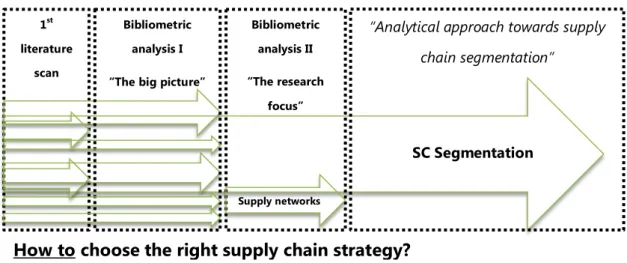
Figure 9 illustrates how the research converged on the specific topic at the different stages. After a brief introduction stating the major developments, follows the methodology explanation. The adopted methodology is a systematic bibliometric approach as visual schematizations are considered to be a powerful way of seizing complex ideas. It is divided in two groups: The “big picture” which is a higher level search on “supply chain strategy” keyword; and a more focused and critically selected body of papers, encompassing a wider range of keywords that are related to the topic. This approach from two different flanks on the same issue regards the known limitations of the bibliometric analysis which tends to overlook similar ideas under different terminologies and the database limitations.
Figure 9: Research evolution
The first approach follows the basic rules for such analysis and is as neutral as possible and regards only one database, in contrast, the second breaks several rules by using different research databases and a wide range of keywords. That way, it is possible to constraint the field of interest enabling more efficient approach on the main interest yet aware of the various streams of research. Once the research segments are identified, the paper focuses on the densest cluster of contributions which can be considered the main stream. This main stream is then analysed on the abstract and keyword level, followed by individual paper
1st literature scan Main stream Bibliometric analysis I “The big picture”
Bibliometric analysis II “The research focus” Supply networks SC Segmentation
“Analytical approach towards supply chain segmentation”
15 reading and respective selection. This allows the identification of strongly related contributions which the general bibliometric approach failed to identify due to its’ inherit limitations.
The literature analysed in this review has been collected through two major scientific research databases: SciVerse ScienceDirect and Emerald Group Publishing Limited. The keywords used to search the business and management research journals were “supply chain management”; “strategy”; “market specific”; “market segmentation”; “management techniques”; “product classification”; “product attributes”; “demand chain management”; “aligning supply chain”; “matching supply chain”. However these keywords resulted in an excessive amount of papers so the initial triage requisite was the term “supply chain management” in combination with others, followed by abstract reading and classification. The identified papers are then categorised into three main groups: Conceptual papers on SC strategy; and empirical case studies of quantitative or qualitative nature.
2.4 Underpinning definitions
2.4.1 Definition of supply chain
Supply chain (SC), at its basis, is the overview of the various elements from the initial source of raw material (supplier) to the ultimate customer; quoting:
“…a single entity rather that relegating fragmented responsibility for various segments in the supply chain to functional areas such as purchasing, manufacturing, distribution and sales.” (Oliver & Webber, 1982) and “Collection of activities that are performed to design, market, deliver and support its product” (Porter, 1985)
And concerning its management, “supply chain management” is the management of a network (complex chain) of interconnected businesses involved in the provision of product and service packages required by the end customer in a supply chain (Harland, 1996)
2.4.2 Definition of strategy
Strategy is the art of organisation. It is originally from the Greek word ‘strategos’ understood as ‘general’. However, the modern use of the word ‘strategy’ is different as it regards to a plan of how to get to a desired position. Focusing on economic terms, it is ‘how’ to achieving objectives (Andrews, et al., 1965).
2.4.3 Definition of supply chain strategy
Supply chain strategy is part of a more general business strategy (Porter, 1985). It is considered essential to the success of most contemporary business organisations and its
16
definition is so far ambiguous and varied (Hines, 2004). However, this thesis philosophic position focused on the customer as the ultimate purpose of a supply chain (Brace, 1989; Childerhouse, et al., 2002; Hines, 2004), thus the presented definition is proposed by Hines (2004) as:
“Supply chain strategies require a total systems view of the linkages in the chain that work together efficiently to create customer satisfaction at the endpoint of delivery to the consumer. As a consequence costs must be lowered throughout the chain by driving out unnecessary costs and focusing attention on adding value. Throughput efficiency must be increased, bottlenecks removed and performance measurement must focus on total systems efficiency and equitable reward distribution to those in the supply chain adding value. The supply chain system must be responsive to customer requirements.”
2.4.4 Definition of segmentation
The concept of market segmentation concerns the market division into different segments (groups) of customers sharing similar product/service requirements and demand pattern (McDonald & Dunbar, 2010). The main purpose of segmentation is to enable better demand perception so the company can best satisfy the clients’ needs. It is considered to be essential for successful marketing and business development (McDonald & Dunbar, 2010).
2.5 Research segments – Bibliometric approach
In nowadays, the number of people contributing to research is rocketing. More and more contributions are coming up and when the amount of information exceeds the human limit, bibliometric approaches (de Bellis, 2009) should be used to embrace the growing world of concepts. Such approach should be seen as a support of human literature analysis and never as an exact or absolute stand-alone method as it has several constraints.
This method is an efficient way of identifying possible intellectual structures in the scope of research (Charvet, et al., 2007; de Bellis, 2009). Citation and co-citations analysis are a powerful visual approach on discovering research sub-fields and it is applied in this work to define its focus (de Bellis, 2009). However, search keywords have a strong influence on the output of this kind of approach. To address this issue, the bibliometric approach using a citation and co-citation analysis was applied on two different groups. Firstly, we performed an independent search in a single database by means of a neutral keyword such as “supply chain strategy/strategies”. The second was an analysis to the selected papers, which were considered relevant for this study and are cited through the work.
17 The two key research questions to address with this particular approach were:
• Which is the main stream of research about supply chain strategy in a global scale? • Which is the intellectual structure of the selected body of references?
2.5.1 Bibliometric approach methodology
The bibliometric approach is used to identify possible intellectual structure within a field of research, namely the selected body of literature, based on two methods: citation and co-citation analysis. The first, co-citation analysis concerns the direct counts of references received from other documents which can be used to assess the impact of the cited work (de Bellis, 2009). The idea is to highlight heavily cited papers, as they are like to hold a great influence on the subject in scope. The co-citation analysis concerns on the common references between each pair of selected papers allowing the identification of proximities between topics, authors or research methods. These proximities, specifically the proximity matrix, allow a space plot using heuristics for spatial scaling, multidimensional scaling (MDS) ProxScal function in the IBM SPSS for example (Charvet, et al., 2007). In detail, multidimensional scaling is a data analysis technique which is used to display a structure of data as a geometrical picture, by means of distance-like data, e.g. proximities matrix; and it is mostly used to understand similarity of discrete entities (Schiffman, et al., 1981).
To perform such analysis, we must first select a pool of documents and prepare the data. The more neutral are the keywords the more efficient is the tool as it is less prone to form artificially induced clusters. However, this approach might prove to be useful applied on handpicked articles, which we already know to be similar.
The interpretation of the bi-dimensional plots is simple. Contributions holding higher rankings of proximity are closer while most of the novel/independent segments appear in the periphery as they lack of common references.
2.5.2 The big picture: Supply chain strategy intellectual structure
Research insight is always limited to the field of study. Any field, as broad as it may seem have a bigger picture which is sometimes difficult or impossible to grasp. So, there is certainly a bigger picture than the particular focus of this work, we performed a parallel research on the keywords “supply chain strategy” and “supply chain strategies” contained in the title, abstract and key wording on the SciVerse Scopus database limited to business/management journals only. This approach is less prone to artificially induced clusters because the more general is the key wordings the more neutral are the obtained results, thus more are the chances of research segment successful identification of the intellectual structure.
18
The query resulted in 326 raw papers with the respective citation count and references. The obtained data were codified as being “First author surname + publication year” and the respective references using the same process. Cases when one author held more than one publication during the same year, letters such as B, C, or D were assigned. This caused almost 10K lines of data, so in order to reduce the variety, we only selected publications containing one of more common reference what resulted in 244 master articles that are connected on different degrees. The 244 articles were organized in a square 244x244 matrix containing proximities that were imported into IBM SPSS for dimensional scaling using ProxScal function. Due to the size, the referred table was not included in the work, but an example of its format can be seen in Appendix 5.
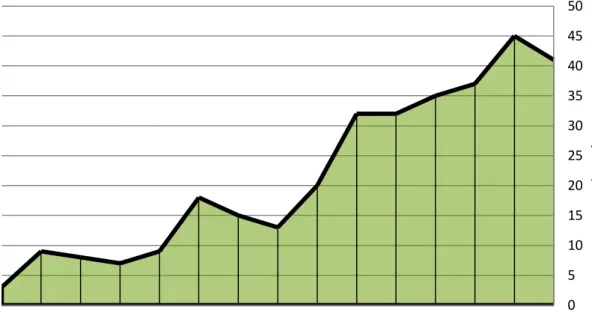
Figure 10: Number of articles per year from 1997 to 2012 (total of 326)
The Figure 10 clearly shows that “supply chain strategy” subject is becoming an eminent topic as the number of publications rose significantly from 1997 to 2011 dipping slightly in 2004 for so far unknown reasons. Concerning this particular search, one of the first key contributions to the topic was by Naylor et al., (1999), at least one of the first to refer explicitly “supply chain strategy”, being among the most cited works so far. This can be seen as the genesis of the problem that remained in the background during the next three years. However, it is important to keep in mind that such analysis is limited to the existent database, constrained by keyword limitations and may induce in wrong conclusions if considered as absolute and definitive. Seminal articles such as Fisher’s (1997) or the famous book by Gattorna & Waters (1996) does not come up in this database search. Another interesting observation is the peak
0 5 10 15 20 25 30 35 40 45 50 2011 2010 2009 2008 2007 2006 2005 2004 2003 2002 2001 2000 1999 1998 1997 N um be r o f pa pe rs Years
19 of contributions in 2002, one year after the publication of one of the most cited papers by Frohlich & Westbrook (2001) on the subject of SC strategy which is also one of the best examples of quantitative approach on the problem.
Figure 11: Most cited contributions
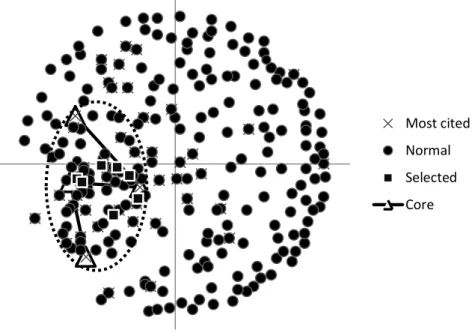
Firstly, for evaluating the impact distribution in the big picture, a quick analysis on the number of paper citations by other researchers considering that a “most cited” article is above the average number of citation of the total sample showed that it is not equally distributed. It is possible to identify that there are some concentrations of more influential (cited) contributions (Figure 11), however, one obviously group stand out which will be described further as the main segment of research on the topic of SC strategy. For example, the concentration of “heavily” cited papers located in the plot’s top, is a research segment that concerns the SC strategy in terms of SC integration with focus on environmental factors, additionally, a central zone leans towards information technologies as the enabler for SC integration, e-business, and performance evaluation. Consequently, many other hotspots arise which require deeper research.
The usefulness of this approach lies in the possibility of identifying intellectual fronts of some given subject. Further analysis must be made on other clusters as it may contain any different insights on the topic; this work focuses on the densest cluster of contributions generally connected to the lean-agile paradigms in the SC context.
Contributions Most cited
20
Figure 12: MDS plot of 244 articles (keyword "supply chain strategy”)
In Figure 12 where the focus segment is outlined by the dotted ellipsoid, it is clear that there are concentrations representing similar segments of research, a labelled plot of the same information can be observed in the Appendix 2 and the complete listing of the 244 contributions in Appendix 3. To define this article’s scope, further analysis will focus on the selected and core articles, enriched with other contributions found suitable to the topic. The conclusion drawn out of the above analysis which is also the answer to the first research question on what is the main research segment on this subject is that lean-agile school is one of the dominant segments, yet, there are other hotspots of contributions on the same matter which require more research.
Journal Counts %
1 Supply Chain Management 18 7%
2 International Journal of Production Economics 15 6%
3 International Journal of Operations and Production Management 11 5%
4 International Journal of Physical Distribution and Logistics Management 9 4%
5 Journal of Operations Management 9 4%
6 International Journal of Production Research 7 3%
7 European Journal of Operational Research 5 2%
8 Industrial Management and Data Systems 5 2%
9 Journal of Supply Chain Management 5 2%
Others 160 66%
Total 244
Table 2: Key journals
Finally, analysing Table 2 listing the top 9 journals regarding the number of contributions of the sample, it is obvious that “Supply Chain Management” journal is the top one. However,
Most cited Normal Selected Core
21 the topic seems to be evenly distributed through many other journals what is yet another evidence of the growing general interest on the matter.
2.5.3 The research focus
As the concepts of “supply chain strategy”, “supply network strategy”, “configuration”, and “segmentation” are often used to refer to the differentiated supply chain, this research selected a body of literature accordingly. It resulted in a list of articles which may be consulted in the Appendix 4 and the respective proximity matrix in Appendix 5 achieved using the script seen in Appendix 1.
Figure 13: Bi-dimensional plot representative of the selected references in this work. Childerhouse2002 Aitken2003 Bruce2004 Christopher2001 Christopher2004 Christopher2009 Cigolini2004 Demeter2006 DeToni1995 Fisher1997 Frohlich2001 Giannakis2006 Godsell2011 Grandori1995 Harland1999 Harland2004 Holweg2005 Lamming2000 Lee2002 Lee2004 Li2001 MasonJones2000 MasonJonesB2000 Nassimbeni1998 Naylor1999 Qi2009 Qi2011 Schnetzler2007 Selldin2007 VanHoek2000 Vitasek2003 Whitten2012
B
A
22
As may be seen in Figure 13, bubble sizes are proportional to direct citations achieved to the date of this writing and arrows indicate the influences: dark arrows represents strong/direct influence and grey is indirect but related. Note the article “constellation” marked with dark straight lines which also appears in the big picture analysis in Figure 12 and Appendix 2. There are five obvious “stars” in the selected literature. Judged by the number of citations works by Grandori and Soda (1995), Fisher (1997), Naylor et al., (1999) and Lee (2002; 2004) are the foundation of most of the further developments. The problematic of the "right" SC has been alive for a while, and many conceptual studies arose. The clearest reference on the topic, cited in hundreds of further researches, is in Fisher's (1997) seminal work "What is the right supply chain?”. Some years later, Naylor et al., (1999) suggested the integration of the lean/agile paradigms into the total SC strategy expanded and discussed as being both complementary (Christopher & Towill, 2001). Further, going to higher conceptual levels, Lee (2004) publishes the well-known "Triple-A Supply Chains" article saying that the SC must be developed in spite of adaptability, agility and alignment.
This trinity of contributions is possibly the best foundation of the differentiated SC strategy. Facing different clients, different suppliers and different products, we must develop different SC strategies, i.e. SC segmentation through demand and product characteristics.
Concerning the forth “star”, Grandori and Soda (1995), belong to a parallel school focused on SCs as supply networks. The bridge between the two different schools can be observed in the contribution by Lamming et al., (2000). It is proposed a classification of supply networks as an extension of SCs stating that the so far existing SC models were too simplistic, linear and unidirectional while the supply network concept takes into account lateral links, reverse loops, two-way exchanges and so on encompassing upstream and downstream activities. On the other side some years later, Cigolini et al., (2004), suggests a new conceptual framework for SC management (SCM), with focus on SCM strategies, establishing it on many references common to Lamming et al., (2000).
There is some degree of confusion between the two concepts. This literature review took into account the supply networks, too, as both concepts are meant to serve the same purpose: satisfy as efficiently as possible the need of the end customer.
2.5.3.1 A – Supply networks school
SCs and supply networks are meant to serve the same purpose: its final customer need. Thus, in order to get an insight on different configurations the present work took into account both perspectives. The most relevant contribution identified is the one by Grandori and Soda
23 (1995) which concern was the antecedents, mechanisms and forms of different interfirm networks. Its key contribution is the organization of the so far developments in the field regarding the assessment of different forms of networks, the organizational mechanisms and main variables (similar to classification variables previously mentioned). In the same year, however much less cited is the work by de Toni and Nassimbeni (1995) that similarly focused on the genesis, stability and logistical implications of the supply networks. However, it was a case study comparing two different industrial districts identifying the variables that determine or impede the formation of efficient buyer-supplier relationships. Amongst three different propositions, they analysed the influence of the product structure and the nature of the process on the networking process.
Following this, Nassimbeni (1998) developed taxonomy of network structures and co-ordination mechanisms, proposing a new framework for the classification of the main network structures. One year later, more focused on the idea of strategy, Harland et al., (1999) presented an article on the conceptualization or supply strategy backed by a Delphi survey. Then Lamming et al., (2000) suggest yet another classification for supply networks with a clear strategic purpose. Both these works by Harland et al., (1999) and Lamming et al., (2000) are completed with the model presented in the contribution by Harland et al., (2004), a more complete conceptual model for researching the creation and operation of supply networks. Despite the common authors, it is observed a clear shift towards strategy and network differentiation through classification variables. Again, the approach towards this important issue is mostly conceptual and qualitative.
2.5.3.2 B – Lean-agile school
This concentration of papers is characterised to be mostly concerned on the lean-agile paradigms applied to the SCM. Most of the contributions share common authors generally from business schools in UK, namely Cranfield and Cardiff. The most citied and one of the oldest contributions is the one by Naylor et al. (1999), who suggested the integration of lean and agile manufacturing paradigms into the total SC strategy in order to meet the demand characteristics, strongly influenced by Fisher (1997). Following that same idea, Mason-Jones et al., (2000) published a work on the leagile SC integrating both lean and agile paradigms into one. In the same year, Mason-Jones et al. (2000) contributed with another work focused on the three SC configurations: Lean, agile or leagile, and the best way of choosing between them accordingly to the marketplace.
Two years later, Childerhouse et al., (2002) starts a slightly different segment of contributions along with Aitken et al., (2003). . It is one of first sector-focused studies followed by many
24
others. It is also the appearing of the demand chain management as a new demand driven SC. The aim is to answer two key questions, one regarding strategy and other the tactics: “what facilities are required and how should they be laid out to enable the necessary focused demand chains?” and “which focused demand chain is appropriate for this product?” respectively. In the meantime, Aitken et al., (2003) uses the same case study to analyse the impact of the product life cycle on the SC strategy. The concern of “matching the product characteristics and customer requirements” explicitly appear as a solution to remain competitive in the modern marketplace. The ability to develop and match the SC strategies to products accordingly to its life-cycle stage is shown as the key to success. Further, Bruce et al., (2004) applies the lean and agile paradigms to the textiles and clothing industries. Likewise, it discusses each one and the combination of both, the leagile SC.
Still in 2004, Cigolini et al., (2004) developed a new conceptual framework for SCM from an operational perspective. Very practical, this article set out a combination of management techniques and supporting tools used to analyse and describe SCM strategies backed up with a large set of SCM case studies from seven different industries.
In the following year, Holweg (2005) promoted a new conceptual model related to the three dimensions of responsiveness. It was based on agile production, identifying the key factors that determine the responsiveness of a SC system. Different SC strategies can be developed by means of the proposed model as each SC settings are matched to the unique profile obtained. The selected key-factors are the product, process and volume as well as others. It took almost ten years to someone finally test the well-known Fisher’s (1997) model. Seldin and Olhager (2007) confirmed the relationship between product design and SC design by means of an extensive empirical survey to 128 companies. The key findings were the significant relationship between product types and SC types, as well as the significant impact of alignment on performance.
The most recent developments in the lean-agile school are focused on the classification of the value streams and SC segmentation through the empirical application of the DWV3 classification variables (Christopher, et al., 2009); (Godsell, et al., 2011).
One of the key characteristics of this cluster is the empirical application of almost all of its contributions, what can be a solid argument about the practical usefulness of the discussed developments. However, most of its empirical applications are qualitative.
25
2.6 Research papers classification
Choosing the right SC based on products and markets has been an eminent topic trough the last decades. The literature review has shown that regarding the period between 1982 and 2012, most of the publications are conceptual. Both empirical research using case studies and exploratory surveys/interviews are qualitative and the lack of quantitative empirical research is obvious. (Table 3)
Author Year Conceptual (Quantitative) Empirical (Qualitative) Empirical Type of industry
Whitten et al. (2012) ● Mix
Qi et al. (2011) ● ● Mix
Godsell et al. (2011) ● ● FMCG
Qi et al. (2009) ● Mix
Christopher et al. (2009) ● ● Mix
Selldin & Olhager (2007) ● Mix
Schentzler et al. (2007) ● ● Electroacoustic
Demeter et al. (2006) ● Automotive
Holweg (2005) ● ● Automotive/Electronic
Cigolini et al. (2004) ● Mix
Lee (2004) ● Mix
Giannakis & Croom (2004) ● Mix
Bruce et al. (2004) ● Textile/Clothing
Harland et al. (2004) ● ● Mix
Christopher et al. (2004) ● Fashion
Aitken et al. (2003) ● Lighting
Vitasek et al. (2003) ● Mix
Christopher & Towill (2002) ● ● Clothing
Childerhouse et al. (2002) ● ● Lighting
Lee (2002) ● Mix
Li and O'Brien (2001) ● Mix
Frohlich & Westbrook (2001) ● Mix
Van Hoek (2000) ● Mix
Mason-Jones et al. (2000) ● ● Mix
Lamming et al. (2000) ● ● Mix
Harland et al. (1999) ● Mix
Nassimbeni (1998) ● Mix
Fisher (1997) ● Mix
Gattorna & Walters (1996) ● Mix
Oliver & Webber (1982) ● ● Mix Table 3: Research papers classification and type of industry
The dearth of quantitative empirical research can be logically explained by the associated complexity of quantifying most of the SC related elements. Vitasek et al. (2003) addressed the supply-demand mismatch by analysing both the volume and variability of demand for