Self-perception of parental competence in parents of pre-school children
Graça Aparícioa*, Madalena Cunhaa, João Duartea a
Health School, Polytechnic Institute of Viseu, Portugal/CI&DETS *Correspondence author: [email protected]
Keywords: Parenting, Child, Self-perception of competence Funders: Superior Health School of Viseu and CI&DETS
Abstract
Background: The concept of self-perception of parental competence refers to how parents perceive their performance, beliefs and attitudes in their role as parents, the ability to address specific problems and find effective solutions. Objectives: To evaluate the self-perception of competence in parents of preschool children and the relationship with sociodemographic variables.
Methods: Cross-sectional and observational study with 792 parents, women average age 34,15 (Dp=5,01), men 36,1 years old (Dp=5,34), living in Portugal. The analyse includes sociodemographic characterization and the Questionnaire d’Auto-Évaluation de la Compétence Éducative Parentale (QAECEP) (Terrisse & Trudelle, 1988) validated to the portuguese population by Aparício (2012).
Results: The validation study of QAECEP indicated good internal consistency (Cronbach's Alpha= 0.773). Self-perception of competence, and satisfaction is high in 51,1% of parents. The older parents see themselves as most competent and effective, with significant results for mothers (Chi-square=21,755; p= 0,010). Parents with higher level of education perceive themselves as more satisfied, motivated and competent, but only significant for the mothers (p=0,000). The high/medium familiar incomes influences significantly the perception of satisfaction, motivation and global parenting competence ( p=0,000). Feelings of low efficacy (p= 0,05) higher satisfaction (AR= 2,6) and global competence (p= 0,036) are significant in parents of younger children.
Conclusions: Age, income and education level influences the self-perception of parental performance, so in health promotion activities is important to identify the parental feelings and increase their self-confidence in the defence of an positive parenting.
Background
Family is one of the most important institutions of society, representing a primary social group which influences and is influenced by other people and institutions. Having children and the consequent establishment of the parental role, generates individual changes, mainly at an emotional level, due to the commitment each member of the family has to put into conceiving the perception of themselves facing their new role1. However, the impact a child has in the family isn't limited to their birth, but rebounds along the family life cycle and proves to be one of the most complexes tasks of adult life1.
Adjusting to parenthood can trigger feelings of insecurity, inability and anxiety which may affect the wellbeing of each family member, impacting in their relationships and shaping the secure or organized bonding with child. Some studies2,3,4,5 that have delved into the subject, revealed that the perception of parental competence differs between mother and father. A study with Australian parents3 (no couples) reported higher levels of efficacy and interest in the parental role within mothers, while fathers showed higher levels of satisfaction, results confirmed in other studies2,5,6.
The concept of parental self-perception of competence refers to the way parents perceive them-selves performing their parenting role, i.e. behaviours and beliefs they have about their role as parents7. Parental self-perception has been linked to the concept of self-efficacy, as it evaluates the way parents perceive their own efficacy in performing the parent role, creating powerful predictors of more effective and sensible parental practices8.
According to the author, the feeling of individual efficacy may be defined as one's belief of their ability to face specific problems and to find effective solutions. This belief is what influences the effort committed in the process. In the context of parental relationships, the feeling of efficacy relates to higher maternal responsibility and with a more realistic perception of the child's health and needs9.
Belsky10 recognises three main levels of influence in the global structuring of parental behaviour: their personal and psychological resources, the child's characteristics and the broader context in which the parent - child relationship is established.
In the context of parental resources, parental performance depends partly in the parent's own childhood experiences, such as the parental representation of their own childhood story, because these are extremely important elements in the construction of the future role as a caregiver11. Other studies5,12 have analysed the influence of the parents social context, such as the socioeconomic status (SES), revealing that these can have a significant impact in the expression of several aspects of parenthood. The authors noticed that education levels related to self-perception of parental efficacy and that parents with low incomes tend to have lower levels of self-efficacy. This means that parents with low SES often believe they have less control over their children's development as a result of the gap between the targets they set and the ability to reach them.
So, in the actual social context, are parents able to ensure the best for their children? Are they able to take pleasure in their parenting and in the inherent responsibilities? Parental role satisfaction is associated with family quality of life. Intuitively this is perceived as the gratification obtained from the pleasure of being a mother or a father1. Self-fulfilment is greatly related to the pleasure we take from performing tasks we get involved into, and we often commit ourselves deeper into those that yield higher gratification. Therefore all things considered, promoting a better attainment of the parental role implies on one hand, understanding the parents self-perception of their competences as a result of their expectations, cultural beliefs and social context and from there we can define strategies to strengthen self-esteem, skills and sensitivity to obtain the most appropriate response13. On the other hand, helping parents create the resources to improve their competences will contribute to a better adaptation to the dynamic (in)balance that a family is.
According to the concept of empowerment, the process of promoting competences has far outgrown the maternal training of the XX century, which promoted the perfect mother's myth, and deeply contributed to the mother’s insecurities and anxiety regarding motherhood14
. Nowadays, parental support programmes intend to improve parent - child interactions, help
parents to better predict their children's developmental changes, suggest learning activities and take on their parental responsibilities. Parents want the best for their children and parental support programs may help them optimise their abilities and reach their goals.
For this purpose, a strict collaboration between parents and professionals is defended and the focus of the process is the expansion of familiar skills and resources and their context while respecting their rhythm, preferences and necessities and encouraging the family's participation in decisions and activities, using a bottom-up approach and never bottom-down15. This work had as main purpose to evaluate the self-perception of competence in parents of preschool children and the influence of their socio-economic context.
Material and methods
This was a cross-sectional and descriptive study, conducted with a non-probabilistic sample of 792 parents (couples) of healthy children, mother’s average age 34,15 years old (Dp=5,01), fathers 36,1 years old (Dp=5,34), with a mean of 1,29 sons (SD= 0,62) ranging between 0 and 5 sons, residents in the centre region of Portugal. The information was obtained by a survey of socio demographic characterization and the Questionnaire d’Auto-Évaluation de la Compétence
Éducative Parentale (QAECEP)16. This questionnaire is an translated and adapted version by Terrisse & Trudelle (1988)16 from the original “Parenting Sense of Competence” (PSOC), to the Canadian population and later validated by different authors and in different countries4,3,6. Widely used in international investigations, it was also our purpose to do its validation for this Portuguese population. The process was preceded by the authorization from the author of the Canadian version and was used the translated version by Coutinho (2004)13. The QAECEP evaluates the parenting sense of competence in the performance of its role and the original version consists of 17 items that are grouped in two dimensions or factors. The first, affective dimension assesses the feeling of satisfaction that stems from parental role, reflecting the level of frustration, anxiety and motivation. The second factor or instrumental dimension evaluates the sense of self-efficacy, reflecting the level of effectiveness, attitude and ability to solve problems arising from the parental role. It can be applied to fathers and / or mothers by replacing the progenitor in the assertions it is intended for. The answers are assessed on a Likert scale with 6 response choices, considering 1 to fully agree and 6 to completely disagree.
The higher the score, the greater the sense of perceived competence by the mother / father. The "Sense of Effectiveness " is measured by seven questions (1, 6, 7, 10, 11, 13 and 15). To calculate the score, the value assigned to each question is the value chosen by the respondent, but reversed (ie if 6 is the chosen response, revert to 1,and so on), the score ranges from 7-42 . The "Sense of Satisfaction" is assessed by the questions 2, 3, 4, 5, 8, 9, 12, 14 and 16. The score obtained, corresponds to the numerical value of the issue chosen by the respondent, ranging from 9-54.
The "Sense of Competence" results from the sum of the scores of the two dimension (sense of effectiveness and satisfaction), ranging from 16-96.
After factorial analysis in the validation process for the Canada population, the item 8 has become incorporated into the "satisfaction" factor and the item 17 was deleted, so that, for all the 16 items, the overall coefficient of internal consistency was 0.79, being respectively 0.76 and 0.75 for the factor "effectiveness" and "satisfaction".
Ethical procedures were safeguarded, by obtaining free and informed consent from parents who accepted to participate.
All analyses were performed with SPSS® – Statistical Package for Social Sciences (Version 21.0 for Windows), and the level of statistical significance was defined as p<0,05.
Results
Family Socio-demographic characterization
The sample under analysis was composed by 792 parents, with the mother’s age ranging from 19 to 50 years (Mean= 34.15 years old; SD= 5.01) and the father from 23 to 60 years (mean= 36.1; SD= 5.34), prevailing in both the age group between 33-39 years. Mostly mothers (35.5%)
has higher education (about 15 years of schooling), while fathers, 39.1% had up to 9 years of schooling. In the sample, the majority were employed, mostly of mothers were experts and liberal professionals (29.3%) and fathers fulfilled as manual worker (20.4%) followed by experts and liberal professionals (19.9%). Of the couples, 51.4% were living in the city and 55.7% had a medium-high wage.
Psychometric Study of the QAECEP
To proceed to the study of QAECEP validation, the results were subjected to exploratory factor analysis in order to be analysed the construct validity, i.e. to assess whether after the process of translation into Portuguese language, the factors measure the same concepts17. To the study of internal consistency were determined the Cronbach's alpha indices, which indicated for all items a good consistency, ranging between 0.744 and 0.779. By extraction of the factors by varimax rotation method, were obtained three factors with eigenvalues greater than 1, which explain 53.96% of the total variance. In factor 1 - Sense of Effectiveness with a Cronbach's alpha = 0.856 saturate the items 1, 6, 7, 10, 11, 13 and 15, as in Canadian version, that explaining 24.07% of the total variance. In factor 2 - Sense of satisfaction saturate the items 2, 3, 4, 5, 8, 9,16, explaining 19.39% of the total variance, (Cronbach's alpha= 0.779), and factor 3 that we called Sense of Motivation, saturate the items 12 and 14, explaining 10.49% of the total variance (Cronbach's alpha = 0.698), items that integrated the satisfaction factor in the original version (Table 1).
Table 1 Cronbach’s Alpha values and total explained variance by factors
Factors N of
Items
Cronbach’s Alpha
Explained Variance
Eigenvalues % Variance Cumulative variance
F1 – Sense of effectiveness 7 0,856 3,852 24,072 24,072
F2 – Sense of satisfaction 7 0,779 3,102 19,390 43,463
F3 – Sense of motivation 2 0,698 1,680 10,490 53,960
To perform the evaluation of the Self-Perception of Parental Competence, which results from the sum of the scores of the three dimensions, we used the cutoff groups defined by the author, that ranging from “very weak sense of competence” (between 16-31) and “sense of competence very high” (81-96).
Faced with these cutoffs, the statistics obtained by parents individually (mother and father) were analyzed in their self-perception of global competence. There was for all, and among parents a
High sense of competence, with an overall average of 67.4 (SD= 10.8), ranging from 36 to 96,
with moderate dispersion (16.13%). The father has an average of 69.25 (SD= 10.40), ranging between 46 and 91 and higher than of the mother (mean= 67.27; SD= 10,90) ranging between 36 and 96 (Table 2).
Table 2 Statistics of global parental self-perception of competence Parents Minimum Maximum Mean SD VC% K/S
Pai 46 91 69,25 10,40 15,01 0,000
Mãe 36 96 67,27 10,90 16,20 0,000
Total 36 96 67,40 10,87 16,13 0,000
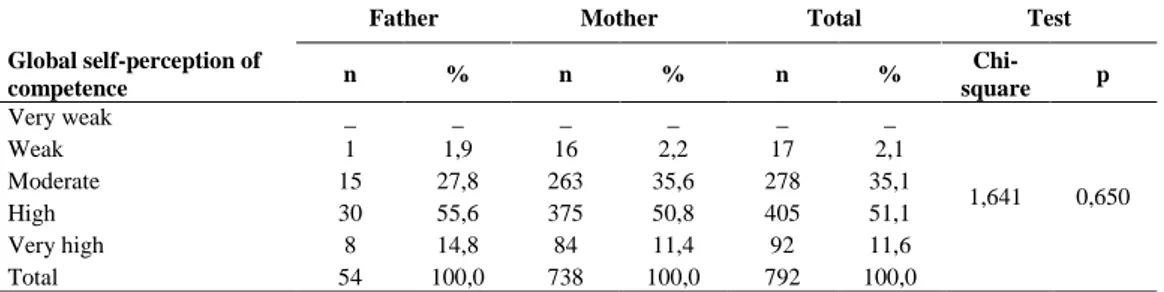
So, for the majority of parents (51.1%), self-perception of competence is High and Moderate in 35.1%. Extreme values (Very High and Weak) arise in respectively 11.6% and 2.1% of parents. Analyzing according to the father and mother individually, there was similar distribution, but the High and Very High self-perception of competence is most frequent in fathers, respectively
55.6% and 14.8%, while the Moderate and Weak is more expressive in mothers, 35.6% versus 2.2%, but the differences do not show statistical significance (p= 0,65) (Table 3).
Table 3 Classification of parental self-perception of competence Global self-perception of
competence
Father Mother Total Test
n % n % n % Chi-square p Very weak _ _ _ _ _ _ 1,641 0,650 Weak 1 1,9 16 2,2 17 2,1 Moderate 15 27,8 263 35,6 278 35,1 High 30 55,6 375 50,8 405 51,1 Very high 8 14,8 84 11,4 92 11,6 Total 54 100,0 738 100,0 792 100,0
Analysing the ratings by factors it appears that for both (father and mother), the perception of global competence and sense of efficacy and satisfaction ranging between a high and moderate level, while motivation is very high, mostly in father (90, 7%). The differences are not statistically significant (p> 0.05), but the adjusted residuals locate differences in very high sense of motivation in father (AR= 2.1).
In order to better realize how the feelings varied according to both parents, was made the U-Mann Whitney test, verifying by the average ordinations that sense of satisfaction, motivation and self-perception of global competence are higher in fathers, while the sense of efficacy is higher in mother, but the differences are not statistically significant..
Relationship between Self-perception of parental competence and socio demographic variables
According to the average ordinations of the Kruskal-Wallis test, are the mothers of the age up or equal to 40 years old, who have a better perception of self-efficacy, motivation and global competence. Those with 33-39 years have a better perception of satisfaction, only significant in the sense of efficacy square= 7.980; p = 0.046) and global parental competence (Chi-square= 9.390; p = 0.025). Regarding the father, those between 26-32 years old perceive themselves as more effective and with more global competence, while the ones between 33-39 years old perceived themselves with higher sense of satisfaction and motivation, but without statistical significance.
In the relationship to the education level, only the mothers with higher education punctuate with higher values and statistical significance in all factors except in the sense of efficacy, where are better classified those who completed only basic education, but without statistical significance in this last.
The relationship between family income and the self-perception of parental competence indicates that parents with higher income have higher average ordinations in satisfaction, motivation and overall competence, with significant statistical differences, while parents with low income, scored better in the sense of efficacy but without statistical significance.
Finally, considering the children's age, there was a significant relationship between the sense of
low efficacy (Chi-square = 21.969, p = 0.05) and high satisfaction (AR = 2.6) in parents of
youngest children (3 years) and a very high perception of global competence (Chi-square = 17.936, p = 0.036), that the residuals locates in children with 4 years old (AR = 2.5).
Discussion
Comparing the results of the performed validation with the validation of Johnston & Mash (1989)4, it is shown that all 16 questions are part of a 3-factor structure that explains 53.96% of the total variance, with a Cronbach’s Alpha=0.773. These results are very close to those found in the Canadian4 version, which overall Cronbach's alpha= 0.76, and 0.76 and 0.79 respectively regarding the efficacy factor and satisfaction.
Similarly, in the validation process carried out for the Australian3 population and where they examined the factor structure for mothers and fathers separately, by using a sample of fathers
(n= 615) and mothers (n= 586) non couples, between 20 and 60 years old, the oblique rotation allowed to retain three factors with eigenvalues greater than 1, that explained 47.3% of the variance for the sample of mothers and 50.1% for the fathers. In this study, the factors were designated as satisfaction, efficacy and interest, with Cronbach's alpha= 0.75 to the mothers and 0.79 to the fathers, in a factor structure similar to the results found in the current validation. From this discussion emerges that QAECEP expresses a good internal consistency, which adds its relevance for using in Portuguese population, pertaining the study of perceived parenting skills and early detection of problems that endanger the parent-child relationship.
The perception of global competence, sense of efficacy and satisfaction by the parents participating in our study fluctuated between high and moderate levels, and it was also verified that the sense of satisfaction, motivation and self-perception of global competence are higher in fathers while the sense of efficacy is higher in mothers, but the differences are only significant in the father's motivation. The differences in the perception of competence, namely, the greater efficacy by the mothers and motivation/father`s satisfaction have been described in several studies2,4,3,12. In fact, considering the already studied connection between the perception of parental competence and cultural environment where the family lives12, the high perception of self-efficacy of the studied mothers, puts them in the active role of their children's education. This is a typical characteristic of Latin mothers, as those of our study, and the father´s as more connected with the emotional aspects. However, some studies have found a positive association between perceived self-efficacy and paternal involvement in childcare18,19, again suggesting the instrumental dimension associated with the perception of self-efficacy. The results also show that the relationship between the perception of parental competence and the social context and economic status (SES), are only significant to the mothers. Therefore older mothers (> 40 years) are the ones that show a better perception of efficacy and global competence, and mothers with higher education and families with higher income have better perception of satisfaction, motivation and global competence.
As quoted in Sansom9 the sense of efficacy correlates with greater sense of maternal responsibility and a more realistic perception of the needs of children in mothers with more maturity. On the other hand, having a higher SES proved to is an important contribution to mother's satisfaction, as other investigations revealed12. As opposed to other studies 3,6, the perception of parental competence varied depending on the age of the child, revealing feelings of low efficacy in young children, which in some way, may be associated to the lack of experience in dealing with small children, since more and more parents were themselves sole sons.
This study open the window to the reflection about why and when parents possess similar and different self-perceptions of their competence, satisfaction or efficacy in parenting and how they set their social agenda and day-to-day decision making in childrearing. Understanding parental perceptions during childrearing will be helpful to helping parents to improve their parent role, and to benefit the children's development and wellbeing.
WHAT IS KNOWN ABOUT THE SUBJECT
Some evidence reveals that the perception of parental competence differs between father and mother. In a study realized with parents but not couples, they reported higher levels of efficacy and motivation in the performance of parental role in mothers, while the fathers took greater levels of satisfaction.
WHAT IS NEW ABOUT THIS STUDY
This study confirms that the QAECEP has a good internal consistency and that can be used in the Portuguese population. In a sample of Portuguese parents of preschool children the self-perception of competence is high and although the tendency, does not differed significantly between fathers and mothers.
Parent’s socioeconomic characteristics, particularly the oldest mothers tend to have higher feelings of efficacy, while those one with high schooling and high income tend to have higher feelings of satisfaction and motivation. The self-perceptions of parenting competence differ with the children’s age.
Conflict of interests No conflicts to declare Acknowledgements
Superior Health School of Viseu and CI&DETS
References
1. Martins SC, Leal I, Maroco J. Escala de Satisfação Parental. In I. Leal & J. Maroco (Eds.), Avaliação em Sexualidade e Parentalidade. Porto: Livpsic; 2010
2. Aparício G, Pereira A, Cunha M, Duarte J. Melhorar as práticas alimentares: uma forma de promover a competência parental. [Abstract]. Psicologia Saúde & Doença 2012; 13(Suplemento): 4.
3. Gilmore, L. A., & Cuskelly, M. Factor structure of the parenting sense of competence scale using a normative sample. Child Care, health & development. 2008; 38(1): 48-55. Available from
http://eprints.qut.edu.au/17084/
4. Johnston C, and Marsh EJ. A measure of parenting satisfaction and efficacy. Journal of Clinical Child Psychology. 1989; 18(2): 167-175.
5. Delvecchio E, Di Riso, D, Salcuni S. Self-perception of parental role, family functioning, and familistic beliefs in Italian parents: early evidence. Front. Psychol. 2016; 6:1983. DOI: 10.3389/fpsyg.2015.01983
6. Ferreira B, Monteiro L, Fernandes C, Cardoso J, Veríssimo M, Santos, A. Percepção de Competência Parental: Exploração de domínio geral de competência e domínios específicos de auto-eficácia, numa amostra de pais e mães portuguesas. Análise Psicológica. 2014: 2 (XXXII), 145-156. DOI: 10.14417/ap.854.
7. Ribas RC, Moura MLS, Bornstein MH. Cognições maternas acerca da maternidade e do desenvolvimento humano: Uma contribuição ao estudo da psicologia parental. Rev Bras Crescimento Desenvolv Hum. 2007; 17(1): 104-113.
8. Bandura A. Auto-efficacité: le sentiment d'efficacité personnelle (J. Lecompte, Trans.). Paris: Éditions De Boeck Université; 2003.
9. Sansom, L. (2010). Confident Parenting - A Book Proposal. Master of Applied Positive Psychology, University of Pennsylvania, Master of Applied Positive Psychology.
10. Belsky J. Social-Contextual Determinants of Parenting. Encyclopedia on Early Childhood Development. 2005: 1-6. Available from:
http://www.child-encyclopedia.com/documents/BelskyANGxp-Parenting.pdf
11. Farkas-Klein C. Escala de evaluación parental (EEP): desarrollo, propriedades psicométricas y aplicaciones. Universitas Psychologica; 2008. 7(2):457-467. Available from:
http://www.scielo.org.co/pdf/rups/v7n2/v7n2a12.pdf
12. Bornstein, MH, Hahn, CS, Haynes OM, Hendricks C, Painter KM, Tamis-LeMonda CContributors to Self-Perceived Competence, Satisfaction, Investment and Role Balance in Maternal Parenting: A Multivatiate Ecological Analysis. Parenting:Sci. and Prac 2003; 3(4):285-326.
13. Coutinho MTB. Apoio à família e formação parental. Aná. Psicológica. 2004; 22(1):55-64. 14. Martins AP. "Vamos criar seu filho": os medicos puericultores e a pedagogia materna no seculo
XX. Hist Cienc Saude Manguinho. 2008; 15(1): 135-154.
15. Becker, D., Edmundo, K., Nunes, N. R., Bonatto, D., & de Souza, R. Empowerment e avaliação participativa em um programa de desenvolvimento local e promoção da saúde. Ciências & Saúde Coletiva. 2004; 9(3): 655-667.
16. Terrisse B, and Trudelle D. Le Questionnaire d’Auto-Évaluation de la Compétence Éducative Parentale (QAECEP). Groupe de recherche en adaptation scolaire et sociale (GREASS): Département des sciences de l'éducation. Université du Québec à Montréal; 1988.
17. Pestana MH, Gageiro JN. Análise de dados para Ciências Sociais: a complementaridade do SPSS 5ª ed. Lisboa: Edições Sílabo Lda; 2008.
18. Jacobs JN, Kelley ML. Predictors of paternal involvement in childcare in dual-earner families with young children. Fathering; 2006; 4: 23-47
19. Tremblay S, Pierce T. Perceptions of Fatherhood: Longitudinal Reciprocal Associations within the couple. Canadian Journal of Behavioral Science. 2011; 43(2): 99-110