Analysis of Reliability and Validity in Refereeing
of Kumite in Karate-Do
Dissertation presented towards Master of Sports Science Degree
with specialisation in Sports Training
Fernando José de Carvalho Fidalgo
Master's Supervisor:
Félix Luís de Lima e Cunha Hopffer Romero PhD
Acknowledgements
I would like to start by thanking my family, especially my parents for the way they always transmitted to me values of work, honesty and human comprehension. To my sons Pedro e João for understanding their father's “absence”.
To my wife, Isabel Pata Fidalgo, for the determining support writing this paper, for the comprehension, affection and specially the help in its final revision.
To Professor Doutor Félix Romero, supervisor of this work, for the dedication, for the understanding, for the incentive, for the time made available, for the counselling and the transmission of knowledge.
To Shihan Mário Águas, in his quality of President and Technical Director of the Portuguese Shotokan Karate Federation (Federação Portuguesa de Karate Shotokan) and personal representative in Portugal of Kancho, Hirokazu Kanazawa, for the way he took the idea, supported, gave incentive to the realization of this study, and above all for his teaching over the last 25 years.
To Kancho Nobuaki Kanazawa, for his availability to be part of the experts commission.
To Nagata Sensei Luís Filipe and José Mário Mil-Homens, for their availability and support, both in the experts commission as well as in the production and analysis of the videos.
To Nagata Sensei Joaquim Reis and Maximino Dias for their availability and logistic support.
To the referees and competitors of the Portuguese Shotokan Karate Federation who were available to participate in this study.
To Professor Doutor Luís Carvalhinho for the incentive to apply for the Master's. To Professor Doutor Carlos Silva for the support in the psychology area.
To Drª Michelle Sabino for her help in translating the abstract.
To the comrades at the Direction of the Portuguese Red Cross Delegation in Caldas da Rainha, Major João Machado and Captain Manuel Filipe, for replacing me in some functions and especially to Petty Officer João Mouro, for replacing me in the “Clic Senior” IT classes.
To the teachers at the Karate Shotokan Club in Caldas da Rainha, Rui Filipe e António Folgado for replacing me in many training sessions over the first year of the master's.
To all the teachers at ESDRM, who in the first year of this second cycle transmitted us fundamental knowledge, for us to follow our investigation projects in a more autonomous way, and also for their permanent availability.
To the labs at ESDRM for the availability of material for the data recordings.
To Ruben Anastácio for the translation of this work to english and Jane Ribeiro for its review.
To every person or entity who in some way participated and supported me in this project.
Resumo
A investigação centrada nos árbitros tem sido pouca ou escassa, sendo praticamente inexistente na arbitragem de kumite em Karate.
O presente estudo teve como objetivo, caracterizar o desempenho dos árbitros de Karate, na competição de kumite, quanto à sua validade, e ainda à fidelidade intra-observador e à fidelidade inter-intra-observador.
A presente investigação assentou na observação, por parte de árbitros de Karate da FPKS, de um combate de Karate com a duração de 2 minutos. Desse combate foi realizado um vídeo com a duração de 8 minutos que reproduzia o combate observado quer da posição do árbitro, quer da posição de cada um dos juízes.
A recolha de dados foi efetuada em dois momentos, o primeiro com vista a analisar a validade e a fidelidade inter-observador e o segundo momento, com um intervalo mínimo de 60 dias para verificarmos a fidelidade intra-observador.
Para a análise da validade foi constituída uma comissão de peritos, com o propósito de se obter uma medida critério.
A observação do vídeo por parte da amostra foi feita individualmente pelos árbitros, em ambiente fechado, através do software Match Vision Studio, em que se fez o registo da observação.
Utilizámos o índice de Bellack, para aferir a fidelidade intra e inter-observador e a validade. Aceitando-se um resultado igual ou superior a 80% como garante da fidelidade (Aranha, 2007, Siedentop, 1983). Foi utilizado o Qui-Quadrado para verificar se havia diferenças significativas na validade entre árbitros nacionais e regionais e em função da posição de observação (árbitro ou juiz).
Os valores da fidelidade intra-observador (78,7%) e inter-observador (77,2%) estão próximos, o que nos diz que a variabilidade encontrada entre os diversos árbitros não é superior às variações que ocorrem num mesmo árbitro em dois momentos distintos.
A validade, é baixa (72,2%), parecendo-nos existir uma diferença de critérios de avaliação entre os peritos e os árbitros, o que se deverá conseguir melhorar com formação específica na melhoria da uniformização dos critérios de decisão.
Não encontrámos diferenças significativas entre as duas categorias de árbitros, nacionais e regionais, quer para a fidelidade intra-observador quer para a fidelidade inter-observador.
No que se refere à validade, encontrámos uma diferença significativa (3,4%, Sig 0,004) entre os árbitros nacionais e aos árbitros regionais, sendo esta mais alta para os primeiros.
A diferença entre o árbitro e os juízes, é significativa quer para a fidelidade intra-observador (9,9 %, Sig 0,002), quer para a validade (9,8%, Sig 0,004), sendo mais alta para os juízes.
Podemos concluir que a validade esteve sempre mais baixa do que a fidelidade intra-observador e a fidelidade inter-intra-observador, o que denota uma divergência de critérios de avaliação entre os árbitros e os peritos.
A falta de fidelidade intra-observador parece ser a principal condicionante para um melhor desempenho.
Palavras-chave: Arbitragem, Karate, Kumite, Fidelidade, Validade, Observação, Avaliação
Abstract
An investigation centered on referees has been relatively scarce or non-existent, particularly in regards to refereeing Kumite in Karate.
The present study’s objective was to characterize Karate referees’ performance in a Kumite match along with its validity, as well as the intra and inter-observer reliability.
This current investigation focused on observations made by Karate referees belonging to the FPKS and entailed a Karate match that lasted two minutes. Based on that match a eight minute video was put together, where it can be seen from the perspective and position of both the referee and each one of the judges.
The data was collected during two different periods of time. The first data collected was to analyse the inter-observer’s reliability and the validity. The second data collection took place within a minimum sixty day interval, in order to verify the intra-observer’s reliability.
In order to analyse the validity, a group of experts was commissioned with the purpose of putting together criteria of measure.
A sample part of the video was observed individually by the referees, in a closed environment setting and documented with the use of the Match Vision Studio software.
The Bellack Index was used to assess the intra and inter-observer’s reliability and validity, therefore accepting a result equal or superior to eighty percent as the guarantor of reliability (Aranha, 2007, Siedentop, 1983). The chi-squared test was used to verify if there were any significant differences in the validity between national and regional referees, as well as, in accordance with the position of the observation (referee or judge).
The reliability results were (78,7%) and (77,2%) for the intra-observer and the inter-observer reliability, respectively. The results are in close proximity to each other and one can conclude that the variability between the various referees is not greater than the variations that occur in the same referee at two different periods of time.
The validity is low (72,2%), seemingly there is a difference in the assessment criteria between the experts and the referees. This should be improved with the aid of specialised training, in order to better the uniformity of decision criteria.
In both the intra and inter-observer’s reliability, no significant differences were found between the national and regional referees.
A significant difference of (3,4%, Sig 0,004) was found between the national and regional referees regarding validity, and being even higher for the national referees.
The difference between referees and judges is significant when it comes to the intra-observer’s reliability which was (9,9% Sig 0,002) and (9,8%, Sig 0,004) for validity, with the judges being even higher.
A conclusion can be made that validity was always lower than the intra and inter-observer’s reliability, which denotes a divergence in the assessment criteria between referees and experts.
The lack of the intra-observer’s reliability seems to be a major constraining factor for a better performance.
Key words: Refereeing, Karate, Kumite, Reliability, Validity, Observation, Evaluation
General Index
Figure Index ... viii
Table List ... ix Acronym List ... x CHAPTER I ... 11 1. Introduction ... 2 CHAPTER II ... 4 1. Review of Literature... 5
1.1. Brief historic review and characterisation of the sporting discipline ... 5
1.2. The refereeing ... 8
1.3. The observation ... 13
1.4. The evaluation ... 14
1.5. Intra-observer and inter-observer reliability ... 16
1.6. Validity ... 17
1.7. The recruitment process ... 17
1.8. Injury prevention ... 18
1.9. Training ... 19
CHAPTER III ... 20
1. Definition of the Problem ... 21
2. Hypothesis Formulation ... 22
CHAPTER IV ... 23
1. Methodology ... 24
1.1. Sample Characterisation ... 25
1.2. Image Recording Protocol ... 26
1.3. Necessary Resources ... 28
1.3.1. Human Resources ... 28
1.3.2. Material Resources ... 29
1.4. Expert Commission Constitution ... 29
1.5. Measure Criteria Constitution ... 29
1.6. Data Collection ... 30
1.7.1. Independent Variables ... 30
1.7.2. Dependent Variables ... 30
1.8. Data treatment ... 31
1.9. Ethical and Legal Considerations ... 32
CHAPTER V ... 33
1. Presentation of results ... 34
1.1. Total set of marked actions ... 34
1.2. Set of outcome affecting actions ... 36
CHAPTER VI ... 38
1. Discussion of Results ... 39
1.1. Analysis of the total set of scored actions ... 39
1.1.1. Sample Total ... 39
1.1.2. Referee Categories ... 40
1.1.3. Observer Positioning (referee or judge) ... 41
1.2. Analysis of the set of result affecting actions ... 41
1.2.1. Sample Total ... 41
1.2.2. Referee Categories ... 42
1.2.3. Observer Positioning (referee or judge) ... 43
CHAPTER VII ... 44
1. Conclusions ... 45
1.1. Total Set of Scored Actions ... 45
1.2. Set of outcome affecting actions ... 45
1.3. Study Limitations ... 48 1.4. Recommendations ... 48 CHAPTER VIII ... 50 1. Bibliographic References ... 51 Glossary ... lv ANNEXES... lvii ANNEX I ... lviii ANNEX II... lix
Figure Index
Figure 1 - The several types of kumite (Kanazawa, 2004, p. 21) ... 6 Figure 2 - Disposition of human and material resources during filming... 26 Figure 3 - Referee with mobile camera. ... 27
Table List
Table 1 – Criteria and categories. ... 28 Table 2 – Record of percentages of the total set of actions for the whole sample... 34 Table 3 – Record of percentage of total actions for national/regional referees ... 35 Table 4 – Comparison of intra-observer reliability and validity between national and
regional referees by 2 test ... 35
Table 5 – Record of the percentage of total actions for the referee/judge ... 35 Table 6 – Comparison of intra-observer reliability and validity between referees and judges using 2 test ... 36
Table 7 – Record of the percentage of point/penalty actions for the whole sample. ... 36 Table 8 – Record of the percentage of point/penalty actions for the national/regional
referees... 36 Table 9 – Comparison of intra-observer reliability and validity between national and
regional referees using 2 test... 36
Table 10 – Record of the percentages of point/penalty actions for the referees/judges. ... 37 Table 11 – Comparison of intra-observer reliability and validity between referees and judges using 2 test. ... 37
Acronym List
FNK-P Federação Nacional de Karate – Portugal (National Karate Federation - Portugal)
FPKS Federação Portuguesa de Karate Shotokan (Portuguese Shotokan Karate Federation)
SKIF Shotokan KarateDo International Federation
SKIP Shotokan KarateDo International Portugal
WKF World Karate Federation
EKF European Karate Federation
CHAPTER I INTRODUCTION
1. Introduction
This study was developed in the scope of sportive competition refereeing in kumite Karate.
Considering the scarce research performed in sports refereeing, with studies performed specifically in Karate refereeing being practically inexistent, we think our research in this field to be pertinent. In this way we mean to contribute towards the scientific understanding of referee performance, orienting efforts to help improve their formation.
To understand the meaning of certain behaviours and attitudes in a training or Karate competition it is necessary to understand the context, understand the art and the culture of origin.
The referee's function is above all a guarantor of the observance of the rules defined for each event. The martial posture which characterises Karate-Do, even in its sportive aspect, should not be distorted so other results may arise in detriment of the truth and exemption in judging situations. In addition to the preparation as a referee, it is indispensable that competitors be regarded and respected as such and not as students of this or that instructor, regardless of what transpires in the competition (FPKS, 2008).
To referee a kumite competition in Karate, a profound technical knowledge of the sporting discipline and of the rules are required, in addition to specific training in observation. Most technical actions that lead to the scoring of points go on at high speed. As such referees must have an essential set of qualities, as described by Renon (2007), attention/concentration, capacity for abstraction, analysis and causal attribution capabilities, self-esteem and self-confidence, tolerance to criticism and frustration, empathy, communication skills, fatigue resistance, depth perception, good peripheral vision and no laterality problems, among others.
Sports kumite (kyõgi kumite) is a real combat between two opponents, directed by a team of referees in accordance to established rules, having the duration of two minutes that can be prolonged to three minutes in case of a tie, and has the sole objective of defeating the adversary.
Competition exists in both kata and kumite Karate. In this study we will specifically address the refereeing of sports kumite.
Participants in a Karate competition expect from the referees/judges, a fair decision-making that is according to the regulations, and which is translated in sportive truth. The way referee's decisions can sometimes negatively influence results and even put competitors' physical integrity at risk should be considered with some apprehension.
According to Guillén & Jimenez (2001), referees' performances in more or less professionalized sports, like football or basketball, may sometimes have involuntarily altered competition results. The same authors refer that the number of scientific studies about refereeing and sports refereeing is still scarce, both in the scope of psychology and in the formation/education field.
Considering that in some aspects Karate refereeing is similar to that of Judo, Escorial (2006), states that Judo refereeing is especially delicate, because a combat can be won before the end of regulation time, as the first competitor to score an ippon wins.
The complexity of kumite Karate refereeing requires an assessment of referees' performance in terms of fidelity and validity. Through the production of scientific data we aim to contribute to the improvement of refereeing quality.
So the idea of analysing the consistency of kumite refereeing arose, by verifying the intra-observer and inter-observer fidelity of Karate-Do referees as well as their validity. This way we hope to contribute to improve the quality of sportive truth.
CHAPTER II REVIEW OF LITERATURE
1. Review of Literature
1.1. Brief historic review and characterisation of the sporting discipline
“Traditionally, martial arts (budõ in Japanese), in Japan as well as Karate’s birthplace of Okinawa, began as a means of strengthening and building the mind and the body”. Kanazawa, (2006) p. 17.
As it is very difficult to know the real history of Karate, due to the lack of existing documents as well as the correction of its translations, we will start with what is called modern Karate, as we know it today which began in Okinawa, to make a small framing of Karate as a martial art and as a sport.
What is Karate then? It is a combat art characterised in its genesis as a weaponless self-defense system, using the body for that effect, in which the physical contact between opponents is controlled.
After an invitation addressed to Master Gichin Funakoshi in May of 1922, to introduce Karate in the first annual National Athletic Exhibition, endorsed by the Education Minister, in Ochanomizu-Tokyo (Figueiredo, 2006), a great diffusion of Karate began, and today it is a martial art practiced and recognized all over the world in its sportive aspect.
Karate-Do is a traditional art form of Japanese culture which became a sport of international stature, practiced around the world (Kanazawa, 1987).
According to Brito (2008) the great dissemination and public acceptance of Karate happens fundamentally for two reasons: the improvement of the individuals' physical condition and the possibility of learning a self-defense technique. It is however its sportive aspect that now begins to have more visibility.
As reported by Kanazawa (2004), today the training process in Karate encompasses four distinct areas: basic training (kihon), combat training (kumite), kata training (choreography of a series of movements and techniques) and competition itself; this Master, a direct student of Gichin Funakoshi, defends that competition is no longer a consequence of the traditional Karate training process. Master Kanazawa says also that current Karate can be divided into “sports Karate”, oriented exclusively for competition, and “budõ (martial art) Karate” with a focus oriented towards discipline and training. He
furthermore states that this training process contributes not only to making an almost instantaneous reaction possible but also to the formation of excellent referees.
Its competitive aspect is divided into two different areas, as in the so called sports Karate: the kata competition and the kumite competition.
Figure 1 - The several types of kumite (Kanazawa, 2004, p. 21)
“Such a dangerous thing should not be permitted” Gichin Funakoshi in (Kanazawa, 2004, p. 11), were the words of the Master when the first kumite meeting began.
The first inter-university Karate training session took place on 23rd of June 1935 at the University of Keyo dojo, an orderly session of gohon-kumite was intended; it turned however into a totally free kumite session, resulting in many serious injuries. The creation of an annual inter-university meeting was nonetheless decided upon. The Universities began developing systems to make these meetings safer, and in 1955 a set of rules for the competition was created, culminating with The First All Japan Collegiate Karate Championship Tournament in 1957 (Kanazawa, 2003).
By increasing the number of specialised referees, Master Funakoshi's apprehensions in relation to kumite competition in Karate can be dissipated (Kanazawa, 2004).
After two international tournaments in 1968, in Los Angeles and Mexico, WUKO (World Union of KarateDo Organisations) was founded in 1970 in Tokyo, where the first Karate World Championships took place.
The first competitive event in Portugal was held in January 19th 1970 at the Colégio Salesiano do Estoril, with all combats refereed by Ronald Clark, a black belt from the Japan Karate Association (Figueiredo, 2006).
In 1972 WUKO, today designated WKF (World Karate Federation), organised the second world championship in Paris, with a Portuguese representation by the CPK (Portuguese Karate Centre).
It was also in this championship that a general unification of competitive rules was achieved. However Japanese, North American and Canadian teams boycotted the championship, refusing to compete in individual kumite due to problems with the team kumite refereeing, where there were two competition areas, a central arena and another arena closed to the public where the Japanese and Americans competed, having been defeated by either lack of contact or by excess of contact, in a refereeing deliberately against the Japanese and United States team according to the report by Master Hirokazu Kanazawa (Kanazawa, 2003).
After several World Championships, in November of 2002 the 16th World Championship, organised by WKF, took place in Madrid, and some profound alterations to the regulations were introduced, with differentiated scoring (one to three points, Ippon, Waza-ari e Yuko), a difference of eight points to attribute victory to a competitor, or more points after the match has ended, changing also the belt colours, now being red (aka) and blue (ao)(the latter having replaced the previous white shiro), probably with the intention of including Karate as a Olympic discipline and promoting its media exposure.
SKIF (Shotokan KarateDo International Federation) still maintains belt colour, red (aka) and white (shiro), as well as the ippon and waza-ri scoring system, with victory attributed to the first competitor to get ippon-han (in individual competition) or ippon (in team competition).
Ippon-han can be literally translated to “point and a half”, and can correspond to one ippon and one waza-ri or to three waza-ri.
As to the criteria for point attribution to a technique they are similar:
Points are given to a technique when executed to a scoring area, according to the following criteria: good form, sportive attitude, vigorous application, alertness (zanchin), good timing and correct distance (FNK-P, 2012).
Ippon - definition – precise and powerful tsuki, ushi and keri techniques, executed to the head (jodan), stomach, side of the torso and back (chudan) applying the following criteria: correct attitude and posture, abundant in spirit and zanchin, good distance and timing and good angle in relation to the target (ideally 90º) (FPKS, 2008).
Although great divergences always exist around international horizontal Karate organisations, rooted in the different so called “styles” or different approaches of the same culture, as demonstrated by Figueiredo (2006), today WKF, the horizontal organisation recognized by the Olympic Committee, is the main driving force behind Karate as a sport. In Portugal the National Karate Federation – Portugal (FNK-P), holder of the statute of public sports utility since 1995, represents the WKF and EKF.
And yet great vertical organisations exist, with their own identity, as is the case of Shotokan Karate-Do International Federation (SKIF), which maintains a sportive aspect of Karate closer to budõ, including its scoring system. SKIF is implemented in over one hundred countries, integrating over two million affiliates. In Portugal it is represented by FPKS, holder of the statute of sports public utility since 1998. It is important to highlight that all FPKS instructors/trainers are registered in FNK-P, as well as competitors that wish to, depending on their trainers.
1.2. The refereeing
As there is no scientific data in the consulted bibliography regarding Karate refereeing, we strived to focus on the aspects that are common to other sporting disciplines. However, with the referee being indispensable, as its absence would warp the competitive and regulated character of the sports practice, as described by Guillén (2003), and because it is impossible to understand a sport if it lacks regulations and someone to enforce them, it is also true that the studies about sports refereeing are still scarce.
“In the opinion of trainers and competitors, referees and judges are “public enemies”. All tend to see them in a negative way. We almost always think they are against us, they will handicap us. And, as soon as they rule against us, we have a tendency to think they are persecuting us.” (Brito, 2006, p.84).
It is the competitive aspect of sports activities that determines the scope of intervention of the referee. In fact, it is during competition that we can see the technical, human and social intervention of refereeing, the extent of which cannot be undervalued as on it depends, in great part, the elevation of quality in sports practice, the defense of health, physical and moral integrity of participants in different disciplines and the reinforcement of ethical values in sports. That intervention, mid competition, is by definition personalised and is the referees' responsibility as the qualified sportive agent for that effect (Gama, et al., 2005).
Refereeing is a complex task that requires an exhaustive knowledge of the rules and good psychological capability (Gonzales-Oya & Dosil, 2007). According to Gonzales-oya and Dosil (2007), traditionally the formation of football referees is focused on an essentially theoretical background with great emphasis on the understanding of the regulations. However the technical preparation of the referee should also encompass its applications in competition. The referee trainer should disseminate knowledge of regulations and evaluate referees during competition, advising them on how their work can be more efficient. The referees' decision can be determinant in the victory or defeat of a team.
Barata-Moura (1991) cited by Gama, et al. (2005) states: The Judge is a mediator, and as such is an integrating element in the game – submitted to rules and dependant on a decisive, authorised and perceptive evaluation. The Judge-referee is the first conscience, the first reflection, of a sportive performance. He or she is, in the field and in the moment, the first assurance or referential of sportive truth of a competition.
The referees' activities are always conditioned and submitted to a set of rules that frame the competitive performances of contenders, who are in tacit agreement with said set of rules and accept them as a code for their way of competing. It is in this framework that the referees' athletic decision give validity to what is actually going on in the institutional competitive aspects of sporting practices. (Gama, et al. 2005).
The activity of a referee is extremely hard, as he must deal with several external factors, for instance: the competitors, the trainers, the public, the media, but also internal factors such as his or her qualities and physical, cognitive and even psychosocial capabilities.
In a study by Guillén, Morán and Castro (1999), cited by Guillén (2003), the main conclusions were as follows: for a large majority of referees and judges, directing a competition turns into hard or very hard work, regardless of the level of competition, be it infants or high level sports. The same study highlights the importance of the referee having been a practitioner of the sport himself, to the extent that practical knowledge of the subject favours good refereeing performance.
The monitoring of the competition, supported on the skilled observation and interpretation of the actions of protagonists and the register made by the referees' judgement, corresponding to the valuation of athletes' performances, substantiates and allows refereeing decisions, determining the validity of what transpired during the competition (Gama, et al., 2005).
The referee must “live” according to a competence primacy which is constituted of a constant demand by athletes, trainers and technicians, sports directors, social media and public (Gama, et al., 2005).
For the assessment of kumite sports competition in Karate, it does not suffice that a technique hits an opponent, said technique must also have: correct attitude and posture, abundant spirit and zanshin alertness, good distance and timing and good angle in relation to the target (ideally 90º) (FPKS, 2008).
Although the referee has to assume competitors have a moral obligation to know the rules and do everything possible not to infringe the “spirit of the rule” (Gama, et al., 2005), nowadays, according to Kanazawa (2004) there is a factor that makes kumite refereeing in Karate more difficult, the attempts of deceiving by competitors, which requires more and more preparation by the referees, as a great number of competitors give great importance to studying the most effective means of affecting the referees' decision.
According to Kanazawa (2004), as Karate spread across the world it also considerably changed. When the competitive system was implemented, the techniques considered of lethal force were seen as the most important. That is, to score points, a technique would, if uncontrolled, cause death or a serious injury to the opponent. Injuring
that referees must classify as Ippon or Wazaari. In jiyû kumite the several attack techniques should be controlled stopping about 3 cm from the point of impact, a practice called sun-dome (Kanazawa, 2004).
“The martial art actions were definitive and unique, there was no margin for mistake, as an error would cost a life and stepping back considered an act of cowardice” (Baena, 1997).
According to Filip Swennen (2009), the points scored in the current competitive model are based on a subjective evaluation of the referee and not its effective application.
Figueiredo (2006), calls it “Karate of contradiction between the real significance of the martial technique, overcome in the ritualised regulated motion for the common benefits of both participants”.
In Guíllen's (2003) opinion, in the first place we should know the problems that affect refereeing and sports judging in general and in each of the different sporting disciplines, subsequently creating training programs.
The technical training of a referee is a decisive factor in sporting quality, and in the interventions they must carry out during the individual and collective performances of competitors, and can be divided into three aspects: technical, human, and social (Gama, et al., 2005).
The referee's technical training allows him to respond positively to the competence demands that are made, and to be considered the guarantor of the competitions' validity. This training, according to Gama, et al., (2005), should focus on three domains: rules, refereeing techniques and regulations corresponding to the level of competition. Guillén (2003) also makes reference to the referee's technical competence, to the degree of knowledge of the regulation and the ability to apply it objectively, as well as to the training and experience.
On the human aspect the referee needs to have a strong personality, which is created by virtue of the manifestation of his or her honesty, integrity, impartiality, decorum, righteousness, technical rigour and public spirit (Gama, et al., 2005).
Regarding the social aspect, refereeing puts on a significant scope, because of the appreciation caused by the influence it can have in the elevation of the technical and human quality in sports practice, defending health, moral and physical integrity of participants of different disciplines, and reinforcing the ethical values of the sport. (Gama,et al., 2005).
According to Gama, et al., (2005) a referee should present certain characteristics such as good physical condition, good psycho-physiological condition, good emotional condition, and good technical conditioning. These should be intimately related and dependant on the sportive and pedagogic characteristics of their sport. The same authors also define the main attributes of the referee's technical profile as: visual and auditory acuity, immediate perception of situations and decision opportunity in judging.
These characteristics fit into what Guillén (2003) construes a referee must possess; an ensemble of physical and psychological capabilities adequate to a good performance of its function. Of all the factors affecting refereeing the most important and transversal to all sports are probably the psychological factors.
According to Guillén (2003) the main psychological function implied in refereeing is decision making. Deciding is an action resulting of the interaction of different activities like understanding and interpreting. The making of a decision is based in the sensory response system which constitutes our physiological support (seeing, hearing and touching) and allows understanding. This physiological support cannot be confused with psychological function, but is a necessary condition for it.
Decision making is not only knowledge of the rules or lack there of, but a complex mental process that can be improved, enhancing the competence of those judging a competition. It is a choice or judgement opted for in detriment of other alternatives. It is made based on information which is constantly mutating in the context of the competition (Gama et al., 2005).
In the referee's performance there are naturally a variety of decision, derived from human nature and inherent to human characteristics. However this variation should not put sportive truth at stake.
Also Tuero et al. (2002) state that decision making, understood as the capacity to make decisions quickly, giving the impression of having been absolutely certain of what was seen, is one of the valuable qualities a good referee should have. Other psychological qualities of a good referee are: self-esteem, referees should trust themselves; concentration ability, referees should know which stimuli and relevant situations they should attend to, and which they should ignore; anxiety is also an important factor to take into account, anxiety can lead to a reduction in concentration and wrong decision making.
The qualities cited by Tuero et al. (2002), are fundamental, and can grant a sensibility appropriate to refereeing, but only those able to add to it the technical attributes that only experience, career and training confer will ever truly be referees.
1.3. The observation
For Gama et al. (2005), learning to observe is one of the main tasks of the referee, so it is essential that, beyond the domain of the regulations that rule the sport, he is worried about constantly improving his competence in observation.
The referee's main mission is to make observations for evaluation, according to the rules and principles, which should have as an orienting model the knowledge of the situations to evaluate (Gama, et al. 2005).
The swiftness, rhythm and alternation of real competitive situations, defined in the scope of each discipline's specificity, extremely hinder the absolute correctness of referees' decisions (Gama, et al. 2005).
According to Piasenta (2002), seeing at great velocity requires habituation, the beginner observer of an action at first apprehends only the epiphenomena, consequences, effects while the cause, at real speed, eludes his sight. The variation of observation, in direction, velocity and duration, depends, among other factors, on what reaches for and captures the eye, and so continuous formation of referees in applied observational methodology seems to us indispensable.
In the understanding of Gama, et al. (2005), the technical formation of the referee has as necessary condition the acquisition of a seeing know-how and a reading know-how, directed at the competitive situations that are characteristic of each sporting discipline. Seeing know-how relates to the “employment” of vision, with the knowledge and experiences from the specific discipline. Therefore if the referee has practised it, as a competitor or trainer, he will potentially have better seeing and reading know-how.
To have reading know-how means to have the capability to identify and interpret the signs that characterise the scoring of points and the infractions or fouls committed by competitors, which is extremely important, as the referee should only intervene, by interrupting, when a competitor scores a point, when illicit actions occur or immediately after the respective occurrence.
According to Anguera (1990), observing depends on the interaction of three fundamental elements: perception, interpretation and previous knowledge.
The referee's activity utilizes in the first instance the visual perception of the athlete's movements, and through this “mental footage” he must take definitive decisions in a few seconds. Furthermore, in some sporting disciplines, the observation of sportive movements is also associated with technical analysis, which requires the referee's observational task to be even more scrutinous. Anguera (1997), cited by Sarmento (2004), states that observing can be an easy or a hard task, depending on the data observed, and giving utmost importance to the formation of qualified observers. However elaborated the observation plan is, it will only be effective according to the observers' abilities (Sarmento, 2004).
For Gama, et al., (2005), the observation of an action registered on video, indirect observation, can provide the referee a comparison point with analysis carried out by other referees and verify possible differences in evaluation. Nonetheless to watch a video register is not the same as seeing an event live.
1.4. The evaluation
The referee is constantly evaluating the competitors actions, that is to say comparing those actions with the information he has about rules and evaluation parameters apprehended in the referee's formation. He or she observes, gathers information, processes it and has to decide accordingly.
To evaluate is to estimate, to appreciate, to calculate something's value. In this sense, evaluation is a constant human activity, as at any given moment we must collect information from the environment, evaluate that information and make decisions accordingly. It is a basic information processing mechanism for human beings.
The information received from the environment is compared to the information available in memory structures, allowing for judgement on the value of that information and determining subsequent action (Rosado & Colaço, 2002).
For Sánchez (2006) to evaluate consists in assigning a value judgement to something or someone. In this sense, evaluation is a common activity and can constitute actions, such as collecting information, emitting judgement based on comparison and making a decision.
A referee can know intimately the sportive discipline and the rules of the competition, but that is not sufficient for him or her to have a good performance. Also of importance are the employment of the sense organs and the processing of information in the brain.
Sometimes the referee must measure the competitors' intentions, which cannot be seen, but inferred from the interpretation of actions compared to the corresponding regulation (Guillén, 2003).
Frequently there is some confusion between the terms measuring and evaluating. Measuring means indicating performance, is a quantitative description, while an evaluation comprises of both the quantitative description and a qualitative description, in addition it can formulate value judgements. However evaluation may or may not be based on measurements (Sánchez, 2006).
To know a sports discipline inside out is to have a deep and concrete understanding of the discipline's rules, not only what they say, but also what is implicit and what they allow us to presuppose (Gama, et al., 2005).
Therefore the referee must know the regulation and be competent in its application, first learning the rules and then learning to apply them.
According to Caracuel, Andreu & Pérez (1995), besides the regulation, one should take into account the domains to which the referee/judge is refereeing the perceived facts, such domains depend on their interpretation of regulation as well as other factors (previous experiences, conduct styles, motivation, situation etc.)
Man stores the information gathered by the senses, compares it to previous experience and and uses it or not in responsive interactions with the world (Caldas, 2000).
The referee must have a refined sense of sight as well as perceptive selection (attention), this plays several roles in perception. One of them is preparation: we are better prepared to perceive when we pay attention. Attention also allows us to select certain aspects of a scene to analyse, ignoring others (Gleitman, Fridlund & Reisberg, 2003).
As perception is a cognitive process, it is necessary to take information to the mind before we can do something with it. During perception, knowledge about the world is combined with constructive abilities, physiology and the experiences of the perception subject (Davidoff, 2001).
Still, in humans, the main way of physically selecting the input of stimuli is eye movement. Several studies show that subjects direct their look more frequently to the most
visually informative areas. The pattern of gaze fixation may vary for different observers (Gleitman, 1999).
Pizzera & Raab (2012), who studied the relation between previous visual and motor past experiences and the current performance of referees in football, handball, ice hockey and trampolines, have concluded that cognitive judgements are related to the referees' previous experiences as athletes or spectators.
According to Hancock (2011), in a study performed about the perception of ice hockey referees, comparing experienced and novice referees, results showed that experienced referees position themselves better, prioritize visual behaviours, seemingly learning from experience and making better use of peripheral vision. It concludes that in referee training focus should be given to visualisation training with video games, using this context to help referees learn to direct their visual attention.
1.5. Intra-observer and inter-observer reliability
A referee must be consistent in his or her decisions, that is, facing the same situation in different moments similar decisions will be made.
According to Gama et al. (2005), athletes and trainers expect the referees to be consistent, i.e. their decisions to be the same facing the same or similar circumstances.
Rodrigues (1997) states that intra-observer reliability intends to guarantee that the same observer in different moments makes a similar codification of the several studied behaviours.
If necessary, intra-observer reliability can be established, comparing the results of the observation of the same video in another occasion (Thomas & Nelson, 1996).
In view of the same situation, different referees should decide in a similar fashion, the inter-observer reliability can be established in some qualitative research studies with the evaluation of a competent agent (Thomas & Nelson, 1996).
In the act of observation, it is necessary that those refereeing a sporting event see it the same way. Every time an action is observed, facts are noticed to which one should add the criteria for measuring and evaluation of observed facts (Guillén, 2003).
Individuality acts as a constraint, actively and dynamically, throughout the observation process, so a totally homogeneous intra-observer and inter-observer tuning
cannot be expected, but instead a relative tuning, which increases proportionally to the experience in observation and/or specific observation training (Sarmento, 1991).
1.6. Validity
It is, without a doubt, the decision of the referee that determines the validity of competitive performances, defining sportive truth. This fact forces us to consider the referee's decision as final, and if the referee applied the regulations correctly, then we can say the decision is valid.
The principle of validity reports to the fact that the instruments used should measure what they propose to (Tenbrick, 1999).
To determine observation validity of the sample, results obtained were compared with the measure criteria defined by the experts commission.
1.7. The recruitment process
“The natural recruiting process for referees should focus on elements of the sportive discipline – ex-athletes, ex-players or trainers, who, having had a concrete experience of the discipline, would opt for a career in refereeing” (Gama, et al., 2005) p. 40-41
In Karate the recruitment process referred to above has been a reality so far, it even occurs that most referees are trainers, and were or are still competitors, as the last grade of Karate competition, veterans, starts at age 70.
The athletes' grade is a relevant pre-requisite for the function of Trainer in all questioned countries, as well as for Refereeing Technicians...
The function of a Refereeing Technician is classically assumed by higher ranking trainers. In the first Karate tournament in Portugal in 1970 the referee was Ronald Clark, exactly the technician who officiated the vocation of the pioneers of the first competitive participation.
The function of the Refereeing Technician, both in the role of judge in the Kata discipline, as well as in the roles of judge and referee in the Kumite discipline, is the natural evolution for the Trainer and evaluator of his or her disciples. It is a role identical to that of the graduation judge, which is also always assumed by the wisest trainer; the master. In that sense, it is natural that the most mature Karate trainer, and some of the pioneers, assume the functions of refereeing technicians (Figueiredo, 2006, p. 551).
For Caracuel, Andreu & Pérez (1995) to be a good referee it is not indispensable to have been an athlete of the sport, yet it always has its influence, but depending on the experiences he had as a contestant, this influence can be positive or negative.
For Gama, et al. (2005), the referee's task is in a way similar to that of the trainer, if we analyse it. Both need to know the technique in the movements, both need to know how to observe well, and differ only in their intervention method: the trainer teaches/corrects, the referee evaluates.
Therefore, we always have the problem of preparation, training and update. A referee has the need to have specific training for his function. As discussed above the referee recruitment process is focused on the most experienced instructors/trainers, who have a great technical knowledge of the discipline and its regulations, specific training is fundamental however.
1.8. Injury prevention
One of the objectives of sporting activities should be health maintenance, so the referees' performance is important in the domain of injury prevention. According to Critchley, Mannino and Meredith (1999), in a study where the objective was to document the injury rate in three consecutive Shotokan Karate championships in England in 1996,1997,and 1998, where protections were forbidden and control mandatory, it was concluded that a strict refereeing is essential to maintain control and minimise contact.
Arriza, Leyes, Zaeimkohan, and Arriaza (2009) state that the most important factors in reducing injury rate have been the disposition for referees to stop the competition when it becomes dangerously rough, penalising contestants that disregard safety in competition, forbidding certain uncontrolled attack methods and strictly applying the existing rules for the competition.
The regulations regarding excessive contact, which causes injuries, are clear as to the penalties to apply, however the evaluation criteria still have large undefined areas (Swennen, 2009)
1.9. Training
A referee's training is permanent. His laboratory the competition he directs daily. The intervention of further training structures must be permanent.
The more organic training, associated to career definition and its category, should be intimately connected to its practical framing. The referee's training must be fundamentally directed towards the resolution of concrete situations (Gama, et al. 2005, p. 41-41).
As described by various authors, the decision-making process is fundamental to the performance of referees. The use of video could be an instrument for their training. A video recording, with segments of actions which require decision, can be created and presented to the referee, improving the decision-making process in sporting contexts (Gama et al., 2005).
The preparation of referees is not limited to the attendance of the initial training courses which enable them to practice the activity. They need a system of continuous preparation considering that, unlike competitors, they cannot train in competition-like conditions (Gama et al., 2005).
Improving the observational, analytical and decision-making competences can be done through discussion and training with more experienced referees. This discussion allows the referee to acquire knowledge on how to resolve a particular situation (Gama et al., 2005).
One of the techniques which is already part of the training plan of athletes and is recently recognized by investigators as an optimisation factor for their performance, is imagery. This concerns the mentally reliving or creating of experiences. Imagery is possible because the human mind can recall past events and recreate them as images. According to Gama, et al. (2005) our mind is capable of reconstructing what we lived in the past differently, according to our intentions. This mental repetition allows us to deal with difficult situations in a more efficient manner, facing them more confidently.
According to Catteeuw, et al. (2010), in a study over two training formats designed to improve decision-making over offsides in football, video simulation and computer animation, concluded that cognitive/perception ability training in both formats had a positive effect on decision making, and therefore should be taken into consideration towards referee/judge training.
CHAPTER III DEFINITION OF THE PROBLEM AND FORMULATION OF HYPOTHESIS
1. Definition of the Problem
The objective of refereeing in sports Karate competition, as in other sporting disciplines, is to achieve the so-called sportive truth, that is, the referee makes decisions according to the rules.
According to Gama et al., (2005) it is the referee's decision which determines the validity of sportive performances. It is the only way to elevate the quality of sports practice, to defend the health and physical as well as moral integrity of competitors and to reinforce ethical sporting values.
For that objective to be met intra-observer reliability is necessary, which means the referee rules in a similar fashion in similar situations. And that all referees will rule the same way facing the same situation so that inter-observer reliability also exists.
It is the objective of this research to characterise the performance of Karate referees in kumite competition with regards to its validity, that is, the intra-observer and inter-observer reliability.
The validity of refereeing is based on the referee's decision making, supported according to the regulation and supported in the seeing and reading know-how applied to the competitors' actions (Gama, et al., 2005).
The referee, before making a decision, is an observer, and according to the methodology of the observation systems, should possess a degree of intra-observer reliability, which aims to guarantee that the same observer, in different moments, presents the same results.
The referee should also possess a certain degree of inter-observer reliability, which assures that different observers using the same observation system make decisions similarly.
We face therefore the problem of studying reliability and validity of Karate referees in kumite (combat) sportive competitions.
In pursuance of our objectives, we identified the following problem:
Is it that Karate referees'/judges' decisions are valid, that is, do they translate sportive truth?
2. Hypothesis Formulation
To be able to answer our problem, the following research hypothesis were formulated:
There are significant differences in intra-observer reliability, inter-observer reliability and validity between national and regional referee categories in kumite Karate.
There are significant differences in intra-observer reliability, inter-observer reliability and validity in kumite Karate refereeing related to the position of the observer (referee or judge).
If we can identify in this study some of the problems that affect refereeing, judging and the consequent decision by the referee/judge, we may contribute to answer the most direct and urgent needs of refereeing through specific training programs, so referees improve their performance.
CHAPTER IV METHODOLOGY
1. Methodology
The comparison between refereeing systems is not the object of this work; still we had to opt for a system, in this case, the present study was performed according to the FPKS/SKIF rules regarding scoring system, but it can be replicated using FNK-P/WKF.
In both systems the refereeing panel for each combat consists of a referee (shushin), four judges (fukushin), and a combat supervisor (kansa).
While it is true that only the points ippon and waza-ri, and the penalties that result in ippon or waza-ri for the adversary, can lead to victory or defeat, we decided to answer the question under investigation in two ways:
1- Utilising the categories in a more comprehensive manner (competitor, level, technique, point, warning/penalty and others), as the referee can influence the result, by not seeing an action he was supposed to (mienai), or attributing an ippon or waza-ri to a technique that lacked correct attitude and posture, abundant spirit and zanshin, good distance and timing and a good angle in relation to the target (ideally 90ª).
Therefore we start by analysing intra and inter-observer reliability and validity for a total set of scored actions, as defined for the recording (competitor, level, technique, points, warning/penalty and others), that is to say, all frames where experts considered an action would lead to stopping the combat for a decision by the referee panel, or when any element of the sample asked the video to be stopped and registered an action.
2- Utilising only the categories that influenced results (competitor, points and warnings/penalties), as in practice they can influence the result of a kumite event and lead to sportive truth.
So we will only analyse the intra and inter-observer reliability and validity for the set of actions which influenced the result of the combat (competitor, points and warnings), as this set of actions influences sportive truth and can effectively respond to the problem raised.
1.1. Sample Characterisation
Of the universe of 36 referees/judges of the Portuguese Shotokan Karate Federation, a sample of 21 referees/judges was conveniently constituted, according to their availability on the dates when data collection was scheduled, and divided into two categories, national referees (age 45±10 min. 32, max. 62, refereeing experience 15±8 min. 3, max. 27) and regional referees (age 34±8 min. 22, max. 50, refereeing experience 3±2 min. 1, max. 5).
It is worth referring that the referees/judges are practitioners, are or were competitors and the majority, 81% of the sample, are trainers.
The present investigation was based on the observation, by FPKS Karate referees, of a Karate combat with a two minute duration. A video was produced of that combat with a duration of eight minutes, which reproduced the combat observed from the referee's position, as well as from the position of each of the judges. For that effect five digital cameras were used, one of which mobile, assembled on the referee's head, and four stationary cameras in the judges' positions (Figure:2). The combat was performed by two experienced senior competitors, both black belt athletes, one of whom was national champion for FPKS in 2012.
Given its purpose, and so as to not influence the sample referees' decision, it was opted, against FPKS rules, that there would be no interruption by the referee in the two minutes of combat.
Three distinct videos were edited, after which a commission of experts selected one of them as being the one presenting the most difficult decision-making situations.
Legend Fixed camera (judges) Mobil camera (referee) Competitors
Figure 2 - Disposition of human and material resources during filming.
For the making of the video six competitors, four camera operators and one experienced international level referee were contacted. A competition area of 8 x 8m was set up, where the three combats took place.
1.2. Image Recording Protocol
All the material was assembled and tested before the beginning of the combats. The stationary video cameras were placed on tripods outside the competition area,
just as the judges, being operated and directed at the competition area.
The capture of images inside the competition area was achieved with a mobile video camera assembled on the head of an internationally experienced referee who was positioned in what would be the best angle of vision.
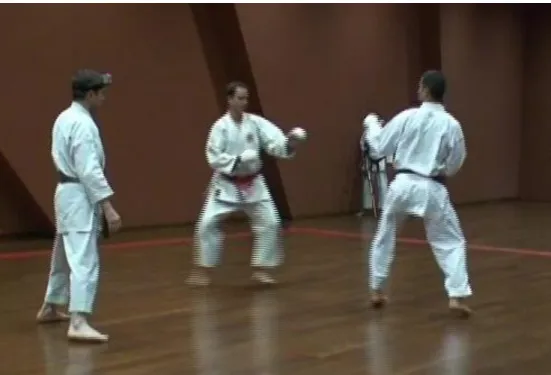
Figure 3 - Referee with mobile camera.
Although all the material was tested, one of the cameras failed to capture parts of the combat, and so its results were discarded; there was no possibility of repeating the image capture under the same conditions. It was considered as not compromising the results, as the three other stationery cameras captured the combat. Furthermore in a kumite competition there may not be enough judges, so it can take place with one referee and two judges in stationery positions or even two referees in mobile positions.
The set of images captured by the four cameras was edited into a single eight minutes film, so that the combat could be analysed from the various angles (Referee and Judges).
After collecting the video recordings, the content was transferred to a PC, converting it to digital format, using the software Magix Terra Tec ® and DVD Vídeo Soft FreeStudio. The viewing of the recordings was done on PC using Match Vision Studio Premium® software.
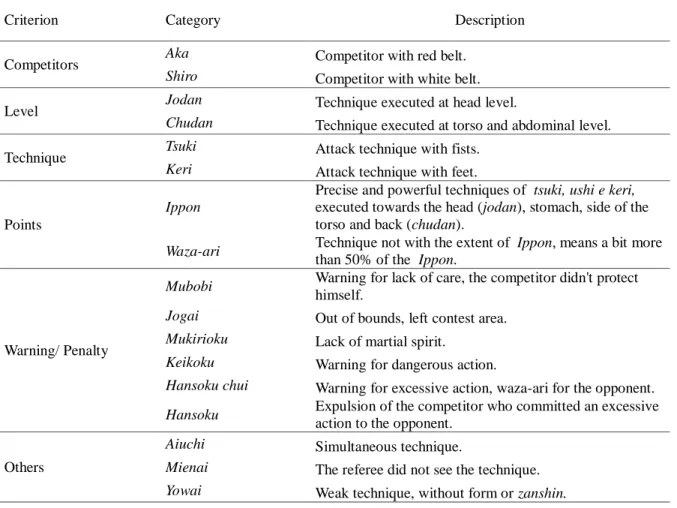
Table 1 – Criteria and categories.
Criterion Category Description
Competitors Aka Competitor with red belt.
Shiro Competitor with white belt.
Level Jodan Technique executed at head level.
Chudan Technique executed at torso and abdominal level.
Technique Tsuki Attack technique with fists.
Keri Attack technique with feet.
Points
Ippon
Precise and powerful techniques of tsuki, ushi e keri, executed towards the head (jodan), stomach, side of the torso and back (chudan).
Waza-ari Technique not with the extent of Ippon, means a bit more
than 50% of the Ippon.
Warning/ Penalty
Mubobi Warning for lack of care, the competitor didn't protect
himself.
Jogai Out of bounds, left contest area.
Mukirioku Lack of martial spirit.
Keikoku Warning for dangerous action.
Hansoku chui Warning for excessive action, waza-ari for the opponent.
Hansoku Expulsion of the competitor who committed an excessive
action to the opponent. Others
Aiuchi Simultaneous technique.
Mienai The referee did not see the technique.
Yowai Weak technique, without form or zanshin.
In table 1 we can find the criterion and categories created in the Match Vision Studio Premium® software to register the actions, according to the regulation and following the criteria for kumite refereeing.
1.3. Necessary Resources 1.3.1. Human Resources 4 Experts; 6 Competitors; 1 Referee; 4 Camera Operators;
1.3.2. Material Resources
As far as material resources the following were necessary: 1 Laptop Computer;
Magic Movies on DVD Terra-Tec Software; Freestudio video conversion Software; Match Vision Studio Premium® Software; PAWS statistical Software (version 18);
4 Video Cameras, with incorporated microphone; 4 Tripods for the video cameras;
1 mobile video camera. Gopro; 1 Chronometer;
Strips to outline the competition area;
1.4. Expert Commission Constitution
For the constitution of the expert commission the following criteria were used: they should all be active international Shotokan Karatedo International Federation (SKIF) referees, with a minimum grade of 6º Dan. The expert commission was constituted of four specialists: Mário Águas Shihan, 7º Dan, Nobuaki Kanazawa Sensei, 6º Dan, Luís Filipe Ferreira Sensei, 6º Dan, José Mário Mil-Homens Sensei, 6º Dan.
1.5. Measure Criteria Constitution
The videos were visualised by the experts commission, gathered in a closed room, with the purpose of obtaining a measure criteria which corresponded to perfect refereeing of the combat, having chosen the video with the most situations which are usually harder to decide for the refereeing team.
The experts visualised the video together, as many times as they saw fit, at normal speed and in slow-motion, until reaching a consensus over the actions liable to be intervened by the referee and judges, deciding over what transpired in the combat.
A measure criteria was obtained by registering the time unit and frame of all actions liable of registry.
1.6. Data Collection
After the video was validated by the expert commission, the referees were contacted individually to watch it.
The data collection was done in two moments, the first aimed to analyse validity and inter-observer reliability, and the second, with an interval of at least sixty days, to verify intra-observer reliability.
The video was viewed by each member of the sample individually, in a closed environment, using the Match Vision Studio software with which the registry of the observation was made. Because there can be a difference between the time at which the viewer requested a pause and the frame where the action took place, all recordings of actions were corrected to the frame in which the referred action occurred.
Before the first viewing, each referee was shown a video of another two minute long combat so as to adapt them to the situation, as there are differences between a real combat and the viewing of its recording.
It was explained to the referees how the data was to be collected, that is to say, that they would watch the video at normal speed, with no chance for repetitions , refereeing the combat and asking to stop the video every time they thought a relevant action occurred, evaluating it like they would in a real combat, where they would make decisions regarding scoring of points, penalties or nothing (tomarisen).
1.7. Study Variables
1.7.1. Independent Variables
Referee categories – National or Regional Observation Position – Referee or Judge
1.7.2. Dependent Variables
Intra-observer reliability – Comparison between each referees first and second observation;
Inter-observer reliability – Comparison between different referees' decisions;
Decision Validity – Comparison between referee/judge decisions and the criteria measure defined by the experts;
1.8. Data treatment
In order to verify the consistency of the referees' evaluation, the results of the first and second viewing were compared, thus determining intra-observer reliability; to do so the results of the frame by frame action record were compared, if different the result would be 0, if the same the result would be 1, in the end the mean score was found.
To determine inter-observer reliability the results of the observation of the referees in the first data collection were compared, allowing us to verify how the referees evaluated, we compared the frame by frame record between referees, if different the result was 0 if the same the result was 1 , in the end we calculated the mean score.
To determine validity, the results of the first observation were compared to the measure criteria defined by the experts (appendix I).
The record of actions was analysed frame by frame, and action by action, that is, each set of actions registered by the referee in each frame was compared to the set of actions (measure criteria) defined by the experts.
We used Bellack's index, commonly used to measure fidelity, and which formula consists of “(total agreements/total agreements + disagreements) x 100.” (Aranha, 2007, Siedentop, 1983). In a larger sample 85% is an acceptable value, in a small sample (i. e., n = 30) a result of 80% or more is accepted as a guarantor of reliability.
The descriptive analysis and testing of inter and intra-observer reliability (Bellack) were made using PAWS (version 18) statistical software.
To verify if there were significant differences in validity between national and regional referees and between referees and judges a chi-squared test was used, and a significance of p ≤ 0,05 adopted for the two hypothesis.
1.9. Ethical and Legal Considerations
To perform this work, authorisation was requested of the President of the Portuguese Shotokan-Karate Federation and of the President of its Refereeing Council to contact the referees for them to participate in the study.
To all the questions formulated in the data collection and treatment, anonymity of the intervening subjects was guaranteed, with the interests of the institution being placed above the interest of the observers.
CHAPTER V PRESENTATION OF RESULTS