Universidade de Aveiro 2010
Departamento de Comunicação e Arte
NATASHA ELENA
C.GONÇALVES
CURRICULA ANALYSIS & STUDY OF DESIGN
EDUCATION; UNDERGRADUATE LEVEL
Universidade de Aveiro 2010
Departamento de Comunicação e Arte
NATASHA ELENA
C.GONÇALVES
ANALISE CURRÍCULAR E ENTENDIMENTO DOS
PROCESSOS DE ENSINO DO DESIGN.
Universidade de Aveiro 2010
Departamento de Comunicação e Arte
NATASHA ELENA
GONÇALVES
ANALISE CURRÍCULAR E ENTENDIMENTO DOS
PROCESSOS DE ENSINO DO DESIGN.
Dissertação apresentada à Universidade de Aveiro para cumprimento dos requisitos necessários à obtenção do grau de Mestre em Design, realizada sob a orientação científica do Dr. Rui Miguel Ferreira Roda (Professor auxiliar convidado da Universidade de Aveiro) e Dr. Francisco Providência (Director de curso do Mestrado em Design do Departamento de Comunicação e Arte da Universidade de Aveiro).
I dedicate this work to the loving memory of my grandmother Amélia Da Gloria Soares Ferreira who provided me with support throughout this experience.
o júri
presidente Prof.ª Dr.ª Susana Bela Soares Sardo
professor a auxiliar da Universidade de Aveiro
Prof. Dr. Heitor Manuel Pereira Pinto da Cunha e Alvelos
professor auxiliar da Faculdade das Belas Artes da Universidade do Porto
Prof. Dr. Rui Miguel Ferreira Roda
professor auxiliar convidado da Universidade de Aveiro (Orientador)
Prof. Dr. Francisco Maria Mendes de Seiça da Providência Santarém
agradecimentos I would like to take this opportunity to thank all the people that have stood by me, believed in me and supported me throughout this experience. First i thank my family. To my father who i will always look up to, thank you for your support, and words of wisdom. To my mother whose encouraging words and unconditional love have made me a stronger person. To my sister and brother for the patience, support and good humour.
I thank my aunt Marlene who has been a friend, for her helpful contribution to this work, for the advice and encouragement.
I am grateful to my colleagues with who I have shared the good and not so good moments during these past two year.
A special thanks to my Professor Rui Roda, for his guidance and belief in this work and to Professor Francisco Providencia who has always been available and supporting throughout this experience. I thank all my professors who have sheared their wisdom.
I would also like to thank all the correspondent professors for their cooperation and contribution to this work.
palavras-chave Ensino de design, licenciatura, curriculo e estrutura, historia, teoria e prática, investigação de design.
resumo A presente dissertação ambicionou reunir e analisar todo um conhecimento considerado disperso focalizado sobre a Prática do ensino em Design.
Em específico, com especial atenção sobre a transferência do conhecimento ao nível da Licenciatura – primeiro ciclo – pretendeu-se observar a informação produzida pelos curricula praticados em diferentes academias de ensino (em Portugal e no estrangeiro) no sentido de compreender a diversidade de abordagens e estratégias adoptadas por cada curso da licenciatura em Design. Como ponto de partida realizou-se uma primeira leitura focalizada no plano curricular praticado pela Universidade de Aveiro, numa abordagem tendente à compreensão do seu plano curricular, ou seja, como é comunicado e representado ao nível do seu modelo conceptual.
Paralelamente, conteúdos de outras licenciaturas foram igualmente analisados, reunindo um conhecimento representativo de diferentes contextos. O estudo apresentado tentou dar uma ordem à informação dispersa pelos diferentes contextos académicos, naturalmente nutrida pela contribuição de especialistas de excelência, convidados a interagir através de entrevistas, ambicionando uma construção consciente e avançada sobre a lente de análise. O estudo, considerando todas as limitações inerentes à ambição deste projecto, iniciou um olhar sobre a extensa informação epistemológica orientada à prática pedagógica, segundo os seguintes critérios:
a) dar forma a uma análise comparativa das variáveis relevantes presentes nos curricula orientados à prática do ensino em Design; b) reunir a informação dispersa de pesquisadores que actuam
teoricamente com o tema – Prática de ensino em Design;
c) organizar e sintetizar a complexidade da informação dispersa, segundo a prática de ensino na Licenciatura em Design, com o objectivo de promover um fácil acesso à informação útil à comunidade científica local interessada no estudo do tema.
keywords design education, undergraduate degree, curricula and stucture, history, theory and practce, design research.
abstract This dissertation intends to collect and analyze all considered spread out knowledge focused on the Practice of Design Education. Focusing particularly on the transfer of knowledge on an Undergraduate level, the intention was to observe the information produces by the prevailing curricula in different educational academies (in Portugal and abroad) in order to understand the diversity of approaches and strategies adopted by each course’s degree in Design.
As a starting point the design curriculum practiced by the University of Aveiro has been employed, in an attempt to understand their curriculum, and how it communicates & represents its conceptual model.
Simultaneously, contents of other degrees were also analyzed, bringing together a representative knowledge of different contexts. The present study attempted to give an order to the wide range of information by the different academic contexts enriched by the contributions from experts who were invited to interact through interviews, in the ambitions of reaching an advanced and conscious construction under the lens of analysis. This study, considering all the limitations of this ambitious project, initiated an extensive look at the epistemological information oriented to the teaching-practice, according to the following criteria:
a) giving form to a comparative analysis of relevant variables that are present in the curricula and oriented toward the practice of teaching in Design;
b) collect the wide range of information of researchers who practice theory on the topic – The Practice of teaching Design;
c) organize and synthesize the complexity of this spread out information, according to the practice of Design Education within an undergraduate level, in order to promote easy access of useful information to the local scientific community interested in studying this issue.
1 Charter –Introduction
1.1 Delimitation of the Topic-Theme
The theme of this study is CURRICULA ANALYSIS & STUDY OF DESIGN EDUCATION; UNDERGRADUATE LEVEL. It was chosen as a topic of study because of the important role that a well structured curricula plays when approaching design as a discipline. A curriculum affects how the design process is transferred from various and specific sources to the design student. These sources may come in theoretical or practical form, in collaboration with other sources outside the faculty, through research, through individual or sheared experiences. Overall the curriculum is the pathway for students to gain a full educational experience. It may be that in certain regions or countries, Design can be the result of an artistic expression, cultural, technical, philosophical and social; or the summation of all these factors. It is interesting to examine how these differences are expressed and incorporated through the curricula of a series of universities that belong to the occidental world.
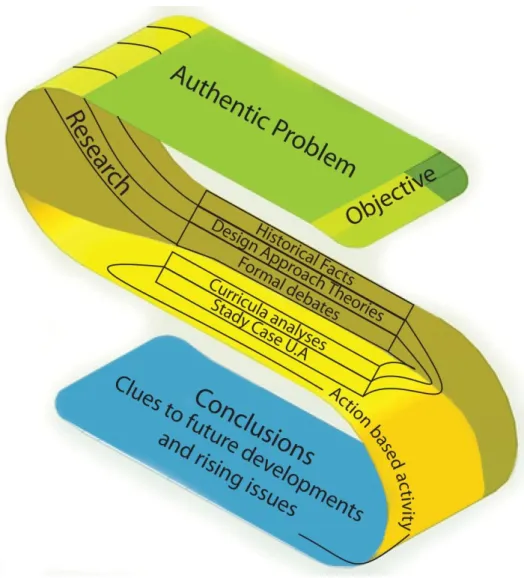
Figure 1.1: Educational Experience.
Source: Natasha, C. Gonçalves.
The specific choice of focusing on the undergraduate level was made because it is the first step in formal education which objective is to prepare a student
for a productive life in our culture, prepare a student for entry-level employment in the profession or for advanced study in a graduate programme. Therefore also being the first formal introduction between knowledge and student that will lead to a specific area of profession.
“Recognise that the design of the everyday world deserves attention not only as a professional practice but as a subject of social, cultural, and philosophic investigation.” Richard Buchanan & Victor Margolin (1996, pp.32-33).
1.1.1 Problem- Question research
For most first year design undergraduate students, the design education system may be confusing and confronting. Most are rarely clear about what they have signed up for, and have little idea of what their peers in other design courses are doing. It is particularly difficult for new student’s to understand the significance of complex ideas such as expression of culture, identity, and design solutions among others. This is one of the main reasons why it is important for faculty to focus their attention and involvement in to improving design education processes, methodologies and curriculums where questions such as;
Which are the alternative approaches to design education?
Can the students learning process be facilitated with a well structured curriculum?
How can a curriculum support the development of a broad understanding of the fields of art and design in response to contemporary trends and conditions in education?
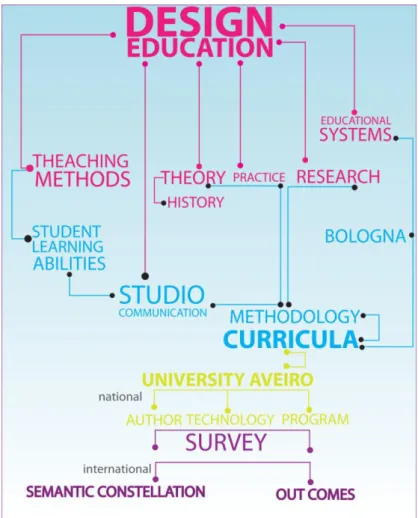
Figure 1.2: Design Curricula.
Source: Natasha, C. Gonçalves.
According to an analysis by Béla, H. Bánáthy (1991) in his book Systems Design
of Education - A journey to create the future. Educational predicament of the
last decade have come up with a number of specific problems that need to be corrected and that there is much more to the genesis of a current crisis in education. The author suggests that there are two main sources: The first is rooted in our prevailing mind-set way we think about education and consequently the way we have approached educational change and reform; This due to the fragmented study of education and the traditional scientific orientation of educational scholarship. The second source is the lack of realisation of the design of educational systems and the gap between the rapidly changing social developments and the persisting (unchanged) nature of education. Changes in our society present a great challenge to all social institutions, including education.
1.1.2 Relevance of the Problem Objective
Design as a practice is very versatile and has little boundaries; this is no different when it comes to design education. There are no specific rules or regulations when it comes to ‘how to pass on design knowledge’ and every faculty may have their own unique method in how to do so. Some may base their design education methodologies on the impact technology has in our lives, others may focus on design collaboration and working with industry, another may base their design education on design theory and philosophy, some other may favour the development of creativity, and it is not uncommon for a faculty to try to combine more than one of these approaches if not all of them. If there is one thing that we have all witnessed throughout the history of design and design education is that there is not ‘one right way’ or one right approach. There are just those which may have had more recognition then others.
Looking in to the design curricula of faculties from different regions and countries, may allow us to understand why it is that each faculty chooses one specific approach and not another. As well, why the approach they have developed or adopted is the most adequate for their specific design course.
Figure 1.3: Design Knowledge-Design Student.
1.2 Objectives
1.2.1 General objective
The general objective of this study is to explore relevant epistemological and pedagogical theories to construct a useful and compelling basis that will contribute to the understanding of design processes in design education thus creating a heritage of information, and for the development of design curricula. Further on the results of this study will be directed to the curriculum program of the University of Aveiro in order to reflect upon this information.
1.2.2 Specific objectives
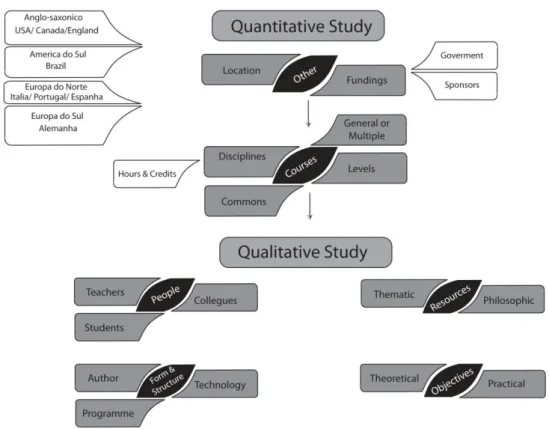
This study aims to research the various and divers approaches of several faculties of the occidental world, and analyse the curriculum structure of their design courses. Through this analysis it is estimated to create a panoramic view of the differences and commons of the various approaches, and how each curriculum communicates its point of execution;
It is also important to support this analysis with a strong ‘body’ that will serve as a point of comparison, discussion and observation, as well as providing a case study of the establishment of a design curriculum. In this case, the ‘body’ employed is the Design curriculum of the Communication and Art department of the university of Aveiro, structured by Professor Francisco Providencia, (2003).
1.3 Methods and Tactics
Employing concepts and methods drawn from other disciplines to explore design, or encouraging individuals from other discipline and professional perspectives to address what they regard as important issues or themes in the phenomenon of design should be provoked in order to prove that design practice can be adequately understood apart from the issues and concerns of contemporary cultural discourse.
Many well noted designers, historians and theorists have contributed to establishing the foundations of design studies, a field of inquiry directed toward better understanding of the ideas and methods lying behind design practice.
Figure 1.4: Methods and Tactics
1.3.1 Work Approach
In an attempt to find the answers to the above questions, related topics will be debated and analyzed throughout this study with the help of professional opinions, papers from several international design education conferences, and publications of design professionals and theorists, as well as including a specifically created survey that focuses on the relation of the provided study case with other current design curricula.
This study is a result of a gathering of new and spread out information, which has been concentrated using the ability of my own intellectual focus. A large amount of information which has been collected from conferences such as the International Conference (2002), and The Design Research Quarterly (2006) has not yet been published; therefore this study provides ‘fresh’ ideas, concepts and information that for the first time come together under the context of Design Education, Curricula Analyses, and Design Research.
1.4 Dissertation structure
The Dissertation structure begins with the identification of the authentic problem that falls under the Area of Design Education and specifically referring to the development of Design curricula. Second the setting of goals and definition of objectives to achieve through this study. As a mean to understand the past & current situation and developments of this study’s topic & problematic, it is important to resort to specific research which is divided in to two parts. First part which includes the study of Historical facts of several disciplines that may be linked to our targeted discipline of Design as well as the history of design it-self, also a valid source of authentic information is found in several publications of well known professionals and theorists in this area. Such as: Victor Margolin, Nigel Cross, Bernhard Burdek, Nigan Bayazit, Alessandro Mendini, Silvia Pizzocaro, Tomas Maldonado and many more, as well as information found through conferences and debates not only on the subject of design education but to relevant subjects as well.
The second part of research is based on the curricula analyses of the curriculum structure of the communication and art department in the University of Aveiro which is the study case provided. As well as the analyses of other curricula of national and international faculty of the occidental world which will be based on the methods and tactics of a survey (questionnaire) developed to determine the representation logic that each faculty in question prefer in order to communicate their curricula and educational choices. This way the second part of the research development can be identified as “Action
Based Activity” as information is gathered through live interaction and
communication with other representatives of current functioning curricula. After the gathering and analysing of all information from all possible sources, the study provides a general overall conclusion and opens doors to future developments and rising issues.
1.5 Brief chapter conclusion- Summary
In short this chapter emphasises the importance of a well structured curriculum and the role it plays as a guide when approaching a design discipline for the design student and teacher. How specific academic choices, methods and tactics affect the curriculum and therefore the educational experience of everyone involved. This chapter also raises questions such as, where does Design education position itself within the alternative approaches of education that exist today and how the design curricula supports this position. How Design as a discipline with very limited boundaries step out of the mind-set ways of traditional scientific orientation while keeping up with the rapidly changing social developments and the persisting (unchanged) nature of education?
2 Chapter – Design Education
What is the purpose for the study of design education? The goal is to try to define, the potential contribution that design education and knowledge might make, for design´s self-understanding (the self-comprehension of design; the means of how it understands what it achieves, how it negotiates with the world, what it means to design) and to knowledge in general. Design can be identified as a subject in its own right, independent of the various areas in which it is applied to practical effect.
The questions or issues that should be addressed when referring to design as a discipline include: Can design be a discipline in its own right? If so, what are its distinguishing features? To what questions should the discipline address itself — in both research and teaching? What methodology does it use? What results — what applications — should be attempted to achieve?
Design and Design Education, although young in comparison with many disciplines, it has had sufficient time to be considered a responsible discipline. The above issues are now being addressed in many faculties around the world like the Institute of Design, Illinois Institute of Technology, which with this self-examination process has led to a re-conceptualization of the faculties programs. These are also issues addressed in Design Research and that will be further developed in this study under Design as a field of investigation.
2.1 Educational alternatives today
Based on the proceedings of the of the Ohio Conference on education October 8.1998, Buchanan Richard, Doordan Dennis, Justice Lorraine & Margolin Victor, Doctorial Education in design 1998: the broad alternatives of education could be divided in to two categories:
“Paleoteric direction” which means the “old learning” or “antique learning”. “Paleoteric thinking” is based on the identification of discrete subject matters,
expand the knowledge in greater and greater detail. Paleoteric education seeks to expand knowledge in new discoveries.
“Neoteric direction” which means the “new learning”. “Neoteric thinking” is based on new problems encountered in practical life and in serious theoretical reflection. The goal is to gather resources from any area of previous learning in order to find new ways of addressing the new problems, thereby creating a new body of learning and knowledge.
In order to create a new pedagogical approach, which of the above enterprises would be more appropriate for design education and why?
There are advantages in moving in either direction. If we consider the state of learning in traditional fields that have achieved remarkable accomplishments in the past and remarkable prospects for new knowledge of nature and human behaviour. We will see that design does not have a subject matter in the traditional sense of other disciplines and fields of learning.
Designers create their subject matter in a way that natural scientists and social scientists do not. If design does have a subject matter, it is the activity of making and the result of making that emerges in human-made products. This is the distinctive domain of experience whether it is actual or only potential. Yet traditional learning has great difficulty in crossing disciplinary boundaries in order to address new problems.
In contrast, design could be identified as a transdiscipline because it makes connections across diverse bodies of knowledge, seeking their concrete integration in the creation of new products. We prise the ability of designers to move across disciplinary boundaries, and seek to better understand how they are able to accomplish this. This is why design education should lean toward “neoteric” enterprise and be shaped as a model of what the new learning may be in our universities and in our culture as a whole.
Knowledge and Organisation
The debate on the changes taking place in the economic environment on the passage from the “Fordist” model of organization to a new paradigm has focused its attention on the value of knowledge as a determinant of the success of contemporary organizations. The passage from the bureaucratic organization to the learning organization marked a major shift of attention from material resources to human resources. If the goal of a bureaucratic organization is to function as a machine, then the goal of a knowledge based organization is to learn. In fact the knowledge based economy should be addressed as a new interpretation of the economic environment although learning organizations and sedimentation of knowledge, has only recently been considered as a key factor for economic survival and success. Thus knowledge becomes the main strategic asset to enable companies to survive and work. Organizations should be structured so as to facilitate development of both its individuals and the organization as a whole.
Many authors have attempted to analyze the characteristics of knowledge, as it is continuously transforming and sharing its patrimony between individuals within organizations. The combination of work and knowledge seems now to be the focus of debates within the disciplines that deal both with organizational management and social sciences, thus bringing in common parlance the term ''knowledge worker'', which was introduced for the first time by Peter Ferdinand Druck (1968). The characteristics of the ''knowledge
worker'' are the ability to integrate technical competence with management
skills. These characteristics have been directly linked to design and the characteristics of the designer. According to Robert Reich (1992) in his book
The work of Nations-Preparing Ourselves for 21st Century Capitalism where he
described the figure of the “symbolic analyst'' as the new ''knowledge worker'' that had the characteristic of problem solving which had been directly linked to project design and production; as well as of problem identification which is also linked to marketing, advertising, and client consultancy.
Figure 2.1: Educational Direction.
Source: Natasha C. Gonçalves
2.2 Teaching and Learning
Design students are exposed to a range of different learning experiences in preparation for their professional work. How well students engage with these experiences affect their learning outcomes. Knowing the range of different ways students are affected by the learning experience, allows a better understanding of the kinds of learning environments that should be encouraged and that will eventually result in exiting competent designers.
Matching styles of teaching with styles of learning by design students may lead to an examination of the personality characteristics of designers, cognate professionals and others. Specific learning preferences are called learning styles, and they serve as stable indicators of how learners perceive and interact with learning environments. Teaches also have styles, these are characteristic ways of teaching which emanates from their own personalities and preferences.
In a study report called Personality and learning preferences of students in design
and design- related disciplines by Durling David, Cross Nigel, & JOHNSON, J.,
(2002) fundamental differences were revealed in the world views adopted by different occupational groups which affect instructional models, type of content, and control of the learning process.
Hudson L. (1966) proposed two kind of problem-solving behaviour which includes
the ''Divergent thinking'', and the ''Convergent thinking''; Designers seem to identify better with the ''Divergent thinking'' because it moves away from the known and predictable and is characterised by ideation and fluency with unusually associated ideas, probably because Designers creativity also seems to be linked to intuition. Where more natural scientists and technologists prefer the
''Convergent'' way of thinking which progresses toward the production of a single,
right answer to a problem, and is characterised by a logical, analytical approach to problem-solving.
So it would be understandable that using the wrong or not so appropriate style of teaching may cause a mismatch with the style of learning. Therefore the student may experience psychological discomfort, and knowledge transfer may be impeded. But not all members or students will share exactly the same style; leading to the conclusion that one kind of treatment is therefore insufficient to cater for the needs of an entire group. No single treatment is suitable for all design students, and so teaching should be adaptive.
Figure 2.2: Divergent &Convergent thinking.
Source: http://www.learningandteaching.info/learning/converge.htm Accessed: 3.May.2010
This study also provided a Broad Teaching preference for Designers:
Begins with the big picture, with concepts and then explains details.
Is focused toward future possibilities and gives alternative viewpoints.
Has lightweight structure, allowing for guided exploration.
Mostly shows objective data, is logic and analytical, and is based on exemplars showing things. With exception that about a third of designers will prefer more subjectivity, a person-centred approach, and the utilisation of value judgments.
By comparison to the non-designers that prefers teaching which:
Begins with details and facts, and then generalises.
Offers more guided instruction which proceeds step-by-step.
Nigel Cross (2006) along many others he (ibid.) has pointed out that one essential difference between design and science is that design does not concentrate on explaining the existing, but aims at understanding what could be- to develop future visions of the human world.
2.2.1 The role of Inspiration
According to the study What inspires undergraduate design students? By Paul Rogers & Alex Milton (2001) which main objective is to explore the relationship of undergraduate students concerning their design inspiration source from fields such as art, cinema, literature, architecture & other. Also the mentioned study is interested to measure the undergraduate student’s level of design awareness and if this level provides an indication as to how well a student will perform their undergraduate education. The results of this study indicated a correlation between a student’s academic performance and their design awareness score; indicating that students with higher design awareness ratings will perform better that their counterparts with a lower rating.
Figure 2.3: Inspiration.
Source: Natasha C. Gonçalves.
Along the study eight questions were asked to a total of 25 undergraduate students:
o What building (past or present) inspires you the most in your design studies?
o Which three-dimensional product (past or present) do you feel has had the most impact on your design work?
o Which author (living or deseeded) inspires your work?
o Which automobile design (past or present) inspires you the most? o Which film (past or present) has inspired your work recently? o What music inspires you the most in your design work?
o What magazine do you read regularly that inspires and informs your design work?
o Who is your favourite designer (living or deseeded) in terms of the impact they have had on your design studies?
From the data gathered during this study, the results did indicate that there may indeed be a correlation between a design student’s level of design awareness and how they perform in their formal design coursework.
2.2.2 The ability to Learn how to practice Design
Design as a discipline seemed about forty years ago to have been founded on a strong desire to recast design in an image of science. The original aims may well have been an understandable reaction to a previous view of design as an ineffable art and therefore as a result of lack of understanding of design ability led to attempts to reformulate design activities in inappropriate ways.
According to the author Nigel Cross (2006) and a series of analysis of design ability strengths and weaknesses, Design Ability has distinctive Features.
o First designers usually have the ability of creativity and intuition, and they are happy making judgements which are intuitive. (Where for example engineering designers although capable to do so, they do not feel comfortable making intuitive based judgments, they prefer to work on the bases of tests and measures.)
o Second common that designers posses is based on the recognition that there is not only one solution to a problem, and that problems and solutions in design are closely interwoven.
o A third common is the need designers have to use sketches, drawings, and models of all kinds as a way of exploring problem and solution together, and of making some progress when faced with the complexity of design.
In other words, the major aspects of what designers do are: Production of novel & unexpected solutions, toleration of uncertainty & working with incomplete information, application of imagination & constructive forethought to practical problems, as well as the use of drawing and other modelling media as means of problem solving. Since every design task is unique, it possesses different conditions, constraints and resources. Designers must develop their own knowledge system and co-ordinate existing and new skills and knowledge together successfully in order to meet the requirements. “Designers use their
innate skills to translate ideas and knowledge about the world around them into new products, messages and environment” Cooper & Press (1995), (ibid.).
Although designers from different disciplines have particular strengths in their specialised field, Bruce and Cooper (1997) (ibid.) classify the skills of a ‘designer’ into two main categories- ‘practical’ and ‘cognitive’. Traditional types of skills involved in undertaking design projects which distinguish the ‘designer’ from other professionals include visualising, model making, simulating and testing, and technical drawing and diagrams.
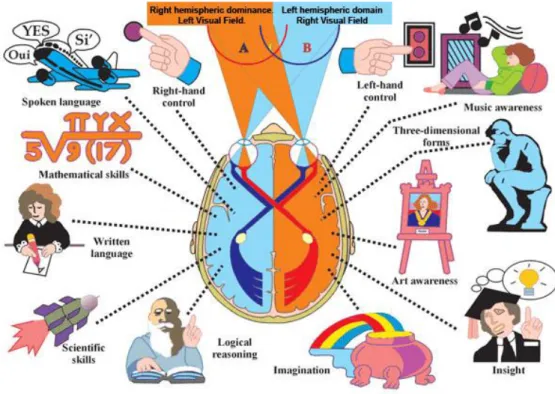
But designers where not born as designers, in the beginning we are all the same, we are just human beings with potential to develop different skills some more directed to the features of a designer and others will develop other skills. The skills we develop may be influenced on the different societies we are brought up in to, such as: industrial or nonindustrial societies, craft-based societies. Although some aspects of design ability can be seen to be widespread in the general population, it has also become clear that the cognitive functions upon which design ability depends on, can be damaged or lost. Experiments and observation in the field of neuropsychology, particularly the work which has become known as
“split-brain” Reeves and Roberts, (1995); studies have shown that the two
hemispheres of the human brain have preferences and specializations for different types of perception and knowledge. Based on this thought design ability can be seen as a form of natural intelligence, a multifaceted cognitive skill possessed in some degree by everyone.
Figure 2.4: Split-Brain.
The role of design as a discipline is to through various stimulants, theoretical, practical, from the past or present cultivate these skills found in design students, challenging their sphere of knowledge and abilities, aiming to develop them to the highest degree possible in order to create design professionals. It is also very important to focus on the attraction and importantly- retention of creative individuals providing them with the freedom to take risks without the threat of criticism and failure.
“Professionalism is based on knowledge and skills.” Victor Margolin (1995.pp23).
Intentionality
Every designer and therefore every design student brings to the task of design their backgrounds understandings and a desire to address the contingencies of the design task. Their intentions largely depend on how they understand what the task is about, and what they think or do under the conditions they encounter. What designers learn through education and experience influences what they do and help to build the meanings their thoughts and actions have for them. Although there has been studies on the reflective thinking during design and research on the applications of design strategies by industrial designers such as Cross and Kruger (2006 pp. 527-548,) there appears to be little theory-based research concerning how purposes and goals become established and operate in the minds of designers. The shift in intent and focus which redirects specific thoughts and actions to achieve a persistent but changing objective are not well understood.
C. Burnette (2002) dedicates a paper entitled “Intentionality and design” to illustrate the concept of Intentionality and to suggest how the representation of human intentions can be made more explicit and useful during design. The author of this paper presents the definition of Intentionality by Johnson (1987, ibid.) as the capacity of mental state or some kind of representation (concept, image, word, sentence) to be about, or directed at, some dimension or aspect of one’s experience; arguing that Intentionality cannot be separated from the conditions that give it context and meaning; that this ‘background’ is always part of meaning and therefore of Intentionality; and that the meaning of experience to an individual must be both intentionally established and mediated by human
understanding because ‘otherwise there would be no relation between symbolic representations and experience. Sometimes becomes meaningful by pointing beyond itself to event structures representing prior experience or toward future structures.
C. Burnette (2002 pp.9) goal was to point out that Intentionality serves as the headwater for the flow of design thinking and that no theory or model of design thinking can afforded to ignore it and that the implications for design research and practice is that more attention should be paid to the dynamic matching of prior knowledge to the focus of current concern.
2.2.3 Particularities in Design Education
It is appropriate to advance with creating a general model for design education and not look at the particularities of each design course? Would such a model would encounter problems in relation to the specific differences of each design course. Do these questions affect the importance to specify the particularities of courses such as Industrial design when integrated in an academic ambient?
First it is important to take in consideration that the discipline of Industrial design has had a slower developing in many counties, where in other’s it has been recognised as a source and tool to gain new product design capabilities parallel to their industrial development much earlier in history. For instance, industrial design education was started in India in the early 1960s on the basis of American and German educational models which developed years before. Latin American countries were influenced by the Industrial design education programs by the German design school of Ulm.
Thus Industrial design educational models are greatly influenced by the economical, industrial and technological development of its country and therefore should be taken in to consideration when creating such a model which would make it different from other educational models developed for other courses and even from other Industrial courses of other counties.
Today in a global connected world of the 2000s, the dichotomy has been weakened by the significant transformation of Design Education it-self due to its experiences in economical, social and technological never ending development and changes. These changes according to Charles Owen (1981), (advocate of the third era of design education), create the necessity for the education to rise to the challenges of new responsibilities and opportunities, new student, new curricula, and a new type of design educator were needed. Particularly emphasises the need for design scholars ‘probably the most difficult task facing design education today is developing the faculty needed for tomorrow.’ C. Owen (1988.pp.7). C. Owen (1988.pp.7) also pointed out the need and difficulty of finding research faculties in design programs by stating that: “Design Education, except for
engineering design and some architectural design, has had the tradition of the fine and applied arts as its model, where personal exploration substitutes for research. Producing the substantial knowledge base and system of communications necessary for vital research will require more than just the efforts of industrial schools and faculties for progress on a broad front, an effort on a larger cooperative scale will be required.”
Changes in the development of communication technology have raised the issue of reinventing or re-creating the university. This issue rises questions regarding the relationship and balance between material and virtual, between physically localised and technologically mediated interaction which is quite complex in the areas of art and design seeing that these are areas that dedicate fundamental importance to materiality and physicality. When approaching this issue from a design studio point of view. According to by Artemis,Yagou (2004) The studio culture as we know it from the past has been traditionally the learning environment which was established with a central role as the place of experimentation, information exchange and socialization. The fist model of a studio based education begun in the workshop of Bauhaus where learning by doing was related through practical work, emphasizing the exploration and combination of form, colour, material and texture. This traditional studio culture has had some difficulties in holding its ground against the demands of current practice due to remote interaction via technology.
One of the questions that Artemis Yagou (2004 pp.2) asks is, “What are the future
scenarios for designers beyond the traditional parameters of design practice and the form of education that will be needed?’ the answer to this question lays in the ‘Virtual Design Studio?” which allows designers to communicate across space &
time, representing information electronically, and implement design ideas to remote geographical locations seeing that design activities have become dispersed worldwide braking distance boundaries. The technology used to provide this communication includes CAD, image processing, World Wide Web, video conferencing, email, shared file and file transfer, shared whiteboards and specialized software for Computer-Supported Collaborative Work. Also through electronically connected workshops allowing the studio to become an extensible network of contacts, which may be located anywhere in the world braking communication barriers.
Figure 2.5: The Nissan Inaugurates New Global Design Studio& FIDM Design
Studio. Source:www.designer.com & L.A Campus Design studio.
It is although very important to realise that technology does not substitute the role or physical presence of the educators, scholars and teachers. As said by the Greek philosopher Κλεόβουλοσ “παν μέτρων άριςτων” which signifies that everything should be used in correct measures. Technology should be used to assist man and not take over the actual role man plays in the educational environment or in any environment for that matter.
A large number of virtual design activities are currently taking place in universities all over the world by employing virtual design studios. Some of the pioneers are Cornell University, Delft University of Technology, ETH Zurich, Massachusetts Institute of Technology, University of British Columbia, Hong Kong University, National University of Singapore, University of Sydney, University of Toronto, Washington University, National Chiao Tung University in Taiwan and Warsaw Polytechnic.
2.3 Activities and issues within the design and design disciplines.
Kees Dorst (2006) in his book Understanding Design: attempts to create a series of 175 essays that provides a panoramic view over the subject of design, The essays are written to challenge design students, to reflect upon many aspects of their field, embracing a wide variety of design disciplines, ranging from product design and graphic design to mechanical engineering, software engineering and architecture. These essays deal with many issues and problems within design practice which spring from the fundamentals nature of design and are, therefore, common to all design disciplines. According to the author, it is much more useful to choose a variety of criteria’s to discern different models of designing, than to draw lines between the design professions as if there were separate species. The author states, that the lines between the design disciplines have always been vague and they are blurring rapidly, pointing out that there are many other criteria’s besides professional categories to use to discern types of design practice. Such as the constrained nature of design problems, the structured or unstructured nature of the design knowledge needed to solve these problems, the costliness of prototyping, and the amount of integration required because of the stresses of mass production. The peculiar traditions and rituals of a design profession, and the role a designer plays during the whole process of bringing a new ‘something’ in to the world with cultural aspects also being extremely influential to the working reality of a designer.
Constraint: There are two kinds of design problems according to the essays. The first being the ‘Open’ design problems that require the ‘creative’ designer to play with concepts and ideas through a wide range of possibilities before settling in a firm direction. And the second being the ‘Closed’ design problems which are more like puzzles and have their own strategies, the closed problem designer will try out solutions, and the feedback from evaluating the design is immediate and clear. The different skills required in the ‘idea juggling’ of the open design problems and the ‘puzzle solving’ of the closed problems, possibly involving completely different types of designers.
Knowledge structure: The thinking tools available to designers depend upon the knowledge structure of disciplines that play a role n the design project. In some technical domains it is possible to reason from problem to solution in a relatively orderly way, however this does not apply to the fields of aesthetics and form-giving which consists of some psychology, some art theory and some craftsman knowledge for what can be done with forms, colours and texture. All of these sub-domains are completely unconnected and have to be combined by the designer during every new design, on the bases of personal preference, taste and style.
Mass Production: The nature of design problem is greatly influenced by the number of units of the design that has to be manufactured. If a design has to be mass-produced, this puts a large emphasis on the efficiency that must be attained in the design. Using as little material possible to perform a maximum number of functions is in the designer’s greatest interest when it comes to mass-production.
Prototyping: Design problems are very broad, so it is impossible to list and explore all potential solutions. The designer or student would have to choose and rule out options as early as possible, striving to be reasonably sure about his design when it comes to the point where a prototype has to be made due to expenses that creating a prototype would require in a design project once the designer leaves the academic field and is working for the ‘real world’. Design disciplines where prototyping is more expensive tend to build in many intermediate steps, checks
In other design disciplines such as web design or interactive system for a computer for instance the above statement does not apply. In this case the designer is working on design that are easy to replicate, and that will be used by means of the same medium on which they are made. This can be an advantage due to the user testing that can be made at all time. Design becomes an evolutionary process where the designer is able to test many generations of the design before delivery.
The author points out one way to get a fresh look at the social aspects of design life by studying designers as if they were a new discovered tribe. Exploring human behaviour into a design department would make visible a lot of things that may have been seldom described such as noticing that a major portion of design work consists of negotiation about information, problems, and ideas among colleagues; Negotiations that are often not conducted on the basis of objective information, conclusions that may be reached according to the status of the one of the parties, or simple human rules like ‘if you give in now on this point then i will give in next time on another’ Kees Dorst (2006,pp.39). People of a design team act as a major influence on what is decided and not always are the final decisions made by the people who are formally in charge. The role of a designer has important distinguishing characteristics. Some architects or designers are cast in the role of the ‘creative’, and hand over the design concepts to technical people to iron out their constructions. Others have a much more integrated approach, and actually use the technology of construction as a source of creativity. When it comes to define if a design project was been successful, it may be judged on its ability to reach speed, efficiency and return of investment. But a design may also be considered successful because of the learning experience they provide. Many times such projects are messy and full of friction between the parties involved as well as false starts, trials and errors, and overruns in time and cost. Such projects although having many set backs are appreciated for their learning experiences especially in an academic environment and many times may serve as starting points for other projects.
Understanding design as a complex activity due to its ability to touch both creativity and analytical reasoning; the word Design may refer either to the end product of to the process and even though design may be seen to an extent as a generic activity, there are real differences between the end products created by designers in various domains.
Many forms of design deal with both precise and vague ideas, call for systematic and chaotic thinking, need both imaginative thought and mechanical calculation. Kees Dorst (2006) focuses on one of the main goals of design which is problem
solving of complex problems which nature may not be easily related to by non-
designers.
The idea that design is problem solving has lead to the development of phase models of the design process, in which you first define the problem, analyze it to formulate requirements and then generate solutions; The designer chooses between these solutions with the help of the requirements, and then implement the chosen solution. This model of design as problem solving has worked well, although it has also been criticized. Like any model it highlights some aspects of design while neglecting others. Yet it seems that as long as the design goals are explicit, clear and stable, and set of comparable solutions can be generated, design can be treated very much like problem solving. But the problem solving model is not enough when we want to know more about design then just how to control and structure it.
The author also stresses how the designer gains knowledge within the design project as the gradual gathering of knowledge about the nature of the design problem and the several routs to take toward a design solution. Therefore through proposing, experimentation, learning from the results, sketching, improving, changing and going back and forth in this process; a learning cycle is created and the designer or design student learns his/her way toward a design solution.
Designers of today should not be trained to follow a set of procedures due to the rate of changes of the world. As a result of technological development, there have been new design domains emerging.
Design has always been connected with our contemporary intellectual endeavour including art, science and philosophy. Design student of today are expected to both appreciate historical work in its own, but also use it to inform contemporary design. The author points out that one of the weaknesses of the traditional studio is that students, in paying so much attention to the end product of their labours, fail to reflect sufficiently on their process.
“We can no longer afford to immerse the design students in a few traditional crafts. Rather they must learn to appreciate and exploit new technologies as they
develop’’. V.K. Jagannathan (n.d. pp.2)
The author Kees Dorst finds the designers process to be gradual and expresses it as an evolution, explaining that the initial idea in a design process may be seen as the primitive object, evolving and becoming more subtly tuned to the design problem over the generations.
As the designer acquires more knowledge about the design problem and about possibilities to solving it, the design also evolves during the design project; So creative design is not a matter of fixing the problem and then performing a ‘creative leap’ to a solution.
Creative design is more a matter of developing and evolving both the formulation of a problem and ideas for a solution, while constantly shuttling between them. The aim of the design is to generate a matching problem- solving pair. In other words design involves a period of exploration in which problem and solution are evolving and are very unstable, until are (temporarily) fixed by an emerge idea which identifies a problem-solution pairing. The creative event in design is not so much a ‘creative leap’ from problem to solution by an idea. A creative event is the moment of insight at which a problem-solution pair comes together.
Figure 2.6: Problem-Solution.
Source: Natasha C. Gonçalves.
The same problem-solution process is expressed as a social process when seeing the complexity of the design problem and the necessity for the cooperation of designer with other designers and consult specialists from various fields making the design process a social process as well. These people don’t only bring their knowledge to the design project; they also bring their own point of view, expectations and ambitions. They represent widely different aspects of the design, and come from different knowledge fields; these groups often have trouble understanding each other. Yet for a design to succeed, it has to perform well within all these different worlds (financial, technical, ergonomically, aesthetical, and other). There is no single overriding perspective that encompasses all aspects of the design problem solution. Because of this, designing becomes a process of negotiating a consensus among all the participants who have different interests in the design.
The idea of design as communication and its related themes have animated more discussion of design theory and practice than any other. Referring not only to graphic design, where communication is an obvious goal and where the concepts of classical rhetoric are now being applied with promising results, but also to the large field of design, which ranges from industrial to product design, to architecture and urban planning and for which there is no unifying theory of rhetoric Kees Dorst (2006).
Design Problems-Solutions:
Among the 175 essays written by Kees Dorst (2006), a few are dedicated to the understanding of problems and solutions within the design activities and processes that may be experienced in academic projects and further in to the manufacturing and working environment that the designer may encounter in his /her future. Designers design not only for them-selves but most of the time for others who find it difficult to describe and create good solutions for certain problems. In order to do so, a wide range of skills, education and training is required.
Design problems have been called “Wicked” C. West Churchman (1967). Horst Rittel and Melvin M. Webber (1984, pp. 135-144 ) formally described the concept of wicked problems contrasting "wicked" problems with relatively "tame", soluble problems in mathematics, chess, or puzzle solving.
“Wicked Problems” have been described this way due to their differences to other kind of problems. For instance the chessboard is a nicely enclosed world, in which the value and the possible moves of all the pieces are known and the goal is clear. But the structure of a chess problem is not present in the case of design where there is no fixed playing surface, many outside influences which can disturb plans at any time and considering design problems from different angles will give a different picture of what can be done to solve it. Also the moves possible for the designer are not pre-defined as in the chess game; there are no rules in design except for the limits set by law and the conscience of the actual designer.
The goals of the design project depend on the interpretation of the people involved, and that may shift during the design project, for instance due to competition. This changeable nature and subjectivity of design problems are never ending till the end of the project and finally there is no assurance for success or failure of the project.
In brief "Wicked problem" is a phrase used in social planning to describe a problem that is difficult or impossible to solve because of incomplete, contradictory, and changing requirements that are often difficult to recognize. Furthermore because of complex interdependencies, the effort to solve one aspect of a wicked problem may reveal or create other problems.
Undetermined problems are one of the major aspects of problem-solving that designers have to deal with; these problems are not completely fixed, but also not completely free. They usually have a triple nature:
They are partly determined by needs, requirements and intentions. A designer had to reserve time in the early stages of the design project unearth these needs, requirements and intentions by gathering and analysis, and learn to accept these specifications.
A major part of the design problem is undetermined. The interpretation of the design problem and the creation and selection of possible solutions can only be decides during the design process on the basis of proposals made by the designer. These proposals entail both the possible interpretation of the design problem and possible solutions to those problems.
Part of the design problem can be undetermined, in the sense that the designer is, to a large extent, free to design according to taste, style and abilities. It is, of course, not the case that the designer will never have to defend these aspects of the design to others. However the designer is dominant, in the sense that he/she provides the criteria on which these aspects of the design are to be judged.
In design projects it is not always easy to see the type of design challenges that have to be dealt with. The amount o difficulty or the amount of freedom is never clear. It is extremely important that the interpretation of the designer toward the design problem is relevant to the stakeholders, and they also agree on the kinds of solutions this particular view of design problem will lead to.
In order to insure a good fit with the stakeholders, it is first required to find out what their fixed demands are. Around the core problem there is a lot of freedom, where an interpretation may be chosen as long as it can convince the stakeholders that the specific interpretation will be fruitful and lead to a good solution.
When it comes to creating a solution for a design project problem there are several aspects that must be taken in to consideration, because designers not only produce ‘things’ but also develop the way of using those things. The author Kees Dorst (2006, p.28) states that it would be more logic to develop the ‘way of using’ or the ‘user plan’ primarily and then continue to design the design itself. The aspects that must be taken in to consideration are:
Interaction – Technological advancement has meant that many of the things designed are now to complex that the ability of the user to interact with them can-not be taken for granted. The interaction itself has to be designed, keeping in mind two main questions. The first being, how can quality in the interaction itself be achieved? The second, how to achieve efficient and effective use of design?
The story behind the design – consists of all the choices the designer makes during the design project and the argument used to all the choices the designer makes during the design project and the argument used in making them. It is the justification of the design, which explains why the design is exactly the way it is. It helps defend the design to others, and it allows the designer to keep track of the designs progression. A design can be seen as a tightly knitted web of decisions which are not independent from one another; chances are that by changing one aspect of the design solution, readjustments will be needed in a lot of the other aspects as well. The tricky thing is to be able to return to those early choices and revise them without disturbing the whole design.
Justification of the design – Explaining the logic behind the design will works as a good fall back that can be the projects history to explain the choice that have been made.
Showing the design alternatives that have been considered and explaining the reason for their demise will strengthen the argument in favour of the chosen design considerably. The design will many times be compared to competitive designs on the market in order to establish a design’s relative quality. It is therefore important to be aware of the competition.
Planning and communication – Designers make plans, they plan the behaviour of the design and the behaviour of the users of the design as well as the production of the design. Designer plans are expressed in all kinds of different media, depending on the design discipline. All designers make presentation drawings and scale drawings, but architects make scale models, while product designers and mechanical engineers often make prototypes or computer animations. The use of the various media is a clear indication of how difficult it is to convey a design, but it is crucial that this is done well. These plans, drawings and models are ultimately used as tools to interact with the people who are actually going to make the design. They have to take these plans and develop a way to produce the design. This difficult step often leads to many changes in the final design but the quality of the produced design depends on this step as well. Many delicate details may get lost when the production people decide there is an ‘easier’ way to make it. It is the designers and the designs best interest to keep lines of communication open to stay involved with the design until the end or even after it is produced.
2.4 Design Practice and Theory
Richard Buchanan & Victor Margolin (1995) in their book: Discovering Design; state that one of the anomalies in academic culture of the past century, was and continues to be an excessive separation between culture and practice, between the words and symbols used to understand important subjects and the concrete actions of individuals and groups who employ personal or formal knowledge to accomplish practical proposes. The development of disciplines such as the history and philosophy of technology, material culture, and cultural studies signifies an effort to reassess the importance of things in cultural life. Both authors believe that by broadening the range of discussion in design studies would create a change that would reflect on design as a contemporary practice; Thus creating an expectation for designers to participate as members of interdisciplinary or cross-functional teams such as engineers, computer scientists, psychologists, sociologists, anthropologist’s experts of marketing and manufacturing and a variety of other individuals whose perspective on design owes little to an understanding of historical development of professional practice in areas such as graphic and industrial design.
Richard Buchanan (1985) in his publication Design Issues; dedicates a dignified
amount of discussion to the subject Declaration by Design: Rhetoric, Argument, and Demonstration in Design Practice where he presents the central idea in design to be
communication, whether direct or indirect and along with all its related themes. He points out that the idea of communication has animated more discussions of design theory and practice than any other. The author continues by justifying that although this at first glance may not be obvious, the themes of communication and rhetoric in the wide field of design exerts strong influence on our understanding of all objects made for human use. He then presents the example of the numerous historical, sociological, esthetical, and cultural studies of design are not exactly rhetorical, but when dealing with the influence of designers and the effects of design on an audience of consumers or society at large, move deeply in to the domain of rhetoric. Buchanan points out that these studies also involve a significant rhetorical component when they are concerned with the process of conceiving designs; the influence of a designer’s personal attitudes, values, or design philosophy;
or the way the social world of design organisation, management and corporate policy shapes a design. Adding that when studies of the ethics of design treat form not only as a quality valuable in itself, but also as means of pleasing, instructing, and passing information, or indeed, as a means of shaping the appearance of objects for whatever intended effect, these studies are rhetorical also because they treat design as a mediating agency of influence between designers and their intended audience.
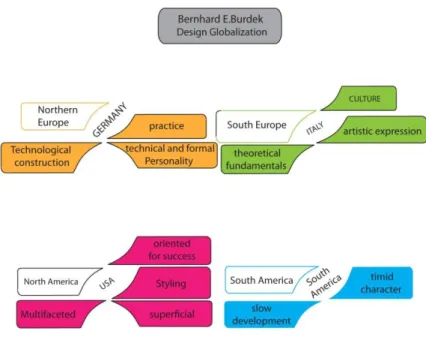
According to Bernhard Burdek (2006) in his book ‘DESIGN-GESCHICHTE, THEORIE UND
DER PRODUCT-GESTALTUNG’; Methodology and Theory of design are reflective
objectives which efforts try to optimise methods, rules & criteria that will help design be investigated evaluated and improved. The author states that Theory and Methodology in design is developed and approached in the same manner as it would be in any other discipline: of the bases of determined hypothesis and suppositions that, most of the time are self explanatory.
Practice
Design is an activity that is aggregated to concepts, to creativity, imagination, investigation and technical innovation which therefore generates expectations of the
design process as a kind of cerebral act. Each object, artefact, symbol or product of
design is a result of a process of development which course is determined by conditions and decisions. Socioeconomic, technical and especially cultural developments as well as historical fundamentals play an important role in design and design
activity. Ergonomic factors, ecologic factors, political interests and artistic & experimental demands also affect design activity in great scale. Lawson Bryan (2006, pp.17-38).