Universidade de Aveiro 2007
Departamento de Biologia
Ana Rita Giraldes
Simões
Convolvulaceae of the island of Timor with special
reference to East Timor
Universidade de Aveiro 2007
Departamento de Biologia
Ana Rita Giraldes
Simões
Convolvulaceae of the island of Timor with special
reference to East Timor
Dissertação apresentada à Universidade de Aveiro para cumprimento dos requisitos necessários à obtenção do grau de Mestre em Ecologia, Biodiversidade e Gestão de Ecossistemas, realizada sob a orientação científica da Prof.ª Doutora Helena Silva e do Prof. Doutor Paulo Silveira, ambos Professores do Departamento de Biologia da Universidade de Aveiro.
o júri presidente
arguente principal
Prof. Doutor Fernando José Mendes Gonçalves
Prof. Associado com Agregação do Departamento de Biologia da Universidade de Aveiro
Doutor Jorge Américo Rodrigues Paiva
Departamento de Botânica da Universidade de Coimbra
orientadores da dissertação Prof.ª Doutora Maria Helena Silva
Prof. Auxiliar do Departamento de Biologia da Universidade de Aveiro
Prof. Doutor Paulo Cardoso Silveira
agradecimentos Aos meus pais, pelo carinho, pelo esforço e pela dedicação. Este trabalho também é deles.
A todos os familiares e amigos que me apoiaram ao longo do caminho, que me motivaram para continuar.
À Prof.ª Helena e ao Prof. Paulo, pelo estímulo e compreensão. Ao Dan Austin, pelo incansável apoio científico.
resumo A seguinte dissertação de Mestrado apresenta uma revisão taxonómica detalhada e actualizada das Convolvulaceae de Timor, com especial referência para a parte oriental da ilha. Este trabalho teve por base um conjunto de fontes bibliográficas, espécimes de herbário e exemplares colhidos em duas expedições botânicas conduzidas apenas na parte oriental da ilha (2004/2005), sob o projecto “Contribuição para os recursos florísticos de Timor Leste”. Na totalidade, foram estudados 283 espécimes, abrangendo 15 géneros, 53 espécies e alguns taxa infraespecíficos, num total de 61 taxa diferentes, de entre os quais se destacam 6 taxa endémicos da ilha de Timor. É sugerida, neste estudo, uma nova espécie e que poderá igualmente ser um caso de endemismo. Dos 7 endemismos, apenas a possível nova espécie ocorre em Timor Leste. São, ainda, apresentados 3 novos registos de Convolvulaceae para Timor, assim como 10 actualizações de nomenclatura relativamente à Flora Malesiana.
abstract The following dissertation presents an updated and thorough taxonomic review of Convolvulaceae from Timor, with special reference to the eastern part of the island. It has been based on the study of bibliographic sources, herbarium specimens and specimens collected in two botanical expeditions to the eastern part of the island only (2004-2005), under the project “Contribution to flora resources management in East Timor”. Overall, 283 specimens were studied, comprising 15 genus, 53 species and a few other infraspecific taxa, in a total of 61 different taxa, among which 6 taxa are endemic to the island of Timor. A new species is suggested in this study, which might also be an endemism. Of the 7 suggested endemisms, only the possibly new species, still under study, occurs in East Timor. Also, 3 new records of Convolvulaceae to Timor are introduced in this study, as well as 10 nomenclatural updates in relation to Flora Malesiana.
Index of contents
1. Introduction ... 11
1.1. Geopolitical context of East Timor... 11
1.1.1. Historical and Political context... 11
1.1.2. Geography ... 13
1.1.3. Soil and Environmental Conditions... 17
1.1.3.1. Climate... 17
1.1.3.2. Hydrology... 18
1.1.3.3. Geology... 19
1.1.3.4. Geological Resources ... 20
1.2. Vegetation and protected areas ... 21
1.2.1. UNEP – WCMC Protected Areas ... 22
1.2.2. Local legislation on Protected Areas ... 25
1.3. Taxonomy of Convolvulaceae ... 26
1.3.1. Main characteristics ... 26
1.3.2. Retrospesctive on taxonomy and collection efforts... 27
2. Objectives ... 29
3. Materials and Methods... 29
4. Results and discussion ... 32
4.1. Taxonomic treatment ... 32
4.2. Distribution... 81
4.3. Habit and Ecology... 82
4.4. Ethnobotanical data ... 83
5. Conclusion ... 99
6. References ... 101
Anex I ... 104
Anex II ... 105
Anex III ... 107
Anex IV ... 108
Index of cited taxa
Argyreia... 33, 34
guichenotii Choisy... 35
reinwardtiana (Blume) Miq.... 34, 35, 82 setosa Choisy... 36 sp. A... 34, 35, 83, 84, 85, 99 walshae Ooststr.... 34, 35, 83 Calonyction mollissimum Zoll.... 49 muticum Decne.... 63 speciosum Choisy... 50 Convolvulus... 26 alsinoides L.... 41 biflorus L.... 51 brasiliensis L.... 59 cairicus L.... 52 hastatus Desr.... 79 malabaricus L.... 42 marginatus Desr.... 55 obscurus L.... 57 ochraceus Lindl.... 57 pes-caprae L.... 59 parviflorus Vahl.... 65 purpureus L.... 61 tiliifolius Desr.... 79 tridentatus L.... 80 turpethum L.... 74 umbellatus L.... 72 vitifolius Burm. f.... 72 Cressa ... 32, 36 australis R. Br.... 37 cretica L.... 37 Cuscuta ... 26, 32, 37 campestris Yunck... 38, 83, 99 cassytoides Nees ex Engelm... 38, 98 monogyna Vahl... 39
reflexa Roxb. ... 38
timorensis Decne.... 38
Dinetus ... 32, 39 racemosus (Roxb.) Buch.-Ham. ex Sweet... 39, 84, 90 Erycibe ... 32, 40 timorensis Hallier f. ex Hoogl.... 40, 83 Evolvulus ... 32, 40, 85 alsinoides (L.) L.... 40, 41 alsinoides var. decumbens (R. Br.) Ooststr.... 40, 42 alsinoides var. javanicus (Blume) Ooststr.... 40, 42 decumbens R. Br... 42
lanceaefolius Span.... 42 pseudo-incanus Span.... 41 pumilus Span... 41 Hewittia... 32, 42 bicolor (L. f.) Kuntze... 42 malabarica (L.) Suresh... 42
scandens (Milne) Mabberley... 42
sublobata (L. f.) Kuntze... 42
Ipomoea... 26, 27, 33, 44 aculeata Blume... 45, 49, 84 aculeata var. mollissima (Zoll.) Hallier f. ex Ooststr.... 49, 86, 96, 97, 98 alba L.... 45, 50, 83, 86, 92, 95 angulata Lam.... 54 angustifolia Jacq. ... 80 aquatica Forssk.... 26, 47, 50, 83, 86, 92 batatas (L.) Lam.... 27, 46, 47, 48, 51, 83, 86, 92 biflora (L.) Pers.... 47, 51 bona-nox L. ... 50 cairica (L.) Sweet... 46, 52, 86 campanulata L.... 63 capillata Span.... 62
carnea Jacq. subsp. fistulosa (Mart. ex Choisy) D. F. Austin... 48, 53 chryseides Ker. - Gawl.... 70
crassicaulis (Benth.) B. L. Rob.... 53
cymosa Roem. & Schult.... 72
decaisnei Ooststr.... 48, 54, 98 digitata auct. nonL... 56
eriocarpa R. Br.... 47, 54 filicaulis Blume... 80
gracilis R. Br... 26
grandiflora (L. f.) Lam.... 79
fistulosa Mart ex Choisy... 53
hederacea auct. nonJacq... 56
hederifolia L.... 45, 54, 83, 94 hispida (Vahl.) Roem. & Schult.... 54
illustris Prain... 64
insuavis Blume... 57
marginata (Desr.) Verdc.... 46, 55 maritima (Desr.) R. Br.... 59
mauritiana Jacq.... 46, 56, 87, 95 nil (L.) Roth.... 48, 56, 83, 88 obscura (L.) Ker.-Gawl.... 48, 57, 88 ochracea (Lindl.) G. Don.... 47, 57, 83 ochroleuca Span.... 57, 83 paniculata R. Br.... 56
paniculata Burm. f.... 65
pes-caprae (L.) Sweet... 26, 27, 47, 58, 59, 83, 99
pes-tigridis L.... 48, 58
petaloidea Choisy... 64
plebeia R. Br. ... 51
polymorpha Roem. & Schult.... 47, 60 pumila Span.... 60 pulchra Blume... 79 purpurea (L.) Roth. ... 48, 61 quamoclit L.... 45, 61, 83 quinata R. Br.... 71 reflexa Span.... 64 reinwardtiana Blume... 35 reniformis Choisy... 70 repanda Jacq.... 61 repens Roth.... 50 reptans Poir.... 50 riedeliana Oliv.... 74
sepiaria Koen. ex. Roxb.... 55
setosa Blume... 56
sumatrana (Miq.) Ooststr.... 46, 61 trichotosa Blume... 64 trichosperma Blume... 45, 62 tricolor Cav.... 47, 62, 96, 97 trichocalyx Steud.... 56 triloba L.... 48, 63, 83 tuba (Schtdl.) G. Don.... 26, 63 turpethum R. Br.... 74 verrucosa Blume... 55
vitifolia (Burm. f.) Blume... 72
violacea L.... 45, 63 Jacquemontia ... 33, 27, 64 paniculata (Burm. f.) Hallier f.... 64, 65, 99 paniculata var. tomentosa (Warb.) Ooststr.... 64, 65, 66 zollingeri Hallier f.... 64, 66 zollingeri var. jonkeri Ooststr.... 66, 83 Lettsomia sumatrana Miq. ... 61 Merremia ... 33, 67 dichotoma Ooststr.... 68, 69, 82, 97 emarginata Hallier f.... 68, 70, 88, 97 gemella Hallier f.... 68, 69 hederacea Hallier f.... 68, 70, 89, 93 peltata (L.) Merr.... 64 quinata (R. Br.) Ooststr.... 68, 71, 99 tridentata (L.)Hallier f... 80
tridentata subsp. angustifolia Ooststr.... 80
tridentata subsp. hastata (Desr.) Ooststr.... 80
umbellata (L.) Hallier f.... 71
umbellata var. orientalis Hallier f.... 72
vitifolia (Burm. f.) Hallier f.... 68, 72, 89
Operculina... 33, 73
riedeliana (Oliv.) Ooststr.... 73, 74
turpethum (L.) Silva Manso... 27, 73, 74, 89, 96, 97
Polymeria ... 33, 75 pusilla R. Br.... 75 Pharbitis nil (L.) Choisy... 56 variifolia Decne.... 54 Porana ... 27, 32, 76 racemosa Roxb... 39 volubilis Burm. f.... 76, 90, 92, 94, 97 volubilis var. burmanniana Blume... 76 Quamoclit vulgaris Choisy... 61 Shutereia bicolor Choisy... 43 Stictocardia... 33, 77 campanulata L.... 63 discolor Ooststr.... 78, 82, 97 neglecta Ooststr.... 78, 96, 97
tiliifolia (Desr.) Hallier f.... 64, 78, 82, 97
Xenostegia ... 33, 78
Index of figures
Fig. 1. The Malesian region in the context of Southeast Asia... 13
Fig. 2. The Lesser Sunda Islands in the context of Southeast Asia... 14
Fig. 3. The Lesser Sunda Islands in detail. ... 15
Fig. 4. The island of Timor, with special focus on EastTimor... 16
Fig. 5. Relief map of the island of Timor, with special focus on the eastern part.. 19
Fig. 6. UNEP-WCMC designated Protected Areas in the island of Timor, with special focus on the eastern part... 23
Fig. 7. Collection efforts of the various botanists who have collected in the island of Timor. ... 28
Fig. 8. Distribution of Argyreia reinwardtiana, Argyreia walshae and Argyreia sp. A in the island of Timor. ... 34
Fig. 9. Distribution of Cressa australis in the island of Timor... 36
Fig. 10. Distribution of Cuscuta campestris and Cuscuta cassytoides in the island of Timor. ... 37
Fig. 11. Distribution of Dinetus racemosus in the island of Timor... 39
Fig. 12. Distribution of Evolvulus alsinoides var. alsinoides and E. alsinoides var. decumbens in the island of Timor... 41
Fig. 13. Distribution of Hewittia malabarica in the island of Timor. ... 43
Fig. 14. Distribution of genus Ipomoea in the island of Timor... 44
Fig. 15. Distribution of Ipomoea aculeata var. mollissima, I. alba and I. aquatica in the island of Timor... 49
Fig. 16. Distribution of Ipomoea batatas and I. cairica in the island of Timor. ... 51
Fig. 17. Distribution of Ipomoea carnea subsp. fistulosa, I. decaisnei and I. hederifolia in the island of Timor... 53
Fig. 18. Distribution of Ipomoea marginata, I. nil and I. obscura in the island of Timor. ... 55
Fig. 19. Distribution of Ipomoea ochracea and I. pes-caprae subsp. brasiliensis in the island of Timor... 58
Fig. 20. Distribution of Ipomoea pes-tigridis, I. polymorpha and I. quamoclit for the island of Timor... 60
Fig. 21. Distribution of Ipomoea trichosperma, I. tricolor, I. triloba and I. violacea in the island of Timor... 62
Fig. 22. Distribution of Jacquemontia paniculata in the island of Timor... 65
Fig. 23. Distribution of genus Merremia in the island of Timor. ... 67
Fig. 24. Distribution of Merremia dichotoma, M. emarginata, M. gemella and M. hederacea in the island of Timor. ... 69
Fig. 25. Distribution of Merremia quinata, M. umbellata subsp. orientalis and M. vitifolia in the island of Timor. ... 71
Fig. 26. Distribution of Operculina tuperthum in the island of Timor... 73
Fig. 27. Distribution of Polymeria pusilla in the island of Timor. ... 75
Fig. 28. Distribution of Porana volubilis in the island of Timor. ... 76
Fig. 29 Distribution of Stictocardia discolor, S. neglecta and S. tiliifolia in the island of Timor. ... 77
Fig. 30. Distribution of Xenostegia tridentata in the island of Timor... 79
1. Introduction
1.1. Geopolitical context of East Timor 1.1.1. Historical and Political context
There is little knowledge of the history of the island of Timor before the 16th century, when the Portuguese arrived to the territory, for the fact that no written records were produced in that time.
In 1511, the Portuguese started to actively interfere with the local commerce, mainly for the exploitation of sandal. However, by then, the Portuguese presence in the territory was limited to pirates, explorers and trademen. The island was at that time sect in various kingdoms, some of which would not tolerate the Portuguese political domination, particularly for the high taxes they would charge the native people. In the mid18th century, a few kingdoms rebelled against the Portuguese government, while the Dutch started to take over the Western part of the island. This caused a significant gradual loss of territory by the Portuguese, which were eventually left with the eastern part of the island plus a small kingdom on the Western part – Oekussi (Fac.Arq.-UTL et al., 2002).
In 1910, the Portuguese monarchy fell and a republican regime was installed, causing some instability which the Dutch took advantage of to take control of yet more territories. The borders between the Western and Eastern parts of the island only stabilized in 1915, and so they remain to date, despite the political changes that occurred ever since (Fac.Arq.-UTL et al., 2002).
In 1945, Indonesia proclaimed its independence from Holland but the Eastern part of the island of Timor was left out because it did not belong to Holland. Here stood a chance for independence for the East Timorese, who would not be very content with the Portuguese lack of economic investment in the region. Still, the Portuguese colonization had also poorly influenced the local culture, which was appreciated by the locals. Controversy rose from those days on, dividing the population in those who would prefer to be part of Indonesia, for economical interests, and those who would rather remain a Portuguese territory, for historical and cultural reasons (Fac.Arq.-UTL et al., 2002).
In 1974, a people’s revolution in Portugal put an end to a long period of dictatorship, and a democratic regime was installed. These new values and political ideologies stated, amongst other things, the decolonization of overseas colonies. This meant giving hand of African territories, as well as East Timor. Opinions were divided in East Timor, and a few political parties were formed, defending different strategies for the territory. The fight for power and control over a “no-man’s land” began, costing the lives of many (Fac.Arq.-UTL et al., 2002).
In 8th December 1975, with the support of the American government, Indonesia conducted a massive military invasion over East Timor. Indonesia and Portugal politically diverged and the situation worsened through time, until chances of dialogue to an agreement were virtually impossible. The political forces in East Timor gathered around an armed force – FALINTIL – that gained power in the rural areas, where the Indonesians had little control. They called themselves the National Resistance and acted mostly as a guerrilla. The occupation forces used a strategy of burning land to scare out the insurrectors, having caused a huge devastation of the vegetation. During this period, 150.000 people are thought to have died both in the killings and from starvation (Fac.Arq.-UTL et al., 2002).
In 1991, at Santa Cruz cemetery, in Dili, a violent massacre was perpetrated by the Indonesian army, in a desperate attempt to control the masses. However, this had quite the opposite effect, as the impact on international media was the spread out of the Timorese cry for help. World wide, people and governments started to actively show their disapproval of the Indonesian’s occupation of East Timor, and the greatest public support to the Timorese cause was shown in 1996 by the Nobel Prize being attributed to two significant personalities of the National Resistance (Fac.Arq.-UTL et al., 2002).
In 1999, the UN conducted a referendum in East Timor, when 80% of the population voted for Independence. The Indonesian army was, therefore, forced to retrieve their troops, leaving a trail of destruction behind them (about half of the buildings in Dili and other major cities were burnt down or destroyed during that period) (Fac.Arq.-UTL et al., 2002).
From 1999 to 2002, the territory was administrated by the United Nations, by a transitional government. To the relief of many, and sorrow for the immense number of casualties on account of it, Independence of East Timor was finally officially proclaimed in May 2002.
1.1.2. Geography
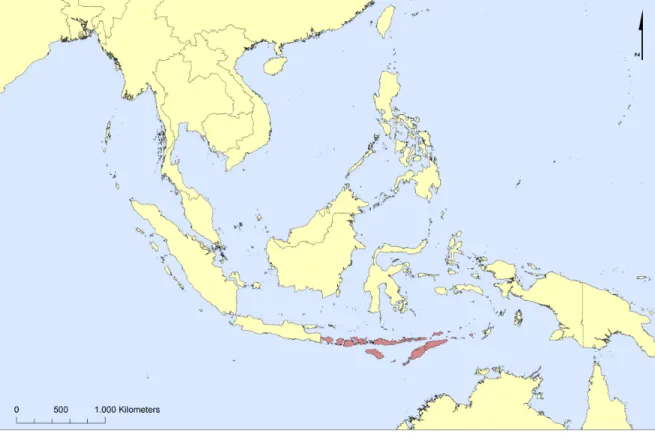
The island of Timor is located at the southern edge of Southeast Asia, and off the Northwest of Australia. It is part of the Malesian biogeographic region, which is one of the greatest diversity centres for tropical plants (Johns, 1995). It extends from the Malay Peninsula, through the Indonesian archipelago, to New Guinea, and comprises the countries Brunei Darussalam, East Timor, Indonesia, Malaysia, the Philippines, Papua New Guinea and Singapore.
Fig. 1. The Malesian region in the context of Southeast Asia.
(IUCN and UNEP, 2006)
This is a very unique region as it is composed of a great number of islands, plus the Malay Peninsula, standing right in between the Indian and Pacific Oceans (see fig. 1). In the history of this region, climate changes and continental drifts have alternately brought its territories together or apart, although they have kept more or less uninterruptely connected to the Asian mainland, enough to allow exchanges in Asian and Malesian flora, originating an intimate connection between both (van Steenis, 1979).
Thus, eventhough the Malesian flora has had a significant endemic development, its composition on family and tribal level is very similar to that of Southeast Asia, both in the lowland and in the mountains (van Steenis, 1979).
The Malesian region can be divided into three main phytogeographic regions (Johns, 1995):
Western Malesia: It includes the Malay Peninsula, Sumatra, Borneo and
Palawan (Philippines). The island of Java may also be included in this region for its geographic position, but this is not clear because the flora of Java is not closely related to that of Sumatra or Borneo.
Central Malesia: It is delimitated by the Philippines, Sulawesi, the Moluccas
and the Lesser Sunda Islands. The flora of these areas is not well known, except for the Philippines. According to what it is known of the Lesser Sunda Islands, they do not have very high diversity, compared to the other Malesian phytogeographic regions (De Vogel in Johns, 1995).
Eastern Malesia (or Papuasia): This region comprises the island of New
Guinea (Irian Jaya and Papua New Guinea), and it shows a high degree of specific endemism, probably around 60-70%.
The island of Timor is included in the Lesser Sunda Islands (Central Malesia), which is a group unlike any other region in the Indonesian archipelago. It is formed by various volcanic and coral reef islands, located in some of the deepest seas in the world. However, they are not all volcanic islands. The Lesser Sunda Islands consist, in fact, of two geologically different island chains: the northern chain is of volcanic origin; Sumba and Timor are of non-volcanic origin (Monk et al., 1997).
Fig. 2. The Lesser Sunda Islands in the context of Southeast Asia.
Fig. 3. The Lesser Sunda Islands in detail.
(IUCN and UNEP 2006).
For their small size, comparing to other islands of the Indonesian archipelago, these islands share very particular characteristics, namely:
- a higher proportion of their landmass can be affected by natural disasters (i.e. volcanic eruptions, earthquakes, landslips and cyclone damage);
- climates are more directly maritime;
- water catchment areas are smaller and erosion levels higher; - coastal regions make up a higher percentage of land;
- their environments may be more specialised, with a higher proportion of endemic species in overall impoverished communities (Monk et al., 1997). Much like the whole of the Malesian region, where the occurrence of seasonal or monsoon areas influences greatly the distribution of plants, in these islands the climate also has an impact in floral composition, particularly for the severe dry season that occurs from about May to October (van Steenis, 1979).
In plant-geography terms, these islands are overall remarkable for a few aspects:
- the extremely low number of endemic genera;
- the absence of some families and many genera which are well represented on other Malesian islands;
- the occurrence of a few species which are known from either south-east Asia or Australia but are otherwise absent or rare in other Malesian islands (van Steenis, 1979).
In the eastern end of the Lesser Sunda Islands, and to the northwest of Australia, we find the island of Timor, with a land area of approximately 24.498 km2 (Monk et al., 1997). It is now politically divided into two parts: the western part,
which is included in the Indonesian Province of Nusa Tenggara Timur, and the eastern part that is, since 2002, internationally recognised as an indepedent country known as Timor Lorosae (= East Timor).
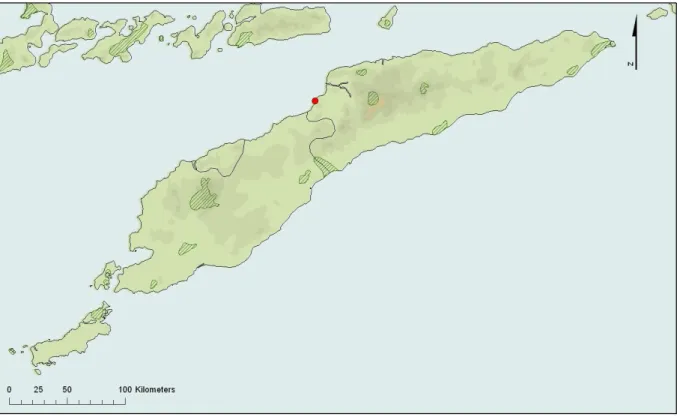
Fig. 4. The island of Timor, with special focus on EastTimor.
(IUCN and UNEP, 2006)
East Timor, as a country, includes not only the eastern part of the island but also a small territory on the northwestern coast – Oekussi - and two other islands off the coast of Timor Lorosae –Jaco and Ataúro. The capital city is Díli, located on the Northeastern coast of the island (Fac.Arq.-UTL et al., 2002).
The territory is divided in 13 main districts: Liquiçá, Díli and Baucau, in the north coast; Covalima, Ainaro, Manufahi and Viqueque, in the south coast; Manatuto and Lautém, on both north and south coasts; Ermera and Aileu, in the
mountainous interior of the island; and Oecussi, which is surrounded by Indonesian Timor (Fac.Arq.-UTL et al., 2002).
1.1.3. Soil and Environmental Conditions
1.1.3.1. Climate
East Timor has a monsoon climate, with two distinct seasons: the dry season, and the rain season, resulting from the wind blowing from different directions. The rain season, apart from the high levels of precipitation, shows greater values of temperature associated with wet winds blowing from the sea. The dry season tends to be drier, with winds blowing from the landside (Fac.Arq.-UTL et al., 2002).
The average monthly temperature in Timor varies, according to the observed location, between 19ºC and 30ºC. However, in local terms, temperature variations are only of 2º C to 4º C. Despite the small variations in temperature, precipation varies considerably in the territory, allowing the distinction between different areas of the territory and classify them according to the variation in precipitation (Fac.Arq.-UTL et al., 2002).
Specifically in East Timor, 5 different types of climate can be found, based on a relationship between the number of dry and wet months (Q value):
1. Climate of Mountain and extreme east:
Q = 0,33 to 0,66
- It is the wettest climate in East Timor. The highest average monthly values of precipitation can go over 400 mm between December and February. From June to September there are 4 dry months, when precipitation values are below 60 mm. Average monthly values of temperature vary from 19ºC to 21ºC.
2. Climate of Plains and southern coast:
Q = 0,60 to 1,00
- It is considered a wet climate; however, the average monthly values never go over 260 mm, the greatest values occurring from December to March. There are 5 dry months, between June and November, in which the precipitation values reach up to 100 mm. Temperature varies from 22ºC in July and August to 26ºC in March. 3. Climate of Plains and Northern Coast:
Q= 1,00 to 1,67
- This is considered a dry climate, with average monthly values of precipitation under 200 mm almost the entire year long. There are only 5 wet months, with average monthly values of precipitation over 100mm. Temperature varies from 23ºC to 26ºC, showing little variation throughout the year.
4. Climate of Littoral, from the northern coast (Liquiçá):
Q= 1, 67 to 3,00
- It is also a dry climate. The highest values of precipitation do not go over 150 mm, and they are mostly lower than 100 mm. This means a low degree of humidity and in a high number of dry months (8). Average monthly temperatures are high throughout the whole year (27º C in July and 30ºC in November).
5. Climate of Littoral, from the northern coast (Manatuto):
Q= 3,00 to 7,00
- It is the driest climate of East Timor, occurring in a handful of locations on the northern coast. Practically every month values of precipitation are recorded to be less than 100 mm and more than half of them are less than 60 mm. There are 10 dry months, which is considered a reasonably high number. Average temperatures are also quite high, varying little through the year, from 27ºC to 28ºC.
1.1.3.2. Hydrology
The largest part of the water courses in East Timor runs from the central part of the island, where the highest mountains occur. Due to the island’s small land cover and accentuated relief, the water is quickly drained into the soil. Also, because of the high number of dry months, the courses are dry through most of the year. Therefore, the great majority of the water lines in Timor are generally small streams and not properly called rivers (Fac.Arq.-UTL et al., 2002).
The few permanent water courses that exist are located in the southern coast, where the climate is wetter, with higher precipitation values and a larger number of wet months.The longest water course in Timor is Lacló, which is approximately 80 km long, baring one of the largest water basins in Timor (Fac.Arq.-UTL et al., 2002).
During the rain season, intense tropical rain events, in addition to the territory’s particular morphology, originate hydrographic basins and erosion phenomena that cause floodings and landslides all over the country. The water courses can drag down its streams a huge amount of soil materials, put down trees or destroy bridges and other buildings. In this period, it is also frequent to find waterfalls, which are due to the irregular morphology of the island. Most of them disappear in the dry season, but a few are permanent, such as Mota Bandeira’s waterfall, between Ermera and Bobonaro (Fac.Arq.-UTL et al., 2002).
1.1.3.3. Geology - Geomorphology
Timor is an island of non-volcanic origin, possibly originated from the Australian continental margin (Audley-Charles in Monk et al., 1997). It is believed to have been formed from sediments that were scraped off the Indo-Australian Plate’s seabed by the time that it slid beneath the Eurasian plate (Hamilton in Monk et al., 1997), and it is thought to have emerged above sea level 4 million years ago, when the Australian continental margin began subducting (Charlton in Monk et al., 1997; Harris in Monk et al., 1997). This phenomenon might as well explain a geological feature that is common to other nearby islands: the presence of complex sedimentary and metamorphic rocks (Monk et al., 1997).
The oldest rocks known to occur in Timor are from 286 million years ago, located in Lolotoi, and are mostly composed of metamorphized sediments. The most common rocks of this formation are mica-slate, gneiss, amphibolite and phyllite (Fac.Arq.-UTL et al., 2002).
Unlike the island of Timor, the island of Ataúro is of volcanic origin. The main types of rocks that can be found here are basalt, andesite, riolite and tuff (Fac.Arq.-UTL et al., 2002).
- Relief
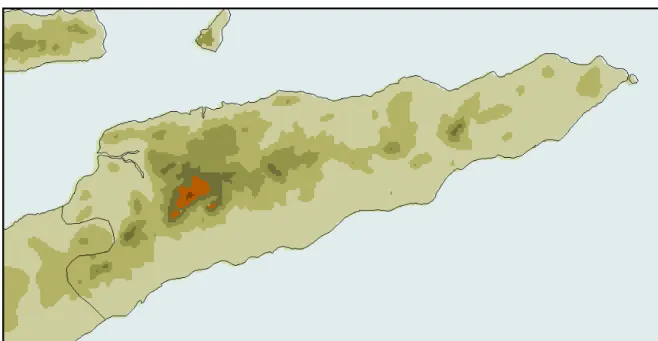
Fig. 5. Relief map of the island of Timor, with special focus on the eastern part.
Dark brown: highest values of altitude Light green : lowest values of altitude. (IUCN and UNEP, 2006)
In the centre of East Timor there is a mountain chain that dominates the whole of the island’s morphology. It smoothly looses altitude as it spreads to the east. The highest peak is Tatamailau, which rises up to 2.963 m (Fac.Arq.-UTL et al., 2002).
Geological relief is generally quite irregular in the island, and many sites are nearly impenetrable. Despite the difficulties in accessibility, mountain sites bare very fertile soils due to geological and hidrological conditions. Therefore, and mostly against the odds, they are actually favourable to the fixation of high populational densities (Fac.Arq.-UTL et al., 2002).
1.1.3.4. Geological Resources - Mineral Resources
In East Timor, there are a few minerals that can be extracted for industrial purposes (Fac.Arq.-UTL et al., 2002):
- gold: by the water courses of Sue and southern Lacló, and in Clerac, Faluberliu (Manufahi district);
- cromium: there are some traces of it in mountain sites; in the subdistrict of Lacló there is a cromium mine;
- manganese: it is one of the most frequently found minerals in East Timor, but its exploitation was left for not being profitable;
- coal: there is evidence of the presence of coal in Viqueque and Baucau.
- Oil Resources
There are a few forms of oil resources occurring in East Timor: liquid exsudations; gaseous emanations; betuminous rocks; and mud vulcanoes. Evidently, liquid exsudations are the ones that have attracted the population the most. Even during the Portuguese colonial period, native people already had ways of extracting oil to produce fuel. Most of the wells are located in the southern part of the country: mainly in Viqueque, but also in Covalima, Manatuto, Bobonaro, Baucau and Manufahi. The largest oil reserve is in the Timor Sea, south of the island. It is said to be one of the 20 largest oil deposits in the world, as its reserves are estimated to be of 400 million liquid oil barrels, and 4 trillion cubic feet of natural gas (Fac.Arq.-UTL et al., 2002).
1.2. Vegetation and protected areas
The largest part of the soil in East Timor is covered by spontaneous and subspontaneous formations. Used soils consist mainly of cultivated fields, agroforested areas, exclusively forested areas, savannas, barren lands and sandy strands. Only 1% of the territory is occupied by urban areas, a large part being concentrated in Dili and its surroundings. Forested areas take up one third of the land cover, and so being the predominant type of soil use. Cultivated fields occupy one fourth of the total territory, and agroforested terreins cover almost the same area. One tenth of the land is covered with bushes, which are concentrated mostly around forested areas in the central mountain chain (Fac.Arq.-UTL et al., 2002).
Most of the agriculture that is practiced is subsistance agriculture, and it is dominated by corn plantations. Nevertheless, areas of suitable soil on cleared and managed agricultural land are fragmented and the most part is used in rice cultivation. This is the most valuable crop, for rice is considered a luxury item (Wright, 2001).
In ancient times, there was a quite different scenario. In the beggining of the Portuguese presence on the territory, the main plantations were coffee, cacao and tobacco. There were other species that the Timorese would not grow but still use, such as cotton (to produce fibers that would be used in clothing), and sandal (Silva, 1910), which has played a major role in the history of East Timor. Since the 10th century, sandalwood has been traded by Chinese traders to Malaya and India but it was not until the 15th century that it attracted western traders to the territory. It is most likely one of the stimuli for the colonization of the territory (Husani in Rohadi et al., 2000).
By 1910, the Portuguese had put up great production centers of coffee and cacao in several districts of the eastern part of the island, and also incentivated the growth of other products in smaller quantities, mainly for internal use (maize, rice, tobacco, beans, potatoes, cotton and coprah), but sandal was still the most important trade, from which the Portuguese administration would take great profit (Silva, 1910). The great interest in sandalwood has come from its wide range of applications. Sandalwood oil can be extracted from the heartwood and used to produce perfumes and cosmetics (BPEN in Rohadi et al., 2000). The wood itself is used locally and on neighbouring islands for woodcarving and various forms of handicrafts, as well as for making joss (incense) sticks for ritual purposes (Rohadi
et al., 2000).
There are several species of sandalwood, but the species Santalum album is thought to be original from the Timor region, even though it can also be found in India. Sandal trees grow well in dry climate regions and, although prefering well-drained soils, they also adapt easily to rocky or stony soil with low fertility. It is known to regenerate either by seeds or by coppices (root or stump) (Sumarna in Rohadi et al., 2000), but efforts to plant the trees have not been succesful so the
current sandalwood production in the territory is based on natural regeneration (Sipayung; Husain in Rohadi et al., 2000).
Seemingly, in 1942, the Portuguese authorities already showed great concern on the future of sandal extraction. The most appreciated product for trading was the sandal root, and that meant destroying the sandal trees to extract their roots, which compromised its natural regeneration. Throughout the centuries, an immense quantity of sandal trees was put down and, since their plantation was never very successful, the sandal resources decreased abruptly. As an alternative, the Portuguese invested more in cultivating coffee, which was highly profitable and easier to grow. Also, a Timorese variety of coffee, “Arabica”, was very appreciated in Northern Europe, which made it an important trading product (Magro, 1943).
Much time later, the exploitation of the remaining stands of sandaltrees increased, as a consequence of a revived interest in sandalwood in the late 1990’s. Curiously enough, shortly before the independence vote in East Timor, in August 1999, large amounts of sandalwood were exported. This resulted in an isolation of the sandal resources, which can now only be found in remote areas.
Recent studies (Rohadi et al., 2000; Wright, 2001) have revealed efforts in searching for solutions for a successful recovery of sandal production in East Timor. It was found that small-scale community forest projects that invest in planning efforts with local communities to ensure their support and participation would be the most successful strategy (Wright, 2001). Also the government is advised to focus more on investment to establish and maintain new plantations, other than insisting on regulations to control the resource, which have shown to be ineffective (Rohadi et al., 2000).
A parallel concern is a defficiency in effective cultivated areas, in East Timor, which is mainly due to two factors: the destructive action of the Indonesian military forces, in the early times of their occupation, and the migration of the population towards communication ways, abandoning the cultivated areas (Fac.Arq.-UTL et
al., 2002).
Given this context, it seems urgent to set up effective and productive plans of management of the natural resources in East Timor, side by side with consistent conservation strategies. This is not so easy to achieve, as the information on species richness and biodiversity levels of the territory is still, to date, quite scarce. Nevertheless, efforts have been made to establish protected areas and create local legislation on nature conservation.
1.2.1. UNEP – WCMC Protected Areas
The World Conservation Monitoring Centre, by the United Nations Environmental Programme (UNEP-WCMC) has build up a database that compiles dispersed information on protected areas from around the world: the World Database on Protected Areas (WDPA), which is managed in partnership with the
IUCN World Comission on Protected Areas (WCPA) and the World Database on Protected Areas Consortium.
According to WDPA 2006 (IUCN and UNEP, 2006), East Timor comprises a total of 16 designated Protected Areas (see fig. 6, tab. 1): 3 Reserves, 1 Game Reserve, 1 Marine Reserve and 10 other areas with unknown designation. Note that some areas had previously been recorded as Indonesian sites, eventhough they are partially (Tilomar) or fully (Lore) included in the boundaries of East Timor. This, and the fact that most protected areas still haven’t been given a designation or IUCN category, suggests that there are many information gaps in terms of biodiversity assessment in East Timor, and that there is a lot to be done before effective conservation strategies can be established in the territory.
Fig. 6. UNEP-WCMC designated Protected Areas in the island of Timor, with special focus on the
eastern part.
Tab. 1. List of designated Protected Areas in Timor according to WDPA 2006.
Area Name Designation AREA (ha) IUCN Category Notes
Jako Island Marine Reserve unknown II (*) -
Sungai Clere Game Reserve 30000 unset -
Tilomar Reserve 12800 unset
Previously recorded as an Indonesian site.
Lore Reserve 11000 unset
Previously recorded as an Indonesian site.
Manucoco Reserve unknown unset -
Tutuala Beach Designation Not Known 25000 unset - Tata Mailau
Mountain Designation Not Known 20000 unset
All elevations above 2000 m
protected. Monte Mundo
Perdido Designation Not Known 25000 unset -
Cristo Rei Beach
Designation Not
Known unknown unset -
Sadoria
Mountain Designation Not Known unknown unset - Mount
Fatumasin
Designation Not
Known unknown unset -
Riverlet Clere Designation Not Known unknown Unset - Mount
Matebian Designation Not Known unknown unset - Malobu
Mountain Designation Not Known unknown unset - Mount Diatuto Designation Not Known unknown unset -
Monte Cablaque
Designation Not
Known unknown unset -
(*) According to the IUCN Protected Area Management Careogries, Category II is a National Park - protected area managed mainly for ecosystem protection and recreation, which is, by definition: a
natural area of land and/or sea designated to (a) protect the ecological integrity of one or more ecosystems for present and future generations, (b) exclude exploitation or occupation inimical to the purposes of designation of the area and (c) provide a foundation for spiritual, scientific, educational, recreational and visitor opportunities, all of which must be environmentally and culturally compatible.
1.2.2. Local legislation on Protected Areas
In 2000, the sitting UNTAET (United Nations Transitional Administration in East Timor) administrator approved a set of laws that aims at protecting several wild areas in East Timor.
The following were considered to be protected:
- the totality of Jaco island, as well as rocks, reefs or other characteristics in its surroundings;
- Tutuala beach and the surrounding forest; - Cristo Rei beach and its inner side;
- Mata Mailau’s Mountain top, and all the elevations over this mountain that rise over 2000m, as well as their surrounding forest;
- Sadoria’s Mountain, and all the elevations over this mountain that rise over 2000m, as well as their surrounding forest;
- Malobu’s Mountain top, and all the elevations over this mountain that rise over 2000m, as well as their surrounding forest;
- Diatuto’s Hill and surrounding forest; - Fantumasin’s Hill and surrounding forest; - Ribeira Clere’s sanctuary;
- Tilomar Reserve; - Lore’s Reseve;
- Mundo Perdido’s Hill and surrounding forest;
- Matebian’s Hill and all the elevations over this mountain that rise over 2000m, as well as their surrounding forest;
- Cablaque’s Hill and surrounding forest; - Manucoco’s Reserve.
These areas are protected so that it is forbidden to: - rise up any kind of temporary or permanent structures;
- bulid through them roads or other access ways for vehicles or other kinds of transportation;
- hunt, set traps, catch or disturb animals; - collect plants or disturb their habitat;
- conduct agricultural activities or animal grazing; - pollute the environment.
With given permission, it may be allowed to: - collect non-forestry products;
- selectively take animals grazing;
- use animals or plants that are not endangered for religious and cultural cerimonies;
- cut down trees in sites under 2000m of elevation, in areas that exclude Jaco island, as long as undertaken in a sustainable way and without the use of
machinery;
- any other traditional activities that respect the legal protection of the designated areas.
Apart from the above listed areas, other objects of protection were designated, namely:
- endangered species; - coral banks;
- marshes; - mangrooves;
- historical, cultural and artistic areas.
1.3. Taxonomy of Convolvulaceae
1.3.1. Main characteristics
Convolvulaceae comprises about 58 genera and ca 1650 species and it is widely distributed in tropical, subtropical and temperate regions (Fang and Staples, 1995). The greater part of the species can be found in the tropics and subtropics of America and Asia. The larger genera Cuscuta, Convolvulus and
Ipomoea are distributed nearly throughout the range of the family but Convolvulus
more in temperate parts and Ipomoea more in the tropics and subtropics (van Ooststroom, 1953).
This family is commonly known as the “morning glory” family. Typical Convolvulaceae are annual or perennial vines, often with milky sap and a sympetalous corolla, usually large and showy (Stefanovic, 2002). Most of the species are found in localities where they are fully exposed to the sunlight, and often occur along edges of thickets and forests. In the primary forest, members of Convolvulaceae are hardly found (van Ooststroom, 1953). Many of the members of the family are successful climbers, this climbing capacity being exclusively due to the twining of the stem, which is always to the right (van Ooststroom, 1953).
Convolvulaceae are generally autotrophic, with exception being made to
Cuscuta, a parasitic genus (van Ooststroom, 1953). The seeds of a number of
species of this family are widely dispersed by seawater (i.e. Ipomoea pes-caprae (L.) Sweet, I. gracilis R. Br. and I. tuba (Schlechtend) Don.), thus being found along the coast or immeadiately behind it – some of them are confined to sandy beaches, very rarely occurring more inland (van Ooststroom, 1953).
Convolvulaceae are quite important for its uses: as food plants, applied in folk medicine or grown in gardens as ornamental plants. Among the species cultivated for food are Ipomoea aquatica Forsk. (“water-spinach”, grown as a vegetable) and
Ipomoea batatas (L.) Lamk. (“sweet-potato”, grown for its edible tubers). Plants
used in folk medicine are e.g. Operculina turpethum and some species of Ipomoea and Merremia, in many cases for their purging properties. Ornamental plants are a few species of Porana, Jacquemontia, Ipomoea, Mina and Turbina. Considering other types of uses, Ipomoea pes-caprae is sometimes planted on sandy coasts as a sand-binder (van Ooststroom, 1953).
1.3.2. Retrospesctive on taxonomy and collection efforts
Due to the particular political and economic situation of the island of Timor, little botanical collections have been conducted recently, so most of the collections are relatively old and some have been poorly treated taxonomically. The most complete taxonomic approach of the Convolvulaceae from Timor was endorsed in the Flora Malesiana treatment, conducted by van Ooststroom, in 1953. Despite the posterior additions and emendations to this publication, many recently published works have brought new insights to the taxonomy of the family. Also, new collections have been conducted in Timor, adding up new local records of some
taxa. This urged the need for a thorough taxonomic review of the Convolvulaceae
from this island, with special reference to the eastern part, which is not so well studied.
The lack of information from this territory is mostly explained by the occasional inaccessibility for the irregular terrain or flooding of roads and paths in the rainy season (Cinatti, 1950), and also by its long history of social and political unstability, more recently turned into armed conflicts (Fac.Arq.-UTL et al., 2002). Even amongst the boldest explorers that would wander in the island of Timor, only a handful has effectively collected in the eastern part. A few collectors are known to have carried out botanical expeditions in East Timor. Among those, the following have contributed with specimens of Convolvulaceae (Cinatti, 1950):
1818 – Gaudichaut 1897 – Francisco Newton
1822 – Reinwardt 1908-10 – Alberto Osório de Castro 1828 – Zippelius 1928-29 – M.E. Walsh
1831 – Spanoghe 1933-37 – De Voogd 1840 – Hombron 1939 – Bloembergen 1946-47 – R. Cinatti 1830-80 – Teysmann
(it is not clear when exactly he was in East
Timor) 1953-54 – van Steenis
1882-83 – Henry O. Forbes
All collected information about previous collections of Convolvulacaee, whether from bibliographic references or preserved specimens, has been organized in a graphic in order to highlight the contrast in the collection effort of different collectors (see fig. 7; Anex I).
C.W. Kooy 18% Other Collectors (28) 24% Unknown collectors 16% M.E. Walsh 8% Spanoghe 6% Zippelius 5% Cinatti 5% Riedlé 4% Guichenot 4% Reinwardt 2% H.O. Forbes 3% R. Brown 3% 2004/2005 2%
Fig. 7. Collection efforts of the various botanists who have collected in the island of Timor.
It can be concluded that, in terms of Convolvulaceae, the greatest collections in Timor have been accomplished by Kooy, Walsh and Spanoghe. Other major collections are those of Zippelius, Cinatti and Riedlé. Many botanists collected very few specimens of Convolvulaceae. However meaningless these small collection efforts might seem, each on its own, they end up having a big impact in the totality of the gathered information. To prove this, these small collections were grouped together and arranged as “Other collectors”. The pie chart above shows that these 28 small collections stand out for representing more specimens than the greatest studied collection (Kooy’s), which proves their importance.
In some specimens, it was not possible to identify the collector, and these were grouped as “Unknown collectors”. It is clear that they should not be neglected, as they represent a reasonable proportion of the whole analysed material, so leaving them out of this study would mean a great shortage in taxonomic information. The collections from the 2004/2005 expedition were grouped together, although they were conducted in 2004 by Paiva & Silveira and in 2005 by Paiva, Silveira & Sousa.
2. Objectives
The current study aims at:
- Presenting an updated and accurate taxonomic review of the family Convolvulaceae for the island of Timor;
- Introducing relevant new information that could be used for local ecosystem management and conservation plans in East Timor;
- Bringing up data that could be directly used by the population of East Timor. For these purposes, this work presents:
- An up-to-date checklist of the Convolvulaceae that occur in Timor, with fully revised nomenclature and including new, locally oriented, identification keys; - Distribution maps of the listed taxa;
- Notes on the habitat and ecology of the Timorese Convovulaceae; - A compilation of ethnobotanical information retrieved from the studied
specimens and consulted literature.
3. Materials and Methods
This study was based on bibliographic sources, herbarium specimens from the totality of the island of Timor (AVE, BM, COI, L, LISC, K and P) and specimens collected in two botanical expeditions to the eastern part of the island only (2004-2005), under the project “Contribution to flora resources management in East Timor”, funded by FCT – Fundação para a Ciência e Tecnologia – and Fundação Oriente, for which ethnobotanical inquiries were also conducted. These lately collected specimens were included in the Herbarium of the Biology Department of Aveiro University (AVE).
The present taxonomic treatment revised 283 specimens (see Anex II) and various bibliographic records from Timor, in order to incorporate all the information into a comprehensive and updated work. Furthermore, the information was adapted to the context of the island, through the creation of identification keys oriented to the local taxa, as well as unique distribution maps for Timor.
For some taxa, only few specimens were available for study, and often these did not hold much morphological information. This difficulted the comparison between different specimens with the purpose of coming up with similarities and
differences between them. The lack of geographical information - or difficulty in interpreting the collectors’ notes - was also an obstacle to the study of the distribution of the species. In many cases, bibliographic sources were used as a reference to help consolidate the specimens’ information.
When there was conflict or disagreement between recent publications, an attempt was made to reach consensus with Flora Malesiana, for it being the most complete taxonomic work on Malesian Convolvulaceae, to date. In many cases, it is assumed that further studies would be required to sort out the nomenclature issues. How nomenclatural conflicts were handled is explained in additional notes under the taxonomic treatment of each taxon.
The taxa are presented in alphabetical order, and not according to their affinity, since some relationships between taxa have not yet been fully clarified.
Identification keys are proposed for genera and species known to occur in Timor, in order to simplify the identification of material from the island. The only available key is from Flora Malesiana, which covers Convolvulaceae from the whole Malesian region and so is much too complex for a small island as Timor. Note that, for this purpose, the keys are restricted to the characters of the taxa known to occur in the island. An attempt was made to give priority to characters that would be present in vegetative specimens, but this could not always be achieved. Therefore, it is advisable to use fertile specimens (with flowers and/or fruits).
Distribution maps were built for all taxa, based on geographic data extracted from specimens’ labels or bibliographic references. The general procedure was to track the locality in a map of the island, and then search its geographic coordinates on free-access online geodatabases, such as Fuzzy Gazetteer, La Tierra and Index Mundi. The global positioning of the retrieved coordinates was confirmed using Google Earth software. The correct coordinates were exported to ArcMap and complemented with geopolitical information from WDPA 2006, to build the distribution maps. The maps were created on a presence/absence criterium, which means that different specimens from the same taxon which were collected in the same locality are represented only by one point, to prevent information redundancy.
Often, the only geographical data on the specimens was “Timor”. These specimens, although included in the taxonomic treatment, were also left out of the distribution study for deficiency of information. Other discarded specimens were those which collection sites remained unknown, even though a locality was indicated: they could not be related to any geographic point in the island, based on the consulted maps or geodata. In fewer cases, when the locality could not be tracked, an attempt was made to speculate on the true collection site – by following the collector’s expedition course, or searching for a locality with a similar name (assuming there could have been misspelling or different pronunciation by the collector).
Also note that the checklist is based mostly on information from specimens. However, some taxa were included considering bibliographic references only, and not having been analysed the corresponding specimens. In fewer cases, there was not solid evidence that a taxon would exist in the island, and therefore these were treated in the taxonomic study as “Doubtful records”.
In the ethnobotanical treatment, a local approach has been taken, being pointed out the use of the species that occur in the island of Timor only. The described uses are, however, not exclusively from Timor, as it is meant to show not only the plant’s current use in the island, but also its potential of usefulness. Vernacular names are restricted to the ones that are known to be used in the region.
4. Results and discussion
4.1. Taxonomic treatment
Identification key for genera of Convolvulaceae
1a. Herbaceous parasites leafless or with minute, scale-like, chlorotic leaves.
3. Cuscuta
1b. Non-parasitic plants with green leaves...2 2a. Style absent ... 5. Erycibe 2b. Style(s) present ...3 3a. Styles 2 ...4 3b. Style 1 ...5 4a. Each style forked... 6. Evolvulus 4b. Styles not forked ... 2. Cressa 5a. Flowers in racemose, paniculate or thyrsiform inflorescences (rarely flowers solitary) ...6 5b. Flowers in one- to few- or many- flowered axillary cymose inflorescences. ....7 6a. Leaf venation pedate, veins prominent, often alate abaxially. Calyx covering
¼ or less of corolla tube...4. Dinetus 6b. Leaf venation pinnate. Calyx covering half or more of the corolla tube.
13. Porana
7a. Ovary unilocular, or imperfectly bilocular at top... 7. Hewittia 7b. Ovary bilocular or tetralocular ...8 8a. Stigma 1...9
9a. Leaves in the lower surface with many black minute glands. Calyx much enlarged in fruit, completely enclosing it... 14. Stictocardia 9b. Leaves without minute black glands beneath. Calyx not much enlarged or
not enlarged in fruit, not completely enclosing the fruit. ... 10 10a. Fruit a fleshy, leathery or mealy berry. ...1. Argyreia 10b. Fruit a capsule. ... 11 11a. Capsule circumscissile. Stems and petioles often winged...11. Operculina 11b. Capsule thin-walled, opening by 4 (rarely 6) valves or irregularly
dehiscing. Stems and petioles not winged. ... 8. Ipomoea 12a. Stigmas 4. ... 12. Polymeria 12b. Stigmas 2 ... 13 13a. Stigmas filiform. ...9. Jacquemontia 13b. Stigmas globular. ... 14 14a. Pollen pantoporate. Anthers straight, not twisted, at dehiscence.
15. Xenostegia
14b. Pollen colpate or rugate. Anthers mostly spiraled when dehisced.
1. ARGYREIA Lour., Fl. Cochinch.: 134 (1790)
Fig. 8. Distribution of Argyreia reinwardtiana, Argyreia walshae and Argyreia sp. A in the island of
Timor.
Identification key for the species of Argyreia
1a. Sepals unequal, two outer ones (10-)15-18 mm long, two inner ones (7-)8 - 9 mm; the outer ones with more or less undulate margins; outside densely sericeous, sometimes less towards the apex. Corolla funnel-shaped, purplish pink, 3 - 4,5 cm long. ... 1. A. reinwardtiana 1b. Sepals subequal, 5 - 8 mm long; outside densely sericeous. Corolla
tubular to funnel-shaped, whitish or yellowish, 2 - 2,75 cm long... 2 2a. Leaves broadly ovate to ovate; length less than two times the width. Lower
surface of leaves densely pubescent to tomentose with short curled hairs. Bracteoles caducous. ...2. A. walshae 2b. Leaves elliptic-oblong; length two (or more times) the width. Lower surface
1. Argyreia reinwardtiana (Blume)
Miq., Fl. Ned. Ind. 2: 589 (1857); Fawc. in H.O. Forbes, Natur. Wand. East. Archip.: 511 (1885); Ooststr., Blumea 5: 360 (1943); Ooststr. in Steenis, Fl. Males., Ser 1, Spermat. 4(4): 497 (1953); Kalkman, Acta Bot. Neerl.: 216 (1955) – Types: Timor,
Reinwardt 1351 (L!, holotype);
Nonbaun, Teysmann s.n., fr. (B); Indonesia (West Timor), Soë, ca 762 m, 15.iii.1929, Walsh 153 fl. (BM!, isotype).
Ipomoea reinwardtiana Blume, Bijdr. Fl.
Ned. Ind. 13: 720 (1826) - Argyreia
guichenotii Choisy, Mém. Soc. Phys. Genève
6: 423 (1833); Decne., Nouv. Ann. Mus. Hist. Nat. 3: 388 (1834); Span., Linnaea 15: 338 (1841); Fawc. in H.O. Forbes, Natur. Wand. East. Archip.: 511(1885).
Distribution: Lesser Sunda Islands
(Timor) (van Ooststroom, 1953).
Habit and ecology: Creeper; found
between chalkrocks; collected at 200 m and ca 762 m.
Specimens: INDONESIA (West
Timor): Tjamplong, 200 m, Kooy 523 (L!). TIMOR: Guichenot s.n. (P); Leschenault de la Tour s.n. (P); Reinwardt 12(?) (L!); Reinwardt s.n. (L!); 1829, Reinwardt s.n. (P!); s.c. s.n. (L!); s.c. s.n. (P!); Spanoghe s.n. (L!); Spanoghe s.n. (L!).
2. Argyreia walshae Ooststr.,
Blumea, 5: 361 (1943); Ooststr. in Steenis, Fl. Males., Ser. 1, Spermat. 4(4): 499 (1953); Kalkman, Acta Bot. Neerl.: 216 (1955) – Type: Indonesia (West Timor), Tobaki, ca 800 m, 10.vi.1929, Walsh 388 (L!, holotype; BM!, isotype).
Distribution: Lesser Sunda Islands
(Timor) (van Ooststroom, 1953).
Habit and ecology: Not very
common; collected at ca 800 m.
Specimens: TIMOR: Jonker 273 (U).
3. Argyreia sp. A
Habit and ecology: Thick liana,
climber on shrubs; plant with milky sap; collected at 700 m.
Uses: The bark can be boiled and the
boiling water is drunk for treating gonorrhea.
Vernacular name: mau halé (Timor:
unknown dialect).
Specimens: EAST TIMOR: Abis,
1.vi.1966, Friedberg 257a (LISC!). INDONESIA (West Timor): Nikiniki, 700 m, 1.iv.1974, Kooy 905 (L!); Supul, ca 750m, 25.iii.1969, Kooy 706 (L!).
Notes: The above listed specimens seem to
present a unique set of morphological features. Comparing to the other two species present in Timor (see Anex III), it can be observed that the leaves are similar in shape to those of A. reinwardtiana - mostly elliptic-oblong - contrasting with those of A. walshae, which are ovate. The lower surface of the leaves is sparsely to rather densely pilose with short, appressed, straight hairs, as occurs in A. reinwardtiana, but not in A.
walshae, where the lower surface is densely
pubescent to tomentose with short curled hairs. Also, it can be noticed that the leaves of Argyreia sp. A are twice (or more times) as long as they are wide, which contrasts with
A. walshae, in which they are less than two
times longer than wide and with A.
reinwardtiana, where they are roughly two
species A and A. walshae are subequal, whereas in A. reinwardtiana the outer sepals are distinctly larger than the inner ones, with undulate margins. Also, sepals of A. sp. A are both entirely densely sericeous outside, while those of A. reinwardtiana are distinctly less sericeous towards the apex.
Doubtful records
Argyreia setosa Choisy, Mém. Soc. Phys.
Genève 6: 425 (1833); Decne., Nouv. Ann. Mus. Hist. Nat 3: 388 (1834); Span., Linnaea 15: 338 (1836); Ooststr., Blumea 5: 383 (1943).
Spanoghe assumes the presence of this species in Timor, based on Decaisne’s
publication. Still, Decaisne does not show evidence of this, instead he declares: Je n’ai
point vu dans les herbiers du Muséum cette espèce originaire de Timor, je la cites d’après l’autorité de M. Choisy. Only five specimens
of this taxon were found, in Genève’s Herbarium, collected by Choisy. They seem to lack taxonomical characters that would allow an accurate identification and they also do not bare annotations of having been collected in Timor. Possibly being aware of this, van Ooststroom has stated in Flora Malesiana: “it is very doubtful that [Argyreia
setosa] occurs in the island of Timor”. A
thourough review of the specimens and access to Choisy’s collection notes could clarify this.
2. CRESSA L., Sp. Pl.: 223 (1753)
1. Cressa australis R. Br., Prodr.:
490 (1810).
Cressa cretica L., Sp. Pl.: 223
(1753); Ooststr. in Steenis,Fl. Males., Ser 1, Spermat. 6(6): 937 (1972).
Distribution: East Timor, Australia
(Western Australia, NorthernTerritory, Southern Australia, Queensland, New South Wales, Victoria) (Austin, 2000).
Habit and ecology: At 100 m from
the sea in a pure stand in the shade of the mangrove tree Avicennia
marina.
Specimens: EAST TIMOR:
Batugadé, lagoon of Bé-Malai, 16.viii.1962, Cinatti 339 (L!, LISC!).
Notes: Only one collection is known from
Timor.
3. CUSCUTA L., Sp. Pl.: 124 (1753)
1. Cuscuta campestris Yunck.,
Mem. Torrey Bot. Club 18: 138 (1932).
Distribution: North American
species, recently introduced in several countries of the Old World. (Liao et al., 2005). New record to
Timor.
Habit and ecology: Often on
Medicago sativa, Trifolium, and
Satureja hortensis, but also on a
great number of other herbaceous plants (van Ooststroom, 1953).
Specimens: EAST TIMOR: Dili,
14.i.2004, Paiva & Silveira 19a (AVE!).
2. Cuscuta cassytoides Nees ex
Engelm., Trans. Ac. Sc. St. Louis 1: 513 (1859); Ooststr. in Steenis, Fl. Males., Ser 1, Spermat. 5: 558 (1958).
Cuscuta timorensis Decne. ex Engelm.,
Trans. Acad. St. Louis 1: 514 (1859); Ooststr. in Steenis, Fl. Males, Ser 1, Spermat. 4(4): 393 (1953); Kalkman, Acta Bot. Neerl.: 216 (1955).
Distribution: East Africa to South
Africa and South Malesia: East Java (Asem Bagus) and Lesser Sunda Islands (Timor, Wetar) (van Ooststroom, 1953).
Habit and ecology: On Ficus glomerata Roxb. and other woody
plants; apparently confined to regions with a very dry season (van Ooststroom, 1953). A specimen from Timor was found at 300 m.
Vernacular name: non-atois
(Dawan).
Specimens: INDONESIA (West
Timor): Fautbena, ca 300m,
7.vii.1967, Kooy 362 (L!); Kupang,
Teijsmann s.n. (L!). TIMOR:
Leschenault de la Tour, s.n. (P); s.c.
s.n. (L!).
3. Cuscuta reflexa Roxb., Pl. Corom.
2: 3, t. 104 (1798); Decne., Nouv. Ann. Mus. Hist. Nat.: 393 (1834); Span., Linnaea 15: 341 (1841); Fawc. in H.O. Forbes, Natur. Wand. East. Archip.: 511 (1885); Ooststr. in Steenis, Flora Malesiana 4(4): 393 (1953).
Identification key for the species of Cuscuta
1a. Stems thin, filliform. Styles 2, distinct. Ovary depressed-globose.
1. C. campestris
1b. Stems coarse up to 2mm or more in diam. Style 1, or nearly absent. Ovary ovate-conical... 2 2a. Corolla scales represented by narrow-wings. Style longer than the
depressed-globose stigma...2. C. cassytoides
2b. Corolla scales abundantly fimbriate. Style shorter than the elongate stigma. 3. C. reflexa
Distribution: Afghanistan, Sri Lanka,
Pakistan, India, Nepal, Thailand, Malaysia, Indonesia (Fang and Staples, 1995).
Habit and ecology: On shrubs. Specimens: TIMOR: s.c. s.n. (K!);
s.c. s.n. (P!).
Doubtful records
Cuscuta monogyna Vahl, Symb. Bot. 2: 32
(1791).
Fawcett (1885) lists this species for Timor, but no specimens are indicated. No herbarium specimens or bibliographic references which would support this record have yet been found.
There are two specimens that remain to be identified at species level: Kooy 727 (L!) and Kooy 903 (L!).
4. DINETUS Buch.-Ham. ex Sweet, Brit. Flow. Gard. 2: t.127 (1825)
Fig. 11. Distribution of Dinetus racemosus in the island of Timor.
1. Dinetus racemosus (Roxb.)
Buch.-Ham. ex Sweet , Brit. Flow. Gard. 2: t. 127 (1825).
Porana racemosa Roxb., (Hort. Bengal.
13, 1814, nom. nud. ) Fl. Ind., ed. 1820. 2: 41 (1824); Fawc. in H.O. Forbes, Natur. Wand. East. Archip.: 511 (1885); Ooststr. in Steenis,