albumin changed over time on PD, although they were closely linked to plasma IL-6 levels. A strong positive cor-relation was found between D/P creat and dialysate IL-6 (rho = 0.77, p < 0.0001) at baseline, but not at 1 year. In contrast, there was a significant correlation between D/P creat and dialysate sIL-6R (rho = 0.39, p < 0.05) at 1 year, but not at baseline. At 1 year, 17 patients with increasing PSTR had higher increases in dialysate IL-6 (28 ± 26 vs –21 ± 78 pg/mL, p < 0.05) and levels of dialysate sIL-6R (693 ± 392 vs 394 ± 274 pg/mL, p = 0.05) compared to patients with stable PSTR (n = 11). Patients who had peritonitis pre-sented higher baseline serum IL-6 concentration (6.8 ± 1.0 pg/mL) compared with patients without peritonitis (4.0 ± 0.6 pg/mL, p < 0.05). Finally, both at baseline and after 1 year, there were significant correlations between plasma and dialysate IL-6 (rho = 0.46, p < 0.05, and rho = 0.40, p < 0.05) respectively.
♦♦ ♦♦
♦ Conclusions: These findings indicate that, (1) intraperi-toneal and systemic inflammation increase in PD patients during the first year of therapy; (2) intraperitoneal and systemic inflammation may be interrelated and the IL-6 system may be the link; (3) the IL-6 system (both intra-peritoneal and systemic) is associated with PSTR, particu-larly in the early phase of PD treatment, in which small and large solute transport are linked. Signs of a transition be-tween acute and chronic inflammation were observed in the follow-up evaluation. Inflammation may, at least in part, be responsible for the development of a high PSTR, and this could be one reason for the high mortality in patients with high PSTR.
Perit Dial Int 2006; 26:53–63 www.PDIConnect.com
SYSTEMIC AND INTRAPERITONEAL INTERLEUKIN-6 SYSTEM
DURING THE FIRST YEAR OF PERITONEAL DIALYSIS
Roberto Pecoits-Filho,
1,3Maria João Carvalho,
1,2Peter Stenvinkel,
1Bengt Lindholm,
1and Olof Heimbürger
1Division of Renal Medicine and Baxter Novum,
1Karolinska Institutet, Stockholm, Sweden; Department of
Nephrology,
2Hospital Geral de Santo António, Porto, Portugal; Centro de Ciências Biológicas e
da Saúde,
3Pontifícia Universidade Católica do Paraná, Curitiba, Brazil
Correspondence to: R. Pecoits-Filho, Divisions of Renal Medicine and Baxter Novum, Karolinska Institutet, K-56, Huddinge University Hospital, 141 86 Stockholm, Sweden.
Received 13 January 2005; accepted 27 May 2005. ♦♦
♦♦
♦ Objective: To investigate if intraperitoneal and systemic interleukin-6 (IL-6) and soluble IL-6 receptor (sIL-6R) are related to each other and to peritoneal solute transport rate (PSTR).
♦♦ ♦♦
♦ Design: Longitudinal study in retrospectively selected patients.
♦♦ ♦♦
♦ Setting: Peritoneal dialysis (PD) unit of a university-based hospital.
♦♦ ♦♦
♦ Patients and Methods: 31 PD patients on treatment with conventional glucose-based solutions participated in a lon-gitudinal study. IL-6 and sIL-6R were measured in plasma and overnight effluent, both at baseline and after 12 ± 2 months on PD. C-reactive protein (CRP) and serum albu-min were used as surrogate markers of inflammation. PSTR of small solutes was evaluated using the dialysate-to-plasma ratio (D/P) of creatinine after a 4-hour dwell; PSTR of large solutes was evaluated using the 24-hour D/P ratio of albumin.
♦♦ ♦♦
♦ Results: D/P creat increased over time (0.67 ± 0.15 vs 0.80 ± 0.11, p < 0.0001) and correlated to D/P albumin only at the baseline evaluation. Patients with plasma IL-6 ≥≥≥≥≥ me-dian had higher (p < 0.005) D/P creat at baseline [0.74 (0.62 – 0.87)] compared to patients with IL-6 < median [0.57 (0.47 – 0.66)]. Dialysate IL-6 at baseline was also higher (p < 0.05) in patients with plasma IL-6 ≥≥≥≥≥ median [24.7 (16.5 – 38.5) pg/mL] compared to patients with IL-6 < median [14.1 (10 – 25.7) pg/mL]. Neither CRP nor
ORIGINAL ARTICLES
by on October 20, 2010
www.pdiconnect.com
KEY WORDS: Peritoneal solute transport rate; in-flammation; interleukin-6.
C
ytokines orchestrate the inflammatory response, and available data suggest that interleukin-6 (IL-6) and its soluble receptor (sIL-6R) are central regulators of the inflammatory process (1). Interleukin-6 is a well-known pleiotropic cytokine that promotes inflammatory events through the activation and proliferation of lymphocytes, differentiation of B cells, leukocyte recruitment, and in-duction of the acute-phase protein response in the liver (1). Its bioactivity in several sites of the human body is regulated mainly by sIL-6R. Formation of the sIL-6R/IL-6 complex widens the repertoire of cells responding to IL-6 action (2). Additionally, sIL-6R regulates the transition between acute and chronic inflammation, suggesting its involvement in the resolution of the inflammatory pro-cess due to its agonistic properties (2). Interestingly, plasma levels of IL-6 are highly correlated with surro-gate markers of inflammation, such as C-reactive pro-tein (CRP) and serum albumin (3), and elevated plasma IL-6 and sIL-6R levels represent major risk factors for mortality, not only in the general population (4) but also in hemodialysis (HD) and peritoneal dialysis (PD) pa-tients (5).A number of factors prevalent in patients with end-stage renal disease (ESRD), such as advanced age, hy-pertension, adiposity, insulin resistance, fluid overload, and persistent infections, are associated with elevated plasma IL-6 levels (3). In addition, hypercytokinemia in PD patients might be attributed to low clearance of in-flammation mediators, uremia per se, and factors related to the dialysis procedure, namely subclinical peritonitis and the bioincompatibility of PD solutions (6). Inflam-matory changes, such as an increased number of macro-phages, are often seen in the peritoneum, even in the absence of peritonitis, indicating that the peritoneum of the PD patient is a chronically inflamed organ (7). During PD treatment, thickening of the submesothelial space and alteration of the microvessel structure are commonly observed. These morphological alterations occur concomitantly with functional changes over time on PD, particularly in patients with higher peritoneal solute transport rates (PSTRs) for small solutes (8). A high PSTR has been identified as a frequent cause of PD technique failure (9) and represents an independent risk factor for increased mortality in PD patients for reasons yet to be clarified (10,11). In a previous cross-sectional study, we observed that patients with high PSTR had higher plasma levels of IL-6 and higher prevalence of comorbidities such as diabetes mellitus and peritonitis (12). Although it has been suggested that PSTRs for small
and large solutes are closely linked, longitudinal infor-mation regarding the relationship between peritoneal transport of those solutes is lacking.
During PD, the peritoneal membrane is continuously exposed to bioincompatible dialysis solutions that con-tain high concentrations of glucose and glucose degra-dation products and have low pH and high osmolality, all of which are potential activators of a proinflammatory response (13). Significant amounts of IL-6 are present in drained PD dialysate in much higher concentrations than in plasma under stable conditions (12), and are increased shortly before the onset of (14) and during peritonitis (15), suggesting its local production and reflecting an intraperitoneal inflammatory state (16). Although intra-peritoneal IL-6 has been used to evaluate local inflam-mation, intraperitoneal sIL-6R levels have not previously been described in the dialysate. Finally, inflammatory changes of the peritoneum are observed even before the initiation of PD treatment (8), suggesting that systemic factors related to uremia may, at least in part, be respon-sible for histological and functional changes of the ure-mic peritoneum. Indeed, recent studies performed in animal models clearly demonstrate the impact of uremia in peritoneal membrane changes (17). However, clinical evidence of the links between systemic and intraperito-neal inflammation remain to be demonstrated.
We hypothesize that signs of inflammation increase over time on PD, and that intraperitoneal and systemic inflammation are interrelated and associated with high PSTR of both small and large solutes. In the present study, we analyzed the natural evolution of the systemic and intraperitoneal IL-6 system (IL-6 and sIL-6R) in 31 patients during their first year of PD treatment with glucose-based solutions. Moreover, we analyzed the pos-sible links between local and systemic inflammation, and the association between the IL-6 system and PSTR. MATERIAL AND METHODS
This was a longitudinal observational study in 31 ret-rospectively selected patients who underwent PD treat-ment at the Home Dialysis Unit affiliated with the Department of Renal Medicine, Karolinska University Hospital at Huddinge, Stockholm, Sweden. All patients treated with conventional glucose-based PD fluids, with an early evaluation of PSTR (within 1 month after start of PD), a follow-up evaluation of PSTR after about 1 year, and simultaneous dialysate and plasma collections stored in our freezers were included in the study. The clinical characteristics were retrieved from patient files. Exclusion criteria were the presence of systemic inflam-matory disease (e.g., vasculitis, disseminated
by on October 20, 2010
www.pdiconnect.com
sia) or peritonitis in the 4 weeks prior to, or after the evaluation. Mean age was 55 ± 15 years and 58% of the patients were males. The etiology of ESRD was diabetic nephropathy in 35%, chronic glomerulonephritis in 23%, nephrosclerosis in 10%, and unknown or other diseases in 32% of the cases. The first-month (14 ± 4 days) and 1-year (12 ± 2 months) analysis of PSTR based on the peritoneal equilibration test (PET) was performed as part of the routine clinical assessment at least once every 12 months in all patients, independent of their clinical characteristics. Peritonitis data were retrospectively col-lected from patients’ records. The Ethics Committee of the Karolinska Institutet at the Karolinska University Hospital at Huddinge approved the study and all patients gave their informed consent to participate.
PERITONEAL TRANSPORT OF SOLUTES
The dialysate-to-plasma ratio (D/P) of creatinine at 4 hours in a standard PET performed with a 2.27% glu-cose solution was used to assess the peritoneal trans-port rate for small solutes. Creatinine determinations were performed by routine procedures in the Department of Clinical Chemistry, Karolinska University Hospital at Huddinge, using the Jaffé method. The D/P creat was corrected for glucose interference in the creatinine assay using the correction factor derived locally by our labo-ratory. According to the changes in D/P creat during the follow-up period, patients were placed into two groups: increasing PSTR or stable PSTR respectively. To assess the transport of higher molecular weight solutes, we used the D/P ratio of albumin in the 24-hour collection per-formed on the day previous to the PET.
INTERLEUKIN-6 AND sIL-6R
Samples for the determination of circulating and di-alysate IL-6 and sIL-R were obtained from plasma EDTA obtained during the PET and overnight dialysate efflu-ent (from exchanges with 2 L 1.36% glucose dialysis fluid) from the night preceding the routine PET. Plasma IL-6 and sIL-6R and dialysate sIL-6R were measured using an enzyme-linked immunosorbent assay (ELISA; R&D Systems, Minneapolis, Minnesota, USA). For the sIL-6R determination, plasma samples were prediluted 40 times and dialysate samples 5 times. The ELISA plates were read using ELISA VERSAmax reader (Molecular Devices Corpo-ration, Sunnyvale, California, USA) and the data were analyzed with the SoftmaxPRO software (Molecular De-vices Corporation). Dialysate IL-6 was determined using an automated immunochemiluminiscence method (Immulite; DPC Biermann, Bad Nauheim, Germany). The
intra- and interassay variations were 2.3% and 4.2% re-spectively for IL-6, and 4.3% and 5.2% rere-spectively for sIL-6R. The detection limit was 0.09 pg/mL for the IL-6 high sensitivity test and 6.5 pg/mL for the sIL-6R test.
OTHER MARKERS OF SYSTEMIC INFLAMMATION
In the same blood sample, serum CRP (immunoneph-elometric method; minimal detection limit 10 mg/L) and serum albumin (bromcresol purple method) were deter-mined and used as markers of systemic inflammation. Patients were considered inflamed when CRP levels were above 10 mg/L or albumin below 3.5 g/dL.
STATISTICAL ANALYSIS
Normality of data distribution was assessed using Kolmogorov–Smirnov test. Values are presented as mean ± standard deviation or as median (interquartile range), unless otherwise specified. Paired Student’s t-test or Wilcoxon signed ranked test were used to compare dif-ferences between baseline and 1-year evaluations. Cor-relation coefficients were performed by linear regression analysis for normally distributed variables, and by Spearman rank correlation test for skewed variables. Differences between groups were evaluated using the Mann–Whitney test. Calculations were performed using the Statistical Package for the Social Sciences (version 10.0; SPSS Inc., Chicago, Illinois, USA). A p value of less than 0.05 was judged to be significant.
RESULTS
BASELINE CHARACTERISTICS
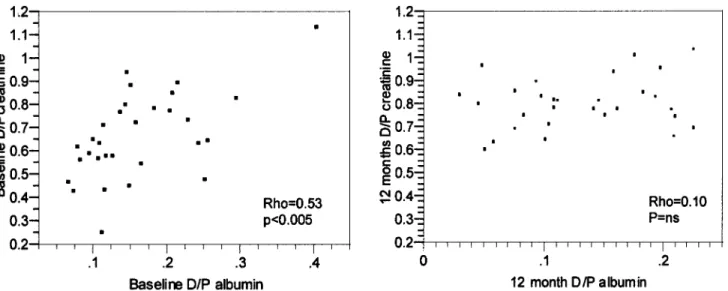
At the start of PD treatment, mean 4-hour D/P creat for the entire group was 0.67 ± 0.15 (range 0.44 – 0.95; median 0.66, interquartile range 0.57 – 0.79). Six pa-tients were classified as low transporters, 9 as low-aver-age transporters, 10 as high-averlow-aver-age transporters, and 6 as high transporters. Mean 24-hour D/P albumin was 0.14 (range 0.06 – 0.40). Median CRP level was 14.6 mg/L (range 10 – 44 mg/L) and median albumin level was 3.2 mg/dL (range 2.1 – 4.6 mg/dL) (Table 1). There was a significant correlation between small solute (D/P creat) and large solute (D/P albumin) transport (rho = 0.53, p < 0.005) (Figure 1).
ONE-YEAR CHARACTERISTICS
After the first year of PD treatment, mean D/P creat was 0.80 ± 0.12 (range 0.61 – 0.96; median 0.80,
by on October 20, 2010
www.pdiconnect.com
interquartile range 0.72 – 0.86) (Table 1). Three patients were classified as low-average transporters, 13 as high-average transporters, and 14 as high transporters. Sev-enteen (61%) patients had increasing PSTR and 11 (39%) had stable PSTR compared to the baseline study. The PSTR increased (p < 0.0001) compared to baseline, but the same increase was not observed for D/P albumin (Table 1). Mean 24-hour D/P albumin at the follow-up evaluation was 0.10 (range 0.02 – 0.22) (Table 1). No association between transport of small and large mol-ecules was observed after 12 months on PD (rho = 0.10, p = NS) (Figure 1). Median CRP level was 14.5 mg/L (range 10 – 77 mg/L) and median serum albumin level was 3.3 mg/dL (range 2.4 – 4.6 mg/dL) (Table 1).
LONGITUDINAL CHANGES IN INFLAMMATION MARKERS AND SYSTEMIC AND INTRAPERITONEAL IL-6 SYSTEM
No significant changes were observed for CRP and albumin levels during the evaluation. Median plasma IL-6 increased during the f irst year on PD, from 3.7 pg/mL (range 2.8 – 6.1 pg/mL) at baseline to 6.5 pg/mL (range 3.4 – 8.25 pg/mL, p < 0.05). Simi-larly, median dialysate IL-6 was greater after 1 year (32.8 pg/mL, range 24.6 – 48.2 pg/mL) compared to baseline (19.7 pg/mL, range 12.6 – 30.0 pg/mL; p < 0.05) (Table 1). In contrast, no changes in either sys-temic or intraperitoneal sIL-6R levels were observed over time on PD (Table 1).
TABLE 1
Longitudinal Evolution of Peritoneal Solute Transport Rate, Inflammation Markers, and Plasma and Dialysate Interleukin-6 (IL-6) System During the First Year of Peritoneal Dialysis
Baseline 1 Year p Value
4-hour D/P creatinine 0.67±0.15 0.80±0.12 <0.0001 24-hour D/P albumin 0.14 (0.06–0.40) 0.10 (0.02–0.22) NS Plasma IL-6 (pg/mL) 3.7 (2.8–6.1) 6.5 (3.4–8.2) <0.05 Plasma sIL-6R (pg/mL) 53023 (42359–58903) 50382 (40227–56786) NS C-reactive protein (mg/L) 14.6 (10–44) 14.5 (10–77) NS Serum albumin (mg/dL) 3.2 (2.1–4.6) 3.3 (2.4–4.6) NS Dialysate IL-6 (pg/mL) 19.7 (12.6–30.0) 32.8 (24.6–48.2) <0.05 Dialysate sIL-6R (pg/mL) 491 (358–741) 584 (236–907) NS D/P IL-6 6.9 6.1 NS D/P sIL-6R 0.012 0.012 NS
D/P = dialysate-to-plasma ratio; sIL-6R = soluble IL-6 receptor; NS = not significant. Values are presented as mean±SE or median and range, accordingly.
Figure 1 — Correlation between low and high molecular weight solute transport at baseline and after 12 months on peritoneal dialysis, showing that dialysate-to-plasma ratio (D/P) of creatinine and albumin were significantly correlated only at the baseline evaluation. ns = not significant.
by on October 20, 2010
www.pdiconnect.com
SYSTEMIC INFLAMMATORY STATUS AND PERITONEAL TRANSPORT
Patients with plasma IL-6 ≥ median at baseline had higher baseline values of 4-hour D/P creat [0.74 (0.62 – 0.87) vs 0.57 (0.47 – 0.66), p < 0.005] compared to pa-tients with IL-6 < median. Changes in plasma IL-6 tended to correlate with changes in D/P creat (r = 0.35, p = 0.07), although this was not statistically significant. At base-line, there was a significant correlation between plasma IL-6 and 4-hour D/P creat (rho = 0.47, p < 0.05), but not between plasma sIL-6R and 4-hour D/P creat (rho = –0.17, p = NS). Additionally, plasma IL-6 was significantly cor-related to D/P albumin at baseline. After 1 year, plasma IL-6 was no longer significantly correlated with D/P creat (rho = 0.16), but remained significantly correlated to D/P albumin (rho = 0.38, p < 0.05). Plasma sIL-6R remained, similarly to baseline, non correlated with D/P creat (rho = 0.36, p = NS). There were no significant associations be-tween serum CRP and albumin levels with PSTR of small solutes, whereas serum albumin was associated with D/P albumin, both at baseline (rho = –0.42, p < 0.01) and after 12 months (rho = –0.51, p < 0.001). A summary of the associations between PSTR and inflammation mark-ers is presented in Table 2.
With the exception of the lack of correlation between baseline serum albumin and IL-6, all inflammation mark-ers were correlated to each other, both at the baseline (CRP vs IL-6: rho = 0.35, p < 0.05; CRP vs serum albumin: rho = –0.47, p < 0.05) and at 12 months (CRP vs IL-6: rho = 0.70, p < 0.0001; CRP vs serum albumin: rho = –0.50, p < 0.05; serum albumin vs IL-6: rho = –0.47, p < 0.001).
CORRELATIONS BETWEEN INTRAPERITONEAL IL-6 SYSTEM AND PSTR
The associations between PSTR and the intraperito-neal IL-6 system are presented in Figures 2 and 3. At baseline, there was a strong positive correlation between
dialysate IL-6 and D/P creat (rho = 0.77, p < 0.0001), but not between dialysate sIL-6R and D/P creat (rho = 0.30, p = NS) (Figure 2). In addition, dialysate IL-6 also corre-lated with D/P albumin (rho = 0.49, p < 0.005). In con-trast to baseline, after 1 year there was no significant correlation between dialysate IL-6 and D/P creat (rho = 0.14, p = NS), although the association between dialy-sate IL-6 and D/P albumin remained significant (rho = 0.44, p < 0.005). A significant positive correlation be-tween 1-year sIL-6R and 1-year D/P creat (rho = 0.39, p < 0.05) was present (Figure 3). Changes in dialysate sIL-6R tended to be associated with changes in D/P creat (r = 0.36, p = 0.07), although this was not statistically significant.
INCREASING VERSUS STABLE PSTR
At the 1-year evaluation (Figure 4), patients with in-creasing PSTR had higher levels of dialysate sIL-6R [594 pg/mL (range 341 – 976 pg/mL) vs 388 pg/mL (range 206 – 618 pg/mL), p = 0.05] compared to patients with stable PSTR (Figure 4), and there was a significantly higher increase in dialysate IL-6 [19.9 pg/mL (range 15.9 – 80.2 pg/mL) vs –1.4 pg/mL (range –168.9 to 66.5 pg/mL), p < 0.05].
PERITONITIS EPISODES
Ten patients had 12 episodes of peritonitis during fol-low-up. No differences in PSTR in patients with and with-out peritonitis episodes were observed. Similarly, there were no differences in serum CRP and serum albumin lev-els in patients with and patients without peritonitis. In-terestingly, patients who later developed peritonitis presented a higher baseline serum IL-6 concentration (6.8 ± 1.0 pg/mL) compared with patients without peri-tonitis (4.0 ± 0.6 pg/mL, p < 0.05) (Figure 5). Moreover, patients with peritonitis had higher dialysate IL-6 con-centration (58.4 ± 12.6 pg/mL) compared with patients without peritonitis (20.3 ± 8.7 pg/mL, p = 0.07) at the TABLE 2
Correlations Between Plasma Inflammation Markers and Peritoneal Transport Rate of Small and Large Solutes
Baseline 1 year
D/P creatinine D/P albumin D/P creatinine D/P albumin
Plasma IL-6 rho=0.47, p<0.05 rho=0.39, p<0.05 rho=0.16, p=NS rho=0.38, p<0.05 Plasma sIL-6R rho=–0.17, p=NS rho=0.06, p=NS rho=0.36, p=NS rho=0.001, p=NS C-reactive protein rho=0.11, p=NS rho=0.16, p=NS rho=0.18, p=NS rho=0.14, p=NS Albumin rho=–0.18, p=NS rho=–0.42, p<0.01 rho=0.28, p=NS rho=–0.51, p<0.001 IL-6 = interleukin-6; sIL-6R = soluble interleukin-6 receptor; D/P = dialysate-to-plasma ratio; NS = not significant.
Rho is Spearman coefficient.
by on October 20, 2010
www.pdiconnect.com
baseline evaluation, but this difference did not reach statistical significance (Figure 5).
RELATIONSHIP BETWEEN SYSTEMIC AND INTRAPERITONEAL IL-6 SYSTEM
The dialysate IL-6 concentration was several-fold higher than the plasma IL-6 concentration, while the dialysate sIL-6R level was markedly lower than the plasma sIL-6R level (Table 1). Plasma IL-6 and dialysate IL-6 lev-els were significantly correlated, both at baseline (rho = 0.46, p < 0.05) and after 1 year (rho = 0.40, p < 0.05) (Figure 6). Accordingly, patients with baseline plasma IL-6 ≥ median had higher baseline levels of dialysate IL-6 (24.7 pg/mL, range 16.5 – 38.5 pg/mL) compared to patients with plasma IL-6 < median (14.1 pg/mL, range 10.0 – 25.7 pg/mL) (p < 0.05). This association was not present at the follow-up evaluation. On the other hand, there were no statistically significant correlations be-tween plasma sIL-6R and dialysate sIL-6R, at baseline
(rho = –0.25) or at 1 year (rho = 0.03). Since the con-centration of sIL-6R was much lower in dialysate than in plasma, we analyzed if the dialysate concentration of sIL-6R was only a reflection of transport from circula-tion. Therefore, we compared D/P sIL-6R (55 kD) to D/P albumin (67 kD) and found no significant correlation be-tween them both at baseline or at 12 months, suggest-ing that factors other than transport from circulation are involved in the appearance of sIL-6R in dialysate. DISCUSSION
The present study is the first description of the natu-ral evolution of the systemic and intraperitoneal levels of components of the IL-6 system (IL-6 and sIL-6R) dur-ing the first year on PD. The results of this longitudinal evaluation indicate that intraperitoneal and systemic inflammation increase in patients treated with conven-tional glucose-based PD solutions during the first year of PD, and that intraperitoneal and systemic
inflamma-Figure 2 — Associations between dialysate levels of interleukin-6 (IL-6) and soluble interleukin-6 receptor (sIL-6R) with transport of small and large solutes in the baseline evaluation. Only dialysate levels of IL-6 were significantly correlated to peritoneal solute transport rate. D/P = dialysate-to-plasma ratio.
by on October 20, 2010
www.pdiconnect.com
tion may be interrelated, particularly during the early phase of PD therapy. The alterations in the IL-6 system were closely associated with alterations in PSTR. We also describe that small and large solute transport rates are linked at baseline, but disconnected after 1 year on PD. Finally, signs of systemic inflammation appeared to be linked to increased risk for peritonitis. These findings, therefore, provide support for the hypothesis that in-flammation may play a central role in the development of high PSTR, and that this involvement may at least partly explain the high mortality and morbidity observed in patients with high PSTR.
Interleukin-6 is a 22 – 27 kDa polypeptide secreted from activated monocytes, macrophages, fibroblasts, adipocytes, and endothelial cells in response to various stimuli, such as tumor necrosis factor alpha, IL-1β, bac-terial endotoxins, and oxidative stress. It is notable that, whereas most other cytokines act via paracrine/auto-crine mechanisms, the major effects of IL-6 are medi-ated by its concentration in the circulation, and thus IL-6
can exert its effects at sites distinct and far from its ori-gin. Circulating IL-6 can be detected in healthy individu-als in the 1 pg/mL range and it is markedly elevated in most ESRD patients (18). Plasma IL-6 is considered a sur-rogate marker of systemic inflammation and its levels are strongly correlated with plasma CRP levels. There is now epidemiological information linking plasma IL-6 concentrations to cardiovascular morbidity and mortal-ity in non-renal patient groups (4) and also in HD and PD patients (5). In the present study, we show an asso-ciation between plasma IL-6 and PSTR, as seen not only by the significant correlation between plasma IL-6 and D/P creat, but also by the increased PSTR in inflamed patients. Interestingly, this association between sys-temic inflammation and PSTR was observed only at the early phase of PD treatment and not after 1 year of di-alysis therapy.
Interleukin-6 exhibits its action via a receptor com-plex consisting of a specific IL-6 receptor and a signal transducing subunit (gp130). The soluble forms of both
Figure 3 — Associations between the dialysate levels of interleukin-6 (IL-6) and soluble interleukin-6 receptor (sIL-6R) with trans-port of small and large solutes in the follow-up evaluation. D/P = dialysate-to-plasma ratio.
by on October 20, 2010
www.pdiconnect.com
Figure 4 — Patients with increasing peritoneal solute transport rate (PSTR) had more pronounced changes of dialysate interleukin-6 (IL-interleukin-6) (p < 0.05) and higher dialysate levels of soluble interleukin-interleukin-6 receptor (sIL-interleukin-6R) (p = 0.05). Box plot representation: 75% and 25% percentiles, median, and maximum and minimum values.
Figure 5 — Baseline plasma and dialysate interleukin-6 (IL-6) levels in relation to peritonitis episodes.
Figure 6 — Plasma and dialysate levels of interleukin-6 (IL-6) at the baseline and 12-month evaluations show significant positive correlations between systemic and local intraperitoneal inflammation.
by on October 20, 2010
www.pdiconnect.com
receptor components are generated by shedding; they reach the circulation and then participate in the regula-tion of IL-6 activity. While sIL-6R binds to IL-6 in plasma, expanding the half-life of the IL-6/sIL-6R complex and extending IL-6 bioactivity to organs containing the gp130 membrane-binding site (1), circulating gp130 acts as an antagonist of IL-6 biological functions, namely activation of the acute-phase response, decreasing ap-petite, hypercatabolism, hypercoagulability, and accel-erated atherosclerosis (2). Furthermore, the formation of the sIL-6R/IL-6 complex appears to be important in the resolution of inflammation (19). Similarly to IL-6, sIL-6R represents a risk factor for mortality in dialysis patients (5), but the precise role of plasma and dialy-sate sIL-6R remains to be determined.
In the present study, plasma IL-6 levels significantly increased throughout the observation period, indicat-ing an increase in inflammatory activity over time on di-alysis. Potential causes for our findings are loss of residual renal function (RRF) and ageing [since they ap-pear to be strongly correlated with systemic inflamma-tion (20)], and clinical events occurring during the course of PD treatment. Because of the cross-sectional design of this study, it is not possible to draw definitive conclusions about the causes of the increasing inflam-matory status in these patients. In this longitudinal evaluation, we confirmed our previous cross-sectional observation that plasma IL-6 appears to be associated with PSTR (12), and found that this occurs mainly in the early phase of PD treatment. Interestingly, at the base-line evaluation, PSTRs of small and large solutes were interrelated, but this was not observed at follow-up. After 1 year of treatment, no correlation between sys-temic inflammation and PSTR of small solutes was present, but the link between plasma IL-6 and PSTR of albumin was still present. Reinforcing these results, we also demonstrated that patients showing more signs of systemic inflammation at the start of PD treatment pre-sented higher PSTRs concomitantly with higher dialysate IL-6 levels.
It is likely that cumulative exposure to bioincompati-ble solutions may play a role in the persistent and in-creasing intraperitoneal inflammatory response, and therefore in the regulation of peritoneal permeability. Permeability changes have been observed following the administration of vasoactive drugs, such as nitroprus-side (21), and during severe inflammation, such as peri-tonitis (15). In our study, intraperitoneal levels of IL-6 were several-fold higher than plasma concentrations, indicating local production of IL-6. Intraperitoneal pro-duction of IL-6 can probably be attributed to mesothe-lial cells (22), macrophages, or endothemesothe-lial cells (23). It
appears from recent studies that IL-6 is a central media-tor of the inflammamedia-tory response in the peritoneal cav-ity. Hurst et al. (19), combining clinical and experimental evidence, recently showed that IL-6 controls the pattern of leukocyte recruitment during inflammation. During the peritoneal inflammatory response, the intraperito-neal actions of IL-6 and sIL-6R are tightly linked and are particularly regulated by mesothelial cells. These cells by nature do not possess a cognate IL-6 receptor and therefore require the presence of the sIL-6R to be respon-sive to IL-6. According to Hurst et al. (19), IL-6 partici-pates in the early phase of the intraper itoneal inflammatory response, which is neutrophil mediated, while the later appearance of sIL-6R is essential for the resolution of the inflammatory process.
In our study, the association between 12-month di-alysate sIL-6R and PSTR, in contrast to the early asso-ciation between dialysate IL-6 and PSTR, hypothetically suggests that the transition in cytokine effluent produc-tion may reflect two distinct phases in the intraperito-neal inflammator y response, namely, an early (neutrophil mediated) and a late (mononuclear leuko-cyte mediated) phase, which may reflect a resolved in-f lammation process. However, to conin-f irm this hypothesis, it will be necessary to perform cytokine mea-surements during active inflammation (i.e., during peritonitis).
It is important to clarify that in vitro studies demon-strated higher IL-6 production in response to exposure to more biocompatible dialysis solutions, in which case IL-6 is presumably a marker of cell vitality (24,25). In contrast, ex vivo studies showed lower cytokine produc-tion when more biocompatible soluproduc-tions were used (26). In fact, recent clinical studies using a bicarbonate/lac-tate solution have shown that the intraperitoneal cellu-lar response to the more biocompatible solution leads to lower dialysate levels of IL-6 in comparison to stan-dard solutions, suggesting a reduced inflammatory re-sponse (27). Also, in a clinical evaluation, Fujimori et al. (28) compared the effects of 1.36%, 2.27%, and 3.86% glucose solutions on dialysate levels of IL-6 and showed that a higher glucose concentration in dialysis fluid in-duced higher production of intraperitoneal IL-6. There-fore, in accordance with Cooker et al. (27), we propose that intraperitoneal IL-6 concentration may be regarded a marker of ongoing intraperitoneal inflammation. Simi-larly to what was observed for systemic inflammation, the association between dialysate IL-6 and PSTR appears to be occurring mainly in the initial phase of PD treat-ment, although intraperitoneal IL-6 was associated with peritoneal permeability to large solutes in a previous cross-sectional study (14), as well as in our own
by on October 20, 2010
www.pdiconnect.com
cross-sectional analysis (12). In the follow-up investi-gation, we observed an association between sIL-6R and PSTR, and noted that patients with increasing PSTR pre-sented higher dialysate levels of sIL-6R at 1 year. More-over, the fact that patients with increasing PSTR presented greater changes in dialysate IL-6 levels dur-ing the first year of PD, and the observation of an asso-ciation between changes in dialysate IL-6 and changes in RRF, the importance of the links between RRF, inflam-mation, and changes in PSTR are reinforced, as observed by Chung et al. (29).
Another novel finding of our study is the association between systemic and local inflammation, based on the correlation between plasma and dialysate IL-6. This as-sociation appears to occur both in the initial phase of PD treatment and at a later phase. Whether systemic inflam-mation causes local inflaminflam-mation or intraperitoneal in-flammatory activation leads to a systemic response needs further evaluation.
Also of interest, we observed a discrepancy between the PSTRs of small and large solutes in the baseline and follow-up evaluations, and local and systemic inflamma-tion (represented by both plasma and dialysate IL-6 lev-els) appeared to be consistently linked to the PSTR of albumin, irrespectively of the time of evaluation. This finding provides evidence connecting IL-6 to increased peritoneal leakage of proteins, which may reflect endothelial dysfunction. In contrast, the PSTR of small solutes was related to IL-6 only at baseline, but in the follow-up evaluation no associations were observed, in-dicating that inflammation may not be directly linked to the high PSTR that develops after long-term PD. The creased PSTR (based on small solute transport) may in-dicate dif ferent mechanisms of solute transport, depending on the moment when it is evaluated. Our re-sults support the hypothesis that there may exist two distinct types of high transporters (30), namely, the early inherent high transporter (associated with high comor-bidity, inflammation, and protein leakage) and the late acquired high transpor ter (not associated with comorbidities, inflammation, and protein leakage). To advance understanding of the high mortality of patients with high PSTR, further studies need to confirm our pre-liminary data.
It is important to emphasize some significant limita-tions of this study. The retrospective selection, the low number of patients included in this analysis, and the short follow-up limit interpretation of the results, par-ticularly in the subgroup analysis. Our observations need to be confirmed in prospective studies, performed in a large number of patients, before definitive conclusions can be drawn. On the other hand, clinical observational
studies are important “hypothesis generators.” Addi-tional experimental studies (including in vitro and ani-mal studies) will need to address variables that were not controlled in the present study.
In summary, our findings indicate that intraperito-neal and systemic inflammation increase over time on PD and are closely interrelated. Whether or not intra-peritoneal inflammation reflects in systemic inflamma-tory activity, or if systemic inflammation causes an intraperitoneal inflammatory state, remains to be inves-tigated in an appropriately designed study. The IL-6 sys-tem is associated with PSTR of both small and large molecules, IL-6 particularly in the early phase and sIL-6R in the later stage of PD treatment. In conclusion, inflam-mation may, at least in part, be linked to the develop-ment of a high PSTR, and this may contribute to the previously reported high mortality in high-transport PD patients.
REFERENCES
1. Jones SA, Horiuchi S, Topley N, Yamamoto N, Fuller GM. The soluble interleukin 6 receptor: mechanisms of pro-duction and implications in disease. FASEB J 2001; 15: 43–58.
2. Papanicolaou DA, Wilder RL, Manolagas SC, Chrousos GP. The pathophysiologic roles of interleukin-6 in human dis-ease. Ann Intern Med 1998; 128:127–37.
3. Pecoits-Filho R, Lindholm B, Axelsson J, Stenvinkel P. Update on interleukin-6 and its role in chronic renal fail-ure. Nephrol Dial Transplant 2003; 18:1042–5.
4. Ridker PM, Rifai N, Stampfer MJ, Hennekens CH. Plasma concentration of interleukin-6 and the risk of future myo-cardial infarction among apparently healthy men. Circu-lation 2000; 101:1767–72.
5. Pecoits-Filho R, Bárány P, Lindholm B, Heimbürger O, Stenvinkel P. Interleukin-6 is an independent predictor of mortality in patients starting dialysis treatment. Nephrol Dial Transplant 2002; 17:1684–8.
6. Stenvinkel P, Chung SH, Heimbürger O, Lindholm B. Mal-nutrition, inflammation, and atherosclerosis in peritoneal dialysis patients. Perit Dial Int 2001; 21(Suppl 3):S157–62. 7. Di Paolo N, Sacchi G. Atlas of peritoneal histology. Perit
Dial Int 2000; 20(Suppl 3):S5–96.
8. Williams JD, Craig KJ, Topley N, Von Ruhland C, Fallon M, Newman GR, et al. Morphologic changes in the peritoneal membrane of patients with renal disease. J Am Soc Nephrol 2002; 13:470–9.
9. Churchill DN, Thorpe KE, Nolph KD, Keshaviah PR, Oreopoulos DG, Page D. Increased peritoneal membrane transport is associated with decreased patient and tech-nique survival for continuous peritoneal dialysis patients. The Canada-USA (CANUSA) Peritoneal Dialysis Study Group. J Am Soc Nephrol 1998; 9:1285–92.
by on October 20, 2010
www.pdiconnect.com
10. Cueto-Manzano AM, Correa-Rotter R. Is high peritoneal transport rate an independent risk factor for CAPD mor-tality? Kidney Int 2000; 57:314–20.
11. Chung SH, Chu WS, Lee HA, Kim YH, Lee IS, Lindholm B, et al. Peritoneal transport characteristics, comorbid dis-eases and survival in CAPD patients. Perit Dial Int 2000; 20:541–7.
12. Pecoits-Filho R, Araujo MR, Lindholm B, Stenvinkel P, Abensur H, Romao JE Jr, et al. Plasma and dialysate IL-6 and VEGF concentrations are associated with high perito-neal solute transport rate. Nephrol Dial Transplant 2002; 17:1480–6.
13. Libetta C, De Nicola L, Rampino T, De Simone W, Memoli B. Inflammatory effects of peritoneal dialysis: evidence of systemic monocyte activation. Kidney Int 1996; 49: 506–11.
14. Zemel D, Betjes MG, Dinkla C, Struijk DG, Krediet RT. Analy-sis of inflammatory mediators and peritoneal permeabil-ity to macromolecules shortly before the onset of overt peritonitis in patients treated with CAPD. Perit Dial Int 1995; 15:134–41.
15. Lai KN, Lai KB, Lam CW, Chan TM, Li FK, Leung JC. Changes of cytokine profiles during peritonitis in patients on con-tinuous ambulatory peritoneal dialysis. Am J Kidney Dis 2000; 35:644–52.
16. Breborowicz A, Oreopoulos DG. Evidence for the presence of chronic inflammation during peritoneal dialysis: thera-peutic implications. Perit Dial Int 1997; 17(Suppl 2): S37–41.
17. Combet S, Ferrier ML, Van Landschoot M, Stoenoiu M, Moulin P, Miyata T, et al. Chronic uremia induces perme-ability changes, increased nitric oxide synthase expres-sion, and structural modifications in the peritoneum. J Am Soc Nephrol 2001; 12:2146–57.
18. Stenvinkel P, Bárány P, Heimbürger O, Pecoits-Filho R, Lindholm B. Mortality, malnutrition, and atherosclerosis in ESRD: what is the role of interleukin-6? Kidney Int Suppl 2002; 80:103–8.
19. Hurst SM, Wilkinson TS, McLoughlin RM, Jones S, Horiuchi S, Yamamoto N, et al. IL-6 and its soluble receptor orches-trate a temporal switch in the pattern of leukocyte recruit-ment seen during acute inflammation. Immunity 2001; 14:705–14.
20. Pecoits-Filho R, Heimbürger O, Bárány P, Suliman M,
Fehrman-Ekholm I, Lindholm B, et al. Associations be-tween circulating inflammatory markers and residual renal function in CRF patients. Am J Kidney Dis 2003; 41: 1212–18.
21. Wang T, Cheng HH, Heimbürger O, Bergström J, Lindholm B. Vasodilatation by intraperitoneal addition of nitroprus-side is not a model for high peritoneal transport. Adv Perit Dial 1999; 15:53–9.
22. Witowski J, Jorres A, Coles GA, Williams JD, Topley N. Su-perinduction of IL-6 synthesis in human peritoneal me-sothelial cells is related to the induction and stabilization of IL-6 mRNA. Kidney Int 1996; 50:1212–23.
23. Serre AF, Marie C, Beaujon G, Betail G, Cavaillon JM, Deteix P. Variations of cytokine levels and production in CAPD patients. Int J Artif Organs 1997; 20:614–21.
24. Plum J, Schoenicke G, Grabensee B. Osmotic agents and buffers in peritoneal dialysis solution: monocyte cytokine release and in vitro cytotoxicity. Am J Kidney Dis 1997; 30: 413–22.
25. Topley N, Williams JD. Effect of peritoneal dialysis on cytokine production by peritoneal cells. Blood Purif 1996; 14:188–97.
26. Mackenzie RK, Jones S, Moseley A, Holmes CJ, Argyle R, Williams JD, et al. In vivo exposure to bicarbonate/lac-tate- and bicarbonate-buffered peritoneal dialysis fluids improves ex vivo peritoneal macrophage function. Am J Kidney Dis 2000; 35:112–21.
27. Cooker L, Luneburg P, Holmes CJ, Topley N. Dialysate lev-els of IL-6 and VEGF in patients using bicarbonate/lactate-based peritoneal dialysis solutions [Abstract]. Perit Dial Int 2001; 21(Suppl 2):S18.
28. Fujimori A, Naito H, Miyazaki T, Azuma M, Hashimoto S, Horikawa S, et al. Elevation of interleukin 6 in the dialy-sate reflects peritoneal stimuli and deterioration of peri-toneal function. Nephron 1996; 74:471–2.
29. Chung SH, Heimburger O, Stenvinkel P, Bergstrom J, Lindholm B. Association between inflammation and changes in residual renal function and peritoneal trans-port rate during the first year of dialysis. Nephrol Dial Transplant 2001; 16:2240–5.
30. Pecoits-Filho R, Stenvinkel P, Wang AY, Heimbürger O, Lindholm B. Chronic inflammation in peritoneal dialysis: the search for the holy grail? Perit Dial Int 2004; 24: 327–39.
by on October 20, 2010
www.pdiconnect.com