W or k in g in I T pr oj e ct s – Opt ion s a n d Lim it s of
W or k D e sign
Erich Latniak, ([email protected]),
Institut Arbeit und Technik – Wissenschaftszentrum Nordrhein-Westfalen, Gelsenkirchen, Germany
Anja Gerlmaier ([email protected]),
Institut Arbeit und Technik – Wissenschaftszentrum Nordrhein-Westfalen, Gelsenkirchen, Germany
Abst r a ct
Flexible forms of work like project work are gaining importance in industry and services. Looking at the research on project work, the vast majority of present literature is on project management, but increasingly, problems concerning the quality of work and the efficiency of project teams become visible. The question now is how project work can be structured in order to simultaneously provide efficient and flexible work and healthy working conditions ensuring the development of human resources for a long time.
Selected results of publicly funded research into project work will be presented based on case studies in 7 software development /IT consulting project teams (N=34). A set of different methods was applied: interviews with management/project managers, group interviews on work constraints, a monthly diary about well-being and critical incidences in the course of the project, and a final evaluation questionnaire on project outcomes focusing on economic and health aspects.
Findings reveal that different types of projects exist with varying degree of team members’ autonomy and influence on work structuring. An effect of self-regulation on mental strain could not be found. The results emphasize, that contradicting requirements and insufficient organizational resources with respect to the work requirements lead to an increased work intensity or work obstruction. These contradicting requirements are identified as main drivers for generating stress. Finally, employees with high values on stress for more than 2 months have significantly higher exhaustion rates than those with only one month peaks.
Structuring project work and taking into account the dynamics of project work, there is a need for an active role of the project team in contract negotiation or the detailed definition of work – this is not only a question of individual autonomy but of negotiation the range of option for work structuring. Therefore, along with the sequential definition of the (software) product, the working conditions need to be re-defined.
I n t r odu ct ion
En t e r pr ise a n d W or k I n n ov a t ion St u die s, N o. 2 , 2 0 0 6 I ET, M on t e de Ca pa r ica , Por t u ga l 2 2
describe a pattern of changes in work with an impact e.g. (1) on the definition and planning of tasks: Even in production, unforeseen situations might emerge due to customers’ demands. Accordingly, tasks cannot be completely planned in advance. Instead, creativity, flexibility, knowledge, and know-how of the employees are needed to solve the emerging problems. Furthermore, (2) there is a shift in working times towards greater flexibility and an extension of regular working times, with the effect that (3) the borderline between work and “non-work” is dissolving. This may cause problems e.g. in work-life-balance. In certain service jobs, (4) there is an increasing number of people who alternately work at different places, e.g. at home, at the office, or at the customer. Finally, (5) all this is related to changes of the work contracts and collective bargaining. Though there are doubts about a broad diffusion of this type of less regulated flexible work structures at present, there is some consensus about the furtherance of dissolving rigid organisational structures and a push towards flexibility.
Project work is covering some of the core characteristics of this kind of flexible work. Therefore, it is useful to focus on working conditions and organisational prerequisites of work in projects in order to develop guidelines for a work design. This is necessary because the changes mentioned tend to challenge the existing concepts on work design. The degree of autonomy and self regulation of project teams is comparatively high e.g.. This has been an indicator for “good” working conditions contrasting to a tayloristic reduction of self-regulation, planning of tasks, and autonomy. But instead of using autonomy for a stress reduction, employees in projects obviously tend to intensify their work in many cases. Studies reveal (cf. Chapter 2) the simultaneous intensification and extension of work in projects, i.e. while employees have to cope with an increasing work load and complexity, they extend their working times with negative consequences for work life balance at the same time. (“intensive work systems” cf. Docherty et al. 2002) Accordingly, problems concerning the quality of work and products/services and the efficiency of project teams become visible. The question now is: How can we design project work in order to simultaneously provide efficient and flexible work and healthy working conditions emphasising the sustainable use and development of human resources?
In this paper, we present selected results of the research project “Nachhaltigkeit in der Projektarbeit” (“Sustainability in Project Work”). It has been funded by the German Federal Ministry of Education and Research from 2003 to 2005. Among others, our study has focused on the following questions:
(1) Which patterns of stress or mental strain can be identified in project work and how do project teams or individuals cope with them?
(2) Is there an influence of autonomy and self-regulation on mental strain and stress, coping strategies and the development of competencies?
(3) Is there an impact of “intensive” work periods in projects on recreation and individual performance?
The intention is to thus support the development of a sustainable type of flexible work contributing to growth and development in industry and services as well as to health and job satisfaction of the project workers.
Ch a r a ct e r ist ics of pr oj e ct w or k a n d a ( sh or t ) r e vie w of
r e se a r ch
En t e r pr ise a n d W or k I n n ov a t ion St u die s, N o. 2 , 2 0 0 6 I ET, M on t e de Ca pa r ica , Por t u ga l 2 3
projects normally cope with a high degree of technological and organisational complexity. Some characteristics of project work can thus be emphasised:
Project work is less pre-structured than other forms of work. There are only few or no work routines available that can be directly applied to cope with the challenges of complexity. Instead, improvisation and adaptation to changing situations are inevitable. This is contrasting to working tasks with a well planned “best way” to proceed which only needs to be followed by the worker (tayloristic approach). In projects, structuring and planning of solutions is an important part of work. So, projects regularly cope with problems, not with definite tasks.
Projects have a defined beginning and end – their duration is limited. Among the project teams, temporary and problem oriented forms of co-operation are predominant, accordingly. There is no continuous co-operation among the project workers like it is in a production department.
In many cases, employees are in charge of several tasks related to different projects at the same time period. They have to individually co-ordinate these tasks based on their capacity available.
Due to a close co-operation and interaction with customers and suppliers, interdependencies need to be taken into account restricting the self-regulative options of the project teams.
During the last 15 years, in Germany, the main focus of research has been on group work while other forms of work and decentralisation measures were less investigated. Concerning projects, there are many “how to”-publications and handbooks on project management. Research efforts on project work primarily focused on factors influencing performance. Brodbeck (1996) and Allen et al. (1980) identified internal team communication as a factor with a positive impact on delivery time and budget situation, especially in a complex environment. Furthermore, effects of group cohesion and (demographic) heterogeneity were investigated. While a medium (but varying) effect of group cohesion on performance could be found, there was no effect of heterogeneity. Models on project efficiency are described by Becker-Beck & Fisch (2001) and Högl (1998).
While many studies are focusing on these success factors and intangible assets like communication and cohesion, there is less research on the long term impacts of project work on health, competencies and performance of the employees or on the constraints of individual action. Presently, there are some studies indicating a stress and burnout risk in software development projects. (Sonnentag et al. 1994; Rubin & Hernandez 1988). But the factors generating mental strain and emotional pressure remain unclear due to the quantitative methods applied in these studies. Further qualitative and explorative research is needed.
En t e r pr ise a n d W or k I n n ov a t ion St u die s, N o. 2 , 2 0 0 6 I ET, M on t e de Ca pa r ica , Por t u ga l 2 4
Th e r e se a r ch a ppr oa ch – ba sic a ssu m pt ion s
In many cases, work related strain is an outcome of contradictions or misfits between work requirements, rules, and resources. The concept of ‘contradictory work demands’ (“Widersprüchliche Arbeitsanforderungen” cf. Moldaschl 1991 & 2005b is a theoretical reference for this notion which we adapted for knowledge work in our research. According to this concept, mental strain is generated if people have to cope with contradicting demands, rules, and resources in their work which constrain the efforts to attain their work objectives and lead to negative consequences for health and motivation. Therefore, in our study, we less focused on personal traits or the individual prerequisites of work (as are e.g. qualification) but on the organisational aspects, i.e. on work design and work environment. On an action level, the mental strain becomes manifest as an extensive time pressure, as additional self-regulation needs to cope with the misfits (additional work), and as work interrupts – the latter is even further emphasising time pressure for the employees.
In our adaptation of the concept of “contradictory work demands” strain is emerging if employees in charge cannot (1) solve, (2) compensate or “buffer” a contradiction or misfit (e.g. by mobilising social support). A negotiation about the constraining factors with management or with the customer (e.g. with respect to the date of delivery of additional product functions) could be another way of coping (3) in order to resolve the constraint in the work environment. If employee action is restricted in a way that none of these solutions is viable, the generation of strain is likely if the misfit would continue. Integrating this idea, we developed a heuristic model of strain generation. (cf. Table 1).
We applied a relational approach to examine the interdependence between resources and the generation of mental strain and stress. Resources are measures which can be used and mobilised by the employees for goal attainment. In our view, resources are helpful and substantial (“substanziell”) for performing work. Depending on the context and on the conditions in which work is performed, something can be applied as a resource or not. Resources are only resources when in use. Resources can be applied to resolve or buffer the misfits, dilemmata or contradictions mentioned. But the same factor can be an element generating strain and stress under different circumstances: E.g. social support can be a resource (= helpful and substantial for the work) when you have to solve a design problem and you can discuss it with your colleagues. But it may be very disturbing and stressing for these colleagues to discuss and solve problems in a work sequence while they are under time pressure.
One of the characteristics of human resources (e.g. like competencies) is the fact that they develop and grow in use (“experience”) while material resources are worn. Human resources will get destroyed over time if the ability to recover from stress and a further development of competencies were restricted. Following the notion of Docherty et al. (2002), sustainable work systems in our view are systems which generate and regenerate at least as much resources as they use while intensive work systems lead to a reduction and wear of resources. (cf. Moldaschl 2005a)
In our model, five different types of misfits or contradictions (cf. flashes in table 1) become visible as reasons for the generation of different types of mental strain if there is (a) no chance for negotiating the constraints and conditions of work or (b) to generate time or capacity buffers:
En t e r pr ise a n d W or k I n n ov a t ion St u die s, N o. 2 , 2 0 0 6 I ET, M on t e de Ca pa r ica , Por t u ga l 2 5
which appear in software development e.g. when a development framework is applied which is not able to generate certain functions of the software in the intended way or – as another example – a server at the customer is not available as needed for testing.
(2) Misfits between task and learning needs: E.g. employees in charge miss adequate experience of the customer’s system environment in which the software is applied. So, they do not exactly know how the software is used.
(3) Contradicting objectives or sub-goals in the project: There is e.g. the obligation to fulfil additional demands of a customer in a software development project while, at the same time, the core of tasks and functionality have to be finished in the existing time and budget frame. Employees are in a ‘double loyality’ conflict because they have to obey to their company rules (and keep the budget and time frame) and, at the same time, they should act in a customer oriented way as much as possible (i.e. being ‘loyal’ to the customer).
Figure 1. Heuristic model of strain generation as a consequence of contradicting/ misfitting conditions (Gerlmaier/Latniak 2005)
(4) Contradictions between task objectives and individual objectives and values (of professional behaviour e.g.): This is the case when e.g. due to time scarceness, the documentation of the software source codes is neglected in order to keep the milestones and delivery time for the software product. For many programmers and software developers, this is a violation of their professional standards which they can hardly accept.
(5) Contradictions between work demand and values/rules of the social context: If you are in the final stage of a software development project, difficulties to integrate family roles and
Conditions of work
Project related work demands
conditions of execution
conditions of acquirement
work related objectives/ goals
individual norms and values
rules of the social context directed to the individual
Restriction of options for
action
Regulation constraints due to excessive demands Action regulation constraints
Learning constraints
Emotional pressure
Forms of strain
Synchronisation difficulties negotiation
En t e r pr ise a n d W or k I n n ov a t ion St u die s, N o. 2 , 2 0 0 6 I ET, M on t e de Ca pa r ica , Por t u ga l 2 6
work demand – leading to an extended working time and inability to regenerate – may emerge and cause mental and emotional strain and stress.
By providing a heuristic model, we intended to be able to investigate into the misfits and contradictions with a dynamic understanding of strain generation. Main influences and rules of the work situation and the work context should be taken into account as well as internal values (e.g. values of professional behaviour) and goals of the employees. Furthermore, the model is emphasising an active role of employees in resolving strain and stressing situations. By finding a “work around” for emerging problem, by mobilising social support or other substantial resources, employees can take an active part in changing the misfit situation. This is even more important because the resolution of difficulties is a specific kind of success in work providing motivation, self-consciousness, and “fun” at work.
Finally, the model is providing categories to classify strain and stressing situations in a way that difficulties are precisely described and starting points for work design become visible. The basic idea is that by reducing work constraints, work can be more efficient and more healthy and sustainable for the employees at the same time. The range of activities covered by the model is reaching from influencing individual competencies and values (training), or organisational measures and rules (strategic decisions, definition of jobs), to the environment of work (working time regulations etc.).
D e scr ipt ion of t h e pr oj e ct s in ve st iga t e d a n d r e se a r ch
m e t h ods a pplie d
Due to the fact that little information was available on existing resource and stress patterns in projects, and furthermore, many traditional methods for work analysis are only of limited use for “knowledge work”, we decided to apply an explorative approach.
We carried out in-depth case studies in 7 software development /IT consulting project teams (N=34 employees) in four different companies in order to find out more about the working conditions and situation of work in “knowledge work” projects. The intention was to investigate into each project from the beginning to the end in order to capture the dynamics of the project and identify its impact on stress and workload. This could not be reached completely in one case due to the fact that the customer cancelled the project request, ad hoc.
En t e r pr ise a n d W or k I n n ov a t ion St u die s, N o. 2 , 2 0 0 6 I ET, M on t e de Ca pa r ica , Por t u ga l 2 7
We used a set of different methods: In order to identify the background of the project work in the companies, we did semi-standardised interviews with management and project managers focusing on the competitive situation, on the company structure, on the organisation of work and working time, and on HR-strategies (N=15).
Furthermore, we used group interviews to investigate into the project related work constraints. All members of the project teams joined this effort. We asked them to describe specific work demands in the projects investigated. Furthermore, we asked them to describe encumbering situations and the ways how the teams were coping with them. Finally we asked them to specify favourable and supportive conditions of their work. Then, the encumbering situations were categorised according to the five different forms of strain mentioned (cf. Table 1). We additionally joined a few team meetings to get further information on the work situation.
In action regulation theory, individual and collective regulation aspects are very important as a favourable and supporting aspect of work. In an additional step, we analysed the forms of regulation and control in the projects. We applied a modified ‘self regulation pattern’ (“Selbstregulationsraster” cf. Ulich 1994) which we adapted for project work. We wanted to find out who is responsible for certain decisions and who else in the teams is taking part in these decisions e.g. concerning working times, planning of HR allocation, project acquisition etc. Two members of each project team answered (N=14).
To identify changes in strain in the project duration, we applied a monthly diary about well-being and critical incidences. The adapted screening questionnaire we used (cf. Künstler 1985) was sent to all project team members by e-mail every month for about one year (with a recall after one week if no answer arrived).
About a month after the end of each project, we sent a standardised questionnaire to all people in the projects for a final evaluation of project outcomes focusing on economic success (scales adapted from Högl 1998), on wear of resources (acc. to Fahrenberg 1975), and on resource generation and development (vocational training opportunities, regeneration opportunities, development of social relations and support at work – own development).
Se le ct e d fin din gs
M isfit s a n d cont r a dict ion s – e n cu m be r in g sit u a t ion s a n d st r a in
In group interviews, the project team members had to describe (a) encumbering situations with a constraining impact on their work and (b) positive factors and resources.
Concerning (a), the reasons for the problems and the coping strategies of the teams were documented. Thus, we identified 92 different strain situations in seven projects, 83 of them (90%) could be assigned to one of the five different categories of misfits or contradictions.
En t e r pr ise a n d W or k I n n ov a t ion St u die s, N o. 2 , 2 0 0 6 I ET, M on t e de Ca pa r ica , Por t u ga l 2 8
of extra-burden (“close your eyes and pass through it”) associated with extending working times, work at the weekend etc. Only in two projects, there were efforts to introduce “checks and balances” into the contracts in order to avoid this.
Four of the projects reported that they received instructions from the customers conflicting with or contradicting to defined work packages in the project planning. The teams tried to fulfil most of these “extra wishes” while at the same time, they tried to stay in the time scheduling – by increasing their speed of work or by an individual extension of their working times. With this strategy, they tried to avoid long lasting negotiations between management and customers. There is only one project where we could find an “active” coping strategy. They escalated the conflict by informing the project manager and negotiation with the customer. In the other projects, employees avoided any disturbance of customer relations due to the difficult market situation for IT-projects in Germany (at that time).
Another aspect is that three teams had severe problems with increasing documentation needs while no additional time this was given. In these projects, the documentation has sharpened a general problem: Companies tend to deploy project staff in different projects at the same time in order to reach a maximum of efficiency. As a consequence, the employees have to coordinate the different time schedules and priorities of the projects individually and furthermore, they have to shift their attention and concentration on different projects within short time. This is leading to an increasing number of mistakes, especially when times of intensive work in different projects overlap. In most teams, people try to cope with the overload by mobilising social support of colleagues as far as this is possible but this is obviously limited.
Increasing quality demands of central departments were reported by three teams. The dilemma is that on the one hand, increasing quality standards should be applied while on the other the necessary time buffers to perform the tests were reduced in the project schedules in order to reduce costs. A similar problem occurs in the project acquisition: Project managers have to calculate the time and budget needed under high time pressure. This is causing a “mis-calculation” which the employees have to compensate during the project duration.
Employees in customer-oriented projects with a high degree of self-regulation and autonomy complain about additional strain caused by difficulties due to unclear responsibilities: two teams are (at least formally) responsible for purchasing hardware, but due to budgetary cuts, the money is not available. After unsuccessful efforts to escalate this conflict with management, the teams meanwhile “bypass” internal rules and use other budgets – causing additional work for them and the project manager is taking the risk of being internally punished.
En t e r pr ise a n d W or k I n n ov a t ion St u die s, N o. 2 , 2 0 0 6 I ET, M on t e de Ca pa r ica , Por t u ga l 2 9
Misfits between task and learning needs (type 2) were identified in T1 and T2 and in the multi-media projects Ti1 and Ti2 while customer oriented projects hardly had this type of misfit. For the sub-projects, there are difficulties due to the fact that employees in charge miss adequate experiences of the system environment at the customer. This difficulty was increased by the fact that the time for an introduction and vocational adjustment has not adequately been calculated in project scheduling. Project team members are in a dilemma: On the one hand, they should adapt and learn about new aspects and features, but on the other hand, they have to work in the project with 100% output and with lacking information and support to learn efficiently in many cases. This causes additional work – be it in correcting mistakes or be it in inefficient ways to design and write the programs.
Concerning strain as a result of contradictions between task objectives and individual objectives and values (4), project team members often mentioned the missing appreciation of their work and performance while a high degree of commitment and demand for flexibility is simply presumed by management. The regular case is that there is no gratification or acknowledgement for extended commitment. As a second aspect, a misfit between individual and project related quality standards became visible. For many employees, their professional ethics are violated by delivering incompletely tested software – extended testing was skipped in order to keep the delivery dates. Quality oriented employees sometimes perform an additional testing. But this is causing conflicts with other members of the teams who focus on keeping the time scheduling.
Finally, due to the emphasis on work related aspects, contradictions between work demand and values/rules of the social context (type 5) tended to be underestimated. The teams mentioned difficulties to co-ordinate work on week ends with family duties. Furthermore, the need to travel to (remote) customers and the extended travelling times often reduce the chance to spend time with the family. Concerning solutions, employees were quite passive in this respect – these difficulties are regarded as an unchangeable part of work. There is only one case where the company is emphasising this aspect in all contract negotiations with customers in order to reduce travel times (as a cost factor) – with remarkable success.
Concerning available resources of the teams, the co-operation within the teams, the options to individually plan working times, and the intellectual challenge of the development tasks were mentioned prevalently as resources to cope with project difficulties. It became evident in the discussions that these resources are challenged by the working conditions in the projects. The rationalisation strategy focusing on scarceness of time and budget is critical for social support structures and for the time scheduling of most of the employees. Especially self-determined working times and the chance to recover at week-end increasingly need to be defended against customer demands and management. The general strategy to cut off budgets and resources for the projects is contributing to an intensification of work while at the same time, it is undermining the conditions for the generation of essential resources, as well.
Our study reveals that in accordance with our model, different types of contradictions or misfit situations generating strain in the course of the project duration can be well described and classified. The five supposed types of contradictions could be found in the descriptions of the teams and they obviously cover the vast majority of strain and stressing situations. Most common problem patterns mentioned in the teams are workload problems caused (1) by work in several projects at the same time, and (2) by additional work caused by inadequate equipment and missing decisions of management or customers.
En t e r pr ise a n d W or k I n n ov a t ion St u die s, N o. 2 , 2 0 0 6 I ET, M on t e de Ca pa r ica , Por t u ga l 3 0
restrictive time scheduling in most of the projects. As a solution, a majority of employees tend to extend their working times which causes other difficulties and misfits e.g. with family roles. So, (parts of) solutions of one aspect often lead to new contradictions and misfits on a different level. According to the group interviews, rather passive modes of coping – highlighted by the notion “close your eyes and pass through it” – and different ways of “buffering” (i.e. mobilising social support, extending working times) are predominant ways to cope while initiating a negotiation on the conditions is less common.
From a work design perspective, it is now interesting to see whether employees in the projects have an influence on the definition of the working conditions and work situation leading to these patterns.
Au t on om y – it s r e la t ion t o j ob con t r ol a n d m a n a ge m e n t con t r ol
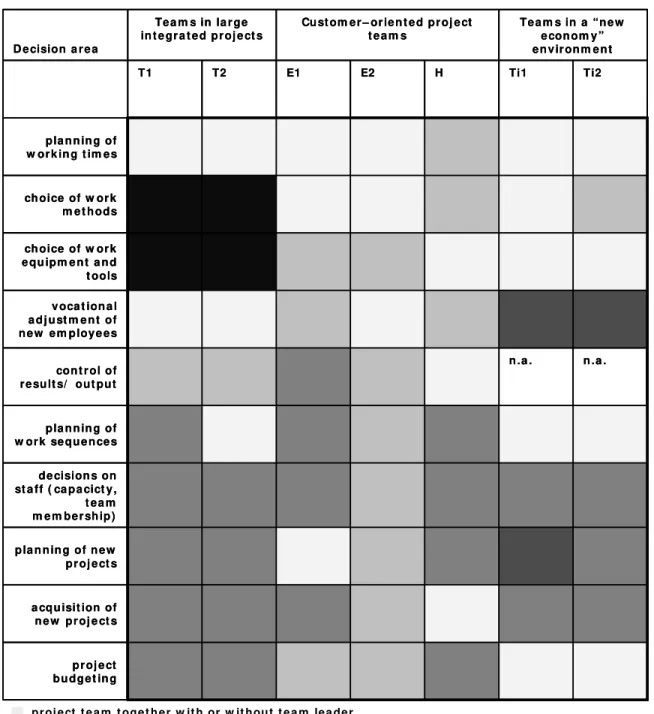
One of our main research interests was directed towards the influence of project teams on work planning, organisation, and work design in the projects. We used a ‘self regulation pattern’ (“Selbstregulationsraster”) to find out which tasks and decisions were (self-) regulated by the teams or individuals and which aspects were controlled and co-ordinated by management. Table 1 reveals that there was no consistent pattern on these decisions in the different projects investigated.
The coordination of the projects T1 and T2 – as sub-projects of large combine projects – are comparatively hierarchic. In both the teams, project managers are the only responsible people for distribution of tasks, planning of the project, budgeting, acquisition of new projects and decisions on staff. Work equipment, tools and methods applied are determined by the customer so that there is no choice for the project team. After fixing the contract, further interaction between customers and project team is not intended. The responsibilities of the project teams are on aspects of working time – coordinated by the project manager –, on the control of work output, and to check the state of work affairs.
En t e r pr ise a n d W or k I n n ov a t ion St u die s, N o. 2 , 2 0 0 6 I ET, M on t e de Ca pa r ica , Por t u ga l 3 1 pr oj e ct
bu dget in g a cqu isit ion of
n e w pr oj e ct s pla n n in g of n ew
pr oj e ct s de cision s on st a ff ( ca pa cict y, t ea m m e m be r sh ip) pla n n in g of w or k se qu e n ces
n .a . n .a .
con t r ol of r esu lt s/ out put
v oca t ion a l a dj u st m e n t of n e w e m ploy e es ch oice of w or k e qu ipm e n t a n d t ools ch oice of w or k
m e t h ods pla n n in g of w or k in g t im es
Ti2 Ti1 H E2 E1 T2 T1
Te a m s in a “n e w e con om y ” e n v ir on m e n t Cu st om er – or ien t e d pr oj e ct
t e a m s Tea m s in la r ge
in t e gr a t e d pr oj e ct s D ecision a r e a
pr oj e ct bu dget in g a cqu isit ion of
n e w pr oj e ct s pla n n in g of n ew
pr oj e ct s de cision s on st a ff ( ca pa cict y, t ea m m e m be r sh ip) pla n n in g of w or k se qu e n ces
n .a . n .a .
con t r ol of r esu lt s/ out put
v oca t ion a l a dj u st m e n t of n e w e m ploy e es ch oice of w or k e qu ipm e n t a n d t ools ch oice of w or k
m e t h ods pla n n in g of w or k in g t im es
Ti2 Ti1 H E2 E1 T2 T1
Te a m s in a “n e w e con om y ” e n v ir on m e n t Cu st om er – or ien t e d pr oj e ct
t e a m s Tea m s in la r ge
in t e gr a t e d pr oj e ct s D ecision a r e a
pr oj e ct t e a m t oge t h er w it h or w it hou t t e a m lea de r
in div idu a l t ea m m e m be r t oge t h e r w it h or w it h out t e a m lea de r t ea m le a der t oge t h e r w it h or w it h ou t m a n a ge m e n t
e x pe r t s be yon d t h e t ea m cu st om e r
Table 1: Employees’ options to contribute to or to decide on organisational aspects in project work
En t e r pr ise a n d W or k I n n ov a t ion St u die s, N o. 2 , 2 0 0 6 I ET, M on t e de Ca pa r ica , Por t u ga l 3 2
the projects. Work related decisions on equipment or tools are discussed among the project coordinator and the team members individually. Compared to the other projects, there is a predominance of informal ways to discuss and decide. A standardised project management has not been developed like it is implemented in the other companies. This ‘short way’ of communication and reduced co-ordination efforts obviously lead to a lack of structure and clear responsibilities.
Our study reveals that there is quite a broad range in the degree of self-regulation and autonomy among the IT-projects investigated. But except for one project, it is evident that the influence on project planning and the involvement in decisions is restricted to planning of working times and holidays, to the choice of equipment and methods, and to the introduction and vocational adjustment of new colleagues – i.e. on job control (cf. Moldaschl 2005b, 258). Employees generally miss adequate influence on staffing and time planning. The majority of the project staff remains excluded from management control, i.e. the design of the framing and contextual conditions of their work and from the influence on substantial resources to be negotiated.
In this sense we can conclude, that there is a remarkable impact of the employees on operational aspects of work while the influence on the work environment is very limited in the majority of the projects we investigated. This means that in most cases, the teams and team members are not able to influence the basic settings of the project scheduling. But as described above, these settings and regulations are the most restricting factors for the generation of strain because as long as they remain unchanged, every additional aspect of work is fostering work intensification. The deviant case of project E2 is indicating that there is an option to act differently. The difference stems from two aspects: Firstly, the individual management style of the project manager in E2 is very participatory – he is very much integrating the team in decisions. Secondly, the project manager is not avoiding conflicts with upper management or risky decisions (i.e. acting against the company internal regulations) to keep his projects going on successfully.
Mental strain and increasing burnout risk
High degrees of work intensity and stress – as described above – in connection with restricted chances to relax and recreate obviously have an impact on individual performance and health. As results of the final questionnaire, approximately 41% of the employees complain about difficulties to “come to an end with work” and to relax at the end of the day, 50% feel being worn out or exhausted. About one third of the employees agreed to the question that they would not be able to stand the workload and strain in the projects continuously.
En t e r pr ise a n d W or k I n n ov a t ion St u die s, N o. 2 , 2 0 0 6 I ET, M on t e de Ca pa r ica , Por t u ga l 3 3
41 31
31 25
58
72
42 27
11 16
21 17
0 10 20 30 40 50 60 70 80
Backache Headache Stomach pain Sleep disorders Nervousness Tiredness/Fatigue
Project staff members ISO-Beschäftigtenbefragung
Figure 2. Psychosomatic disorders of project team members compared to results of a representative employee survey in Germany (ISO-Beschäftigtenbefragung, cf. Bauer et al.
2004) in %
Compared to forms of work with predictable and standardised tasks, project work is characterised by discontinuous patterns of demand and strain. In our study, we investigated into the impact of degree and duration of strain on burnout risk and the development of mental exhaustion. The analysis of the monthly diaries on well-being provided further insight on the course of individual strain. We started from analysing the stress values which were recorded monthly by project team members we and compared the degree of mental exhaustion between different groups of employees.
By a comparison of mean values, we could identify that project team members reporting on high values of stress for more than eight weeks significantly suffer more often from mental exhaustion than comparable groups with lower degrees of stress or with the ability to relax earlier. There was no similar effect for employees with high values in less than two months. This is indication that a period of stress which is longer than two months is drastically increasing the risk of burnout.
Lim it s of t h e st u dy
For the purposes of this study, the application of in-depth case studies with the project teams and their members as unit of analysis has proved to be fruitful. We applied a qualitative approach as an attempt to focus on the conditions generating resources and strain and to take into account the dynamic aspects of projects. But this research approach has certain limits concerning the scientific validity and reliability of the results.
En t e r pr ise a n d W or k I n n ov a t ion St u die s, N o. 2 , 2 0 0 6 I ET, M on t e de Ca pa r ica , Por t u ga l 3 4
For aspects of work design in the companies and projects, this is not a problem: Based on the group interviews, specific solutions and approaches were initiated to improve the work situation and change certain misfits. But for further scientific validation, adapted methods need to be developed in order to investigate deeper into this aspect. Finally, we were not completely successful in analysing the specific constraints of employees working in several projects at the same time. The focus on a single project as unit of research turned out to be a limiting but unavoidable factor, here.
Con clu sion – opt ion s a n d lim it s of w or k de sign
The results of our study emphasise that contradicting requirements and insufficient organizational resources in relation to the work requirements are driving factors of work intensity. Five different types of contradictions or misfits could be identified describing the vast majority of encumbering situations of the project teams. Furthermore, our study revealed that these “gap situations” are main drivers for generating strain.
Concerning the strain, we found out that employees with higher stress values for more than 2 months have significantly higher mental exhaustion rates: These employees have an increased burnout risk. Furthermore, psychosomatic disorders reported in the projects are comparatively high for aspects of fatigue, nervousness and sleep disorders. We can conclude that for a large part of the employees in the projects analysed, the general exposition to stress and strain has reached a critical level while the resources available to cope with the misfits and contradictions are obviously insufficient. This kind of extended burnout risk is not only a problem of individual health but it is an increasing risk for the companies: High performers and employees with a lot of experiences and special know how are continuously needed to keep the company successful. The efforts to reach a sustainable workability especially of these people must be emphasised and fostered.
Furthermore, we identified different types of projects with varying degrees of team members’ autonomy and influence on work structuring and work environment. As a result of the “self regulation pattern” analysis, we could not find evidence for the assumption that IT-projects as a certain type of knowledge work are generally related to high degrees of autonomy or extended options of self-regulation. Instead, we found hierarchically coordinated projects based on a division of labour as well as forms with a strong emphasis on individual and team regulation. The degree of labour division is strongly influenced by the structure of the tasks performed (cf. types of projects in Table 1) and by the management style which is executed. Taking into account these limited options to solve the constraints mentioned, we can conclude, the strain is generated especially when employees are missing adequate influence on the conditions of their work. This is the case in the vast majority of the projects. An effect of self-regulation on mental strain could not be found.
Concerning the chances to design project work, we have to admit that certain characteristics of IT-project work are unchangeable, as are e.g. the insecurity in acquisition or work interrupts due to customer problems. But for a more sustainable coping with misfits or contradictions, we propose four starting points for further work design activities:
En t e r pr ise a n d W or k I n n ov a t ion St u die s, N o. 2 , 2 0 0 6 I ET, M on t e de Ca pa r ica , Por t u ga l 3 5
is not intended, yet. Therefore, specific regulations on a project contract level are necessary to enable this: It would be useful to introduce procedural rules in the contracts defining what happens when ad hoc wishes or “quick shots” were requested. We found examples that this type of regulation can be introduced (cf. the example on travelling times in one company). This would be a step towards a reduction of strain and an increase of product quality.
According to our experience, the prerequisites for a change in the use of employees and resources in projects are threefold: (a) there is a need for awareness of strain and burnout risks in management, (b) there is a need for employees’ awareness of this aspect and an need to train and enable them to act in away to reduce the risks, and finally, (c) a need for company internal strategic regulations and rules negotiated. So, training for management and employees to better understand signs of burnout and work overload would be helpful as a prerequisite to better cope with these aspects in the future. This would contribute to a reduction of strain and a long term sustaining of workability of scarce experts and experienced staff.
There is obviously a need for organisational solutions for restricting work load when people are working in different projects in parallel. In most cases in which this is applied, there was an individual responsibility of the employees to manage that – while this is an organisational problem which actually needs an organisational solution. Together with Schott et al. (2003, 47ff.), we propose to initiate a co-ordinator (“assignment manager”) for multi-project work who has to check for personnel demands of the projects on the one hand and individual capacities and workload of the employees available on the other. The assignment manager has to contribute to a better (i.e. less overloaded) use of the staff in the companies being independent from line or project responsibilities. Together with aspects of personnel development, this could be a core task of an HR department.
According to our findings, there is a need for extended relaxation options for the employees in the projects. It would be useful to enable employees to have relaxation and recovering periods close to the periods of strain, if necessary, while it is not helpful to foster sabbaticals or long recovery times for this purpose. These measures can be useful for other objectives but they obviously do not help to avoid burnout or reduce burnout risks. There is a need for recovering close to the strain.
Lit e r a t u r e
Allen, T. J.; Lee, D & Tushman, M. (1980): R&D-Performance as a function of internal communication, project management, and the nature of work. In: IEEE Transactions on Engineering Management, 27, 2 – 12.
Bauer, F.; Groß, H.; Lehmann, K. & Munz, E. (2004): Arbeitszeit 2003. Arbeitszeitgestaltung, Arbeitsorganisation und Tätigkeitsprofile, Köln: ISO-Institut.
Becker-Beck, U.; Fisch, R. (2001): Erfolg von Projektgruppen in Organisationen: Erträge der sozialwissenschaftlichen Forschung. In: R. Fisch, D. Beck & B. Englich (eds.): Projektgruppen in Organisationen. Göttingen: Verlag für Angewandte Psychologie. 45 – 60.
Bollinger, H. (2001): Neue Formen der Arbeit – Neue Formen des Gesundheitsschutzes. Das Beispiel Projektarbeit. In: WSI-Mitteilungen 11, 685 – 691.
En t e r pr ise a n d W or k I n n ov a t ion St u die s, N o. 2 , 2 0 0 6 I ET, M on t e de Ca pa r ica , Por t u ga l 3 6
Fahrenberg, J. (1975): Die Freiburger-Beschwerdeliste. In: Zeitschrift für Klinische Psychologie, 4, 49 – 100.
Gerlmaier, A. (2002): Neue Selbstständigkeit in der Informationsgesellschaft. Ein Vergleich von Anforderungen und individuellen Ressourcenpotenzialen bei autonom-flexiblen und arbeitsteiligen Arbeitsformen im IT-Bereich. Universität Dortmund: Dissertation.
Gerlmaier, A. (2004): Projektarbeit in der Wissensökonomie und ihre Auswirkungen auf die Work Life Balance. In: Kastner, M. (ed.): Die Zukunft der Work Life Balance: Wie lassen sich Beruf und Familie, Arbeit und Freizeit miteinander vereinbaren? Kröning: Asanger, 282 – 304.
Gerlmaier, A. & Latniak, E (2005a). Widersprüchliche Arbeitsanforderungen bei Projektarbeit - ein ressourcenorientierter Ansatz der Belastungsanalyse. In: Gesellschaft für Arbeitswissenschaft e.V. (ed.): Personalmanagement und Arbeitsgestaltung. Dortmund: GfA-Press, 419 – 422.
Gerlmaier, A. & Latniak, E. (2005b): Methoden der Analyse subjektivierter Arbeit - Wege und Grenzen In: Moldaschl, M. (ed.): Methoden der Messung und Bewertung immaterieller Ressourcen. München/Mering: Hampp (in print).
Gerlmaier, A. & Latniak, E. (2005c): Zwischen Innovation und alltäglichem Kleinkrieg – Arbeits- und Lernbedingunge bei Projektarbeit im IT-Bereich. In: Moldaschl, M. (ed.): Nachhaltigkeit von Arbeit und Rationalisierung. Band III. München/Mering: Hampp. (in print)
Hatchuel, A., 2002: Sources of intensity in work organisations. In: Docherty et al. 2002, 40 – 51.
Högl, M. (1998): Teamarbeit in innovativen Projekten. Einflussgrößen und Wirkungen. Wiesbaden: Dt. Univ.-Verl.
Kalimo, R.; Harju, A.; Leskinen, J. & Nykyri, E. (1992): Work load, psycho-physiological strain and coping of innovation project management in industry. In: Scandinavian Journal of Work Environment and Health, 18, 2, 130 – 132.
Kerber, G.; Marré, R. & Frick, A. (eds.) (2003): Zukunft im Projektmanagement. Beiträge zur gemeinsamen Konferenz „Management und Controlling von IT-Projekten“ und „interPM“. Glashütten: dpunkt.verlag.
Künstler, B. (1980): Psychische Belastung durch Arbeitstätigkeit – theoretisches Rahmenkonzept der Entwicklung eines Fragebogens zum Belastungserleben. In: Probleme und Ergebnisse der Psychologie, 74, 45 – 67.
Leitner, K.; Volpert, W.; Greiner, B.; Weber, W. & Hennes, K. (1987): Analyse psychischer Belastungen in der Arbeit. Köln: Verlag TÜV Rheinland.
Moldaschl, M. (ed.) (2005a.): Immaterielle Ressourcen. München/Mering: Hampp.
Moldaschl, M. (2005b): Ressourcenorientierte Analyse von Belastung und Bewältigung. In Moldaschl 2005a., 243 – 280.
Moldaschl, M. (2002): Subjektivierung – Eine neue Stufe in der Entwicklung der Arbeitswissenschaften? In: M. Moldaschl (ed.): Subjektivierung von Arbeit. München/Mehring: Hampp, 23 – 52.
Moldaschl, M. (1991): Frauenarbeit oder Facharbeit? Frankfurt: Campus.
En t e r pr ise a n d W or k I n n ov a t ion St u die s, N o. 2 , 2 0 0 6 I ET, M on t e de Ca pa r ica , Por t u ga l 3 7 Rubin, H. I. & Hernandez, E. F. (1988): Motivations and behaviours of software
professionals. In: Awad, E. (ed.): Proceedings of the 1988 AM SIGCPR Conference, New York: ACM. 62 – 71.
Rau, R. (2005): Lern- und gesundheitsförderliche Arbeitsgestaltung: eine empirische Studie. In: Zeitschrift für Arbeits- und Organisationspsychologie, 48, 4, 181 – 192.
Sauer, D. (2002): Unternehmensorganisation und Entgrenzung von Arbeit – Thesen zum Umbruch. In: Sauer, D. (ed.): Dienst-Leistungs-Arbeit. Kundenorientierung und Leistung in tertiären Organisationen. München: ISF, 27 – 38.
Schott, E.; Campana, Chr.; Von Steinbüchel, A. & Dammer, H. (2003): Ressourcenmanagement – Ergebnisse einer qualitativen Fallstudienauswertung. In: Kerber et al. (2003), 47 – 62.
Sonnentag, S.; Brodbeck, F.; Heinbokel, T. & Stolte, W. (1994): Stressor-burnout relationship in software development teams. In: Journal of Occupational and Organizational Psychology, 67, 327 – 341.
Ulich, E. (1994): Arbeitspsychologie. Zürich: VdF.
Zapf, D. (1991): Fehler, Stress und organisationaler Kontext. In: Frese, M. & D. Zapf (eds.): Fehler bei der Arbeit mit Computern. Bern: Huber. 106 – 117.