profile of the diplomatic corps and career patterns
Rodolfo de Camargo Lima¹
Amâncio Jorge Silva Nunes de Oliveira²
¹ Universidade de São Paulo / Programa de Pós-graduação do Departamento de Ciência Política, São Paulo / SP — Brazil ² Universidade de São Paulo / Instituto de Relações Internacionais, São Paulo / SP — Brazil
This work seeks to analyze the social profiles and career patterns of the Brazilian diplomatic corps, using Zairo B. Cheibub (1989) as a parameter and reference. In terms of profiles, there has been an increase in the age at which people enter this career, an increase in the proportion of those born in São Paulo as compared to Rio de Janeiro, subtle alterations in terms of gender and race, an increase in graduates from the University of São Paulo and the University of Brasília, and a preponderance of those with undergraduate law degrees. Looking at career patterns, we compare the average time for promotions to the diplomatic elite (second ministers and ambassadors) in terms of social categories and other institutional variables. Only the latter stands out and the average promotion time has increased in both hierarchies for those who have spent more than on stint in Class B and C diplomatic posts. On the other hand, for second ministers who have been named to political positions the promotion time has diminished. Both social profiles and career patterns point more to continuity rather than change in terms of profiles and patterns in the Ministry of Foreign Affairs.
Keywords: Ministry of Foreign Affairs; Itamaraty; government career; bureaucrats; diplomats.
Manutenção e mudanças no Ministério das Relações Exteriores: perfis do corpo diplomático e padrões na carreira
O presente trabalho tem como objetivo analisar perfis sociais e padrões de carreira do corpo diplomático brasileiro, tendo como parâmetro de comparação e referência o artigo de Zairo B. Cheibub (1989). Em relação aos perfis, notam-se o aumento médio da idade de ingresso, mudança dos nascidos do Rio de Janeiro para São Paulo, sutil alteração em gênero e raça, crescente entrada de formados pela Universidade de São Paulo e a Universidade de Brasília, e a liderança relativa dos bacharéis em direito. Para os padrões na carreira se comparam os tempos de promoção médios à elite diplomática (segundos ministros e embaixadores) entre as categorias sociais e demais variáveis institucionais. Apenas as últimas se destacam e o tempo médio de promoção aumenta, em ambas as hierarquias, para aqueles que possuem mais de uma passagem por postos diplomáticos de classes B e C. Já os segundos ministros que foram nomeados para cargos de confiança (DAS) sugerem ter seus tempos de promoção à elite, em média, diminuídos. Ambas as parcelas do trabalho apontam que as manutenções do perfil e dos padrões de carreira superam as mudanças no MRE. Palavras-chave: Ministério das Relações Exteriores; Itamaraty; carreira pública; burocratas; diplomatas.
DOI: http://dx.doi.org/10.1590/0034-7612175199
Article received on February 1, 2017 and accepted on April 6, 2018.
This work is a product of Rodolfo de Camargo Lima’s dissertation and we would like to acknowledge the critiques and suggestions in this process provided by Janina Onuki, Fernando Luiz Abrúcio and Pedro Feliú Ribeiro. Previous versions of this article have been presented at the 8th Alacip Congress (PUC-Peru), which received support from Capes-Proex and DCP-USP, and we would like to acknowledge
the observations of José Carlos M. Beliero Jr. and Bernardo S. Muratt; the 39th Anpocs Meeting (GT 13), which featured the support of
Caeni USP, and we would like to acknowledge the comments of Renato M. Perissinotto; and the 7th Student Seminar of the USP Graduate
Manutención y cambios en el Ministerio de las Relaciones Exteriores: perfil del cuerpo diplomático y patrones en la carrera
El presente trabajo tiene como objetivo analizar perfiles y patrones de la carrera del cuerpo diplomático brasileño, teniendo como parámetro de comparación y referencia el artículo de Zairo B. Cheibub (1989). En relación a los perfiles, se observa un aumento promedio de la edad de ingreso, el cambio de origen de nacimiento desde Rio de Janeiro a São Paulo, un sutil incremento de mujeres y afrodescendientes, la crecente entrada de los formados por la Universidad de São Paulo y la Universidad de Brasília, y el liderazgo relativo de los bachilleratos en derecho. Para los patrones en la carrera, se comparan los tiempos de promoción promedios a la elite diplomática (segundos ministros y embajadores) entre las categorías sociales y demás variables institucionales. Solamente las últimas se destacan y el tempo promedio de promoción aumenta, en ambas las jerarquías, para aquellos que poseen más de un pasaje por puestos diplomáticos de clases B y C. Los segundos ministros que han sido nombrados en cargos de confianza “DAS” sugieren tener sus tiempos de promoción a la elite, en promedio, disminuidos. Las dos partes del trabajo apuntan para que las manutenciones superan los cambios en el MRE.
Palabras clave: Ministerio de las Relaciones Exteriores; Itamaraty; carrera pública; burocratas; diplomáticos.
1. INTRODUCTION
This work seeks to examine the social profiles and career patterns of the Brazilian Ministry of Foreign
Affairs (henceforth the MFA or Itamaraty) vis-à-vis its diplomatic corps. The opening of this institution’s
“black box” will be achieved through analysis on an individual level by first describing the social characteristics of its actors and then identifying the patterns of career advancement through differences in the amount of time needed for promotions to the ministerial elite, including social categories and other institutional variables. Thus, this study intends to observe continuity and change in the diplomatic corps, comparing the ministerial composition of 1960 with that of 2010, in a descriptive and exploratory manner.
The data that has been researched and presented in this paper is original, but this study is not singular in its conception, given that it uses contemporary data to dialogue with, as well as compare and expand variables and perform tests based on, the pioneering reference article by Cheibub (1989). To take full advantage of this author’s results, we will accompany the descriptive behavior of the bureaucratic corps, which offers a comparative and panoramic vision which is privileged in that it includes profiles of these diplomats and the promotion patterns of this elite group. In this way, this study addresses gaps in the literature regarding the Brazilian Executive Branch in terms of understanding the internal workings of the bureaucracy (Loureiro, Olivieri and Martes, 2010:18), providing an advance in the analysis of the bureaucratic structure, its degree of professionalization, selection methods and administrative models (Figueiredo, 2010:192). Both parts of this work suggest that continuity exceeds change, both in terms of the composition and institutional functioning of the Brazilian diplomatic corps.
2. THEORETICAL REFERENCE
the following period is termed “rational-bureaucratic,” in which the ministry was consolidated bureaucratically in the direction of more meritocratic and professional careers (Cheibub, 1985).
This last phase, therefore, constituted the central axis for the study which was later published in
the Revista de Administração Pública (Brazilian Journal of Public Administration) — which is here our
fundamental reference —, and analyzes, as the title indicates, “The Bureaucratic Process of Itamaraty” (Cheibub, 1989). To the author, this process is delimited based on Huntington’s theoretical proposal (1968), which is characterized by factors of adaptability, complexity, autonomy and institutional cohesion (Cheibub, 1984:2, 1989:125).
Without entering into the merits of this debate and considering the proposed analysis, Cheibub (1989:99) states that “the tendency toward democratization can be considered to be an indicator of bureaucratization because, in response to democratic social demands — in the social sense —, Itamaraty has gradually come to be guided by explicit selection criteria.” To the author, the “application of clear and universal criteria made more democratic recruitment and a more bureaucratized diplomatic career possible” which resulted in a “greater broadening of the recruitment base” (Cheibub, 1989:98). And, within a broader institutional context, this therefore led to a “gradual acquisition of autonomy in the face of exogenous influences and the transformation of the diplomatic career into a more meritocratic career” (Cheibub, 1989:98).
Thus, Cheibub (1989) opted to analyze the diplomatic profile and observe the ministry’s bureaucratization process by categorizing individuals based on their class years, dividing them temporally into these groups according to the critical phases of the career and the institutional life of the MFA itself. This study continues on from where this author’s study left off in 1982. In addition, we propose two cohorts: one in 1996 and another in 2002. We briefly list their respective descriptions and then theoretically justify the choice of these divisions by administration:
• 1983-1996: Transition to democracy and the consolidation of the regime, as well as the
implementation of career changes under the FHC administration (1996);
• 1997-2002: Visualization of the alterations during the FHC administration, its changes and the
end of this administration (2002);
• 2003-2010: Beginning of the Lula administration (2003) and a visualization of the alterations
promoted until the entering class of 2009 which was updated in 2010.
(iv) the exclusion of the French language exam that year — currently French is required (Amado, 2013:33) —, a selection criterion that was considered “elitist” (Amado, 2013:33; Cheibub, 1989); and, finally, (v) the use of this cohort as a reference, even though somewhat roughly, for the beginning of the FHC administration.
The other important division occurred at the end of FHC’s mandate in 2002, which also witnessed qualitatively significant alterations, among which may be cited: (i) the implementation of an affirmative
action program (AAP) for candidates of African descent in the form of a scholarship prize;1 (ii) the
RBrI acquired the status of a professional Master’s degree recognized by the Ministry of Education
(MEC);2 and (iii) this year constituted the end of the FHC administration and the beginning of the
Lula administration. In addition to the next interval, which runs from 2003 to the entrance of the last class in the database in 2009 (updated in 2010), we also have: the redesign of the entrance exam — removing criteria perceived as very subjective by the candidates —, the making available of exam material on the website of Funag/MRE (Faria, Lopes and Casarões, 2013:6), a historical increment in the number of positions available between 2006 and 2010 (with more than 100 positions per year), as well as an increase in the remuneration of the initial position.
The following section of the social profile of the diplomats, deals specifically with the diplomatic elite, understood to be the second and first ministers (ambassadors). To advance in terms of our understanding of the differences in career promotion times, it is important to reiterate that the literature considers the Ministry of Foreign Affairs to be the civil bureaucracy that’s most insulated from particular and party demands (Geddes, 1994; Schneider, 1993) and, therefore, it constitutes the most closed federal civil ministry of the Executive Branch (Loureiro and Abrucio, 1999). Currently, the MFA continues to wield great control and monopolizes its political appointments positions — which are largely set aside for their career professionals (Lopez, 2015) —, imputing it with great capacity, as well as few party principals which ensures that they have great autonomy (Bersch, Praça and Taylor, 2017). On the other hand, this study considers that bureaucracies are not isolated single blocks, given that they are constantly interacting within a political context, and the actors that constitute them participates in various interactive and strategic political dynamics to gain legitimacy, since they do not possess elective mandates (Huber, 2007). In this sense, in addition to being affected by multiple types of pressure, these bureaucrats have preferences in terms of their professional and political goals and interests, which range from seeking promotions to disputing posts and positions over the length of their careers as well as broader collective and institutional demands (Dunleavy, 1991) — which are elements that put in check the bureaucrat’s supposed neutrality (Dargent, 2014).
3. MATERIAL AND METHODOLOGY
The source of the database constructed by the authors is the 2010 Ministry of Foreign Affairs Annual Diplomatic Personnel Report, which consists of the resumes of 1,466 active diplomats and 18 retired diplomats (who were not included in this analysis), who entered this career between 1961 and 2009 (information updated in 2010).
1 For more information, access: <www.institutoriobranco.itamaraty.gov.br/programa-de-acao-afirmativa>. Accessed on: 6 Apr. 2018. 2 According to Capes’s triannual 2001-2003 evaluation, IRBr (Rio Branco Institute) students are considered professional Master’s students
The Cheibub (1989) study used the Annual Diplomatic Personnel Reports of the MFA from 1960 to 1977, along with registration forms for the Rio Branco Institute from 1978 to 1982. It should be noted that the data from 1961-1982 was not considered in the present work in order to update it; thus, the data from this period is not included in the graphics. We have maintained, however, the hypotheses and trend forecasts made by the author for comparison purposes. Therefore, we have made descriptive use of the Cheibub (1989) data based on the 1960 Annual Report and, in the present study, have constructed its continuation since then. In this sense, the first part of this work should be considered the visualization of two temporally and politically distinct time frames. These considerations are fundamental because even though one of the graphs have been constructed in a continuous manner since Cheibub’s findings (1989) — through cohorts of administrative and governmental alterations —, they should be read comparatively in two time frames, or in other words, one based on 1960 (with data beginning in 1913) and the other 2010 (with data beginning in 1961).
For the contemporary database, you can visualize those who have passed the Diplomatic Career Entrance Exams (DCEE) since 1946, and those who were active in 2010 — each year’s entrants and those who appear in the “2010 Annual Diplomatic Personnel Report,” which depicts the diplomatic corps that we are examining. We would like to reiterate that this study considers only and specifically the diplomatic population that was active in this year; this way it does not include the other individuals who did not pass the exams.
GRAPH 1 CANDIDATES APPROVED IN THE DCEE AND ACTIVE DIPLOMATS AS OF 2010
Source: Elaborated by the authors based on information from the Ministry of Foreign Affairs3
and the MFA’s Annual Diplomatic Personnel Report (Diplomatas, 2010).
For the second portion of the work, there is no harm in the comparison of the diplomatic elites of the past and present, because the ample gap in their years of entrance offers two historically distinct elites. Thus, we compare the promotion averages of the high elite rankings based on social profile and other political-bureaucratic variables through variance analysis (Anova) — which is based on the ratio of mean squares and seeks to test the predictive effects of the two estimates of variance for each group. After the Anova, we conducted regressions using the ordinary least squares (OLS) method to report the results.
4. DISCUSSION AND RESULTS
4.1 REGISTRATIONS AND AGE AT DIPLOMATIC CAREER ENTRANCE
There has been an increase in the number of people registered for the diplomatic career entrance exams (DCEE) during the period examined. Significant changes have occurred during this interval, including the following which we will pay attention to: (i) the end of oral English and French exams in 1975 (Cheibub, 1989:101) and the expansion of Regional Registration Centers for these entrance exams, which in 1978 were offered in 10 cities (Castro and Castro, 2009:610) — the exam became
in fact national in scope only in 2011;4 (ii) the extinction of the French test and the compatibility of
the initial salary with the initial position in 1996 (Moura, 2007); and, (iii) the significant increase in salary and the number of positions available beginning in 2006. These actions, which are displayed in the graph below (by the vertical lines for 1975, 1996 and 2006), appear to have been influential in maintaining or increasing the number of people registering for the exams, the competitiveness of the applicants, and the increase in the amount of time necessary to prepare for the exams.
GRAPH 2 NUMBER OF CANDIDATES REGISTERING FOR THE DCEE FROM 1946 TO 2014
Source: Elaborated by the authors based on information provided by the Ministry of Foreign Affairs5
4 According to the DCEE, it was only in 2011 that the exams effectively were offered throughout the country with their arrival in the cities
of Aracaju, Boa Vista, João Pessoa, Macapá, Maceió, Palmas, Porto Velho, Rio Branco and Teresina. To see this and previous information,
access: <www.cespe.unb.br/concursos/_antigos/default.asp>. Accessed on: 6 Apr. 2018.
It should be emphasized that even though age limits for public exams were prohibited by the Constitution of 1988, Itamaraty continued to only accept applicants of up to 32 years of age, a practice which was continued until 1996, and then extended to 36 years of age, before it was subsequently abolished (Moura, 2007:61; Balbino, 2011:58). We may observe an overall increase in the average age of those entering the diplomatic corps to roughly 27 years of age, as well as the median age of these entrants, which also extended to an older segment entrance after 1996.
GRAPH 3 AVERAGE AGE (ABOVE) AND BOXPLOT (BELOW) OF INDIVIDUALS ENTERING DIPLOMATIC CAREERS
Source: Elaborated by the authors based on the MFA’s Annual Diplomatic Personnel Report (Diplomatas, 2010).
4.2 SOCIAL PROFILES
4.2.1 GEOGRAPHIC ORIGIN: BIRTH
The above mentioned decentralization of the first phase of the exams that began in 1959 (Cheibub, 1989:100), and the gradual further expansion of the exam locations from 1978 through the first decade of this century, has not resulted in a greater diversification in terms of the origins of the approved candidates, as can be seen in the graph below. In relation to the findings of the reference study, it states that the birthplaces of the candidates have displayed: “a growing participation in terms of São Paulo and the South and a corresponding decline in the proportion of diplomats from Rio de Janeiro” (Cheibub, 1989:101).
Thus, we observe that the declining trend of diplomats from Rio de Janeiro led to its losing its pole position to São Paulo during the period 2003-2010. In addition, since the mid-70s Itamaraty has made an effort to attract students from universities in São Paulo, (Cheibub, 1989:101), which seems to have had a progressively greater effect along with educational variables, as we’ll see below. Compared to the diplomatic corps in 1960, we can observe in regional terms that the clear concentration of career entrants from the Southeast has been maintained.
GRAPH 4 DIPLOMATS BORN IN THE SOUTHEAST (ABOVE), OTHER REGIONS AND ABROAD (BELOW), 1913-2010 (%)
Source: Until 1960, Cheibub (1989). Following periods, elaborated by the authors based on the MFA Annual Diplomatic Personnel
4.2.2 GENDER
In a fundamental study of gender in the ministry, Balbino (2011:56) presents central facts in terms of the historical disparities in Itamaraty: (i) in 1918, a women came in first place in the entrance exams; (ii) from 1919 to 1938, 18 women embarked on this career; and, (iii) from 1938 to 1954 women were prohibited from entering this career — during this period, Amado (2013:46) points out that “Maria Sandra Carneiro de Mello (later Macedo Soares) was the woman who questioned this
ban: she registered sub judice for the exams, passed them and studied at the Rio Branco Institute; in
January 1954, she witnessed the revocation of this ban.” Later in the graph, we can identify a certain, but nonetheless insufficient improvement: female participation in the diplomatic corps has grown from approximately 10% during the entrance classes of the 1960s, to almost a quarter of the entrants during the first decade of this century.
GRAPH 5 GENDER, 1961-2010 (%)
Source: Elaborated by the authors based on the MFA Annual Diplomatic Personnel Report (Diplomatas, 2010).
elements that belong to diplomatic culture, in addition to (iii) promotion bottlenecks or institutional
modus operandi — which open up possibilities for the exercise of discretionary decisions in selecting
who advances to the top.
In relation to this last aspect, the boxplot of the diplomatic elite below initially points to women in the first cohort needing a longer period of time to be promoted, and somewhat more equal median results for the second cohort. We would like to reiterate, however, that in the following portion of this study, in which we test the differences in promotion times, the models suggest that there should be no differences when comparing the male and female categories and their respective average times to ascend to the top of the career ladder, in terms of both the second minister and ambassador
hierarchies, ceteris paribus.
GRAPH 6 BOXPLOT OF THE PROMOTION YEARS FOR THE ELITE (SECOND MINISTERS AND AMBASSADORS)
Source: Elaborated by the authors based on the MFA Annual Diplomatic Personnel Report (Diplomatas, 2010).
4.2.3 RACE
An affirmative action program (AAP) was implemented in 2002,6 and since 2003 a scholarship worth
a total of R$ 25,000, with a chance to renew, has been offered to individuals who declare themselves to be of African descent — which requires a formal declaration and a 3x4cm photo on the registration
6 They analyzed Rio Branco Institute scholarship competitions from 2002 to 2013. This material can be accessed at:
form. During that same year, they implemented objective and essay exams and, in 2004, they specified the following relative weights: one for the objective exam, two for the interview and three for the essay; this was maintained until 2008 — in 2011, with the essay having been abolished, the weight of the objective exam became two and that of the interview became one.
In terms of the exam content, we note that: in 2003, the objective exam and the essay were administered in Portuguese and English respectively. In 2005, content was added related to the history of Brazil and geography (together with the Portuguese language for the objective exam and Portuguese for the essay and English in the next phase). In 2008, geography was removed and in its place there appeared “notions of international politics.” Finally, in 2011 a chance for a second renewal of the scholarship became based on the individual’s performance in the DCEE. In addition, that same year a quota system was implemented, but this is only valid for the first phase of the exams. That year, 30 positions were reserved for candidates of African descent.
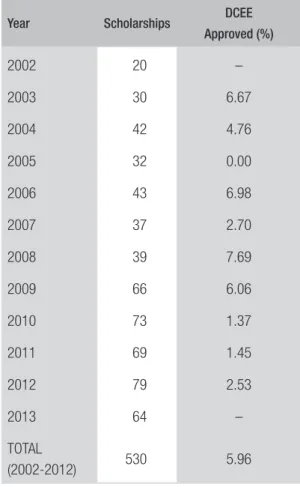
Between 2002 and 2012, 319 students benefitted from 530 available scholarships, and among the scholarship students, 19 individuals passed the DCEE. For the percentage of those approved over the number of beneficiaries (and not over the total number of scholarships offered), we have:
TABLE 1 AAP SCHOLARSHIPS AND DCEE APPROVED BENEFICIARIES (%)
Year Scholarships DCEE Approved (%)
2002 20 –
2003 30 6.67
2004 42 4.76
2005 32 0.00
2006 43 6.98
2007 37 2.70
2008 39 7.69
2009 66 6.06
2010 73 1.37
2011 69 1.45
2012 79 2.53
2013 64 –
TOTAL
(2002-2012) 530 5.96
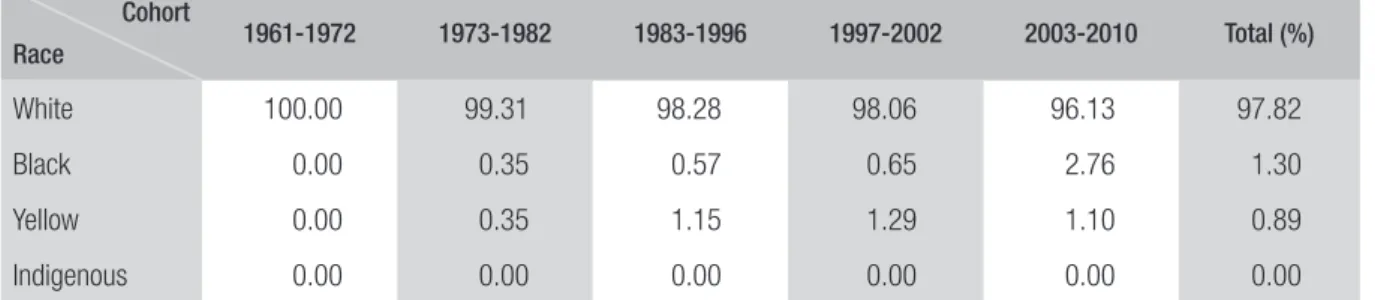
In the database constructed for this study, we were able to locate 14 beneficiaries of the AAP who embarked on this career as members of the classes between 2003 and 2009. Since the 2010 Annual Report features 3×4 photos of the diplomats, it was possible to classify the individuals in the database based on race. Below we can visualize that the entrance of this small group via AAP increased very slightly, but it was enough to constitute a change in the ministry’s racial inclusion that actually went beyond decimal points.
TABLE 2 RACE, 1961-2010 (%)
Cohort
Race 1961-1972 1973-1982 1983-1996 1997-2002 2003-2010 Total (%)
White 100.00 99.31 98.28 98.06 96.13 97.82
Black 0.00 0.35 0.57 0.65 2.76 1.30
Yellow 0.00 0.35 1.15 1.29 1.10 0.89
Indigenous 0.00 0.00 0.00 0.00 0.00 0.00
Source: Prepared by the authors based on the MFA Annual Diplomatic Personnel Report (Diplomatas, 2010).
It is true that these scholarships have had an effect on the overwhelming dominance of white individuals in the national diplomatic corps. The effect of these 14 scholarship students is worthy of recognition; however, it is because of this group’s performance in relation to the candidates overall,
as stated in this press release from Itamaraty:7
The approval percentage of ex-scholarship students in the admission exams for a diplomatic career is several times higher that the percentage of candidates approved in general. Of the 319
scholarship students (beneficiaries between 2002 and 2012), 19 were approved in the admission
exams. This corresponds to 6% of the total. This is a high success rate if we consider that [in general] the percentage of those approved has ranged from 0.5% to roughly 1.6% in general overall.
What is the profile then of the 14 AAP beneficiaries who were successful in the DCEE? The average age of this entering group is 32 years of age, with 10 being men and 4 women, with their origins being the Southeast (6), Northeast (5), Central-West (1), North (1) and South (1), and 10 being born in state capitals and four not. In terms of college education, 12 graduated from public universities and two from private ones — three of them possess two degrees —, and seven took graduate school courses. Eight entered diplomatic careers with previous professional experience in their concentrations.
7 According to a report on the Terra Portal from 10/25/2013, in the Education Section, “Itamaraty’s Program of Diplomatic Candidate
Scholarships Yields Positive Results,” which is available at:
4.2.4 EDUCATION: COLLEGE
Up until 1967 the Rio Branco Institute required only a high school degree; this later changed to the first year of college in any major. In 1968, the requirement rose to the second year of college and in 1975, the Rio Branco Institute became a college degree, or in other words, those who entered with incomplete college degrees complemented their studies to receive a college degree by the end of their course of study at the Institute. In 1985, a third year of college was required, and in 1996 a college degree in any area of knowledge was required (Cheibub, 1989; Moura, 2007).
The graph below illustrates, on the left, the nature of the undergraduate institution, and on the right, the majors that appear more than average at least in one cohort. First, in relation to the nature of the undergraduate institutions, it should be noted that: (i) the 1996 requirement bars those with incomplete degrees from the diplomatic corps (“No und.”), even though the number of those with college degrees has been growing successively since the 1940s (Cheibub, 1989); (ii) there is a bias in the career selection process in the sense of recruiting individuals from public universities — the proliferation of private universities during the 1990s did not affect the institution percentages of those recruited —; (iii) the decrease in the number of those who have received college degrees abroad (“Abr.”) — which added to the decrease in the number of those born abroad (“Abr.” in graph 4) — suggests the diminishing of the influence of language in the selection process, given that the exams place an emphasis on the knowledge of a foreign language, imputing an advantage to those who have received part or all of their education abroad (Cheibub, 1989:113).
In terms of completed college courses of study, Cheibub (1989:106) relates that “the dominance of a law degree is an undisputable truth [...] However, what is more important is the verification and finding that if current trends continue, this domination will end in the medium term.” This forecast, should be placed in context, because as we have observed in these diplomats’ undergraduate degrees, which appears on the right in graph 7: (i) a major in Law, even though it is declining (Cheibub, 1989:107) still maintains its relative leadership; Economics (“Econ.”), which was in political favor among the ministry’s elite during the 1950s and 60s (Cheibub 1989:108), has declined making way for two majors which have gained a higher profile: (iii) Social Communications (“Com.”) and International Relations (“I.R.”) — with the latter having grown considerably since its recent creation and national dissemination (Miyamoto, 2003); and, (iv) Engineering (“Eng.”), which constitutes the only college major with an above average percentage that is outside of the human sciences.
represented roughly 35% of the entrants in the diplomatic corps during the first decade of this century. Another aspect that should be mentioned is the establishment of traditional preparatory courses in São Paulo and the current Federal District, which were previously only available in Rio de Janeiro. Simply put, in perceiving a tendency to select individuals from public universities, we may observe that this filter is strongly associated with a handful of elite universities in this country.
GRAPH 7 NATURE OF UNDERGRADUATE INSTITUTIONS (ON THE LEFT) AND MAIN COMPLETED UNDERGRADUATE MAJORS (ON THE RIGHT), 1961-2010 (%)
Percentage
1971-1972 1973-1982 1983-1996 1997-2002 2003-2010 1961-1972 1973-1982 1983-1996 1997-2002 2003-2010
100 80 60 40 20 0
No und. No und. No und. Public Public Law Law Law Law Law
Public Public Public Private Private Private Private Private Abr.
Abr. Abr. Abr. Abr.
Army Army Army Army Army
I.R. I.R. I.R. I.R. I.R. Econ. Econ. Econ. Com. Com. Com. Com. Adm. Adm. Adm. Adm. Adm. Soc. Sc. Soc. Sc. Soc. Sc. Soc. Sc. Hist. Hist. Hist. Hist. Soc. Sc. Hist. Lethers Lethers Lethers Lethers Lethers Philos. Philos. Philos. Philos. Archit. Archit. Archit. Archit. Eng. Eng. Eng. Eng. Eng.
Source: Elaborated by the authors based on the MFA Annual Diplomatic Personnel Report (Diplomatas, 2010).
GRAPH 8 USP AND UNB (ABOVE) AND UNIVERSITIES IN RIO DE JANEIRO (BELOW), 1961-2010 (%)
1961-1972 USP
UnB
Source: Elaborated by the authors based on the MFA Annual Diplomatic Personnel Report (Diplomatas, 2010).
4.3 CAREER PATTERNS
4.3.1 CAREER ADVANCEMENT
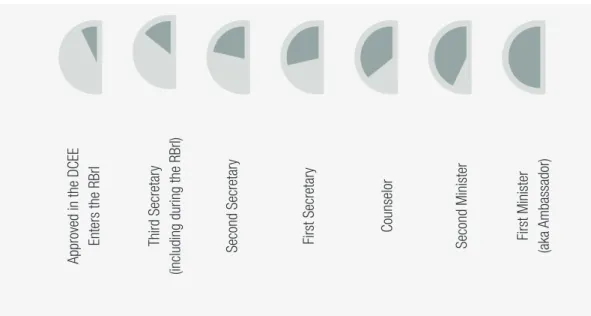
As mentioned above, since 1996 candidates enter as third secretaries once they are approved in the entrance exams and attend the Rio Branco Institute for two years. The first promotion from third to second secretary is based solely on seniority, and the second promotion, from second to first secretary also considers merit, which comes to dominate further promotions. The criterion of seniority is used only in special cases in which, having reached the ceiling for remaining in a position or in terms of age, depending on the class that the individual belongs to, this criterion also enters into consideration, allowing the individual to also be promoted for this reason. It is also necessary for individuals to spend periods abroad (which are totaled in a distinct manner depending on the location of the post)
and complete advanced courses at the Rio Branco Institute.8
8 A list of promotion rules is available on the Itamaraty Civil Servant Union website: <www.sinditamaraty.org.br/anexos/-01_QUADRO%20
COMPARATIVO%20REGRAS%20DE%20PROMOCAO%20NO%20SERVICO%20EXTERIOR%20BRASILEIRO%20-%20FINAL.
FIGURE 1 HIERARCHICAL STEPS IN CAREER ADVANCEMENT (FROM LEFT TO RIGHT)
Approved in the DCEE
Enters the RBrI Third Secretar
y
(including during the RBrI)
Second Secretar
y
First Secretar
y
Counselor
Second Minister First Minister (aka Ambassador)
Source: Elaborated by the authors.
Promotions occur twice a year through a complex system that combines seniority and merit, evaluating whether diplomats have achieved the eligibility criteria in the opinion of their superiors and their peers, conducted by a “House of Evaluation” and a “Promotion Commission,” both composed of actors within the ministerial elite (Balbino, 2011:63-64).
These addenda regarding advancement, promotions and hierarchical allocation of the bureaucratic corps are fundamental to the comprehension of the contemporary dilemmas and challenges of the ministry. In 2014, a young group of diplomats, a majority of which were third
secretaries, expressed concern in terms of the perspectives for career advancement,9 and in the
same vein their union reinforced their complaint in terms of the “flux of the entire hierarchical
pyramid.”10 Cheibub’s study (1989:122) states that the decrease in the standard deviation for
promotion times indicates that the “diplomatic career is becoming more and more predictable in terms of patterns of functional advancement, and therefore more and more uniform and bureaucratic.” Making the calculations using the recent data, this slight decline over time can still be observed, both for the first three hierarchical career promotions as well as the two highest promotions in the bureaucratic elite.
9 According to an article in the newspaper Folha de S.Paulo from 9/28/2014, in the World section, “Diplomats criticize Itamaraty ‘anomaly’,”
available at: <www1.folha.uol.com.br/mundo/2014/09/1523783-diplomatas-criticam-anomalia-no-itamaraty.shtml>. Later, a portion of the people who signed the document criticized the content of this report in the reader’s section on 10/2/2014, “Diplomats of Itamaraty contest report about careers in this government body.” Available at: <www1.folha.uol.com.br/paineldoleitor/2014/10/1525760-diplomatas-do-itamaraty-contestam-reportagem-sobre-carreira-no-orgao.shtml>. Accessed on: 6 Apr. 2018.
TABLE 4 STANDARD DEVIATION VALUES FOR PROMOTION TIME IN YEARS (FROM THIRD SECRETARY)
Cohort
Hierarchy 1961-1972 1973-1982 1983-1996 1997-2002 2003-2010
Second Secretary 1.00 1.11 0.78 0.94 0.59
First Secretary 2.52 2.17 2.14 1.38 0.95
Counselor 3.56 3.28 2.98 0.96
Second Minister 3.95 2.89 2.43
First Minister (Ambassador) 4.31 2.52 1.41
Source: Elaborated by the authors based on the MFA Annual Diplomatic Personnel Report (Diplomatas, 2010).
4.3.2 DIFFERENCES IN PROMOTION TIME FOR THE DIPLOMATIC ELITE
This last section seeks to analyze the differences in average promotion time for the elite of the MFA, second ministers and ambassadors, comparing both higher echelons and the elites of the past and present. Thus, we use variance analysis (Anova) which is an appropriate model for exploratory purposes (Gelman, 2005) to answer the following research question: are there differences in average promotion times for diplomats ascending to elite positions in terms of various social categories and institutional variables?
The dependent variable is the promotion time, in years, between starting as a third secretary and reaching the elite positions of second minister (n=235) and ambassador (n=186). The independent variables follow the traditional social profile of Brazilian diplomats presented earlier in this article, namely: being born in Rio de Janeiro (RJ), being male, having a law undergraduate degree, and having received a degree from a public university. The race variable was not included in the model, because the composition of the diplomatic elite is almost entirely white. Moreover, we added winning the Lafayette prize (first place in the DCEE exams), winning the Rio Branco prize (first place in the graduating class of the Rio Branco Institute), having attended graduate school (previous to being promoted and here considered to include: specializations, MBAs, Master’s, PhDs, post-doctorates and teaching at a college level), and having at least one book or article published (whether technical, academic or artistic/philosophical). These categories function as socio-educational proxies which can influence or function as tradeoffs for rising within the hierarchy.
(data provided by Lopez, 2015). The other institutional variables are related to at least one previous stint — or in other words, a dummy, yes or no, for the stint —, prior to be being promoted to elite positions, in the following institutions: the Office of the President (“OP”); or another national institution — whether it is in the Executive, Legislative and/or Judicial Branch at any level of the country’s government, excluding the OP —; or the United Nations (UN); and/or another international organization — formal or informal associated with international law, excluding the UN. Finally, diplomatic posts abroad have been divided according to the MFA’s own classification, compatible with the updated data from the 2010 Annual Diplomatic Personnel Report, which separates consulates,
embassies, and other specific posts into four classes: “A,” “B,” “C,” and “D.”11 The diplomatic posts
have three levels, which consist of no stints, one stint, and more than one stint, given that it is the institutional context that features the most stints during the diplomatic elite’s career trajectory — with the exception of Class D posts which we maintained as a dummy due to the lack of there being more than one stint on the way to becoming second minister and the very low frequency of more than one stint for ambassadors.
We can consider these categories to be political-bureaucratic career “treatments,” or in other words, they function as an institutional proxy of the increase or decrease in the average promotion time. To reiterate, the objective of this section, and this article in general, is exploratory and comparative with Cheibub’s study (1989:115), and we consider that “the relationship between the social, educational and political-bureaucratic factors and promotion time can help understand the differences between these career progressions as indicators of career patterns.” It is understood that some of these institutional variables are of interest, such as political appointments, stints in the Office of the President, the United Nations, and/or Class A diplomatic posts while rising through the diplomatic hierarchy, which may diminish the average promotion time. Below we will present brief justifications for the choices we have made in terms of the segmentation of the institutional variables of interest cited above.
First of all, it should be emphasized that political appointments constitute the most important administrative and political nominations of trust below the rank of minister and vice-minister (D’Araújo, 2014), and therefore this is a fundamental tool for examining the internal political
dynamics which operate within the Secretariat of the State (Sere).12 Secondly, it should be noted
that the prominent role of the MFA depends on the omission, authorization and delegation practiced by the President of the Republic (Lima, 2000); in this manner, the sponsorship by, and relationships with, the core of national political system are of crucial importance. Thirdly, it should be reinforced the fact that the United Nations (UN) as the principal international political institution (Amorim Neto, 2011:129) is a locus of systemic, historical and current interest to Brazilian multilateral foreign policy (Amorim Neto, 2011:129; Lima and Hirst, 2009). Also in terms of diplomatic posts abroad, Class A posts are highly central to the international system compared
11 To consult diplomatic posts of other classes, according to Ordinance No 534, of August 31, 2010, access: <www.asof.org.br/arquivos_site/
c438b8f77d455975e82614f3cd786c68.pdf>. Accessed on: 6 Apr. 2018. The stints of diplomatic posts which are listed in the 2010 Annual Diplomatic Personnel Report and no longer exist are classified as “NA” and they have been removed from the analysis, even though they remain in the database for consultation.
12 For a table of commissioned posts and paid positions within the Ministry of Foreign Affairs, see: <www.planalto.gov.br/ccivil_03/_
to the other classes, even though stints in Class C posts are multiplied by two and Class D by three for promotion purposes. In terms of these institutional incentives, the current elite does not seem
to value peripheral posts,13 and possibly opt for being stationed in Class A posts because they
possess larger staff, budgets, and political status, as well as privileged locations — being located in: Barcelona, Berlin, Bern, Boston, Brussels, Buenos Aires, Chicago, Geneva, the Hague, Lisbon,
London, Los Angeles, Madrid, Miami, Milan, New York, Paris, Rome, San Francisco, the Vatican, Vienna and, last but not least, Washington.
In terms of the social composition variables in the Cheibub study (1989:117), the finding was that “diplomats who had a Master’s degree were rewarded in terms of promotion time (two years on average) to second minister”. It also related the positive correlation between first place in the Rio Branco Institute course of study, categorized by the author as “DCPC classification” — referring to the “Diplomatic Career Preparation Course” —, and being promoted to first minister (ambassador). For the political-bureaucratic variables, the results of the Cheibub study (1989:120) reveal “that there is a significant relationship between promotion time for the two highest career positions and service in other public agencies, with it tending to have a positive influence on diplomatic careers,” given that “in accordance with the political-bureaucratic game, the MFA is susceptible to the demands of other public organizations” (Cheibub, 1989:120). However, the author states “there is no location that is privileged in terms of having a positive influence over one’s career” (Cheibub, 1989:121).
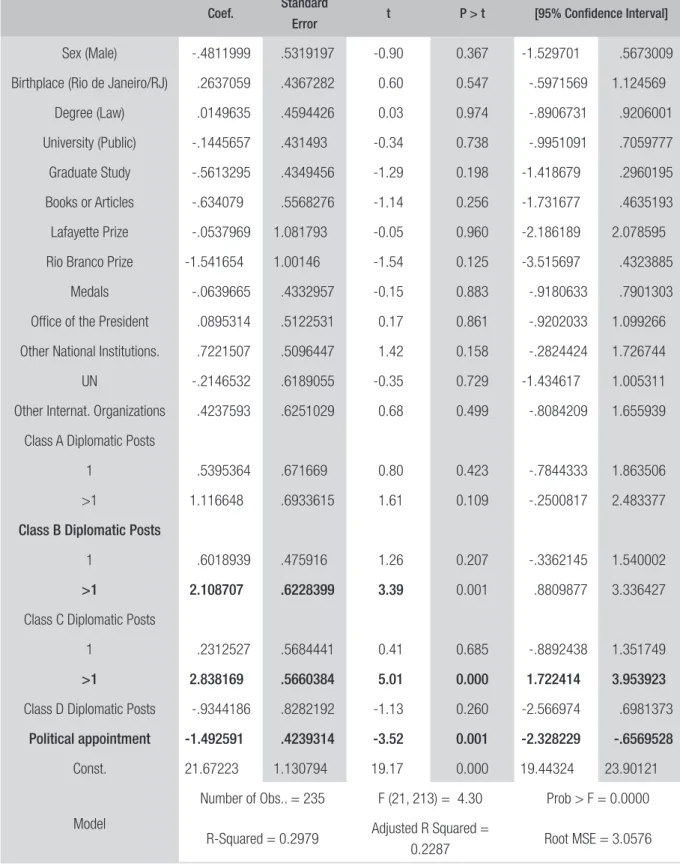
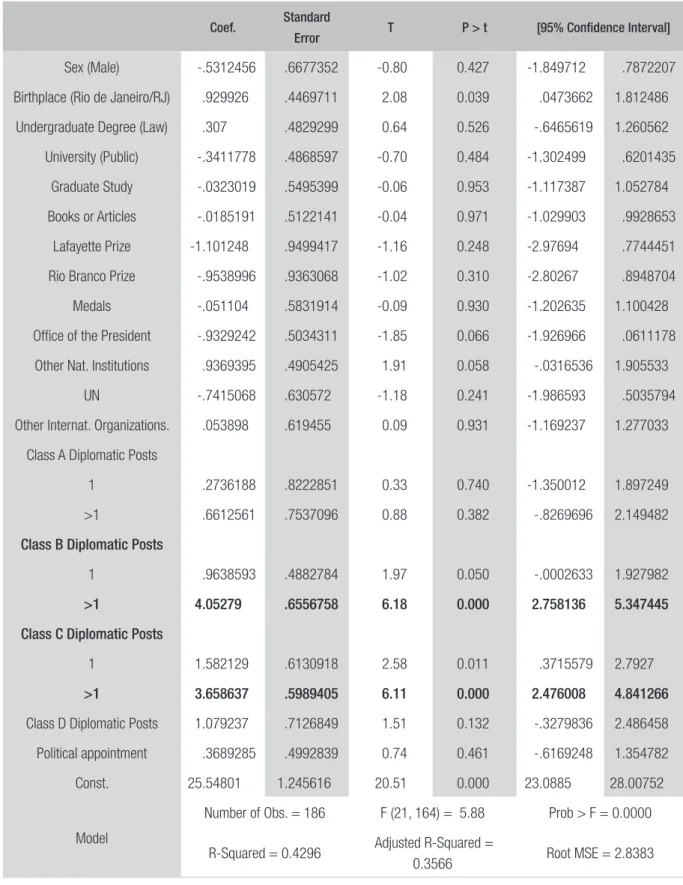
In relation to contemporary data, we may observe in table 5 that the results point in two different directions. On one hand, they point out the significance of having done stints in diplomatic posts of Classes B and C. Among these classes, when comparing those who have spent more than one stint with those who never spent time in posts of these categories, second ministers who passed through Class B posts increased their average promotion time by two years, while those who passed through Class C posts increased their average time by almost three years in terms of reaching the second highest rung on the career ladder – when controlling for the other variables. On the other hand, in terms of the hypothesis suggested by this study, those appointed to political positions took roughly one year and a half less time to be promoted than those second ministers who did
not receive any nominations for ministerial political positions within MFA, ceteris paribus.
For the highest echelon of the diplomatic hierarchy, we find that the significant results for the ambassadors converge on two of the variables verified for the second ministers: stints in Class B and C diplomatic posts. In respect to these variables, the differences in promotion times for both of these high level positions have become more pronounced. Ambassadors who have had more than one stint in B posts presented promotion times that were on average four years longer, and those who had more than one stint in C posts presented promotion times that were on average three and a half years longer than those that never occupied these posts during their ascension to the top of the diplomatic elite – when we control for the other variables.
13 The ambassador in Accra relates that: “In general, even for the current generation, the most prominent diplomats in Itamaraty never
spend time in these posts [C and D], especially Africa. The message is that Africa, or smaller posts or posts that constitute a sacrifice, cannot appear on the resumes of those who entertain hopes of having a good career in the Chancellery.” See the August 2012 report in
TABLE 5 OLS REGRESSION (AFTER ANOVA) FOR PROMOTION TIME OF SECOND MINISTERS
Coef. Standard
Error t P > t [95% Confidence Interval]
Sex (Male) -.4811999 .5319197 -0.90 0.367 -1.529701 .5673009
Birthplace (Rio de Janeiro/RJ) .2637059 .4367282 0.60 0.547 -.5971569 1.124569
Degree (Law) .0149635 .4594426 0.03 0.974 -.8906731 .9206001
University (Public) -.1445657 .431493 -0.34 0.738 -.9951091 .7059777
Graduate Study -.5613295 .4349456 -1.29 0.198 -1.418679 .2960195
Books or Articles -.634079 .5568276 -1.14 0.256 -1.731677 .4635193
Lafayette Prize -.0537969 1.081793 -0.05 0.960 -2.186189 2.078595
Rio Branco Prize -1.541654 1.00146 -1.54 0.125 -3.515697 .4323885
Medals -.0639665 .4332957 -0.15 0.883 -.9180633 .7901303
Office of the President .0895314 .5122531 0.17 0.861 -.9202033 1.099266
Other National Institutions. .7221507 .5096447 1.42 0.158 -.2824424 1.726744
UN -.2146532 .6189055 -0.35 0.729 -1.434617 1.005311
Other Internat. Organizations .4237593 .6251029 0.68 0.499 -.8084209 1.655939
Class A Diplomatic Posts
1 .5395364 .671669 0.80 0.423 -.7844333 1.863506
>1 1.116648 .6933615 1.61 0.109 -.2500817 2.483377
Class B Diplomatic Posts
1 .6018939 .475916 1.26 0.207 -.3362145 1.540002
>1 2.108707 .6228399 3.39 0.001 .8809877 3.336427
Class C Diplomatic Posts
1 .2312527 .5684441 0.41 0.685 -.8892438 1.351749
>1 2.838169 .5660384 5.01 0.000 1.722414 3.953923
Class D Diplomatic Posts -.9344186 .8282192 -1.13 0.260 -2.566974 .6981373
Political appointment -1.492591 .4239314 -3.52 0.001 -2.328229 -.6569528
Const. 21.67223 1.130794 19.17 0.000 19.44324 23.90121
Model
Number of Obs.. = 235 F (21, 213) = 4.30 Prob > F = 0.0000
R-Squared = 0.2979 Adjusted R Squared =
0.2287 Root MSE = 3.0576
Source: Elaborated by the authors based on the MFA Annual Diplomatic Personnel Report (Diplomatas, 2010) and information on
TABLE 6 OLS REGRESSION (AFTER ANOVA) FOR PROMOTION TIME OF AMBASSADORS
Coef. Standard
Error T P > t [95% Confidence Interval]
Sex (Male) -.5312456 .6677352 -0.80 0.427 -1.849712 .7872207
Birthplace (Rio de Janeiro/RJ) .929926 .4469711 2.08 0.039 .0473662 1.812486
Undergraduate Degree (Law) .307 .4829299 0.64 0.526 -.6465619 1.260562
University (Public) -.3411778 .4868597 -0.70 0.484 -1.302499 .6201435
Graduate Study -.0323019 .5495399 -0.06 0.953 -1.117387 1.052784
Books or Articles -.0185191 .5122141 -0.04 0.971 -1.029903 .9928653
Lafayette Prize -1.101248 .9499417 -1.16 0.248 -2.97694 .7744451
Rio Branco Prize -.9538996 .9363068 -1.02 0.310 -2.80267 .8948704
Medals -.051104 .5831914 -0.09 0.930 -1.202635 1.100428
Office of the President -.9329242 .5034311 -1.85 0.066 -1.926966 .0611178
Other Nat. Institutions .9369395 .4905425 1.91 0.058 -.0316536 1.905533
UN -.7415068 .630572 -1.18 0.241 -1.986593 .5035794
Other Internat. Organizations. .053898 .619455 0.09 0.931 -1.169237 1.277033
Class A Diplomatic Posts
1 .2736188 .8222851 0.33 0.740 -1.350012 1.897249
>1 .6612561 .7537096 0.88 0.382 -.8269696 2.149482
Class B Diplomatic Posts
1 .9638593 .4882784 1.97 0.050 -.0002633 1.927982
>1 4.05279 .6556758 6.18 0.000 2.758136 5.347445
Class C Diplomatic Posts
1 1.582129 .6130918 2.58 0.011 .3715579 2.7927
>1 3.658637 .5989405 6.11 0.000 2.476008 4.841266
Class D Diplomatic Posts 1.079237 .7126849 1.51 0.132 -.3279836 2.486458
Political appointment .3689285 .4992839 0.74 0.461 -.6169248 1.354782
Const. 25.54801 1.245616 20.51 0.000 23.0885 28.00752
Model
Number of Obs. = 186 F (21, 164) = 5.88 Prob > F = 0.0000
R-Squared = 0.4296 Adjusted R-Squared =
0.3566 Root MSE = 2.8383
Source: Elaborated by the authors based on the MFA Annual Diplomatic Personnel Report (Diplomatas, 2010) and information on
Unlike Cheibub’s study (1989), the social and educational categories did not present significant differences in terms of promotion times for the contemporary diplomatic elite. Also in contrast to the previous study in terms of the political-bureaucratic variables, it was not the public bureaucracies that affected promotion as in the past, but rather the internal political and institutional dynamics of the MFA — made up of the Secretariat of the State (Sere) and its specific divisions and units
abroad.14 In regard to this aspect, the lesser time required for rising to the position of second
minister seems to be related to diplomat's being named to political positions within Sere. In terms of increases in promotion times for both career top rank, the association points to those who have had stints in Class B and/or Class C diplomatic posts. In graph 9 we summarize the results discussed in this section.
GRAPH 9 PREDICTED VALUES FOR SIGNIFICANT VARIABLES FOR SECOND MINISTERS AND AMBASSADORS (95% C.L.)
Source: Elaborated by the authors based on MFA Annual Diplomatic Personnel Report (Diplomatas, 2010) and information on political
appointments from Lopez (2015).
5. FINAL CONSIDERATIONS
From the point of view of social profiles, we can see that the contemporary composition of the Brazilian bureaucracy has not become more representative regionally. Thus, in terms of the birthplaces and university degrees of active diplomats in 2010, they remain concentrated in the Southeast, more specifically Rio de Janeiro and São Paulo. In parallel to this continuity, the leadership of the Rio-São Paulo axis has been inverted, or in other words, Rio de Janeiro, lost its historic leadership in terms of the birthplace and higher education of diplomats to São Paulo in the first decade of this century. On the other hand, those born outside of state capitals have come to represent a quarter of the entrants at the same time that those born abroad have been gradually disappearing from the ministerial profile.
In terms of undergraduate degrees, the number of entrants from the elite universities of Rio de Janeiro has declined to make room for those from the University of São Paulo and the University of Brasilia. In contrast to Cheibub’s forecast (1989), having a law degree continues to be the relative leading profile, and there has recently been a growing number of majors in Social Communications and International Relations. We have also verified a very discreet change in terms of race and gender.
The career patterns indicate a decrease in the average promotion time for second ministers which are related politically and bureaucratically to political appointments. Meanwhile, for both high echelon average increases in promotion time are associated with stints in Class B and C consulates, embassies and specific diplomatic posts. We have demonstrated that those who have spent in these post categories more than one stint take significantly longer to be promoted on average when compared to those who have never occupied positions in these classes.
In sum, the objective of this work is to show continuity and change in the diplomatic corps from 1960 to 2010, and we have found that continuity has been more dominant than change. In other
words, not only is the modus operandi of foreign affairs slow and gradual, but so is the internal
REFERENCES
AMADO, André. Por dentro do Itamaraty: impressões
de um diplomata. Brasília: Fundação Alexandre de Gusmão, 2013.
AMORIM NETO, Octavio. De Dutra a Lula: a
condução e os determinantes da política externa brasileira. Rio de Janeiro: Elservier, 2011.
ARBILLA, José M. Arranjos institucionais e mudança conceitual nas políticas externas argentina
e brasileira (1989-1994). Contexto Internacional,
v. 22, n. 2, p. 337-385, 2000.
BALBINO, Viviane R. Diplomata, substantivo
comum de dois gêneros: um estudo sobre a presença
das mulheres na diplomacia brasileira. Brasília: Fundação Alexandre de Gusmão, 2011.
BERSCH, Katherine; PRAÇA, Sérgio; TAYLOR, Matthew M. State capacity, bureaucratic politicization, and corruption in the Brazilian State.
Governance, v. 30, n. 1, p. 105-124, 2017.
CASTRO, Flávio M. de O.; CASTRO, Francisco
M. de O. 1808-2008: Dois séculos de história da
organização do Itamaraty. Brasília: Fundação
Alexandre de Gusmão, 2009. (Volume 1: 1808-1979). CAVALINI, Marta. Cresce disputa para diplomata;
veja graduações que passaram em 2012. Portal G1,
São Paulo, 25 jun. 2013. Available at: <http://g1.globo. com/concursos-e-emprego/noticia/2013/06/ vagas-para-diplomata-caem-e-disputa-cresce-veja-graduacoes-que-passam.html>. Accessed on: 26 June 2018.
CHEIBUB, Zairo B. A carreira diplomática no Brasil:
o processo de burocratização do Itamarati. Rev. Adm.
Pública, Rio de Janeiro, v. 23, n. 2, p. 97-128, 1989.
CHEIBUB, Zairo B. Diplomacia, diplomatas e política
externa: aspectos do processo de institucionalização do Itamaraty. 1984. Thesis (master degree) — Instituto Universitário de Pesquisas do Rio de Janeiro, Rio de Janeiro, 1984.
CHEIBUB, Zairo B. Diplomacia e construção institucional: o Itamaraty em uma perspectiva
histórica. Dados — Revista de Ciências Sociais, Rio
de Janeiro, v. 28, n. 1, p. 113-131, 1985.
COCKLES, Mariana T.; STEINER, Andrea Quirino. As mulheres na carreira diplomática brasileira: considerações sobre admissão, hierarquia e
ascensão profissional. Monções: Revista de Relações
Internacionais da UFGD, v. 6, n. 11, p. 250-280, 2017.
DARGENT, Eduardo. Technocracy and democracy
in Latin America: the experts running government.
New York: Cambridge University Press, 2014.
D’ARAÚJO, Maria Celina Soares. Elites burocráticas, dirigentes públicos e política no poder executivo no Brasil. In: D’ARAÚJO, Maria Celina (Org.).
Redemocratização e mudança social no Brasil. Rio
de Janeiro: FGV, 2014. p. 205-229.
DELAMONICA, Laura. Mulheres diplomatas
brasileiras. 2014. Thesis (master degree in
international relations) — Universidade de Brasília, Brasília, 2014.
DUNLEAVY, Patrick. Democracy, bureaucracy
and public choice economic explanations in political
science. New York; London: Harvester, 1991.
EVANS, Peter B.; RAUCH, James E. Bureaucracy
and growth: a cross-national analysis of the effects of ‘Weberian’ State structures on economic growth.
American Sociological Review, v. 64, n. 5, p. 748-756, 1999.
FARIA, Carlos A. P. de; LOPES, Dawisson B.; CASARÕES, Guilherme. Itamaraty on the move: institutional and political change in Brazilian foreign service under Lula da Silva’s Presidency (2003-2010).
Bulletin of Latin American Research, v. 32, n. 4,
p. 468-482, 2013.
FARIAS, Rogério; CARMO, Géssica. As mulheres na carreira diplomática brasileira: uma análise do ponto de vista da literatura sobre mercado de trabalho e
gênero. Mundorama, jan. 2016.
FIGUEIREDO, Argelina. Executivo e burocracia. In: MARTINS, Carlos Benedito; LESSA, Renato
(Org.) Horizonte das ciências sociais no Brasil:
ciência política. São Paulo: Instituto Ciência Hoje; Barcarolla; Discurso Editorial, 2010. p. 191-216.
GEDDES, Barbara. Politician’s dilemma: building
state capacity in Latin America. Berkeley: University of California Press, 1994.
GELMAN, Andrew. Analysis of variance — why it
is more important than ever. The Annals of Statistics,
v. 33, n. 1, p. 1-53, 2005.
HUBER, Gregory. The craft of bureaucratic neutrality.
HUNTINGTON, Samuel P. Political order in
changing societies. New Haven: Yale University
Press, 1968.
LIMA, Maria Regina S. de. Instituições democráticas
e política exterior. Contexto Internacional, v. 22,
n. 2, p. 265-303, 2000.
LIMA, Maria Regina S.; HIRST, Monica. Brasil como país intermediário e poder regional. In: HURRELL,
Andrew et al. (Org.). Os Brics e a ordem global. Rio
de Janeiro: FGV, 2009. p. 43-74.
LOPEZ, Felix G. Evolução e perfil dos nomeados para
cargos DAS na administração pública federal
(1999-2014). Brasília: Ipea, 2015.
LOUREIRO, Maria Rita; ABRUCIO, Fernando Luiz. Política e burocracia no presidencialismo brasileiro: o papel do Ministério da Fazenda no primeiro governo Fernando Henrique Cardoso.
Revista Brasileira de Ciências Sociais, v. 14, n. 41, p. 69-89, 1999.
LOUREIRO, Maria Rita; OLIVIERI, Cecília;
MARTES, Ana C. B. Burocratas, partidos e grupos de interesse: o debate sobre política e burocracia no Brasil. In: LOUREIRO, Maria Rita et al. (Org.).
Burocracia e Política no Brasil: desafios para a ordem
democrática no século XXI. Rio de Janeiro: FGV,
2010. p. 73-108.
MIYAMOTO, Shiguenoli. O ensino das relações internacionais no Brasil: problemas e perspectivas.
Revista de Sociologia e Política, v. 20, n. 1, p. 103-114, 2003.
MOURA, Cristina P. O Instituto Rio Branco e a
diplomacia brasileira: um estudo de carreira e
socialização. Rio de Janeiro: FGV, 2007. (digital
edition, 2012).
SCHNEIDER, Ben R. The career connection: a comparative analysis of bureaucratic preferences
and insulation. Comparative Politics, v. 25, n. 3,
p. 331-350, 1993.
Rodolfo de Camargo Lima
PhD candidate in Political Science at the University of São Paulo (DCP-USP). Website: <www.rodolfolima.net>. E-mail: [email protected].
Amâncio Jorge Silva Nunes de Oliveira