evaluation in two border municipalities in Mato Grosso
do Sul State, Brazil, 2016*
Correspondence:
Elisângela Martins da Silva Costa – Alameda Vera Cruz, No. 9, bairro Universitário, Corumbá, MS, Brazil. CEP: 79304-033 E-mail: [email protected]
Elisângela Martins da Silva Costa1 – orcid.org/0000-0001-8522-8511 Rivaldo Venâncio da Cunha1
Edgar Aparecido da Costa2
1Universidade Federal de Mato Grosso do Sul, Programa de Pós-Graduação em Saúde e Desenvolvimento na Região
Centro-Oeste, Campo Grande, MS, Brasil
2Universidade Federal de Mato Grosso do Sul, Programa de Pós-Graduação em Estudos Fronteiriços, Corumbá, MS, Brasil
Abstract
Objective: to evaluate the degree of implementation of the National Dengue Control Program (PNCD) in two border municipalities in Mato Grosso do Sul State (Corumbá and Ponta Porã), Brazil, 2016. Methods: This was a normative evaluation based on indicators of service structure and work process; questionnaires were answered by health professionals involved in dengue prevention and control; the cut-off points used to determine the degree of implementation were 'implemented' (>75% of the activities implemented), 'partially implemented' (50 to 75%), 'low level of implementation' (25 to 49%), and 'not implemented' (<25%). Results: 383 health professionals participated in this study, 227 of whom were from Corumbá and 156 from Ponta Porã; the degree of PNCD implementation was 63.1% and 66.4% for Corumbá and Ponta Porã, respectively, thus being classified as partially implemented in both municipalities. Conclusion: PNCD implementation was partial in both municipalities; problems observed indicate the need for program enhancement.
Keywords: Dengue; Health Services; Health Program and Project Evaluation; Border Areas; Evaluation Studies.
doi: 10.5123/S1679-49742018000400007
Introduction
Dengue is endemic in most countries of Latin America, South-East Asia and Central Africa, where epidemics occur in large and small cities.1 It is
estimated that 390 million cases occur annually all over the world. Of this total, it is estimated that 96 million are apparent infections and at least 20,000 progress to death.2 Since 2001 Brazil has reported more cases
of dengue fever than any other country: approximately 11 million up until 2016, with the recent epidemics of 2015 and 2016 standing out with 1.6 and 1.5 million cases, respectively. In 2016 Mato Grosso do Sul state recorded 44,814 suspected cases of the disease - an increase of 39% in relation to the previous year.3
The control of this disease in Brazil is carried out in accordance with the guidelines of the National Dengue Control Program (PNCD).4 PNCD has been in force in
Brazil since 2002 and has ten components. These include operational actions related to integrated surveillance, entomological surveillance, environmental surveillance, assistance to the sick, health education, communication and social mobilization, training of professionals, political and social support and monitoring and evaluation. Implementation of the program’s actions is incorporated into the routine of the Municipal Health Departments, with support from State Health Departments and the Ministry of Health when necessary. Most of their funding comes from the federal level.
PNCD priority municipalities include those located in the international border area, because they are considered to be prone to the introduction of the disease. In these areas the cross-border flow of people is an important vehicle for the spread of dengue virus serotypes/strains, thus increasing the potential for epidemics.5
Regarding the magnitude of its presence in the Brazilian border areas, among mandatory notifiable diseases dengue was the second most reported in these locations between 2007 and 2009,6 surpassed only by malaria. In
2010, the mean dengue incidence rate in the twin frontier cities was 1.6 times higher than the national average.7
The vulnerability of border area municipalities to dengue fever epidemics, as well as the absence of PNCD evaluative studies on this region, justify research being performed with the aim of contributing to PNCD improvement. The objective of this study was to evaluate the degree of PNCD implementation in two border municipalities in Mato Grosso do Sul State, Brazil, 2016.
Methods
This was a normative evaluation study measuring the degree of PNCD implementation in two border municipalities of Mato Grosso do Sul State with regard to service structure and work process,8 from November
to December 2016.
The following criteria were adopted in order to select the municipalities: municipal territory being directly on the international border and being a priority city for PNCD in Mato Grosso do Sul. Using these criteria we identified two municipalities: Corumbá and Ponta Porã.
Corumbá is located in the western part of Mato Grosso do Sul state, in the Midwest region of Brazil, on the border with Bolivia. In 2016, the municipality had an estimated population of 109,899 inhabitants.9
At the time of data collection, Corumbá had 22 Family Health care centers with 26 Family Health Strategy (FHS) teams implanted (22 located in the urban area and four in the rural area), as well as a Brazilian Nacional Health System (SUS) outsourced charity hospital: namely the Santa Casa Hospital.
Ponta Porã, located in the south of the state, on the Brazilian border with Paraguay, had an estimated population of 89,592 inhabitants in 2016.9 The
municipality’s public health care network had 15 Family Health centers, with 15 FHS teams (11 in the urban area and four in the rural area), in addition to the Dr. José de Simone Neto Regional Hospital.
Health professionals belonging to different categories and from different health care services were invited to participate in the study: epidemiological surveillance coordinator and technical staff; endemic disease vector control coordinator and health agents;
PNCD priority municipalities include
Primary Health Care coordinator, doctors, nurses and community health agents of the urban FHS teams; and doctors and nurses from the emergency departments and the hospital beds (adult and pediatric) sectors of the municipal hospitals. All epidemiological surveillance, vector/endemic disease control and urban area FHS team professionals were interviewed, with the exception of those who refused to participate in the study or those who were absent from the workplace when the researchers collected information there. The rural area FHS teams were excluded from the study owing to access difficulties.
A day shift doctor and nurse and a night shift doctor and nurse from each municipal hospital were invited to take part in the study. They were selected by drawing lots. We sought to include working days and weekends. If the health professional drawn by lot did not agree to participate in the study, another draw was made. Given that many health professionals worked as part of the FHS teams and also at the hospitals, we excluded those who had already answered the questionnaires. In order to evaluate the degree of PNCD implementation, ten program components were considered:4
1. Epidemiological surveillance; 2. Vector combat;
3. Assistance to the sick; 4. Integration with Primary Care; 5. Environmental sanitation;
6. Health education, social mobilization and communication;
7. Human resources training; 8. Legislation;
9. Political-social support; and 10. Monitoring and evaluation.
An analysis and judgment framework was built, listing a set of indicators for evaluating service structure and work process for each PNCD component. For service structure, we evaluated material resources, infrastructure and human resources. For work process, we evaluated the elements comprising the practices of each component. The indicators were defined based on Ministry of Health normative and technical publications4,10-12 and on published PNCD
evaluation studies.13-16
When validating the framework and establishing the scores expected for each indicator, a consensus technique (Delphi method) was used with 11 experts
on the subject, in accordance with the methodology described by Souza Silva and Hartz.17 A total of 68
indicators were established to evaluate PNCD, 24 being for structure and 44 for process. The maximum expected score was 706 points (∑ of the score expected for the indicators), 274 for structure 432 for process. The questionnaires were prepared based on the consensual framework.
Data collection was conducted by means of structured questionnaires, complemented by open-ended questions. In the case of service coordinators, the questionnaires were answered in interviews conducted by the first author of this article. In the case of other health professionals, once the objectives of the study had been explained they themselves answered the questionnaires. Data was input to a Microsoft Excel® 2007 spreadsheet and then categorized for program scoring and classification.
When compiling the scores for degree of implementation, initially the score was calculated based on the proportion of positive answers for each indicator and the degree of implementation was determined in percentage terms (scores given / expected scores x 100). Subsequently, we calculated the degree of implementation of each component based on the total scores for its set of indicators. The degree of structure and process implementation was obtained from the total of the scores of their components. The final classification of the degree of implementation of PNCD and its components was determined based on the arithmetic average of the degree of implementation of each dimension (degree of total implementation = degree of structure implementation + degree of process implementation / 2). Taking the scores achieved, the degree of implementation was classified in four categories: implemented (>75%); partially implemented (50 to 75%); low level of implementation (25 to 49%); and not implemented (<25%).16.18
Results
Of the total number of 470 health professionals eligible for this study, 383 (81.5%) agreed to participate, 52 (11.1%) refused and 35 (7.4%) were absent from the workplace at the time of the survey. Losses were considered to be when there were two unsuccessful attempts to administer the questionnaire. Among those who agreed to participate, 227 were from Corumbá (3 epidemiological surveillance coordinators e 6 technical staff, 43 endemic disease control agents, 111 community health agents, 13 FHS physicians and 20 FHS nurses, as well as 14 hospital physicians and 17 hospital nurses) and 156 were from Ponta Pora (3 epidemiological surveillance coordinators and 5 technical staff, 30 endemic disease control agents, 66 community health agents, 8 FHS doctors and 9 FHS nurses, as well as 17 hospital physicians and 18 hospital nurses).
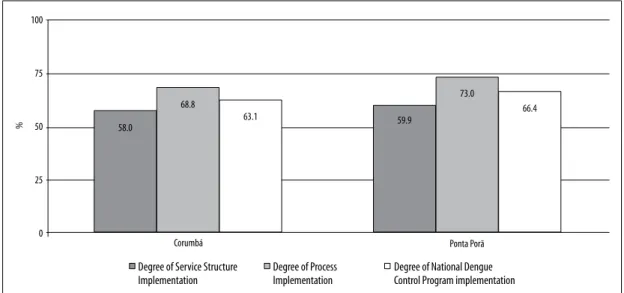
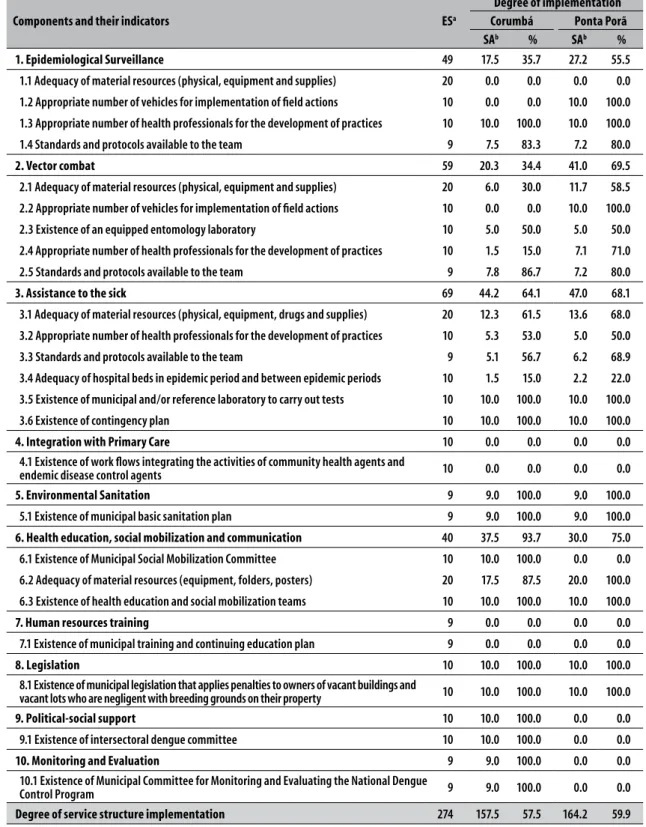
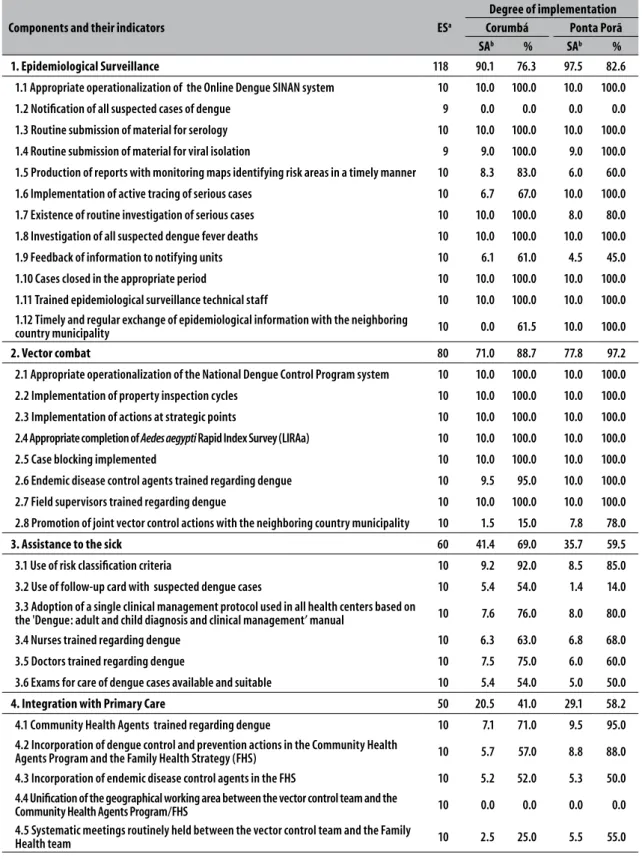
As to the degree of PNCD implementation, both municipalities were classified as being partially implemented: Corumbá 63.1% and Ponta Porã 66.4%. Service structure and work process were classified as being partially implemented in both municipalities (Figure 1). The expected score, the score achieved and the degree of implementation of each indicator used to assess the ten PNCD components, according to service structure and work process, are shown in Tables 1 and 2. The results of the assessment of the
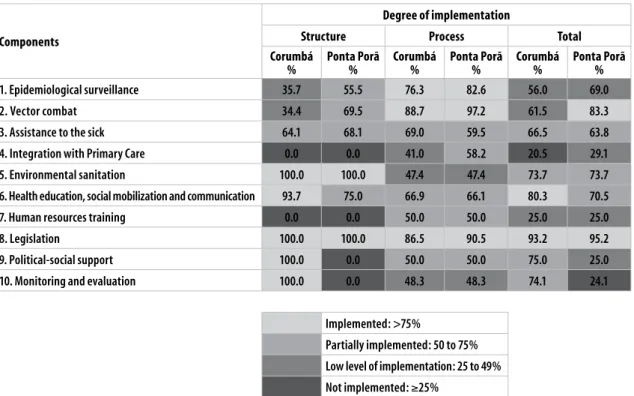
degree of implementation of each PNCD component are shown in Figure 2.
As regards the degree of ‘Structure’ and ‘Process’implementation in relation to the 'Epidemiological surveillance' component, Corumbá achieved a score of 56.0% and Ponta Porã 69.0%, both being classified as partially implemented (Figure 2). The critical point of this component was structure, assessed as having a low level of implementation in Corumbá (35.7%) and as being partially implemented in Ponta Porã (55.5%); its main limitations refer to the 'adequacy of material resources', in both municipalities, and the ‘appropriate number of vehicles for implementation of field actions' in Corumbá (Table 1).
The 'Vector combat' component was partially implemented in Corumbá (61.5%) and fully implemented in Ponta Porã (83.3%). The process element of this component was found to have better performance, being fully implemented in both municipalities (Figure 2), although 'promotion of joint vector control actions with the municipality of the neighboring country' stands out as being the only indicator not implemented in Corumbá (15.0%) (Table 2). With regard to the structure element, 'vector combat' had a low level of implementation in Corumbá (34.4%) and was partially implemented in Ponta Porã (69.5%) (Table 1), and only one of the five indicators used to assess this component was implemented in Corumbá, namely 'norms and protocols available to the team' (86.7%); in Ponta Porã, apart
Figure 1 – Degree of National Dengue Control Program implementation in the municipalities of Corumbá and Ponta Porã, Mato Grosso do Sul, 2016
Degree of Service Structure Implementation
Degree of Process Implementation
Degree of National Dengue Control Program implementation
100
75
50
25
0
58.0
68.8
63.1 59.9
73.0
66.4
%
Table 1 – Degree of implementation according to evaluated National Dengue Control Program service structure components and indicators, Corumbá and Ponta Porã, Mato Grosso do Sul, 2016
Components and their indicators ESa
Degree of implementation
Corumbá Ponta Porã
SAb % SAb %
1. Epidemiological Surveillance 49 17.5 35.7 27.2 55.5
1.1 Adequacy of material resources (physical, equipment and supplies) 20 0.0 0.0 0.0 0.0
1.2 Appropriate number of vehicles for implementation of field actions 10 0.0 0.0 10.0 100.0
1.3 Appropriate number of health professionals for the development of practices 10 10.0 100.0 10.0 100.0
1.4 Standards and protocols available to the team 9 7.5 83.3 7.2 80.0
2. Vector combat 59 20.3 34.4 41.0 69.5
2.1 Adequacy of material resources (physical, equipment and supplies) 20 6.0 30.0 11.7 58.5
2.2 Appropriate number of vehicles for implementation of field actions 10 0.0 0.0 10.0 100.0
2.3 Existence of an equipped entomology laboratory 10 5.0 50.0 5.0 50.0
2.4 Appropriate number of health professionals for the development of practices 10 1.5 15.0 7.1 71.0
2.5 Standards and protocols available to the team 9 7.8 86.7 7.2 80.0
3. Assistance to the sick 69 44.2 64.1 47.0 68.1
3.1 Adequacy of material resources (physical, equipment, drugs and supplies) 20 12.3 61.5 13.6 68.0
3.2 Appropriate number of health professionals for the development of practices 10 5.3 53.0 5.0 50.0
3.3 Standards and protocols available to the team 9 5.1 56.7 6.2 68.9
3.4 Adequacy of hospital beds in epidemic period and between epidemic periods 10 1.5 15.0 2.2 22.0
3.5 Existence of municipal and/or reference laboratory to carry out tests 10 10.0 100.0 10.0 100.0
3.6 Existence of contingency plan 10 10.0 100.0 10.0 100.0
4. Integration with Primary Care 10 0.0 0.0 0.0 0.0
4.1 Existence of work flows integrating the activities of community health agents and
endemic disease control agents 10 0.0 0.0 0.0 0.0
5. Environmental Sanitation 9 9.0 100.0 9.0 100.0
5.1 Existence of municipal basic sanitation plan 9 9.0 100.0 9.0 100.0
6. Health education, social mobilization and communication 40 37.5 93.7 30.0 75.0
6.1 Existence of Municipal Social Mobilization Committee 10 10.0 100.0 0.0 0.0
6.2 Adequacy of material resources (equipment, folders, posters) 20 17.5 87.5 20.0 100.0
6.3 Existence of health education and social mobilization teams 10 10.0 100.0 10.0 100.0
7. Human resources training 9 0.0 0.0 0.0 0.0
7.1 Existence of municipal training and continuing education plan 9 0.0 0.0 0.0 0.0
8. Legislation 10 10.0 100.0 10.0 100.0
8.1 Existence of municipal legislation that applies penalties to owners of vacant buildings and
vacant lots who are negligent with breeding grounds on their property 10 10.0 100.0 10.0 100.0
9. Political-social support 10 10.0 100.0 0.0 0.0
9.1 Existence of intersectoral dengue committee 10 10.0 100.0 0.0 0.0
10. Monitoring and Evaluation 9 9.0 100.0 0.0 0.0
10.1 Existence of Municipal Committee for Monitoring and Evaluating the National Dengue
Control Program 9 9.0 100.0 0.0 0.0
Degree of service structure implementation 274 157.5 57.5 164.2 59.9
from this indicator (80%), the 'appropriate number of vehicles for implementation of field actions' was also fully implemented (100.0%).
Analysis of the 'Integration with primary care' component showed that both municipalities did not meet the evaluation requirement for structure (0.0%) (Table 1). As to work process, the most poorly assessed indicator was ‘unification of the geographical working area between the vector control team and the Community Health Agent Program/FHS' (0.0% for both municipalities); while the best assessed was 'community health agents trained regarding dengue', achieving 71.0% in Corumbá and 95.0% in Ponta Porã (Table 2). As to the degree of implementation of this component, Corumbá was assessed as not being implemented (20.5%) and Ponta Porã as having a low level of implementation (29.1%) (Figure 2).
Based on the analysis of service structure and work process, both municipalities obtained similar scores in the assessment of two components: ‘Assistance to the sick', this being partially implemented in Corumbá (66.5%) and also in Ponta Porã (63.8%), and 'Legislation', for which Corumbá obtained a score of 93.2% and Ponta Porã 95.2%, both being classified as implemented (Figure 2). A further two components achieved the same scores in both municipalities: ‘Environmental sanitation', which was partially implemented (73.7%), and 'human resources training', which had a low level of implementation (25.0%) (Figure 2).
When compared to Ponta Porã, Corumbá showed better performance in the assessment of the following components: 'Health education, social mobilization and communication' (80.3% - implemented), 'political-social support’ (75.0% - partially implemented) and 'Monitoring and evaluation' (74.1% - partially implemented) (Figure 2). It can be seen that in Ponta Porã the critical point related to these components was service structure, with scores of 70.5%, 0.0% and 0.0%, respectively (Table 1). Both municipalities presented weaknesses in the process aspect of the 'monitoring and evaluation' component, mainly because they do not carry out periodic meetings to evaluate intersectoral actions of the program (Table 2).
Discussion
This is the first study to evaluate PNCD in border municipalities. The indicators used allowed us to
classify it as partially implemented in Corumbá and Ponta Porã. Several problems were identified with program implementation and many of them were common to both municipalities.
Implementation of the 'Epidemiological surveillance’ component was partial in both municipalities: with the lowest scores being found for service structure rather than work process. A study conducted in Goiás in 2011 found similar results for dengue surveillance system infrastructure. Lack of vehicles to transport technical staff and the reduced number of these professionals were the main problems pointed out by the authors.19
Case underreporting was referred to in both municipalities and was attributed to low adherence of private health services. Failure to report or late reporting of dengue cases compromises the timely definition of epidemiological control strategies. As such, the implementation of specific strategies for private health services, such as the establishment of streamlined efficient scientific and technical information production and dissemination mechanisms, as well as appropriate communication processes, should be adopted as priorities, so that the private health sector sees itself as an integral part of the surveillance system.20
There were also problems relating to the use of data produced by epidemiological surveillance. Shortcomings in producing bulletins and/or reports, absence of adequate FHS team feedback and failure to use entomological and epidemiological information to inform sanitation actions, as found in both locations, are consistent with the literature.14,21 These are aspects
capable of having negative repercussions on the continuity of program monitoring, the rationality of human and material resources, as well as intra- and intersectoral articulation.21
Table 2 – Degree of implementation according to evaluated National Dengue Control Program work process components and indicators, Corumbá and Ponta Porã, Mato Grosso do Sul, 2016
Components and their indicators ESa
Degree of implementation
Corumbá Ponta Porã
SAb % SAb %
1. Epidemiological Surveillance 118 90.1 76.3 97.5 82.6
1.1 Appropriate operationalization of the Online Dengue SINAN system 10 10.0 100.0 10.0 100.0
1.2 Notification of all suspected cases of dengue 9 0.0 0.0 0.0 0.0
1.3 Routine submission of material for serology 10 10.0 100.0 10.0 100.0
1.4 Routine submission of material for viral isolation 9 9.0 100.0 9.0 100.0
1.5 Production of reports with monitoring maps identifying risk areas in a timely manner 10 8.3 83.0 6.0 60.0
1.6 Implementation of active tracing of serious cases 10 6.7 67.0 10.0 100.0
1.7 Existence of routine investigation of serious cases 10 10.0 100.0 8.0 80.0
1.8 Investigation of all suspected dengue fever deaths 10 10.0 100.0 10.0 100.0
1.9 Feedback of information to notifying units 10 6.1 61.0 4.5 45.0
1.10 Cases closed in the appropriate period 10 10.0 100.0 10.0 100.0
1.11 Trained epidemiological surveillance technical staff 10 10.0 100.0 10.0 100.0 1.12 Timely and regular exchange of epidemiological information with the neighboring
country municipality 10 0.0 61.5 10.0 100.0
2. Vector combat 80 71.0 88.7 77.8 97.2
2.1 Appropriate operationalization of the National Dengue Control Program system 10 10.0 100.0 10.0 100.0
2.2 Implementation of property inspection cycles 10 10.0 100.0 10.0 100.0
2.3 Implementation of actions at strategic points 10 10.0 100.0 10.0 100.0
2.4 Appropriate completion of Aedes aegypti Rapid Index Survey (LIRAa) 10 10.0 100.0 10.0 100.0
2.5 Case blocking implemented 10 10.0 100.0 10.0 100.0
2.6 Endemic disease control agents trained regarding dengue 10 9.5 95.0 10.0 100.0
2.7 Field supervisors trained regarding dengue 10 10.0 100.0 10.0 100.0
2.8 Promotion of joint vector control actions with the neighboring country municipality 10 1.5 15.0 7.8 78.0
3. Assistance to the sick 60 41.4 69.0 35.7 59.5
3.1 Use of risk classification criteria 10 9.2 92.0 8.5 85.0
3.2 Use of follow-up card with suspected dengue cases 10 5.4 54.0 1.4 14.0 3.3 Adoption of a single clinical management protocol used in all health centers based on
the 'Dengue: adult and child diagnosis and clinical management’ manual 10 7.6 76.0 8.0 80.0
3.4 Nurses trained regarding dengue 10 6.3 63.0 6.8 68.0
3.5 Doctors trained regarding dengue 10 7.5 75.0 6.0 60.0
3.6 Exams for care of dengue cases available and suitable 10 5.4 54.0 5.0 50.0
4. Integration with Primary Care 50 20.5 41.0 29.1 58.2
4.1 Community Health Agents trained regarding dengue 10 7.1 71.0 9.5 95.0 4.2 Incorporation of dengue control and prevention actions in the Community Health
Agents Program and the Family Health Strategy (FHS) 10 5.7 57.0 8.8 88.0
4.3 Incorporation of endemic disease control agents in the FHS 10 5.2 52.0 5.3 50.0 4.4 Unification of the geographical working area between the vector control team and the
Community Health Agents Program/FHS 10 0.0 0.0 0.0 0.0
4.5 Systematic meetings routinely held between the vector control team and the Family
Health team 10 2.5 25.0 5.5 55.0
Giovanella et al.22 identified greater presence of
health cooperation initiatives on the border between Mato Grosso do Sul and Paraguay, when compared to the border areas of the states of Rio Grande do Sul and Santa Catarina with Argentina. Local cooperation initiatives between health service managers can guide the formulation of specific guidelines for frontier situations and, consequently, possible improvement of health actions between the South American countries.22
With regard to combating the vector, different degrees of implementation were found in Corumbá (partially implemented) and Ponta Porã (fully implemented). Contextual differences between the municipalities analyzed may explain part of the results found. The fact of Corumbá not having a sufficient number of health professionals and vehicles for implementing actions,
in addition to the municipality having inadequate material resources, was decisive for failure to achieve full implementation of the component. These data were similar to those resulting from the evaluation of dengue entomological and epidemiological surveillance in the municipality of Cuiabá.16
The 'assistance to the sick' component was considered to be partially implemented in both municipalities. Other assessments have identified similar results.13.15 The critical point related to the
structure of this component was the lack of hospital beds, both in the epidemic period and also in the period between epidemics. It is worth noting that in the cities studied, foreign patients seek SUS services and frequently require hospitalization.22 This
peculiarity may be one of the factors that influenced
Table 2 – Degree of implementation according to evaluated National Dengue Control Program work process components and indicators, Corumbá and Ponta Porã, Mato Grosso do Sul, 2016
Components and their indicators ESa
Degree of implementation
Corumbá Ponta Porã
SAb % SAb %
5. Environmental sanitation 19 9.0 47.4 9.0 47.4
5.1 Sanitation actions targeted according to entomological and epidemiological
information information 10 0.0 0.0 0.0 0.0
5.2 Implementation of urban cleaning task forces 9 9.0 100.0 9.0 100.0
6. Health education, social mobilization and communication 36 24.1 66.9 23.8 66.1
6.1 Implementation of educational actions across the local education network 10 10.0 100.0 10.0 100.0
6.2 Articulation of partnerships with civil society 9 5.1 56.7 4.8 53.3
6.3 Communication and social mobilization technical staff trained regarding dengue 9 9.0 100.0 9.0 100.0
6.4 Preparation of bilingual educational material about dengue prevention 8 0.0 0.0 0.0 0.0
7. Human resources training 10 5.0 50.0 5.0 50.0
7.1 Continuous professional training 10 5.0 50.0 5.0 50.0
8. Legislation 20 17.3 86.5 18.1 90.5
8.1 Knowledge of normative instruments 10 8.1 81.0 8.5 85.0
8.2 Application of normative instruments 10 9.2 92.0 9.6 96.0
9. Political-social support 10 5.0 50.0 5.0 50.0
9.1 Meetings held with the mayor and municipal secretaries to presentat the program and
obtain continuous political priority 10 5.0 50.0 5.0 50.0
10. Monitoring and evaluation 29 14.0 48.3 14.0 48.3
10.1 Situation room implemented 10 5.0 50.0 5.0 50.0
10.2 Periodic intersectoral meetings to evaluate program actions 10 0.0 0.0 0.0 0.0 10.3 Follow-up and evaluation visits conducted in the municipality by the State
Department of Health 9 9.0 100.0 9.0 100.0
Degree of work process implementation 432 297.4 68.8 315.0 72.9
the opinion of the majority of the health professionals interviewed. With regard to work process, only the ‘use of risk classification criteria' was fully implemented. The other activities recommended by the Brazilian Ministry of Health12 had only been
partially implemented by the municipalities. The shortcomings in the 'assistance to the sick' component with regard to service structure and work process, can limit the quality of care for individuals with dengue. The organization of the health services network starting at the Primary Health Care level, with work flows defined for the different levels of complexity, laboratory support, presence of physicians, nurses and other professionals, is recognized as a necessary measure to avoid the occurrence of a negative outcome.15
Integration with Primary Health Care, although more noticeable in Ponta Porã, can be seen to be timid in these municipalities. The interviewees made no reference to the existence of work flows and integration of the activities of endemic disease control agents and community health agents. The two types of agents having distinct working territories, in addition to the scarcity of moments of joint discussion, compromise
team integration, the analysis of the health situation in the territory, as well as the planning of actions. In 2012, Pessoa et al.23 also detected several obstacles to
achieving the integrated actions recommended by PNCD when analyzing the consensus produced by endemic disease control agents and community health agents working in a health district in Goiânia, the capital of the state of Goiás. When there is systematic articulation of epidemiological and entomological surveillance in Primary Health Care, with activities taking place in an integrated manner, work is potentialized and duplication of actions is avoided.23
Included among the components that most negatively influenced the degree of PNCD implementation in Corumbá and Ponta Porã, is 'human resources training’, which was assessed as having a low level of implementation. The municipalities did not have a municipal training and continuing education plan, but they did perform unsystematic, one-off and fragmented actions, usually in response to increased cases of the disease. This was also reported by Bispo Junior & Moreira in a study conducted in 2014/2015, with FHS team professionals in cities in the southwest region of the state of Bahia.24
Components
Degree of implementation
Structure Process Total
Corumbá
% Ponta Porã% Corumbá% Ponta Porã% Corumbá% Ponta Porã%
1. Epidemiological surveillance 35.7 55.5 76.3 82.6 56.0 69.0
2. Vector combat 34.4 69.5 88.7 97.2 61.5 83.3
3. Assistance to the sick 64.1 68.1 69.0 59.5 66.5 63.8
4. Integration with Primary Care 0.0 0.0 41.0 58.2 20.5 29.1
5. Environmental sanitation 100.0 100.0 47.4 47.4 73.7 73.7
6. Health education, social mobilization and communication 93.7 75.0 66.9 66.1 80.3 70.5
7. Human resources training 0.0 0.0 50.0 50.0 25.0 25.0
8. Legislation 100.0 100.0 86.5 90.5 93.2 95.2
9. Political-social support 100.0 0.0 50.0 50.0 75.0 25.0
10. Monitoring and evaluation 100.0 0.0 48.3 48.3 74.1 24.1
Implemented: >75%
Partially implemented: 50 to 75%
Low level of implementation: 25 to 49%
Not implemented: ≥25%
Another critical point observed in our study was the lack or limited operation of the Municipal Committee for Mobilization, Monitoring and Evaluation of dengue control measures. This represents a restriction to integrated PNCD actions and to the implementation of the 'political-social support' and 'monitoring and evaluation' components. This result was also found by Pimenta Júnior14 when evaluating PNCD in six
municipalities in Minas Gerais state in 2004. Although the Committee existed in Corumbá, it was not operating satisfactorily. For the most part, only health sector representatives, more specifically the epidemiological surveillance and vector control services, took part in its monthly meetings. In Ponta Porã, the Committee had been disbanded and this also contributed to the 'Health education, social mobilization and communication' component only being partially implemented.
Comprised of various segments of society and, in the case of border municipalities, also comprised of institutions from the neighboring country, the Committees are responsible for proposing, implementing, coordinating, evaluating and monitoring dengue control actions at local level. Putting the Committees in place is a strategy that enables the program’s intersectorial actions to be made operational in order to achieve the expected results, in a manner more efficient than the health sector could achieve on its own.25
A limitation of this study is the fact that the information was provided by the respondents and is therefore subject to bias resulting from their professional training, length of service and experience in Public Health, as well as their personal, professional and cultural relationships. However, the type of evaluation used has contributed to the development and improvement of health care service organization.26
Moreover, there are some issues that are outside of the goals of this study and which could be explored in future research, namely: the analysis of the external and political-organizational context of the municipalities, in order to broaden the understanding of the factors facilitating and limiting PNCD implementation; and the impact of the results found in this study on PNCD effectiveness. The evaluation indicated several factors that hampered the implementation of the program, many related to intra- and intersectoral disarticulation.
Recommendations that require greater attention include: (i) adequacy of service structure; (ii)
improvement of integration between health surveillance and the Family Health Strategy, (iii) continuing investment in training that approaches PNCD in an integrated manner; (iv) restructuring of epidemiological and entomological surveillance actions with a view to expanding channels of communication with other public and private sectors in order to streamline the flow of data and information; and (v) the most appropriate form of implementing Municipal Committees for Mobilizing, Monitoring and Evaluating dengue control measures, in order to integrate the different sectors of government and society to discuss, evaluate and promote intersectoral dengue prevention and control actions.
There is evidently a need for active participation of health services managers and health workers in the process of rethinking an integrative policy on combating dengue in frontier municipalities which considers the border population to be a single one. One of the possible strategies in this direction would be to have permanent discussion forums on approaching and addressing dengue, with the participation of frontier municipality health service managers and with the support of Ministry of Health and the Pan American Health Organization. The impact of this set of measures will bring benefits not only for dengue control but also for the control of chikungunya virus, these being emerging diseases in Brazil that share the same vector.
We conclude that the implementation of a State initiative such as the National Dengue Control Program, underpinned by intersectoral actions, it is still a challenge in the frontier municipalities we studied, where the proximity with another country and cross-border flows require international cooperation actions in order to achieve effective control of this disease.
Authors’ contributions
1. Barcellos C, Lowe R. Expansion of the dengue transmission area in Brazil: the role of climate and cities. Trop Med Int Health. 2014 Feb;19(2):159-68. doi: 10.1111/tmi.12227. 2. Bhatt S, Gething PW, Brady OJ, Messina JP, Farlow AW,
Moyes CL, et al. The global distribution and burden of dengue. Nature. 2013 Apr;496(7446):504-7. doi: 10.1038/nature12060.
3. Ministério da Saúde (BR). Secretaria de Vigilância em Saúde. Situação epidemiológica / dados. Casos de dengue: Brasil, grandes regiões e unidades federadas, 1990 a 2016 [Internet]. Brasília: Ministério da Saúde; 2017 [citado 2017 ago 30]. Disponível em: http://portalsaude.saude.gov.br/index.php/situacao-epidemiologica-dados-dengue
4. Ministério da Saúde (BR). Fundação Nacional de Saúde. Programa nacional de controle da dengue (PNCD) [Internet]. Brasília: Ministério da Saúde; 2002 [citado 2018 set 10]. 32 p. Disponível em: http:// bvsms.saude.gov.br/bvs/publicacoes/pncd_2002.pdf 5. Jones JM, Lopez B, Adams L, Gálvez FJ, Núñez AS,
Santillán NA, et al. Binational dengue outbreak along the United States – Mexico border – Yuma County, Arizona and Sonora, Mexico, 2014. Morb Mortal Wkly Rep. 2016 May;65(19):495-9. doi: 10.15585/mmwr.mm6519a3. 6. Cerroni MP, Carmo EH. Magnitude das doenças de notificação compulsória e avaliação dos indicadores de vigilância epidemiológica em municípios da linha de fronteira do Brasil, 2007 a 2009. Epidemiol Serv Saude. 2015 out-dez;24(4):617-28. doi: 10.5123/ S1679-49742015000400004.
7. Carvajal Cortés JJ, Honório NA, Gibson G, Peiter PC. Determinantes sociais da distribuição espacial dos casos de dengue na faixa fronteiriça do Brasil. Esp Geografia. 2015;18(3):611-38.
8. Donabedian A. Evaluating the quality of medical care. Milbank Q. 2005 Dec83(4):691-729. doi: 10.1111/j.1468-0009.2005.00397.x.
9. Fundação Instituto Brasileiro de Geografia e Estatística. Cidades. População estimada em 2017 [Internet]. 2017 [citado 2017 nov 6]. Disponível em: https://cidades.ibge.gov.br/
10. Ministério da Saúde (BR). Secretaria de Vigilância em Saúde. Departamento de Vigilância Epidemiológica. Diretrizes nacionais para prevenção e controle de epidemias de dengue [Internet]. Brasília: Ministério da Saúde; 2009 [citado 2018 set 10]. 160 p. Disponível em: http://bvsms.saude.gov.br/bvs/publicacoes/ diretrizes_nacionais_prevencao_controle_dengue.pdf
11. Ministério da Saúde (BR). Secretaria de Atenção á Saúde. Diretrizes para a organização dos serviços de atenção à saúde em situação de aumento de casos ou de epidemia de dengue [Internet]. Brasília: Ministério da Saúde; 2013 [citado 2018 set 10]. 41 p. Disponível em: https://www.caism.unicamp.br/PDF/diretrizes_ para_a_organizacao_dos_servicos_de_atencao_a_ saude_em_situacao_de_aumento_de_casos_ou_de_ epidemia_de_dengue_1389634901.pdf
12. Ministério da Saúde (BR). Secretaria de Vigilância em Saúde. Departamento de Vigilância das Doenças Transmissíveis. Dengue: diagnóstico e manejo clínico: adulto e criança [Internet]. 5. ed. Brasília: Ministério da Saúde; 2016 [citado 2018 ser 10]. 58 p. Disponível em: http://portalarquivos2.saude.gov.br/images/pdf/2016/ janeiro/14/dengue-manejo-adulto-crianca-5d.pdf 13. Vinhal LC. Avaliação da qualidade da assistência
hospitalar para os casos graves de dengue [dissertação]. Rio de Janeiro (RJ): Escola Nacional de Saúde Pública Sergio Arouca; 2008.
14. Pimenta Júnior FG, Sabroza PC. Desenvolvimento e validação de um instrumento para avaliar o Programa Nacional de Controle da Dengue no âmbito municipal. In: Santos EM, Cruz MM. Avaliação em saúde: dos modelos teóricos à prática da avaliação de programas de controle de processos endêmicos. Rio de Janeiro: Fiocruz; 2014. p. 33-60.
15. Figueiró AC, Hartz ZMA, Brito CAA, Samico I, Siqueira Filha NT, Cazarin G, et al. Óbito por dengue como evento sentinela para avaliação da qualidade da assistência: estudo de caso em dois municípios da Região Nordeste, Brasil, 2008. Cad Saúde Pública. 2011 dez;27(12):2373-85. doi: 10.1590/S0102-311X2011001200009. 16. Girardi ML. Avaliação da vigilância
entomo-epidemiológica no Programa de Controle da Dengue no Município de Cuiabá – MT [dissertação]. Rio de Janeiro (RJ): Escola Nacional de Saúde Pública Sergio Arouca; 2010.
17. Souza LEPF, Silva LMV, Hartz ZMA. Conferência de consenso sobre a imagem-objetivo da descentralização da atenção à saúde no Brasil. In: Hartz ZMA, Silva LMV. Avaliação em saúde: dos modelos teóricos à prática na avaliação de programas e sistemas de saúde. Salvador: EDUFBA; 2005. p. 65-102.
18. Consendey MAE, Hartz ZMA, Bermudez JAZ. Validation of a tool for assessing the quality of pharmaceutical services. Cad Saúde Pública. 2003 Mar-Apr;19(2):395-406. doi: 10.1590/S0102-311X2003000200006.
Received on 20/03/2018 Approved on 14/08/2018
19. Santos KC, Siqueira Júnior JB, Zara ALSA, Barbosa JR, Oliveira ESF. Avaliação dos atributos de aceitabilidade e estabilidade do sistema de vigilância da dengue no estado de Goiás, 2011. Epidemiol Serv Saúde. 2014 abr-jun;23(2):249-58. doi: 10.5123/S1679-49742014000200006.
20. Kemp B, Toscano CM, Barros ENC, Barros FR, Moraes JC. Setor privado de saúde e a vigilância da síndrome febril exantemática: uma experiência municipal. Epidemiol Serv Saúde. 2009 abr-jun;18(2):141-52. doi: 10.5123/S1679-49742009000200005. 21. Costa CS, Rocha AM, Silva GS, Jesus RPFS, Albuquerque
AC. Programa de Controle da Esquistossomose: avaliação da implantação em três municípios da Zona da Mata de Pernambuco, Brasil. Saúde Debate. 2017 mar;41(Esp.):229-41. doi: 10.1590/0103-11042017S17. 22. Giovanella L, Guimarães L, Nogueira VMR, Lobato
LVC, Damacena GN. Saúde nas fronteiras: acesso e demandas de estrangeiros e brasileiros não residentes ao SUS nas cidades de fronteira com países do MERCOSUL na perspectiva dos secretários municipais de saúde. Cad Saúde Pública. 2007;23 Sup 2:S251-66. doi: 10.1590/S0102-311X2007001400014.
23. Pessoa JPM, Oliveira ESF, Teixeira RAG, Lemos CLS, Barros NF. Control of dengue: consensus views of endemic disease control agents and community health agents on their integrated action. Ciênc Saúde Coletiva. 2016 Aug;21(8): 2329-38. doi: 10.1590/1413-81232015218.05462016.
24. Bispo Junior JP, Moreira DC. Educação permanente e apoio matricial: formação, vivências e práticas dos profissionais dos Núcleos de Apoio à Saúde da Família e das equipes apoiadas. Cad Saúde Pública. 2017 set;33(9):e00108116.25. doi: 10.1590/0102-311x00108116.
25. Lima EC, Vilasbôas ALQ. Implantação das ações intersetoriais de mobilização social para o controle da dengue na Bahia, Brasil. Cad Saúde Pública. 2011 ago;27(8):1507-19. doi: 10.1590/S0102-311X2011000800006.