Acta Scientiarum
http://www.uem.br/acta ISSN printed: 1679-9275 ISSN on-line: 1807-8621
Doi: 10.4025/actasciagron.v39i4.32786
Germination and development of
Amburana cearensis
seedlings as
influenced by seed weight, light and temperature
João Paulo Nobre de Almeida1*, Bruno Franca da Trindade Lessa2, Charles Lobo Pinheiro3, Fernanda Melo Gomes3, Sebastião Medeiros Filho3 and Cydianne Cavalcante Silva1
1
Universidade Federal Rural do Semi-Árido, Cx. Postal 137, 59625-900, Mossoró, Rio Grande do Norte, Brazil. 2Universidade Federal do Vale do São Francisco, Petrolina, Pernambuco, Brazil. 3Universidade Federal do Ceará, Fortaleza, Ceara, Brazil. *Author for corresponde. E-mail: [email protected]
ABSTRACT. The objective of this work was to study the seed germination and seedling growth of A. cearensis (Allemão) A. C. Sm. influenced by seed weight and under different temperature and light conditions. Seeds were individually weighed and divided into three weight classes (light, medium and heavy), and each was subjected to germination tests under two light conditions (presence or absence) and six temperature regimes (20, 25, 30, 35, 40, and 20-30°C). The experiment was established with a completely randomized design in a split-split plot arrangement with four replicates. We determined the first count, final germination percentage and germination speed index. To assess seedling growth, the length and dry mass of the epicotyl and root + hypocotyl axis were also determined. The data were subjected to Tukey’s test (p ≤ 0.05). The optimal conditions for seed germination occurred at a temperature of 30°C, with light and medium seeds showing greater vigour. Temperatures of 35 and 40°C were detrimental to the growth of the species, whereas the best conditions occurred with light and medium seeds at temperatures of 25 and 30°C in the presence of light.
Keywords: cumaru, abiotic factors, seed vigour.
Germinação e desenvolvimento de plântulas de
Amburana cearensis
em função do peso da
semente, luz e temperatura
RESUMO. O objetivo do trabalho foi estudar a germinação de sementes e o crescimento de plântulas de Amburana cearensis (Allemão) A. C. Sm. em função do peso das sementes sob diferentes condições de temperatura e luz. As sementes foram pesadas individualmente e separadas em três classes (leves, médias e pesadas), e cada uma foi submetida a testes de germinação em duas condições de luz (presença e ausência) e seis regimes de temperatura (20, 25, 30, 35, 40 e 20-30°C). O experimento foi inteiramente casualizado em parcela sub-subdividida com quatro repetições. Nós determinamos a primeira contagem, porcentagem final e o índice de velocidade de germinação. Para a avaliação do crescimento das plântulas, o comprimento e a massa seca do epicótilo e do eixo raiz/hipocótilo. As condições ótimas para a germinação das sementes ocorreram na temperatura de 30°C e com um maior vigor com sementes leves e médias. As temperaturas de 35 e 40°C foram prejudiciais ao crescimento da espécie, enquanto as melhores condições ocorreram com as sementes leves e médias nas temperaturas de 25 e 30°C e na presença de luz.
Palavras-chave: cumaru, fatores abióticos, vigor de sementes.
Introduction
The predatory extraction suffered by some important plant species native to the Caatinga biome is putting them at risk of extinction. The survival of
Amburana cearensis (Allemão) A. C. Sm., commonly known in Brazil as ‘cumaru’ or ‘imburana-de-cheiro’, is threatened, given that the simple removal of its bark (medicinal part) causes great damage to the plant (Canuto, Silveira, Bezerra, Leal, & Viana, 2008). It is necessary to preserve this species as, despite its unquestionable economic and social importance, due to logging and the wide use of ther parts of the plant in folk medicine, its predatory use continues to decimate
large areas (Almeida et al., 2010). However, primary information about A. cearensisis limited and scattered, particularly regarding its propagation and ecology, which makes studies on the germination and seedling establishment of this species necessary to enable agronomic management including appropriate techniques for its proliferation.
M b t 2 p s E A 2 t d 2 g p p p p F Moraes, 2007) better nourish therefore more and larger amo 2012).
Several stu influence of s physiological However, stu species, with
stigonocarpa, T Enterolobium co
(Pereira, Gira Costa, Senna, Lessa, Gome Almeida, Pin 2015). The ecolo among seed temperature f need to avoid difficult for s Grime, 1983 requirement influenced by seeds can germ species (Bewl 2013). Tem germination p absorption rat al., 2007). A presence of lig photoblastic photoblastic ( photoblastic o
Figure 1. Freque seeds.
). This is bec hed during the
e vigorous due ounts of reserve
udies have been seed weight o quality of udies are still
h some sp
Tabebuia heptap ontortisiliquum
ldelli, Laura, & Caliman, 2 s, & Medeir nheiro, Gome
ogical significa weight, lig fluctuation see d germination small seeds to 3). In som for seed ge y the tempera minate, which ley, Bradford, mperature dir percentage, af te and biochem According to ght, seeds can
(benefited (negatively aff
r indifferent (M
ncy histogram (A)
cause heavier eir developme e to well-forme es (Carvalho &
n conducted to on the germin many plan quite scarce pecies such
aphylla, A. cea
being citedam & Souza, 201 2012; Almeida ros Filho, 20 es, & Medei
ance of the re ght requirem ems to be rela in deep soil, w o emerge (Th me species,
ermination is ature range o h is characteris Hilhorst, & rectly influe ffecting both mical reactions
their respon be classified a by light), ffected by ligh Marcos Filho,
) and box plots (B
seeds were ent and are ed embryos & Nakagawa,
o assess the nation and nt species.
for forest
Hymenaea arensis and mong them 1; Ribeiro, a, Pinheiro, 014; Lessa, iros Filho, elationships ments and
ated to the where it is ompson & the light s strongly over which
stic of each Nonogaki, ences the
the water s (Amato et nse to the
s positively negatively ht)
ornon-2015).
B) for the weight d
Some re and type of native speci Moreira, S
Luetzelburgia Medeiros Fi of informat reserves an germination Thus, germination seedlings fr different tem Material and We rand the ripe frui Farm Vale d km from Fo in polyethyl Laboratory (UFC) in F were extract shade condi were packe ±12°C and Four hu total seed sa analytical ba into three weight (Fig medium (0 Thereafter, were individ respective cl
distribution of a sa
esearchers hav light suitable f ies such as Li
Silva, & Med
a auriculata (N ilho, 2012). N ion regarding nd environm n process of for
this work a n and develo om different mperature and
d methods
domly collected it of 20 adult do Curu in Pe ortaleza. The h lene bags and at the Fede Fortaleza, Cea ted, manually itions for six d
d in polyethy 50% relative h undred seeds ample and ind
alance (0.0001 distinct classe gure 1), defin 0.25 - 0.35 g) the seeds fro dually weighe lasses.
ample of 400 Amb
ve studied the for the seed ge
icania rigida Be deiros Filho, Nogueira, Silva Nevertheless, th
the direct ef mental factor
rest species. aimed at st opment of A
seed weight c light conditio
d seeds of A. c
plants at the E entecoste, Cea harvested fruit sent to the S eral Universit ará State, whe processed and days. Thereaft ylene bags an humidity.
were separate ividually weig 1 g) to classify es based on t ned as light ) and heavy om the subm ed and classifie
urana cearensis (All
temperature ermination of enth. (Diniz, 2008) and a, Bezerra, &
here is a lack ffects of seed
rs on the
tudying the
A. Cearensis
classes under ons.
cearensis from Experimental ará State, 110 were packed Seed Analysis ty of Ceará ere the seeds d dried under
ter, the seeds nd stored at
ed from the ghed using an fy the sample their specific (< 0.25 g), (> 0.35 g). mitted sample ed into their
Seed germination in Amburana cearensis 527
The water content and weight of a thousand seeds from every class were determined based on the recommendations of the Rules for Seed Analysis (Brasil, 2009). Seed sterilization was performed by immersing all the seeds from every class in 5% sodium hypochlorite for 15 minutes and a 0.4% nystatin®
solution to prevent fungal growth.
The effects of temperature, light and weight were studied using a completely randomized experiment witha split-split plot design, with temperature regimes applied to the whole plots (20, 25, 30, 35, 40, or 20-30°C) and light conditions applied to the subplots (presence or absence). The sub-subplots consisted of seed weight classes (light, medium and heavy) with four replicates, and every experimental unit was one paper roll containing 25 seeds.
Seeds from every weight class were placed in rolls of blotting paper moistened with distilled water (2.5 times the paper weight) to germinate. These rolls were packed in transparent plastic bags to reduce water loss in B.O.D. (Biochemical Oxigen Demand) incubators regulated at constant (20, 25, 30, 35, and 40°C) and alternating temperatures (20 - 30°C) with a photoperiod of 12 hours under two light conditions (presence or absence). The treatments under darkness included paper rolls with seeds wrapped in aluminium foil and black bags, and the first count was performed under green safe light.
Germination was assessed on a daily basis, and the substrate was moistened when necessary. The germinated seeds showed radicle protrusion equal to or greater than 2 mm. At the end of the test, we recorded the germination percentage (first and final count at 7 and 21 days, respectively) and the germination speed index (GSI), which was determined based on the daily counts of the number of germinated seedlings up to 21 days after sowing, based on Maguire (1962).
After 21 days, the length of normal seedlings was assessed by the portion above (epicotyl length - EPL) and below (root + hypocotyl axis - RHL) the cotyledon insertion; these results were expressed in cm.seedling-1. After removing the cotyledons, the
epicotyl and root + hypocotyl fractions of every experimental unit were dried in a forced air oven (at 80°C for 24 hours) to determine the epicotyl dry mass (EPDM) and root + hypocotyl dry mass (RHDM). Thereafter, the seedlings were weighed using an analytical balance with an accuracy of 0.0001 g; these results were expressed in g seedling-1. Furthermore, the
total length and dry biomass of the seedlings were determined by the following calculations: EPL + RHL and EPDM + RHDM, respectively.
These data were evaluated by the Shapiro-Wilk and Kolmogorov tests to assess their normality. Analysis of variance (ANOVA) and Tukey’s test (5%) were then conducted for the normally distributed data. The Box-Cox transformation was used for the non-normal data, and the non-parametric Mann-Whitney test (5%) was conducted when the normal distribution assumption was not met. Assistat 7.6 beta software was used to perform the ANOVA and Tukey’s test, whereas the normality and Mann-Whitney tests were performed using the Action 2.4 software.
Results and discussion
Seeds from the three weight classes had a water content of approximately 9.4% (Table 1), regardless of their weight, showing that the classes did not influence the hygroscopic equilibrium between the seeds and the environment. A significant increase in the thousand-seed weight due to the increase in weight categories is also observed in Table 1, wherein a marked difference of more than 180 grams between heavy and light seeds stands out. This reveals that A. cearensis seeds have great weight variability, which is a critical factor in the perpetuation and survival of this species in highly competitive environments.
Table 1. Water content (WC) and thousand-seed weight (TSW) of Amburana cearensis (Allemão) A.C. Sm. seeds as influenced by weight classes.
Weight Classes WC TSW
---- % ---- --- g ---
Light 9.4 221.4 c
Medium 9.3 285.4 b
Heavy 9.4 403.3 a
CV (%) - 1.85
Means followed by the same letter do not differ by Tukey’s test at the 5% probability level.
T m F T e L T e W T L T e T * c t t g b p F c
Table 2. Summa mass (EPDM), ro
FV Temp. error 1 Light T x L error 2 Weight T x W L x W T x L x W error 3 Total CV 1 CV 2 CV 3
** p < 0.01; * p < 0.05
By analysi
cearensis seeds, i the effects of e onthe first co Seed germinat and absence o the seeds as n light. These reported by Le germination of regardless of th Means foll by the non-pa probability lev
Figure 2. First c conditions (A), w
ary of ANOVA fo oot + hypocotyl d
GL GS
5 16.63 18 0.3 1 1.15 5 3.62 18 0.2 2 41.33 10 2.17 2 0.57 10 0.45 72 0.3 143 19. 17.6 19.4
5; ns: not significant, bas
ing the germi it is possible to environmental ount and final
tion was observ f light (Figure neutrally phot results are sim essa et al. (2015
f Enterolobium co
he light conditio lowed by the arametric Man vel.
count and final g eight classes (B) a
or germination sp ry mass (RHDM)
SI EPL 3** 118.91* 32 0.70 ns 89.36* 2** 6.99** 26 0.88 3** 18.01* 7** 5.76**
ns 0.42 n
ns 0.26*
32 0.88 .5 28.57
63 32.1 45 31.89
sed onthe F-test.
ination behavi see marked di
factors and se germination rved both in th e 2A), which ch toblastic or ins
milar, in part ), who also fou
ontortisiliquum s ons.
same letter do nn-Whitney te
germination perce and temperature re
peed index (GSI), ) and total dry bio
RHL ** 152.74*
0.56 ** 40.78*
* 3.25 n
1.72 ** 19.35*
* 4.21**
ns 0.23 n
* 0.5 ns
0.93 7 23.71
41.56 9 30.68
iour of A.
fferences in eed reserves percentage. he presence haracterizes sensitive to t, to those und that the
eeds occurs
o not differ est at a 5%
entage (%) of Am
egimes (C).
, epicotyl length omass (TDB) of A
EPD Mean Squar ** 1.17x1 0 ** 3x10
-s 6x10
-0 ** 5x10
-* 2x10
s 10-5
s 10-6
10
22.8 6 23.2 8 35.0
This ins quantity of p active form germination search for k the ecologic
Luetzelburgia Clitoria fairch mifolia, Di colubrine (Fig frequently r
mburana cearensis (A
(EPL), root + hy
Amburana cearensis (
DM R
re
0-3** 1.2 -4** 9.1
-5** 6x
-5** 1
0-5
* 1
ns 1
6
* 1
-5 88 25 01 sensitivity to phytochrome m being ins n process (Be
knowledge abo cal succession
a auriculata (
hildiana (Alves
morphand ram
gliolia, Aguiar eported in the
Allemão) A. C. S
ypocotyl axis (RH (Allemão) A.C. Sm
RHDM 24x10-3**
10-5
1x10⁻⁴**
x10-5**
10-5
10-5 ns
10-5
ns 10-5 ns
10-6 ns 10-5 24.14 23.98 24.8
light may be present in the ufficient to ewley et al., out the effects of forest spe (Nogueira et
s et al., 2012)
molli sand A
r, & Silva, 200 e literature.
Sm. seeds as infl
HL), epicotyl dry m.
TDB 4.64x10⁻³**
2x10⁻⁵
2.32x10⁻³**
1.7x10⁻⁴**
2x10⁻⁵
10-4*
4x10-5
ns 3x10⁻⁵ ns
10-5 ns 3x10⁻⁵ 22.27 22.46 28.18
e due to the e seeds in the
induce the 2013). The s of light on ecies, such as al., 2012), ), Guazumaul Anadenanthera
09), has been
Seed germination in Amburana cearensis 529
Regarding the temperature regimes (Figure 2C), evidence of the best temperature for germination of A. cearensis seeds was already noted in the first count, for which 30°C was ideal. As for the final germination percentage, the temperature range was increased, with 20, 25, 30 and 20-30°C being considered as appropriate for germination. In both tests, the temperature of 40°C was strongly detrimental. The simple fact that germination occur sunder more than one temperature regime characterizes, for many plant species, adaptation to natural temperature variation in the environment. These results corroborate, in part, those obtained by Guedes et al. (2010), who found 25, 30, and 20-30°C to be some of the most ideal temperatures for the final germination percentage of A. cearensis seeds. The temperature range of 20 to 30°C can be considered optimal for the seed germination of forest species (Diniz et al., 2008; Alves et al., 2012; Nogueira et al., 2012).
Significant differences in the first count and the final germination percentage can be further seenby evaluating the influence of seed weight on germination (Figure 2B). Seeds from the light and medium classes showed higher germination performance in the first count in relation to heavy seeds. Nevertheless, this characteristic changed in the final germination percentage, for which anincrease in seed weight adversely affected germination. In this case, light seeds are the best option to increase the germination of A. cearensis. These results differ from the reports of Carvalho and Nakagawa (2012), in which heavier seeds were noted to be the most well-nourished, being more vigorous due to the presence of well-formed embryos and larger amounts of reserves.
However, it is important to note that, in some circumstances, heavier seeds might not be the most vigorous. This may be due to factors such as temperature, water and nutrient supply, light intensity and photoperiod length, which may affect seed development and the accumulation of reserves, consequently affecting seed vigour (Carvalho & Nakagawa, 2012). On the other hand, studies demonstrating that light seeds exhibit better germination are scarce.
Taking into account that heavy seeds have a larger amount of reserves, it can be inferred that the various types of substances present in this weight class, as well as their quality, could be somehow detrimental to seed germination. Considering that
A. cearensis seeds are highly allelopathic due to the coumarin compound, this substance might influence their germination process. Chemicals present in the extract of A. cearensis seeds have strong allelopathic potential, which can interfere with seed
germination and the development of other plants in the same environment (Silva et al., 2006; Felix, Ono, & Araújo, 2010).
Barbosa (2003) makes reference to the fact that, so far, no inhibition of the germination of A. cearensis
seeds has been reported and that coumarin might be present in low concentrations in mature seeds of this species, as the inhibition of germination can be related to increasing levels of this substance. Based on these studies, it can be assumed that heavy A. cearensis seeds (> 0.35 g) have large amounts of coumarin, which is likely to inhibit their germination, a fact that has not yet been proven in the literature. Hence, future studies should be directed at explaining this gap.
From an ecological point of view, regarding the dispersibility of this species, light seeds tend to travel longer distances than heavy seeds, the latter of which usually remain near the mother plant due to their weight and end up competing for nutrients and space. In terms of survival, it can also be inferred that this species may repel its dispersers by investing in a larger coumarin content in the heavy seeds.
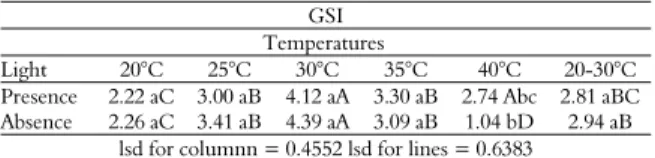
Table 3 shows that the lowest GSI values were obtained at 20 and 40°C. This result was more evident in the absence of light at the temperature of 40°C (1.04), resulting in this being the only treatment for which the absence of light had a significant effect. This shows that under the different temperature regimes,
A. cearensis seeds are insensitive to light, i.e., are neutrally photoblastic, except at a temperature of 40°C, at which they are preferably positively photoblastic. Certain temperature limits above or below the upper or lower limits of the optimal temperature range tend to decrease the germination speed, thus resulting in a disruption of membranes and leading to a reduction in the total germination (Carvalho & Nakagawa, 2013).
Table 3. Germination speed index (GSI) of Amburana cearensis
(Allemão) A.C. Sm. seeds subjected to different temperatures in the presence or absence of light.
GSI Temperatures
Light 20°C 25°C 30°C 35°C 40°C 20-30°C Presence 2.22 aC 3.00 aB 4.12 aA 3.30 aB 2.74 Abc 2.81 aBC Absence 2.26 aC 3.41 aB 4.39 aA 3.09 aB 1.04 bD 2.94 aB
lsd for columnn = 0.4552 lsd for lines = 0.6383
Means followed by the same letter, upper case in the same row and lower case in the same column, do not differ by Tukey’s test at a 5% probability level.
b g f t p c T d L E H M s t d F a between these speed index ob absence of ligh
By analysin observed that germination sp for 35°C, at w other weight c temperature o promoted the negatively influ seen at 40°C. reported in th seeds are usua speed. Lessa et
contortisiliquum
index.
Table 4. Germin (Allemão) A.C. different temperat
Classes
Light 2.63 aC Edium 2.19 abC Heavy 1.89 bA
lsd for colu
Means followed by the same column, do not di
A possible of heavy seed that the ratio seed is reduce decreases the a
Figure 3. Total le and temperature r
e factors, with btained at a tem ht.
ng the results sh light and me peed indices a which only ligh classes. Howev of 30°C and l highest germin uenced this sp
These results he literature, w ally those with t al. (2015) foun
seeds had a h
nation speed inde Sm. seeds of d ture regimes.
GSI Temperat 3.85 aB 4.99 aA 3.32 aB 5.27 aA 2.45 bA 2.50 bA umn = 0.6714 lsd fo
e same letter, upper cas iffer by Tukey’s test at a
explanation fo ds on the germ
between the ed with an inc ability of a seed
ength (TL) of Am
regimes (C).
the highest g mperature of 3
hown in Table edium seeds h at all temperatu ht seeds differe
ver, the combi light and med nation speed. H eed, which can s differ from which indicate h the highest g nd that heavy E
higher germina
ex (GSI) of Amb
ifferent weight c
tures
4.38 aAB 2.22 aC 3.14 bB 2.77 aB 2.07 cA 0.67 bB or lines = 0.8195
se in the same row and a 5% probability level.
for the negative mination spee surface and vo crease in seed d to obtain eno
mburana cearensis (A
germination 30°C in the
4, it can be had higher ures except ed from the ination of a dium seeds Heavy seeds
n be clearly the results that heavy germination Enterolobium ation speed urana cearensis classes under
C 3.74 Ab BC 3.13 Ab B 1.74 bA
d lower case in the
e influence ed index is olume of a d size. This ough water
Allemão) A.C. Sm
to beginthe 1966), thus and seedlin provide an proliferation homogeneo medium A.
most to an in The fol growth beh seedlings. T detrimental killing seedl Regardin seedlings, fo Figure 3 th seeds were (Figure 3A) seedling d temperature ideal for see respect to expected re (2010), with promoted g regard to the weight on sh similar res seedlings.
Means fo by the non-probability l
m. seedlings as inf
germination p causing grea ng establishm n appropriate n of this sp us and vigoro
cearensis seeds ncrease in the llowing result haviour and d Temperatures o
to the estab lings shortly af ng the total or the isolated hat the best gr
germinated ). The weight development
es of 25 and edling establis the tempera sults were co h 30°C being greater seedlin
e fact that ther hoot growth, L sults in En
followed by th -parametric M level.
fluenced by light c
process (Harpe ater delays in ment. Such fi
e weight cla pecies to pro ous seedlings, are likely to co propagation o ts take into dry biomass o of 40 and 35°C blishment of fter germinatio
length of factors, it can rowth occurre
in the presen t classes did n
(Figure 3B) 30°C were c shment (Figur atures, the co onfirmed by G one of temp g length in A
re was no influ Lessa et al. (20
nterolobium co
he same letter Mann-Whitney
conditions (A), w
er & Benton, germination findings may
ass for the oduce more as light and ontribute the of the species.
account the of A. cearensis
C were highly the species, on.
A. Cearensis
be seen from ed when the nce of light not influence
), and the considered as
re 3C). With orresponding Guedes et al. peratures that
A. cearensis. In uence of seed 015) reported
ontortisiliquum
do not differ test at a 5%
Seed germination in Amburana cearensis 531
The light requirement of seeds is associated with different ecological groups: pioneer, secondary and climax (Figliolia & Piña-Rodrigues, 1995). Amburana cearensis is described in different ways in the literature, being included in more than one ecological group. This has been verified by Barbosa (2003), who describes that A. cearensis demonstrates shade tolerance, as it germinates under the forest canopy, and it later shows characteristics of pioneer species during the young plant stage.
Regarding the influence of different temperatures and seed weight on the root + hypocotyl length (Table 5), it can be seen that low (20°C) and high temperatures (35 and 40°C) were not critical in the differentiation among the weight classes. Temperatures of 25, 30, and 20-30°C were essential to the perception of such differences, for which light and medium seeds stood out as the best in terms of the promotion of increased root growth. The optimal temperature for germination and seedling growth is a prime factor that ensures the action of seed reserves in the establishment of the species, with the ideal temperature being responsible for increasing metabolism and the translocation of these reserves to the embryonic axis.
Table 5. Root + hypocotyl length (RHL) of Amburana cearensis
(Allemão) A. C. Sm. seedlings as influenced by seed weight.
RHL Temperature
Classes 20°C 25°C 30°C 35°C 40°C 20-30°C Light 3.70 aC 7.95 aA 5.24 Ab 0.81 aD 0.00 aD 3.66 aC Mediu 3.87 aC 7.27 aA 5.86 Ab 0.66 aD 0.00 aD 3.28 aC Heavy 3.24 aB 5.49 bA 2.86 Bb 0.88 aCD 0.13 aD 1.94 bBC
lsd for columns = 1.1606 lsd for lines = 1.314
Means followed by the same letter, upper case in the same row and lower case in the same column, do not differ by Tukey’s test at a 5% probability level.
The process that led to this greater root growth is the result of favourable conditions for germination, which are associated with a complex sequence of biochemical reactions. In these reactions, reserve substances stored in the supporting tissue are broken down, transported and resynthesized in the embryonic axis. The higher the temperature, the faster and more efficient the germination, up to a certain limit (Carvalho & Nakagawa, 2012). Within these limits, the temperature of 25°C enabled the better translocation of reserves, with maximum efficiency, when light and medium seeds were used. A comparison between light and heavy seeds reveals an increase in root growth of more than 44 and 83.22% at temperatures of 25°C and 30°C, respectively.
It can be seen in Table 6 that the factor of light along with temperature showed unique responses in terms ofthe epicotyl length. This growth was certainly evidenced by the perception of light,
withits presence being critical for growth. Along with the light factor, temperatures of 25 and 30°C led to increased epicotyl length, with increases of 20.89 and 38.98%, respectively, when compared to that in the absence of light. These results are similar to those reported by Alves et al. (2012), who found that the greatest Clitoria fairchildiana length occurred at a temperature of 30°C under a white light regime.
Table 6. Epicotyl length (EPL), epicotyl dry mass (EPDM), root + hypocotyl dry mass (RHDM) and total dry biomass (TDB) of
Amburana cearensis (Allemão) A.C. Sm. as a function of temperature and light presence or absence.
Temperature
Light 20°C 25°C 30°C 35°C 40°C 20-30°C Presence 2.06 aD 5.96 aA 6.56 aA 3.10 aC 0.16 aE 4.36 aB Absence 1.08 bC 4.93 bA 4.42 bA 0.00 bC 0.00 aC 2.47 bB
EPDM (g)
Presence 0.006 aC 0.017 aAB 0.018 aA 0.007 aC 0.00 aD 0.014 aB Absence 0.005 bD 0.017 aA 0.014 bB 0.000 bE 0,00 aE 0.008 bC
RHDM (g)
Presence 0.013 aC 0.023 aA 0.018 aB 0.007 aD 0.00 aE 0.014 aC Absence 0.011 bBC 0.015 bA 0.011 bB 0.000 bD 0.00 aD 0.008 bC
TDB (g)
Presence 0.019 aC 0.040 aA 0.036 aA 0.014 aC 0.00 aE 0.0284 aB Absence 0.015 aC 0.033 bA 0.025 bB 0.000 bD 0.00 aD 0.0241 aB
Means followed by the same letter, upper case in the same row and lower case in the same column, do not differ by Tukey’s test at a 5% probability level. LSD for EPL, EPDM, RHDM and TDB in columns (0.8083, 0.0018, 0.0020, 0.0036, respectively) and lines (1.0957, 0.0025, 0.0029, 0.0052, respectively).
The temperatures of 30, 25, and 20-30°C (in this order) showed higher mean values of epicotyl dry mass, with the highest results obtained under light conditions, with the exception of 25°C, at which the mean values were not different (Table 6). For the root + hypocotyl dry mass, the greatest increase (53.33%) was observed in the presence of light at a temperature of 25°C.The total dry missal so responded similarly to epicotyl growth, for which the highest results were obtained at temperatures of 25 and 30°C (21.21 and 44%, respectively) when compared to seedlings under light limitation. One of these results is similar to those reported by Pacheco, Matos, Ferreira, and Feliciano (2007), where a constant temperature of 30°C resulted in a greater increase in the hypocotyl dry mass of
Apeibati bourbou Aubl. seedlings.
seedling growth, enabling the normal development of seedling structures, thus indicating that this species might be classified as a pioneer in ecological succession.
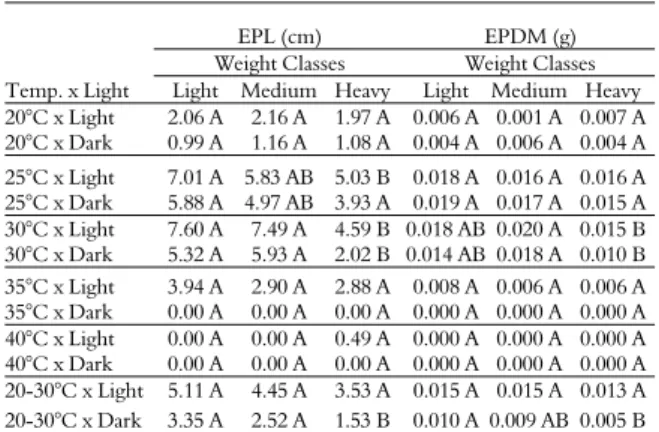
Table 7 shows the influence of the factor of seed weight on EPL and EPDM, which showed a significant three-way interaction. Based on the results previously mentioned and described by the statistical breakdown of the temperature × light interaction (Table 6), which revealed the superiority of the combination of 30 or 25°C in the presence of light for these variables, it can be seen from Table 7 that seed weight is a key factor in the development of A. cearensis
seedlings, affecting even seed photoblastism. The data showed that under the best combination of temperature and light (30 or 25°C in the presence of light) for EPL, seeds classified as light or medium produced more vigorous seedlings when compared to the heavy seeds. For EPDM, this behaviouroccurred again at 30°C, whereas at 25°C, there was no difference among the weight classes. These results are also similar to those reported by Almeida et al. (2014), who observed higher growth of A. cearensis seedlings by using light and medium seeds at a temperature of 30°C.
Table 7. Epicotyl length (EPL) and epicotyl dry mass (EPDM) means of Amburana cearensis (Allemão) A. C. Sm. seedlings for the three-way interaction of temperature × light × weight.
EPL (cm) EPDM (g)
Temp. x Light
Weight Classes Weight Classes Light Medium Heavy Light Medium Heavy 20°C x Light 2.06 A 2.16 A 1.97 A 0.006 A 0.001 A 0.007 A 20°C x Dark 0.99 A 1.16 A 1.08 A 0.004 A 0.006 A 0.004 A 25°C x Light 7.01 A 5.83 AB 5.03 B 0.018 A 0.016 A 0.016 A 25°C x Dark 5.88 A 4.97 AB 3.93 A 0.019 A 0.017 A 0.015 A 30°C x Light 7.60 A 7.49 A 4.59 B 0.018 AB 0.020 A 0.015 B 30°C x Dark 5.32 A 5.93 A 2.02 B 0.014 AB 0.018 A 0.010 B 35°C x Light 3.94 A 2.90 A 2.88 A 0.008 A 0.006 A 0.006 A 35°C x Dark 0.00 A 0.00 A 0.00 A 0.000 A 0.000 A 0.000 A 40°C x Light 0.00 A 0.00 A 0.49 A 0.000 A 0.000 A 0.000 A 40°C x Dark 0.00 A 0.00 A 0.00 A 0.000 A 0.000 A 0.000 A 20-30°C x Light 5.11 A 4.45 A 3.53 A 0.015 A 0.015 A 0.013 A 20-30°C x Dark 3.35 A 2.52 A 1.53 B 0.010 A 0.009 AB 0.005 B
Uppercase letters in the same rows do not differ by Tukey’s test at a 5% probability of error. EPL: LSD = 1.5862. EPDM: LSD = 0.0053.
Overall, light and medium seeds promoted better development of A. cearensis, which may indicate that they have higher tolerance to adverse environmental conditions. In terms of the low performance obtained with heavy seeds, these seeds have been influenced since the germination stage, which also causes changes in seedling establishment. A possible explanation for the detrimental effect of heavy seeds on seedling development under optimal temperature and light conditions is most likely associated with higher coumarin levels.
Seed weight also did not influence seedling development under non-optimal temperatures (20,
35, and 40°C), with the exception of alternating temperatures (20 - 30°C) in the absence of light, which also shows the influence of weight on light perception. This reveals once more a superiority of light and medium seeds (Table 7), i.e., the seedlings obtained from heavy seeds under dark conditions do not exhibit good development rates.
Temperature modifies seedling growth according to the amount of reserves in the seeds, indicating changes in the type of phytochrome throughout the development of this species. This shows that environmental factors establish different behaviours in this species depending on the ambient temperature and the type of light. Both extrinsic factors affect responses in the plant according to the amount of reserves in the seeds. These results may provide ecological and agronomic information for a better understanding and the sustainable exploitation of this species, allowing it to be propagated more efficiently for reforestation and preservation purposes.
Conclusion
The germination of A. cearensis shows neutral photoblastism, where seeds from light and medium classes have greater vigour, and light seeds have a higher final germination percentage.
The temperature of 30°C is the most suitable for germination, whereas 35 and 40°C are strongly detrimental to seedling growth.
Temperature and seed weight influence the perception of light for seedling development.
Seedlings obtained from light and medium seeds resulted in greater epicotyl growth and dry mass at temperatures of 25 and 30°C in the presence of light.
References
Almeida, J. R. G. S., Guimarães, A. G. G., Siqueira, J. S., Santos, M. R. V., Lima, J. T., Nunes X. P., & Quintans, Júnior, L. J. (2010). Amburana cearensis – uma revisão química e farmacológica. Scientia Plena, 6(11), 1-8.
Almeida, J. P. N., Pinheiro, C. L., Lessa, B. F. T. M, Gomes, F. M., & Medeiros Filho, S. (2014). Estresse hídrico e massa de sementes na germinação e crescimento de plântulas de Amburana cearensis (Allemão) A.C. Smith. Revista Ciência Agronômica, 45(4), 777-787.
Seed germination in Amburana cearensis 533
Amato, A. L. P., Maia, F. C., Maia, M. S., Caetano, L. S., Simioni, S. B., Conto, L., & Bonini Filho, R. M. (2007). Estabelecimento de condições de luz e temperatura na germinação de sementes de amendoim forrageiro. Revista Brasileira de Sementes, 29(3), 61-66. Barbosa, D. C. A. (2003). Estratégias de germinação e
crescimento de espécies lenhosas da caatinga com germinação rápida. In I. R. Leal, M. Tabarelli, & J. M. C. Silva (Eds.), Ecologia e conservação da caatinga (p. 625-656). Recife, PE: Universidade Federal de Pernambuco.
Bewley, J. D., Bradford, K. J., Hilhorst, H. W. M., & Nonogaki, H. (2013). Seeds: Physiology of development, germination and dormancy (3rd ed.). New York, US: Springer.
Brasil. (2009). Ministério da Agricultura, Pecuária e Abastecimento – Secretaria de Defesa Agropecuária. Regras para análise de sementes. Brasília, DF: Mapa/ACS. Canuto, K. M., Silveira, E. R., Bezerra, A. M. E., Leal, L.
K. A. M., & Viana, G. S. B. (2008). Uso de Plantas Jovens de Amburana cearensis A. C. Smith: Alternativa para preservação e exploração econômica da espécie. Petrolina, PE: Embrapa Semiárido.
Carvalho, N. M., & Nakagawa, J. (2012). Sementes: ciência, tecnologia e produção (5a ed.). Jaboticabal, SP: Funep. Carvalho, R. F., & Peres, L. E. P. (2013). Fotomorfogênese.
Retrieved from http://www.miniweb.com.br/ ciencia/artigos/fotomorfogenese.pdf.
Diniz, F. O., Moreira, F. J. C., Silva, F. D. B., & Medeiros Filho, S. (2008). Influência da luz e temperatura na germinação de sementes de oiticica (Licania rigida Benth.). Revista Ciência Agronômica, 39(3), 476-80. Felix, R. A. Z., Ono, E. O., & Araújo, F. P. (2010). Efeitos
alelopáticos de extratos de Amburana cearensis na germinação de sementes de rabanete e alface. Cultivando o Saber, 3(1), 18-31.
Figliolia, M. B., Aguiar, I. B., & Silva, A. (2009). Germinação de sementes de três arbóreas brasileiras. Revista do Instituto Florestal, 21(1), 107-115.
Figliolia, M. B., & Piña-Rodrigues, F. C. M. (1995). Considerações práticas sobre o teste de germinação. In Manual técnico de sementes florestais (p. 45-59). São Paulo, SP: Instituto florestal. (Série Registros, 14).
Guedes, R. S., Alves, E. U., Gonçalves, E. P., Braga Júnior, J. M., Viana, J. S., & Colares, P. N. Q. (2010). Substratos e temperaturas para testes de germinação e vigor de sementes de Amburana cearensis (Allemão) A.C. Smith. Revista Árvore, 34(1), 57-64.
Harper, J. L., & Benton, R. A. (1966). The behaviour of seeds in soil: II. The germination of seeds on the surface of a water supplying substrate. Journal of Ecology, 54(1), 151-166.
Lessa, B. F. T., Almeida, J. P. N., Pinheiro, C. L., Gomes, F. M., & Medeiros Filho, S. (2015). Germinación y crecimiento de plántulas de Enterolobiumcontortisiliquum enfuncióndel peso de lasemilla y las condiciones de temperatura y luz. Agrociencia, 49(3), 315-327.
Maguire, J. D. (1962). Speed of germination-aid in selection and evaluation for seedling emergence and vigor. Crop Science, 2(1), 176-177.
Marcos-Filho, J. (2015). Fisiologia de sementes de plantas cultivadas (2a ed.). Piracicaba, SP: Fealq.
Nogueira, F. C. B., Silva, J. W. L., Bezerra, A. M. E., & Medeiros Filho, S. (2012). Efeito da temperatura e luz na germinação de sementes de Luetzelburgia auriculata (Alemão) Ducke Fabaceae. Acta Botanica Brasilica, 26(4), 772-778.
Pacheco, M. V., Matos, V. P., Ferreira, R. L. C., & Feliciano, A. L. P. (2007). Germinação de sementes de Apeibati bourbou Aubl. em função de diferentes substratos e temperaturas. Scientia Forestalis, 19(73), 19-25.
Pereira, S. R., Giraldelli, G. R., Laura, V. A., & Souza, A. L. T. (2011). Tamanho de frutos e de sementes e sua influência na germinação de jatobá-do-cerrado (Hymenaea stigonocarpa var. Stigonocarpa Mart. ex Hayne, Leguminosae Caesalpinoideae. Revista Brasileira de Sementes, 33(1), 141-148.
Ribeiro, C. A. D., Costa, M. P., Senna, D. S., & Caliman, J. P. (2012). Fatores que afetam a germinação das sementes e a biomassa de plântulas de Tabebuia heptaphylla. Revista Floresta, 42(1), 161-168.
Silva, G. M., Maia, M. S., & Moraes, C. O. C. (2007). Influência do peso da semente sobre a germinação e o vigor de cevadilha vacariana (Bromus auleticus Trinius). Revista Brasileira de Agrociência, 13(1), 123-126.
Silva, W. A., Nobre, A. P., Leites, A. P., Silva, M. S. C., Lucas, R. C., & Rodrigues, O. G. (2006). Efeito alelopático de extrato aquoso de Amburana cearensis A. Smith na germinação e crescimento de sementes de sorgo (Sorghum bicolor L.). Agropecuária Científica no Semi-árido, 2(1), 48-54.
Thompson, K., & Grime, J. P. (1983). A comparative study of germination responses to diurnally fluctuating temperatures. Journal of Applied Ecology, 20(1), 141-156.
Received on July 18, 2016. Accepted on October 17, 2016.