Faculdade de Engenharia da Universidade do Porto
Ambient Lighting Integrated
Assistance System
Pedro Miguel de Almeida
Mestrado Integrado em Engenharia Informática e Computação
Supervisor: António Miguel Pontes Pimenta Monteiro
Second Supervisor: Filipe de Oliveira e Sousa
Ambient Lighting Integrated Assistance System
Pedro Miguel de Almeida
Mestrado Integrado em Engenharia Informática e Computação
Approved in oral examination by the committee:
Chair: José Magalhães Cruz
External Examiner: José Maria Fernandes
Supervisor: António Miguel Pontes Pimenta Monteiro
July 22, 2015Abstract
Nowadays a lot of knowledge about the effects of lighting on human health and mood exists and is still growing. However, this knowledge isn’t generally being put into practice. Light is something that surrounds us every day and everywhere, therefore knowledge of it can also be used every day from dawn to dusk and everywhere like home, schools, health facilities, workplace or even outside.
Artificial lighting is harmful if used incorrectly, affecting the normal circadian rhythm’s pace and therefore several biological properties. Elderly people are fur-ther affected by artificial lighting since they prevail more time inside buildings, under the effect of artificial lighting, and have usually more health problems.
This project was developed on Fraunhofer Portugal facilities and integrated in the SmartCompanion project, which has the objective to improve elderly’s life. Smart-Companion is a launcher for Android smartphones that, for example, allows the elder to request help from his caregiver and detects his falls.
In the sense of enhancing artificially made environments, the main goal of this project is to develop a system able to provide a soother, safer and self–healing envi-ronment for elderly people and their caregivers. Shortly, the system should: 1) React to external events like elderly’ falling detection and help requests, using the light bulbs to visually notify the caregiver of possible problems with the elderly. 2) React to SMS and phone call receptions, performing visual notifications to help elderly peo-ple with hearing impairments. 3) Perform periodic updates on the lights to promote the normal pace of the circadian rhythm.
This work encourage the usage and development of lighting and lighting systems in a smarter and deliberated manner with not only illumination concerns, but also biological one.
Resumo
Atualmente, embora em crescimento, existe algum conhecimento sobre os efeitos da luz na saúde e bem-estar do ser humano. No entanto, geralmente, este conhecimento não está a ser posto em prática. A luz é algo que nos rodeia todos os dias e em qualquer lugar e portanto conhecimento sobre esta pode também ser utilizado todos os dias, a qualquer hora e em qualquer lugar, por exemplo em casa, nas escolas, em instituições de saúde, locais de trabalho e até no exterior.
A luz de origem artificial é prejudicial se for usada incorretamente, afetando a regulação natural do ritmo circadiano e portanto vários parâmetros biológicos. Um grupo que é especialmente afetado com este problema são os idosos, pois estes nor-malmente permanecem mais tempo dentro de edifícios, sobre o efeito de luzes artifi-ciais e têm mais problemas de saúde.
Este trabalho foi desenvolvido nas instalações da Fraunhofer Portugal e integrado no projeto SmartCompanion que tem como objetivo melhorar a vida do idoso. O SmartCompanion é um launcher para smartphones Android que, por exemplo, per-mite ao idoso pedir ajuda ao seu cuidador e detetar as suas quedas.
No sentido de melhorar os ambientes artificialmente iluminados, o principal obje-tivo deste trabalho é o desenvolvimento de um sistema capaz de fornecer, ao idoso e ao seu cuidador, um ambiente otimizado, mais seguro e que promova as capacidades de autorregulação do idoso. De forma resumida, o sistema deve: 1) Reagir a eventos externos como a deteção da queda ou pedidos de ajuda do idoso, utilizando as luzes para notificar visualmente o cuidador de possíveis problemas com o idoso. 2) Reagir à receção de SMS e chamadas telefónicas, realizando notificações visuais para auxiliar idosos com problemas auditivos. 3) Executar atualizações nas luzes periodicamente, de forma a promover o normal funcionamento do ritmo circadiano.
Este trabalho incentiva o uso e desenvolvimento de luzes e de sistemas de nação de uma forma mais deliberada e inteligente, com interesses não só na ilumi-nação, mas também nas reações que esta provocará no ser humano.
Acknowledgements
First, I want to thank both the institutions that held me, Faculdade de Engenharia da Universidade do Porto and Fraunhofer Portugal for providing me all the necessary conditions required to the success of my academic life and this work.
My gratitude to António Pimenta Monteiro for his clarifications and meticulous reviews of this work.
I would like to thank Filipe de Oliveira e Sousa for all his kindness, help and support, and Nino Rocha for his help on Latex tools.
Many thanks, for the help and good time spent, to my friends who shared both institutions with me: Ana Santos, Cristiano Rodrigues, Bruno Guedes, Diogo Mendes and Miguel Brito.
I want also to thank to my work colleague, friend and girlfriend, Lara Marinha for her support and joyous moments shared.
Last, but not least, thanks to my family, Armando, Lidia and Duarte Almeida for their unconditional and constant support during all my life.
“A minha média subiu quando eu pensei, «hum, secalhar devia deixar de ir às aulas»”
Contents
1 Introduction 1
1.1 Context . . . 1
1.2 The problem and its characterization . . . 2
1.3 Goals . . . 3
1.4 Expected benefits with the solution of the problem . . . 3
1.5 Structure and organization of the document . . . 3
2 Light and its effects 5 2.1 Light . . . 5
2.1.1 Colored Light . . . 5
2.1.2 Vitamin D . . . 6
2.2 Healing with color . . . 6
2.2.1 Sympathetic and Parasympathetic nervous system . . . 6
2.3 Circadian Rhythm on humans . . . 10
2.3.1 How it works . . . 11
2.3.2 Circadian System in elderly people . . . 13
2.3.3 Cardiovascular System . . . 13
2.3.4 Depression . . . 13
2.3.5 Preterm infants . . . 13
2.3.6 Breast Cancer . . . 14
2.3.7 Pain . . . 14
2.3.8 Natural light vs Artificial light . . . 14
2.3.9 Light in Buildings . . . 15
2.3.10Habits of our society . . . 15
3 The Philips illumination systems and project technologies 17 3.1 Philips illumination systems and related projects . . . 17
3.1.1 Philips Hue . . . 17
3.1.2 Philips Hue API . . . 18
3.1.3 Philips HealWell . . . 20
3.1.4 Philips SchoolVision . . . 20
3.1.5 Halcyon-Lighting . . . 21
3.2 Application development technologies for personal illumination control . 21 3.2.1 Mobile Devices . . . 21
CONTENTS
4 Solution description and user stories 27
4.1 Requirements, assigned technologies and solution’s holistic view . . . . 27
4.2 Module description and assignment . . . 29
4.3 User stories . . . 30
4.4 Usage scenarios . . . 32
5 Architecture and Implementation 35 5.1 Physical Architecture . . . 35
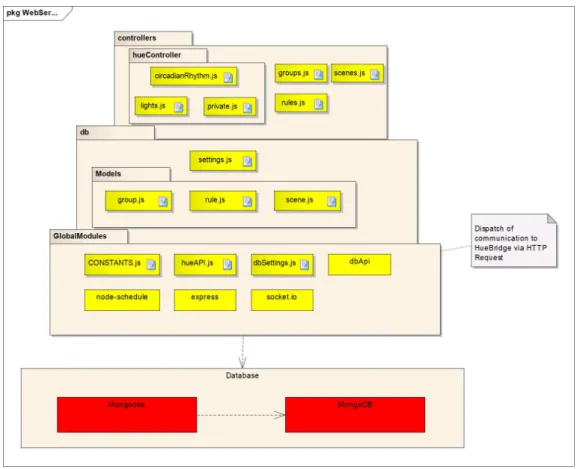
5.2 Web Server . . . 37
5.2.1 Database Architecture . . . 39
5.3 Web Application Architecture . . . 42
5.3.1 Hue Values Converter . . . 45
5.4 Mobile Application Architecture . . . 46
6 Results 49 6.1 Web Server . . . 49 6.2 Web Application . . . 50 6.3 Mobile App . . . 56 6.4 System Interaction . . . 58 6.5 Remote API . . . 62
6.6 Development and environment . . . 63
7 Conclusions 65 7.1 Objectives fulfilment . . . 65
7.2 Future work . . . 66
List of Figures
1.1 Philips Hue lighting system. Image from [App15] . . . 2
2.1 The visible Spectrum and his wavelengths. Image taken from [Vir15] . . 6
2.2 Link between chakra, color and body areas. Image taken from Light: Medicine of the Future [Lib90] . . . 8
2.3 Relation between color and body. Image taken from [Tro01] . . . 10
2.4 Cones sensitiveness by wavelengths. Image taken from [Irr00] . . . 11
2.5 Eye sensitivity to different wavelengths and max sensitivity is at 464nm (Indigo color). Image taken from [BHG+01] . . . 12
2.6 Difference between blue exposure (460nm) and green exposure (555nm) on melatonin production. Image taken from [SWLC13] . . . 12
3.1 CIE color model with x and y coordinates. Image taken from [Sys00] . . 20
3.2 Sample of a typical two–tier architecture. Image taken from [Ree00] . . 23
3.3 Sample of a typical three–tier architecture. Image taken from [Ree00] . 23 3.4 Two-Way data binding. Image taken from [Ang15a] . . . 25
4.1 Holistic view of the solution. . . 29
5.1 Physical Architecture of the solution . . . 36
5.2 Web server Layered Architecture . . . 37
5.3 Database Architecture . . . 39
5.4 Web application Architecture . . . 42
5.5 Connection between Lights and LightControllers on the Web App, similar with Groups or Scenes . . . . 43
5.6 Inside Hue Light bulb. Image taken from [Cri14] . . . 45
5.7 Yellow light with official hue value, using WinHue . . . 45
5.8 Yellow light requested on official Hue application for Android . . . 45
5.9 Yellow light using custom converter on Web App . . . 45
5.10Graph of real hue values (X axis) and the ones that should be sent to the Hue Bridge (Y axis). . . 46
5.11Mobile Application Architecture. . . 47
5.12Package Diagram of the Mobile App . . . 48
6.1 Web server HTTP requests . . . 49
6.2 Navigation Tab . . . 50
6.3 Home page . . . 50
6.4 Lights page . . . 51
LIST OF FIGURES
6.6 Groups page . . . 52
6.7 Modal page to create a new Group. Similar modal for edit Group . . . . 52
6.8 Scenes page . . . 53
6.9 Add Scene page . . . 54
6.10Color indicates that the Scene MigraineStop is running . . . 54
6.11Rules page . . . 55
6.12Modal page to add a new Rule . . . . 55
6.13List of possible messages during Web Application interaction . . . 56
6.14Interface of the Mobile Application . . . 57
6.15Interface of the Mobile Application on connection loss. . . 58
6.16Example of System’s behavior on User Interaction. . . 59
6.17Interfaces before User Interaction (turn off 1st Rule) . . . . 60
6.18Interfaces after User Interaction (1st Rule turned off). . . . 60
6.19Example of System behavior: Incoming phone call. . . 61
6.20Example of System behaviour: SMS reception. . . 62
6.21Bridge installed on Fraunhofer Portugal ’s facilities. . . 63
6.22Testing space with fully immerse environment. . . 64
List of Tables
2.1 Resume of conclusions from several studies analyzed. . . 9
3.1 Philips Hue API Methods . . . 19
4.1 Project Requirements . . . 27
4.2 Concepts or Terminology . . . 28
4.3 Users . . . 30
4.4 User stories . . . 30
Abbreviations
API Application Program Interfaces ANS Autonomic Nervous System CCFL Cold Cathode Fluorescent Lamp CRT Cathode Ray Tube
EMR Electromagnetic Radiation GUI Graphical User Interface HTML HyperText Markup Language HTTP Hypertext Transfer Protocol IOL Intraocular Lens
IPRGCs Intrinsically Photosensitive Retinal Ganglion Cells JSON JavaScript Object Notation
LED Light-Emitting Diodes MVC Model-View-Control NoSQL Not Only SQL
NPM Node Package Manager OS Operating System PDT Photodynamic Therapy
PNS Parasympathetic Nervous System pRGCs photosensitive Retinal Ganglion Cells SAD Seasonal Affective Disorder
SCN Suprachiasmatic Nucleus SMS Short Message System SNS Sympathetic Nervous System UI User Interface
UV-B Ultra Violet type B
Chapter 1
Introduction
This chapter introduces lighting and circadian rhythm as a study object and a mean to provide better ambient and healing conditions for people. It is introduced also the lack of concern about lighting in human health and well-being as the problem, followed by the goal and expected results from the solution.
1.1
Context
Light is essential for all kinds of living forms. Light has an influence on animals and plants day-by-day life, setting their biorhythms. In humans, it is proved that light has an influence on people’s health, vitamin D production, mood, depression, fatigue, alertness, among others [AJ06]. However, how light influences people and how far humanity can use it on their advantage, isn’t still fully understood.
Light is an electromagnetic radiation and it can have several wavelengths, result-ing in different colors. Since early times, many theories of human exposure to colored radiation exist and stayed in use in traditional medicine. Despite not being considered scientifically proved at that time, several theories persisted to modern times where some of them are now accepted scientifically and are used in modern medicine. Oth-ers are now being intensely studied using modern technologies and knowledge.
Circadian rhythm is a biological rhythm that makes part of human’s daily cycle. The main stimulus of circadian rhythm is the exposure and reception of light in our eyes and skin. It is known that circadian rhythm affects several physiological and psychological parameters of humans. Circadian rhythm and light exposure have the ability to enhance or disrupt melatonin production, which itself, alters among other things, energy, alertness and sleepiness levels. Several studies, with consistent data, even concludes that circadian rhythm has a weight on cardiovascular diseases, can-cer, pain relief and others exposed in this report.
Philips Hue is a system that allows the manipulation of several lighting parameters and the creation of visual notifications.
Therefore, a tool that provides to the user not only the ability to control of several lighting characteristics like color and intensity, but also an automatic self-healing and well-being environment with color and circadian rhythm concerns, should be useful.
Introduction
Figure 1.1: Philips Hue lighting system. Image from [App15]
Fraunhofer Portugal is a private non-profit association with the goal to enhance social well- being and improve quality of life of its end-users. The major development focus of Fraunhofer Portugal is elderly people. Fraunhofer Portugal developed a large number of sensor based solutions in order to make elderly’s life easier and safer through technology-driven assistance living. One of Fraunhofer’s projects is called SmartCompanion, an Android launcher specially designed to meet seniors’ needs like preventing isolation while promoting autonomy, quality of life and health monitoring [Por13]. This work was developed on Fraunhofer Portugal facilities and integrated on the SmartCompanion project with the objective of providing visual notifications from falls or other events like incoming calls or medication alarms, as well as through an automatic ambient lighting system, provide a self-healing environment.
1.2
The problem and its characterization
Artificial lighting usually doesn’t take into consideration human health in terms of circadian rhythm and colored lighting effects. A visual notification system for assisted living with concerns about the well-being and biological effects of lights is something that should be useful. In addiction artificial light without this deliberation may cause unwanted effects.
Many ancient theories survived up to the present day about certain color radi-ations affecting our body and mind, some of them more credible and scientifically based than others. Despite some theories had already been accepted and in use in modern medicine, most of them are still waiting for being studied and approved or discarded.
Other studies, more scientific, about circadian rhythm exist. In fact, many of these studies are relatively recent and emphasize the curiosity and interest science currently has on this specific subject. Nevertheless, many of these studies were done
Introduction
in a very specific situation or with small samples, concluding that further investigation is still missing.
1.3
Goals
This work aims to provide a personalized wireless ambient lighting for assistive envi-ronments. The main idea is the usage of ambient lighting as a communication channel and as a health support system. Knowledge of circadian rhythm and colored lighting is used to provide an improved self-healing environment. Other features include the reaction to external events captured by sensors, changing the lighting status in order to serve as a visual communication and notification channel, readily understood. The development of such a tool is composed by the development of 4 essential sub-parts: 1) Android application that allows the user to define settings such as types of external events and their visual notifications, as well as the activation of predefined lighting configurations; 2) Web application for programming complex user defined lighting scenes and configurations; 3) Web server that provides the services necessary for the user, getting and storing user settings and lighting status as well as command light bulbs actions from external events or circadian rhythm updates, 4) Database where all the user defined settings and lighting status are stored.
In the future, the tool can also allow to put in practice and test existing theories and studies about lighting, colors and circadian rhythm effects on humans.
1.4
Expected benefits with the solution of the problem
With ambient lighting integrated assistance system, it is expected to promote home as a healing, safe, enjoyable and integrated living environment. The promotion of cir-cadian rhythm regulation and colored lighting effects for living environments should provide a self-healing and improved ambience. Besides, visual notifications should al-low an integrated ambient system as well as a notification channel for hearing impair-ments, so they can be aware of audible notifications from smartphones for example.
This system can also contribute, in the future, to an increment of research on the healing capabilities of all kinds of visible radiation and circadian rhythm, as well as improve quality of studies in this area, providing a tool capable to create several types of ambiences and dynamic lighting. It is likely that with additional and improved technological conditions that this work provides, as well as increased knowledge in the area, results on new solutions and treatments to modern days’ issues could arise.
1.5
Structure and organization of the document
During this document, all the work performed will be presented and discussed. In this first chapter an introduction and description of the document, with its goals, expected benefits and context, is done.
The second chapter is a literature review of the context of the project. It details the light and color properties, its healing effects, its effects on the circadian rhythm and finally, the circadian rhythm effects on people.
Introduction
In the third chapter, a technological overview of several technologies relevant to the project are presented. In this chapter is also covered the Philips Hue System and similar projects.
The chapters 4, 5 and 6 refer to the development of the system. In the chapter 4, the solution, to solve the problem of the project and to fulfill it’s objectives, is presented and detailed. In this chapter, it is also covered some key concepts, require-ments, technological assignment, user stories and some usage scenarios.
In the chapter 5 the system developed is detailed. It is shown, for each module, the architecture, some explanations and implementation details.
In the chapter 6 the results obtained are presented. It is displayed how the several parts of the system interact with each other and with the user. Some images of the system are shown in order to illustrate the final product. In this chapter we cover also the usage of a remote API in order to overcome some project constraints.
In the last chapter, the conclusions of the system developed are detailed. The accomplished objectives are presented together with the development of this work and some future work proposals in order to further improve the final system.
Chapter 2
Light and its effects
In this chapter the properties of light are covered initially, followed by a description of some healing properties of colored lighting with several ancient time theories and scientific studies about them. Circadian rhythm, his biological properties on human body, and his effects on humans are also covered in this chapter.
2.1
Light
Light makes part of animal and plant life. It’s essential for continuity and sustainabil-ity of all kinds of life.
Both animals and plants have what is called a circadian rhythm. This circadian rhythm is a biological cycle that repeats approximately every 24–hours and that, in both cases, the main stimulus is light. Studies show that light can improve human health, mood, depression, fatigue, alertness, etc. and also that it’s possible to control the body’s circadian system [AJ06].
Light is an electromagnetic radiation (EMR) in a wavelength interval that, is usu-ally visible, but can include some invisible wavelengths (infrared, ultraviolet). Light’s source can be natural or artificial.
The properties of visible light are intensity (or illuminance with the symbol lx), propagation direction, polarization and wavelength that include the range from 400 nanometers to 700 nanometers. There are some differences about natural and arti-ficial lights. For example natural light has a more complex spectrum of wavelengths from visible to invisible while artificial light has a narrower range of wavelengths.
Light is already being used in different ways for therapeutic applications, such as the treatment of seasonal affective disorder (SAD), certain sleep problems, depression and jet lag [mag14].
2.1.1
Colored Light
Color is a visual perception obtained by visible light. The colors differ from each other by their wavelength (nm) or frequency (THz), as shown in Figure2.1. The same
Light and its effects
wavelength light can appear as a different color, depending on the light intensity, for example orange–yellow in low–intensity is perceived as brown.
Figure 2.1: The visible Spectrum and his wavelengths. Image taken from [Vir15]
On objects, the perceived color is the result of light absorption, reflection and emission of certain wavelengths.
2.1.2
Vitamin D
Vitamin D is a chemical that can be acquired by diet or by skin exposure to Ultra Violet type B (UV–B). In the case of skin exposure, the natural procedure is to expose bare skin to sunlight, then the liver and kidney are responsible to activate it through enzymatic conversion.
Vitamin D enhances the calcium and phosphorus absorption in the bones, so the benefits of vitamin D are consensual in terms of bone health, however any other ben-efits are not clear [RMA+11]
2.2
Healing with color
For many years the scientific community refused to accept color medicine for medical practice. It is considered pseudoscience and it’s mainly used in traditional medicine [AR05]. However, over the years new treatments were accepted and discovered. In the late 90’s it was discovered that exposure to blue light was a cure for neonatal jaun-dice, a disease found in two thirds of premature babies that, in some cases, can be fatal. Now this technique, called Phototherapy it’s the main treatment for neonatal jaundice and can be administrated through white, blue, turquoise and green wave-lengths [Han14]. Photodynamic Therapy (PDT) is another example, in which light is used to kill microbial cells. It is mainly used for acne but the expansion of this method is happening to treat other diseases and even cancer patients [Pas93].
2.2.1
Sympathetic and Parasympathetic nervous system
The Autonomic Nervous System (ANS) also named involuntary nervous system is re-sponsible for the regulation of the unconscious actions of the body. It is divided by the Sympathetic Nervous System and by the Parasympathetic Nervous System.
The Sympathetic Nervous System (SNS) is responsible for “Fight-or-Flight” ac-tions. These actions are the several responses that the body performs automatically for survival in case of harmful events, fights or dangers. The body responses include
Light and its effects
acceleration of heart and lungs, constriction of the blood vessels except for muscles where they dilate with the increase of blood pressure, burn of fat to obtain energy, among others. In terms of psychological responses, this state is associated with anxi-ety and aggression [COFF10]
The Parasympathetic Nervous System (PNS) is the complement of the Sympathetic Nervous System. Is responsible for “rest-and-digest” or “feed and breed” actions like salivation or digestion [McC07]
It is believed that different areas of the brain respond and react to different col-ors (wavelengths) of radiation, interacting differently with the endocrine system to increase, decrease and even to start or stop hormonal production [AR05]. With the improvements of technology and medicine, it is highly probable to find more correla-tions between wavelengths of radiation and the human response. In 1991, Dr. Jacob Lieberman published the book Light: Medicine of the Future [Lib90] about this corre-lation. He pointed out that only in current times we are accepting traditional oriental knowledge used in ancient times in Egypt, Greece, China and India [AR05] to modern medicine. In this book can be found a digest and the results of several studies on this subject.
Figure 2.2 shows some oriental knowledge acquired since ancient times. A cor-relation of colors and body areas is shown, suggesting that these theories should be further studied and tested.
Until this date, the following content represents some knowledge acquired about this specific subject.
Blue and red colors are the most investigated [JYS12], and several studies estab-lished a relationship between blue and red colors to the ANS, where red color stimu-lates the SNS and the blue wavelengths stimustimu-lates the PNS. This means that red light increase blood pressure, pulse rate, respiration rate, eye–blink rate, excitement and increase of tension. The opposite happens with the Blue light. A feeling of relaxation is produced as well as a decrease of blood pressure, less anxiety and less hostility.
Light and its effects
Figure 2.2: Link between chakra, color and body areas. Image taken from Light: Medicine of the Future [Lib90]
A report about the effect of red light on migraines show a method where the usage of goggles that emitted flashing red light at patients’ eyes stops migraines [Lib90]. The patients could adjust the frequency and intensity that the red light is emitted. Results show great success, especially at high frequency and intensity. Other studies were made that show red light as a treatment for cancer, constipation and healing wounds [AR05].
Relative to blue, a study concerning the hypothesis of short wavelengths to ease pain was published [McD82]. The context of the study is pain relief for rheumatoid arthritis of 60 middle–aged women. The method used was the exposure to blue light in the subjects’ hands up to fifteen minutes. Results show that most subjects reported a reduction of pain that is directly proportional to the duration of exposure. Blue light can be used likewise for healing injured tissue, preventing scar tissue, burns and lung conditions [AR05].
Another study about the several wavelengths concludes that the colors that can increase blood pressure, pulse rate and respiration rate is yellow, followed by orange and red. On the other side, the colors that more decrease these vital signs are blue and then green. [Lib90]
Light and its effects
Table2.1resume the conclusions of the several studies analyzed. The meanings of the symbols are: +++ Maximum increase; ++ High increase; + Increase; - Decrease; -- High decrease.
Table 2.1: Resume of conclusions from several studies analyzed.
Color Physiological Psychological
Blue
-- Blood Pressure -- Pulse Rate -- Respiration Rate Treat. Neonatal Jaundice Pain relief
Treat. Healing tissue
+ Relaxation - Anxiety - Hostility Green - Blood Pressure - Pulse Rate - Respiratory Rate Yellow +++ Blood Pressure +++ Pulse Rate +++ Respiration Rate Orange ++ Blood Pressure ++ Pulse Rate ++ Respiration Rate Red + Blood Pressure + Respiratory move-ments Stop Migraine
Treat & Prevent cancer Healing wounds
+ Anxiety
An American Journal article of acupuncture exposes the case of Dr. Dinshah Gha-diali. Dinshah was born in India but is an American citizen. At 24 years old, he cured his first patient using lighting radiation. After that he dedicated his life to un-derstand phototherapy using physics and mathematics as a background [Coc99]. He established a relation between radiation wavelengths and human organs and how the human body responds to different frequencies. Figure2.3shows some conclusions of his work [Eis01].
Light and its effects
Figure 2.3: Relation between color and body. Image taken from [Tro01]
Despite colors’ healing effects are subject of studies since 2000 BC [AR05], many contradictory conclusions still remain. It is required much more studies and effort to progress and find practical and scientific conclusions that mankind can use in their benefit.
2.3
Circadian Rhythm on humans
Circadian Rhythm is a natural biological clock that is inherent not only for humans, but also for other animals and even plants. It is noticeable that energy, alertness and sleepiness levels change throughout the day. It is known that the major stimulus that regulates the circadian rhythm is light. The main light stimulus that all animals and plants are exposed is sunlight. Naturally sunlight changes from dawn to dusk, and this change affects our circadian rhythm that adjusts energy, alertness and sleepiness levels.
In the following sections it is exposed not only the relationships between light, circadian rhythm and biological responses but also some related health issues that studies from this subject conclude.
Some other effects of the circadian rhythm interference are the impairment of the immune system function, and possibly some cardio metabolic consequences such as type 2 diabetes, metabolic syndrome, obesity, and heart disease [Kre13]
Light and its effects
2.3.1
How it works
Light is received in the eyes, more specifically by the retina. The reception of the light (or lack of reception) is communicated to the suprachiasmatic nucleus (SCN) of the hypothalamus in the brain. In the SCN, if the information received indicates that there isn’t light, the SCN will communicate the pineal gland to produce melatonin. On the other hand, if retina receives light, the SCN will indicate the pineal gland to not produce melatonin. This melatonin then is transported to all parts of the human body containing “time” information [AJ06].
The reception of the light by the retina is captured by rods and cones. Rod cells are located on the outer edges of the retina and are responsible for peripheral vision. These cells are more light sensitive than cone cells and almost exclusively responsible for night vision. Cone cells on the other hand, require 100 times more photons to be activated and are responsible for color vision. There are 3 types of cone cells in the human eye, like those shown on figure 2.4: S–cones (short wavelengths), M–cones (medium wavelengths) and L–cones (long wavelengths).
Figure 2.4: Cones sensitiveness by wavelengths. Image taken from [Irr00]
Intrinsically photosensitive Retinal Ganglion Cells (ipRGCs) or photosensitive Reti-nal Ganglion Cells (pRGCs) are a type of nerve cells in the retina that mold a non–image forming visual system [RGD13], this means that the result is not an image but a synap-tic response from cones’ and rods’ inputs. These cells respond over the long term of light exposure, giving as a result a stable representation of ambient light intensity. IpRGCs contribute to pupillary control and release of melatonin from the pineal gland through the SCN [RGD13].
Melatonin can be present in different levels, and it affects the activity and energy levels. Several studies show that if during the day the amount of light is lower than it should be, it causes feelings of depression and sleepiness [AJ06], since a high level of melatonin causes drowsiness. Also a low level of melatonin is associated with a state of alertness [LMAV01, ET02]. However, the effects of lighting are not completely universal, mood changes can diverge from person to person [BHH03].
It is also known from several studies that short wavelength lights (around blue) are the ones with the biggest effect on melatonin suppression. Figure2.5shows the different sensitivity levels to wavelength and also that the wavelength more effective
Light and its effects
in melatonin suppression is around 464 nm [BHG+01] which represents the indigo color.
Figure 2.5: Eye sensitivity to different wavelengths and max sensitivity is at 464nm (Indigo color). Image taken from [BHG+01]
Another study [SWLC13] that support this conclusion is summarized in Figure2.6. Different reactions, translated as melatonin levels, from exposure to 460nm (indigo) and to 555nm (green) monochromatic light can be seen.
Figure 2.6: Difference between blue exposure (460nm) and green exposure (555nm) on melatonin production. Image taken from [SWLC13]
Light and its effects
2.3.2
Circadian System in elderly people
During aging, the human lens suffers transformations. It is common to notice a yel-lower appearance of elderly people’s eyes. This is caused by 2 reasons: the first is that with aging the normal pigment deposition increases. The second reason is that the average lens density increases linearly between 20 and 60 years old. However the increase is doubled for ages above 60 [PSL87]. These two factors beyond the yellowing factor, causes an increased filtering of short–wave radiations (violet, blue and some green) which itself causes a decrease of S–Cone (short–wavelength) cells sensitivity [EFKM87]. The lack of S–Cone sensitivity has a direct impact on melatonin suppression. This can be the cause of sleep, circadian rhythm and body rhythms tur-bulence. However the effects of lack of sensitivity of S–Cone on the elderly are still to be studied [HMTS05].
Many seniors who have done intraocular implant lens (IOL) have reported that the world looks much more bluer after the surgery [Cha03]. This causes the blue sensitivity to rise to youthful levels because of the property of the lens that transmits high amounts of short–wavelengths. The effects of IOL surgeries on seniors’ circadian rhythm are still to be fully understood [Cha03].
2.3.3
Cardiovascular System
The cardiovascular system can be linked with the circadian rhythm since several pa-rameters of this system like heart rate, heart rate variability and blood pressure had been related to circadian rhythm. Many issues associated with these parameters, for example, coronary artery disease, sudden cardiac death, atrial and ventricular ar-rhythmias as well as stroke have been extremely investigated and have been found connections with the circadian rhythm. For prevention, diagnosis and treatment of cardiovascular diseases, several studies conclude that circadian rhythm is a parame-ter that should be taken into account and there are still a lot of things we can learn from it [GS03].
2.3.4
Depression
Several studies suggested that artificial light between 2.500-10.000 Lux - around cloudy day and full daylight [Sch10], is effective in reducing depression on patients and that it’s as effective as natural light [AJ06]. Another interesting indication is that isn’t just the production of melatonin that maters, the time is also a major concern because the melatonin’s effects are different throughout the day. For depression re-duction, morning lighting is more effective than in the evening [AJ06].
2.3.5
Preterm infants
Other studies were made to test lighting cycle vs normal lighting. On an inten-sive–care unit for preterm infants it was shown that infants with cycled lighting had greater gain weight and spent less time on the ventilator and on phototherapy than preterm infants with normal lighting [AJ06].
Light and its effects
2.3.6
Breast Cancer
A study published by Journal of Pineal Research discusses the possibility of can-cer–cell growth caused by circadian disruption through light-at-night exposure. The study concluded that melatonin, through enzymatic processes, reduces the activation of cell proliferation and reduce cancer risk. The disruption of melatonin production at night by artificial light exposure is associated with higher risk of breast cancer. This is a problem particularly important for night shift workers [BHD+11]
2.3.7
Pain
A study was done with the purpose of testing if sunlight exposure would reduce the analgesic usage of postoperative patients. The study used 89 patients, half of them under dim conditions and the other half at bright exposure of sunlight. The study has as result that bright side patients used 22% less analgesic and had 21% less analgesic medication cost than dim side patients [WDW+05]. This study can prove that natural light, at least under this study’s specifications, is a concern to have during the architecture phase of hospitals and healing healthcare institutions.
2.3.8
Natural light vs Artificial light
Natural light is free and always available on exterior during daytime, but inside build-ings it depends on the building’s architecture and orientation. Artificial light on the other hand can be available on interiors, but has an economic cost.
Natural light has an inherent cycle that promotes the circadian rhythm and there-fore alertness and energy during daytime and sleepiness during night time. However, artificial light isn’t designed to turn off at night, exactly the opposite, is designed to stay on until trying to fall asleep, and in some cases even while we are sleeping. A study was performed to discover how much time light can delay the melatonin levels even after the lights are shut down, and concluded that there was a 90 minute delay after all the lights are turned off [GCS+10]. This means that if immediately before going to sleep there is exposure to: light of the television to watch a novel, lamps that are normally turned on for home orientation, a laptop for a last update of the news and then at bed a smartphone or tablet to check e–mails or social networks; then it is struggling to fall asleep because the SCN thinks that it is day already and the melatonin levels are the same as daytime [SPSH06].
There are different types of artificial lights. Nowadays, Light–Emitting Diodes (LED) are becoming widely used and in growth [Bea14], which produces a light with high amounts of short wavelengths. A possible solution would be to use a full–spectrum fluorescent light that is more similar to natural light, however there are still no concrete proofs that these fluorescent lights would be better, and at an economic point of view, these lights wouldn’t be a good replacement since they are about 6 times more expensive and less energy–efficient, so it would cause a rise of the power bill to maintain the same levels of brightness [ET02]. One thing to keep in mind is that none of this artificial lights are stock equipped to change throughout the day, they are static while sunlight changes its intensity and color from dawn to dusk.
Light and its effects
2.3.9
Light in Buildings
As shown previously, light is a major concern in healthcare facilities. Light can influ-ence mood and perception of people as several studies suggested [BHH03]. Workers tend to choose spots to work near windows with natural light and showed higher sat-isfaction than when working away from windows, because daylight and a view tend to be desirable. Light conditions can affect productivity, happiness, and job–satisfaction for performing visual tasks. Daylight’s spectrum of wavelengths is normally more complete than artificial light, providing better color rendering, but also can cause glare and distraction [BHH03]. A reduction of stress and healthcare demands from workers with windows and natural light exposure is also reported [BHH03]. However, this area still needs further investigation.
2.3.10
Habits of our society
While light exposure at night time affects our sleep and living rhythms, as well as our mood and health, our society is opening the door for this event. Modern society is full of light, even during night time, from reading using tablets, to cellphone usage in bed. 95% of the population of America said that they use electronic equipment within one hour before they go to bed, at least a few nights a week [Kre13]. It was shown that the exposure to light of 1000 Lux - similar to a cloudy daylight [Sch10] for 1 hour is enough for bringing the human melatonin levels from night time to day time [SPSH06]. This causes a confused SCN and a wrong circadian cycle that causes sleep deprivation with serious problems associated with it, namely, cardiovascular disease and diabetes risk factors, depression, automobile and workplace accidents, learning and memory problems, and an overall increase in mortality [KF09].
Technology is evolving more and more, and with it its usage is increasing as well. People now use technological devices for almost everything and at any time. To make the situation even worse, the screens also evolved from Cathode Ray Tube (CRT) to LEDs. This evolution, in terms of circadian rhythm, isn’t healthy since CRT wasn’t as harmful as LED because CRT uses Cold Cathode Fluorescent Lamp (CCFL) as back–light, which emits a wide spectrum of wavelengths. However, nowa-days back–lighted LED screens emit twice as much the shorter wavelengths (bluish) than CRT or any other non–LED CCFL backlighted screen. This results on an easier and faster deregulation of the Circadian Rhythm like several studies have exposed [Giu12].
A similar process is happening in public illumination where sodium vapor light bulbs are being changed to more Energy–efficient LED lights. This sodium vapor bulbs are yellowed lights where the LED are bluish lights that have more repercus-sions to circadian rhythm.
Since the blue color reception in our retina is the main problem in melatonin suppression, a way to overcome this problem is to block the respective wavelengths to reach our eyes. Some programs like f.lux [f.l13] change the emission of screen colors from computers and mobiles throughout the day without any user interaction, only with the current time information at the specified time zone. Nevertheless, even at night we are surrounded by other light emissions (like chandeliers or even ceiling bulbs) that are not modulated and reach our eyes, making this software less effective
Light and its effects
or even ineffective. Other solutions go toward amber–lensed goggles that are orange and filters the blue–wavelength lights, independently of the source of the light. There are even some proper amber–lenses to use on top of normal glasses. A study shows that orange–lens decreases 94% of melatonin suppression where grey–lens decreases only 54% [SPSH06]
Chapter 3
The Philips illumination systems
and project technologies
In this chapter the current state of knowledge in several subjects is described, includ-ing similar projects and a technical overview.
Philips Hue system, related projects and relevant technologies in the context are also included.
3.1
Philips illumination systems and related projects
Illumination systems allow the control of several colors, intensities, and even varia-tions through computing systems. It can be built interconnecting several pieces of hardware like bulbs with several characteristics, controllers like dimmers and oth-ers, electronics, digital interfaces, computer systems and computer applications of many features and architectures. The illumination branch of Philips created recently an illumination kit ready for installation and use, allowing multicolor bulbs and sev-eral types of control, known as Philips Hue. Philips has also presented solutions for Hospital and School illumination, briefly presented below.
3.1.1
Philips Hue
Philips Hue is a product composed by one or more LED RGB light bulbs connected through wireless to a bridge that is connected to the internet and smartphone or tablet. Philips hue has available three different types of light bulbs, BR30, A19 and GU10 [Hue14]. All of them are able to produce 16 million colors and all shades of white. The differences between them is illuminance and beam angle, where BR30 have higher illuminance and emitted light is slightly narrow, A19 have a little lower illuminance than BR10 but the light emitted is wider, and GU10 is the one with lowest illuminance and angle.
Philips Hue allows users to download several mobile apps that let users to di-rectly manipulate the light bulbs through a connection to the wireless bridge. These
The Philips illumination systems and project technologies
mobile apps have still a connection with IFTTT (details on IFTTT are present on sec-tion3.2.2.8) service that allows changes to happen on the light bulbs if events happen in the device, e.g. the reception of a weather notification or an e-mail. IFTTT connec-tion with the Philips Hue, allows not only connecconnec-tions to mobiles, but also to other services like e–mail or Facebook accounts [IFT14].
The Bridge and light bulbs work with a ZigBee model, i.e. a wireless protocol that uses low–power energy and allows a wide range of devices that aims to device-to-device communication on a mesh–network [Zig14]
IFTTT supports mobile apps for Android, iPhone and iPad devices. This way, it is possible to be noticed directly to the devices using push notifications. Those mobile apps allows also other triggering events, like synchronization of contact list of Android contacts, to open drive, or send e–mail to notify missed calls.
3.1.2
Philips Hue API
Philips Hue light bulbs are connected to one bridge, this bridge is responsible for command actions to the light bulbs. The bridge also provides an Application Program Interfaces (API, detailed on Web API, section 3.2.2.4) for developers to create their own application with interaction to the Philips Hue system.
Philips Hue API provides several types of classes, like lights, groups and scenes. Lights represent the light bulbs and can be used for interaction with a specific light bulb. Groups are a set of light bulbs and can be used for interacting with more than one light at once. Scenes are a group of light bulbs linked with lighting status. Can be used for example to change a light Group to previously recorded scenes.
After configuration of the bridge the creation of users is possible by a POST Hy-pertext Transfer Protocol (HTTP) Request containing “devicetype” and “username” information to “/api” URL. After successful creation of one user, is possible to request several services like those described on table3.1:
The Philips illumination systems and project technologies
Table 3.1: Philips Hue API Methods
Description Request Response
Get all light status – GET
– /api/<username>/lights All light bulbs current status in-formation
Set light status
– PUT
– /api/<username>/lights/ <id>/state
– on (Boolean)
– bri (uint8, brightness from 1 to 254)
– hue (uint16, hue color value from 0 to 65535)
Success or error message
Get light group – GET
– /api/<username>/groups All groups, with information about which light bulb belongs to each group and the group current status
Create group
– POST
– /api/<username>/groups – lights (lights Ids)
– name (String)
Success or error message
Set group attributes
– PUT
– /api/<username>/groups/<id> – on, bri, hue, sceneID
Success or error message
Create scene
– PUT
– /api/<username>/scenes/<id> – lights (lights Ids)
– name (String)
Success or error message
Philips Hue Bridge provides three different methods to set light color:
– hue and saturation, hue is an integer from 0 to 65535 and saturation another integer but from 0 to 254;
– xy, i.e. list of 2 numbers, the x and the y, started and finished with rectangular brackets “[” and “]” and separated by a comma. x and y are float numbers up to 4 decimal figures that represent the x and y coordinates of CIE color space (Figure3.1); e.g. “xy”: [0.675,0.322] for red color;
– ct, represent the “reciprocal mega kelvin” aka “mirek” color temperature, i.e. a representation of the desired color temperature, integer from 500 (represent 2000K) to 153(6500K).
The Philips illumination systems and project technologies
Figure 3.1: CIE color model with x and y coordinates. Image taken from [Sys00]
3.1.3
Philips HealWell
Philips HealWell [Phi11b] is a lighting system targeted for hospitals. This solution is composed by ambient colored light, dynamic light with varying light levels according to the time of day, reading and orientation light. Patients have a controller to manip-ulate colored lights in order to set the ambience with their preferences. Staff can set the dynamic light instantly brighter for examination or emergencies. HealWell uses dynamic lighting to promote patient’s comfort, satisfaction, mood and quality of sleep as well as staff performance. Using light that changes throughout the day in order to simulate the rhythm of sunlight as well as promoting pleasant ambience for patients, HealWell solution is able to increase sleep time as well as decrease time to fall asleep.
3.1.4
Philips SchoolVision
Philips SchoolVision [Phi11a] simulates the patterns of daylight inside classrooms. SchoolVision has as objective to promote students’ focus and learning capabilities. This solution uses different illuminances and color temperatures for four different settings: Energy, Focus, Calm and Standard. Each setting has a different purpose. The energy setting is used to activate the students in the beginning of the day and after lunch, while the focus setting is used for challenging tasks that require more concentration. The calm setting promotes relaxation at the end of the day as well as calm down hyperactive class. The standard setting for typical class activities like reading and writing. The teacher is the one responsible for changing the settings accordingly to each situation.
The Philips illumination systems and project technologies
3.1.5
Halcyon-Lighting
Halcyon-Lightint [Hal15] is an integrated lighting system for both personal and pro-fessional use. Halcyon’s system is composed by a set of light bulbs and a server.
The system performs automatic updates to promote the circadian rhythm and al-lows users to change the lights’ current status using a web browser.
3.2
Application development technologies for personal
il-lumination control
In this section a technological overview of several components that can be used in the development of a illumination solution, as well as a resume of the characteristics of the components, is presented.
3.2.1
Mobile Devices
A mobile device is a small technological device. It can be also known as handheld com-puter because normally it can be held and manipulated easily with the hand. smart-phones, Tablet PCs, PDAs and Ultra–Mobile PCs are all different kind of Mobile de-vices. All these devices have normally in common several hardware like touch–screen monitor, speakers, microphone and internet connectivity through wireless LAN or mobile data from the operators.
3.2.1.1 Android
Android is an Operating System (OS) targeted for mobile devices. This OS was devel-oped by Google and Open Handset Alliance in 2007, Android is based on Linux oper-ating System and uses Open source code mostly written in C/C++ and Java [Ope14].
Android applications can be developed using an Integrated Development Environ-ment (IDE), i.e. a set of programming tools composed by a code editor, compiler, de-bugger and Graphical User Interface (GUI) [PCM13]. Eclipse or NetBeans are some examples of free IDEs. Android provides several ways of developing. Android Studio is an IDE released in December 2014 by Google [And14]. Android can be developed using other IDEs, like Eclipse. Google provides a Software Development Kit that sep-arates into packets several blocks of software needed to start developing on other environments.
It is possible to develop Android Apps that connects to the internet, using normal HTTP requests or socket based connections
Usually Android operations run on the front stage, i.e. on the User Interface (UI) thread, so that the user can see what is happening. However, for long time running operations, this practice can lead to unstable UI as well as frustrating users. Because of that, the usage of the UI thread for long time running operations, isn’t neither advised neither a good programming practice. Background Services are Android op-erations that runs behind the UI and can be set to run while the application is not visible and after the application is closed. Android devices provides the IntentSer-vice class that allows the creation of such serIntentSer-vices. If the background serIntentSer-vice needs
The Philips illumination systems and project technologies
to communicate some event to the UI thread, it can be done using messages. The UI should be ready to ear and react to the specific message from the background service. Android devices also provides their own databases in SQLite. SQLite is a SQL database engine with the particularity that it is an embedded database that provide only local data storage for individual applications and devices, without the need to setup or administrate a database manager. However SQLite doesn’t provide shared data or concurrency access [Gmb14,Goo15].
Android provides several other APIs and support for easy developing in all kinds of devices, from low level to high level Tablet PC and smartphones. Accordingly to
StatCounterAndroid Operating System is the most used Operating System for Mobile
devices worldwide, with 59% of the market worldwide and 62% in Europe at the end of 2014.
3.2.1.2 Open Handset Alliance
Composed by 84 technology and mobile companies, Open Handset Alliance is a group of companies with the shared goal to provide a better mobile experience and easier development processes [All07]
3.2.2
Software Architecture
There isn’t a broadly agreed definition of software architecture, however, one that is worth knowing is that software architecture is the adaptation of software engineering practices and methods in the current needs based on the trends [JT10]. Software ar-chitecture is a way to regulate and restrict all the components, interfaces and commu-nications that will compose the system in a way that all the requirements are fulfilled optimally. It has as objective to help the design of the software structure, explain the system to others and guide the development of the software.
3.2.2.1 Server
A server is a software application that provides some sort of service to clients in a client–server architecture. Normally they accept requests from client applications and answers back to them. Servers are used for connectivity and distribution issues and they can run on both dedicated computers or not, depending of the type of service that is provided and his critical value. There are several types of servers with different goals, e.g. Mail servers that provides communication between clients through emails, File servers that provides remote access of files to the clients and Web servers that provides World Wide Web’s HTTP connections.
There are multiple programming languages to develop a Web Server, the most common is PHP [W3T15], which is well known in the web programming commu-nity. PHP is, besides widely used worldwide, normally preferred for learning web programming. However, it has some drawbacks like security [Cho08, McA14]. PHP is very easy and cheap to host mainly through LAMP (Linux + Apache + MySQL + PHP) shared servers. For developing a web page using PHP, it is required not only PHP programming, but normally also SQL for databases as well as HyperText Markup Language (HTML), CSS and some JavaScript.
The Philips illumination systems and project technologies
3.2.2.2 Two–tier architecture
Two–tier architecture is a client–server model where the Server can offer the same services to several possible clients. The clients are the ones that ask for any kind of service or resource from the server. Web applications are generally two–tier ap-plications where the server provides the data and the client apap-plications provides an interface to access data from the server through internet [Ree00]
Figure 3.2: Sample of a typical two–tier architecture. Image taken from [Ree00]
Two–tier architecture is mainly used for client–server communication where it doesn’t require many data interpretation, manipulation or processing [Ree00].
3.2.2.3 Three–tier architecture
Three–tier architecture is the simplest kind of architecture for N–Tier architectures. In this architecture the system is composed by a presentation tier, logic tier and the database tier. Presentation tier is where the UI is. The logic tier is where all the “business rules” are defined as well as data from database is represented in the form of objects. The database tier is where all the requests to the database are processed. This architecture allows not only to physically separate the three tiers, but also to de-velop them separately. The added tier allows the client applications to see the updated data, eliminating the risks of dirty writes. Scalability with this kind of architecture is better, since it is possible to escalate the tiers independently with less code change [Ree00].
The Philips illumination systems and project technologies
The drawbacks of this kind of architecture are mainly the difficulty to develop and maintain such a system. It requires more skilled software engineers that are conformable with N–tier programming. Also, it requires more maintenance since there are more components in the system [Ree00].
3.2.2.4 Web API
Several servers provides Web Application Program Interfaces (Web APIs), i.e., a ser-vice that offers a software-to-software interface for client applications to access Web--based software application through HTTP requests [Rou07]. These HTTP requests are normally responded in JavaScript Object Notation (JSON) or Extensive Markup Language (XML) formats. This way it is possible to establish a communication tunnel from several applications to communicate through. As an example, Amazon’s API of-fers a way allowing other applications search and buy products from Amazon [Roo08].
3.2.2.5 Node.Js
Node.Js is a framework that is getting more and more popular. It uses JavaScript lan-guage and is known by his event–driven architecture and non–blocking input/output model. This framework is built on top of V8 JavaScript Engine that provides a great performance at low CPU cost, plus is an open source package written in C++ from Google and used in Google Chrome Browser [Tea15]. The Node.Js version 0.0.1 was released in May of 2009 [git09].
Node.Js allows not only the development of the backend replacing the standard PHP, but also allows the development of frontend and database through JavaScript using for example Angular.js and MongoDB. On the dark side, Node.Js due to his relatively new concept of event–driven and asynchronous architecture, is harder to start learning because it takes more time to fully understand it and getting used to.
Node.Js uses several packages or libraries for different requirements from the developer. If, for example, an XML or JSON converter is needed, it can be easily obtained by the Node Package Manager (NPM). NPM is an online repository for open source Node.Js projects and a command–line interface that communicates and installs packages from the online repository [Nod11]
3.2.2.6 Angular.Js
Angular.Js is a framework used for building dynamic web pages using JavaScript on a Model-View-Control (MVC) architecture. Angular.Js allows data binding, forms and validations, DOM event handling, among others, to interact with HTML making the webpage dynamic instead of a static document that is HTML [Ang15b].
Angular.Js allows Two-Way Data Binding, i.e. update the view accordingly to the data and update the data accordingly to UI interactions, like shown in Figure3.4.
The Philips illumination systems and project technologies
Figure 3.4: Two-Way data binding. Image taken from [Ang15a]
3.2.2.7 MongoDB
MongoDB is a Not Only SQL (NoSQL) open–source document database. Written in C++, MongoDB uses JSON–style document–oriented storage and allows dynamic queries in JavaScript [Kov15]. Accordingly to MongoDB Webpage, MongoDB is the leading NoSQL database, on top of Google searches as well as LinkedIn’s job skills [Mon13]. Node.Js have an official MongoDB driver that allows a native asynchronous Node.js interface to MongoDB which uses only JavaScript [Mon14]
NoSQL was developed in the early 2000s in order to provide higher scalability, replication and unstructured data storage that SQL Databases don’t support For ex-ample NoSQL allows data storage in XML or JSON formats, while SQL requires table and column format [Mon15]
3.2.2.8 IFTTT
IFTTT means If-This-Then-That (IFTTT) and is a service that provides communica-tion from known services (IFTTT calls them channels) like Facebook, Gmail, Feedly, Weather, etc. to other channels [IFT15]. IFTTT is composed by Channels, Triggers, Actions, Ingredients and Recipes. Channels are the services that IFTTT can work with, Triggers are the events that need to happen for the communication to start and represent the “This” part on “If-This-Then-That” Actions are the “That” part, i.e. the activity that should take place after the initial trigger. The ingredients are the data inside the Triggers, for example, Email Triggers can be the subject, sender, body or attachments. Recipes are the Trigger, Action and Ingredients all combined. As an example of IFTTT usage, the recipe: If Weather Channel says it is going to rain tomorrow, then notify the user by e–mail.
Chapter 4
Solution description and user
stories
In this chapter a solution for building a colorized illumination system is proposed and described. Some user stories to which it should respond are also included. The solution is composed by the requirements, used technologies, holistic point of view, and a brief explanation of each module that makes part of the solution.
4.1
Requirements, assigned technologies and solution’s
holistic view
To meet all the objectives previously stated in chapter1, the project should fulfill the following requirements:
Table 4.1: Project Requirements
Importance Requirement
Must Availability: All time accessible
Must Maintainability: System must be able to keep its state updated
Must Non-Blocking & User-friendly UI
Must Fewer communication, data and connections as possible
Must Reliability on system’s usage Should Portability: Everywhere accessible Should Security: Access control to the system
The project has some constraints:
1. Users need to have Philips Hue Bridge and Philips Hue Lights installed, as the chosen technology for illumination;
Solution description and user stories
3. User should have the SmartCompanion launcher on Android smartphone to take advantage of all the features;
The constraint2 means that Philips Hue’s development team only published the local API, the remote API is still under development and its access restricted [Hue15] (login is required). To access the remote API, a request need to be filled. This request was submitted on 16th November 2014, and we are still waiting for an answer from Philips Hue’s development team.
Therefore, only two possible solutions can be found: 1) Use a static IP Address and open a port at home network. This way the bridge can be accessed from outside of the local network; 2) The server needs to communicate with the Hue Bridge locally. The first option requires some technical knowledge and opportunity to open ports on the network. This option was automatically discarded, since it wasn’t an option to open ports on Fraunhofer’s facilities.
The second option prevents the requirement Portability to be fulfilled, since all the system must be on local network, and therefore, the Security requirement isn’t a concern anymore, because all the requests are coming from inside the local network. However, if this option wasn’t the adopted one, an access control layer should be im-plemented, to restrict the system’s access to only authorized users.
On table4.2some keywords used in the problem’s scope are explained.
Table 4.2: Concepts or Terminology
Concept Description
Group Set of one or more lights
Scene Specifies a set of lighting actions (color, sat-uration, brightness and blink) for several Lights or Groups
Trigger Predefined event originated by a user or auto-matically that will produce a chain of actions by the system
Rule Relationship between a Trigger and Scene, can be active (subscribed) or inactive (unsub-scribed). Eg: "When Trigger happens, if Rule.Active activate Scene
The system is composed by an Android application, a web application, a web server and the Philips Hue package that includes the light bulbs, sockets and the bridge, as shown in Figure4.1.
The web server is developed with Node.Js because, as mentioned previously, it is a technology that is getting increasingly popular and has an event-driven architecture that allows communication in a non-blocking user interface. It provides as well the us-age of different packus-ages from NPM like node-schedule and socket.io. These libraries are used in updating the lights accordingly to the time of the day and to communicate with client applications. The server is in charge of all communications to the bridge, which is responsible to manage the light actions.
Solution description and user stories
The Android application provides a user interface to subscribe or unsubscribe Triggers that are activated when certain events happen, for example, an SMS or phone call reception or fall detection, and to apply predefined Rules.
The web application is developed on AngularJS since it allows two-way data bind-ing and MVC architecture with the same programmbind-ing language as the Server, Java-Script. It will provide a proper communication and non-blocking UI. The web appli-cation allows the user to subscribe or unsubscribe Triggers, just like the Android App, in addition to manage more complex user settings, e.g. Groups, Scenes and Rules accordingly to each Trigger.
All the user settings will be communicated to the web server and stored on a MongoDB database. MongoDB was chosen not only because Node.Js have an official MongoDB driver, but also because it uses JavaScript, allows dynamic queries and unstructured storage with JSON.
Figure 4.1: Holistic view of the solution.
4.2
Module description and assignment
As referred in section 1.1, this work is integrated with the SmartCompanion project that is targeted for elderly people and their caregivers. Therefore, this project needs to fit in the SmartCompanion targets’ requirements and constraints.
As a result, major concerns while planning and developing this project are the little knowledge that elderly people have around technology, uncommon and limited interaction with smartphones and poor vision.
This project is composed by two UI Modules, the Web Application and the Mobile Application.
The Mobile Application is aimed for the elderly to use from the SmartCompanion launcher. It will allow the elderly to call SOS, turn on/off user-defined rules and call rules’ scenes manually or automatically (by triggering events).
![Figure 1.1: Philips Hue lighting system. Image from [App15]](https://thumb-eu.123doks.com/thumbv2/123dok_br/19173257.942107/22.892.172.681.144.451/figure-philips-hue-lighting-system-image-from-app.webp)

![Figure 2.3: Relation between color and body. Image taken from [Tro01]](https://thumb-eu.123doks.com/thumbv2/123dok_br/19173257.942107/30.892.233.614.116.631/figure-relation-color-body-image-taken-tro.webp)

![Figure 3.1: CIE color model with x and y coordinates. Image taken from [Sys00]](https://thumb-eu.123doks.com/thumbv2/123dok_br/19173257.942107/40.892.248.600.147.538/figure-cie-color-model-coordinates-image-taken-sys.webp)
![Figure 3.3: Sample of a typical three–tier architecture. Image taken from [Ree00]](https://thumb-eu.123doks.com/thumbv2/123dok_br/19173257.942107/43.892.277.646.912.1087/figure-sample-typical-tier-architecture-image-taken-ree.webp)
![Figure 3.4: Two-Way data binding. Image taken from [Ang15a]](https://thumb-eu.123doks.com/thumbv2/123dok_br/19173257.942107/45.892.277.655.148.414/figure-two-way-data-binding-image-taken-from.webp)