Foreign Investment as a Catalyst for
Performance
A Research Applied to Professional Football
Luís Alexandre Ferreira Ribeiro
Dissertation submitted as a partial requirement for the conferral of
Master in Management
Supervisor:
Professor Álvaro Augusto da Rosa, ISCTE Business School, Marketing, Operations and Management Department
ACKNOWLEDGEMENTS
I would like to start by thanking my supervisor, Professor Álvaro Rosa, who was crucial for the development of this paper. I would like to thank him for his availability and know-how that helped me in conducting this research, as well as to his fast response to my doubts and his words of encouragement.
I would also like to thank my family who supported me during this time, contributing for me to focus on elaborating this thesis. Also, a great thanks to my girlfriend that shared this journey with me.
Last but not least I would also like to thank the journalists that took the time to help me by participating in this study, providing a determinant contribution for the development of this dissertation.
RESUMO
No decorrer das duas últimas décadas, o futebol tem-se vindo a consolidar como um dos desportos que mais dinheiro faz circular dentro da indústria do desporto. Por esse facto, tem igualmente conseguido reunir bastante interesse da perspectiva de negócio, com vários clubes Europeus a verem grande parte do seu capital adquirido por investidores estrangeiros.
A seguinte dissertação tem como principal objectivo estudar a influência do investimento estrangeiro na performance desportiva dos clubes da English Premier League (EPL) e English Football League (EFL) Championship, referente à temporada 2015/2016.
De modo a conseguir este objectivo, foi elaborado um método de pesquisa misto, considerando abordagens quantitativas e qualitativas. A primeira na forma de um inquérito online, com o intuito de reunir as opiniões de especialistas do desporto relativamente ao nível de performance que constituiria uma performance desportiva de sucesso para as equipas da EPL e EFL Championship. A última foi realizada na forma de uma pesquisa das estruturas de capital publicamente divulgadas pelos clubes da EPL e EFL Championship.
Finalmente, foi aplicada uma comparação de performances através de um teste T de Student, de modo a atingir uma conclusão estatística relativamente à possibilidade de o investimento estrangeiro influenciar a performance das equipas da EPL e EFL Championship.
Os resultados indicaram que o investimento estrangeiro não teve influência na performance desportiva das equipas da EPL. No entanto, foi possível concluir que o investimento estrangeiro esteve correlacionado com uma performance negativa das equipas da EFL Championship, considerando a temporada 2015/2016.
Palavras-Chave: Investimento Estrangeiro; Performance; Desporto; Estruturas de Capital
ABSTRACT
Over the last two decades, football has been turning into one of the most money-driven sports in the sports industry, thus gathering a lot of interest from a business perspective, with foreign investors acquiring relevant equity stakes in the ownership of several football clubs all over Europe´s main professional football leagues.
The following thesis aims to study the influence of foreign investment on the sports performance of the English Premier League (EPL) and English Football League (EFL) Championship teams, over the course of the 2015/2016 season.
In order to accomplish this, a mixed research method was carried out, with both qualitative and quantitative data being considered. The first in the form of an online survey, aiming to gather the opinions of sports specialists on what performance would constitute a successful season for the EPL and EFL Championship teams. The latter in the form of a research of the publicly disclosed capital ownership structures of the EPL and EFL Championship teams.
Finally, a comparison of performances was applied, by performing a Student´s T-Test, in order to reach a statistical conclusion on whether or not foreign investment plays a role in the performance of the EPL and EFL Championship teams.
The results indicated that foreign investment did not have any influence on the sports performance of the EPL teams, but it did have a negative correlation with the performance of the EFL Championship teams, over the course of the 2015/2016 season.
Keywords: Foreign Investment; Sports; Performance; Ownership Structure
JEL Classification System:
M10 – Business Administration: General
F21 – International Factor Movements and International Business: International Investment • Long-Term Capital Movements
LIST OF FIGURES
Figure 1 : AFC Bournemouth Survey Results ... 34
Figure 2 : Arsenal Survey Results ... 34
Figure 3 : Aston Villa Survey Results ... 34
Figure 4 : Chelsea Survey Results ... 34
Figure 5 : Crystal Palace Survey Results ... 35
Figure 6 : Everton Survey Results ... 35
Figure 7 : Leicester Survey Results ... 35
Figure 8 : Liverpool Survey Results ... 35
Figure 9 : Manchester City Survey Results ... 36
Figure 10 : Manchester United Survey Results ... 36
Figure 11 : Newcastle Survey Results ... 36
Figure 12 : Norwich City Survey Results ... 36
Figure 13 : Southampton Survey Results ... 36
Figure 14 : Stoke City Survey Results ... 37
Figure 15 : Sunderland Survey Results ... 37
Figure 16 : Swansea City Survey Results ... 37
Figure 17 : Tottenham Hotspur Survey Results ... 37
Figure 18 : Watford Survey Results ... 38
Figure 19 : West Bromwich Albion Survey Results ... 38
Figure 20 : West Ham United Survey Results ... 38
Figure 21 : Birmingham City Survey Results ... 39
Figure 22 : Blackburn Rovers Survey Results... 39
Figure 23 : Bolton Wanderers Survey Results ... 39
Figure 24 : Brentford Survey Results ... 39
Figure 25 : Brighton & Hove Albion Survey Results ... 40
Figure 26 : Bristol City Survey Results ... 40
Figure 27 : Burnley Survey Results ... 40
Figure 28 : Cardiff City Survey Results ... 40
Figure 29 : Charlton Athletic Survey Results ... 41
Figure 30 : Derby County Survey Results ... 41
Figure 31 : Fulham Survey Results ... 41
Figure 32 : Huddersfield Town Survey Results ... 41
Figure 33 : Hull City Survey Results ... 42
Figure 34 : Ipswich Town Survey Results ... 42
Figure 35 : Leeds United Survey Results ... 42
Figure 36 : Middlesbrough Survey Results ... 42
Figure 37 : Milton Keynes Dons Survey Results ... 43
Figure 38 : Nottingham Forest Survey Results ... 43
Figure 39 : Preston North End Survey Results ... 43
Figure 40 : Queens Park Rangers Survey Results ... 43
Figure 41 : Reading Survey Results ... 44
Figure 42 : Rotherham United Survey Results ... 44
Figure 43 : Sheffield Wednesday Survey Results ... 44
LIST OF TABLES
Table 1 : Survey Participants by League ... 33
Table 2 : Performance Values of the EPL Teams ... 46
Table 3 : Performance Values of the EFL Championship Teams ... 47
Table 4 : EPL Variables Values ... 49
Table 5 : EFL Championship Variables Values ... 50
Table 6 : EPL Student´s T-Test ... 51
Table 7 : EFL Championship Student´s T-Test ... 52
Table 8 : EPL 2015/2016 League Table Factual Performance ... 66
Table 9 : EFL 2015/2016 Championship League Table Factual Performance ... 67
List of Abbreviations:
FDI – Foreign Direct Investment
EPL – English Premier League
EFL – English Football League
NFL – National Football League
Table of Contents
ABSTRACT ... iv
LIST OF FIGURES ... v
LIST OF TABLES ... vi
1. INTRODUCTION... 1
1.1
English Premier League ... 1
1.2
English Football League Championship ... 3
1.3
Foreign Investment in Football ... 4
2. LITERATURE REVIEW ... 6
2.1
Foreign Investment ... 6
2.2
Corporate Governance ... 10
2.3
Ownership Structure & Firm Performance ... 12
3. METHODOLOGY ... 15
3.1
Research Question and Hypotheses ... 15
3.2
Definition of Variables ... 16
3.2.1
Sports Performance ... 16
3.2.2
Investment Origin ... 18
3.3
Research Design ... 18
3.4
Data Sampling ... 19
3.4.1
English Premier League ... 20
3.4.2
EFL Championship ... 26
3.5
Data Collection... 32
3.5.1
English Premier League ... 34
3.5.1.1 Analysis of EPL Survey Results ... 38
3.5.2
EFL Championship ... 39
3.5.2.1 Analysis of EFL Championship Survey Results ... 45
4. DATA ANALYSIS ... 46
4.1
Performance in the EPL ... 46
4.2
Performance in the EFL Championship ... 47
4.3
Comparison of Performances ... 49
5. DISCUSSION OF RESULTS ... 54
6. CONCLUSION ... 57
6.1
Limitations, Recommendations and Future Research ... 58
7. BIBLIOGRAPHY ... 60
1. INTRODUCTION
In the current global business environment, where competitiveness among companies is growing stronger every day, business investment plays a great role in getting ahead of the competition and prospering on the market. This is valid for numerous business segments, on which the sports industry is also included.
At the same time, due to the globalization, companies and businesses are not restricted to operate in their home countries anymore, often trying to internationalize their activities in order to have visibility and success abroad. These are called multinational companies.
Due to the increasing internationalization of businesses, it comes as natural that home country companies and businesses end up sharing ownership with foreign investors, through Foreign Investment.
This multinational shared ownership of the business may have implications for its performance and success both in the short and long term.
The present thesis proposes to study the implications of Foreign Investment in the sports performance of the English Premier League´s (EPL) and English Football League (EFL) Championship´s forty-four teams that participated in these two competitions in the 2015/2016 season.
1.1 English Premier League
According to its official website, the English Premier League is the main domestic football competition in England. It was founded on the 20th of February, in 1992, and it is and has always been composed of twenty different teams. It acts as a corporation, of which the twenty clubs are its shareholders.
The competition takes place between the months of August and May, where the twenty clubs compete against each other twice - home and away - in a total of 380 games per season.
A win is awarded with three points, a draw with one point and a defeat with zero points, with the club with the most points at the end of the season winning the Premier League title. On the other hand, the teams that end the regular season in the bottom three places of the table are relegated to the Championship - the second tier of English football. Those teams are replaced by three clubs promoted from the Championship. These are the sides that finish in first and second place as well as the third, via the end-of-season play-offs, in accordance with the Premier League official website.
The EPL also comprises several domestic cups as the FA Cup and the FA Community Shield and also a League Cup - the Capital One Cup - where teams from different tiers of the English Football Leagues compete against each other for the title.
The FA Cup and the Capital One Cup gain an extra importance, as the winners of these two competitions will be awarded a place in the UEFA Europa League Group Stages.
There is also the possibility for the EPL teams to join international competitions through their classification in the table at the end of each season. The top three teams in the table qualify directly for the UEFA Champions League Group Stages, while the 4th classified enters the UEFA Champions League qualifying round. The 5th place will qualify the team for the UEFA Europa League Group Stages, joining the winners of the FA Cup and the Capital One Cup.
The Premier League is one of the most famous and well-known football leagues in the world, followed by millions of people. As of 2014, according to the Premier League Global Media Platform, it was the most-watched sports league worldwide, broadcasted in 225 territories, reaching 730 million homes and gathering an astonishing audience of over 3 billion people.
It is also one of the football leagues with the highest average match attendance, with 36,695 per game attendance and almost 14,000,000 of total attendance, only falling behind the German Bundesliga (Harris, 2015).
1.2 English Football League Championship
According to its official website, the EFL Championship is the second tier of the English Football System, coming right behind the English Premier League as the second highest overall division in which teams can compete in. It was introduced in the 2004/2005 season, as it was previously known as the Football League First Division.
It is composed of twenty-four teams and follows the same rules in terms of the number of games, temporal timeframe and points system of the EPL.
At the end of each season, the two top teams are directly promoted to the Premier League while the teams that finish the season between the third and sixth place are enrolled in a playoff competition where the winner ends up joining the top two teams on getting promoted to the EPL. Opposingly, the bottom three teams in the table are relegated to the Football League One - the third tier of the English Football System.
The teams that compete in the EFL Championship also have the possibility to match up against teams from different tiers of English Football in the domestic Cup competitions, as the previously mentioned FA Cup and Capital One Cup. In the rare event that a team belonging to the EFL Championship wins any of these Cups, that said team would be able to compete in international competitions in the following season, as it would be automatically qualified for the Europa League Group Stage.
Although the EFL Championship is a second tier division of European football, it is highly commercial and a great driver of business. In 2014, in a study conducted by Deloitte, it was considered to be, by far, the wealthiest non-top football division in the world and the seventh wealthiest division in Europe.
It is also the second most watched secondary league in the world, coming behind the German 2.Bundesliga - in similarity with the English Premier League and the German Bundesliga, respectively - with an average match attendance of 17,583 and a total sum of almost 10 million across 552 games, as of the 2015/2016 season.
1.3 Foreign Investment in Football
The industry of sports is long gone as a solely recreational and leisure type of industry, as it has, over the years, become highly business-driven, generating hundreds of millions of revenues every year.
Among the sports that contribute to this industry, Football might as well be one of the most known, practiced and loved worldwide, as it is, undoubtedly, the most followed. In accordance with an article published online by Russell, Bill (2013) football is the most followed sport in the world, with over 3.5 billion followers, mainly in Europe - where it is the most popular - Africa, Asia and America.
In terms of revenue streams, considering the available information on the subject, in the top 10 Professional Sports Leagues by revenue, football occupies the 4th, 6th, 7th, 8th and 9th positions. The NFL - an American Football competition - occupies the first place with over 12 million € in revenues in 2016.
The Premier League is the most well-placed football competition in this top 10, amassing 4,070 million € in the 2014-2015 season. German Bundesliga, Spanish La Liga, Italy Serie A and French Ligue 1 are the remaining football representatives, respectively, gathering a combined total of over 8 million €.
Apart from this facts, football also comprises four of the top ten richest sporting events in the world, according to an article by Burke (2012), published by Forbes. The podium is fully composed of football events, as three of the four football events present in this study hold the three first positions, surpassing other important sports events, like the Super Bowl, which appears in the 4th place.
The UEFA Champions League tops the table paying an amount of 77 million € to the winner. The UEFA European Football Championship comes right after, with a 33 million € prize, followed by the FIFA World Cup that attributes 31 million € to its
winner. The last football sporting event representative is the UEFA Europa League with a more modest prize of 9 million €, occupying the 8th place in the table.
Considering these statistics, and having in mind some of the latest football players transfers, with English side Manchester United and Spanish club Real Madrid paying over 100 million € for a single player, football will most likely continue to move great amounts of capital and to increase its revenue streams, which makes it an increasingly interesting industry for investors to invest in.
This is already something that can be felt in the principal football leagues of the world. The top 5 football leagues worldwide - according to the UEFA Ranking – already have foreign investors in the capital structure of at least one of the teams.
For instance, in French “Ligue 1”, Paris Saint-Germain was acquired in 2011 by Qatari investor Nasser Al-Khelaifi who secured a 70% stake in the capital of the French team. Last year, in 2016, Italian side Inter Milan was acquired by a Chinese corporation - Suning Holdings Group - who now own over 65% majority share of the usually called
Nerazzurri. Also in Spanish “La Liga” several clubs already present foreign investments
in their capital structure. As of German “Bundesliga”, there is the evident example of RB Leipzig, which is owned by the famous Austrian energy drink enterprise Red Bull GmbH, who managed to be promoted from the fifth division of German football to the Bundesliga in the space of seven years, since the club was acquired by the Austrian multinational company.
The Premier League is currently 3rd in the list of this UEFA ranking but tops the number of teams which already have foreign investment in their capital structures, as 14 of the 20 Premier League teams have foreign owners and over 50% of the teams in England´s top football tiers are owned by a foreigner.
2. LITERATURE REVIEW
Over the years there has been a great amount of literature and documentation focusing on the possible influences of Foreign Investment in all sorts of aspects, ranging from specific matters such as the productivity of domestic firms and the industrial development in sub-developed countries, to large fields of study as economic growth, firm value and corporate performance, including the sports industry.
Foreign Investment can be divided into direct and indirect and as the ownership structures of the EPL and EFL Championship teams are mixed, with teams having national, foreign and even evenly shared ownership controlling stakes, both will be approached.
Adding to Corporate Governance, Ownership Structure and Firm Performance, which are somewhat linked and related to Foreign Investment, these will be the main subjects to cover in the subsequent review of the literature.
2.1 Foreign Investment
Foreign Investment occurs when an individual or company acquires a stake of ownership in companies based in other nations, different than the nation of the investor. Foreign Investment can be broken down into two types: direct or indirect.
According to the International Monetary Fund, Foreign Direct Investment (FDI) refers to an investment made to acquire a lasting or long-term interest in enterprises operating outside of the economy of the investor.
Meaning that the investor will have a controlling ownership of the company, conferring him management rights, as he will own over 50% of the company´s capital structure.
On the other hand, Foreign Indirect Investment, also commonly referred to as Portfolio Investment, is associated with investors buying stakes or positions in foreign enterprises, but only at an ownership right level instead of management right level, as it refers to under 50% of equity ownership.
The intention of investing in businesses in foreign countries must follow a deep analysis and criteria for the investment decision process.
Buckley, Peter J. & Ghauri, P. (2015) approach this subject by defining three important elements of said analysis – organization and environment, time dimension, and uncertainty.
Investors must align their interests with the interests of the company they are investing in, which should be a long process and not a “point decision” as it is also necessary to assess the risks associated with said investment.
Adding to this, investors should also ponder which type of Foreign Investment would be more suitable to their intentions, as investors who know that they are more likely to get a liquidity shock will choose Foreign Portfolio Investments while investors who know that they are less likely to get a liquidity shock will go for Foreign Direct Investments (Goldstein & Razin, 2005).
In a study conducted by Kang & Stulz (1996) regarding foreign ownership in Japanese firms, it was also found out that investors get a greater return when overweighting the firms´ ownership, with direct investment instead of portfolio investment, but are also subject to greater volatility on their monthly returns.
Part of this decision process is also the geographic, cultural and social concerns of where to invest. Aggarwal, Kearney, & Lucey (2010) concluded that the existence of common language and religion between the investing partners leads to positive effects in Foreign Portfolio Investments of equity and debt.
Javorcik (2004) stated that FDI has contributed to increasing productivity and competitiveness of the domestic firms, as a result of gaining access to new improved and cheaper intermediate inputs produced by multinationals.
FDI creates additional competition and has a positive impact on national firms´ productivity levels, ending up acting as a catalyst for the development of local industry and have a positive impact on the host country development.
Not only Foreign Direct Investment creates favourable conditions for evolution and progress it also stimulates and has a positive overall effect on economic growth, assuming an important role in the transfer of technology to the host country (E. Borensztein, J. De Gregorio, 1998).
In a study conducted by Aitken & Harrison (1999), the authors found out that increases in foreign equity participation would lead to increases in productivity of small firms with less than 50 employees, while increases in foreign ownership would affect negatively wholly domestically owned large firms in the same industry.
Mukhopadhyay & Chakraborty (2017) also elaborate on this subject, as they found a positive and significant impact of foreign investment in the performance of Indian firms, in the manufacturing industry. Wulan, Noor, Khalifah, & Suyanto (2016) delved into the same subject and industry, applying their study to Indonesian firms, and concluded that foreign direct investment has a positive effect on the firms´ productivity and efficiency.
Regarding productivity as a result of Foreign Investment, E. Borensztein & J. De Gregorio (1998) also concluded that FDI contributes relatively more to growth than domestic investment, as it is more productive.
This productivity is approached by Graham & Krugman (1991) who argue that this is how foreign firms compensate the disadvantages they face against domestic firms, such as the knowledge and access to domestic markets, by enjoying lower costs in production and offering higher productive efficiency when compared to domestic competitors.
Also, it is important to untangle the type of Foreign Direct Investment that is being made, as it can be related to the core - also referred to as greenfield investments - or non-core activity of the firms.
This is something approached by Doukas & Lang (2003) that understand, recurring to evidence, that geographic diversification increases shareholder value and improves the firms’ performance when firms engage in core-related investments, which outperform non-core related investments both in short and long-term performance.
On the same note, the relationship between shareholder and firm value and geographic diversification of the business is a subject that has been studied by several authors, who came to different conclusions.
Morck & Yeung (1991) agree with Doukas & Lang (2003) as they found a positive relation between international diversification and firm value, as well as Bodnar & Gebhardt (1999) that argue that shareholder value increases with global diversification.
In contrary, Denis, Denis, & Yost (2010) contend that global diversification reduces shareholder value, reaching 18% as the percentage on which the shareholder value decreases with geographical diversification.
FDI in football is a fairly new phenomenon (Jones, 2014) with investors entering the capital structure of clubs not only in English championships but also in the Italian Serie A, Spanish La Liga or French Ligue 1.
Jones (2014) concluded that FDI impacted negatively the competitiveness of the EPL but on the other hand, had a positive impact in the statute of the League.
Club-wise, the author found out that the investment of foreign capital had mixed effects, as some clubs had positive impacts in terms of revenue while others faced spillover effects due to increased expenditures.
Nauright & Ramfjord (2010) also elaborated on the foreign investment and ownership in the EPL arguing that foreign English club owners are professionalizing the clubs´ operational model in their marketing and management, in order to align it with the North American professional sports leagues where the fans are often viewed as loyal consumers other than hardcore supporters.
The authors added that this model that started in North America will soon be applied worldwide, aiming for investors to maximize profits, which can harm the traditional supporter cultures and end up ruining the traditional game.
2.2 Corporate Governance
The Business Dictionary defines Corporate Governance as “The framework of rules and practices by which a board of directors ensures accountability, fairness, and transparency in a company's relationship with its all stakeholders”.
According to Pintea & Fulop (2015), corporate governance has become one of the most discussed subjects in the scope of global business.
The above authors attribute the achievement of companies´ financial and non-financial objectives to good levels of governance, which can be seen as crucial for the long-term sustainability of firms. Thus, making it a subject of great interest and discussion.
There are different opinions regarding the correct definition of what Corporate Governance is and what it stands for.
Jamali, Safieddine, & Rabbath (2008) approached the subject in a heterogeneous way, confronting different authors’ opinions, in their Corporate Social Responsibility
Synergies and Interrelationships paper, published in 2008. “Corporate Governance
revolves around a set of universal attributes, including ensuring accountability to shareholders and other stakeholders (Keasy and Wright, 1997), creating mechanisms to control managerial behavior (Tricker, 1994), ensuring that companies are run according to the laws and answerable to all stakeholders (Dunlop, 1998), ensuring that reporting systems are structured in such a way that good governance is facilitated (Kendall, 1999), crafting an effective leadership/strategic management process that incorporates stakeholder value as well as shareholder value (Tricker, 1994; Kendall, 1999), and enhancing accountability and corporate performance (Keasy and Wright, 1997). “
Leadership, direction, control, transparency, and accountability attributes thus lie at the heart of sound and effective CG (Huse, 2005; Van den Berghe and Louche, 2005)”.
In a more succinct way, Cadbury (1992) defined Corporate Governance as “the system by which companies are directed and controlled”.
Corporate Governance plays a big role not only in business but in sports as well, as it is essential in the football industry for the effective management and economic survival of clubs (Michie & Oughton, 2005).
The authors also consider that this is a topic that still requires improvements in the football industry, as the standards of Corporate Governance of football clubs are below those of listed companies.
Michie & Oughton (2005) suggest that this issue could be addressed by following best practice guidelines in several areas such as governance standards, risk management and board composition.
Hassan & Hamil (2010) also address the corporate governance issue in professional football, arguing that the governance of professional football clubs, presently, is not as straightforward as it historically was. Mainly because football began to deviate itself from a conventional industry where clubs were not actively seeking to maximize profits and did not consider themselves as part of the entertainment business, which they now do.
The authors add that as a consequence, the sports industry becomes more economically productive which causes their leading representatives in corporate governance to have greater and disproportionate degrees of power.
The authors also exemplify this with what is happening in the EPL, where this situation has been developing itself in a major way, causing the greater English clubs to become the most influent and dominant stakeholders in the football industry.
Also the national government itself plays a role, and should keep on doing so, in English football as it is concerned that those responsible for the commercial and marketing strategies are working in the interests of the sport, which results from the increasing recognition of the importance of football in the English society nowadays (Day, 2000).
Jonathan Michie (2000) elaborates on this issue on his paper regarding the governance and regulation of professional football, blaming the increased commercialization of the sport to take away the game from the fans. And advising for the inevitable repercussions for the management of the clubs but also for the regulation of football, and overall sports, that the government support to independent supporters associations, that are against the public limited company (plc) structure and ownership of their clubs, might have in the future.
A good example of this discontent of football fans with the ownership and governance of the clubs which they support is given by Brown (2007), who approached the happiness of Manchester United Football Club fans with the governance of the club owner Malcolm Glazer – an American businessman – who has placed more than 500 million pounds of debt on to the club, making it the most debt-ridden club in English football and one of the most debt-ridden in Europe.
This situation does not appeal to some of the club fans who ultimately even founded a new club - FC United – in order to show their discontent with not having anywhere to turn to protect the club from Glazers´ ownership and governance.
2.3 Ownership Structure & Firm Performance
Ownership may be defined as “the state, relation or fact of being an owner; a group or organization of owners” according to the Merriam-Webster Dictionary.
More concretely, the ownership structure is defined as the distribution of equity regarding votes and capital but having the identity of the equity owners also into account.
The ownership structures are of great importance in corporate governance as they determine the incentives of managers and thus the economic efficiency of the corporations they are managing (Jensen & Meckling, 1976).
As per Demsetz & Lehn (1985) large publicly traded companies frequently have highly diffuse ownership structures, which effectively help to separate ownership of residual claims from the control of corporate decisions.
Ownership Structure and Performance may be considered to be intrinsically related and connected, which is something that has been studied by several researchers over the years.
It was first approached in the 30´s by Berle & Means (1932) who argued that when ownership is widely scattered and diffuse, the working control can be maintained but with a minor interest, revealing an inverse correlation between shareholdings and firm performance, as Demsetz & Villalonga (2001) pointed out.
The latter authors introduce the idea that the ownership structure of a firm reflects the decisions made by the shareholders, which is as such influenced by their interest in maximizing profits, resulting in no systematic relation between variations in ownership structure and variations in corporate performance.
Concluding that there is unequivocal evidence for the endogeneity of ownership structures but no evidence to support the notion that a variation in the ownership structure will result in a variation in firm performance.
This idea is corroborated by Demsetz & Lehn (1985) and Morck, Shleifer, & Vishny, (1988), which could not find any correlation between the two variables.
Inversely, Wei et al. (2004) covered the subject by studying the relationship between the ownership structure and firm value in Chinese privatized firms, and were able to find associations between the two variables, as they concluded that state ownership is
negatively related to firm value and foreign ownership is significantly positively related to firm value.
Khamis, Hamdan, & Elali (2015) go on the same note, finding out through their study “The Relationship Between Ownership Structure Dimensions and Corporate Performance: Evidence from Bahrain” that ownership concentration has a negative impact on company performance while managerial ownership has a positive one, but only in case of declining ownership concentration.
The previous study was also able to perceive a negative relationship between foreign ownership and performance, in Bahraini companies, which differs from the conclusions of the previously mentioned Wei et al. (2004) study.
Most recently, in a study conducted by Wilson (2011), the author proposed to study the relationship between ownership structure and league performance of the EPL football clubs and was able to conclude that there was no systematic link or correlation between these two variables.
3. METHODOLOGY
The following section will cover the methodology of the dissertation. Aiming to explain and justify the means by which the research will be conducted in the pursuit of valid insights, in order to reach conclusions regarding the influence of foreign investment in the EPL and EFL Championship football clubs´ sports performance
.
First, the research question and hypotheses will be presented, followed by the definition of the variables being considered. Afterwards, the design of the research, as well as the data collection and application of the research methods, will be explained and justified.
3.1 Research Question and Hypotheses
The present dissertation proposes to evaluate whether or not foreign investment influences the sports performance of professional football teams, focusing on the two English top football tiers – the English Premier League and EFL Championship – considering the factual results of the 2015/2016 season.
As such, and taking into account the mixed conclusions on the existing literature, regarding the correlations between sports performance and ownership, a research question was formulated for the study: Does Foreign Investment Affect the Sports Performance of the EPL and EFL Championship Teams?
Furthermore, in order to answer the research question and aiming to reach a statistical conclusion on the subject, two hypotheses were formulated to investigate the matter being considered. These aim to test the influence of foreign investment on sports performance, and are the following:
H0: Foreign Investment does not affect sports performance H1: Foreign Investment does affect sports performance
3.2 Definition of Variables
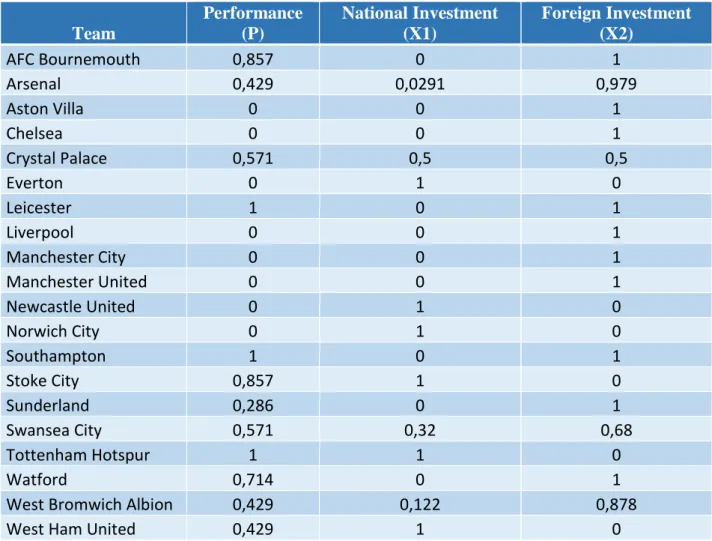
The present study contemplates three variables being considered towards reaching a conclusion on whether or not foreign investment influences sports performance on the EPL and EFL Championship teams, considering the 2015/2016 season. These are Performance (P), which is the dependent variable; National Investment (X1) and Foreign Investment (X2), which are the explanatory variables for the model being applied. Sections 3.2.1 and 3.2.2 aim to explain and justify the means by which the values of these variables were attained.
3.2.1 Sports Performance
Success is a very subjective concept as it might concern different situations and have different meanings from individual to individual. Success in sports, more concretely in football, is no different.
A very similar performance throughout the season between two teams might be successful for one of them and a disaster for the other. It all depends on a series of factors that can be difficult for the regular sports enthusiast to dominate.
There is no established method among the scientific community to measure sports success or literature that supports what a successful performance in football is.
As such, the following thesis presents a method of performance measurement based on expectations and not on abstract success. This will be achieved by gathering the inputs of sports media professionals regarding their opinion on what a successful performance for the EPL and EFL Championship clubs would be, as presented in Section 3.5 of this dissertation. The performance expectations for the clubs will afterwards be compared to their factual sports performance in the league, in order to reach a final value for performance via a simple success factor equation, which is detailed in Section 4.
which aimed to get the respondents´ opinions regarding what objective performance would constitute a successful 2015/2016 football season for the 44 teams of the EPL and EFL Championship. This will further help to determine what performance is considerable as successful for each club in each competition and determine, through a comparison of performances means, if foreign investment had an influence on the sports performance of the teams.
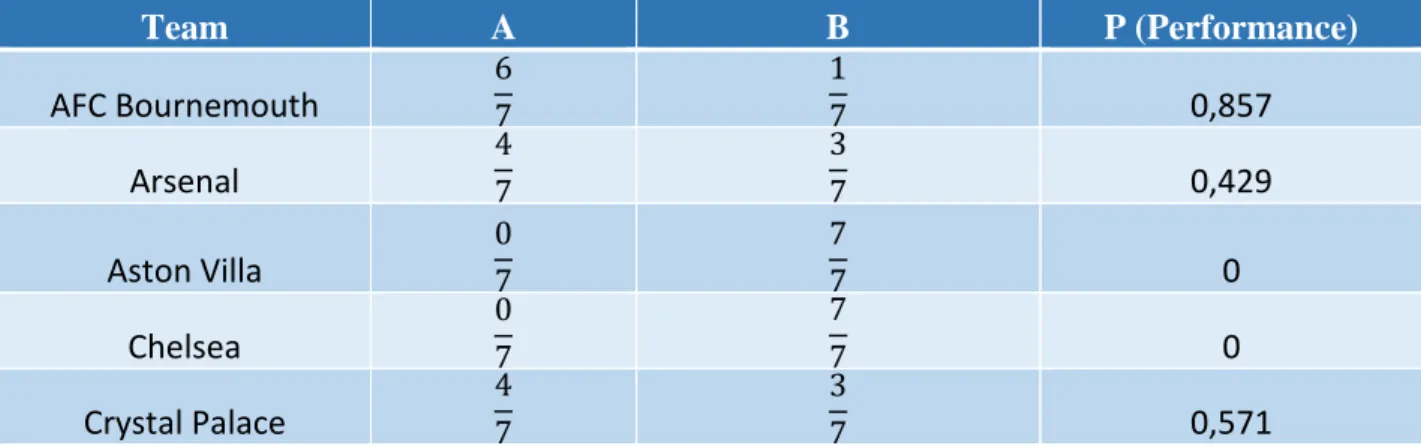
As mentioned before, the value of Performance (P) will be determined by multiplying the success factor - 0 or 1, where 0 is “no success” and 1 is “success” - that will be pondered through the analysis of the factual performance, as seen in Tables 8 and 9 of the annexes - that the 44 considered clubs had during the 2015/2016 competitions by the number of respondents that consider a certain result as a successful result for each competition, divided by the total number of respondents.
Meaning that:
𝑃 = 1 × (Σ of respondents that selected an option that was achieved
𝑇𝑜𝑡𝑎𝑙 𝑛𝑢𝑚𝑏𝑒𝑟 𝑜𝑓 𝑟𝑒𝑠𝑝𝑜𝑛𝑑𝑒𝑛𝑡𝑠 ) + 0 × × (Σ of respondents that selected an option that was not achieved
𝑇𝑜𝑡𝑎𝑙 𝑛𝑢𝑚𝑏𝑒𝑟 𝑜𝑓 𝑟𝑒𝑠𝑝𝑜𝑛𝑑𝑒𝑛𝑡𝑠 )
This can be simplified to 𝑃 = Σ of respondents that selected an option that was achieved
𝑇𝑜𝑡𝑎𝑙 𝑛𝑢𝑚𝑏𝑒𝑟 𝑜𝑓 𝑟𝑒𝑠𝑝𝑜𝑛𝑑𝑒𝑛𝑡𝑠 ,
however equation “1” will be used further on instead of equation “2”, in order to take into account the success factors and make them explicit towards justifying the results that will be obtained.
For instance, taking Manchester City as an example, which is the 2015/2016 Premier League vice-champions. Its success factor will be 1 for whatever of the options that are chosen by the respondents in the survey apart from the “Winners” option which would have a success factor of 0 as, objectively, Manchester City did not win the Premier League. If in six respondents, five would consider that a successful performance for Manchester City would be to reach top three of the Premier League - which it did - and one would consider that a successful performance would be to actually win the Premier
1
.
2
League - which it did not -, then “P” would be reached by multiplying in the following way: 1 ×56 + 0 ×16 . “P” would be 56 = 0,83(3) for Manchester City in the Premier League.
3.2.2 Investment Origin
The values of National Investment (X1) and Foreign Investment (X2) are determined by analyzing the ownership structures of the 44 teams that compete in the EPL and EFL Championship, where a certain amount of equity held by a foreign investor will be translated into a percentage in order to retrieve X2. On the other hand, the amount of equity held by national investors will be put in a percentage perspective, therefore retrieving X1.
When analyzing the data, the teams will be divided by competition - English Premier League and EFL Championship - and by two groups within each competition: teams that are majoritively owned by national investments (≥ 50%) and teams that are majoritively owned by foreign investments (> 50%) so that it is possible to compare the data of each and try to perceive if foreign investment does affect sports performance.
3.3 Research Design
The present paper proposes to study the possibility of Foreign Investment having an impact on the performance of the EPL and EFL Championship clubs.
In order to reach a conclusion regarding whether or not an increase in Foreign Investment is related to an augment of performance, a comparison of performance means will be analyzed with the objective of rejecting or not the null hypothesis, and achieve a conclusion on the research question: Does Foreign Investment Affect the Sports Performance of the EPL and EFL Championship Teams?
As mentioned before, the null and alternative hypotheses are the following: H0: Foreign Investment does not affect sports performance
There will be two explanatory variables being studied - National Investment (X1) and Foreign Investment (X2) - and one dependent variable, which will be the Performance (P) of each team.
First - following a mixed research method - a quantitative approach will be applied by gathering the values of X1 and X2 by studying the teams´ ownership structures.
Afterwards, a qualitative research will be applied by gathering the opinions of sports media professionals that were asked to provide their insights on what a successful performance for the EPL and EFL Championship clubs would be, considering the 2015/2016 season, via an online survey. The professionals´ opinions are then compared with the teams´ factual performances in order to reach a final value for Performance (P), following the method presented in Section 3.2.1.
After obtaining the values of the variables, a Student´s T-test will be performed in order to obtain the statistical data so that it is possible to assess whether or not Foreign Investment played a role in the performance of the EPL and EFL Championship teams by testing the null and alternative hypothesis and answering the research question.
3.4 Data Sampling
The quantitative data that will be used to study the subject of this paper - Foreign Investment as a Catalyst for Performance - will be the ownership structures of the 44 clubs that compose the EPL and EFL Championship. In this section, a brief introduction of each team will be provided, along with its publicly known and available capital structure, - as of March 2017 - divided between National Investment and Foreign Investment. Foreign Investment will be considered for every ultimate owner that it is not a citizen of the United Kingdom or company that is based abroad, outside of the United Kingdom.
It is important to refer that some of the 44 football clubs being studied are owned by public limited companies (plc) which are, on the other hand, owned by other investors, which will be considered in order to reach the percentage of national and foreign equity
of each team. As for the teams for which it is not possible to determine to whom the full percentage of equity shares belong to, the remaining percentage of shares will be considered as belonging to the club and its associates and, as such, as a national investment. If no individual stakes are disclosed at all, the percentage of shares will be divided equally between all the investors.
3.4.1 English Premier League
AFC Bournemouth
National Investment (X1) - 0% Foreign Investment (X2) - 100%
Bournemouth was founded in 1980 and was promoted to the EPL for the first time during the 2015/2016 season, after winning the EFL Championship in 2014/2015. According to Bournemouth´s official website, its ownership is divided between Russian investor Maxim Denim (75%) and an American private equity firm (25%) – PEAK6 Investments.
Arsenal FC
National Investment (X1) - 2,91% Foreign Investment (X2) - 97,9%
Arsenal was founded in 1886, and it is one of the most historic and successful clubs in England, having won 13 league titles.
According to Arsenal´s official website, Arsenal Holding plc equity ownership is divided between American investor E. Stanley Kroenke (67.05%) and Russian investor Alisher Usmanov (30.04%).
Aston Villa FC
National Investment (X1) - 0% Foreign Investment (X2) - 100%
Aston Villa was founded in 1874 and was one of the founder clubs of The Football League, in 1888, and are one of the 5 English clubs to have won the Champions League. According to Aston Villa´s official website, the club is fully owned by the Chinese company “Recon Group Limited”.
Chelsea FC
National Investment (X1) - 0% Foreign Investment (X2) - 100%
Chelsea was founded in 1905 and it is currently considered as one of the best football teams in England, reaching high levels of competitive success in the last 20 years. According to Chelsea´s official website, the club is fully owned by Chelsea FC plc which is owned by Russian investor Roman Abramovich.
Crystal Palace FC
National Investment (X1) - 50% Foreign Investment (X2) – 50%
Crystal Palace was founded in 1905. The club has managed to win the FA Cup twice, and had its best run in the EPL in 1991, finishing in third place. According to Crystal Palace´s official website, the club is owned by its holding company “CPFC 2010 Ltd”, which is controlled by English businessman Steve Parish and American investor Joshua Harris.
Everton FC
National Investment (X1) - 100% Foreign Investment (X2) - 0%
Everton was founded in 1878, being one of the founding members of The Football League, in 1888. The club´s major title highlights were the 1985 European Cup Winners´ Cup, and its last won trophy was the FA Cup in 1995.
According to Everton´s official website, Everton´s major shareholders are Iranian-English investor Farhad Moshiri (49,90%), and Iranian-English investors Bill Kenwright (12,16%) and Jon Woods (8,9%).
Leicester City FC
National Investment (X1) - 0% Foreign Investment (X2) - 100%
Leicester was founded in 1884. The club was recently promoted to the Premier League, in 2013, and managed to win its first Premier League Title in 2016, becoming one of the
only six clubs to have ever won The Premier League in its current format, since its inception in 1992.
According to Leicester´s official website, the club is owned by Thai company “King Power International Ltd”, which is controlled by Thai Srivaddhanaprabha family.
Liverpool FC
National Investment (X1) - 0% Foreign Investment (X2) - 100%
Liverpool is one of the most historic and titled clubs in English Football. It was founded in 1892 and has won several titles throughout its history, such as the European Cup, UEFA Cup, UEFA Super Cup as well as 18 League titles and 7 FA Cups.
According to Liverpool´s official website, the club is owned by the American firm “Fenway Sports Group”.
Manchester City FC
National Investment (X1) - 0% Foreign Investment (X2) - 100%
Manchester City was founded in 1980. The club had a period of great success during the 1960 to 1970 decade winning several titles including the European Cup Winners´ Cup. After this period, the club ended up in the third tier of English football, in 1998. Since then, it regained its position in the Premier League after being acquired in 2008. According to Manchester City´s official website, the club is owned by the UAE company “Abu Dhabi United Group” (87%) and by the Government of China (13%).
Manchester United FC
National Investment (X1) - 0% Foreign Investment (X2) - 100%
Manchester United was founded in 1878 and it is the most successful club in the EPL History. The club has won a record 20 League titles as well as 3 European Cups, among several other domestic and international club titles.
According to Manchester United´s official website, the club is fully owned and controlled by the American “Glazer” family, a group of American investors.
Newcastle United FC
National Investment (X1) - 100% Foreign Investment (X2) - 0%
Newcastle United was founded in 1892 and it is one of the few clubs to have never dropped from the second tier of English football, being a member of the Premier League for all but three years of its existence. It has won six League titles, six FA Cup titles and a European title, winning the Intertoto Cup in 2006.
According to Newcastle´s official website, the club is owned by Newcastle United Limited, which is controlled by English investor Mike Ashley.
Norwich City FC
National Investment (X1) – 100% Foreign Investment (X2) - 0%
Norwich City was founded in 1902 and was promoted for the first time to the EPL in 1972. The club managed to win the League Cup twice during its lifetime and secured a third place in the Premier League in 1993, which was its best performance ever in the top tier.
According to Norwich´s official website, the club´s major investors are Welsh businessman Michael Wynn Jones, the English cook Delia Smith (53%) and Sarah Foulger (13%).
Southampton FC
National Investment (X1) - 0% Foreign Investment (X2) - 100%
Southampton was founded in 1885 and found its greatest success by winning the FA Cup in 1976 and finishing in second place in the Premier League in 1984.
According to news from the newspaper "The Guardian”, published in 2014, the club is owned by Swiss businesswomen Katharina Liebherr.
Stoke City FC
National Investment (X1) - 100% Foreign Investment (X2) - 0%
Stoke City was founded in 1863 which makes it the second oldest football club in England. The club was one of the founder clubs of The Football League, and won its major trophy in 1972, by beating Chelsea in the League Cup final.
According to Stoke City´s official website, the club is fully owned by the English gambling company bet365 Group, whose owners are the Coates Family.
Sunderland FC
National Investment (X1) - 0% Foreign Investment (X2) - 100%
Sunderland was founded in 1879 based in the North East of England. The club had its greatest period during its first 30 years of existence, winning 3 League Titles. Since then it has managed to win two more League Titles - only surpassed by five other clubs - and two FA Cups. According to Sunderland´s official website, the club is owned by American investor Ellis Short.
Swansea City AFC
National Investment (X1) - 32% Foreign Investment (X2) - 68%
Swansea City was founded in 1912 and it is currently the only Welsh-based club enrolled in the EPL, to which it got promoted in 2011. The club´s first major trophy was the League Cup in 2013.
According to Swansea´s official website, Swansea City AFC is a wholly owned subsidiary of Swansea City Football 2002 Limited, which is controlled by American investors Stephen Kaplan and Jason Levien (68%) and Swansea City Supporters Society Ltd (21,1%).
Tottenham Hotspur FC
National Investment (X1) - 100% Foreign Investment (X2) - 0%
Tottenham Hotspur was founded in 1882 and managed to register several historical records during its history, such as being the only club out of the top tier to win the FA Cup; The first club to win both the League Cup and the FA Cup in the same year; The
first British club to win a UEFA club competition and the first British club to win two different European competitions.
According to Tottenham´s official website, the club is controlled by English investment firm “Enic International Limited” (85.5%).
Watford FC
National Investment (X1) - 0% Foreign Investment (X2) - 100%
Watford was founded in 1881 and joined The Football League in 1920. The club´s most successful period was in 1984 when it reached the FA Cup final and competed in the UEFA Cup.
According to Watford´s official website, the club is owned by Italian businessman Gino Pozzo.
West Bromwich Albion FC
National Investment (X1) – 12,2% Foreign Investment (X2) – 87,8%
West Bromwich Albion was founded in 1878. The club was one of the founding members of The Football League, and have spent the majority of its existence among the top clubs in the English top tier. It has won the League once, in 1920 and managed to win the FA Cup for five times.
According to West Bromwich´s official website, the club is owned by the West Bromwich Albion Group Ltd which is controlled by Chinese investor Guochoan Lai (87,8%).
West Ham FC
National Investment (X1) – 100% Foreign Investment (X2) – 0%
West Ham United was founded in 1895 and joined The Football League in 1919. It is one of the eight clubs to have never fallen below the English second tier. It managed to win the FA Cup for three times, as well as reaching two European Finals and winning the European Cup Winners´ Cup in 1965.
According to West Ham´s official website, the club is owned by Welsh investor David Sullivan (51,1%), English businessman David Gold (35,1%) and “CB Holding ehf” (10%), a firm based in the Cayman Islands.
3.4.2 EFL Championship
Birmingham City FC
National Investment (X1) - 0% Foreign Investment (X2) - 100%
Birmingham was founded in 1875, the club was the first ever champions of the Football League Second Division, and have managed to win the League Cup twice in their history.
According to Birmingham´s official website, Birmingham City is owned by Birmingham International Holdings Limited that holds the great majority of the club´s issued shares. Ultimately, Birmingham International Holdings Limited is owned by Chinese businessman Paul Suen, and its headquarters are in Hong Kong.
Blackburn Rovers FC
National Investment (X1) – 0,01% Foreign Investment (X2) – 99,9%
Blackburn was founded in 1875 and it is one of the founding members of The Football League. The club has managed to win the League title three times during its history. According to a news published by "BBC”, Blackburn Rovers was acquired by Indian company “Venky´s London Limited” in 2010, who now owns 99,9% of the club.
Bolton Wanderers FC
National Investment (X1) – 100% Foreign Investment (X2) - 0%
Bolton was founded in 1874 and is one of the founding members of The Football League, holding the record for the team with most seasons in the top tier of English Football without winning the title.
According to Bolton´s official website, the club is owned by English company Burnden Leisure Limited.
Brentford FC
National Investment (X1) - 100% Foreign Investment (X2) - 0%
Brentford was founded in 1889, having achieved the FA Cup quarter-finals as its major history highlight.
According to Brentford´s official website, the club is owned by English businessman Matthew Benham.
Brighton & Hove Albion FC
National Investment (X1) - 100% Foreign Investment (X2) - 0%
The club was founded in 1901, having achieved the final of the FA Cup once, in 1983. According to Brighton´s official website, the club is owned by English investor and club Chairman Anthony Grant Bloom, who is the majority shareholder.
Bristol City FC
National Investment (X1) - 100% Foreign Investment (X2) - 0%
The club was founded in 1894, having reached its only final in 1909, losing the FA Cup to Manchester United.
According to Bristol´s official website, the club is owned by Bristol City Holdings Ltd, which is ultimately controlled by English investors Stephen Lansdown and Keith Dawe.
Burnley FC
National Investment (X1) - 100% Foreign Investment (X2) - 0%
Burnley was founded in 1882, having been one of the founding members is The Football League. The club has managed to win the FA Cup and achieved the quarter-finals of a European competition during its history.
According to Burnley's official website, the club´s majority shareholders are English businessmen Mike Garlic and John Banaszskiewicz.
Cardiff City FC
National Investment (X1) - 49% Foreign Investment (X2) - 51%
Cardiff City was founded in 1899 and it is one of the six Welsh clubs to participate in the English football system, being the only Welsh side to have won the FA Cup.
According to Cardiff´s official website, the club´s majority shareholder is Singapore investor Vincent Tan, holding 51% of the club´s equity.
Charlton Athletic FC
National Investment (X1) - 0% Foreign Investment (X2) - 100%
Charlton was founded in 1905 and managed to reach the FA Cup final twice, losing it both times.
According to Charlton´s official website, the club is owned by Belgium company “Staprix NV”, which is controlled by Belgium investor Roland Duchâtelet.
Derby County FC
National Investment (X1) - 100% Foreign Investment (X2) - 0%
The club was founded in 1884 and it is one of the founding members of The Football League, also assuming itself as one of the very few clubs to have played in every season of the English Football League system.
According to Derby´s official website, the club is owned by English investor Mel Morris.
Fulham FC
National Investment (X1) - 0% Foreign Investment (X2) - 100%
Fulham was founded in 1879 and has never won any major trophy in its history. The club reached the FA Cup and Europa League finals but lost both.
According to Fulham´s official website, the club is fully owned by American investor Shahid Khan.
Huddersfield Town FC
National Investment (X1) - 100% Foreign Investment (X2) - 0%
The club was founded in 1908 and it is one of the four clubs to have won three consecutive league titles, and the first to do so.
According to Huddersfield Town official website, the club is owned by English Businessman and clubs´ chairman Dean Hoyle.
Hull City FC
National Investment (X1) - 100% Foreign Investment (X2) - 0%
Hull City was founded in 1904 and its greatest achievement was reaching the FA Cup final in 2014.
According to Hull´s official website, Hull City is fully owned by the Egyptian-British Allam Family.
Ipswich Town FC
National Investment (X1) - 100% Foreign Investment (X2) - 0%
Ipswich Town was founded in 1878. During its history, the club has managed to win the English League title, the FA Cup and the now extinguished UEFA Cup.
According to Ipswich´s official website, Ipswich´s majority shareholder is English businessman Marcus Evans.
Leeds United FC
National Investment (X1) - 0% Foreign Investment (X2) - 100%
Leeds was founded in 1919, having won the English First Division for three times, as well as the FA Cup and League Cup once.
According to Leeds´ official website, the clubs´ ownership is divided equally between Italian investors Massimo Cellino and Andrea Radrizzani.
Middlesbrough FC
National Investment (X1) - 100% Foreign Investment (X2) - 0%
The club was founded in 1876, having spent only two seasons outside of England´s top two tiers. Its major highlight trophy-wise is the League Cup in 2004, having also reached a European Final in 2006.
According to Middlesbrough´s official website, Middlesbrough is fully owned by English investors Steve Gibson and Mike O´Neill.
Milton Keynes Dons FC
National Investment (X1) - 100% Foreign Investment (X2) - 0%
The club is very recent, having been founded only in 2004 and achieving the promotion to the EFL Championship in 2015.
According to Milton´s official website, the club is fully owned by English businessman Pete Winkelman.
Nottingham Forest FC
National Investment (X1) - 0% Foreign Investment (X2) - 100%
Nottingham Forest was founded in 1865, having a very successful period during the 70´s when it won the League as well as two European Cups.
According to Nottingham´s official website, the club is owned by “NFFC Group Holdings Limited” who is controlled by the Kuwait “Al Hasawi” Family.
Preston North End FC
National Investment (X1) - 100% Foreign Investment (X2) - 0%
The club was founded in 1880 and it is one of the founding members of The Football League, having won the inaugural season.
According to Preston´s official website, Preston North End is owned by “Deepdale PNE Holding Limited”, which is controlled by English investor Trevor Hemmings.
Queens Park Rangers FC
National Investment (X1) - 0% Foreign Investment (X2) - 100%
The club was founded in 1886, having the victory in the League Cup in 1967 as its major success.
According to Queens Park Rangers' official website, the club is owned by Malaysian investor Tony Fernandes (66%) and Indian investor Lakshmi Mittal (33%).
Reading FC
National Investment (X1) - 0% Foreign Investment (X2) - 100%
Reading was founded in 1871 and has never won any major competition or title.
According to Reading´s official website, Reading is owned by Thai businessmen Narin Niruttinanon (50%), Sasima Srivikorn (25%) and Sumrith Thanakarnjanasuth (25%).
Rotherham United FC
National Investment (X1) - 100% Foreign Investment (X2) - 0%
The club was founded in 1925, having featured in the very first League Cup final in 1961.
According to Rotherham´s official website, the club is wholly owned by “ASD Holdings Ltd”, which is controlled by English investors Tony Stewart, J. Stewart and R. Stewart.
Sheffield Wednesday FC
National Investment (X1) - 0% Foreign Investment (X2) - 100%
The club was founded in 1867, being one of the oldest clubs in the world. It has managed to win four League titles, one League Cup and three FA Cups throughout its history.
According to Sheffield´s official website, Sheffield Wednesday is fully owned by Thai investor Dejphon Chansiri.
Wolverhampton FC
National Investment (X1) - 0% Foreign Investment (X2) - 100%
The club was founded in 1877, and it is one of the founding members of The Football League. It has won three League titles, four FA Cups and two League Cups, having reached, as well, a European Final in 1972.
According to Wolverhampton´s official website, the club is owned by the Chinese investment company “Fosun”.
3.5 Data Collection
Regarding the qualitative data, in order to gather the results from the sports media professionals’ opinions, two questionnaires were created using the Google Documents platform. One questionnaire concerned only the EPL teams and the other the EFL Championship teams. The questionnaires were created separately so that it would not become too time-consuming for the professionals to answer them at the same time. This way, the respondents were able to answer the questionnaires in different occasions.
Aiming to get an accurate estimate of what performance would be considered as successful for the EPL and EFL Championship teams through the survey, only current or ex-sports media professionals were contacted. The respondents were contacted via the social networks LinkedIn and Twitter, as well as by e-mail.
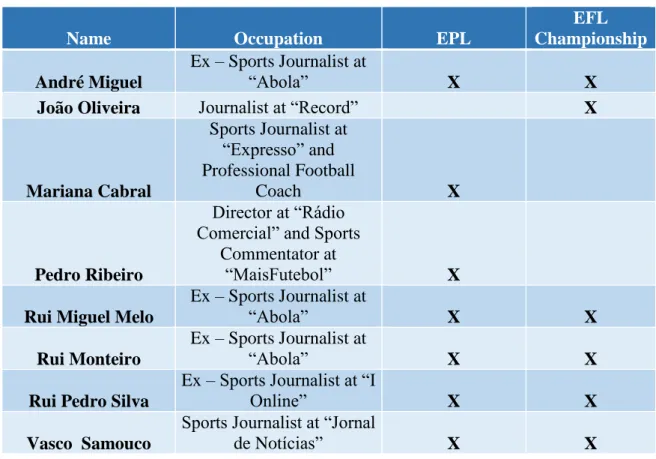
There were a total of eight different Portuguese sports media professionals which agreed to participate in the survey. English sports media professionals were also contacted but did not show interest in participating in the survey. Not every one of the eight sports media professionals participated in both surveys, as there were seven answers on the EPL questionnaire and only six on the EFL Championship questionnaire. The participants in each of the questionnaires are detailed in Table 1, below.