CUIDADO É FUNDAMENTAL
UNIVERSIDADE FEDERALDO ESTADODO RIODE JANEIRO. ESCOLADE ENFERMAGEM ALFREDO PINTO
RESEARCH DOI: 10.9789/2175-5361.2019.v11i1.167-172
DOI: 10.9789/2175-5361.2019.v11i1.167-172 | MonteAS; MonteAS; LimaLRF; et al. | Epidemiological analysis of candidates for the donation of organs...
CUIDADO É FUNDAMENTAL
UNIVERSIDADE FEDERALDO ESTADODO RIODE JANEIRO. ESCOLADE ENFERMAGEM ALFREDO PINTO
R E V I S T A O N L I N E D E P E S Q U I S A
Epidemiological analysis of candidates for the donation of organs
in the states of Ceará, São Paulo and Acre
Análise epidemiológica dos candidatos à doação de órgãos nos estados do
Ceará, São Paulo e Acre
Análisis epidemiológica de los candidatos a la donación de órganos en los
estados del Ceará, São Paulo y Acre
Aline Santos Monte;1 Alana Santos Monte;2 Larissa Rodrigues de Freitas Lima;3 Valderlene dos Santos Freire4
How to quote this article:
MonteAS, MonteAS, LimaLRF, Freire VS. Análise epidemiológica dos candidatos à doação de órgãos nos estados do Ceará, São Paulo e Acre. Rev Fun Care Online. 2019 jan/mar; 11(1):167-172. DOI: http://dx.doi. org/10.9789/2175-5361.2019.v11i1.167-172
ABSTRACT
Objective: To analyze the epidemiological aspects of candidates for donation of organs from Ceará, comparing
them with the best and worst performing states regarding transplantation. Methods: A descriptive cross-sectional study with a quantitative approach was performed with data from the Brazilian Transplant Registry published in 2016. Results: The worst and best condition in relation to organ donations were Acre and São Paulo, respectively. The number of effective donors per million population in Ceará was higher than in São Paulo. Family refusal accounted for most of the causes of non-transplantation in the three states. Cerebral Vascular Accident was the main cause of death in São Paulo and Acre, while in Ceará it was traumatic brain injury. Ceará and Acre had a predominant age group of 18-34 years. Conclusion: The performance of Ceará when compared to the other states was higher in relation to the transformation of potential donors into effective donors.
Descriptors: Tissue donors; Tissue and organ procurement, Organ transplantation.
RESUMO
Objetivo: Analisar aspectos epidemiológicos de candidatos a doação de órgãos do Ceará, comparando com os estados de melhor e
pior desempenho quanto ao transplante. Método: Estudo Transversal descritivo com abordagem quantitativa realizado com dados do Registro Brasileiro de Transplantes publicados em 2016. Resultados: O pior e melhor estado em relação às doações de órgãos foram Acre e São Paulo, respectivamente. O número de doadores efetivos por milhão de população no Ceará foi superior ao de São Paulo. A recusa familiar representou a maioria das causas de não concretização dos transplantes nos três estados. O Acidente Vascular Cerebral foi a principal causa de morte em São Paulo e Acre, enquanto no Ceará foi o Traumatismo crânio encefálico. Ceará e Acre apresentaram
1 Farmacêutica. Doutora em Farmacologia pela Universidade Federal do Ceará. E-mail: [email protected]. 2 Enfermeira. Doutora em Enfermagem. Professora Adjunta da Universidade da Integração Internacional da Lusofonia
Afro-brasileira. E-mail: [email protected].
3 Enfermeira. Escola de Saúde Pública do Ceará. E-mail: [email protected]. 4 Enfermeira. Escola de Saúde Pública do Ceará. E-mail: [email protected].
faixa etária predominante de 18-34 anos. Conclusão: O desempenho do Ceará quando comparado com os outros estados foi superior em relação a transformação de potenciais doadores em doadores efetivos.
Descritores: Doadores de tecidos,Obtenção de tecidos e órgãos,
Transplante de órgãos.
RESUMEN
Objetivo: Analizar aspectos epidemiológicos de candidatos a la
donación de órganos de Ceará, comparando con los estados de mejor y peor desempeño en cuanto al trasplante. Métodos: Estudio Transversal descriptivo con abordaje cuantitativo realizado con datos del Registro Brasileño de Trasplantes publicados en 2016. Resultados: El peor y mejor estado en relación a las donaciones de órganos fueron Acre y São Paulo, respectivamente. El número de donantes efectivos por millón de población en Ceará fue superior al de São Paulo. La negativa familiar representó la mayoría de las causas de no concreción de los trasplantes en los tres estados. El Accidente Vascular Cerebral fue la principal causa de muerte en São Paulo y Acre, mientras que en Ceará fue el Traumatismo cráneo encefálico. Ceará y Acre presentaron rango de edad predominante de 18-34 años. Conclusión: El desempeño de Ceará cuando comparado con los otros estados fue superior en relación a la transformación de potenciales donantes en donantes efectivos.
Descriptores:Donantes de tejidos,Obtención de tejidos y órganos,Trasplante de órganos.
INTRODUCTION
Organ donation and transplantation are widely discussed throughout the world.1 In Brazil, these procedures are regulated by the Law 9,434 from February 4th, 1997, which provides for the removal of organs, tissues and parts of the human body for the purpose of transplantation.2
In 2016, the effective donor rate grew by 3.5%, reaching 14.6 donors per million citizens; this increase was lower than the forecast, revised in 2015, of 15.1 per million citizens. Analyzing the forecast for the donation rates of each State, it is observed that they reached or exceeded the target for the year; the three States of the South Region and also the
Mato Grosso do Sul, Pará, Bahia, Ceará and Paraíba States.3 The most prominent States in the demand for organ donation were: Santa Catarina (36.8 per million citizens) and Paraná (30.9 per million citizens). The goal for 2017 is to reach the rate of 16.6 donors per million citizens in Brazil. Nonetheless, the rate of non-family leave remains high (43%), being less than 35% in Paraná alone (33%). Some States in the North Region (Rondônia and Acre States) had rates above 75%.3
Annually, the Ceará State is among the States that most perform organ transplants in the country. In 2016, the State surpassed the national donation rate (20.2 per million citizens).4 Both cardiac, renal and hepatic transplants increased from 1.5 to 1.6 transplants per million citizens.5
Until December 2016, the waiting list for transplantation in adults and in Brazil totaled 34,542 active patients. Being pediatric patients 916, reaching a total of 35,458 active patients on the waiting list in Brazil. The reporting rate of potential donors has grown slowly and is close to 50 per million citizens, with the South Region standing at 74.9 per million citizens, above the country’s estimated 70 per million citizens.3
The growth in the areas of Intensive Care Unit, the production of knowledge about the immune system and the discovery of medicines in pharmacology, promoted the increase in the rates of transplantation of organs and tissues making it an effective therapeutic alternative of excellence in the treatment of organs failure.6
Many factors make it difficult to donate such as: lack of hospital infrastructure, no notification of brain death, unprepared professionals to clarify the family about this process, cardiorespiratory arrest of the patient before the end of the brain death protocol, and clinical exams with positive serologies.7
The refusal of the family member of the potential donor patient at the time of the interview is still considered the greatest obstacle to donation in Brazil.8 It is understood as a potential donor any patient in whom the diagnosis of brain death is suspected and the protocol for its confirmation, according to criteria defined by the Conselho Federal de
Medicina (CFM) [Federal Council of Medicine] through
the Resolution CFM 1480/97.9
Bearing in mind this reality, even with the existence of legislation, the issue of donation and organ transplants creates a dilemma not only for professionals working in the health area, but also for religious, forensic and for the whole society involved.8
The lack of clarification to the public about this process reflects not only the paucity of potential donors but also, and above all, the failure to convert them into effective donors. It is of great relevance studies on the identification of the profile of this potential donor and the factors that make it difficult to perform the transplantation in order to make it possible to obtain organs and tissues.
Hence, this study aims to analyze epidemiological aspects of organ donors in the Ceará State, articulating a comparison with the State of both better and worse performance in regards to the transplantation process.
METHODS
It is a descriptive and cross-sectional study with a quantitative approach that was performed using the Brazilian Transplantation Registry from the Associação Brasileira de
Transplantes de Órgãos (ABTO) [Brazilian Association of Organ
Transplants] published from January 1st to December 31st, 2016. The study population consisted of all individuals identified as donors of either organs or tissues in the Ceará State and in two other States of the Brazilian territory. In order to classify the Brazilian States as better and worse in relation to transplants, 3 criteria were used, as follows: 1) identification of potential donors, 2) transformation of potential donors into effective donors, and 3) number of donors with transplanted organs. This classification took place through the cluster analysis. For the formation of the clusters, the agglomerative hierarchical procedure was used by the mean linkage method.
All Brazilian States were submitted to this analysis, except for those who did not have regularized data with the Brazilian Transplantation Registry (Amapá, Roraima, Tocantins and
Subsequently, the Ceará State was compared with the other two States elected in better and worse for several variables.
We included all the individuals that were included in the definition of donor in the States to be studied in the period from January 1st to December 31st, 2016, which had their data sent to the Brazilian Transplantation Registry according to a published schedule. We excluded those who did not fit the definition of potential donor, as well as patients whose data were not recorded.
Three types of variables related to the organ and tissue donation process were collected: 1) Number of potential donors and number of effective donors; 2) Variables related to non-transplantation: Family refusal, medical contraindication, cardiorespiratory arrest and others, and 3) Variables related to the donor profile: gender, blood type, cause of death and age group.
The Statistical Package for Social Sciences (SPSS), version 22.0, was used for the statistical analysis.
RESULTS
The highest ranked State with regards to organ donation was São Paulo, and the worst ranked State was Acre, and the States were chosen for comparative analysis with the
Ceará State.
As to the profile of effective donors, there was a predominance of males in the three States assessed. In the
Ceará State, the predominant age group from 18 to 34 years
old (26.5%). In the Acre State 2 effective donors were between 18 and 34 years old and 2 were between 35 and 49 years old. Concerning the São Paulo State, there was a change in this profile, where it was predominant subjects within the age group from 50 to 64 years old, with 291 (34.5%) effective donors.
Regarding the blood group, donors from the Ceará State showed a predominance of blood group O with 122 cases (55%). In the Acre State 3 (60%) donors had blood group A and in São Paulo 437 (51.9%) donors had blood group O. Table 1 - Profile of effective donors with regards to their
genders who lived in the Ceará, Acre and São Paulo States over 2016.
Gender Ceará State
n %
Acre State n %
São Paulo State n % Female 80 36 1 20 385 46 Male 142 64 4 80 457 54 Age group 0 to 17 30 13.5 0 0 47 5.5 18 to 34 59 26.5 2 40 190 22.6 35 to 49 54 24.3 2 40 240 28.5 50 to 64 54 24.3 1 20 291 34.5 > 65 25 11.2 0 0 74 8.7 Blood group A 77 34.7 3 60 286 34 AB 4 2 0 0 25 3 B 19 8.5 0 0 94 11.16 O 122 55 2 40 437 51.9 Source: ABTO, 2016.
From January to December 2016, 587 notifications of potential donors were observed in the Ceará State, 60 in the Acre State and 2,757 in São Paulo. It was observed that in the Ceará State 38% of potential donors became effective donors. In São Paulo, 30% of donors became effective, and the Acre State had only 8% (Table 2).
Table 2 - Number of potential donors and effective donors
in the following States: Ceará, Acre and São Paulo over 2016.
Outcome Ceará State n % pmc/ year Acre State n % pmc/ year São Paulo State n % pmc/year Potential Donor 587 100 65.9 60 100 74.6 2,757 100 62.1 Effective Donor 222 38 24.9 5 8 6.2 842 30 19 Source: ABTO, 2016.
*pmc – per million citizens
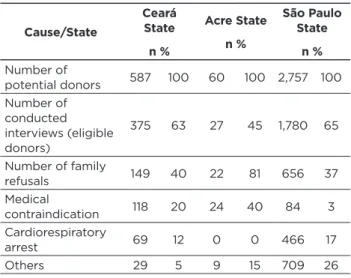
Observing the 587 potential donors in the Ceará State, 375 (63%) were eligible for transplantation, and the family was therefore interviewed. At the time of the interview it was evidenced that the non-family authorization corresponded to 40%. In the Acre State, of the potential donors, 45% were eligible for donation and of these 81% were denied by relatives. In São Paulo, of the 2,757 potential donors, 1,780 (65%) were eligible, and therefore, the families interviewed about the transplant authorization. A total of 656 families (37%) did not authorize the donation (Table 3).
Table 3 - Causes of transplantation failure in the following
States: Ceará, Acre and São Paulo over 2016.
Cause/State Ceará State n % Acre State n % São Paulo State n % Number of potential donors 587 100 60 100 2,757 100 Number of conducted interviews (eligible donors) 375 63 27 45 1,780 65 Number of family refusals 149 40 22 81 656 37 Medical contraindication 118 20 24 40 84 3 Cardiorespiratory arrest 69 12 0 0 466 17 Others 29 5 9 15 709 26 Source: ABTO, 2016.
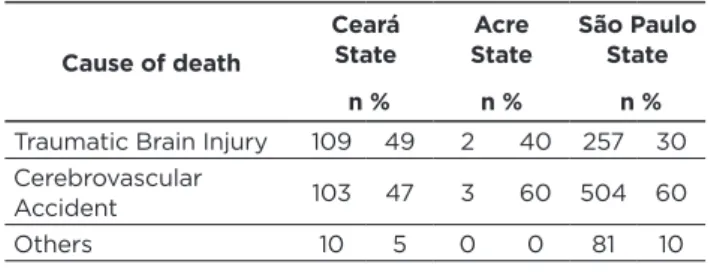
Concerning the cause of death of the effective donors, it was evidenced that in Ceará organ donors were mostly victims of traumatic brain injury 109 (49%). Cerebrovascular Accident (stroke) was the predominant cause in the Acre State, with 3 cases (60%) and in São Paulo, with 504 cases (60%) (Table 4).
Table 4 - Donor profile regarding the cause of death in the
following States: Ceará, Acre and São Paulo over 2016.
Cause of death Ceará State n % Acre State n % São Paulo State n %
Traumatic Brain Injury 109 49 2 40 257 30 Cerebrovascular
Accident 103 47 3 60 504 60
Others 10 5 0 0 81 10
Source: ABTO, 2016.
DISCUSSION
It can be seen that in the three States studied, the majority of effective organ donors were men. In 2010, there was already a predominance of males of effective donors in Ceará, then totaling 66%.10 This was also found in 2014, when a survey was performed at the Organ and Body Search Service from the Hospital de Clinicas in Campinas city, where it was verified that 55% of donors were men.11
It is suggested that this fact is associated with males being generally more vulnerable to several risk factors, such as accidents and violence.10
According to the survey data, it was found a higher prevalence of donors in the age range between 18 and 34 years old in the Ceará and Acre States. Corroborating these data, another study showed that the highest prevalence of effective donors was concentrated in the age group between 18 and 40 years old, represented by 50.5% of the records.10 These results are close to the national data with more prevalent age groups between 18 and 49 years old with 49% of donors.3
Considering the São Paulo State, there was a change in this profile, where the age range of 50-64 years old predominated. Two other studies in Brazil found that the predominant age group of donors was 41-60 years old and 46-60 years old. This fact may be related to the cause of the death that was predominantly the Cerebrovascular Accident with 45% followed by the Cranioencephalic Trauma with 31.7%.11,12
From these data it is possible to observe a change in the profile of donations, as the age of the potential donor is increasing, possibly as a result of the aging process of the Brazilian population and the adjustment of the clinical criteria of inclusion of organ donors (expanded donors, marginal, not ideal donors or borderline donors, i.e., donors that are outside the optimal criteria for donation).7
Regarding the aspects related to the clinical variables, a predominance of blood group O was found in Ceará and
São Paulo. Similar data were found in studies on the blood
typing of effective donors, in which it was shown that the O group was also dominant.10,13
These data are equivalent to that found in the Brazilian Transplantation Registry, which shows that 16 of the 23 Brazilian States that perform transplantation have donors with predominant blood type O, corresponding to 70% of effective donors.3
In Brazil, the most common blood groups are “O” and “A” types. Together these two groups cover 69% of the population.
Therefore, the blood type profile of the effective donors of this study is close to the frequencies presented by the total Brazilian population.14
According to data published in the Brazilian Transplantation Registry, the three States analyzed showed a very small number of potential donors for the number of patients who entered the waiting list in 2016.
In 2016, the waiting list for transplants in Ceará consisted of 2,204 adults and 79 pediatric patients, the Acre State showed 57 adults, and São Paulo presented 12,031 adults, and 763 pediatric patients.3 Still, in 2016, Spain had 39.7 effective donors per million citizens, being the world reference in organ donation. Brazil in 2016 was the second in absolute number of renal and hepatic transplants.3
Comparing the three States, it was perceived that Ceará was the State in which more potential donors became effective donors, even surpassing the São Paulo State in this point.
A survey conducted in Brazil found that only 30% of potential donors became effective donors, corroborating the present study.13
It can be seen that the actual number of potential donors is much higher than the number of notifications made. Compulsory notification is a failure, and the donor’s detection is often the result of the active search of the Centers for Notification, Collection, and Distribution of Organs and Intra-Hospital Commissions for Organ Donation and Tissue for Transplantation, and not for awareness of the need for physician notification.15
In Ceará and the other two States analyzed, the main cause of donation failure was a family refusal. A survey carried out in the Santa Catarina State regarding the profile of donors of a hospital showed that 86% of the donations of organs not performed were due to family refusal in the interviews, overlapping the national values of refusals according to the Brazilian Transplantation Registry in the year 2016 that was 43%.3,12
In 2016 there were 2,571 families who refused to donate the organs and tissues of their loved ones, which is equivalent to a 25% family refusal when calculated on potential donors, but when the denominator becomes the number of family interviews performed, the family refusal rate rises to 43%. The year with the highest number of family refusals in Brazil was 2013 with 47%.3 (ABTO, 2016)
Several aspects influence this decision, the most prevalent are: respect to the will of the potential donor; beliefs such as maintaining body integrity for the afterlife; the lack of trust in the medical team and the inadequate approach of the Intra-hospital Transplant Commission.12
There are several causes related to family refusal, the most implicated being the deceased’s wish expressed in life contrary to donation, lack of understanding of the concept of brain death, degree of family satisfaction with medical care given to the potential donor, fear of mutilation of the deceased body, denial of death, lack of family consensus, and religious beliefs.15
The clarification that the relatives receive about the occurrences with the patient during the period of hospitalization can facilitate or make difficult the interview. The
family that is informed at the beginning of the examinations about the confirmation of the diagnosis of brain death has the possibility to prepare for the death of the patient. However, those who receive the information only after confirming the diagnosis are generally shocked.16
An analysis of the causes of family refusal to donate organs and tissues concluded that 64% of the families interviewed had no knowledge of the will of the loved one about organ donation. Among the reasons for refusal pointed out by the interviewees, it is observed that there is still little knowledge of relatives about this subject.17
Nevertheless, these data are controversial because, according to a survey carried out in the northern area of Ceará, medical contraindication prevailed as to why donation did not take place with 67% of cases, followed by family refusal with 33% of the cases.11
In the Ceará State, the main cause of death of effective donors was a traumatic brain injury. These data are similar to the results obtained in another study that showed that 52% of the causes of brain death among the participants in the research were also traumatic brain injury.10
In 2013, in Pará State, 57.7% of the causes of organ donor deaths were due to cranioencephalic trauma.15 Such a high percentage may be related to the higher prevalence of male individuals as effective donors, since external causes constitute the second cause of death in men, second only to diseases of the circulatory system, of which Cerebrovascular Accident is the main occurrence in Brazil.18
Nonetheless, it was evidenced that in the Acre and São
Paulo States the majority of deaths were due to Cerebrovascular
Accident, corroborating with another Brazilian study that showed a predominance for the causes due to Stroke with 50.8% of deaths, followed by cranioencephalic traumatism with 44.1%.12
The change in this epidemiological profile of the potential donor, with Cerebrovascular Accident as the main cause of death and no more traumatic causes, implies a new posture by parts of the transplantation teams, since it has to adapt to a donor with greater range age and with more comorbidities.17
Hence, it is suggested that traumatic causes may be giving way to Cerebrovascular Accident. One explanation for this may be the reduction of automobile accidents. The mortality rate in Brazil due to traffic accidents fell from 22.5% per 100,000 citizens in 2012 to 6.5% in 2016. The Ministry of Health notes that the fall is a possible reflection of the hardening of the Law 11,705 from June 19th 2008, Lei Seca, in 2012.19,20
FINAL CONSIDERATIONS
It was identified that the Acre State was considered the less effective in identifying potential donors, and also in getting potential donors to be effective donors, furthermore, it has had the lower number of donors with transplanted organs. In the other hand, the São Paulo State was considered the best in doing those practices.
Comparing Ceará with these two other States, it was concluded that Ceará State performed best in terms of
transforming potential donors into effective donors, even though it presented a still high rate of family refusal as the main cause of non-transplantation, where this is the reason for the non-donation in the three States, especially the Acre State, which presented a higher rate in comparison to Brazil.
Given the aforementioned data, it is suggested the development of projects and campaigns aimed at the training of professionals working in the Centers for Notification, Collection and Distribution of Organs and in the Intra-Hospital Commissions for Organ Donation and Tissue for Transplantation.
In addition to public sector support for transplant programs, development of public policies to encourage organ donation and active search strategies by potential donors, showing the importance of transplantation and the need for information and awareness of the population about the desire to become a donor.
The limitations of the study are related to the transversal design, which does not allow the establishment of causal relationships. Moreover, some States did not forward their data to the publication in the Brazilian Transplantation Registry, which constitutes a sub-notification.
REFERENCES
1. Paz ACAC, Ribeiro PCA, Mascarenhas MDM, Silva MV. Caracterização dos doadores de órgãos e tecidos para transplante do estado do Piauí, de 2000 a 2009. Rev Enf em Foco. 2011;2( 2):124-7.
2. Ministério da Saúde (BR). Lei 9.434, de 4 de fevereiro de 1997. Dispõe sobre a remoção de órgãos, tecidos e partes do corpo humano para fins de transplante e tratamento e dá outras providências. 2001a. Available at: <http://dtr2001.saude.gov.br/sas/dsra/lei9434.htm>. Acesso em 25 de Agosto de 2016.
3. Associação Brasileira de Transplante de Órgãos (ABTO). Dimencionamento dos Transplantes no Brasil e em cada estado. Registro Brasileiro de Transplantes. Ano XXII nº 4,São Paulo – SP, 2016.
4. Secretária de Saúde do Ceará (CE). Comissões Intra-Hospitalares de Doação de Órgãos e Tecidos para Transplante (CIHDOTT)/ Organização por Procura de Órgãos e Tecidos (OPO. 2016. <Available at: http://www.saude.ce.gov.br/index.php/rede-de-servicos/central-de-transplante/cihdott-opo> acesso em 18 de abril 2017.
5. Secretária de Saúde do Ceará (CE). Doação de órgãos. Instituição no período: janeiro/2015 a Dezembro de 2015. Registro Brasileiro de Transplantes, v. 18, n. 2, p.1-34, 2012. Available at: <http://www.abto. org.br/abtov03/Upload/file/RBT/2013/RBT-dimensionamento2016. pdf> Acesso em 23 de junho de 2016.
6. .Magalhães ACSP, Ramos, R.P. O enfermeiro na central de captação de órgãos. Rev Eletr enfer. São Paulo; 2010;28 (2):13-20.
7. Moraes E L, Silva L BB, Moraes, T C, Paixão, N C S, Izumi NMS , Guarino AJ. O perfil de potenciais doadores de órgãos e tecidos. Rev Lat Am Enfermagem. Ribeirão Preto,2009;17( 5):68-75.
8. Pereira WA, Arruda DMR, Mendonça RCF, Hadda JA . Opinião dos Profissionais da Saúde Em Relação À Doação de Órgãos E Tecidos para transplante no Ano de 2009 - santa casa de belo horizonte/MG. JBT J Bras Transpl. 2008;1(2):138-40.
9. Conselho Federal de Medicina. Resolução CFM n. 1.480, de 08 de agosto de 1997. Dispõe sobre a caracterização de morte encefálica. DOU, Brasília, 21 de agosto de 1997; p. 1822.3]. Available at:http:// www.portalmedico.org.br/resolucoes/
10. Aguiar MI F de, Araújo TOM, Cavalcante MMS, Chaves ES, Rolim ILTP. Perfil de Doadores Efetivos de Órgãos e Tecidos no estado do Ceará. Rev Min Enferm. 2010, 14(3): 353-60.
11. Rodrigues, BT, Vasconcelos OM, Brito, ICC, Sales M S, Silva DC da, Alves, RC; Souza ÂM. Perfil de Potenciais Doadores de órgãos em hospital de referência. Rev Rene. 2013;14(4):713-71.
12. Noronha MGO de, Seter GB, Perini LD, Salles FMO de, Nogara, MAS. Estudo do perfil dos doadores elegíveis de órgãos e tecidos e motivos da não doação no Hospital Santa Isabel em Blumenau, SC. Rev da AMRIGS, 2012 Porto Alegre, 56(3): 199-203.
13. Freire ILS, Vasconcelos QLDAQ de, Oliveira e Araujo R, Pinto TJM, Torres GV. Caracterização dos Potencias Doadores de órgãos e Tecidos para Transplantes. Rev Enferm UFPE. 2013;7(1): 184-91.
14. Silva RA, Mendes SO, Souza AVV, Luz PRG, Medeiros MO. Mapeamento dos Sistemas de Grupos Sanguíneos ABO e Rh dos Doadores de Sangue em Primavera do Leste – MT. Rev biodiversidade [on line]. 2010. <Available at: http://periodicoscientificos.ufmt.br/ojs/ index .php/biodiversidade/article/view/100 >acesso em 26 de maio de 2017.
15. Conceição MPS, Oliveira AJB, Pontes RWF, Brito NB. Análise dos aspectos epidemiológicos dos candidatos à doação de órgãos no estado do Pará. Rev Bras Clin Med. 2013; 11 (2): 123-8.
16. Massarolo MCKB, Kurcgant P. O vivencial dos enfermeiros no programa de transplante de fígado de um hospital público. Rev Lat Am Enfermagem. Ribeirão Preto, 2011; 8(4):66-72.
17. Pessoa JLE, Schirmer J, Roza BA. Avaliação das causas de recusa familiar a doação de órgãos e tecidos. Acta paul enferm. [online]. 2013; 26(4):323-30
18. Gonçalves AA, Castilho BCS, Rabelo JR, Bedran T. The nusse leading the process of organ and Tissue procurement with the potential Donoris family. Journal of Nursing UFPE. Pernambuco. 2012,6 (5):1202-10.
19. Departamento Estadual de Trânsito do Ceará (DETRAN-CE) – Estatísticas de acidentes no estado do Ceará. 2016. Disponivel em<http://vias-seguras.com/os_acidentes/estatisticas/estatisticas_ estaduais/estatisticas_de_acidentes_no_ceara> acesso em 18 de abril de 2017.
20. Ministério da Saúde (BR). Entendendo a doação de órgãos. Dados numéricos da doação de órgãos e transplantes realizados por estado e instituição no período: janeiro a junho de 2016. Available at: <http://www.abto.org.br/abtov03/Upload/file/RBT/2016/RBT-dimensionamento2016.pdf> Acesso em 25 de Agosto de 2016.
Recebido em: 01/10/2017 Revisões requeridas: Não houve Aprovado em: 17/01/2018 Publicado em: 01/01/2019
Autora responsável pela correspondência:
Alana Santos Monte UNILAB. Avenida da Abolição, 3 – Centro Redenção-CE CEP: 62.790-000