Faculdade de Medicina Dentária
Evaluation of marginal discrepancy on
All-ceramic crowns manufactured by CAD/CAM
versus Conventional methods
Pedro Nuno Pimenta
Dissertação
Mestrado Integrado em Medicina Dentária
Faculdade de Medicina Dentária
Evaluation of marginal discrepancy on
All-ceramic crowns manufactured by CAD/CAM
versus Conventional methods
Pedro Nuno Pimenta
Dissertação orientada pelo Prof. Doutor Tiago Mourão
Mestrado Integrado em Medicina Dentária
i | P a g e
AGRADECIMENTOS
Não posso deixar de fazer uma menção especial a determinado conjunto de pessoas que sem elas este trabalho teria sido impossível de realizar
Ao Professor Doutor Tiago Mourão pela simpatia, conhecimentos e disponibilidade demonstrada ao longo de todo este trabalho. Este trabalho é o culminar de anos de transmissão de conhecimentos que ficarão para sempre na minha memória.
Aos doutores Pedro Rabaço, Leonel Gonzalez, Manuel Marques e Diogo Viegas pelos conhecimentos clínicos que me transmitiram e pela eterna disponibilidade para aprofundar os conhecimentos.
À minha colega e namorada Catarina Leonardo por me fazer sorrir todos os dias. O teu apoio foi essencial para esta conclusão e agradeço-o todos os dias.
À minha colega Sara Domingos por dois anos de trabalho na clínica da faculdade cheios de altos e baixos mas sempre com a capacidade de trazer o de bom no que á de mau. Aos meus colegas Luís Braz e Bárbara Menezes pelo apoio e inúmeras conversas que tanto ajudam a trazer a força necessária nos momentos de maior cansaço.
Aos meus amigos, a vossa amizade enche-me de felicidade e faz-me ser melhor todos os dias.
Aos meus pais e avós por estarem sempre disponíveis para qualquer dificuldade. Sempre cheios de amor e carinho em todas as fases da minha vida. São o sustento do que eu sou e serei.
ii | P a g e
Table of Contents:
Agradecimentos ... i Table of Contents ... ii Abstract ... iv Resumo ... v Chapter 1: Introduction ... 11. Ceramics used for the fabrication of permanent dental crowns ... 2
1.1. Glass Ceramics ... 2
1.1.1. Feldspathic Glass ceramics ... 2
1.1.2. Leucite-reinforced glass ceramics ... 3
1.1.3. Lithium disilicate glass ceramics ... 4
1.2. Yttrium-tetragonal zirconia polycrystal ceramics (Y-TZP)... 5
1.3. Bi-layered materials ... 6
1.3.1. Aluminium oxide ceramics ... 6
1.3.2. Zirconia Ceramics ... 7 2. CAD/CAM technology ... 7 2.1. History ... 7 2.2. CAD/CAM Components ... 8 2.2.1. Scanner ... 8 2.2.2. Design Software ... 9 2.2.3. Processing devices ... 9 2.2.3.1. Chairside system ... 10 2.2.3.2. Lab-side system ... 10 2.2.4. CAD/CAM technique ... 10 2.2.4.1. Substractive technique ... 11 2.2.4.2. Additive technique ... 11 3. Conventional Methods ... 11 3.1. Slip Casting ... 11 3.2. Heat-Pressing ... 12
iii | P a g e
4. Marginal Fit ... 13
Chapter 2: Objective / Materials and Methods ... 14
1. Objective ... 15
2. Materials and Methods ... 15
Chapter 3: Results ... 17
Chapter 4: Discussion and Conclusions ... 26
iv | P a g e
Abstract:
Introduction: The marginal integrity of a dental prosthesis can determine
longevity and predictability. This gap is important because the amount of space will determine the amount of possible cement dissolution. Margin inaccuracy can lead to the accumulation of plaque and bacteria, the dissolution of luting material, and the introduction of unfavorable inflammation or the periodontal tissues. With the introduction of new technologies to fabricate dental ceramic crowns (CAD/CAM), marginal fit is a valuable way to determine the prognosis of the restoration in comparison to the more conventional methods.
Objectives: The objective of this work was to review the current literature in regards of the marginal gap/fit of all-ceramic crowns manufactured by conventional methods (Heat-Pressing and Slip-Casting) versus digital methods (CAD/CAM).
Materials and Methods: A research on PubMed electronic database was
conducted for articles with the following combination of key words: (discrepancy or fit or gaps or adaptation) and (disilicate or ceramic) and (copings or crowns). The studies considered for this research were in English from peer-reviewed publications that focused on the evaluation of the marginal fit in ceramic single crowns.
Results: An overall review of the data retrieved for marginal gap showed that
86.8% of the values measured were less than or equal to 120 µm described by McLean and Von Fraunhofer. The widest marginal gap measured was 180 µm, and the smallest was 17 µm. CAD/CAM ceramic crowns showed, an overall, better marginal fit than conventional crowns.
Conclusion: Based on the results obtained, the digital method seems to be a
legitimate alternative to the traditional methods. Analysis of the results of this study suggested that the digital method exceeds the standards of clinical acceptability and can sometimes surpass the vertical marginal fit of conventionally fabricated crowns.
Keywords: marginal fit; marginal discrepancy; marginal gap; ceramics;
v | P a g e
Resumo:
Introdução: A utilização de qualquer prótese cerâmica em tratamentos
restauradores tornou-se popular e muitas destas restaurações podem ser fabricadas por ambos os métodos laboratoriais tradicionais e de CAD/CAM. Os métodos tradicionais de fabricação de cerâmica têm sido descritos como sendo especialmente exigentes em termos de tempo de laboratório bem como tempo clínico, técnica sensível e imprevisível, devido a diversas variáveis . Assim os sistemas de CAD/CAM podem ser uma boa alternativa tanto para os dentistas bem como para os laboratórios. A tecnologia CAD/CAM pode também reduzir o tempo de fabricação de cerâmica de alta resistência, tais como InCeram (Vita Zahnfabrik, Bad Sackingen, Alemanha), até 90%. Além disso, os blocos fabricados industrialmente apresentam-se mais homogéneos traduzindo-se em menor número de defeitos intrínsecos. Podemos, assim dizer, que os avanços na tecnologia CAD/CAM são fundamentais para a pesquisa e desenvolvimento de cerâmicas de alta resistência, tais como o dióxido de zircônio estabilizado que não poderiam ser praticamente processado por métodos laboratoriais tradicionais. Estes materiais tornaram possível a utilização de coroas cerâmicas bem como pontes em espaços posteriores com elevadas cargas oclusais.
A integridade marginal de uma prótese dentária pode determinar a longevidade e a sua previsibilidade a longo prazo, logo a sua mensuração requer avaliação precisa e quantificação dos parâmetros marginais. Holmes et al. definiram geometricamente a relação da linha cavo-superficial da preparação dentária com a margem da prótese em termos de oito variáveis: diferença interna, “gap marginal”, discrepância marginal vertical e horizontal, margem sobre-extendidas, margem sob-extendida, discrepância marginal absoluta e discrepância de adaptação. A adaptação marginal foi descrita em estudos “in vitro” e estudos “in vivo” como a discrepância marginal, vertical ou na horizontal. Esta diferença é importante porque a quantidade de espaço irá determinar a quantidade de dissolução possível de cimento. Imprecisão ao nível da margem da restauração pode levar à acumulação de placa bacteriana, dissolução do material de cimentação, e aparecimento de inflamação nos tecidos periodontais. McLean e Von Fraunhofer descreveram discrepâncias marginais clinicamente aceitáveis de ≤ 120 µm. No entanto, de acordo com a American Dental Association (ADA) Especificação N ° 8, o espaço marginal de restaurações cimentadas deve estar entre os 25-40 µm para
vi | P a g e
permitir a espessura adequada para a cimentação, no entanto este intervalo raramente é realizável.
Objectivos: O objectivo deste trabalho foi realizar uma revisão da literatura
sobre a adaptação marginal de coroas cerâmicas totais fabricadas por métodos convencionais, em comparação com coroas em cerâmica total fabricadas por métodos digitais (CAD/CAM).
Materiais e Métodos: Uma pesquisa na base de dados electrónica PubMed foi
realizada com a seguinte combinação de palavras-chave: (discrepancy or fit or gaps or adaptation) and (disilicate or ceramic) and (copings or crowns). A última pesquisa foi realizada a 25 de abril de 2015. Os estudos considerados para esta pesquisa foram em Inglês a partir de publicações revistas cientificamente, que abordavam a avaliação da adaptação marginal ou coroas individuais totalmente em cerâmica. Estudos “in vivo” e “in vitro” foram incluídos. Artigos que incidiam sobre a adaptação marginal de restaurações não-cerâmicas não foram considerados para esta revisão. Foram ainda excluídos estudos que incluíssem próteses parciais fixas, facetas, “inlays”, “onlays”, coroas parciais, restaurações diretas, coroas metalo-cerâmicas e restaurações implanto-suportadas. Estudos que mediram a adaptação marginal de coroas cerâmicas fabricadas por sistemas menos populares ou desatualizados foram excluídos. Após a leitura e análise do resumo de uma artigo possível para ser incluído, o texto integral do artigo foi revisto e sujeito aos critérios de inclusão e exclusão. A pesquisa eletrônica também foi complementada por uma pesquisa manual através das referências dos artigos selecionados. Os seguintes dados foram extraídas de cada artigo: tipo de sistema estudado, estágio de conclusão da restauração, tamanho da amostra, tipo de limite da preparação dentária, a ocorrência de cimentação, método de exame da adaptação marginal e os valores da discrepância marginal absoluta ou “gap” marginal.
Resultados: Entre 525 relatórios identificados através da pesquisa eletrônica, 15
foram selecionados, todos publicados entre 2005 e Abril de 2015. Todos os estudos foram realizados “in vitro”. Uma análise global dos dados obtidos para a adaptação marginal mostrou que 86,8% dos valores medidos foram inferiores ou iguais a 120 µm como descrito por McLean e Von Fraunhofer. A maior diferença marginal medida foi de 180 µm, e a menor foi de 17 µm. Quatro estudos afirmam que o método
vii | P a g e
convencional demonstra melhores resultados de adaptação marginal, dois estudos mostraram existir nenhuma diferença significativa entre os métodos convencionais e de CAD/CAM e nove estudos mostraram melhores resultados para os grupos de CAD/CAM.
Discussão: O ajuste marginal ao nível das coroas cerâmicas é fundamental para
o sucesso da restauração; coroas com ajuste deficiente estão propensas a falhas devido a micro-infiltração, dissolução do cimento e cárie dentária. Neste trabalho, a adaptação das coroas foi avaliada com base na medição da discrepância marginal vertical, que foi escolhido como o fator mais crítico de fenda marginal, no entanto será o fator menos suscetível à manipulação de pós-fabricação, conforme indicado por Holmes et al. Discrepâncias horizontais, como as saliências da coroa, podem ser modificadas até certo ponto intra-oralmente, no entanto, a discrepância marginal vertical, apenas pode ser fechado com cimento de cimentação, o que é propenso a dissolution. Por esta razão, este tipo de adaptação vertical tem a maior relevância clínica e deve ser considerado como o factor mais importante na avaliação da margem da coroa.
Restaurações em CAD/CAM estão atualmente a ser utilizadas por um grande número de dentistas em todo o mundo; no entanto, a precisão desses sistemas ainda é questionável, apresentando bons resultados em alguns estudos. No entanto, a precisão da aquisição de dados varia de acordo com várias tecnologias impressão óptica do sistema e do fabricante. A precisão do software de design bem como a tecnologia de fresagem também sofrem de diferenças entre os sistemas. Além disso, dentro do mesmo sistema, podem haver diferenças substanciais entre os valores de medição que podem ser explicadas por diferentes protocolos experimentais utilizados em cada estudo. A utilização do método convencional de fabricação de coroas tem sido utilizado durante décadas com resultados comprovados de longo prazo, tanto para a sobrevivência e longevidade. A seleção cuidadosa de materiais e procedimentos de fabricação meticulosos são necessários para compensar as expansões e contração dos diferentes materiais envolvidos na criação de uma coroa. No entanto, a impossibilidade de controlar todas as variáveis, combinada com a propensão para o erro humano, pode resultar em má adaptação marginal ou mesmo desajuste. O uso de um método digital parece diminuir a margem de erro. A intervenção humana no fabrico da coroa pode desempenhar um papel relativo à perícia do técnico de laboratório dentário sendo uma variável difícil de controlar. O número de passos envolvidos no processo é um outro
viii | P a g e
elemento importante porque a probabilidade de erro aumenta consideravelmente com cada passo adicional necessário. Por exemplo, os sistemas não-CAD / CAM não apresentam a necessidade de aplicação de um espaçador por parte de um técnico, e o tradicional sistema In-Ceram foi descrito como técnica singularmente sensível.
Conclusão: Com base nos resultados obtidos, o método digital parece ser uma
alternativa legítima para os métodos tradicionais. A análise dos resultados deste estudo sugeriram que o método digital excede as normas de aceitação clínica e, por vezes, pode superar a adaptação marginal vertical de coroas convencionalmente fabricadas.
Palavras-chave: adaptação marginal; discrepância marginal; cerâmicas;
1 | P a g e
2 | P a g e
Dental crowns have been used for many years to restore compromised or heavily restored dentition, and for esthetic changes and improvements. New CAD/CAM materials and systems have been developed and evolved in the last decade for fabrication of all-ceramic restorations. Dental CAD/CAM technology is gaining popularity because of its benefits in terms of manufacturing time, material savings, standardization of the fabrication process, predictability of the restorations and economic value. When the CAD/CAM manufacturing process is employed, the number of steps required for the fabrication of a restoration is less compared to traditional methods, which can bring fewer errors to the process. Another benefit of CAD/CAM dentistry includes the use of contemporary materials and data acquisition instruments; which represents a non-destructive method of saving impressions, restorations and information that are saved on a computer and constitutes an extraordinary communication tool for evaluation. Cooper (2011) stated that: “CAD/CAM technology is an efficient and effective point for critical evaluation of the proposed restorations prior to its fabrication”. The incorporation of dental technology has not only brought a new range of manufacturing methods and material options but also some concerns about the processes involving restorations fit, quality, accuracy, short and long-term prognosis (MIYAZAKI et al. 2009).
1. Ceramics used for the fabrication of permanent dental crowns 1.1. Glass Ceramics
1.1.1. Feldspathic Glass ceramics
Feldspathic glass ceramics are silica-based ceramics with low to moderate crystalline leucite filler (K2O.AL2O3.4SiO2) with around 5-25% of volume, which is
created by firing feldspar at 1150ºC ( DENRY et al. 1996; GIORDANO and MCLAREN 2010). This high glass content in the feldspathic ceramics results in excellent aesthetic properties resembling the natural tooth substance (PJETURSSON et
al. 2007). Leucite particles are used to provide high translucency and alter the
coefficient of thermal expansion, as well as to improve the material strength by inhibiting crack propagation. However, the original feldsphatic ceramics have a random distribution and large size of leucite particles, which contributes to the material’s low fracture strength (FISCHER et al. 2008), so they are commonly used as a veneering
3 | P a g e
ceramic for metal-ceramic restorations (GIORDANO and MACLADEN 2010). In 1985, Vita Mark I blocks (VITA Zahnfabrik, Bad Säckingen, Germany) were developed, becoming the first glass ceramics for the Sirona CAD/CAM system (Sirona Dental System, Bensheim, Germany). This material had a flexural strength of around 120MPa (GIORDANO et al. 1995) and was intended to be used for fabrication of inlays, onlays and veneers. New generations with around 30% by volume fine grain (10µm to 20µm) and very evenly distributed particles we developed (TINSCHERT et al. 2000, GIORDANO and MCLAREN 2010) in 1991 as Vita Mark II block (VITA Zahnfabrik, Bad Säckingen, Germany). The fine crystal microstructure and the CAD/CAM processing technique produce the enamel-like abrasion characteristic of this material (KREJCI et al. 1994). According to the manufacturer data, this material is suitable for the fabrication of inlays, onlays and monolithic anterior crowns and veneers (POSSELT and KERSCHBAUM 2003, FRADEANI et al. 2005). This material can also be etched with hydrofluoric acid to create micromechanical retention for adhesive cementation (FASBINDER 2002, OTTO 2004).
1.1.2. Leucite-reinforced glass ceramics
The glass matrix in leucite-reinforced ceramic is based on an alumino-silicate glass. A high proportion of leucite crystal ranging from 35% to 45% by volume (DEANY 1996), is used to reinforce the glass ceramic and improve its biomechanical properties. Adding more leucite can increase the flexural strength of glass ceramic up to 105-120 MPa (SEGHI et al. 1990). Leucite reinforced are highly translucent (HEFFERNAN et al. 2002). The type of ceramic was first introduced as VITA VMK 68 ceramic (VITA Zahnfabrik, Bad Säckingen, Germany) in 1968 in powder/liquid form as metal-ceramic veneering material (GUESS el at. 2011). To improve this powder/liquid ceramics in terms of micro-porosity and shrinkage, the IPS Empress ceramic (Ivoclar Vivadent, Schaan, Liechtenstein) was introduced in 1990 and must be the most widely used leucite-reinforced pressable ceramic (GIORDANO and MCLAREN 2010). The ceramic ingots, supplied by the manufacturer in a variety of shades, can be pressed under heat (1050-1080ºC) and pressure (0.3-0.4 MPa) (GONZAGA et al. 2008). The produced ceramic microstructure consists of uniformly distributed leucite crystals in a glassy matrix with a size range between 1-5µm (ET 2008). Fine leucite crystals and heat-pressing techniques have contributed to the increased material flexural strength of 160-180MPa (GROTEN and PROBSTER 1997). This ceramic material is indicated for
4 | P a g e
inlays, onlays, veneers or crown restorations in anterior teeth (FRADEANI and REDEMAGNI 2002). IPS Empress CAD (Ivoclar Vivadent, Schaan, Liechtenstein) is the CAD/CAM machinable version. It was introduced in 2006 with flexural strength of around 160 MPa and designed to be used either with chairside or in lab-side CEREC systems to fabricate veneers, inlays, onlays and anterior crowns (GIORDANO and MCLAREN 2010).
1.1.3. Lithium disilicate glass ceramics
In order to construct anterior three-unit all-ceramic bridge restorations, a glass ceramic based on lithium disilicate (Li2Si2O5) was developed. Arranged in a dense way
lithium disilicate crystals had a concentration of 70% by volume (GUAZZATO et al. 2004) with a length of 4µm and a diameter of 0.5µm, and are uniformly distributed in a glass matrix. This interlocking structure prevents crack propagation and elevates the flexural strength of lithium disilicate ceramic to 300-400 MPA, which is more than twice the strength of leucite-reinforced glass ceramic (DENRY and HOLLOWAY 2010). Ivoclar Vivadent introduced the first lithium disilicate ceramic (IPS Empress II, Ivoclar Vivadent, Schaan, Lichtenstein) in 1998 as an ingot form to be used with the press technique at approximately 920ºC. Further improvement in physical properties and translucency of lithium disilicate glass ceramics was provided with the introduction of IPS e.max Press (Ivoclar Vivadent, Schaan, Liechtenstein) (STAPPERT et al. 2006). Pressable ingots are available in a variety of opacities, from high opacity to high translucency. This material is recommended in the fabrication of monolithic inlays, onlays and posterior crowns, or as a core for crowns and anterior 3-unit fixed dental prostheses (FDPs) (HOLLAND et al. 2000). As CAD/CAM production of dental restorations has become more common, a new innovation in lithium disilicate glass ceramics was developed in 2005 as IPS e.max CAD (Ivoclar Vivadent, Schaan, Liechtenstein) for milling techniques. The IPS e.max CAD block is a partially crystallized block consisting of 40% lithium meta-silicate crystals, allowing the material to be easily milled. After processing the block, a recrystallization process takes place at 850ºC for 10 minutes, through which the lithium meta-silicate is transformed into lithium disilicate crystals. This transformation provides the restoration with its final mechanical and aesthetic properties. According to the manufacturer’s data, the flexural strength of a fully crystallized IPS e.max CAD is about 360 MPA. This material is indicated for the fabrication of monolithic inlays, onlays, single crowns, and anterior
5 | P a g e
FDPs, but also for short posterior FDPs (HOLLAND et al. 2008), with either conventional or adhesive cementation (BINDL et al. 2006).
1.2. Yttrium-tetragonal zirconia polycrystal ceramics (Y-TZP)
Zirconia in a pure state is polymorphic and exhibits three crystallographic phases at different temperatures: a cubic phase (c), stable from 2680ºC to 2370ºC, a tetragonal phase (t) stable from 2370ºC to 1170ºC and a monocyclic phase (m), stable from 1170ºC to room temperature (DENRY and KELLY 2008). This transformation is associated with substantial volume increase (4%), and causes high internal stress, which can induce severe cracking (GUAZZATO et al. 2005). Addition of minor components such as magnesium oxide (MgO), calcium oxide (CaO), or yttrium oxide (Y2O3) to pure
zirconia provides formation of multiphase materials known as partially stabilized zirconia (PSZ) at room temperature (CATTANI-LORENTE et al. 2011). Advances in CAD/CAM technology enable the use of zirconia in dentistry. Two CAD/CAM processing techniques are available, hard processing and soft processing of zirconia blanks (VAGKOPOULOU et al. 2009). The first method is involves milling fully sintered zirconia blanks to the desired framework shape and diminution. Unfortunately, fully sintered zirconia requires special milling equipment and long processing times (GIORDANO and MCLAREN 2010). The second method is based on milling partially-sintered zirconia blanks. Enlarged frameworks are designed and fabricated using CAD/CAM technology to compensate for about 20-25% material shrinkage after final sinter firing at 1300-1500ºC for around 2-6 hours (SUTTOR et al. 2001). The most frequently used CAD/CAM systems for the processing of pre-sintered zirconia include CERCON (Dentsply Friadent, Mannheim, Germany), CEREC (Sirona, Bensheim, Germany), LAVA (3M ESPE, Seefeld, Germany), and Procera (Nobel Biocare, Gothenburg, Sweden). Recently, monolithic, fully anatomic zirconia ceramic restorations have been introduced to serve in high stress-loading posterior teeth, to avoid chipping failure as with veneering glass-ceramic. Lava all-Zirconia (3M ESPE, Seefeld, Germany), Zircon Zahn (ZIRCONZAHN GMBH, Bruneck, Italy), and BruxZir Solid Zirconia (Gildewell laboratories, California, USA) have been introduced to the market as zirconia monolithic restorations. According to the manufacturers, all-zirconia monolithic restorations are indicated for fabrication of posterior single crowns restorations in patients with parafunctional habits or limited occlusal space. However, as zirconia is a high value with opaque material, staining the restoration prior to sintering
6 | P a g e
develops the desired tooth shade. Due to the inferior aesthetic properties of the monolithic zirconia ceramic, its application is restricted to the less aesthetically demanding posterior area (HOLT and BOKSMAN 2012, GRIFFIN 2013).
1.3. Bi-layered materials
Despite the superior aesthetic appearance of ceramic restorations, brittleness and susceptibility to fracture in high-stress areas are the common disadvantages of ceramic materials. In order to overcome this problems high-strength core materials were needed. These high strength ceramics tend to be opaque and therefore require veneering with glass ceramic to achieve a natural aesthetic look.
1.3.1. Aluminium oxide ceramics
The first application of aluminium oxide (Al2O3) in all-ceramic dental
restorations was with the development of In-ceram Alumina (VITA Zahnfabrik, Badsäckingen, Germany) in 1989 (HASELTON et al. 2000). A infrastructure is produced by sintering a slurry of densely packed aluminium oxide (70-80%) at 1120ºC for 10 hours, followed in a second stage by infiltration of a lanthanum silicate glass at 1100ºC for 4 hours (XIAO-PING et al. 2002). Either traditional slip casting or CAD/CAM processing of pre-sintered blocks with CEREC (Sirona dental system, Charlotte, NC) can be used for fabrication of the ceramic core (BINDL and MORMANN 2002; GIORDANO and MCLAREN 2010). The aesthetic appearance of the restoration is achieved by veneering the core with feldspathic porcelain (HASELTON et al. 2000). The produced material has a high flexural strength of around 450 MPa and moderate translucency, making it suitable for fabricating anterior and posterior single crowns (GIORDANO and MCLAREN 2010). Increased attention to improve the ceramic core materials led to the development of Procera In-Ceram Alumina crowns (Nobel Biocare, Gothenburg, Sweden) in 1993. Densely sintered pure alumina consisting of 99.9% alumina oxide of 5 µm grain size is formed by compacting alumina powder into an enlarged die under high pressure, and then sintering at about 1600ºC (ANDERSSON and ODEN 1993). This technique compensates for about 20% shrinkage of the alumina core, which is the veneered with feldspathic porcelain (ANDERSSON and ODEN 1993). Flexural strength of approximately 490-700 MPa were reported (RAIGRODSKI 2004). In-Ceram Spinell (VITA Zahnfabrik, Badsäckingen, Germany), is an oxide ceramic based on a magnesium-aluminum mixed
7 | P a g e
oxide, and was first introduced in 1993 with an improved dentin-like translucency (WASSERMANN et al. 2006). In-Ceram Zirconia (VITA Zahnfabrik, Badsäckingen, Germany), is an alumina oxide ceramic reinforced with 35% partially stabilized zirconium oxide. It was introduced in 1999 with a flexural strength of 420-800 MPa (GUAZZATO et al. 2002). Due to its high strength the material is suitable for fabrication of posterior single crown restorations and 3-unit FDPs (WASSERMANN et
al. 2006). In-Ceram zirconia frameworks can be made either by using conventional slip
casting or CAD/CAM processing techniques (TINSCHERT et al. 2000).
1.3.2. Zirconia Ceramics
Zirconium dioxide (ZrO2), is a glass-free ceramic material formed by the
addition of oxygen to the pure, elemental zirconium metal (PICONI and MACCAURO 1999). Zirconia in a polycrystalline form is a white opaque material with high flexural strength ranging from 900 to 1200 MPa and a high fracture toughness (MANICONE et
al. 2007). The absence of a glassy-phase in zirconia impairs the effectiveness of the
traditional hydrofluoric acid etching to aid adhesion (DERAND et al. 2005). Therefore, several surface treatments, especially airborne abrasion and selective infiltration etching, have been reported to facilitate the bond strength between resin cement and zirconia ceramics (ABOUSHELIB et al. 2007). A weak point in bi-layered zirconia CAD/CAM fabricated dental restorations is their need to be veneered with low strength glass ceramics. Chipping of the veneer ceramic layer is the most widely reported failure mode with this system (BEUER et al. 2009; GUESS et al. 2010). By using soft or hard CAD/CAM machining, dental restoration frameworks can be fabricated. Examples of (YTZP) blocks include Lava Frame (3M ESPE), Everest ZS and ZH (KaVo), In-Ceram YZ (VITA), Zerion (Straumann), and Cercon Smart Ceramics (DeguDent) (BEUER et
al. 2008).
2. CAD/CAM technology 2.1. History
The acronym CAD/CAM is the abbreviation for computer aided design/computer aided manufacturing. The technology of computer aided design (CAD) applies the use of computer systems to assist in the creation, modification, analysis or optimization of a design (ET 2008), and computer aided manufacturing (CAM) applies
8 | P a g e
the use of the computer systems that plan, manage and control the manufacturing operations (PICHLER et al. 2000). This technology was first developed in the 1960s and used in aircraft industries. A decade later, Dr. Francois Duret was the first to develop a dental CAD/CAM device known as the Sopha System (Sopha Bioconcept, Inc.Los Angeles USA) (DURET and PRESTON 1991). However, due to high cost and complexity of use, the Sopha System was unsuccessful in the dental market. In the early 1980s, Dr. Mörmann and his team succeeded in developing the first dental chairside CAD/CAM system known as the CEREC system (MÖRMANN 2004). Digital impression of an inlay prepared cavity was performed using optical intra-oral camera, and digitized data was used to design and fabricate the first single visit chairside CAD/CAM inlay restoration. In 1983, a CAD/CAM technology for fabricating composite veneered restorations was introduced. This systems was later known as the Procera System (ANDERSSON and ODEN 1993). Since then many different systems have been introduced to the dental market.
2.2. CAD/CAM Components
Every developed dental CAD/CAM systems are composed of three basic components (BEUER et al. 2008);
2.2.1. Scanner
The scanner is one of the most critical components of any dental CAD/CAM system, since the accuracy of the design is limited by the accuracy of the captured and imported data (FASBINDER 2010). A digital scanner collects 3-dimensional data of the prepared teeth, neighboring structures and opposing teeth either intra-orally or extra-orally from cast models. Following image acquisition, the final data is either used for chairside fabrication of restorations or digitally transmitted to a laboratory. Today, there are many different scanning devices. The most widely used is the optical scanner, in which a laser or white light source is used based on a triangulation procedure to capture several static or video images of the prepared tooth surfaces (CEREC, Lava Scan, Everest Scan) (BEUER et al. 2008). To enhance the intra-oral scanning quality, application of a high reflective oxide powder to the scanned tooth surfaces is required in some optical scanner systems (RONALD et al. 2011). The first intra-oral digital scanner (CEREC) was introduced in the early 1980s by Dr. Mörmann and Brandstinian, and has since been upgraded (MORMANN 2006). Whereas the earlier versions of CEREC were
9 | P a g e
powered by and infrared camera, advances in the performance of short-wavelength blue light (BlueCam, Sirona dental system, Bensheim, Germany) have surpassed the quality of longer-wavelength infrared cameras. According to manufacturer data, the shorter-wavelength intense blue light allows for higher precision in the captured optical image. However, it does continue to require an optical powder to properly image the desired area. Recently the CEREC Omnicam scanner (Sirona dental system, Bensheim, Germany) was introduced in the market. This system provided the advantages of the unrivalled handling and powder-free scanning with precise 3D images in natural colors.
2.2.2. Design Software
Design software can be defined as a computer unit equipped with software programs for visualization of the scanned data, planning and designing 3D dental restorations (ET 2008). A variety of dental restorations can be designed, including inlays, onlays, single crowns, copings and fixed dental prostheses. Software engineer Alain Ferru in cooperation with Mörmann designed the first dental software. Using the anatomy of natural tooth and the collected intra-oral preparation data, the CEREC 1 software was able to design the first chairside CAD/CAM inlay restoration (MORMANN 2006). The design was displayed two-dimensionally. With subsequent development of CEREC 2 software in 1994, the dentist was able to design and fabricate full crown restorations and copings. However, the design was still displayed in a 2D format. Partially due to recent improvements in computer speed and memory, the CEREC 3, with 3D capability, was introduced in 2005 (FASBINDER 2010). The software has become much simpler and enables automatic virtual occlusal adjustment (MORMANN 2006). This generated 3D data can be transformed into various data formats. Standard transformation language (STL) is used with open systems and allows free choice among different CAM processing systems (WITKOWSKI 2005). However, many closed systems are linked through the specific data format of the user (BEUER et
al. 2008).
2.2.3. Processing devices
Virtual restorations provided by CAD software systems are converted to dental restorations using computer-controlled milling devices. A variety of prefabricated material blocks, such as ceramics, composites and metals can be machined in different axes to produce the desired restoration (RONALD et al. 2011). Final manual correction,
10 | P a g e
polishing and staining must be carried out by the dental technician. Two processing CAD/CAM systems can be defined.
2.2.3.1. Chairside system
With this system, all the components of the CAD/CAM system are located in the dental office, which offers the dentist the ability to fabricate a tooth-colored restoration in one appointment (BEUER et al. 2008). Different dental ceramic material blocks for chairside milling are available. Currently there are two chairside CAD/CAM systems, CEREC (Sirona dental system, Bensheim, Germany) and E4D (D4D Technologies, Texas, USA) in the market. The CEREC system is the most widely used and it is found to be well documented. CEREC AC (Sirona dental system, Bensheim, Germany) is the newest version of CEREC, which provide the ability to fabricate chairside dental restorations in one visit. Through the Sirona digital network (CEREC Connect) the optical impression can be also send by email to the dental laboratory. Recently, CEREC AC, powered by Omnicam, was introduced in the market. This systems provides the advantage of powder-free scanning and wide indication spectrum to fabricate chairside inlays, onlays, veneers, single crowns, bridges and surgical guides.
2.2.3.2. Lab-side system
All the component and production steps of a CAD/CAM system are located in the laboratory (BEUER et al. 2008). To generate 3D data of the preparation, a conventional dental impression is used to produce a master cast, which is later digitally scanned, or chairside digitally scanned data can be sent or mailed from the dental office to a laboratory. Many of the lab-side systems, such as Lava (3M ESPE, St.Paul, USA), Everest (KaVo, Biberach, Riss) or Cerec InLab (Sirona, Bensheim, Germany), produce monolithic restorations and copings and frameworks, which later require veneering with either manual or CAD/CAM techniques.
2.2.4. CAD/CAM technique
There are two types of processing techniques capable of generating a desired geometry of a dental restoration.
11 | P a g e
2.2.4.1. Substractive technique
The traditional CAD/CAM manufacturing of dental restorations is based on the subtractive technique in which sharp machine tools such as diamond drills are used to cut sintered or pre-sintered material blocks to the desired geometry. Computer programs are used to control all steps of the manufacturing (VAN NOORT 2012). Although this technique allows manufacturers to fabricate a more sophisticated dental restoration, considerable waste in the raw material drives manufacturers to save costs by using the additive technique (EBERT et al. 2009).
2.2.4.2. Additive technique
Instead of machining sintered or pre-sintered ceramic blocks, a 3D component can be built up layer-by-layer using a computerized numerical control (CNC) machine (SILVA et al. 2011b). Five additive manufacturing processes are present (EBERT et al. 2009): 1. Stereolithgraphy; 2. 3D printing; 3. Selective laser sintering; 4.Selective laser melting; 5. Direct inject printing. Additive manufacturing can produce complex shapes with little or no waste of materials, however it should be remembered that the materials currently being used are not suitable for medical industries (VAN NOORT 2012).
3. Conventional Methods 3.1. Slip Casting
Slip-cast ceramics for dental restorations were introduced in mid 1990s. A porous infrastructure is produced by slip-casting, sintered, and later infiltrated with a lanthanum-based glass, producing two interpenetrating continuous networks, one composed of the glassy phase and the other being the crystalline infrastructure. Three crystalline phases are available, namely alumina (Al2O3), spinel (MgAl2O4) and zirconia-alumina (12 Ce-TZP-Al2O3). Alumina-based slip-cast ceramics contain 68 vol % alumina, 27 vol % glass and 5 vol % porosity (GUAZZATO et al. 2004). The
microstructure consists of blocky alumina grains of various sizes and shapes. Evidence of grain pull-out, bridging and crack deflection was reported with this type of ceramic (GUAZZATO et al. 2004), indicative of efficient crystalline reinforcement, and accounting for mechanical properties in the range of heat-pressed lithium disilicate glass-ceramics. It has also been suggested that the coefficient of thermal expansion mismatch between the alumina crystals and the infiltration glass could contribute to
12 | P a g e
strengthening due thermal residual stresses. The presence of large alumina crystals with a high refractive index, and a non-negligible amount of porosity, account for some degree of opacity in this all-ceramic system. Spinel-based slip-cast ceramics offer better translucency (HEFFERNAN et al. 2002), similar to that of lithium disilicate heat-pressed ceramics, at the expense of mechanical properties (JUNG et al. 1999)
3.2. Heat-Pressing
The popularity of heat-pressed ceramics relies on the ability to use the lost-wax technique to produce dental ceramic restorations. Dental technicians are usually familiar with this technique, commonly used to cast dental alloys. In addition, the equipment needed to heat-press dental ceramics is relatively inexpensive. The first generation of heat-pressed dental ceramics contains leucite as reinforcing crystalline phase. The second generation is lithium disilicate-based. First generation heat-pressed ceramics contain between 35 and 45 vol % leucite as crystalline phase (DENRY et al. 1995). Flexural strength and fracture toughness values that are about two times higher than those of feldspathic porcelains (SEGHI et al. 1995). This increase in strength and toughness was explained by dispersion of fine leucite crystals from the heat pressing process (GUAZZATO et al. 2004). It should be noted, however, that coalescence of micro cracks can also cause decoupling of the crystals from the matrix and lead to degradation in strength and fracture toughness (MACKERT et al. 1996). The presence of about 9% porosity should also be considered, when analyzing the mechanical properties of this system (GUAZZATO et al. 2004). Further work revealed that the flexural strength of these ceramics was significantly improved after additional firings, due to additional leucite crystallization (DONG et al. 1992).
Second generation heat-pressed ceramics contain about 65 vol % lithium disilicate as the main crystalline phase, with about 1% porosity (GUAZZATO et al. 2004). Lithium disilicate glass-ceramics have been extensively studied (HÖLAND et al. 2006). All studies seem to agree that the mechanisms leading to the crystallization of lithium disilicate in these systems are somewhat complex, due to the presence of nanosized crystal phases (BOROM et al. 1975). High temperature X-ray diffraction studies revealed that both lithium metasilicate (Li2SiO3) and cristobalite (SiO2) form during the crystallization process, prior to the growth of lithium disilicate (Li2Si2O5) crystals (HÖLAND et al. 2006). The final microstructure consists of highly interlocked lithium
13 | P a g e
disilicate crystals, 5 μm in length, 0,8 μm in diameter. The interlocked microstructure and layered crystals are also likely to contribute to strengthening. Crack propagation is easy along the cleavage planes, but more difficult across the planes, leading to multiple crack deflections due to an array of crystal orientations.
4. Marginal Fit
The marginal integrity of a dental prosthesis can determine longevity and predictability, and its measurement requires accurate assessment and quantification of marginal parameters so as to differentiate fir from misfit. Holmes et al. defined geometrically the relation of the cavosurface finish line to the prosthesis margin and defined fir in terms of eight variables: internal gap, marginal gap, vertical marginal discrepancy and horizontal marginal discrepancy, overextended margin, under extended margin, absolute marginal discrepancy and seating discrepancy (HOLMES et al. 1989). Fit has been described in both in vitro and in vivo studies as the marginal discrepancy, either vertically or horizontally (GARDNER et al. 1982). This gap is important because the amount of space will determine the amount of possible cement dissolution. Margin inaccuracy could lead to the accumulation of plaque and bacteria (GRASSO et al. 1985), the dissolution of luting material (JACOBS et al. 1991), and the introduction of unfavorable inflammation or the periodontal tissues (JANENKO et al. 1979). McLean and Von Fraunhofer described clinically acceptable marginal gaps of ≤ 120 µm (MCLEAN and VON FRAUNHOFER 1971). However, according to the American Dental Association (ADA) specification No. 8, the marginal fir of cemented restorations should be in the range of 25-40 µm to allow for luting cement thickness, however this range is rarely achievable (MAY et al. 1998).
14 | P a g e
Chapter 2: Objective / Materials and
Methods
15 | P a g e
1. Objective
The objective of this work was to review the current literature in regards of the marginal gap/fit of all-ceramic crowns manufactured by conventional methods (Heat-Pressing and Slip-Casting) versus digital methods (CAD/CAM).
2. Materials and Methods
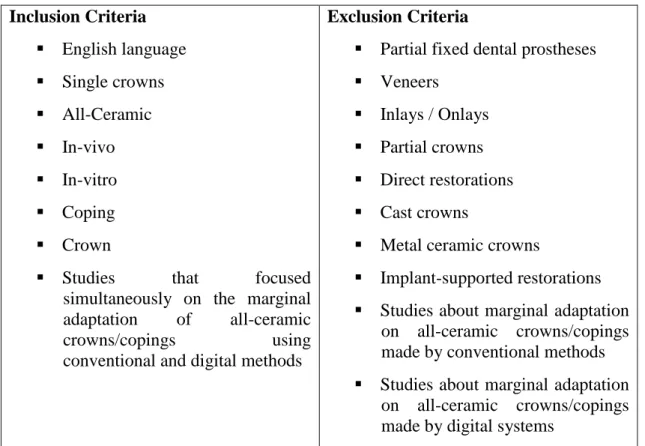
A research on PubMed electronic database was conducted for articles with the following combination of key words: (discrepancy or fit or gaps or adaptation) and (disilicate or ceramic) and (copings or crowns). The last search was conducted on April 25th of 2015. The studies considered for this research were in English from peer-reviewed publications that focused on the evaluation of the marginal fit or ceramic single crowns. Both in vivo and in vitro studies were included. Articles that focused on the marginal fit of restorations other than ceramic restorations were not considered for this review. This excluded studies of partial fixed dental prostheses, veneers, inlays, onlays, partial crowns, direct restorations, cast crowns, metal ceramic crowns, studies that focused only on the marginal adaptation of conventionally manufactured ceramic crowns/copings implant-supported restorations and studies that focused only on the marginal adaptation of ceramics manufactured by digital systems. Studies that measured the marginal fit of ceramic crowns manufactured by less popular or outdated systems were excluded. After the identification of an abstract for possible inclusion, the full text of the article was reviewed, and subject to the inclusion and exclusion criteria. The electronic search was also supplemented by manual searching through the references of selected articles.
The following data was extracted from each article: type of system studied, stage of completion of the restoration, sample size, type of finish line, occurrence of cementation, examination method and value of the absolute marginal discrepancy or marginal gap measured.
16 | P a g e
Table 1: Inclusion and Exclusion Criteria for the selection of the studies Inclusion Criteria English language Single crowns All-Ceramic In-vivo In-vitro Coping Crown
Studies that focused simultaneously on the marginal adaptation of all-ceramic crowns/copings using conventional and digital methods
Exclusion Criteria
Partial fixed dental prostheses Veneers
Inlays / Onlays Partial crowns Direct restorations Cast crowns
Metal ceramic crowns
Implant-supported restorations Studies about marginal adaptation
on all-ceramic crowns/copings made by conventional methods Studies about marginal adaptation
on all-ceramic crowns/copings made by digital systems
17 | P a g e
18 | P a g e
Among 525 reports identified through the electronic search, 15 were selected, all published between 2005 and April 2015. All the studies were conducted in vitro. An overall review of the data retrieved for marginal gap showed that 86.8% of the values measured were less than or equal to 120 µm described by McLean and Von Fraunhofer. The widest marginal gap measured was 180 µm, and the smallest was 17 µm. The selected articles displayed a significant heterogeneity in terms of experimental
protocols, which led to different discrepancies being measured, sometimes even for the same system. Four reports stated that the conventional method showed better MG values (PELEKANOS et al. 2009; MOUSLY et al. 2014; SULAIMAN et al. 1997; BESCHIT and STRUB 1999). Two studies reported no significant difference between the conventional methods and CAD/CAM (RINKE et al. 1995, ANADIOTI et al. 2013). Nine studies showed better results for the CAD/CAM groups (YEO et al. 2003; QUINTAS et al. 2004; BINDL and MORMANN 2005; KORKUT et al. 2011;
YUKSEL and ZAIMOGLU 2011; ASAPVAPANUMAS et al. 2013; NG et al. 2014; DEMIR et al. 2014; PIMENTA et al. 2015).
Seven studies measured the MG on crowns (RINKE et al. 1995; BESCHIT and STRUB 1999; YEO et al. 2003; ANADIOTI et al. 2013; NG et al. 2014; MOUSLY et
al. 2014; DEMIR et al. 2014), one did not report where they made the measurements
(SULAIMAN et al. 1997) and seven measured on copings (QUINTAS et al. 2004; BINDL and MORMANN 2005; PELEKANOS et al. 2009; KORKUT et al. 2011; YUKSEL and ZAIMOGLU 2011; ASAPVAPANUMAS et al. 2013; PIMENTA et al. 2015). Five studies used a finish line in shoulder (RINKE et al. 1995; BESCHIT and STRUB 1999; YEO et al. 2003; ASAPVAPANUMAS et al. 2013; DEMIR et al. 2014), seven used a chamfer (BINDL and MORMANN 2005; PELEKANOS et al. 2009; KORKUT et al. 2011; YUKSEL and ZAIMOGLU 2011; NG et al. 2014; MOUSLY et
al. 2014; PIMENTA et al. 2015) and 3 didn’t report the kind of finish line in their
preparations (SULAIMAN et al. 1997; QUINTAS et al. 2004; ANADIOTI et al. 2013). Nine studies presented their results without cementing the crowns/copings
(RINKE et al. 1995; SULAIMAN et al. 1997; YEO et al. 2003; PELEKANOS et al. 2009; ASAPVAPANUMAS et al. 2013; ANADIOTI et al. 2013; NG et al. 2014; MOUSLY et al. 2014; PIMENTA et al. 2015), three studies presented their results after cementation (BINDL and MORMANN 2005; KORKUT et al. 2011; YUKSEL and
19 | P a g e
ZAIMOGLU 2011) and three studies reported values of MG before and after
cementation (BESCHIT and STRUB 1999; QUINTAS et al. 2004; DEMIR et al. 2014). Four studies used direct examination with optical microscope (RINKE et al. 1995; SULAIMAN et al. 1997; YEO et al. 2003; QUINTAS et al. 2004), four studies used scanning with micro-XCT technology (PELEKANOS et al. 2009; MOUSLY et al. 2014; DEMIR et al. 2014; PIMENTA et al. 2015), two studies used cross-sectioning of the copings/crowns prior to the use of optical microscopes (KORKUT et al. 2011; YUKSEL and ZAIMOGLU 2011), two studies used scanning with stereomicroscope and photographs (ASAPVAPANUMAS et al. 2013; NG et al. 2014), one study used direct examination with SEM (BINDL and MORMANN 2005), one study used an epoxy replica of the marginal area and then measured the values using an optical microscope (BESCHIT and STRUB 1999) and finally, one study did not state the type of method used to make the measurement (ANADIOTI et al. 2013).
20 | P a g e
Article System Manufacturer
Sample Size State Finish Line Cemented Examination Method Marginal Gap (µm) Conclusion Rinke et al. 1995 In-Ceram Alumina (split-casting) Celay
(block In-Ceram Alumina)
10 Pm 10 Inc 10 Pm 10 Inc Crown S No In vitro Direct examination with optical microscope 45 33.5 45 38 No significant difference Sulaiman et al. 1997 Procera AllCeram IPS Empress I (veneering technique) In-Ceram Alumina (slip-casting) 30 30 30 NA NA No In vitro Direct examination with optical microscope 82 62 160.66 Significant difference between the 3 methods
21 | P a g e Beschnidt and Strub 1999 In-Ceram Alumina (split-casting) Celay (block Vita Celay)
Celay
(block In-Ceram Alumina)
10 10 10 Crown S No Yes No Yes No Yes In vitro Direct examination on an epoxy resin replica of the marginal area with optical microscope 60 82 99 117 78 91 Significant difference between CAD/CAM and conventional method Yeo et al. 2003 In-Ceram Alumina (slip-casting) Celay
(block In-Ceram Alumina)
30 29 Crown S No In vitro Direct examination with optical microscope 112 83 In-Ceram has worse MG than the Celay
Quintas et al. 2004 IPS Empress II In-Ceram Alumina (slip-casting) Procera AllCeram 60 60 60 Coping NA No Yes No Yes No Yes In vitro Direct examination with optical microscope 68 110 57 117 25 44 Procera copings presented better MG
22 | P a g e Bindl and Mormann 2005 In-Ceram Zirconia (Slip-casting) IPS Empress II Cerec InLab
(block In-Ceram Zirconia) DCS Précident Decim Procera AllCeram 12 12 12 12 12 12
Coping C Yes In vitro Direct examination with SEM 25 44 43 33 23 17 Procera copings presented better MG All crowns were within clinical acceptable values Pelekanos et al. 2009 WolCeram (in-Ceram Alumina) In-Ceram Alumina (slip-casting) Cerec inLab
(block In-Ceram Alumina) Celay
(block In-Ceram Alumina)
4 4 4 4 Coping C No In vitro Micro-XCT 34.86 21.08 55.09 139.27 Conventional methods presented the best results Cerec inLab presented clinically acceptable values
23 | P a g e Korkut et al. 2011 Cercon IPS Empress II Procera Zirconia 10 10 10
Coping C Yes In vitro Cross-sectioning and optical microscope examination 43.02 47.51 50.29 Best MG in the Cercon group Differences were statistically significant Yuksel and Zaimoglu 2011 Lava IPS e.max Press
12 12
Coping C Yes In vitro Cross-sectioning and optical microscope examination 82.7 92.6 Better MG results on the CAD/CAM group Asavapanumas et al. 2013
IPS e.max Press Cercon Lava 12 Coping S No In vitro Stereomicroscope and photographed 132.61 128.35 162.23 The LAVA group demonstrated the worst MG value The Cercon group presented the best results for
24 | P a g e
Anadioti et al. 2013
IPS e.max Press LAVA COS (block IPS
e.max CAD) 30 Crown NA No In vitro 75 74 There was no statistical difference between the two groups Ng et al. 2014
IPS e.max Press DMG (block IPS e.max
CAD) 15 15 Crown C No In vitro Stereomicroscope and photographed 74 48 CAD/CAM group showed better marginal
fit than the conventional
method
Mously et al. 2014
IPS e.max Press E4D (block IPS e.max Cad
30 Crown C No In vitro Scanning by micro-XCT 30.8 49.35 The heat-press group showed the best marginal crown adaptation Demir et al. 2014
Cerec InLab (block Vitabloc Mark II) Cerec InLab (block
In-Ceram 2000 AL) IPS e.max Press
10 10 10 10 10 10 Crown S Yes No Yes No Yes No In Vitro Micro-XCT examination 60 20 180 80 160 70 Cerec inLab with Vitablocs Mark II showed the best marginal adaptation
25 | P a g e
Pimenta et al. 2015
ZirkonZahn IPS e.max Press
5 5 Coping C No In vitro Scanning by micro-XCT 35.5 76.19 CAD/CAM showed the best results for
MG All the groups
were within clinically acceptable
26 | P a g e
27 | P a g e
Crown marginal fit is critical for success of the restoration; crowns with poor fit (marginal gap) are prone to failure due to micro-leakage, cement dissolution, and dental caries. In this paper, the fit of crowns was assessed based on the vertical gap measurement which was selected as the most critical factor of marginal gap while being the least susceptible to manipulation post-fabrication, as indicated by Holmes et al. in 1989. Horizontal discrepancies, such as crown overhangs, can be adjusted to some degree intra-orally, however, vertical MG can only be closed with luting cement, which is prone to dissolution (NG et al. 2014). For this reason, the vertical MG has the most clinical relevance and should be regarded as the most critical in crown margin evaluation.
Chairside CAD/CAM restorations are currently being used by a large number of dentists all-over the world; however, the accuracy of these systems is still questionable. The coping, and sometimes even the crown, could be completed without the use of a die through intraoral impression. However, the accuracy of the data acquisition varies according to the system’s various optical impression technologies and manufacturer’s (CONTREPOIS et al. 2013). Software technology and milling accuracy also suffers from differences between systems. In addition even for the same system, there can be substantial differences and variations among the measured values which can be explained by different experimental protocols used in each study as can be showed in this results.
The use of the conventional method of crown fabrication has been used for decades with proven long-term results for both longevity and survival. Careful selection of materials and meticulous fabrication procedures are necessary to compensate for expansions and contraction of the different materials involved in creating an accurately fitting crown (NG et al. 2014). However, the impossibility of controlling all the variables, combined with the propensity for human error, can result in poor marginal adaptation or even misfit. The use of a digital method seems to decrease the margin of error. Human intervention in the manufacturing of the crown could play a role according to the skill of the dental laboratory technician and the relative importance of his contribution (PELEKANOS et al. 2009).
28 | P a g e
The number of steps involved in the process is another important element because the probability of error increased with each additional step required For example, non-CAD/CAM systems required the use of a die spacer applied by a technician, and the traditional In-Ceram slip-casting system was described as singularly technique sensitive. (BINDL and MORMANN 2005).
Different measurement methods were used among the various studies, and this could have impacted results significantly. The first and most widely used method involved direct microscopic examination of the marginal area. Unfortunately, this method has two great disadvantages. First, identifying reference points to measure may prove difficult. Second, it may lead to projection errors (GROTEN et al. 2000). In the second method, cemented specimens were cross-sectioned, and the marginal area was then examined under a microscope. However, only a limited number of sections could be cut on any one specimen. These two techniques were also sometimes used to measure an epoxy resin replica of the marginal area instead of the area itself. This technique does not provide accurate results (CONTREPOIS et al. 2013). A third method involved creating a light bodied silicone replica of the gap between the crown and the tooth. This replica was then sectioned, and the zone that corresponded to the marginal area was observed by microscopy. This provided only a limited number of marginal gap measurements (BESCHIT and STRUB 1999) .The last technique used was x-ray microtomography. This innovative and nondestructive technique, which delivers 2-dimensional and 3-dimensional imaging of the space between the reconstitution and the die, and it can provide very close sections of the marginal area, which allows for a great number of measurement sites and for easy recognition of the critical distances. (PELEKANOS et al. 2009). This method has several advantages over other technologies including the 3-dimensional evaluation of the marginal and internal gaps. Furthermore, it is easy to perform, nondestructive, and more time efficient and accurate than other methods. The main disadvantages are radiation artifacts, which are caused by the differences in the coefficient of radiation absorption among the different materials and the difficulty in using luting agents because they have some radiopacity, which might affect the evaluation of the marginal gap. (MOUSLY et al. 2014).
Another important factor is that, a better approximation of clinical conditions may be reached by conducting measurements upon completion of the crown
29 | P a g e
(CONTREPOIS et al. 2013). In addition, measuring fit at the crown stage is necessary to compare single-layer crowns and multi-layer crowns.
Some studies also measured the marginal gap before and after cementation of the crown or coping. Measurements made solely after cementation do not allow for the determination of the relative impact on the marginal fit of cementation and of a system’s intrinsic precision (GROTEN et al. 2000) It is also more convenient to conduct measurements without cementing the crown as most studies did. Further evaluation of the capacity of all-ceramic conventional methods and CAD/CAM systems marginal adaptation after cementation, should be studied with different objectives and not mixed with non-cementing studies.
The type of finish line used in the studies varied from shoulder or chamfer. This variable also could have been responsible for the different results obtained between the conventional and digital methods or even inside the same system. Finish lines made in in vitro studies should be prepared in accordance to the most realistic clinical conditions. So with this in mind, the use of models that bear no relation to an actual tooth anatomy should be discontinued. Furthermore, finish lines that present some degree of curvature should be preferred since they can better simulate the presence of a gingival margin (CONTREPOIS et al. 2013).
Analysis of the results of this study suggests that more studies support the idea that digitally made crowns/copings can have better marginal adaptation values. However, most results seem to be well within clinical acceptable values (≤120 µm), which means digital or conventional made crowns are still two well supported options for fixed rehabilitation. Better protocols should be implemented to study the adaptation or CAD/CAM ceramic crowns versus conventional ceramic crowns. Although there are many studies made all over the years regarding marginal discrepancy on all-ceramic crowns, little has been done to clearly compare the digital method and the conventional method. This fact could be appointed to the fact that CAD/CAM is a relatively new technology that is slowly making its way to medical office because of its high costs, making the conventional method still a very low cost/benefit method, still preferred my most dentists in the world.
30 | P a g e
Conclusions:
Based on the results obtained, the digital method seems to be a legitimate alternative to the traditional methods. Analysis of the results of this study suggested that the digital method exceeds the standards of clinical acceptability and can sometimes surpass the vertical marginal fit of conventionally fabricated crowns.
Further studies are encouraged using standardized protocols as well as systems and techniques, in order to better evaluate the capabilities of this digital systems.
31 | P a g e
References:
1. Aboushelib M.N., Kleverlaan C.J.,Feilzer A.J. (2007). "Selective infiltration-etching technique for a strong and durable bond of resin cements to zirconia-based materials." J Prosthet Dent 98(5): 379-388.
2. Anadioti E, Aquilino SA, Gratton DG, Holloway JA, Denry I, Thomas GW, Quian F. 3D and 2D marginal fit of pressed and CAD/CAM lithium disilicate crowns made from digital and conventional impressions. Journal of Prosthodontics 23 2013 610-617.
3. Andersson M.,Oden A. (1993). "A new all-ceramic crown. A dense-sintered, high-purity alumina coping with porcelain." Acta Odontol Scand 51(1): 59-64. 4. Asavapanumas C, Leevailoj C. The influence of finish line curvature on the
marginal gap width of ceramic copings. J Prosthet Dent 2013;109:226-233. 5. Beschnidt SM, Strub JR. Evaluation of the marginal accuracy of different
all-ceramic crown systems after simulation in the artificial mouth. J oral Rehabil 1999;26:582-93.
6. Beuer F., Edelhoff D., Gernet W.,Sorensen J.A. (2009a). "Three-year clinical prospective evaluation of zirconia-based posterior fixed dental prostheses (FDPs)." Clin Oral Investig 13(4): 445-451
7. Beuer F., Schweiger J.,Edelhoff D. (2008). "Digital dentistry: an overview of recent developments for CAD/CAM generated restorations." Br Dent J 204(9): 505-511.
8. Bindl A, Mormann WH. Marginal and internal fit of all-ceramic CAD/CAM crown-copings on chamfer preparations. J Oral Rehabil 2005;32:441-7.
9. Bindl A., Luthy H.,Mormann W.H. (2006). "Strength and fracture pattern of monolithic CAD/CAM-generated posterior crowns." Dent Mater 22(1): 29-36. 10. Bindl A.,Mormann W.H. (2002). "An up to 5-year clinical evaluation of
posterior in-ceram CAD/CAM core crowns." Int J Prosthodont 15(5): 451-456. 11. Borom, M.P.; Turkalo, A.M.; Doremus, R.H. Strength and microstructure in
32 | P a g e
12. Cattani-Lorente M., Scherrer S.S., Ammann P., Jobin M.,Wiskott H.W. (2011). "Low temperature degradation of a Y-TZP dental ceramic." Acta Biomater 7(2): 858-865.
13. Contrepois M, Soenen A, Bartala M, Laviole O. Marginal adaptation of ceramic crowns: a systematic review. J Prosthet Dent 2013;110:447-454.
14. Cooper, L. Direct ceramic restoration using digital technologies. International dentistry Australian edition VOL. 7, NO. 1. 2011. 32-35.
15. Deany I.L. (1996). "Recent advances in ceramics for dentistry." Crit Rev Oral Biol Med 7(2): 134-143.
16. Demir N, Ozturk AN, Malkoc MA. Evaluation of marginal fit of full ceramic crowns by microcomputed tomography (micro-CT) technique. Eur J Dent 2014;8:437-44
17. Denry I.,Holloway J. (2010). "Ceramics for Dental Applications: A Review." Materials 3(1): 351-368.
18. Denry I.,Kelly J.R. (2008). "State of the art of zirconia for dental applications." Dent Mater 24(3): 299-307.
19. Denry I.,Kelly J.R. (2008). "State of the art of zirconia for dental applications." Dent Mater 24(3): 299-307.
20. Denry, I.L.; Rosenstiel, S.F. Phase transformations in feldspathic dental porcelains. In Bioceramics: Materials and Applications; Fischman, G., Clare, A., Hench, L., Eds.; The American Ceramic Society: Westerville, OH, USA, 1995; pp. 149–156.
21. Derand T., Molin M.,Kvam K. (2005). "Bond strength of composite luting cement to zirconia ceramic surfaces." Dent Mater 21(12): 1158-1162.
22. Dong, J.K.; Luthy, H.; Wohlwend, A. Heat-pressed ceramics: Technology and strength. Int. J. Prosthodont. 1992, 5, 9–16.
23. Duret F.,Preston J.D. (1991). "CAD/CAM imaging in dentistry." Curr Opin Dent 1(2): 150-154.
24. Ebert J., Ozkol E., Zeichner A., Uibel K., Weiss O., Koops U., Telle R.,Fischer H. (2009). "Direct inkjet printing of dental prostheses made of zirconia." J Dent Res 88(7): 673-676.
33 | P a g e
25. Et L.N. (2008). Computer Aided Design And Manufacturing, Prentice-Hall Of India Pvt. Limited
26. Fasbinder D.J. (2002). "Restorative material options for CAD/CAM restorations." Compend Contin Educ Dent 23(10): 911-916, 918, 920 passim; quiz 924.
27. Fasbinder D.J. (2010). "Digital dentistry: innovation for restorative treatment." Compend Contin Educ Dent 31 Spec No 4: 2-11; quiz 12
28. Fischer J., Stawarczyk B.,Hammerle C.H. (2008). "Flexural strength of veneering ceramics for zirconia." J Dent 36(5): 316-321.
29. Fradeani M., Redemagni M.,Corrado M. (2005). "Porcelain laminate veneers: 6- to 12-year clinical evaluation--a retrospective study." Int J Periodontics Restorative Dent 25(1): 9-17.
30. Fradeani M.,Redemagni M. (2002). "An 11-year clinical evaluation of leucite-reinforced glass-ceramic crowns: a retrospective study." Quintessence Int 33(7): 503-510.
31. Gardner FM. Margins of complete crowns—Literature review. The Journal of prosthetic dentistry 1982;48:396-400.
32. Giordano R.,McLaren E.A. (2010). "Ceramics overview: classification by microstructure and processing methods." Compend Contin Educ Dent 31(9): 682-684, 686, 688 passim; quiz 698, 700.
33. Gonzaga C.C., Cesar P.F., Okada C.Y., Fredericci C., Beneduce Neto F.,Yoshimura H.N. (2008). "Mechanical properties and porosity of dental glass-ceramics hot-pressed at different temperatures." Materials Research 11: 301-306.
34. Grasso JE, Nalbandian J, Sanford C, Bailit H. Effect of restoration quality on periodontal health. The Journal of prosthetic dentistry 1985;53:14.
35. Griffin J.D., Jr. (2013). "Tooth in a bag: same-day monolithic zirconia crown." Dent Today 32(1): 124, 126-131.
36. Groten M, Girthofer S, Probster L. Marginal fit consistency of copy-milled all-ceramic crowns during fabrication by light and scanning electron microscopic analysis in vitro. J Oral Rehabil 1997;24:871-81