UNIVERSIDADE DA BEIRA INTERIOR
Ciências Sociais e Humanas
Neuropsychotherapy: a preliminary review
Jaime Manuel Estorninho Apolinário
Versão Definitiva Após Defesa Pública
Dissertação para a obtenção do grau de Mestre em Psicologia
Clínica e da Saúde
Orientador: Prof. Doutor Luis Alberto Coelho Rebelo Maia Coorientador: Doutor Jorge Evandro de Araújo Alves
Acknowledgements
This section will be written both in English and in Portuguese.
First, I would like to thank Professor Luis Maia for challenging me to write my dissertation about the topic of neuropsychotherapy and for guiding me through this process. I would also like to thank my family, and mainly my parents and grandparents. Without their unconditional love and support, I would not be able to get through this. To my friends, especially to Paul Lima and Michael Köster for the linguistic aid, and to João Bernardo, Miguel Santos, and Fábio Monteiro, for the constant feedback with wisdom and good humor in equal parts. To Cláudia, for being there for me throughout the whole process. Her patience is unmatched. Finally, to Doctor Jorge Alves, for accepting to co-orientate this dissertation, and for being like a mentor to me during the last few months.
E agora, em português, porque a minha avó não compreende inglês.
Antes de mais, gostaria de agradecer ao Professor Doutor Luis Maia por me lançar o desafio de escrever a minha dissertação de mestrado sobre a neuropsicoterapia, e por me ter orientado durante todo o processo. Gostaria também de agradecer à minha família, mas principalmente aos meus pais e aos meus avós pelo amor e apoio incondicional que me dão, sem os quais nunca teria conseguido levar este processo a termo. Aos meus amigos, especialmente ao Paul Lima e ao Michael Köster pelo apoio com alguns termos técnicos em alemão, e ao João Bernardo, ao Miguel Santos e ao Fábio Monteiro, pelo suporte constante que tinha tanto de sabedoria como de bom humor. À Cláudia, por estar sempre comigo durante este processo. A paciência dela não tem igual. Finalmente, ao Doutor Jorge Alves, por ter aceite o convite para coorientar esta dissertação, e por ter sido como um mentor para mim ao longo destes últimos meses.
Resumo
O termo neuropsicoterapia tem dois significados: a psicoterapia como ferramenta para a reabilitação neurológica (Ellis, 1989; Judd, 1999) e a psicoterapia informada pelas neurociências (Grawe, 2007). Sendo um conceito relativamente recente, ainda não existia nenhuma revisão da literatura com uma abordagem sistemática à pesquisa. Nesta dissertação pretende-se dar resposta a essa lacuna, sendo efetuada uma revisão da literatura com uma abordagem sistemática à pesquisa sobre este tópico. Foram abrangidas seis bases de dados científicas (EBSCO, B-on, MEDLINE/PubMed, PsycINFO, Web of Science e Scielo). Oito artigos preencheram os critérios definidos para inclusão nesta revisão. Os artigos foram analisados cronológica, geográfica e tematicamente, tendo posteriormente sido discutidos os resultados.
Palavras-chave
Abstract
The term neuropsychotherapy has two distinct meanings: Psychotherapy as a tool for neurological rehabilitation (Ellis, 1989; Judd, 1999) and psychotherapy informed by neurosciences (Grawe, 2007). Being a relatively new concept, there was not any review of the literature with a systematic approach to article search yet (to the extent of our knowledge). This dissertation intends to fill that gap, by reviewing articles on the topic across six scientific databases (EBSCO, B-on, MEDLINE/PubMed, PsycINFO, Web of Science and Scielo). Eight articles fulfilled the inclusion criteria defined for this review. The existing literature is classified in chronological, geographical, and content-related terms. The dissertation ends with a discussion on the existing literature.
Keywords
Index
1. Introduction 1
2. Neuropsychotherapy 2
2.1. Neuropsychotherapy as a neurological rehabilitation strategy 2
2.2. Neuropsychotherapy as a neurologically informed general psychotherapy 4
3. Objectives 7 4. Methods 7 5. Results 9 6. Discussion 17 7. References 19 8. Annex 22
Figure List
Figure 1 – Selection process flowchart
Table List
Table 1 – Geographical distribution of publications Table 2 – Studies’ Summary
Acronyms
ADHD Attention Deficit and Hyperactivity Disorder
APA American Psychological Association
CAARS Conners Adult ADHD Rating Scales
CNS Central Nervous System
DMN Default Mode Network
EMDR Eye-Movement Desensitization and Reprocessing
fMRI Functional Magnetic Resonance Imaging
MAP Mindfulness Awareness Practice
PE Psychoeducation
PTSD Post-traumatic Stress Disorder
1. Introduction
George Bush Sr., the former president of the United States of America, during his presidency, declared the decade of 90 as the decade of the brain. He made it so both by rising public investment in neuroscience investigation to unprecedented values for his time and by increasing the general awareness to this scientific field. In no moment in recorded history has there been this much interest in this area, which translates to both financial and scholarly efforts for the pursuit of knowledge and understanding of our nervous system, particularly in the central nervous system (CNS) structures (Jones & Mendell, 1999). This brought advances in the field that, among other things, allow us to understand that behavior, in all its forms and manifestations, origins in CNS activity. In turn, this points out the importance of a good neuroanatomic theoretical foundation, as well as a solid grasp in some of the basic principles of neural functioning in the understanding of human behavior (Kandel, Schwartz, Jessel, Siegelbaum & Hudspeth, 2013). This and the surging of new techniques for brain study (particularly, neural imaging techniques) gave us non-invasive access to aspects of neural structure and functioning, which might contribute to psychotherapeutic reasoning. Grawe (2007, p. 3) states that if all mental processes are grounded in neural processes, by analog logic changes in mental processes should be linked with significant changes in neural processes. LeDoux (2002) affirms that psychotherapy, being essentially a learning process, is a way to rewire the brain; therefore, psychotherapy uses biological mechanisms and neural underpinnings to treat patients with mental illnesses. Kandel and colleagues (2013) also defend this stance, and state that neuroimaging methods may be used not only in mental illness diagnosis but also in the assessment of the effectiveness of psychotherapy strategies and techniques.
In line with all that was referred above, psychology and neuroscience are becoming increasingly interconnected, as demonstrated by the creation of particular fields of research such as cognitive or affective neurosciences. Therefore, the number of publications that aim to explain or at least provide a correlation between concepts of both fields has grown during the last few decades. Consequently, psychotherapy has also followed this trend, and studies about the effect of the various psychotherapeutic approaches on the nervous system are being published
2. Neuropsychotherapy
Some authors, influenced by this surge of studies on the neural basis of psychotherapy, have created several psychotherapeutic intervention models based on the contributions of neuroscientific knowledge to the understanding of human behavior. At first, these models were designed only taking in mind the psychotherapeutic intervention in neurological patients. Later, newer models were created aiming interventions with pathologies deemed of the psychiatric source. Eventually, all this effort led to the creation of a relatively new psychotherapy field: Neuropsychotherapy (Ellis, 1989; Grawe, 2007).
Neuropsychotherapy is a psychotherapeutic approach that can be defined as an approach to psychotherapeutic intervention that draws concepts, strategies, and techniques both from psychology and neuroscience; using neuroscientific knowledge and psychotherapy efficacy studies in order to maximize its efficacy (Grawe, 2007). The idea of having a neurologically informed psychotherapy can be retraced to Freud (1895, cit. in Walter, Berger & Schnell, 2009), however, due to the technological limitations of his time Freud eventually abandoned that idea in favor of the development of the psychoanalytic method (Kenny, 2016). Neuropsychotherapy currently follows two different major working definitions: psychotherapy as a neurological rehabilitation strategy (e.g. Ellis, 1989; Judd, 1999; Laaksonen & Ranta, 2013), and general psychotherapy informed by neuroscientific knowledge (e.g. Grawe, 2007; Walter, Berger & Schnell, 2009). Even though most literary sources usually establish a division between these definitions, both are based on the principle referred above, with the main difference being the population to which the intervention is aimed.
2.1. Neuropsychotherapy as a neurological rehabilitation strategy
Psychotherapy has been used as a rehabilitation strategy in neurologically impaired patients for about half a century, and its main function in this context is to ameliorate the cognitive, emotional and social problems that arise from the different types of neurological dysfunction (Judd, 1999; García-Molina, Roig-Rovira, Enseñat-Cantallops & Sánchez-Carrión, 2014). However, due to the lack of a core theoretical model, psychotherapeutic intervention for neurological rehabilitation outcomes have failed to produce significant positive outcomes
As an example of a proposed core model, Warren and Judd (2019) affirm that one can take into account Suchy’s (2011) model. Suchy, in an attempt to summarize emotional processing, created a model that includes five components, based on both psychological concepts and neuroanatomical knowledge: Reflexive reactions, triggered responses, emotional communication, emotional regulation, and emotional awareness.
Reflexive reactions include fight or flight responses, appetitive behaviors, arousal, and involuntary emotional expressions. This component is primarily mediated by the autonomic nervous system and endocrine systems (Suchy, 2011).
Triggered responses refer to fear, disgust, anger, and several forms of attraction. Sensory stimuli appear to have two main routes before being translated into a reaction: a “fast route”, that goes through the thalamus and the primary sensory cortex, which enables a nearly immediate response; and a “slow route”, which uses the secondary and tertiary sensory cortices and the hippocampus, allowing an evaluation of the stimulus content. Disruptions in this component may include overreactions, reduced reactions, and changes to the learning process (Suchy, 2011).
Emotional communication includes both emotional perception and emotional expression. The right cortical hemisphere is mainly responsible for emotional perception. Disruptions in the perceptual system may result in misinterpretation of the emotional content of non-verbal communication. Emotional expression involves frontal lobes and various subcortical structures. Disruptions in this system can cause symptoms that may lead to misinterpretation of the patient’s emotional state, (e.g. aprosodia) (Suchy, 2011).
Emotional regulation mobilizes several different brain structures, such as the posterior cortex in the evaluation of situations and contexts and the frontal lobes and basal ganglia involved in initiating and inhibiting responses. Disruptions in this component may cause abulia, emotional lability and compulsive and/or addictive behavior (Suchy, 2011).
Emotional awareness refers to both self-awareness and awareness of others' emotions. The neuroanatomy of emotional awareness is not fully understood yet, but it involves many parts of the brain, such as the mirror-neuron system and the superior parietal cortex. The main concept associated with emotional awareness is empathy, which has cognitive and emotional components associated with portions of the dorsolateral prefrontal cortex. Anosognosia or alexithymia might be symptoms of disruptions in this system (Suchy, 2011).
Suchy's model is a prime illustrative example of a conceptual neuropsychotherapeutic model that correlates neural substrates and affected functions (Warren & Judd, 2019). However, a
the patient, and it is in this aspect that neuropsychotherapy as a rehabilitation strategy differentiates itself from classic neuropsychological rehabilitation (Warren & Judd, 2019).
2.2. Neuropsychotherapy as a neurologically informed general
psychotherapy
Neuropsychotherapy as a broader approach to psychotherapy (as opposed to the previous definition), is defined by being an approach that attempts to provide a theoretical foundation for psychotherapy based on validated and effective psychotherapeutic processes, as well as on neurological knowledge that may impact mental functioning (Grawe, 2007). Dahlitz (2015) further states that neuropsychotherapy is a neurobiologically informed framework that aims to view thought and behavior as a phenomenon emerging from motivational schemata developed for the goal of preserving or enhancing basic psychological needs.
Despite this more general definition, several conceptual core-models for neuropsychotherapy have been proposed, the most notable being Grawe’s consistency-theoretical model (Grawe, 2007).
Grawe, drawing from Epstein’s (1998) cognitive-experiential self-theory and Deci and Ryan's (2000) self-determination theory, developed a theoretical model of mental functioning that he coined as “consistency-theoretical model”. In this model, Grawe took the four basic human psychological needs differentiated by Epstein (Orientation/control, pleasure/pain avoidance, attachment, self-esteem enhancement) and proposed that in order to satisfy and avoid violation of basic needs every individual develops motivational schemas. In turn, the individual's motivational schemas mainly direct his or her experience and behavior and guide the person throughout his or her life. These motivational schemas can be either of approach or avoidance nature, and depend on the person's developmental course (i.e. if the individual grows in an environment that fulfills his or her needs, his or her schemas will be mainly of an approach nature; if the environment is perceived as threatening the individual will develop mainly avoidance schemata).
By consistency, Grawe refers to “the agreement or compatibility of simultaneously transpiring neural/mental processes” (2007, p.168). Therefore, an organism’s state can be considered “consistent” by Grawe’s definition when there’s no conflict between the different neural/mental processes, which is to say when the motivational schemas previously defined succeed in achieving the fulfillment of the individual's basic needs, and therefore, his or her
previously used notions: Rossouw shifts the focus from motivational schemas to the importance of addressing the basic human needs when working with clients and introduces the need for safety as a primary need. According to Rossouw (2014, cit. in Kostyanaya, 2015), the need for safety is the key to the facilitation of neural proliferation, which translates into an increased approach motivational schemata and more adapted avoidance schemata; and compromised safety may cause neural protection and enhanced avoidance motivational schemata. Kostyanaya (2015) further states that in Rossouw's model the need for safety is activated through three of the needs identified by Grawe (orientation/control, pleasure/pain avoidance, and attachment). Rossouw's integrated theoretical model of neuropsychotherapy also differs from Grawe's by proposing that the concept of self and self-esteem is a higher order construct that results from neural patterns related to the primary needs and their interaction with the environment, may it be enriched or compromised. Therefore, in Rossouw's (2014, cit. in Kostyanaya, 2015) view, the self is a higher order construct which both strives to fulfill the basic needs and results from their culmination.
Ward, Delrue, and Plagnol (2017) also present a theoretical model in the light of neuropsychotherapy. According to the authors, it is possible to use cognitive notions of representation from neuroscience to explain how each person develops a cognitive internal world, designed as “representational space”. This model is compatible with traditional notions of psychotherapeutic practices. For example, certain defense mechanisms, like denial or repression, may constrain the individual’s representational space over time.
Using the example of post-traumatic stress disorder (PTSD), the authors use this model to explain several issues that have not been completely explored (Plagnol, 2004, cit. in Ward, Delrue & Plagnol, 2017). Those issues are the fact that in cases of trauma the memory of the traumatic event does not fade with time, as it tends to happen with other memories, and the fact that sometimes there is a delay between the event and the symptoms that trauma patients normally exhibit. Plagnol (2004, cit. in Ward, Delrue & Plagnol, 2017) states that all representation derives from sensory experience. The human being then codes the experiences via symbols and language, connecting them into the representational space. This, in turn, enriches the representational space, creating a deep, complex and rich personal internal world. The author also proposes that this internal world is relatively consistent over time. Similarly to Grawe’s (2007) concept of incongruence, Plagnol (2004, cit. in Ward, Delrue & Plagnol, 2017) suggests that divergent fragments of the representational space, which may conflict with other codified experiences, may raise a degree of tension. Conway, Singer, and Tagini (2004) propose
To explain the previously mentioned issues of the trauma strengthening and delay through time, Ward, Delrue, and Plagnol (2017) suggest that the possibility of death or critical harm that often accompanies traumatic events forces the individual to face the perspective of death. This perspective and the concept of non-existing are alien to most of the people, conflicting with the majority of the ordinary fragments and notions that compose the average representational space. If any of those fragments or representations are active at the time of the flashback, the individual creates an association between the said representations and the traumatic event, therefore “contaminating” the original clean representation. Over time, conflict and incongruence infect increasingly more of the representational space, which explains both the strengthening phenomenon and the delay (Ward, Delrue & Plagnol, 2017).
Besides the referred models, Walter, Berger, and Schnell (2009) also proposed a working definition for neuropsychotherapy in Grawe’s (2007) sense (i.e. psychotherapy referencing primarily neuroscientific evidence). In their perspective, the authors suggest a definition that encompasses and captures neuropsychotherapy as a field of applied research. According to the authors, the aim of neuropsychotherapy should consist in three separate, although interrelated, aspects: The identification of neural mediators and functional targets of psychotherapeutic effects, the determination of new therapeutic routes using neurotechnology, and the design of psychotherapeutic interventions based on neuroscientific knowledge (Walter, Berger & Schnell, 2009).
About the first aspect referred (the identification of neural mediators and functional targets of psychotherapeutic effects), the authors give the example of studies of basic learning mechanisms, specifically the fear conditioning and extinction in psychotherapy. Animal studies show that the extinction of conditioned fear responses happens due to active inhibition of amygdala reactions by the orbitofrontal cortex (Maren & Quirk, 2004). Fonzo et al. (2017) demonstrated that the inhibition of amygdala through the dorsolateral prefrontal cortex can be achieved with prolonged exposure therapy. This study shows several similarities with Maren and Quirk's (2004) animal studies and validates the applicability of the aforementioned aspect. About the second aspect (the determination of new therapeutic routes using neurotechnology), Walter, Berger, and Schnell (2009) refer as an example the use of neurofeedback as a direct route to functional targets, by the altering of psychopathological states using brain signals as feedbacks. Several studies explore the utility of functional magnetic resonance imaging (fMRI) in psychotherapy aiming several pathological symptoms, such as the relieving of
obsessive-indeed an effective, evidence-based technique for the treatment of PTSD, which validates the last aspect referred by Walter, Berger, and Schnell (2009) in their definition of Neuropsychotherapy.
However, some authors appoint some limitations to this approach to psychotherapy. Richter (2012) affirms that a neurobiological view of the human being may cause the psychotherapist to view the person as a "psychophysiological state", rather than a person that is a part of various complex social systems and fulfills different social roles, while interacting with other people that also are part of various social systems. Richter further adds that the decision-making process and the orientation of psychotherapy depend on reasons of interpersonal motives that the patient may have, and a neurobiological view might override this approach, in favor of a more “machinist” one, based on the patient’s neurological functioning. Aligning with Richter’s view, Fuchs (2004) states that the neurosciences may prove futile in explaining from a neurobiological perspective the interpersonal processes that occur during psychotherapy. Gauggel (2006) presents several arguments in favor of the neuropsychotherapeutic perspective, but alerts to the possible neglect of the psychosocial aspect of psychotherapy; stating that human behavior and experience have a role in shaping a person’s self that goes beyond the biological, including also the social and the cultural aspects.
3. Objectives
This study aims to characterize and provide a summary of the existing literature about neuropsychotherapy across mainstream databases (EBSCO, B-on, Medline/PubMed, PsycINFO, Web of Science and Scielo), as well as clarify possible courses for future research. The characterization will include an analysis of the chronological and geographical (according to the authors' institutions) distribution of publications. The studies will also be described and characterized concerning its content via a studies' summary table. To the extent of our knowledge, there is no other literature review with a systematic approach to the search process that includes quantification and the temporal evolution of research about this particular topic.
- The publication must be a scientific article. Other formats (e.g. conference posters) will not be included;
- The article must be available in one of the above-mentioned databases;
- The article must include the word “neuropsychotherapy” in the abstract and/or in the title, and the article main focus must either be neuropsychotherapy or an intervention that includes neuropsychotherapy, and it must specifically refer to that;
- The article must be published in a peer-reviewed scientific journal.
The following research terms were used in all databases: “Neuropsychotherapy”, “Neuropsychotherapeutic”, “Neuropsicoterapia”, and “Neuropsicoterapêutico”.
Using EBSCO, the following sub-databases were selected: Academic Search Complete, Psychology and Behavioral Sciences collection, Cochrane Database of Systematic Reviews, and MEDLINE Complete. The search was further refined by selecting the option “Search all my search terms”, deselect expanders, and limit results to peer-reviewed journals. This search resulted in thirteen (13) entries.
Using B-On, the search was developed by selecting “Advanced Search”, unchecking “Also search within the full text of the articles” and “Apply equivalent subjects”, and checking the option “Peer Reviewed”. The search resulted in 55 database entries.
In Medline/Pubmed, besides using the research terms mentioned above, we selected the option “search in title/abstract”. The search wielded eight (8) search results.
While using PsycInfo, the search was conducted after unselecting “Include related terms” and selecting the option “peer-reviewed journals”. The search wielded thirty (30) database entries. In Web of Science and Scielo, we did not select any advanced search options. Web of Science wielded thirty-two (32) search entries and Scielo wielded zero (0).
The search wielded in total a hundred and thirty-eight (138) results.
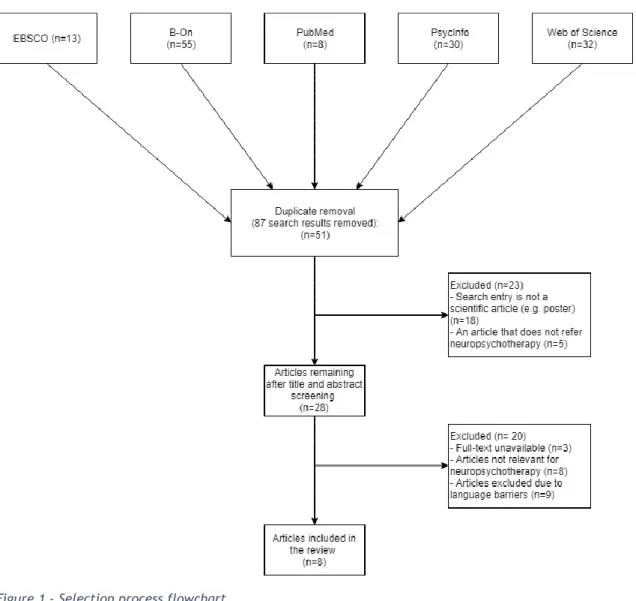
Due to duplicate removal, eighty-seven (87) entries were removed and fifty-one (51) entries remained. After title and abstract screening, twenty-eight (28) database entries remained. Twenty-three (23) search results were excluded; of which eighteen (18) were not a scientific article and five (5) did not refer neuropsychotherapy at all.
Of the twenty-eight (28) remaining entries, three (3) were excluded because the article full-text was not available (the search entries referred an article, but after a thorough search and contacting the authors, no response was obtained and still no article was found), eight (8)
table 1) distribution of the publications. The articles also were analyzed and classified by their content (see table 2).
5. Results
After a thorough search through the main databases, eight studies were included in this review. The chronologic analysis (see Figure 2) indicates that the number of articles has been increasing since the first article published (Jønsson, Korfitzen, Heltberg, Ravnborg & Byskov-Ottosen, 1993), with most of the articles being published after 2005 (6 articles).
Figure 2 - Chronological Distribution of Publications
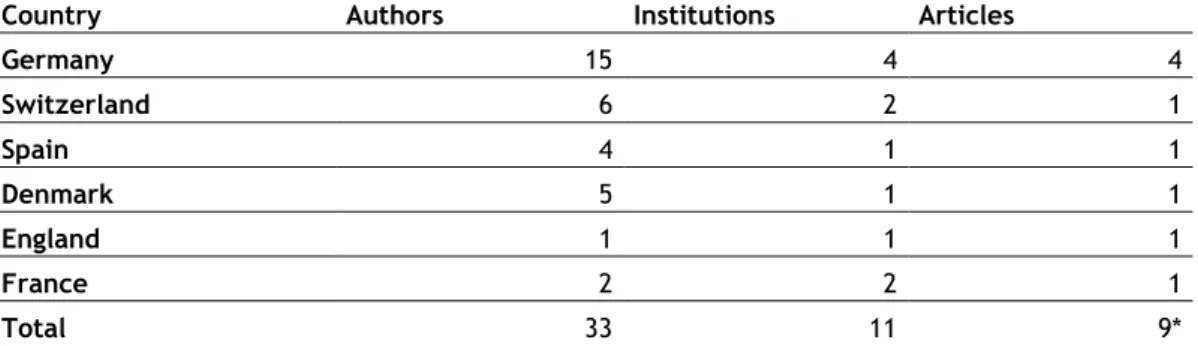
The geographical analysis (see table 1) shows that most articles (4 articles) are published by authors (15 authors) associated with German institutions (4 institutions). There are also articles published by Swiss (6 authors, 2 institutions and 1 article), Danish (5 authors, 1 institution and 1 article), Spanish (4 authors, 1 institution and 1 article), French (2 authors, 2 institutions and 1 article), and English (1 author, 1 institutions, and 1 article) institutions.
Table 2 shows a summary of the various studies included in this review. Of the eight studies, three can be considered primary literature and five secondary By primary literature, we refer to articles that present original research (i.e. randomized controlled trials) (Galvan & Galvan, 2017). Secondary literature refers to the scientific communications that review original research (i.e. literature reviews) (Carter, Griffin & Carter, 2006).
All three primary literature studies included in this review are clinical studies that focus on the effectiveness of therapeutic strategies that may be considered neuropsychotherapeutic. Of the three primary literature articles, two (Bachmann et al., 2018; Jønsson et. al, 1993) are randomized controlled trials (RCT) and one (Hofer et al., 2012) is a single-group clinical study. Bachmann et al. (2018) conducted a randomized clinical trial to test and compare the
0 1 2 3 4 5 6 7 8 9 1990-1994 1995-1999 2000-2004 2005-2009 2010-2014 2015-2019
single-group design study, also matching the Judd’s (1999) definition of neuropsychotherapy. All the studies’ results, conclusions, and limitations are stated in table 2.
The secondary literature articles consist of five literature reviews, all of which discuss neuropsychotherapy. Bachmann, Lam, and Phillipsen (2016) discussed the neural effects of mindfulness practice and possible ways the said effects could be harnessed in therapy. The authors also reviewed eight studies, five of which focus on neuroimaging in mindfulness practitioners and three on clinical trials of mindfulness-based intervention programs. Fuchs (2004) disserted about neurobiological research relevant for psychotherapy and alerted to some conceptual problems that may arise from this new approach. García-Molina et al. (2014) disserted about the utility of neuropsychotherapy as a brain rehabilitation tool and discussed several theoretical aspects of psychotherapy with brain-injured patients. Walter, Berger, and Schnell (2009) reviewed several studies related to the concept of neuropsychotherapy and proposed a novel working definition of neuropsychotherapy (as discussed above). Ward, Delrue, and Plagnol (2017) also reviewed several articles related to neuropsychotherapeutic theoretical models, and proposed a new one, using trauma as an example and referring several illustrative cases.
Table 1 – Worldwide geographical distribution of publications
Country Authors Institutions Articles
Germany 15 4 4 Switzerland 6 2 1 Spain 4 1 1 Denmark 5 1 1 England 1 1 1 France 2 2 1 Total 33 11 9*
*The total number of articles (9) exceeds the actual number (8) because one of the articles is the result of a collaboration between English and French institutions.
Table 2 – Studies’ summary
Article Source type Article description Sample (if applicable) Results/Conclusions Notes Bachmann et al., 2018 Primary literature Randomized and controlled trial to compare intervention strategies in Attention-Deficit/Hyperactivity Disorder (ADHD) in adults, namely a mindfulness-based intervention program (Mindfulness Awareness Practice, or MAP), and psychoeducation (PE), with an assessment of therapy effectiveness with a working memory task (n-back task) during fMRI. ADHD symptoms were also assessed via the Conners Adult ADHD Rating Scales (CAARS).
- Sample: n=42;
- 21 participants per group; - 1 control group (PE); - 1 experimental group (MAP); - Sample age: 19 to 61 years; - Participants inclusion criteria: - Diagnosis of ADHD combined subtype or inattentive subtype (DSM-IV criteria);
- Participants were not doing pharmacological therapy for ADHD (stimulants or atomoxetine) 3 months before and during study participation;
- Participant I.Q. > 85;
- Participants were also excluded if they matched the criteria for schizophrenia, bipolar disorder type I, or had any of the following characteristics: substance abuse dependence, autism, acute suicidality, self-injurious behavior or neurological disorders;
- Participants must not have any MRI-specific contraindications.
- Both groups have shown improvement in n-task performance. However, no significant main effect of therapy and no significant interaction effect were found.
- Both the CAARS Blind Observer Rating and the CAARS self-rating indicated that there was a
significantly lower level of ADHD symptoms in both groups. Again, no effect of therapy nor interaction effect was found in between-subjects comparison.
- The experimental group manifested higher activation in several areas when comparing post- with pre-intervention. These areas were mainly located in the bilateral inferior parietal lobule, right posterior insula, and right precuneus.
Study limitations mentioned by the authors:
- The study results were based only in an exploratory analysis, so there is no clear cause for the improvement after therapy;
- The duration of the intervention program (8 weeks) may not be enough to exert a significant neurobiological effect;
- The fMRI results should be carefully interpreted, since mindfulness practice may activate different brain areas depending on the practitioner’s experience.
Article Source type Article description Sample (if applicable) Results/Conclusions Notes Hofer et al.,
2012
Primary Literature
Single group clinical study of a
neuropsychotherapeutic intervention program for post-stroke fatigue with pre- and post-intervention assessment with a self-assessment questionnaire for mental fatigue (SQfMF).
- Sample: n=8;
- Sample by gender: 5 males, 3 females;
- Sample age: 20-61 years (Mean: 48);
- Stroke subtypes: 2 hemorrhagic and 6 ischemic strokes.
- Time since stroke: 4 to 65 months (Mean: 18 months).
- A significant difference emerged from the end-therapy to the pre-therapy assessment with a marked decrease of fatigue;
- The study participants claim to have attained the goals formulated at the beginning of the intervention.
The authors mention the following limitations: - Small sample size and lack of a control group;
- The fact that this intervention program is included in a larger neuropsychotherapeutic program, therefore not being possible to distinguish the effects of this specific intervention from the effects of the larger program; - The use of self-report measures both during the intervention and in the pre- and post-intervention assessment. Jønsson, Korfitzen, Heltber, Ravnborg & Byskov-Ottosen, 1993 Primary Literature Randomized controlled clinical trial of an intervention program involving aimed cognitive stimulation and
neuropsychotherapy vs. non-specific cognitive
stimulation in patients with multiple sclerosis (MS).
- Sample: n=40;
- Sample by gender: 19 females and 21 males;
- Mean age: 44,5 years (SD=8,3); - Experimental group (intervention program) n=20;
- Control group (non-specific cognitive stimulation) n=20; - Inclusion criteria: Participants must match the criteria for an EM
Results:
- The experimental group registered improvements in visual perception and
visuospatial memory, as well as in depressive symptoms. This group has also reported lesser anxiety, although the results were not statistically significant.
The authors acknowledged the following limitation:
- The cognitive assessment battery used may have not been ideal for assessing the full extent of the treatment effects.
Article Source type Article description Sample (if applicable) Results/Conclusions Notes Bachmann, Lam
& Phillipsen, 2016
Secondary
literature Narrative review of the effects of mindfulness practice in neural activation and the effectiveness of mindfulness-based intervention programs for ADHD adult patients.
- 8 studies reviewed - 5 neuroimaging studies in mindfulness practitioners; - 3 clinical studies of ADHD mindfulness-based intervention.
Neuroimaging studies results shown increased activation in prefrontal and parietal areas in novice practitioners, and reduced activation of some prefrontal and parietal areas, as well as in the default-mode network (DMN), and increased activation of striatum, insula, and anterior cingulate cortex in advanced
practitioners.
Clinical studies shown reduced ADHD symptom manifestation, especially in hyperactivity, impulsivity, and attention control.
The authors mention some limitations in the reviewed studies, mainly about the sample sizes, in the study control conditions, and the randomization techniques. Furthermore, the authors also address the need to study eventual
correlations between neural activation and clinical improvement in this type of intervention program.
Fuchs, 2004 Secondary Literature
Literature review about neurobiological research relevant for psychotherapy and discussion of some conceptual problems associated with this new approach.
Non-applicable The author summarizes the review by affirming that there are all kinds of positions in the antagonism-endorsement about this particular paradigm. The author goes on by saying that the research at the time of the writing was still preliminary. The author also acknowledges the possibility of using neurobiological models to improve the design of
psychotherapeutic interventions. The author finishes by warning that it may be futile to expect that the interpersonal Table 2 - Studies' summary (continuation)
Article Source type Article description Sample (if applicable) Results/Conclusions Notes García-Molina, Roig-Rovira, Enseñat-Cantallops & Sánchez-Carrión, 2014 Secondary Literature
Literature review about neuropsychotherapy as a tool in brain damage rehabilitation, through the description of the
theoretical aspects of psychotherapy with neurological patients
Non-applicable The authors conclude that the acknowledgment of the need for neuropsychotherapy as a
neurorehabilitation strategy between neurological healthcare professionals has grown over the last years. The authors also advance that the aim of neuropsychological rehabilitation goes beyond recovery and maintenance of the patients' cognitive functions, with its true aim being the improvement of quality of life, with
neuropsychotherapy being a fundamental tool for such goal. Walter, Berger
& Schnell, 2009 Secondary literature Narrative review about the concept of neuropsychotherapy, with a proposal of a working definition for the said concept, a review of neuroimaging studies of psychotherapy and a discussion about the ethical issues of this possible field of research and clinical practice.
Non-applicable The authors conclude that
neuroscience is being integrated with psychotherapy, and suggest a working definition for neuropsychotherapy consisting of the identification of neural mediators and functional targets, determination of therapeutic routes to the said targets, and designing the referred therapeutic routes. The authors also point out that the discussion about
neuropsychotherapy should not only include its possible merits but also its limitations.
Table 2 - Studies' summary (continuation)
Article Source type Article description Sample (if applicable) Results/Conclusions Notes Ward, Delrue &
Plagnol, 2017 Secondary literature Literature review to describe the neuropsychotherapeutic perspective applied to practical psychotherapy using the example of trauma, with a
presentation of illustrative clinical cases.
- Sample: n=4
- The described cases match the criteria for PTSD;
- Female 91 years old patient; - Female 92 years old patient; - Female 93 years old patient; - Male 91 years old patient.
The authors conclude by summing up the various theoretical strands that compose the theoretical frame of
neuropsychotherapy, and through the example of trauma, they explain how the integration of
neuroscientific knowledge might answer some questions about the etiopathogeny of disorders.
6. Discussion
In the present work, we reviewed all the studies related to neuropsychotherapy available in the mainstream databases (namely EBSCO, B-on, Medline/Pubmed, PsycINFO, Web of Science and Scielo). After the search and screening process, eight articles were eligible to be included in the review.
Through the chronological distribution of publications on the topic of neuropsychotherapy, one can observe that the number of publications has been on the rise for the last few years, which suggests an increase in the interest in this topic. This is consistent with Goss’s (2016) findings, and with the seemingly rising trend of the neuroscience of psychology studies.
The geographical distribution shows that the majority of the research is being conducted in Germany. This may be because Grawe’s (2007) work, Neuropsychotherapy – How neurosciences
inform effective psychotherapy, was first published in German, and therefore it may have
captured the attention of the German researchers due to geographical proximity and linguistic compatibility.
Of the eight included articles, three were primary literature sources, namely two RCT (Bachmann et al., 2018; Jønsson et al., 1993) and one clinical study with single-group design (Hofer et al., 2012), and five were secondary literature sources (mainly literature reviews). The summary of the included studies can be consulted in table 2.
The primary literature studies included represent the only intervention procedures described as neuropsychotherapy in scientific databases. However, it should be considered that there are many other interventions described that may fit the criteria for being considered neuropsychotherapeutic in nature, but are not described as such (e.g. neuromodulation-assisted therapy). It is important to clarify that the articles referring to those interventions were not included in this review since its purpose was to characterize the available scientific literature that clearly identified neuropsychotherapy (i.e. described by the authors as neuropsychotherapy).
In this study, there are several limitations to be taken into account. Due to language barriers, several articles were excluded from this review (eight articles in German and one in Czech). These articles, if eligible, should be considered in a future review.
Several limitations were also found in the included primary literature studies, namely: - Small sample sizes (Bachman et. al, 2018; Hofer et. al, 2012);
- The use of assessment instruments that may not have been ideal for evaluation of the intervention impact (Jønsson et. al, 1993).
In the secondary literature studies, the main limitation is the fact that none of the articles mentions the inclusion criteria used for article selection.
In order to establish consensus and generate high-quality evidence for this field, several measures could be undertaken. First and foremost, the creation of specialist discussion groups would be advised, in an attempt to generate an agreement and unify the different approaches and models of neuropsychotherapy. An effort should be made to clarify the possible interconnection between Ellis’s (1989) and Judd’s (1999) perspective (neuropsychotherapy as a tool for neurological rehabilitation) and Grawe’s (2007) perspective (neuropsychotherapy as a neurologically informed psychotherapy). Although both perspectives draw from the same principles to achieve the same goals, to the extent of our knowledge no author has ever unified both perspectives. Namely, both perspectives aim to use neuroscientific knowledge to improve the quality of psychological intervention, with the aim of improving the patients’ quality of life and general functioning. However, as referred, no author acknowledges these similarities between approaches. In addition, experts should strive to produce unified formal criteria for what qualifies as a neuropsychotherapeutic intervention. Other possible measures would be the elaboration of more clinical studies; particularly more randomized controlled trial with better control conditions and study design (such as a clearly defined neuropsychotherapeutic intervention in the experimental groups, and control groups with placebo and waiting list condition), and compared efficacy and effectiveness trials featuring possible neuropsychotherapeutic interventions and standard interventions. In this sense, Grawe (2007, p. 437) proposed guidelines for a neuropsychotherapeutic intervention following his theoretic model. However, there is no study describing its effectiveness, and so this can be a possible investigation route. We are aware of a scientific journal that seeks to fill some of the gaps previously referred (i.e. The International Journal of Neuropsychotherapy – IJNP, 2019). However, since it is not indexed in any of the consulted databases, its articles did not fulfill the inclusion criteria for this review and therefore were not included.
In conclusion, with this review, we clarify and summarize the existent scientific literature about Neuropsychotherapy. Additionally, we suggest possible courses for future research for the advancement of the field.
7. References
Bachmann, K., Lam, A.P., Sörös, P., Kanat, M., Hoxhaj, E., Matthies, S., Feige, B., Müller, H., Özyurt, J., Thiel, C.M., Philipsen, A. (2018). Effects of mindfulness and psychoeducation on working memory in adult ADHD: A randomised, controlled fMRI study. Behaviour Research and Therapy. doi: 10.1016/j.brat.2018.05.002.
Bachmann, K., Lam, A., & Philipsen, A. (2016). Mindfulness-Based Cognitive Therapy and the Adult ADHD Brain: A Neuropsychotherapeutic Perspective. Frontiers In Psychiatry, 7. doi: 10.3389/fpsyt.2016.00117
Carter, A., Griffin, G., & Carter, T. (2006). A survey identified publication bias in the secondary literature. Journal Of Clinical Epidemiology, 59(3), 241-245. doi: 10.1016/j.jclinepi.2005.08.011
Conway, M.A., Singer, J.A. & Tagini, A. (2004). The self and autobiographical memory: Correspondence and coherence. Social Cognition, 22(5), 491–529.
DeCharms, R. (2008). Applications of real-time fMRI. Nature Reviews Neuroscience, 9(9), 720-729. doi: 10.1038/nrn2414
Ellis, D. (1989). Neuropsychotherapy. In D. Ellis & A. Christensen, Neuropsychological Treatments after Brain Injuries (pp. 241-269). Boston: Kluwer.
Epstein S. (1998) Cognitive-Experiential Self-Theory. In D.F. Barone, M. Hersen & V. B. Van Hasselt, Advanced Personality. The Plenum Series in Social/Clinical Psychology. Springer, Boston, MA
Fonzo, G., Goodkind, M., Oathes, D., Zaiko, Y., Harvey, M., & Peng, K. et al. (2017). PTSD Psychotherapy Outcome Predicted by Brain Activation During Emotional Reactivity and Regulation. American Journal Of Psychiatry, 174(12), 1163-1174. doi: 10.1176/appi.ajp.2017.16091072
Fuchs, T. (2004). Neurobiology and psychotherapy: an emerging dialogue. Current Opinion In Psychiatry, 17(6), 479-485. doi: 10.1097/00001504-200411000-00010
Goss, D. (2016). Integrating Neuroscience Into Counseling Psychology. The Counseling Psychologist, 44(6), 895-920. doi: 10.1177/0011000016650263
Grawe, K. (2007). Neuropsychotherapy - How the Neurosciences inform effective psychotherapy. New York: Psychology Press.
Hofer, H., Grosse Holtforth, M., Lüthy, F., Frischknecht, E., Znoj, H., & Müri, R. (2012). The Potential of a Mindfulness-Enhanced, Integrative Neuro-psychotherapy Program for Treating Fatigue Following Stroke: A Preliminary Study. Mindfulness, 5(2), 192-199. doi: 10.1007/s12671-012-0167-5
IJNP - International Journal Of Neuropsychotherapy. (2019). Retrieved from http://www.iaan.com.au/journal/
Jones, E., & Mendell, L. (1999). Assessing the Decade of the Brain. Science, 284(5415), 739. doi: 10.1126/science.284.5415.739
Jønsson, A., Korfitzen, E., Heltberg, A., Ravnborg, M., & Byskov-Ottosen, E. (1993). Effects of neuropsychological treatment in patients with multiple sclerosis. Acta Neurologica Scandinavica, 88(6), 394-400. doi: 10.1111/j.1600-0404.1993.tb05366.x
Judd, T. (1999). Neuropsychotherapy and community integration. New York: Kluwer Academic/Plenum Publishers.
Kandel, E., Schwartz, J., Jessell, T., Siegelbaum, S., & Hudspeth, A. (2013). Principles of Neural Science (5th ed.). New York: McGraw-Hill.
Kenny, D. (2016). A brief history of psychoanalysis: From Freud to fantasy to folly. Psychotherapy and Counselling Journal of Australia. Retrieved from: http://pacja.org.au/?p=2952.
Kolb, B., & Whishaw, I. (2014). Introduction to Brain and Behavior (4th ed.). New York: Worth Publishers.
Kostyanaya, M. (2015). Russian psychology and neuropsychotherapy: Comparative analysis. International Journal Of Neuropsychotherapy, 3(1), 70-88. doi: 10.12744/ijnpt.2015.0070-0088
National Research Council (1999). A Question of Balance: Private Rights and the Public Interest in Scientific and Technical Databases. Washington, DC: The National Academies Press. doi: 10.17226/9692.
Novo Navarro, P., Landin-Romero, R., Guardiola-Wanden-Berghe, R., Moreno-Alcázar, A., Valiente-Gómez, A., & Lupo, W. et al. (2018). 25 years of Eye Movement Desensitization and Reprocessing (EMDR): The EMDR therapy protocol, hypotheses of its mechanism of action and a systematic review of its efficacy in the treatment of post-traumatic stress disorder. Revista De Psiquiatría Y Salud Mental (English Edition), 11(2), 101-114. doi: 10.1016/j.rpsmen.2015.12.002
Richter, M. (2012). Brauchen wir eine „Neuropsychotherapie“?. Forum Der Psychoanalyse, 28(1), 27-49. doi: 10.1007/s00451-011-0082-8
Ryan, R., & Deci, E. (2000). Self-determination theory and the facilitation of intrinsic motivation, social development, and well-being. American Psychologist, 55(1), 68-78. doi: 10.1037//0003-066x.55.1.68
Suchy, Y. (2011). Clinical Neuropsychology of Emotion. New York: Guilford Press.
Thibault, R., MacPherson, A., Lifshitz, M., Roth, R., & Raz, A. (2018). Neurofeedback with fMRI:
A critical systematic review. Neuroimage, 172, 786-807. doi:
10.1016/j.neuroimage.2017.12.071
Walter, H., Berger, M., & Schnell, K. (2009). Neuropsychotherapy: conceptual, empirical and neuroethical issues. European Archives Of Psychiatry And Clinical Neuroscience, 259(S2), 173-182. doi: 10.1007/s00406-009-0058-5
Ward, T., Delrue, N., & Plagnol, A. (2017). Neuropsychotherapy as an integrative framework in counselling psychology: The example of trauma. Counselling Psychology Review, 32(4), 18-28. Retrieved from http://eprints.uwe.ac.uk/33996
Warren, M., & Judd, T. (2019). Psychotherapy and Neuropsychotherapy. In K. Sanders, Physician's Field Guide to Neuropsychology (pp. 543-559). New York: Springer.
8. Annex - Theoretic Supplement
Psychotherapy and Clinical Psychology: A theoretical frame
Psychotherapy, since its birth, has divided scholars between the different theoretical approaches of the larger domain of clinical psychology (Gleitman, Gross & Reisberg, 2011). American Psychological Association (APA) (2019) distinguishes five different approaches to psychotherapy: psychanalysis and psychodynamic, behavior, cognitive, humanistic, and integrative psychotherapies.
In order to fully understand psychotherapy, its evolution and why it has so many different theoretical approaches, each with its strategies and techniques, it is necessary to establish a parallelism between psychopathology, psychology, sociology, as well as with the cultural context and scientific thinking across times (Norcross, VandenBos & Freedheim, 2011).
While there are written records of mental health studies since the VII century (found in old Islamic texts, see Haque, 2004), the first steps of psychotherapy as we know it today can be retraced to the final of the XVIII century, in two distinct events:
- The development of moral treatment, by Phillipe Pinel (Pereira, 2004); - The creation of mesmerism, by Franz Anton Mesmer (Goodwin, 2015).
Moral treatment is born from the rising of the inductive scientific method that characterizes the Renaissance movement of the XVII and XVIII centuries (Carlson & Dain, 1960). According to Pereira (2004), Phillipe Pinel, a French psychiatrist, noticed that the conventional psychiatric treatments of his time (namely bloodletting and physical punishments) were ineffective, and so sought a more effective treatment strategy. This strategy focused on the individualized and compassionate care, and on the effects of the environment on psychiatric health (both aspects are fundamental characteristics of modern psychotherapy). In practice, moral treatment consisted in involving patients in occupational therapy, religious exercises, entertainment activities, and in individual conversations with hospital staff (Pereira, 2004). Norcross, VandenBos and Freedheim (2011) state that an individual plan was formulated for each patient, keeping in mind their personal interests.
Mesmerism draws his name from Franz Anton Mesmer (1734-1815), a german doctor that developed a procedure for treating hysteria based on the animal magnetism theory, which he also developed (Norcross, VandenBos & Freedheim, 2011). This theory was later considered
field; the most known of which Charcot and Josef Breuer. With Charcot, Freud learned about hypnosis, which later contributed to his theory of unconscious. Josef Breuer (1842-1925), an Austrian physician, presented the Anna O. case to Freud, which led to Breuer and Freud’s publication of “Studies on Hysteria”, considered the founding event of psychanalysis and the catharsis method (Kenny, 2016). While developing his theory of psychanalysis, Freud also attempted to explain mental processes with neuro-physiological knowledge (Freud, 1895, cit. in Grawe, 2007), however, he soon dropped that project (Goodwin, 2005). Freudian psychanalysis is centered on the concepts of unconscious mind, defense mechanisms, structural theory, and many more (Kenny, 2016).
Lothane (2006, cit. in Kenny, 2016) states that psychanalysis is simultaneously a psychotherapeutic framework, a theory of personality, and an investigation tool. Initially, Freudian psychanalysis emphasized catharsis and repressed sexual instincts, which contributed to the separation of several followers of this approach. This caused a ramification in the psychodynamic approach (Goodwin, 2015). Carl Jung (1875-1961), a Swiss psychiatrist and Freud’s student, after falling apart with his mentor, developed analytical psychology – a psychodynamic approach to personality that focuses on individual psyche and on concepts like archetypes, symbols, personal and collective unconscious (Kenny, 2016). Alfred Adler (1870-1937), an Austrian medical doctor, was part of an informal discussion group formed by Freud, until he and several followers dissented from traditional psychoanalysis. Adler went on to develop his own theory of the human psyche, individual psychology (Kenny, 2016). Individual psychology is based on the individual evaluation of the world, and its consequences on the individual. It takes into account concepts like compensation, resignation, over-compensation and inferiority complex (Goodwin, 2015). All of these approaches to psychology developed several ramifications, and were highly influential across most of the theoretic approaches to psychology. Psychodynamic and psychanalytical psychotherapy have suffered several changes across time, and are still practiced today.
During the first half of the XX century, psychodynamic theories were the predominant approaches to clinical psychology and psychotherapy (Goodwin, 2015). Despite this, influenced by Darwinian Theory, human behavior researchers and theorists have felt the need to adopt a more quantifiable perspective in their studies, employing methods similar to the ones used in natural sciences and starting to take an interest in animal behavior and learning (Parot, 2001). In fact, we can trace the first steps of the behaviorist approach to Alexander Bain (1813-1903), a Scottish philosopher who asked the following question: “When someone performs an action
popularized as the “Thorndike puzzle boxes”, in which an hungry cat was placed inside the box, and would be rewarded if he managed to escape the box (Parot, 2001). Through those experiences, Thorndike inferred that animals associated the behavior with the response (in this case, the reward), and called this association the “law of effect” (Thorndike, 1898; cit. in Parot, 2001).
While Thorndike studied the behavioral law of effect, Ivan Pavlov (1849-1936), a Russian physiologist, developed a research project about the triggering of gastric secretion in dogs. By conditioning a previously neutral stimulus, Pavlov was able to elicit gastric secretion in dogs without using food stimuli. Thus, Pavlov had just discovered what we now call of classic conditioning.
These two researchers set the foundation for behaviorism. However, behaviorism as a major theoretical approach to psychology was only founded later, by John Watson (1878-1958) and his manifesto, “Behaviorist Manifesto” (Watson, 1913, cit. in Goodwin, 2015). In the manifesto, Watson affirmed that introspective psychology of subjective nature should give way to an objective behavioral psychology that emphasized the relationship between stimuli and response (Harzem, 2004). Watson’s main works were “Behaviorism”, in which he exposed most of his behaviorist theory (Goodwin, 2015), and “Psychological Care of Infant and Child”, in which he discussed children educative methods that followed the principles of his behaviorist theory (Parrot, 2001).
After Watson’s behaviorism, a new theoretical strand within behaviorism began to gain strength: Neobehaviorism (Amsel, 1989). According to Amsel (1989), neobehaviorism is characterized by including the concept of “organism” in the usual “stimuli-response” relationship, in the sense that the cognitive functioning (under the form of intervening variables) of the organism influences the response to stimuli. The main representatives of this theoretical strand are Edwin Guthrie (1886-1959), Edward Tolman (1886-1959), and Clark Hull (1884-1952) (Goodwin, 2015). Guthrie’s main contribution was the concept of contiguity (the experiencing of things together), Tolman introduced purposive behavior theory (Leary, 2004; Goodwin, 2015) and Hull attempted to define behaviorist psychology as a hypothetical-deductive system (Parot, 2001; Leary, 2004; Goodwin, 2015).
Later, radical behaviorism would resurface with one researcher that would become one of the leading experts and main authors in the field of behaviorist psychology: Buhrrus Skinner (1904-1990). Skinner’s main contribution was the development of the concept of operant
enumerates two main contributors to the birth of this movement: Jean Piaget (1896-1980) and Frederick Bartlett (1886-1969). Jean Piaget is celebrated for his work in developmental psychology and the introduction of the concept of schemata, widely used in cognitive-behavioral therapy (Schultz & Schultz, 2011). Bartlett is noted for his work on memory, “Remembering: A Study in Experimental and Social Psychology” (Bartlett, 1932; cit. in Goodwin, 2015), which described the active role of the individual on the organization of mnesic content.
Although the birth of cognitive psychology cannot be credited to individual researchers, Schultz and Schultz (2011) affirm that two scholars contributed with work that is today considered breakthroughs of cognitive psychology: George Miller (1920-2012) and Ulric Neisser (1928-2012). Miller is remembered by its research on short-term memory capacity and the founding of the Center for Cognitive Studies (Schultz and Schultz, 2011). Neisser published several reference works, namely Cognitive Psychology (1967, cit. in Schultz and Schultz, 2011) and Cognition and
Reality (1976, cit. in Schultz and Schultz, 2011). Neisser is particularly important to
psychotherapy, having defended a practical application of cognitive psychology and claiming that cognitive psychology should be able to apply their findings to practical problems, and help people to deal with everyday issues in their lives (Schultz and Schultz, 2011).
Cognitive psychology is considered to be “psychology regaining consciousness” (Schultz and Schultz, 2011, p. 353). Renegading radical behaviorism, cognitive psychology’s emphasis resides on the process of knowing, rather than just responding to stimuli. If one wants, a parallelism with Neobehaviorism and its concept of “intervening variables” can be established; the main difference being that in cognitive psychology the intervening variables are the protagonists, and not merely components of behavior (Goodwin, 2015).
Behaviorism and cognitivism gave birth to another prominent psychotherapeutic approach: cognitive-behavioral therapy. Cognitive-behavioral therapy is defined as “a class of interventions that share the basic premise that mental disorders and psychological distress are maintained by cognitive factors” (Hofmann, Asnaani, Vonk, Sawyer & Fang, 2012). Hoffman and colleagues state that Aaron Beck (1921-) and Albert Ellis (1913-2007) pioneered this approach. The cognitive movement was not the only theoretic current “rebelling” against behaviorism. Humanistic psychology appeared in the middle of the XX century, as a counter-current against the “mechanichal, impersonal, hierarchical, elitist psychoanalytical establishment and overly scientistic, cold, removed behaviorism” (Cushman, 1992; cit. in Goodwin, 2015). The core principles of the humanistic perspective, as stated by Buhler (1971) are the study and
humanistic psychology (Rogers, 1946). Rogers (1946) believed that in order to produce beneficial results in therapy, the therapist should create a therapeutic environment that would enable the client to take control of his or her life and strive for self-actualization. This environment should abide to three conditions (Goodwin, 2015): (i) the therapist must be honest with the client, so that the therapist may serve as a model of emotional health intended in the client; (ii) the therapist must have a posture of full acceptance, in the sense that he value the client simply by the virtue of being human; and (iii) the therapeutic relationship must be based on empathy.
The last psychotherapeutic approach enumerated by APA (2019) is integrative psychotherapy. Therapists that follow this approach “blend in elements from different approaches and tailor their treatment according to each client’s needs” (APA, 2019). According to Zarbo, Tasca, Cattafi and Compare (2016), most of the psychologists use more than a single theoretical orientation in their practive, with the median number of approaches used being four. Neuropsychotherapy then can be considered an integrative approach to psychotherapy, since it strives towards using neuroscience to orient and gauge the effectiveness of techniques from different psychotherapeutic approaches (Grawe, 2007).
Brain, Behavior and Neuropsychotherapy
In the course of history, the origin of human behavior has always been one of the main points of interest of humankind. Kolb and Whishaw (2014) appoint three main chains of thought: mentalism, dualism and materialism.
Mentalism is the most ancient of the referred chains of thought, remounting to ancient Greece. Aristotle, alluding to the mythological history of Cupid and Psyche, affirms that the origin of intellectual activity is in the human psyche, with it being responsible for life and death (Matthews, 2008). In Aristotle theory, the human brain didn’t had any relationship with behavior. The psyche was an immaterial entity, independent of any physical restrictions. This theory is a good illustration of the philosophical position of Mentalism: the mind (or psyche) exists independently of the body, being the first responsible for the behavior and the second being only a vehicle (Carlson, 2002).
Dualism is a relatively recent philosophical current, when compared to Mentalism. Proposed by Descartes (1663), Mentalism defends that the human brain is a point of connection between body and mind, although the latter remains a separate entity. In this case, the body would be
Materialism refers to the idea that, in a general way, everything can be explained through material and physical factors (Armstrong, 1978). Applied to the study of behavior, materialism stands by the notion that the nervous system completely explains rational behavior, without the interference of an incorporeal mind (Rekret, 2018).
According to Kolb and Whishaw (2014), this theory became especially popular after the evolutionary theories of Charles Darwin and Alfred Russel Wallace. The referred theories, when associated with Mendel’s genetic inheritance theory, as well with the general concepts of epigenetics bring us three assumptions that are fundamental to the study of the brain-behavior relationship (Kolb and Whishaw, 2014):
-If all the animal species are related and have a common ancestry, so must their brains: Nowadays, it is well known that the brain cells of all the animals are quite similar, so they must share some degree of kinship in an evolutionary perspective. In addition, the encephalon of the different species is very similar, regarding both morphology and cytoarchitecture; so much, so that certain studies of the nervous system of various animals may be generalized to some extent the human being.
- If all animal species are related and have a common ancestry, so must their behavior: This assumption is evident in certain behavioral expressions innately present in every human being. Emotional facial expressions are a good example of this: every human being shares similar facial expressions when reacting to some emotions, even when they originate from different cultural contexts.
- Although both the brain and the behavior of complex animals (including humans) evolved from the brain and behavior of simpler animals, both continue to depend on learning: Of course, not all behavioral expression is innate. Most behavioral expressions are learned throughout life, and this learning will shape not only the individual in behavioral and neurological aspects, but also the species in terms of genetic aspects.
Following this line of reasoning, in order to be able to understand the relation brain-behavior of the current human being, it is necessary to be aware of the evolutionary process of the human encephalon.
In a chronological scale, two million years separate the first individuals of the genre Homo (Homo habilis) and Homo sapiens sapiens. Beyond the chronological scale, they are also separated by an increase in cortical volume of about 700 cm3 (Holloway, Broadfield & Yuan,
In order to understand the relationship between brain and behavior, it is also necessary to have at least elementary knowledge of the functioning of neural anatomy. Kandel and colleagues (2013) affirm that it is possible to have a greater understanding of how the nervous system produces behavior by taking into account 5 features:
- The structural components of individual nerve cells; - The mechanisms of communication between nerve cells;
- The patterns of communication between central nervous system (CNS), peripheral nervous system (PNS) and muscles and glands;
- The relationship between the different patterns of communication and different behavior;
- How nerve cells and their communication are modified by experience.
There are two main different types of cells in the nervous system: neurons and glia (Kandel, 2013).
The neuron typically has four components: the soma or cell body, dendrites, axon and presynaptic terminal. The cell body is the center of the cell, it contains the nucleus, and usually is connected to the dendrites and the axon (Kandel, 2013). The communication between neurons is made via an electrochemical process known as synapsis. The electrical part of the synapsis occurs when the entrance of positively charged ions enter the neuron, causing a depolarization of the cell and triggering an action potential. The electric signal is carried along the axon until it reaches the presynaptic terminals. Upon receiving the signal, presynaptic terminals release unto the synaptic cleft (the space between the communicating neurons) chemical substances known as neurotransmitters. These neurotransmitters will then influence the triggering or inhibiting of an action potential in the post-synaptic neuron (Kandel, 2013). Kandel (2013) signal a key principle of brain function: the information conveyed by action potentials does not depend on the form of the signal, but by the course it takes.
Glia are cells that support the neurons and its numbers are vastly superior – glia outnumber neurons by two to ten times in the CNS (Kandel, 2013). Glial cells’ function is not entirely known yet. They form the myelin sheath that insulates the axon, and thus facilitates the propagation of the electrical signals. They are also envolved in the regulation of the chemical environment surrounding the neurons, in the supplying process of the neuron, and in denditric arborization protection via the destruction of pathogens and the removal of dead neurons (Kolb