of Semantic Relatedness between Source Code
Elements and Problem Domain Concepts
Nuno Ramos Carvalho1, Jos´e Jo˜ao Almeida1, Pedro Rangel Henriques1, and Maria Jo˜ao Varanda Pereira2
1
University of Minho, Braga, Portugal {narcarvalho,jj,prh}@di.uminho.pt
2
Polytechnic Institute of Bragan¸ca, Bragan¸ca, Portugal
Abstract. Software maintainers are often challenged with source code changes to improve software systems, or eliminate defects, in unfamiliar programs. To undertake these tasks a sufficient understanding of the system (or at least a small part of it) is required. One of the most time consuming tasks of this process is locating which parts of the code are responsible for some key functionality or feature. Feature (or concept) location techniques address this problem.
This paper introducesConclave, an environment for software analy-sis, and in particular theConclave-Mappertool that provides a feature location facility. This tool explores natural language terms used in pro-grams (e.g. function and variable names), and using textual analysis and a collection of Natural Language Processing techniques, computes syn-onymous sets of terms. These sets are used to score relatedness between program elements, and search queries or problem domain concepts, pro-ducing sorted ranks of program elements that address the search criteria, or concepts. An empirical study is also discussed to evaluate the under-lying feature location technique.
1
Introduction
Reality shifts, bug fixes, updates or introducing new features often require source code changes. These software changes are usually undertaken by software main-tainers that may not be the original writers of the code, or may not be familiar with the code anymore. In order to carry out these changes, programmers need to first understand the source code [43]. This task is probably the main challenge during software maintenance activities [9].
Software reverse engineering is a process that tries to infer how a program works by analyzing and inspecting its building blocks and how they interact to achieve their intended purpose [8,30]. Many of these techniques rely on mappings between human oriented concepts and program elements [35]. These are often used to locate which parts of the program are responsible for addressing specific
B. Murgante et al. (Eds.): ICCSA 2014, Part VI, LNCS 8584, pp. 116–131, 2014. c
domain concepts [3], and are usually referred in the literature as feature location techniques [12].
Programming languages unambiguous grammars limit the sentences that can be used to write software. Still some degree of freedom is given to the program-mer to use natural language terms (e.g. program identifiers, constant strings or comments). These terms can give clues about which concepts the source code is addressing, and the meaningfulness of these terms can have a direct impact on future program comprehension tasks [24]. Most of the programming communi-ties promote the use of best practices and coding standards that usually include rules and naming conventions that improve the quality of terms used (e.g. the ”Style Guide for Python Code”1). Feature location techniques that exploit such elements are typically described as textual analysis, often combined with static analysis [12].
This paper introduces Conclave2, a system of tools for software analysis, with special focus onConclave-Mapper3, a tool that provides a technique to measure semantic relatedness between source code elements, and elements sup-plied by the maintainer as query searches. It allows the creation of mappings between source code and real world concepts, facilitating feature location ac-tivities. The main goal of this system is to provide programmers with insight and information about software packages to enhance program understanding activities and ease software maintenance tasks.
Conclave-Mapper uses source code static analysis to extract data from source code (e.g program identifiers, function definitions). The extracted data is loaded to an ontology that represents the program. Other ontologies can be added to the system if available (e.g. the problem domain ontology, dynamic traces information). Using a set of Natural Language Processing (NLP) tech-niques and textual analysis,kind-of Probabilistic Synonymous Sets (kPSS) are computed for every element present in the ontologies, and a scoring function is used to measure the semantic relatedness4 between them. The main output of this tool are ranks – sorted by relevance – of program elements that are prone to address some specific real world domain concept. This tool also provides a Domain Specific Language (DSL), for writing search queries.
In the next section related work, and some state-of-the-art feature location techniques are discussed; Section 3 gives a brief overview of the Conclave environment; and Section 4 describes in more detail the Conclave-Mapper tool. Section 5 describes the experimental validation held to evaluate the feature location technique, including results discussion. Finally, Section 6 includes some final remarks and trends for future work.
1
http://www.python.org/dev/peps/pep-0008/ (Last accessed: 29-01-2014). 2
http://conclave.di.uminho.pt (Last accessed: 27-01-2014). 3
http://conclave.di.uminho.pt/mapper (Last accessed: 27-01-2014). 4
2
Related Work
Program Comprehension (PC) is a field of research concerned with devising ways to help programmers understand software systems. In the context of PC, feature (or concept) location is the process of locating program elements that are relevant to a specific feature implementation. This is typically the first step a programmer needs to perform in order to devise a code change [3, 28, 35].
Feature location techniques are usually organized by types of analysis: (a) dynamic analysis, which is based in software execution traces, and examines programs runtime (e.g. [1, 13, 40, 44]); (b) static analysis, based on static source code information, such as slicing, control or data flow graphs (e.g. [7,27,39]); and (c) textual analysis, explore natural language text found in programs like com-ments or documentation. This last type can be based on Information Retrieval (IR) methods (e.g. [4,5,26]), NLP (e.g. [18,41]), or pattern matching (sometimes also referred as grep-like) based approaches (e.g. [14]). For more details about different trends and other approaches please refer to surveys [12] and [44].
The Conclave-Mapperunderlying feature location technique uses a com-bination of static and textual analysis, and ontologies. Examples of other ap-proaches that explore the same combination of analysis include: in [47], Zhaoet al use a static representation of the source code named BRCG (branch-reserving call graph) to improve connections between features and computational units gathered using an IR technology; in [17], Hillet al present a technique that ex-ploits the program structure and also program lexical information; in [36], Ratiu and Florian establish a formal framework that allows the classification of redun-dancies and improper naming of program elements, which is used as a based to represent mappings between the code and the real world concepts in ontologies; in [16], Hayashiet al proposed linking user specified sentences to source code, using a combination of textual and static analysis domain ontologies. Other ap-plications of ontologies in software engineering in [15].
State-of-the-art feature location approaches involve combining techniques tak-ing advantage of havtak-ing data produced from different types of analysis (e.g. [23, 26]).
3
Conclave
Overview
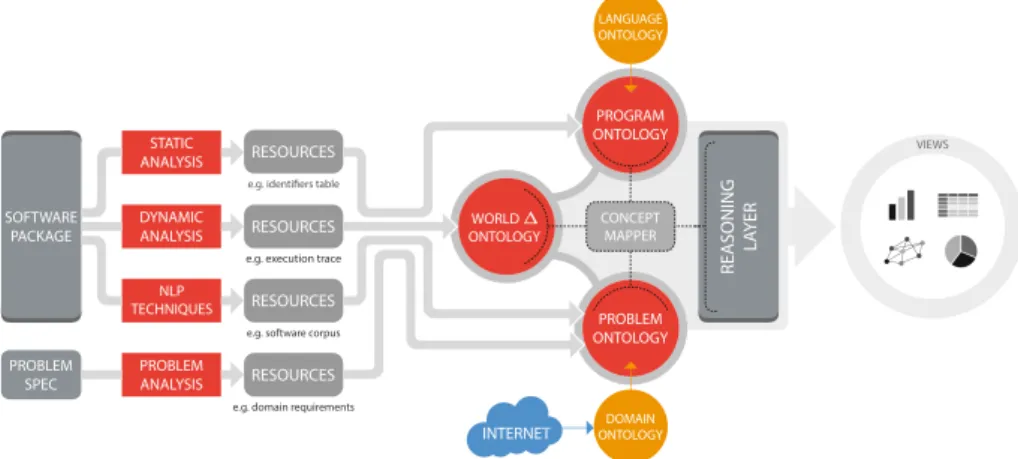
Fig. 1.Overview of the major stages of theConclavesystem workflow
3.1 Collecting Data
This is the first stage of the main workflow; its goal is to collect data from a software package, and any kind of problem specification if available. It takes as input the complete package (and other available documents) and produces as output an heterogeneous collection of resources. The processing tools involved in this stage can use different type of analysis: static source code analysis (e.g. parsing code to extract identifiers and static call graphs), dynamic analysis (e.g. execution traces), etc.
Any analysis can be used to collect information, and produce a resource. In the context of this work, some tools were implemented to provide some initial data to the system and contribute to PC in general, here are some examples:
Conc-clang: is a static analysis tool, based on the clang compiler library [22] for gathering identifiers and static functions calls information for C/C++
programs;
Conc-antlr: is a static analysis tool, based on the ANTLR parser genera-tor framework [31], for gathering program identifiers information for Java
programs;
Conclave-IdsProcessor: provides a tool for splitting program identifiers, mainly because programmers tend to use abbreviations and word combi-nations to name program elements (like variables or functions), these need to be split and expanded to improve feature location techniques [10, 11].
3.2 Normalizing Information, Populating Ontologies
The main goal of this stage is to convey the data collected during the previous stage into the system ontologies. The input of this stage is a collection of re-sources, and the output is a set of populated ontologies. Usually three ontologies are populated for each software package:
Program Ontology: abstract representation of some key program elements (e.g. methods, functions, variables, classes);
Problem Ontology: concepts and relations in the application domain; World △ Ontology: runtime effects of executing the program (e.g. program
run traces).
There are two important details about this stage. The first one is the for-mat and technology chosen to store the ontologies. A RDF based triple-store technology was adopted to store the data. This allowed for a scalable and efficient method for performing storing and querying operations, and also al-lows to export the data in several community accepted ontology formats (e.g. OWL, RDF/XML, Turtle) [19, 21]. Querying facilities are also readily available; for instance, SPARQL is a querying domain specific language for RDF triple-stores [32, 34].
Although these technologies provide scalable and efficient environments for handling information, development wise, they are far from the abstraction de-sired by the applications level implementation. To overcome this problem the On-tology ToolKit (OTK)5was implemented, which provides an abstraction layer on top of the RDF technology, to develop ontology-awareapplications. In practice, when applications developers want to perform an ontology related operation, in-stead of using triple-store low level primitives, they can use the abstraction layer. To motivate for the development of this abstract framework, consider the mod-ern Object-Relational Mappers (ORM) in the context of relational databases. Which provide an abstraction layer and interface for programming languages to handle data (stored in databases) as objects, allowing the development of applications regardless of the underlying database technology used [20].
The second important detail is the data semantic shift. Resources tend to produce raw data, but the data stored in the ontologies conveys a richer semantic. Most resources require a specific tool to read the resource data, and translate it to information that is ready to store in the ontology, i.e. follows the semantic defined by the ontology. OTK has also proven useful to implement this family of tools.
A simple example to illustrate the previously discussed details follows. Imagine the Conc-clang tool was used to process a C source code file, included in a software package. The raw output of this tool is something like6:
Function,source.c::add::6,add,,source.c,6,8
5
Implemented as a set of libraries for the Perl programming language. 6
For more examples please visit the tool website:
This line by itself conveys small to none semantic of the data being included in the final resource. In loose english this line states that: ”in the ’source.c’ file there is a ’Function’ definition which has a identifier represent by ’add’ that starts in line ’6’ and ends in line ’8’”, and this is the kind of semantic that needs to be conveyed to the ontological program representation of the program. The Program Ontology has a class to represent instances of elements that are functions in the source code, another for identifiers, and the line numbers are stored as data proprieties7. To illustrate the use of OTK, the following snippet illustrates a simplified version of the required code to load this information to the Program Ontology.
use OTK ;
my $ontology = OTK - > new ( $pkgid , ’ program ’ ); $ontology - > add_instance ( ’ add ’ , ’ Function ’ ); $ontology - > add_instance ( ’ add ’ , ’ Identifier ’ );
$ontology - > add_data_pro p ( ’ add ’ , ’ hasLineBegin ’ , 6 , ’ int ’ ); $ontology - > add_data_pro p ( ’ add ’ , ’ hasLineEnd ’ , 8 , ’ int ’ ); $ontology - > add_obj_prop ( ’ add ’ , ’ inFile ’ , ’ source . c ’ );
The Program Ontology used is in line with other authors’ proposed descrip-tions (e.g. [37, 45, 46]). This also eases future integration processes with other tools that followed those same approaches. Figure 2 illustrates a subset of the class hierarchy exported to OWL. Once all the data is stored in the ontologies, the reasoning layer can be used to relate informations gathered from different
Fig. 2.Program ontology sub-set of the class hierarchy
7
elements and domains to build semantic bridges between elements. More details about this stage are discussed in the next section.
3.3 Reasoning and Views
During this stage more knowledge about the system is build and provided to the system end-user. The tools in this stage use as input the ontologies built during the previous stage, and generally fall in one of the two categories, either they: (a) process information to compute new information and knowledge about the system – usually in this case the tool output is new content added to the ontologies; or (b) information or knowledge suitable for visualization is built – in this particular case the final output of the tool is a view for the package system. Querying the ontology, and adding information if necessary, can easily be done using the OTK framework. Also note that the tools in this stage are language agnostic, in the sense that data about the source code (language dependent) has already been gathered, and OTK tools do not depend anymore on the source language. For example, if a tool processes identifiers, to get a list of the program identifiers simply query the Program Ontology using OTK, as follows:
use OTK ;
my $ontology = OTK - > new ( $pkgid , ’ program ’ );
my @identifiers = $ontology - > get_instances ( ’ Identifier ’ );
Conclave-Mapper, described in detail in the next section, is an example of tools that are used during this stage.
4
Conclave-Mapper
Feature Location Approach
Conclave-Mapper is an application that relies on data computed by other tools (see Sec. 3.1 and 3.2), to create relations between elements of any of the ontologies available for a given package. The input for this application is a set of ontologies, and either a search query, or a mapping query; and the output is a sorted rank of element relations, or a mapping of element relations respectively. The Program Ontology represents the elements of the program, a software main-tainer can ask the application to compute the relations between elements in the program and either a set of keywords provided in a search query, or elements in other ontologies (e.g. Problem Ontology) using a mapping query. In the first case, the result is a sorted rank of the program elements that are related with the keywords provided in the search query, and in the latter a matrix of relatedness score between the elements selected from both ontologies. Both can be used to find which parts of the code are responsible for implementing a domain concept – feature location.
Before discussing function implementations, a formal description of the data types required for creating each output follows8:
8
typeRank = [Entry]
dataEntry =Entry{score :: Float, element :: Element}
This defines aRank as a collection ofEntry, where eachEntry contains the se-mantic relatedness (score), between the element (element) and the query search (more details about how this score is calculated in Sec. 4.2). The typeElement, represents an instance in any ontology (if elements of the Program Ontology are being used all other data is also available: source file, begin and end line, identifier, etc.).
dataMap=Map{rows :: [Element], cols :: [Element], cells :: [Cell]}
dataCell =Cell{row :: Int, col :: Int, score :: Float}
This defines a Map as a matrix, with an Element for each row and column; eachCell in the matrix (besides its position information) contains the semantic relatedness measure (score) for the corresponding elements (more details on how score is calculated in Sec. 4.2).
The application implements two main functions to compute each one of the available output types. Thelocate function creates aRank and is defined as:
locate ::Query → Rank
locate q= letelements= getElements q
entries = [Entry score e|e ← elements, computeScore q e] inRank entries
This function, given aQuery, computes aRank, by iterating over all the elements being analyzed (defined by the search query), and for each element computing a semantic relatedness score, and adding it to the Rank as a new Entry. The element set being searched and the scoring function are defined by the search query (see Sec. 4.2 for details).
Themapping function creates aMap and is defined as:
mapping :: Query → Query → SFunction → Map mapping q1q2f = letrows = getElements q1
cols = getElements q2
i = 0
j = 0
cells = [Cell i j (f r c)|
r ← rows, c ← cols, i ← i+ 1, j ← j + 1 ] inMap rows cols cells
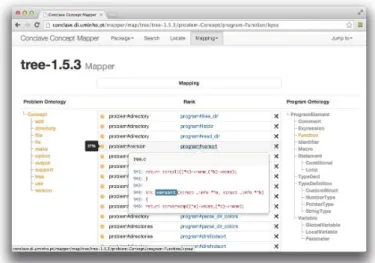
Fig. 3.A mapping produced byConclave-Mapper: on the left the Problem Ontology can be used to constrain the concepts being searched, on the right the Program Ontol-ogy can be used to constrain the range of which program elements are being analyzed, and in the center the resulting rank sorted by relevance
The Query type used before describes a query supplied by the user (a pre-defined set of queries is also available via the system interface). A DSL was developed to describe these queries (either search or mapping); this language is discussed in the next subsection.
4.1 The Query Language
In order to compute rankings and mappings at least one query is required. This section describes the DSL that was devised to create such queries. Each query has at least three main components: (a) keywords; (b) domain and range constrains (e.g. search only functions, or variables); and, (c) the scoring function used to compute the relatedness score between the elements (some of these have default values).
The DSL query language allows two major types of queries: (a) simple strings; or (b) complex queries where a set of proprieties that define the query are sup-plied in the form ofPropriertyName=PropriertyValue9. To distinguish simple queries from complex, the latter are enclosed in square brackets ([ ]). To in-troduce possible queries and proprieties a set of query examples are presented next.
9
The simplest possible query that can be written is a simple string, where the words that represent features or concepts being search are concatenated together using blank spaces, for example:
"color"
"color schema"
These queries search for elements that are closely related with the words"color"
(or also"schema"). By default, a score is computed for all the Program Ontology elements (functions, variables, classes, etc.), and the scoring function used iskpss
(scoring functions are discussed in detail in Sec. 4.2).
The program maintainer when initially addressing a possible bug fix, may be interested in searching functions (or methods) only. The class propriety can be used to constrain the subclass of elements that are being retrieved from the ontology. The following query performs a search for the words "color" and
"schema", but only analyses elements that are instances of the classFunction
(remember the ontology definition in Sec. 3.2, and that the Program Ontology is the default ontology for selecting elements):
[ word=color word=schema class=Function ]
This means that the elements of the resulting rank are only instances of func-tions, because the query constrains the search domain of the locate function. Another example, can be searching for variables, by selecting the classVariable, this includes all the members that are instances of the classVariableand also instances of all sub-classes ofVariable (e.g. Parameter,LocalVariable), i.e. the resulting rank includes all kinds of variables in the original program:
[ word=color class=Variable ]
Particular types of variables can be selected, for example searching only local variables:
[ word=color class=LocalVariable ]
Another important propriety that can be defined is the scoring function, i.e. the function that will compute the semantic relatedness score between the keywords searched and each of the selected elements, this is done using thescorepropriety. For example, the query:
[ word=color class=Variable score=levenshtein ]
uses the levenshteinword distance algorithm [25], to compute the score. By default, the scoring function based on kPSS is used.
[ word=color class=Function score=levenshtein aggr=inFunction ]
for example, analyses all the functions, and for each function also considers all the elements that are related with that function by the relation inFunction
(defined in the ontology). This relation is used to link all the local variables and parameters to all the functions (or methods depending on programming language) where they are defined and used. In practice, the score for each element (function) is the average between computing the score for the element itself, and the score for every local variable and parameter defined in that function.
The scores used by the locate and mapping functions are calculated by the function defined in the query, and are discussed in the next section.
4.2 Scoring Functions
The score between two elements (or an element and a word) quantify how close they are semantically related. This score is used to sort the ranks computed by thelocatefunction by relevance, or to highlight the cells that express close relat-edness between elements in the matrixes computed with themapping function. The main scoring function available in the Conclave system is the kpss function (used by default), and is based on kPSS, which defines a formalism to describe synonymous sets based on Probabilist Synonymous Sets (PSS) [6, 42]. These define synonymous sets based on statistical analysis of parallel corpora.
A kPSS of order n is formally defined as a set of orders; a synonymous set corresponds to each ordern(wheren∈N), which is defined as a list ofTerm. EachTerm contains a word and a probability:
typekPSS = [Order]
dataOrder =Order{n :: Int,synsen :: [Term]}
dataTerm =Term{word :: String, prob :: Float}
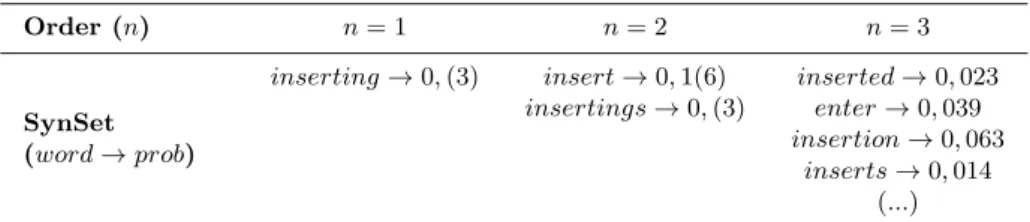
The sum of all the probabilities in every synonymous set, for every order is always equal to 1. A kPSS can be built for any given word, and usually only up to order 3. Every time a new order is added, probabilities need to be normalized so that the invariant is kept valid. The first order contains the original word itself only, the second order synset contains only words directly derived from the original word (e.g. lemma, inflection), and the third order contains terms extracted from the PSS for the same word. Table 1 illustrates the kPSS for the word ”inserting”.
Once a kPSS is available for a pair of words, the relatedness score between these words can be calculated. Thekpss function is used to compute this score (as aFloat) and is defined as:
kpss :: kPSS → kPSS → Float kpss k1k2 = [min(prob x) (prob y)|
x ← flatten k1, y ← flatten k2, word x ==word y]
Table 1.kPSS of order 3 for the word ”inserting”
Order (n) n= 1 n= 2 n= 3
SynSet (word→prob)
inserting→0,(3) insert→0,1(6) inserted→0,023 insertings→0,(3) enter→0,039
insertion→0,063 inserts→0,014
(...)
flatten :: kPSS → [Term]
flatten kpss=concat[synset order|order ← kpss]
Other scoring functions can be used to produced different ranks and mappings. The levenshtein function is another example, this calculates the score as the word distance between terms. Another function implemented in the system is the match function (this helps simulating techniques based on grep10), that simply returns 1 if the words match, or 0 otherwise. The next section describes the experimental evaluation done to empirically verify the advantages of the use of kPSS.
5
Experimental Validation
The previous sections describe the underlying technique used in theConclave system for feature location, based on kPSS. This section describes the prelimi-nary evaluation done, to verify if this technique introduces benefits over other common techniques. In current available IDEs, common search facilities provided to the users, are still grep-like approaches, so the following research question was formulated:
RQ1: How does the kpss scoring function performs, when compared to the match scoring function, for finding relevant elements of the code given a search query?
To help answering this question the following experience was performed:
Step 1: in order to ease the process or replicating this experience the benchmark provided by Ditet al11for the jEdit12editor (version 4.3) was used, instead the devising a new data set. The benchmark contains a set of 150 bug reports, including the function set that was changed to resolve the bug (refered as the gold set) – more details about the benchmark in [12];
Step 2: the title for each bug report was extracted, stop words13were removed, and the resulting set was archived as keywords;
10
http://www.gnu.org/software/grep/ (Last accessed: 29-01-2014). 11
http://www.cs.wm.edu/semeru/data/benchmarks/ (Last accessed: 29-01-2014). 12
http://www.jedit.org/ (Last accessed: 29-01-2014). 13
Step 3: for each bug report, the locate function to compute a rank was called, using thematch scoring function, the keyword set computed inStep 2, and setting as range theFunctionprogram element;
Step 4: replicateStep 3but using thekpss scoring function; Step 5: calculate the effectiveness measure for each resulting rank.
The effectiveness measure is calculated by analyzing the computed rank in order, and its value is the first position of the rank that is a relevant function. Functions that are part of the set of functions changed to resolve the bug (the gold set) are considered relevant. The rank position can be compared for dif-ferent scoring functions to measure which rank produced the best results. This approach was also used in [33] and [38] for comparing feature location techniques performance.
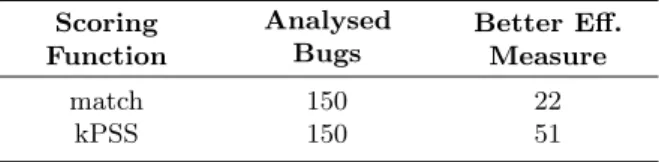
The results of this experience are presented in Table 2. They show that for this software package the kPSS based scoring approach produced a better result 55 times, outperforming the 22 better results achieved by the simple match function. The remaining times either both approaches scored the same, or none of the relevant functions were found in the resulting rank.
Table 2.Results of the experimental validation
Scoring Function
Analysed Bugs
Better Eff. Measure
match 150 22
kPSS 150 51
Although these results are satisfactory, they do not provide enough empirical data to generalize the performance of kPSS based techniques. Also, the keywords used to build the queries and the functions gold sets are a threat to validity because: (a) the keywords set was built automatically from reports titles that sometimes lack relevant terms, or use only ambiguous words (e.g. ”bug”), a human would be more prone to devise a set of terms (after reading the report) that would create a more accurate rank; (b) sometimes, when fixing bugs, the actual defect is really not related to the concepts functions are addressing, which translates in changing code unrelated to search queries.
6
Conclusion
Many PC techniques benefit from mappings between the source code and prob-lem domain concepts. These relations help the programmer quicker understand the source code, and discover which areas of the code need changing to address a specific feature or bug fix.
heterogenous results and data in a single representation format. Applications can take advantage of a panoply of tools available (e.g. inference engines, de-scriptive logics, OTK-like frameworks), to perform data analysis and relate el-ements in different domains. kPSS based feature location is a sound example of such applications. The OTK framework for abstracting ontology operations from the underlying technology has proven a valuable asset during applications implementation.
The main trends for future work include devising new scoring functions, as well as combinations of approaches to improve results. And also, design practical experiments to compareConclave-Mapperwith other state-of-the-art feature location techniques.
References
1. Antoniol, G., Gu´eh´eneuc, Y.-G.: Feature identification: An epidemiological metaphor. IEEE Transactions on Software Engineering 32(9), 627–641 (2006) 2. Bechhofer, S., Van Harmelen, F., Hendler, J., Horrocks, I., McGuinness, D.L.,
Patel-Schneider, P.F., Stein, L.A., et al.: Owl web ontology language reference. W3C Recommendation 10, 2006–01 (2004)
3. Biggerstaff, T.J., Mitbander, B.G., Webster, D.: The concept assignment problem in program understanding. In: Proceedings of the 15th International Conference on Software Engineering, pp. 482–498. IEEE Computer Society Press (1994) 4. Binkley, D., Lawrie, D.: Information retrieval applications in software maintenance
and evolution. In: Encyclopedia of Software Engineering (2009)
5. Binkley, D., Lawrie, D.: Information retrieval applications in software development. In: Encyclopedia of Software Engineering (2010)
6. Carvalho, N.R., Almeida, J.J., Pereira, M.J.V., Henriques, P.R.: Probabilistic synset based concept location. In: SLATE 2012 — Symposium on Languages, Ap-plications and Technologies (June 2012)
7. Chen, K., Rajlich, V.: Case study of feature location using dependence graph. In: 8th International Workshop on Program Comprehension. IEEE (2000)
8. Chikofsky, E.J., Cross II, J.H.: Reverse engineering and design recovery: A taxon-omy. IEEE Software, 13–17 (1990)
9. Corbi, T.A.: Program understanding: Challenge for the 1990s. IBM Systems Jour-nal 28(2), 294–306 (1989)
10. Deissenboeck, F., Pizka, M.: Concise and consistent naming. Software Quality Jour-nal 14(3), 261–282 (2006)
11. Dit, B., Guerrouj, L., Poshyvanyk, D., Antoniol, G.: Can better identifier split-ting techniques help feature location? In: IEEE 19th International Conference on Program Comprehension (2011)
12. Dit, B., Revelle, M., Gethers, M., Poshyvanyk, D.: Feature location in source code: a taxonomy and survey. Journal of Software: Evolution and Process 25(1), 53–95 (2013)
13. Eisenbarth, T., Koschke, R., Simon, D.: Locating features in source code. IEEE Transactions on Software Engineering 29(3), 210–224 (2003)
15. Happel, H.-J., Seedorf, S.: Applications of ontologies in software engineering. In: Proc. of Workshop on Sematic Web Enabled Software Engineering (SWESE) on the ISWC, pp. 5–9. Citeseer (2006)
16. Hayashi, S., Yoshikawa, T., Saeki, M.: Sentence-to-code traceability recovery with domain ontologies. In: 2010 17th Asia Pacific Software Engineering Conference (APSEC), pp. 385–394. IEEE (2010)
17. Hill, E., Pollock, L., Vijay-Shanker, K.: Exploring the neighborhood with dora to expedite software maintenance. In: Proceedings of 22nd IEEE/ACM International Conference on Automated Software Engineering, pp. 14–23 (2007)
18. Hill, E., Pollock, L., Vijay-Shanker, K.: Automatically capturing source code con-text of nl-queries for software maintenance and reuse. In: Proceedings of the 31st International Conference on Software Engineering. IEEE (2009)
19. Horrocks, I., Patel-Schneider, P.F., van Harmelen, F.: From SHIQ and RDF to OWL: the making of a Web Ontology Language. Web Semantics: Science, Services and Agents on the World Wide Web 1(1), 7–26 (2003)
20. Keller, W.: Mapping objects to tables. In: Proc. of European Conference on Pattern Languages of Programming and Computing, Kloster Irsee, Germany, vol. 206, p. 207. Citeseer (1997)
21. Klyne, G., Carroll, J.J., McBride, B.: Resource description framework (rdf): Con-cepts and abstract syntax. W3C Recommendation, 10 (2004)
22. Lattner, C.: Llvm and clang: Next generation compiler technology. In: The BSD Conference, pp. 1–2 (2008)
23. Lawrie, D., Binkley, D.: Expanding identifiers to normalize source code vocabulary. In: 2011 27th IEEE International Conference on Software Maintenance (ICSM), pp. 113–122 (2011)
24. Lawrie, D., Morrell, C., Feild, H., Binkley, D.: What’s in a name? a study of identifiers. In: 14th International Conference on Program Comprehension (2006) 25. Levenshtein, V.I.: Binary codes capable of correcting deletions, insertions, and
reversals. Soviet Physics Doklady 10, 707–710 (1966)
26. Marcus, A., Sergeyev, A., Rajlich, V., Maletic, J.I.: An information retrieval ap-proach to concept location in source code. In: Proceedings of the 11th Working Conference on Reverse Engineering, pp. 214–223. IEEE (2004)
27. Marcus, A., Rajlich, V., Buchta, J., Petrenko, M., Sergeyev, A.: Static techniques for concept location in object-oriented code. In: Proceedings of the 13th Interna-tional Workshop on Program Comprehension, IWPC 2005, pp. 33–42. IEEE (2005) 28. Marcus, A., Rajlich, V.: Identification of concepts, features, and concerns in source code. In: Panel Discussion at the International Conference on Software Mainte-nance (2005)
29. Martin, J.H., Jurafsky, D.: Speech and language processing (2000)
30. Nelson, M.L.: A survey of reverse engineering and program comprehension. Arxiv preprint cs/0503068 (2005)
31. Parr, T.: The Definitive ANTLR 4 Reference. Pragmatic Bookshelf (2013) 32. P´erez, J., Arenas, M., Gutierrez, C.: Semantics and complexity of SPARQL. In:
Cruz, I., Decker, S., Allemang, D., Preist, C., Schwabe, D., Mika, P., Uschold, M., Aroyo, L.M. (eds.) ISWC 2006. LNCS, vol. 4273, pp. 30–43. Springer, Heidelberg (2006)
34. Prud’Hommeaux, E., Seaborne, A., et al.: Sparql query language for rdf. W3C Recommendation, 15 (2008)
35. Rajlich, V., Wilde, N.: The role of concepts in program comprehension. In: Proceedings of the 10th International Workshop on Program Comprehension, pp. 271–278. IEEE (2002)
36. Ratiu, D., Deissenboeck, F.: How programs represent reality (and how they don’t). In: 13th Working Conference on Reverse Engineering, WCRE 2006, pp. 83–92. IEEE (2006)
37. Ratiu, D., Deissenboeck, F.: From reality to programs and (not quite) back again. In: 15th IEEE International Conference on Program Comprehension, ICPC 2007, pp. 91–102. IEEE (2007)
38. Revelle, M., Dit, B., Poshyvanyk, D.: Using data fusion and web mining to sup-port feature location in software. In: 2010 IEEE 18th International Conference on Program Comprehension (ICPC), pp. 14–23. IEEE (2010)
39. Robillard, M.P.: Topology analysis of software dependencies. ACM Transactions on Software Engineering and Methodology (TOSEM) 17(4), 18 (2008)
40. Safyallah, H., Sartipi, K.: Dynamic analysis of software systems using execution pattern mining. In: 14th IEEE International Conference on Program Comprehen-sion (2006)
41. Shepherd, D., Fry, Z.P., Hill, E., Pollock, L., Vijay-Shanker, K.: Using natural language program analysis to locate and understand action-oriented concerns. In: Proceedings of the 6th International Conference on Aspect-Oriented Software De-velopment, pp. 212–224. ACM (2007)
42. Sim˜oes, A., Almeida, J.J., Carvalho, N.R.: Defining a probabilistic translation dic-tionaries algebra. In: XVI Portuguese Conference on Artificial Inteligence - EPIA, pp. 444–455 (September 2013)
43. Von Mayrhauser, A., Vans, A.M.: Program comprehension during software main-tenance and evolution. Computer 28(8), 44–55 (1995)
44. Wilde, N., Buckellew, M., Page, H., Rajlich, V., Pounds, L.: A comparison of methods for locating features in legacy software. Journal of Systems and Software (2003)
45. W¨ursch, M., Ghezzi, G., Reif, G., Gall, H.C.: Supporting developers with natural language queries. In: Proceedings of the 32nd ACM/IEEE International Conference on Software Engineering, vol. 1 (2010)