Leucogram and serum acute phase protein concentrations in queens submitted to
conventional or videolaparoscopic ovariectomy
[Leucograma e concentrações séricas de proteínas de fase aguda de gatas submetidas à ovariectomia convencional ou por videolaparoscopia]
A.E. Alves, A.P.C. Ribeiro, P.A. Di Filippo, M.F. Apparicio, J.J. Fagliari, W.R.R. Vicente
Faculdade de Ciências Agrárias e Veterinárias - UNESP Via de Acesso Prof. Paulo Donato Castellane, s/n,
14884-900 – Jaboticabal, SP
ABSTRACT
Thirty health queens were submitted to ovariectomy by conventional technique or by videolaparoscopy. In order to study the intensity of inflammatory response by means of acute phase protein analysis and white blood cell count, serum samples were taken before and until 144 hours after the surgical procedures. The protein concentrations that were significantly increased 24 hours after surgical procedures were: ceruloplasmin, hemopexin, haptoglobin, and 1-acid glycoprotein, 69.8%, 103.5%,
117.3%, and 199.0%, respectively, for conventional ovariectomy; and 22.3%, 46.1%, 79.8%, and 74.6%, respectively, for laparoscopic ovariectomy. Therefore, inflammatory response was more intense in queens submitted to conventional ovariectomy. Results indicate that the increase or decrease in acute phase proteins, as well as in white blood cells count, may be useful in the evaluation of inflammatory response induced by these surgical procedures.
Keywords: queen, videolaparoscopy, acute phase protein
RESUMO
Trinta gatas, saudáveis, foram submetidas à ovariectomia pela técnica convencional e por videolaparoscopia. Amostras de sangue foram obtidas com o objetivo de verificar a intensidade da resposta inflamatória por meio da análise das concentrações de proteinas de fase aguda e contagem de leucócitos antes e até 144 horas após procedimento cirúrgico. As proteínas que apresentaram aumento significativo 24 horas após a cirurgia foram: ceruloplasmina, hemopexina, haptoglobina e 1
-glicoproteína ácida, 69,8%, 103,5%, 117,3% e 199,0%, respectivamente, para ovariectomia convencional, e 22,3%, 46,1%, 79,8% e 74,6%, respectivamente, para ovariectomia por videolaparoscopia. A resposta inflamatória foi mais evidente nas gatas submetidas à ovariectomia convencional. Os resultados mostram aumento e diminuição na concentração de proteínas de fase aguda e na contagem de leucócitos, podendo ser utilizados na avaliação da resposta inflamatória induzida por procedimentos cirúrgicos.
Palavras-chave: gata, videolaparoscopia, proteina de fase aguda
INTRODUCTION
Dog and cat population have been increasing excessively. Thus, the study of new techniques of sterilization is part of programs to control the population growth of these species with the purpose to increase the security of public health.
Recebido em 12 de março de 2009 Aceito em 28 de dezembro de 2009 E-mail: [email protected]
estimated that videolaparoscopy propitiate less tissue trauma, risk of contamination, postoperative leukocytosis, discomfort, and pain during the postoperative period as well as reduction in post-surgical recovery (Malm et al., 2005).
Videolaparoscopic procedures can avoid or minimize physiological alterations such as leukocytosis (Bonica, 1992). Tissue injury of different causes, stress, pain, and immediate postoperative, 12 to 36 hours after surgery, can stimulate the hypothalamus-hypofisis-adrenal axis to release glycocorticoids which increase the production and migration of neutrophils (Tvdten, 1994). Acute phase proteins are blood proteins that change in concentration in animals subjected to external or internal challenge, such as infection, inflammation, surgical trauma, or stress (Murata et al., 2004).
The first stage of the inflammatory reaction includes many alterations named acute phase answer. The circulating concentrations of the acute phase proteins are related to the severity of the disorder and the area of tissue damage (Kent, 1992) and quantification of their concentration can provide diagnostic and prognostic information about the animal disorder (Murata et al., 2004; Petersen et al., 2004). The pathogenesis of the acute phase protein begins with the inflammatory sites, where cells involved in the innate immune response (macrophages and neutrophils) produce and release pro-inflamatory cytokines such as interleukin (IL)-1, IL-6, and tumor necrosis factor (TNF)- (Paltrinieri, 2008). A little is known about the molecular pathogenesis of feline protein acute phase, but the majority of studies on protein acute phase production by feline cells have examined the response to specific virus infections (Paltrinieri, 2008).
The eletrophoresis study represents one of the most important tools to recognize blood proteins (Kaneko et al., 2008). The most used techniques in veterinary medicine have with primordial cellulose acetate band(Fagliari et al., 1983) and agarose films (Mattews, 1982), but all of them provide limited banding. The electrophoresis technique with sodium dodecil sulphate (SDS-PAGE) is simple, less expensive, and is enable to visualize proteins with extremely low concentrations as well the identification of 20 to
30 proteins. Using this technique, Fagliari et al. (1997) identified 19 proteins in the serum proteinogram in equines with laminitis and Fagliari et al. (2002) studied the serum proteinogram of equine with acute abdomen. The aim of the present study was to evaluate the results of hemogram and serum protein concentrations in queens submitted to videolaparoscopic or conventional ovariectomy.
MATERIAL AND METHODS
Thirty adult queens from different breeds, weighing between 1.2 and 3.9kg, with ages between 8 months and 3 years old, were used in the study. The animals were considered healthy after clinical, physical and laboratorial examinations and were kept in fasting for 6 hours of water and 12 hours of food before the surgical procedure.
The animals were randomly allotted into three groups with 10 queens each, as follow: Group 1 (G1): conventional ovariectomy; Group 2 (G2): ovariectomy by videolaparoscopy, and Group 3(G3): control group that was anaesthetized, but not subjected to surgery to evaluate the changes caused by this procedure alone. This study was submitted at Ethical Committee and Animal Welfare (FCAV-UNESP-Jaboticabal/Brazil) by protocol 016782-07.
Anesthesia was conducted using 0.2% acepromazine maleate (Acepran - Univet S/A), 0.05mg/kg and buprenorphine chloridrate (Temgesic - Schering-Plough S/A), 0.01mg/kg by intramuscular injection (IM), 30 minutes before induction. For induction and maintenance tiletamine, 5mg/kg, and zolazepam (Zoletil - Virbac S/A), 5mg/kg, (IM) were used. After the animal was anesthetized a catheter (Intracath - BD Brasil) was introduced in the jugular vein for blood sampling. During surgical procedure, the animal received intravenous fluid therapy with lactated Ringer’s solution (10mL/kg/h).
2cm caudal to the umbilicus, with the purpose to create a pneumoperitonium (internal pressure from 8 and 10mmHg CO2). The Veres needle
was removed, and in the same punction, a 7mm trocar was introduced so that the endoscopy (with a source of light and a microcamera) could be introduced. The second and third access to cavity were also made in the medium line, with the 5mm trocar placed 1cm caudal to the umbilicus (between the scar and the first punction) and the 10mm trocar placed 1cm cranial to the umbilicus (to allow the introduction of the handling tweezers). The ovaries were located and individually fixed with an atraumatic tweezer and then the titanium clips were placed in each ovary pedicle and uterotubal junction, with distance of approximately 2mm between them. After hemostasia, the uterine tube, the cranial portion of the uterus, and the ovary pedicle were sectioned and the ovaries were removed through the trocar tube. Then, the abdominal cavity was deflated and the incisions were sutured in two layers, being first the muscles and then skin, using simple separate sutures, and 2-0 monofilament nylon.
Blood samples for serum protein concentrations were collected and placed in tubes without anticoagulant and for white blood cell counts in tubes with anticoagulant. They were obtained before the surgical procedures (0h) and at 12, 24, 48, 72, 96, 120, and 144 hours later. White blood cell counts were performed in automatic cell counter (ACT8 Coulter); blood smears were stained by means of Wright method (Jain, 1986) and used for differential counting of cells.
Serum protein concentrations were determined by means of SDS-PAGE, as recommended by
Weber and Osborn (1969). Concentrations of protein were determined by the use of computer assisted densitometry (Shimadzu CS 9301). Proteins were identified by the use of reference markers (Sigma) with molecular weights of 29.000, 45.000, 66.000, 97.400, 116.000, and 205.000 Daltons (Da), and by comparison with eletrophoretic mobility of purified albumin, IgG, haptoglobin, transferrin, ceruloplasmin, and 1
-antitrypsin. Statistical analysis was performed using the SAS/1999, followed by the Tukey test for comparison of means.
RESULTS AND DISCUSSION
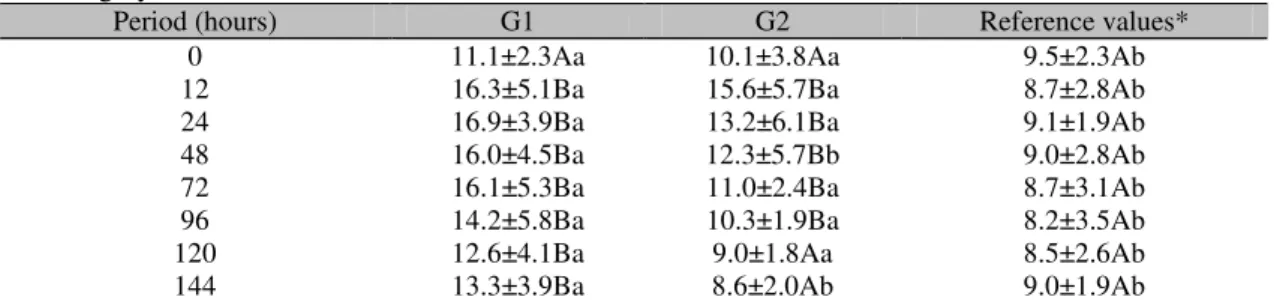
There was an increase in white blood cell count during the postoperative period when compared to the period before surgery, independently of the surgical procedure (Table 1). However, there was a significant difference among the groups. During the postoperative period, the group of queens submitted to laparoscopy presented the lower values compared to the conventional group. In this group, there was a peak followed by a decrease in white blood cell count 24 hours after surgery, while in the laparoscopy group, the same oscillation was observed 12 hours after surgery.
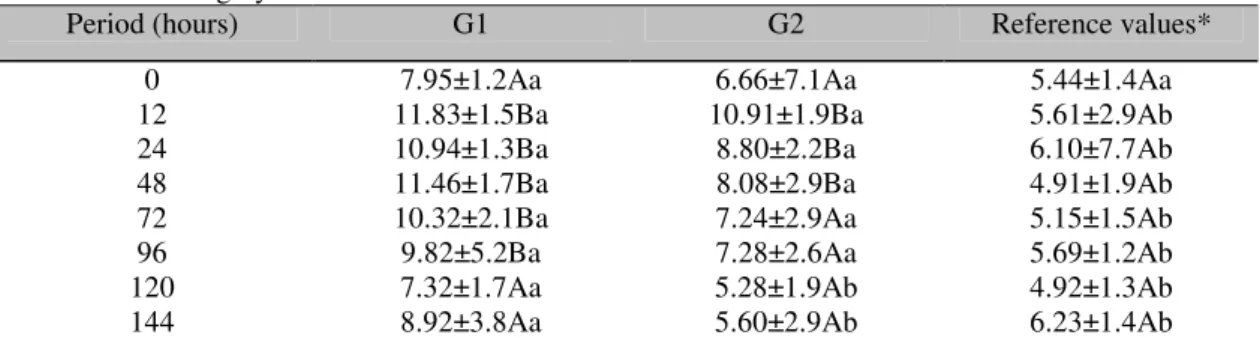
As there was no difference among the groups regarding the counts of basophils, eosinophils, lymphocytes, and monocytes and the values of these cells remained within normal range during the postoperative period, it was decided to present only the data for segmented neutrophils. The values obtained for segmented neutrophils followed a pattern similar to that described for total white blood cells count (Table 2).
Table 1. Means and standard deviation of leukocyte counts (x103/uL) of queens submitted to ovariectomy by conventional technique (G1) or by laparoscopy (G2) before and 12, 24, 48, 72, 96, 120, and 144 hours after surgery
Period (hours) G1 G2 Reference values*
0 11.1±2.3Aa 10.1±3.8Aa 9.5±2.3Ab
12 16.3±5.1Ba 15.6±5.7Ba 8.7±2.8Ab
24 16.9±3.9Ba 13.2±6.1Ba 9.1±1.9Ab
48 16.0±4.5Ba 12.3±5.7Bb 9.0±2.8Ab
72 16.1±5.3Ba 11.0±2.4Ba 8.7±3.1Ab
96 14.2±5.8Ba 10.3±1.9Ba 8.2±3.5Ab
120 12.6±4.1Ba 9.0±1.8Aa 8.5±2.6Ab
144 13.3±3.9Ba 8.6±2.0Ab 9.0±1.9Ab
Table 2. Means and standard deviations of neutrophil counts (x103/uL) of queens submitted to conventional ovariectomy (G1) or laparoscopic ovariectomy (G2) before and 12, 24, 48, 72, 96, 120, and 144 hours after surgery
Period (hours) G1 G2 Reference values*
0 7.95±1.2Aa 6.66±7.1Aa 5.44±1.4Aa
12 11.83±1.5Ba 10.91±1.9Ba 5.61±2.9Ab
24 10.94±1.3Ba 8.80±2.2Ba 6.10±7.7Ab
48 11.46±1.7Ba 8.08±2.9Ba 4.91±1.9Ab
72 10.32±2.1Ba 7.24±2.9Aa 5.15±1.5Ab
96 9.82±5.2Ba 7.28±2.6Aa 5.69±1.2Ab
120 7.32±1.7Aa 5.28±1.9Ab 4.92±1.3Ab
144 8.92±3.8Aa 5.60±2.9Ab 6.23±1.4Ab
Means followed by distinct capital letters in columns and lower case letters in rows are different (P<0.05) Tukey test. *Reference values of healthy queens only submitted to the same anesthetic protocol used in group 1 and 2.
The increase in the number of leukocytes observed in the animals submitted to ovariectomy possibly occurred due to the action of cortisol released in animals under stress, pain, and immediate postoperative, situations presented in both procedures. According to Tvedten (1994), the concentrations of serum corticosteroids are proportional to the intensity and duration of stress and liberation of adrenocorticotrophic (ACTH), returning to basal concentrations within 12 to 24 hours, as observed in this study. Neutrophilia induced by corticosteroids has a reduced time and returns to normal values within 24 hours, as reported by Jain (1986). The authors consider that the trauma induced by the surgical procedures was discrete due to an increase in the number of leukocyte be directly proportional to the extent of the injury.
Theoretically, within a few minutes after an inflammatory stimulus, the leukocyte count in feline blood may triple and remain high for a long period. Nevertheless, the actual leukocyte count depends on the equilibrium between the rate of neutrophil production and tissue demand. It is possible that in case of exaggerated tissue demand, leukocytosis can be mild or characterized by the presence of circulating immature forms (Paltrinieri, 2008). In this study, a discrete left-shift was observed during the first three and four days in the postoperative period for G2 and G1, respectively; which according to Bush (1991) may be observed in situations of pain and stress. However, the increased values observed in animals submitted to conventional ovariectomy suggest that this procedure induces an inflammatory reaction greater than that caused by laparoscopy.
During the postoperative period, serum protein concentration was significantly higher in queens which underwent conventional ovariectomy compared to laparoscopic ovariectomy, with higher values observed at 0, 12, 24, 48, 72, 96, 120, and 144 hours after the surgical procedure (Table 3). In general, the variation noticed for serum total protein was similar to that of neutrophils, suggesting that both are indicators of inflammatory response, as reported by Heindrich et al. (1990) and Gruys et al. (1994).
In this study in which SDS-PAGE was used, 29 protein bands were identified, with molecular weights ranging from 16.000 to 165.000Da. However, data analyses indicate that the acute phase proteins that presented a significant increase were ceruloplasmin, hemopexin, haptoglobin, and 1-acid glycoprotein as showed
in Table 3, according to Gruys et al. (1994).
Table 3 also shows the percentage of increase observed 24 hours after surgery for ceruloplasmin, hemopexin, haptoglobin, and 1
-acid glycoprotein in the conventional group. Ceruloplasmin (PM=128.000Da) presented the lowest percentage of increase in the laparoscopy group, with peak of 37.41%, 12 hours after surgery. In the G1, ceruloplasmin was also the protein with the lowest increase (69.8%) 24 hours after the procedure. In this group, the increases in hemopexin (PM=83.000Da), haptoglobin (PM= 47.000Da), and 1-acid
respectively. The highest percentage of increase verified in queens submitted to conventional ovariectomy was due to the larger area of contamination and greater inflammatory stimuli compared to queens submitted to laparoscopic ovariectomy In both groups, the serum protein concentrations tended to decrease along the time, suggesting that hepatic synthesis needs the presence of inflammatory mediators, such as
cytokines (Heindrich et al., 1990). Generally, the main function of these proteins is to contribute to body defenses during inflammation by modulating the immune system, by transporting molecules to prevent their potential loss or by protecting tissue from excessive damage generated by inflammatory mediators (Petersen et al., 2004)
Table 3. Percentage of increase in serum concentrations (mg/dl) of ceruloplasmin, hemopexin, haptoglobin, and
1-acid glycoprotein (acid glycop) after ovariectomy in queens by conventional technique or laparoscopy
compared with values before surgery (0h)
Proteins 0h 12h 24h 48h 72h 96h 120h 144h
Ceruloplasmin
G1 42.29Aa 48.80Aa 69.85Ab 58.80Ab 27.52Aa 27.52Aa 24.92Aa 21.70Aa
G2 35.47Aa 37.41Ba 22.31Bb 13.53Bc 10.83Ac 05.36Bd 02.18Bd 0.18Bd
Hemopexin
G1 35.31Aa 60.86Cb 103.49Cc 72.99Bb 65.98Bb 49.98Cb 33.70Ab 20.61Ab
G2 32.89Aa 46.24Bb 46.09Ab 38.27Aa 23.98Aa 21.13Aa 05.50Bc 04.49Bc
Haptoglobin
G1 28.2Aa 82.0Cb 117.31Cc 103.80Cc 88.23Bb 87.40Cb 85.82Ab 19.44Aa
G2 12.1Aa 14.92Bb 79.77Ac 92.80Cc 59.35Bc 58.42Cc 53.99Ac 44.25Cc
Acid glicop
G1 28.35Aa 41.60Bb 199.06Cc 138.64Cc 85.06Bc 58.55Cb 34.99Aa 19.44Aa
G2 12.86Ba 13.56Db 74.56Ac 73.89Bb 68.67Bb 54.74Cb 53.05Ab 45.18Cd
Means followed by distinct capital letters in columns and lower case letters in rows are different (P<0.05).
The results showed that the pattern of increase and decrease of acute phase proteins, as well as that of neutrophils, may be useful in the evaluation of inflammatory response induced by surgical procedures.
Moreover, it is possible that the analysis of these parameters in the postoperative period may be useful in the detection of undesirable alterations, such as inflammation/infection and, consequently, in defining a prognosis. It is also possible that the intensity of inflammatory response due to any conventional surgery and also by laparoscopy may be evaluated by means of acute phase protein determination and the leukogram.
CONCLUSION
The results confirm that SDS-PAGE technique and leukogram are diagnostic tools, able to show the intensity of inflammatory answer after conventional and laparoscopic ovariectomy in queens. The postoperative period of ovariectomy procedure in queens by laparoscopy showed lower serum acute phase protein levels, and seems to induce low inflammatory answer, in comparison to conventional procedure.
REFERENCES
BONICA, J.J. Pain research and therapy history, current status and future goals. In: SHORT, C.E.; POZNACK, A.V. (Ed.). Animal pain. New York: Churchil Livingston,1992. p.1-29.
BRUN, M.V. Ovário-histerectomia em caninos por cirurgia laparoscópica. 1999. 181f. Dissertação (Mestrado) - Faculdade de Veterinária, Universidade Federal do Rio Grande do Sul, Porto Alegre.
BUSH, B.M. White blood cells (WBCs). In: ____. Interpretation of laboratory results for small animal clinicians. Oxford: Blacwell Scientific, 1991. p.132-195.
FAGLIARI, J.J.; FERREIRA NETO, J.M.; LUCAS, A. Proteinograma total e fracionamento eletroforético do soro de bezerros Guzerá passivamente imunizados contra paratifo. Arq. Bras. Med. Vet. Zootec., v.35, p.317-332, 1983.
FAGLIARI, J.J.; SILVA, S.L. Hemograma e proteinograma plasmático de equinos hígidos e de equinos acometidos por abdômen agudo, antes e após laparotomia. Arq. Bras. Med. Vet. Zootec., v.54, p.559-567, 2002.
GRUYS, E.; OBWOLO, M.J.; TOUSSAINT, M.J.M. Diagnostic significance of the major acute phase proteins in veterinary clinical chemistry: a review. Vet. Bull., v.64, p.1009-1018, 1994.
HEINDRICH, P.C.; CASTELL, J.V.; ANDUS, T. Interleukin-6 and acute phase response.
Biochem. J., v.256, p.621-636, 1990.
JAIN, N.C. The erythrocyte in disease. In: ____.
Schalm’s veterinary hematology. 3.ed. Philadelphia: Lea & Febiger, 1986. p.405-470.
KANEKO, J.J. Clinical biochemistry of domestic animals. 6.ed. San Diego: Academic, 2008. 916p.
KENT, J. Acute phase proteins: their use in veterinary diagnosis. Br. Vet. J., v.148, p.279-282, 1992.
MALM, C.; SAVASSI-ROCHA, P.R.; GHELLER, V.A. et al. Ovário-histerectomia: estudo experimental comparativo entre as abordagens laparoscópica e aberta na espécie canina. II Evolução clínica pós-operatória. Arq. Bras. Med. Vet. Zootec., v.57, supl.2, p.162-172, 2005.
MATTEWS, A.G. Serum protein electrophoresis in horses and ponies. Equine Vet. J., v.14, p.322-324, 1982.
MURATA, H.; SHIMADA, N.; YOSHIOKA, M. Current research on acute phase proteins in veterinary diagnosis: an overview. Vet. J., v.168, p.28-40, 2004.
OKKENS, A.C.; KOOISTRA, H.S.; NEICKEL, R.F. Comparison of long-term effects of ovariectomy versus ovariohisterectomy in bitches. J. Reprod. Fertil., v.51, suppl., p.227-231, 1997.
PALTRINIERI, S. The feline acute phase reaction. Vet. J., v.177, p. 26-35, 2008.
PETERSEN, H.H.; NIELSEN, J.P.; HEEGAARD, P.M.H. Application of acute phase protein measurements in veterinary clinical chemistry. Vet. Res., v.35, p.163-187, 2004.
TVEDTEN, H. Leucocytes disorders. In:
WILLIARD, M.D.; TVEDTEN, H.;
TURNWALD, G.H. Small animal clinical diagnosis by laboratory methods. 2.ed. Philadelphia: W.B. Saunders, 1994. p.53-79.