EUROPEAN UNION, RUSSIA AND THE MH17 CASE: STRATEGIC NARRATIVES’ ANALYSIS (2014-2019)
Paulo Ramos
[email protected] Master degree student in International Relations at the School of Economics and Management, University of Minho, Braga, Portugal and holder of a Bachelor Degree in Communication Sciences from the University of Porto. His research interests include EU-NATO relations with Eastern European countries, including Russia.Alena Vieira
[email protected] Integrated member of the Research Centre in Political Science (CICP) and Professor of theDepartment of International Relations and Public Administration, School of Economics and Management, University of Minho, Portugal. She has a Ph.D. in Political Science from the University of Erlangen-Nuremberg (Germany) and was Visiting Researcher at the Finnish Institute of International Affairs, at the Institute for Strategic and International Studies (Lisbon), and at the Catholic University of Leuven. She received scholarships and research grants from the Chair Inbev-Baillet Latour; Hanns-Seidel-Stiftung; Haniel-Stiftung; Compania di San Paulo, Riksbanken Jubileumsfond and Volkswagen-Stiftung foundations, as well as from the Foundation for Science and Technology. Her book 'Russland, Belarus und die EU-Osterweiterung' was published by Ibidem-Verlag, and her articles were published in the Europe-Asia Studies, Post-Soviet Affairs, EIOP Cambridge Review of International Affairs, and International Spectator journals, among others. Alena Vieira has also published several briefing papers and reports for EU institutions and think-tanks (orcid: 0000-0002-5643-0398). Abstract
The armed conflict that has erupted in Ukraine in 2014 has been affecting the way the states involved interact and how they seek to implement certain narratives in a new regional political context. While Russia has taken a more assertive stance in its neighbourhood through a narrative that seeks to contradict Western values promoted by the European Union (EU), the latter has shown some difficulty in presenting a coherent narrative in the face of developments over the past five years.
In this sense, this article proposes to analyse the EU-Russia interaction, using as a case study the incident involving the crash of the Malaysia Airlines civil aircraft MH17. The analytical perspective combines elements of Role Theory - which here focuses on the interaction of states on the basis of certain expectations regarding their internal (national) and external (regional/international) roles - and Strategic Narratives. The differences between issue narratives (including regarding the Bellingcat Investigation Team narrative), system narratives and identity narratives are explored. The argument presented here is that the externalization of the EU issue narrative has emerged in two distinct ways - one more moderate in its official stance as an institution; another more assertive from the point of view of the work done by the East Stratcom Task Force (EATF). This ends up creating some dissonance in the way the European Union designs its narrative, and misalignment with the EU's narrative identity as a role state.
Keywords
MH-17, Role Theory; Strategic Narratives; Ukraine; European Union; Russia How to cite this article
Ramos, Paulo; Vieira, Alena (2019). "European Union, Russia and the MH17 case: strategic narratives’ analysis (2014-2019)". JANUS.NET e-journal of International Relations, Vol. 10, N.º 2, November 2019-April 2020. Consulted [online] on the date of the last visit, https://doi.org/10.26619/1647-7251.10.2.4
EUROPEAN UNION, RUSSIA AND THE MH17 CASE: STRATEGIC NARRATIVES’ ANALYSIS (2014-2019)12
Paulo Ramos
Alena Vieira
Introduction
The armed conflict in Ukraine in the Donbass region gained renewed momentum with the crash of the Malaysia Airlines plane on the route between Amsterdam and Kuala Lumpur on 17 July 2014 as it flew over the conflict zone in Eastern Ukraine. The death of almost 300 people, the vast majority European, has led EU countries to take a more assertive joint stance in seeking a resolution of the armed conflict in that region. The EU's stance stood out for greater unity, paving the way for broader sanctions against Russia, targeting key sectors of the Russian economy, including the financial, arms and energy sectors. However, the Minsk Protocol signed in September 2014 under the auspices of the OSCE failed to achieve the ceasefire proposed in the document. The same happened with Minsk II, signed by the Ukraine, Russia, France and Germany in February 2015, which unsuccessfully sought to resolve the shortcomings of the first agreement.
Petro Poroshenko, who in 2014 became the new President of Ukraine, since the beginning was determined to regain institutional ties with the EU, while Russia has sought to implement new ways of destabilizing the country and fostering its own narrative about the events in Ukraine. His successor, Volodymyr Zelensky, elected in 2019, is in the same position and has the same aspirations. Thus, having at its doorstep a conflict which, according to the UN, has already led to the deaths of 13,000 people, of whom over 3,000 civilians (Office of the United Nations High Commissioner for Human Rights, 2019) means that the EU's foreign policy has come under heavy media pressure in recent years, which further increases its responsibility in this process.
Through the analysis of various secondary and primary sources, this paper aims to analyse the evolution of the narratives of Russia and the EU in relation to the fall of the MH17, which serves as the main case study in this context.
1 The translation of this article was co-funded by Instituto Camões in the framework of the 1st International
Conference on Conflict Resolution and Peace Studies. Text translated by Carolina Peralta.
2 Special issue of articles presented at the 1st International Conference on Conflict Resolution and Peace
Theoretical framework
The theoretical framework of this article will be based on the concept of Role Theory. Developed in the field of sociology and psychology, this theoretical framework has been adapted to international relations since the 1970s (Harnisch, 2011, p.7; see Walker 1987). The roles played by certain actors are defined as “social positions” influenced by internal and external expectations regarding their purpose (Thies, 2010b, p. 6336; Andrews, 1975, p. 529; quoted in Harnisch, 2011, p.8).
According to Sebastian Harnisch, role expectations and role conceptions arise internally (ego) and externally (alter), and can be challenged, as the role of a particular actor can collide with that of another. According to Stephan Klose (2018, p. 6), for example, “the ability of an international actor to fulfil his or her representative aspirations in society depends as much on his/her creativity and resources as on the social expectations of others”.
In this sense, post-Soviet states have different perceptions of the EU's role in the region, and only a few see the institution as a normative power (Nitoiu, 2018, p. 704). This brief explanation is relevant in the context of this article, as the perception and expectations of the EU's role as an international actor are not uniform, within the EU or outside the institution - notably in Russia, with whom it often collides, as the conflict in Ukraine exemplifies (Ademmer et al., 2016; Chaban and Holland, 2014; Delcour and Wolczuk, 2018; Lucarelli, 2014).
Dirk Nabers (2011, p. 82) presents two distinct ways in which the roles played by different actors relate to their identities. On the one hand, the role of a particular actor represents the limit of his actions, which in turn defines his identity. On the other hand, the actor's representation can also be influenced by his identity, and the former can serve as a reference or framework for the latter (Nabers, 2011, p. 83). This is important in the context of the EU, particularly in the case of the conflict in Ukraine, due to what several authors identify as an imbalance between what is perceived as “European identity” and what is done in foreign policy matters.
In addition to the support provided by Role Theory as a theoretical approach, this paper will also use Strategic Narratives, a concept developed by Alister Miskimmon, Ben O'Loughlin and Laura Roselle (2013). This choice is because it allows us to better understand how communication (political and not only) affects relations between states, something that may also help to understand whether this narrative fits in with the identity and role of the EU.
The armed conflict in Ukraine is particularly highlighted by the confrontation of interests, discourses and identities between the actors involved, whether they stand closer to the EU narrative or to the Russian narrative. For this reason, it is crucial to understand how these dynamics evolve and affect the actors involved, especially at a time when Russia seeks to assert itself as a true global actor, and in a context where the EU suffers the consequences of migration-related problems, Brexit or the US administration led by Donald Trump.
The armed conflict in Ukraine has attracted academic attention in recent years as it has become a stage for combat, not only in military terms but above all in political communication. However, empirical applications of the Strategic Narratives concept in this context are not often found. Moreover, the work that has been developed focuses mainly on the impact of the Russian narrative, as exemplified by the contributions of Joanna Szostek (2017; 2018) or Irina Khaldarova (2016). It is, therefore, important to understand how this dynamic has been built on the EU side, and what influence it has had on consolidating the role of the organization as an international actor.
Some authors defend that the EU behaved like any other actor under the circumstances, and noted that the reaction was quick on several levels (Karolewski and Cross, 2017, p.138). Michal Natorski and Karolina Pomorska (2017, p.66) also agree with this idea, saying that the armed conflict in Ukraine has even led to increased confidence among EU members in the face of growing discomfort in relations with Russia. The cleavage between the EU and Russia is, moreover, one of the most important aspects of this conflict because of the consequences it has not only for Ukraine but also for the first two. Regarding this difference, Svante Cornell argues as follows:
“(…) the Russian sphere of influence is incompatible not only with the form of European integration envisaged by the EaP, but at a more fundamental level with the type of countries that the EU’s instruments would help to create. Where European leaders want a stable neighbourhood, Russia seeks an unstable one; where Europe seeks to develop accountability, Russia undermines it. Thus, the competition between Russia and Europe is not only geopolitical; it is fundamentally ideological.” (Cornell, 2014, p.119)
Allister Miskimmon (2017, p.164) states that the incongruity of the EU narrative in relation to Ukraine has affected the institution's international credibility and hampered the process of affirmation as an international actor in foreign policy. Although the argument does not refer directly to the MH17 issue, it demonstrates the EU's difficulty in creating a narrative that can be receptive not only to the Ukrainian community, but also within the institution; Ukraine thus represents “a test for its identity narrative as a regional peacemaker and defender of universal values” (Miskimmon (2017, p.161). The idea that the EU has played a limited role in the face of the Ukrainian conflict is supported by other authors. Taras Kuzio, for example, presents three factors to support this argument: the inability to exert an assertive influence on internal reforms in Ukraine, given the lack of a prospect of integration of the country into the EU; the difficulty in understanding the motivations of Ukrainian elites; and the difficulty in understanding Russia's foreign policy dynamics in thinking that enlargement to eastern countries would have no repercussions (Kuzio, 2017, pp.116-117).
The difficulties experienced in dealing with the Ukraine stem in part from a relationship with various ups and downs over the last two decades. This link between the two parties is described as an “ambiguous partnership, founded on a complex legal and institutional design” (Ferreira-Pereira and Vieira, 2014, p.12). Apart from this institutional difficulty, Ukraine's rapprochement with the EU has also been affected by internal problems such
as corruption or lack of stable democratic institutions. Indeed, “the willingness of the elites to exploit energy dependence for their own benefit” is seen as one of the main reasons for the high Ukrainian dependency vis-à-vis Russia (Dragneva and Wolczuk, 2016, p.694). This makes “the obstacles that Ukraine faces on its 'path to Europe' formidable” (Wolczuk, 2017, p.287). The same author, in another article, highlights the irony that, “after decades of marginalization, Ukraine has become crucial to debates about the future of Europe” (Wolczuk, 2016, p.70).
This somewhat tumultuous relationship is exacerbated, as it turns out, by Russia's growing detachment from the EU, and vice versa. Relations within this triangle, at least until the beginning of the conflict, are described by Vsevolod Samokhvalov (2015, p.1372) as “a more or less homogeneous complex of zero-sum dynamics”. The author lists four key arguments in the development of this process, which should be noted carefully: firstly, each of the actors (EU and Russia) seeks to introduce into Ukraine political practices in line with their own values and interests; secondly, at economic level, each actor has sought to open the Ukrainian market to its own markets in order to create a transnational dynamic; thirdly, both sides have sought to lure Ukraine into their security projects in the region, a scenario in which NATO also appears as a central actor; finally, each side has attempted to introduce an ideology and perception of history closer to its interests (Samokhvalov, 2015, pp.1372-1373).
All this leads to the belief that the EU has indeed had several difficulties in assuming a coherent role vis-à-vis Russia and Ukraine. Moreover, the role it plays is not always viewed positively (by other actors). According to Bengtsson and Elgstrom (2011, p.129), this is a consequence of inconsistent performance and contradictory elements in the development - and the current result - of European integration.
Strategic Narratives in the Context of Armed Conflict in Ukraine
Given the scenario described above, it is important to explore more carefully the Strategic Narratives concept. According to Miskimmon, O'Loughlin and Roselle, they are "representations of a sequence of events and identities, a communicative tool through which political actors - usually elites - try to attribute a particular meaning to the past, present and future in order achieve political goals” (Miskimmon et al., 2013, p.5). The focus on these narratives as vehicles for the transmission of ideas or identities is important because it allows “to connect the space between the concepts of hard and soft power” (Roselle et al., 2014, p.75), because the narrative of a particular actor may, for example, include the use of military resources, so the study of communication and narratives makes it possible to bridge the gap between these two concepts and to realize that boundaries are not always easily discernible.
An important aspect of Strategic Narratives, especially in the context of the work conducted here, is its division into three distinct forms: issue narratives; identity narratives; and system narratives (Miskimmon, 2017, p. 155). In the case of the first, the author explains that they refer to how a particular narrative suits a policy, particular action or event. Identity narratives are related to the identity that a given actor attributes to himself, and that ends up influencing his narrative and how to act in the international arena. Finally, system narratives refer to how these same actors view the modern
international system, which in turn influences the way narratives are created and projected.
Some authors use the Strategic Narratives concept as part of an analysis of the spread of fake news during the armed conflict in Ukraine (Khaldarova and Pantti, 2016). The authors conclude that fabricated news and reports are part of a pre-established strategy to “elicit an affection response from the public” (Khaldarova and Pantti, 2016, p.899). This means that strategic narratives can, in certain contexts, take on a destabilizing role, as has been seen in relation to Russia's position in the conflict with Ukraine.
One of the main catalysts of this informative “anarchy” characteristic of modern conflicts was the emergence of new communicative tools, namely social media. One of the great innovations of this technology was that it “provides users with the ability to search for information and share their own content within their own networks” (Zeitzoff, 2017, p.1972). This ultimately creates a more chaotic environment where information can be reproduced and shared by anyone with access to these tools, thus increasing the possibility of fake news spreading - extremely common in the context of the MH17 incident, as we will see later. In the case of the conflict between Russia and Ukraine, this can be seen as a case where the Internet has increased the power of the actors involved to produce disinformation (Mejias and Vokuev, 2017, p.1027).
This new communicative environment is often described as the post-truth regime, that is, a world in which facts are less important in shaping public opinion than appeals to personal emotions and beliefs. This aspect becomes increasingly important considering that the identity of populations is a central factor in the perception of certain narratives. In the case of Ukraine, for example, Joanna Szostek (2018, p.129) states that "it should not be surprising that people negotiate the meaning of news with reference to their values and experiences". This idea is present in another article by the same author:
“A state may spend any amount of money on disseminating messages about itself and the world, but the results will ultimately still hinge on factors that are largely beyond its control – including the attributes of (multiple, diverse) receiving audiences and the discursive context.” (Szostek, 2017: p.380).
If narratives are produced by actors in order to achieve certain goals, those same narratives are susceptible to manipulation by the actors involved. In this sense, it is important to frame the concept of disinformation. This can be understood as “intentional lies spread as simulated news or documentary formats to achieve political ends” (Bennett and Livingston, 2018, p.124). The ease with which this type of malicious information circulates among the various media makes it increasingly difficult to distinguish the true information from the one that merely intends to lie or mislead.
Some authors place the responsibility of this process in the strengthening of social networks as a vehicle of communication (Hannan, 2018). This makes it critical to analyse the evolution of this procedure on social networks, where the spread of fake news is considerably easier and more effective.
In the case of Ukraine and the conflict that started in 2014, one of the existing arguments is that “the use of social media has weakened the power of civil society by allowing the rampant diffusion of disinformation” (Mejias and Vokuev, 2017, p. .1028). Associated with what is considered to be a “breach of trust in democratic press and political institutions” (Bennett and Livingston, 2018, p.127), the sheer amount of information sources in today's communication landscape makes disinformation an increasingly viable tool. Let us look at the words of Bennett and Livingston for an idea of this context:
“Compared to the mass media era, the current age displays a kaleidoscopic mediascape of television networks, newspapers and magazines (both online and print), YouTube, WikiLeak, and LiveLeak content, Astroturf think tanks, radical websites spreading disinformation using journalistic formats, Twitter and Facebook among other social media, troll factories, bots, and 4chan discussion threads, among others.” (Bennett e Livingston, 2018, p.129)
This helps to create a more chaotic information environment, a kind of “far-west communication” (Hannan, 2018, p.11). In turn, this factor increases the possibility of “information wars”, as has been the case in Ukraine, where different positions seek to dilute the importance of the adversary's narrative. In one of her studies of the Ukrainian population, Joanna Szostek demonstrates how most people who participated in the study looked at the general media with a high level of distrust (Szostek, 2018, p.124).
This type of hybrid combat methods (using not only traditional military means but also information warfare systems) has been a major concern for the EU, especially given Russia's recent external action (Wagnsson and Hellman, 2018). These authors propose a normative stance that favours support to secondary actors who can challenge attitudes they identify as incorrect, without seeking to ridicule “the other” (Wagnsson and Hellman, 2018, p.12). This difficulty within the EU to find a proper stance towards what is generally understood as Russia's escalation in hybrid warfare demonstrates the importance of using the concept of Strategic Narratives. By understanding how this process is assembled and propagated, it will be easier in the future to find ways to deal with it.
On the other hand, the literature on this subject has focused, as previously mentioned, on the impact of Russian narratives during the armed conflict in Ukraine (Khaldarova and Pantii, 2016; Mejias and Vokuev, 2017; Szostek, 2017; Szostek, 2018). One of the shortcomings this article intends to fill is precisely to explain the EU's role in this process, and to understand how the European narrative has evolved over the last few years.
MH-17 and the Clash of Narratives
The crash of the MH17 plane in July 2014 was a pivotal moment with regard to the evolution of the narratives of the actors involved regarding the conflict in Ukraine. On
the one hand, the EU has had the opportunity to strengthen its role as a relevant player on the ground, as two of its members (the Netherlands and Belgium) have been directly affected, and have been involved in the Joint Investigation Team (JIT)3, the team
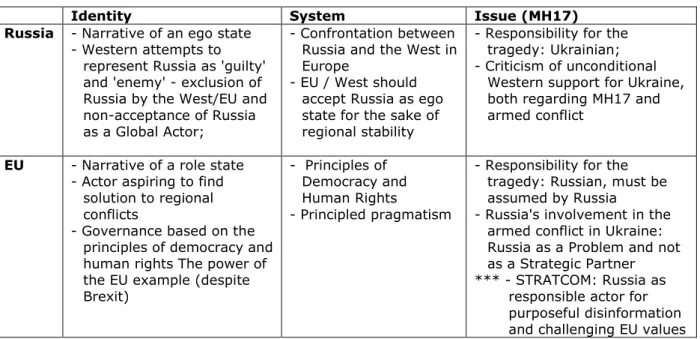
responsible for analysing the MH17 case. On the other hand, Russia has sought to use the incident as evidence that the West continues to push the country away from the centre of decisions, in particular because of its refusal to participate in the JIT (see Table 1). However, Russia's stance was not oriented towards cooperation; instead, a context has been created in which the JIT has been constantly confronted with new versions of the events leading up to the MH17 tragedy. In this section, we look at some important turning points in the development of the MH17-related process.
On 18 July 2014, a day after the MH17 crash, Ukrainian authorities revealed several tapes of conversations between Ukrainian separatists and Russian military officials about the crash (BBC, 2014). Although it was not possible to confirm their veracity, the suspicions raised from the first hour centred Russia's participation in the crash of the aircraft. This prompted a rapid reaction from the Russian government, which immediately took an accusatory stance on Ukraine's role in the case. In an official statement made on the same day, the Russian Ministry of Defence asserted that Russian air defence systems did not operate in that area on the day of the crash, implying that there would be Ukrainian forces with access to equal air defence units in the region, the same as those used to shoot down the plane, the BUK-TELAR (Russian Ministry of Defence, 2014). On 21 July, the same ministry held a press conference where it directly accused Ukraine of the disaster, notably through a model Su-25 Ukrainian fighter plane, allegedly sighted near the MH17 before the crash. According to the Bellingcat group, all hypotheses raised by Moscow "have been refuted by multiple sources, sometimes even by the evidence provided by the Russian government itself" (Toler, 2018). For several months after the disaster, the Russian narrative of events alternated mainly between these two versions: on the one hand, that the plane had been shot down by a Ukrainian army-controlled BUK system; On the other hand, the theory that it was a Ukrainian fighter plane to cause the fall of the MH17.
As early as June 2015, an analysis by Russian state-owned armament company Almaz-Antey claimed that the 9M38M1 missile, used to shoot down the MH17, had not been used by Russian forces since 1999 (Russia Today, 2015). This information came in line with the theory that the missile was operated by Ukrainian forces without Russian military personnel being involved in the process. Once again, the Bellingcat research group contested this information, bringing together a set of images showing how the Russian military continued to use the same type of missile (Higgins, 2015). In October of the same year, the Dutch Safety Board's (DSB)4 final report concluded that the MH17 was
indeed shot down by a Russian-made BUK system, even though it had no definitive conclusions as to who was responsible for shooting it (Dutch Safety Board, 2015). These results, though not definitive, again put the Russian government under fire. Once again, the Moscow narrative was one of denial, trying to convey the message that the West was trying to incriminate Russia without sufficient evidence (see Table 1).
3 The Joint Investigation Team was created after the fall of the MH17 in August 2014 to lead the criminal
investigation of the case. The group is made up of police and judicial forces from the Netherlands, Ukraine, Belgium, Malaysia and Australia.
4 The Dutch Safety Board was invited to participate in the MH17 criminal investigation by the National Bureau
In this context, the years following the incident were marked by a narrative battle in which the results raised by the DSB or JIT were quickly refuted by Russian officials, who sought to feed various theories about the plane crash, particularly the two referred to above. In September 2016, for example, the Russian Ministry of Defence presented radar images showing the alleged presence of Ukrainian air defence systems in the region where the MH17 had crashed, but without reference to the presence of Ukrainian military aircraft near the MH17, in contradiction to what had been said two years earlier at the press conference on 21 July 2014 (Higgins, 2016).
It appears, therefore, that Russia's attitude throughout the process has varied, demonstrating a serious inconsistency in its issue narrative dimension - notably as regards its concern with the issue of the BUK missile that shot down the MH17 and the details that involved its production process and transportation to Ukrainian territory. Moreover, in the identity narrative dimension, we can frame the Russian stance, in the context of Role Theory, as an ego state - especially in the context of its contesting stance on the work of the JIT, the attribution of responsibility to Ukraine, and the criticism of the EU as well as of the West for unconditional support for Ukraine (Telegraph 2014, see Table 1).
Although the case has lost some media attention since then, the May 2018 JIT report has once again focused attention on Russia's alleged role. Let us look at one of the main conclusions:
“Today, the JIT has concluded that the BUK-TELAR which was used to shoot down flight MH17 originated from the 53rd Anti-Aircraft Missile Brigade of the Russian armed forces. This observation raises questions, such as the question whether the Brigade itself was actively involved in the downing of flight MH17 on 17 July 2014. An important question, which the JIT is still investigating.” (Joint Investigation Team, 2018)
According to the argument put forward, the Russian military would have been directly involved in transporting the system used to shoot down the MH17, a narrative corroborated by the Bellingcat team. The Russian narrative, on the other hand, remains to be one of denial of any involvement in the case, reinforcing (recently) the accusatory stance towards Ukraine. In September 2018, the Russian army announced that the missile used to shoot down MH17 belonged to the Ukrainian military, having left Russian territory in 1986 (Vasilyeva, 2018).
On 19 June 2019, the JIT announced that criminal proceedings will be initiated in the Netherlands against four persons responsible for the MH17 flight tragedy.
The East Stratcom Task Force and the EU’s Response
The traditional EU’s difficulty to act with one voice towards Ukraine has increased in recent years by the growing campaigns of discrediting and disinformation promoted largely in the context of conflict by Russian-influenced media or the Kremlin itself. This is particularly relevant given the EU's inability to prevent its members from sometimes
having different or even contradictory positions (Karolewski and Cross, 2017, p. 148). Nevertheless, the fall of the MH17 initially boosted the EU's stance towards Russia, particularly through the tightening of sanctions imposed on Moscow and the assertiveness of some previously reluctant actors to harass Russia, with particular emphasis on the case of Germany. This change, brought about by the deaths of European citizens, has allowed the EU to attribute itself its own narrative as a prominent actor in the region, whose role is central to the resolution of the conflict, assuming its position as role state in the face of Russian involvement. The EU's strategic narrative stands out for its recognition that Russia is involved in the armed conflict in Ukraine, and calls on Russia to assume its responsibility for the MH17 tragedy (e.g. High Representative, 2018, 2019). However, particularly at the outset, the EU sought to move away from the 'narrative war' on the course of events leading to the fall of the MH17, without following the changes in the Russian narrative, or to highlight the serious inconsistency of this narrative in its official discourse. Eventually, this made the Russian strategic narrative maintain its projection, which was further reinforced by the surprising position of Mahathir Mohamad, Prime Minister of Malaysia, who in June 2019, contrary to the previous government's position, challenged the JIT conclusions by stating that the latter had no evidence of Russian involvement in the tragedy.
The EU’s stance - which focused on supporting the work of the EIC/JIT, considered 'essential' and conducted 'with independence, professionalism and impartiality' (High Representative, 2018) - went no further than this, ultimately weakening the issue narrative dimension of the EU’s strategic narrative, creating a misalignment with its narrative identity of an actor invested in the promotion and defence of human rights, values, and able to contribute to the resolution of an armed conflict, in line with the action of a role state (see Table 1).
The main way the EU found to counter Russian disinformation campaigns was the establishment in 2015 of the East Stratcom Task Force (ESTF), a team to monitor and document disinformation narratives that are somehow linked to Russia or related media groups operating in the Eastern European region. In its conclusions of March 2015, the European Council reiterated the “need to address continuing Russian disinformation campaigns” (European Council, 2015), which led to the writing of an Action Plan presented in June of that year. The importance the EU attaches to the ESTF is appreciated by its assessment of the systematization of 4500 cases of Russian disinformation by the Council in 2018 and the tripling of the ESTF budget in 2019 compared to that in 2018 (EEAS 2018). However, the ESTF position “cannot be considered the official position of the EU” (EEAS 2018).
Through a weekly publication entitled Disinformation Review and its EUvsDisinfo website, the ESTF seeks to analyse fake or biased news in favour of the Kremlin's official position. Unlike the EU, the ESTF takes a much more critical stance on Russia's role in the armed conflict in Ukraine. In the case of the MH17, the work conducted resulted in the publication of several articles that generally point to Russia as responsible for covering up the true cause and those responsible for the crash of the plane, with 'nine waves' of Russian disinformation directed at the MH17 case to be listed in one of the analysed examples (EUvsDisinfo 2017).
In another article on the subject, the team argues that “the Russian authorities have been conducting, together with the media, a disinformation campaign that they directly
and indirectly control in order to cover up the truth about who shot down the MH17 flight of the Malaysian Airlines in Eastern Ukraine” (EUvsDisinfo, 2018). A more recent article presents a chronological analysis of what is defined as “five years of pro-Kremlin disinformation campaigns” (EuvsDisinfo2019). This shows that the ESTF sees Russia not only as an “enemy” of MH17 research, but also as an obstacle to the EU's own values. If we compare this position with that of a certain official withdrawal from the EU regarding these disinformation campaigns, we find that there is a dissonance in the EU's strategic narrative, with a more thoughtful position and seeking to maintain an open line of dialogue with Russia; and another more assertive, which clearly identifies Russia as an antagonistic actor - the position of the ESTF. The latter better aligns the EU issue narrative and identity narrative as a normative actor in line with a role state, but is not accepted as an official EU strategic narrative.
Conclusions
The armed conflict that started in Ukraine in 2014 has proved to be a difficult obstacle for the EU in terms of foreign policy and international projection. The MH17 flight tragedy serves as the clearest example of this conflict as a combat stage, not only in military terms, but above all in political communication.
In the case of Russia, the response to the incident has ranged from a focus on issue narrative - notably as regards its concern with the issue of the BUK missile that shot down the MH17 and the details that involved its production process and transport to Ukrainian territory; and on a narrative identity that we can frame, in the context of the Role Theory, as an ego state - especially in the context of its stance on the JIT's work. The narrative dimensions presented turn out to be inconsistent and misaligned, but ultimately create a serious challenge for the projection of the EU's own narrative, which initially sought to move away from this war of narratives.
Table 1. Russian and EU strategic narratives regarding the MH 17: identity, system, issue
Identity System Issue (MH17)
Russia - Narrative of an ego state - Western attempts to
represent Russia as 'guilty' and 'enemy' - exclusion of Russia by the West/EU and non-acceptance of Russia as a Global Actor;
- Confrontation between Russia and the West in Europe
- EU / West should accept Russia as ego state for the sake of regional stability
- Responsibility for the tragedy: Ukrainian; - Criticism of unconditional
Western support for Ukraine, both regarding MH17 and armed conflict
EU - Narrative of a role state - Actor aspiring to find
solution to regional conflicts
- Governance based on the principles of democracy and human rights The power of the EU example (despite Brexit)
- Principles of Democracy and Human Rights
- Principled pragmatism
- Responsibility for the tragedy: Russian, must be assumed by Russia
- Russia's involvement in the armed conflict in Ukraine: Russia as a Problem and not as a Strategic Partner *** - STRATCOM: Russia as
responsible actor for purposeful disinformation and challenging EU values
Following the analysis presented here, we find that this withdrawal made it difficult to project a more assertive narrative, officially, a kind of "outsourcing" of the response to the Member States and the JIT taking place. The clearest answer comes as a result of the work of the ESTF and the “EU v. Disinfo”, although it is rarely incorporated into the EU’s position as an institution. The dissonance that results from this EU position ultimately weakens the issue narrative dimension of its strategic narrative, further creating incongruity with its narrative identity as an actor invested in the promotion and defence of human rights, values, and able to contribute to the peace in the region. We can conclude that the EU, while seeking to maintain its narrative identity as a role state in the region, has had difficulty fighting Russia's constant disinformation campaigns in the context of the fall of the MH17.
The aspiration to maintain its narrative identity did not result in the institution projecting a consistent and strong enough narrative, but it served as a kind of “testing ground” for the projection of new disinformation campaigns.
References
Ademmer, E., Delcour, L. and Wolczuk, K. (2016) ‘Beyond geopolitics: exploring the impact of the EU and Russia in the ‘contested neighborhood’’ Eurasian Geography and
Economics 57(1): pp. 1-18.
High Representative of the EU (2018). Statement by High Representative Federica Mogherini on behalf of the EU on the third anniversary of the shooting of the Malaysian Airlines flight MH17. Available at: https://www.consilium.europa.eu/pt/press/press-
releases/2018/07/17/declaration-by-the-high-representative-on-behalf-of-the- european-union-on-the-occasion-of-the-fourth-anniversary-of-the-downing-of-malaysian-airlines-flight-mh17/ (retrieved on: 21 August 2019).
BBC (2014) ‘MH17 crash: Ukraine releases alleged intercepts’, British Broadcasting Corporation, 18 July. Available at: https://www.bbc.com/news/world-asia-28362872 (retrieved on: 12 October 2018).
Bengtsson, R. and Elgstrom, O. (2011) ‘Reconsidering the European Union’s roles in international relations’ in Harnisch, S., Frank, C. e Maull, H. (eds) Role Theory in
International Relations: Approaches and Analyses. Oxford: Routledge, pp. 113-129.
Bennett, W. L. and Livingston, S. (2018) ‘The disinformation order: Disruptive communication and the decline of democratic institutions’ European Journal of
Communication 33(2): pp. 122-139.
Chaban, N. and Holland, M. (2014) ‘Introduction: The Evolution of EU Perceptions: From Single Studies to Systematic Research’ in Chaban, N. and Holland, M. (eds)
Communicating Europe in Times of Crisis: External Perceptions of the European Union.
Palgrave Macmillan, UK, pp. 1-23.
Cornell, S. E. (2014) ‘Underestimating yourself: the EU and the political realities of the eastern neighbourhood’ European View 13: pp. 115-123.
Delcour, L. and Wolczuk, K. (2018) ‘Well-Meaning but Ineffective? Perceptions of the EU’s Role as a Security Actor in the South Caucasus’ European Foreign Affairs Review 23(1): pp. 41-60.
Dragneva, R. and Wolczuk, K. (2016) ‘Between Independence and Integration: Ukraine’s Relations with Russia’ Europe-Asia Studies 68(4): pp. 678-698.
Dutch Safety Board (2015) ‘Crash of Malaysia Airlines flight MH17’, October 2015, Haia. Available at: https://www.onderzoeksraad.nl/en/page/3546/crash-mh17-17-july-2014 (retrieved on: 14 October 2018).
Office of the United Nations High Commissioner for Human Rights (2019). Report on the human rights situation in Ukraine 16 November 2018 to 15 February 2019. Available at: https://www.ohchr.org/Documents/Countries/
UA/ReportUkraine16Nov2018-15Feb2019.pdf (retrieved on: 21 July 2019).
EUvsDisinfo (2017). Time for the ninth MH17 disinformation round. Available at: https://euvsdisinfo.eu/time-for-the-ninth-mh17-disinformation-round/( retrieved on: 14 August 2019).
EuvsDisinfo (2018). MH17: Time is running out for disinformation. Available at: https://euvsdisinfo.eu/mh17-time-is-running-out-for-disinformation/ (retrieved on: 21 July 2019).
EUvsDisinfo (2019). Tracing Five Years of Pro-Kremlin Disinformation about MH17. Available at: https://euvsdisinfo.eu/tracing-five-years-of-pro-kremlin-disinformation-about-mh17/ (retrieved on: 21 August 2019).
Ferreira-Pereira, Laura C., and Alena Vieira (2015) ‘Ukraine in the European Union’s Partnership Policy: A Case of Institutionalized Ambiguity’ European Politics and Society 16(2): pp. 143-158.
Hannan, J. (2018) ‘Trolling ourselves to death? Social media and post-truth politics’
European Journal of Communication 33(2): pp. 1-13.
Harnisch, S. (2011) ‘Role Theory: Operationalization of key concepts’ in Harnisch, S., Frank, C. and Maull, H. (eds) Role Theory in International Relations: Approaches and
Analyses. Oxford: Routledge, pp. 7-15.
Higgins, E. (2015) ‘Evidence the Russian Military Supplied the Type of Missile Used to
Shoot Down MH17’, Bellingcat, 3 June. Available at:
https://www.bellingcat.com/news/uk-and-europe/2015/06/03/evidence-the-russian-military-supplied-the-type-of-missile-used-to-shoot-down-mh17/comment-page-1/ (retrieved on: 13 October 2018).
Higgins, E. (2016) ‘The Russian Defense Ministry Presents Evidence They Faked Their
Previous MH17 Evidence’, Bellingcat, 26 September. Available at:
https://www.bellingcat.com/news/uk-and-europe/2016/09/26/russian-defence-ministry-presents-evidence-faked-previous-mh17-evidence/ (retrieved on: 13 October 2018)
Joint Investigation Team (2018) ‘JIT MH17 Press Meeting’, 24 May, Utrecht. Available at: https://www.om.nl/onderwerpen/mh17-vliegramp/
Karolewski, I. P.and Cross, M. K. (2017) ‘The EU’s Power in the Russia-Ukraine Crisis: Enabled or Constrained?’ JCMS 55(1): pp. 137-152.
Khaldarova, I. (2016) ‘Strategic Narratives of the Ukraine Conflict Projected for Domestic and International Audiences by Russian TV Channels" in Pantti, M. (Ed.). Media and the Ukraine Crisis: Hybrid Practices and Narratives of Conflict. New York: Peter Lang, 124-138.
Khaldarova, I. and Pantti, M. (2016) ‘Fake News: The narrative battle over the Ukrainian conflict’ Journalism Practice 10(7): pp. 981-901.
Klose, S. (2018) ‘The emergence and evolution of an external actor’s regional role: An interactionist role theory perspective’ Cooperation and Conflict: pp. 1-16.
Kuzio, T. (2017) ‘Ukraine between a Constrained EU and Assertive Russia’ JCMS 55(1): pp. 103-120.
Lucarelli, S. (2014) ‘The EU’s Leadership in Global Governance: Perceptions from the others’ in Chaban, N. e Holland, M. (eds) Communicating Europe in Times of Crisis:
External Perceptions of the European Union. Palgrave Macmillan, UK, pp. 45-64.
Mejias, U. A. and Vokuev, N. E. (2017) ‘Disinformation and the media: the case of Russia and Ukraine’ Media, Culture & Society 39(7): pp. 1027-1043.
Russian Ministry of Defence (2014) ‘Official statement from the Russian Defence Ministry in connection with Boeing 777 crash’, 18 July, Moscow. Available at:
https://www.globalresearch.ca/mh-17-crash-in-ukraine-official-statement-from-russian-defense-ministry/5392000 (retrieved on: 12 October 2018).
Miskimmon, A., O’Loughlin, B. and Roselle, L. (2013) Strategic Narratives:
Communication Power and the New World Order. New York, Routledge.
Miskimmon, A. (2017) ‘Strategic narratives of EU foreign policy and the European Neighbourhood Policy’ in Schumacher, T., Marchetti, A. and Demmelhuber, T. (eds) The
Routledge Handbook on the European Neighbourhood Policy. Oxford: Routledge, and New
York: Routledge, pp. 153-166.
Nabers, D. (2011) ‘Identity and role change in international politics’ in Chaban, N. and Holland, M. (eds) Communicating Europe in Times of Crisis: External Perceptions of the
European Union. Palgrave Macmillan, UK, pp. 74-92.
Natorski, M. and Pomorska, K. (2017) ‘Trust and Decision-making in Times of Crisis: The EU’s Response to the Events in Ukraine’ JCMS 55(1): pp. 54-70.
Nitoiu, C. (2018) ‘The European Union’s ‘Ideal Self’ in the Post-Soviet Space’ Europe-Asia
Studies 70(5): pp. 692-710.
Roselle, L., Miskimmon, A. and O’Loughlin, B. (2014) ‘Strategic Narrative: A New Means to Understand Soft Power’ Media, War & Conflict 7 (1): pp. 70–84.
Samokhvalov, V. (2015) ‘Ukraine between Russia and the European Union: Triangle Revisited’ Europe-Asia Studies 67(9): pp. 1371-1393.
Swimelar, S. (2017) ‘Deploying images of enemy bodies: US image warfare and strategic narratives’ Media, War & Conflict 11(2): pp. 179-203.
Szostek, J. (2017) ‘The Power and Limits of Russia’s Strategic Narrative in Ukraine: The Role of Linkage’ Perspectives on Politics 15(2): pp. 379-395.
Szostek, J. (2018) ‘Nothing is True? The credibility of News and Conflicting Narratives during ‘Information War’ in Ukraine’ The International Journal of Press/Politics 23(1): pp. 116-135.
Telegraph (2014) MH17 plane crash: Russia's UN ambassador accuses the world of taking
Ukraine's side, Available at: https://www.telegraph.co.uk/
news/worldnews/europe/russia/10977407/MH17-plane-crash-Russias-UN-ambassador-accuses-the-world-of-taking-Ukraines-side.htm (retrieved on: 21 August 2018).
Russia Today (2015) ‘MH17 likely downed by old BUK-M1 missile system not used by
Russia – manufacturer’, Russia Today, 3 June. Available at:
https://www.rt.com/news/264421-buk-missile-manufacturer-investigation/ (retrieved on: 13 October 2018).
Toler, A. (2018) ‘The Kremlin’s Shifting, Self-Contradicting Narratives on MH17’, Bellingcat, 5 January. Available at: https://www.bellingcat.com/news/uk-and-europe/2018/01/05/kremlins-shifting-self-contradicting-narratives-mh17/ (retrieved on: 13 October 2018).
Wagnsson, C. and Hellman, M. (2018) ‘Normative Power Europe Caving In ‘EU under Pressure of Russian Information Warfare’ JCMS 56(5): pp. 1161-1177.
Walker, S. G. “Role Theory and the Origins of Foreign Policy.” In New Directions in the Study of Foreign Policy. Edited by Charles F. Hermann, Charles W. Kegley, and James N. Rosenau, 269–284. London: Harper Collins, 1987.
Wolczuk, K. (2016). ‘Ukraine and Europe: Reshuffling the borders of order’ Thesis Eleven 136(1): pp. 54-73.
Wolzcuk, K. (2017) ‘Ukraine in the European Neighbourhood Policy’ in Schumacher, T., Marchetti, A. and Demmelhuber, T. (eds) The Routledge Handbook on the European
Neighbourhood Policy. Oxford: Routledge, and New York: Routledge, pp. 279-288.
Vasilyeva, N. (2018) ‘Russia: Missile that shot down flight MH17 was Ukrainian’,
Associated Press, 17 September. Available at:
https://www.apnews.com/f53b42ce3aab44308730eb2d89c9e545 (retrieved on: 13 October 2018).
Zeitzoff, T. (2017) ‘How Social Media is Changing Conflict’ Journal of Conflict Resolution 61(9): pp. 1970-1991.