Ar
ti
cl
e
0103 - 5053 $6.00+0.00
*e-mail: [email protected]
DDT in Fishes and Soils of Lakes from Brazilian Amazon: Case Study of
Puruzinho Lake (Amazon, Brazil)
Giselle C. Saldanha,a,b Wanderley R. Bastos,b João Paulo M. Torres*,a and Olaf Malma
aEduardo Penna Franca Radioisotope Laboratory, Federal University of Rio de Janeiro, Centro de Ciências da Saúde, bloco G, Subsolo, sala 61, Ilha do Fundão, 21941-902Rio de Janeiro-RJ, Brazil
bWolfgang C. Pfeiffer Environmental Biochemistry Laboratory, Federal University of Rondônia, Rodovia BR-364, km 9,5 Sentido Acre, 78900-500 Porto Velho-RO, Brazil
Foram quantiicadas as concentrações de DDT em peixes e 20 pontos de solos ao longo do lago Puruzinho. A determinação dos poluentes consistiu em quatro etapas consecutivas: extração, “clean-up”, fracionamento e injeção automática em cromatógrafo gasoso acoplado a um detector de captura de elétrons (CG-DCE). Em relação as amostras de peixes foram realizados os testes para avaliação da distribuição normal dos teores de compostos em peixes ou solos de Shapiro-Wilk (distribuição dos compostos) e o teste de Kruskal-Wallis para variáveis independentes (distribuição dos compostos entre os hábitos alimentares). Os resultados de ∑DDT nos peixes (ng g-1 peso seco) variaram de 0,3 a 71,4. As concentrações de ∑DDT nos solos das casas variaram de 2,0 a 55,4 ng g-1, enquanto que nos solos lorestais foram obtidos valores entre 1,6 e 13,3 ng g-1. Para o cálculo de normalidade dos compostos entre as amostras de solos foi utilizado o teste de Shapiro-Wilk (p < 0,001 = para solos das casas e p < 0,007 = para os solos lorestais). Posteriormente também foi aplicado o teste U de Mann-Whitney para comparação de distribuição dos compostos entre as amostras das casas e de loresta (p > 0,290).
DDT concentrations had been quantiied in ishes and at 20 points along the “Puruzinho” lake. The determination of pollutants in the samples consisted in four consecutive steps: extraction, clean-up, fractionation and automatic injection in high resolution gas chromatography coupled to an electron capture detector. The ∑DDT results in ishes (ng g-1 dry weight) ranged from 0.3 to 71.4. The concentrations of ∑DDT on house soils varied from 2.0 to 55.4 ng.g-1 while forest soils the obtained values were between 1.6 e 13.3 ng g-1. The Shapiro-Wilk test showed that the distribution was not normal for both the results of the soil of the houses (p < 0.001) as well as for the forest soils (p < 0.007). The U test of Mann-Whitneyreveled that there were no signiicant difference between the results obtained for both houses and forest soils (p > 0.290).
Keywords: DDT, metabolites, ishes, soils, Amazon
Introduction
Dichlorodiphenyltricloroethane (DDT), synthesized in 1874, was the irst of the synthetic insecticides when it was rediscovered in 1939 to be used as a mothproof agent in wool. Since them it was largely used both in agriculture and in disease vector control against malaria, yellow fever and leishmaniasis. The irst one is considered to be the one of the main focal disease of the world. At the Amazon region it is classiied as an endemic disease.1
In 1965, the combat of malaria in Brazil was based on the creation of the campaign for the eradication of malaria (EMC), the Amazon applying a strategy based on intra application of DDT. However, the characteristics of the Amazon region, dominated by precarious housing, non regular wall surfaces that do not allows a proper and correct application of DDT, put under the risk of failure the conventional strategy, which then were conirmed.2
Around 1970 the use of DDT was banned at most of the developed world due to its toxicity, environmental persistence and insect resistance.3-5 The physic-chemical
as well as to the other organochlorine compounds make them to be readily absorbed by the organisms. The accumulation rate varies among the species and maybe related to the environmental concentration at a given time, to the overall conditions of the site as well as to the time trend of the exposure.
The aquatic biota is an important reservoir of DDT, its metabolites and other organochlorines compounds and is a consequence of the biomagniication process along the food chains.6 In animals the degradation of DDT
follow mainly the dehydrochlorination step via DDE (dichlorodyphenildichloroethylene) formation, but it may also degraded to DDD (dichlorodyphenyldichloroethane) in a minor scale.7
Organochlorine residues have contaminated practically all of the ecosystems and they are often found in the most varied environmental matrices. Researchers recently found the organic pollutants moving through the atmosphere from its sources located in warmer areas of the globe and showed that they may condense when the air masses reach the colder regions, leading the pollutant to precipitation over soils, vegetation and water courses.8
The transport of DDT through the soils systems may also occur by colloidal transportation, via solvents and by biosorption. However the mobility of DDT is somewhat low due to its lack of solubility in water and high afinity to clay and silt and other mineral surfaces, especially when covered by organic matter ilms.9
In the tropics the permanence of DDT is expected to be shorter, rendering to high evaporating and degradation rates by microorganisms. DDT can disappear more rapidly during loods, but this escape also occurs in dry conditions. Soil type and pH seems to govern such phenomena, with acidic soils rendering a longer half life for tropical soils. In general, in temperate soils the half life is estimated to be greater than 5 years or more.10
Experimental
Study area
The “Puruzinho” Lake is located at “Humaitá” municipality in the utmost south region of the Amazonas State in Brazil (Figure 1). It is formed by the “Puruzinho” River watershed and it is located around 5 km from its mouth at the left margin of the “Madeira” River, one of the most important tributaries of the right margin of the Amazon River. The lake’s area corresponds to 38 km2 and
its perimeter was calculated in 23.195 m.11
In the high water period (rainy season, December-May), the majority of lakes and streams of the “Madeira”
River basin has its levels inluenced by the waters of the “Madeira” River, both directly (in places where the river invades the streams), as indirectly (where it prevents the disposal of surface water), forming temporary lakes. During the period of increased drought (dry season, August-November), as the lakes “Puruzinho” remain attached to the “Madeira” River by a small channel, but it’s water level decreases sharply compared to the period of high waters. This condition is typical in the Amazon.
The “Puruzinho” Lake was selected for this study basically because it gathers the following characteristics: (i) it represents a place with singular importance for environmental studies of the dynamics of persistent organic pollutants in particular DDT, due to its lacustrine conditions; (ii) the region has a historical spraying of DDT to control vectors and (iii) it is part of a larger study conducted by the team of the laboratory of Environmental Biogeochemistry in the analysis of breast milk showed the DDT.12
Material and Methods
The ish samples were collected at the “Puruzinho” Lake using ishing nets. The ishes were captures using 10 m long nets, with different sizes (30, 40, 50, 60, 70, 80, 90, 100 and 120 mm). In total were installed at every sampling point, three of this nets that were checked every four hours during 24 h. The process of catching ish was approved by the department of fauna and ishing resources of the Brazilian institute of environment and natural resources (IBAMA-DIFAB) through the authorization No. 091.
the samples were from a “A” soil horizon layer and where collected using acetone rinsed metallic devices and where stored in acetone washed wide mouth glass jars closed with metal caps over an aluminum foil protection.
The determination of the persistent organic pollutants in both kind of samples followed the method described by Japenga and co-workers,13 modiied by Torres.14 It consists
of four distinct consecutive steps: extraction (modiied continuous soxhlet for fishes samples and ultrasonic device for soils samples), clean-up(acid digestion of fat using sulfuric acid for ishes and desulphurization using sodium sulite adsorbed to alkaline alumina for soils), fractionation (dry silica gel column) and automatic injection of 2 μL (Shimadzu AOC-17, split less) high resolution gas chromatography coupled to an electron capture detector (Shimadzu GC-14B). All reagents used in this study were purchase from Merck (Pesticide Residue Analysis).
We used ultra-pure hydrogen (35 mL min-1) trough the
SE-30/SE-52 capillary columns (25 m; 0.2 mm i.d.; 0.25 μm ilm thickness) and ultra-pure N2 was the make-up gas. The injector and the detector temperatures were set in 300 and 310 °C, respectively. For quantiication, an internal standard OCN (octachloronaphtalene) was added prior injection.
Statistical analysis
To perform the basic descriptive analysis we used the software STATISTICA (version 6.0) and Microsoft Excel®.
For the estimation of normal compounds distribution in soil samples from houses and jungles the Shapiro-Wilk test was performed. Later we also applied the U test of Mann-Whitney for comparison of distribution of compounds between the samples of houses and forest soils.
For ish samples we realized the test of Shapiro-Wilk normality to assess whether distribution of the compound was normal. In order to compare the distribution of compounds between diet was used the Kruskal-Wallis test for independent variables. The signiicance level (α) used was 5%.
Results and Discussion
Fish samples
The work for the determination of the DDT and its metabolites concentration were realized in 86 specimens of 21 different ish species collected at the “Puruzinho” Lake in march of 2005 (Table 1). All of the analyzed samples presented residues of ∑DDT below the maximum limits recommended by the US-FDA in 2002 (United States Food and Drug Administration: 5 mg kg-1 or ppm).15
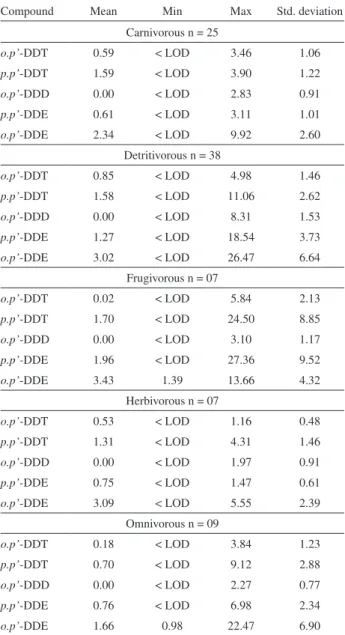
The basic descriptive analysis was performed between the compounds analyzed considering the different feeding habits (carnivorous, detritivorous, frugivorous, herbivorous and omnivorous) of the species examined. The results are shown in Table 2.
In the present work the minimum quantity of ∑DDT (o,p’-DDT, p,p’ -DDT, p,p’-DDD and p,p’-DDE, o,p’-DDE) detected by the used technique was 0.6 ng g-1 while the
maximum one was 71.6 ng g-1. The results are quite similar
to those found by D’Amato16 in ishes collected in 1991
(14.0 to 71.1 ng g-1) and higher to the ones collected in
2000 (6.5 to 16.7 ng g-1) .
The Shapiro-Wilk test was performed and the value p << 0.01 was found. To compare the effect of compound (quantitative variables) between different dietary habits (qualitative variables) all distributions were considered free, non-parametric.
The test used to compare independent variables was the Kruskal-Wallis test. The results were: no signiicant difference between eating habits for the o,p’-DDT, p,p’ -DDT, p,p’-DDD and p,p’-DDE, where 0.75 < p < 0.92 and found a signiicant difference for the isomer o,p’-DDE where p = 0.045. Table 1. Fishes collected in “Puruzinho” Lake/AM, 2005
Species Vulgar name Habit n
Acestrohynchus falsitrostis Peixe Cachorro Carnivorous 01
Ageneiosus beviilis Mandubé Carnivorous 03
Bourengela maculata Bicuda Carnivorous 08
Cichla monoculus Tucunaré Carnivorous 01
Cichlasoma sp Cará Omnivorous 01
Catoprion mento Pacú Piranha Omnivorous 01
Geophagus sp Acará Omnivorous 01
Hemiodus maculatos Charuto Herbivorous 03
Hoplias Malabaricus Traíra Carnivorous 08
Hydrolicus armatus Pirandirá Carnivorous 01
Laemolita próxima Piau Herbivorous 04
Mylossoma aureum Pacu Frugivorous 03
Mylossoma duriventre Pacu Frugivorous 04
Oxydoras sp Bacu Detritivorous 04
Plagiosum sp Pescada Carnivorous 01
Potamorihna altamazonica Chora Detritivorous 10
Potamorihna latior Chora Detritivorous 20
Psictogaser sp Branquinha Detritivorous 04
Schizodas fasciatum Piau Omnivorous 03
Surubim lima Bico de Pato Carnivorous 02
Triportheus lavus Sardinha Omnivorous 03
Total 86
The ratio DDT/DDE found at the present work was 0.49 (mean) and demonstrated that the residues are old and the ratio is lowering. This trend is clearly observed when we compare the present results with the ones of D’Amato16 1.53 (1991)
and 1.58 (2000) in ishes obtained at the local Market of “Humaitá”/Amazon, the municipality where the “Puruzinho” Lake belongs.
To observe the biomagniication phenomenon, where carnivorous ish with a diet had higher concentrations of DDT and its metabolites than those of non-carnivorous feeding habit, we also took the Kruskal-Wallis test for the values of ∑DDT and was observed p = 0.39 which indicated that there was no signiicant difference between eating habits for the total DDT.
Among the ishes with predatory habits the highest concentration of ∑DDT found was 14.1 ng.g-1 (Acestrorincus
falcirostris - Urubarana), while the species that eat preferentially fruits (frugivorous) or detritus (detritivorous) presented maximum values of 71.4 ng g-1 and 50.7 ng g-1,
respectively. The specie that presented the highest levels of ∑DDT was Potamorihna latior (n = 20).
Soils samples
The concentrations of ∑DDT on house soils varied from 2.0 a 55.4 ng g-1 while forest soils the obtained values were
between 1.6 and 13.3 ng g-1. The result of the descriptive
analysis is shown on Table 3.
First we performed the test of normality of Shapiro-Wilk, which sought to assess whether if the distribution of compounds (o,p’-DDE, p,p’-DDE, p,p’-DDD, o,p’-DDT and p,p’-DDT) was normal between samples of soils. The Shapiro-Wilk test showed that the distribution was not normal for both the results of the soil of the houses (p < 0.001) as well as for the forest soils (p < 0.007).
For comparison purposes the composite soil between the house and forest, all distributions were considered free, non-parametric. The test used to compare the samples was the U test Mann-Whitney. The results were: p > 0.290 compounds for p,p’-DDE, o,p’-DDE, p,p’-DDD and p,p’-DDT and p < 0.027 for the o,p’-DDT.
With the exception of the isomer o,p’-DDT, there was no signiicant difference between the houses and compounds in the forest. This results may be explained the fact that
p,p’-DDT isomer correspond to 77.1% of the constitution of the insecticide.6,10
Table 2. Concentrations of DDT (ng g-1) and its metabolites in ish of different feeding habits of “Puruzinho” Lake-Amazon, 2005
Compound Mean Min Max Std. deviation
Carnivorous n = 25
o.p’-DDT 0.59 < LOD 3.46 1.06
p.p’-DDT 1.59 < LOD 3.90 1.22
o.p’-DDD 0.00 < LOD 2.83 0.91
p.p’-DDE 0.61 < LOD 3.11 1.01
o.p’-DDE 2.34 < LOD 9.92 2.60
Detritivorous n = 38
o.p’-DDT 0.85 < LOD 4.98 1.46
p.p’-DDT 1.58 < LOD 11.06 2.62
o.p’-DDD 0.00 < LOD 8.31 1.53
p.p’-DDE 1.27 < LOD 18.54 3.73
o.p’-DDE 3.02 < LOD 26.47 6.64
Frugivorous n = 07
o.p’-DDT 0.02 < LOD 5.84 2.13
p.p’-DDT 1.70 < LOD 24.50 8.85
o.p’-DDD 0.00 < LOD 3.10 1.17
p.p’-DDE 1.96 < LOD 27.36 9.52
o.p’-DDE 3.43 1.39 13.66 4.32
Herbivorous n = 07
o.p’-DDT 0.53 < LOD 1.16 0.48
p.p’-DDT 1.31 < LOD 4.31 1.46
o.p’-DDD 0.00 < LOD 1.97 0.91
p.p’-DDE 0.75 < LOD 1.47 0.61
o.p’-DDE 3.09 < LOD 5.55 2.39
Omnivorous n = 09
o.p’-DDT 0.18 < LOD 3.84 1.23
p.p’-DDT 0.70 < LOD 9.12 2.88
o.p’-DDD 0.00 < LOD 2.27 0.77
p.p’-DDE 0.76 < LOD 6.98 2.34
o.p’-DDE 1.66 0.98 22.47 6.90
< LOD: below the limit of detection of the method.
Table 3. DDT and its metabolites concentrations (ng g-1) in house and forest soils of the “Puruzinho” Lake-Amazon, 2005
Average Min Max Std. deviation
House soils n = 10
o.p’-DDE 7.48 0.85 31.02 9.56
p.p’-DDE 1.01 < LOD 6.23 1.96
p.p’-DDD 6.96 < LOD 55.79 17.30
o.p’-DDT 7.26 < LOD 38.12 12.06
p.p’-DDT 8.39 < LOD 70.80 22.04
Forest soils n = 10
o.p’-DDE 3.09 0.71 7.18 1.75
p.p’-DDE 0.70 0.02 2.19 0.84
p.p’-DDD 0.47 0.22 0.81 0.20
o.p’-DDT 0.44 < LOD 2.37 0.92
p.p’-DDT 0.43 < LOD 1.28 0.40
The p,p’-DDD/p,p’-DDE ration in house soils (mean = 3.85) and for forest soils (mean = 1.87) were high when we compared this results to the previous work of Vieira17 at a location with a known history of
DDT utilization. In this work, surface soils, from high areas located on the hills, were collected at rural areas of “Jacarepagua”, located at Rio de Janeiro City were 0.06 (1997) and 0.09 (1999). On the one hand, this results were expected since our sampling occurred during the rainy season, with high index of heavy rains in this region. Our study conirms the previous work of Parr and Smith18 and
Ramesh et al. 19 that demonstrated that DDT degradation
to DDD is mediated by anaerobic bacteria and fungus present in reductive environments, that may be the case of the Amazon soils during the rainy season. However, this interpretation must be taken with caution since no other soil parameters were measured in the present work. More work in this or in related areas should be done in the dry season to further investigate this degradation patterns and overall half life subjects.
The DDT/DDE ration can be used as an estimative of the time trend of DDT application. The present study of the “Puruzinho” Lake we have found mean ratios of 1.86 for the house soils and 0.85 for the forest soils. The mean value for the soil of the houses is similar to the one found by Vieira and co-workers,3 1.91 in 1997 and 1.19 in 1999.
However these results are higher than the previous ratios reported by Torres,14 in a study using urban soils collected
in some towns along the “Madeira” River. These high ratios may be due do recent reported uses of DDT against termites that commonly attack the local wooden houses.
Conclusions
The ishes that have a detritivorous habit presented the highest concentrations of ∑DDT on its lesh when it was expected that the carnivorous ones would have more residues due to the biomagniication process.
Taken in account the fact that the highest concentrations were found on non-predatory detritivorous ish that are particularly eaten by the traditional riverine population, one question comes to our minds: at what point should we consider them at risk of being ill because of this pesticide? Does DDT represent a real menace to this people?
The DDT concentrations at both forest and house soils are irregularly distributed showing a somewhat erratic distribution and behavior of pesticide in the study area.
The eficacy of DDT on the malaria vector control in urban areas is unquestionable, since DDT was the synthetic molecule that had saved more lives along the last century. However, the study area is not urbanized and the huts
were the people live, are not more that temporary housing made of wood and palm leaves. Thus, better housing may represent may be a better solution to improve their life quality and this may make a difference at such a place where people get malaria three times per year.
Acknowledgments
The authors are indebted to the Puruzinho Lake community. This work was supported by CNPq, CAPES, FAPERJ, ITREOH Fogarty-NIH/USA Grant No.: 1D43TW00640, MCT-CT-Amazônia and CNPq-PPG-7-Phase II. Special thanks to the ield team of the UNIR-UFRJ agreement (PR-5 No.: 01-2002).
References
1. Barata, R. de C.; Cad. Saúde Pública1995,11, 128; http://www.
scielo.br/pdf/csp/v11n1/v11n1a11.pdf, accessed in October 2009.
2. Loiola, C. C. P.; Silva M., C. J.; da Tauil, P. L.; Rev. Panam.
Salud Publica; Pan. Am. J. Pub. Health2002, 11, 235; http://
www.scielosp.org/pdf/rpsp/v11n4/10469.pdf, accessed in October 2009.
3. Vieira, E. D. R.; Torres, J. P. M.; Malm, O.; Environ. Res.2001,
86, 174.
4. Carlson R.; Silent Spring, Houghton Miflin Co.: New York, 2002.
5. Curtis, C. F.; Lines, J. D.; Paras. Today 2000, 16, 119. 6. WHO (World Health Organization), Environmental Health
Criteria 83, Finland, 1989.
7. D’Amato C.; Torres, J. P. M.; Malm. O.; Quim. Nova2002, 25, 995.
8. Simonich, S. L.; Hites, R. A.; Science1995, 269, 1851. 9. Morrison, R.D.; Newell, A. E.; J. Soil Cont.1999, 8, 63. 10. ATSDR, Toxicological, Proile for DDT, DDE and DDD, U.S.
Department of Health and Human Services, Public Health Service 2002, 497; http://www.atsdr.cdc.gov/toxproiles/tp35.
pdf, accessed in October 2009.
11. Almeida, R. de; MSc Dissertation, Universidade Federal de Rondônia, Brazil, 2006.
12. Azeredo, A.; Sarcinelli, P.N.; Fonseca, M.F.; Saldanha, G.C.; Meire, R.O.; Rebelo, M.F.; Bastos, W.R.; Malm, O.; Luz, C.; Marowitz, S.; Chemosphere2008, 73, S246.
13. Japenga, J.; Wagenaar, W. J.; Smedes, F.; Salomons, W.;
Environ. Tech. Lett. 1987, 8, 9.
14. Torres, J. P. M.; Malm, O.; Vieira, E. D. R.; Japenga, J.; Koopmans, G.; Ciência e Cultura1999, 51,54.
16. D’Amato, C.; Torres, J. P. M.; Malm, O.; Oecologia Brasiliensis
2007, 11, 202; http://www.oecologiaaustralis.org/ojs/index.php/ oa/article/view/179/105, accessed in October 2009.
17. Vieira, E. D. R.; Torres, J. P. M.; Malm, O.; Environ. Res.2000,
86,174.
18. Parr, J.F.; Smith, S.; Soil Sci.1974, 118, 45.
19. Ramesh A.; Tanabe, S.; Tatsukawa, R.; Environ. Pollut. 1989,
62, 213.