Article
J. Braz. Chem. Soc., Vol. 25, No. 12, 2385-2391, 2014. Printed in Brazil - ©2014 Sociedade Brasileira de Química 0103 - 5053 $6.00+0.00
A
*e-mail: [email protected]
#Present address: Departamento de Química, Universidade Federal do
Paraná (UFPR), 81531-990 Curitiba-PR, Brazil
Aqueous Micelles as Catalytic Nanoreactors for Dephosphorylation Reactions
Eduardo H. Wanderlind, Elisa S. Orth,# Michelle Medeiros, Deise M. P. O. Santos, Eduard Westphal, Hugo Gallardo, Haidi D. Fiedler and Faruk Nome*
Instituto Nacional de Ciência e Tecnologia de Catálise em Sistemas Moleculares e Nanoestruturados (INCT-Catálise), Departamento de Química, Universidade Federal de Santa
Catarina (UFSC), 88040-900 Florianópolis-SC, Brazil
A reação entre um novo derivado de imidazol, 3,5-bis((1H-imidazol-1-il)metil)anilina (BIm), e o triéster de fosfato dietil 2,4-dinitrofenil fosfato (DEDNPP), que procede por um mecanismo SN2(P), é substancialmente acelerada em presença do surfactante catiônico brometo de cetiltrimetrilamônio (CTAB) e do surfactante aniônico dodecil sulfato de sódio (SDS). Tal efeito micelar atípico ilustra o emprego de efeitos hidrofóbicos dos reagentes para otimizar o efeito catalítico de micelas aquosas. Tal observação é importante e útil no planejamento de modelos miméticos de reações biológicas, já que a melhoria da incorporação dos reagentes aumentará efetivamente a qualidade dos sistemas biomiméticos, sendo que ambos os surfactantes catiônico e aniônico poderão atuar como nanoreatores homogêneos, concentrando os reagentes neutros hidrofóbicos.
The reaction of a new imidazole derivative, 3,5-bis((1H-imidazol-1-yl)methyl)aniline (BIm), and the model triester diethyl 2,4-dinitrophenyl phosphate (DEDNPP), which proceeds via a SN2(P) mechanism, is substantially enhanced in the presence of either cationic cetyltrimethylammonium bromide (CTAB) or anionic sodium dodecyl sulfate (SDS). This unusual micellar effect illustrates the use of the hydrophobic character of the reactants to enhance micellar catalysis. This is an important and useful guideline in planning mimics for biological reactions, because improving incorporation will increase the quality of the biomimetic systems, and both cationic or anionic surfactants will act as homogeneous nanoreactors concentrating the neutral, hydrophobic reactants.
Keywords: dephosphorylation, imidazole, nucleophilic catalysis, micellar catalysis
Introduction
Imidazole is a versatile group involved in highly efficient enzymatic reactions as a general acid, general base and/or nucleophile. The histidine imidazole plays a fundamental role in many phosphoryl transfer reactions such as the cleavage of RNA, catalyzed by RNAse A.1 Additionally, cellular signaling processes involve rapid and reversible phosphohistidine formation, via nucleophilic attack by neutral imidazole on phosphorus.2 Thus, considering the diverse pathways in which imidazole participates, different mechanisms have been proposed and biomimetic models have been developed to better elucidate these reactions.3,4 The literature is
particularly rich in models of general acid-base catalysis promoted by imidazole, but mimics of nucleophilic reactions are less abundant, and we reported previously simple intramolecular models, with rate enhancements of about 106- to 109-fold and mechanisms including general acid-base and nucleophilic pathways.5-7
Microheterogeneous environments have been developed for catalysis of dephosphorylation reactions, typically comprising hydrophobic negatively charged alpha-nucleophiles in cationic micellar media,9-14 which allow the exploration of properties such as counterion binding to improve experimental rate enhancements.15-17 Similarly, metallomicelles show significant rate increases and the results further comprehension of the role of metal ions in enzymes.18 However, imidazole reactions are not particularly easy to catalyze by the addition of aggregates such as micelles, due to the high water solubility of imidazole, which disfavors its incorporation into the micellar phase. To study the effect of micellar media on these particular reactions, we synthesized a new imidazole derivative, 3,5-bis((1H-imidazol-1-yl)methyl)aniline (BIm), which readily incorporates to aqueous micelles, and are known to efficiently accelerate nucleophilic reactions of phosphate esters.19,20 We report the reaction of DEDNPP with BIm (Scheme 2) in micellar environments and examine in detail the effect of the ionic surfactants cetyltrimethylammonium bromide (CTAB) and sodium dodecyl sulfate (SDS).
Experimental
Materials
The phosphate ester DEDNPP was synthesized by standard methods as previously described.21 The surfactants SDS (Sigma) and CTAB (Sigma) were the best available reagent grade and purified as described elsewhere.22 All other inorganic and organic reagents were of the best available analytical grade from commercial sources (Merck, Aldrich, Fluka and Acros Organics) and used as received. Doubly deionized water, conductance < 5.6 × 10⁻⁸Ω-1 cm-1 and pH 6.0-7.0, from a NANOpure analytical deionization
system (type D-4744) was used to prepare the standard and reagent solutions. The synthetic route to obtain the novel imidazole derivative is described in the Supplementary Information along with the characterization data.
Potentiometric titration
The pKa values of BIm in water and CTAB aqueous micellar medium at 25 °C were determined by potentiometric titration. The pH was measured with a Metrohm 713 pH meter and the glass electrode was calibrated against standard buffers, at 25.0 ± 0.1 ºC. Titrations were performed in a 150 mL thermostatted stirred cell under N2 at 25 °C. The solutions were titrated with small increments of CO2-free KOH, and all precautions were taken to eliminate carbonate and CO2 during the procedure.
Kinetics
Reactions were followed spectrophotometrically b y m o n i t o r i n g t h e a p p e a r a n c e o f t h e p r o d u c t 2,4-dinitrophenolate. Reactions were started by adding 20 µL of stock solution of 5.0 × 10⁻³ mol L-1 DEDNPP (in acetonitrile) to 3 mL of solution in quartz cuvettes to give the final substrate concentration of 3.33 × 10⁻⁵ mol L-1. In the reactions with BIm, the imidazole derivative was in excess to guarantee pseudo first-order kinetics with respect to the substrate. The temperature of reaction was maintained with a thermostatted water-jacketed cell holder, and the pH was maintained with 0.01 mol L-1 of the buffers citric acid (pH 3-3.5), acetic acid (pH 4-5.5), sodium dihydrogen phosphate (pH 6-7.5), 2-amino-2-hydroxymethyl-propane-1,3-diol (TRIS, pH 8-9) and potassium hydrogen carbonate (pH 9.5) in the reactions in aqueous medium, and 0.01 mol L-1 of biological buffers 2-[bis(2-hydroxyethyl) amino]-2-(hydroxymethyl)-1,3-propanediol (BIS TRIS, pH 6-7) and TRIS (pH 7-9) in the reactions in micellar media. Absorbance vs. time data were stored directly on a microcomputer, and observed first-order rate constants,
kobs, were calculated, using absorbance changes obtained for at least 90% of the reaction, using an iterative least-squares program; correlation coefficients were > 0.999 for all kinetic runs. For the deuterium solvent isotope effect, pD was corrected by the relation pD = pH + 0.4, at 25 °C.
Results and Discussion
Titration studies
BIm has three amino groups that form four species with potentially different reactivities and potentiometric titration + 2.4-DNPO
-P
EtO
EtO N N
O P OEt O
OEt NO2 O2N
DEDNPP
H N
N +
Im
P O EtO
O -EtO
- Im
Phosphorylimidazole derivative
O
Scheme 1. Imidazole-promoted dephosphorylation of DEDNPP.
2,4-DNPO– is 2,4-dinitrophenolate.
O P OEt O
OEt NO2 O2N
DEDNPP NH2
N N
N N
BIm
of BIm in water, at 25 °C, was used to determine the pKa values for the different species, Scheme 3.
The pKa values given in Scheme 3 were obtained by fitting the titration curve given in Supplementary Information Figure S1 with the program BEST7. The aniline amino group was assigned to the highest acidity (pKa1 = 2.5), and the pKa values of the two imidazole groups (6.07 and 7.26) are close to 7. Based on these pKa values, the species distribution of BIm as function of pH can be conveniently calculated (see Figure S1) and allows us to understand its reactivity in the dephosphorylation reaction of DEDNPP.
Reaction of BIm with DEDNPP in aqueous solution
The results show that BIm promotes the DEDNPP dephosphorylation effectively. Figure 1 shows the pH-rate constant profile for the reaction, compared with that observed for the spontaneous hydrolysis of the triester, and shows that the monoprotonated and neutral species of BIm are reactive, and indicates that the dephosphorylation reaction involves the neutral forms of the imidazole groups. The similarities between the observed rate constants in the region of pH 3 to 4 with the uncatalyzed reaction at pH 7, indicates the absence of a significant contribution of the arylamino moiety, which is both sterically hindered and considerably less basic than the imidazole substituents.
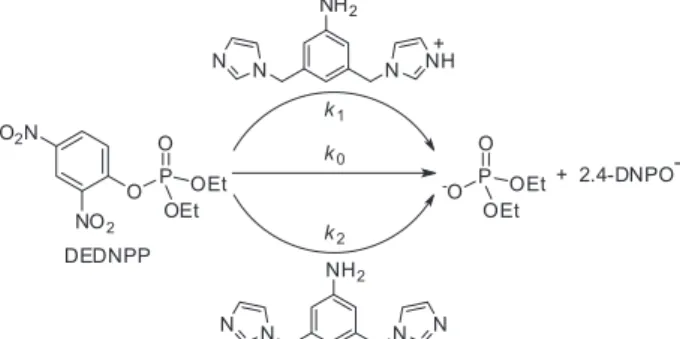
The observed kinetics are consistent with Scheme 4 and allows the derivation of equation 1.
[
]
(
)
obs 0 BIm 1 BImH 2 BIm
k k kχ k χ
+
= + × + (1)
Equation 1 is a description of the reaction of DEDNPP with water (k0), and χBImH+ and χBIm are the molar fractions of the monoprotonated and neutral species of BIm, respectively, which were calculated using the acid dissociation constants pKa2 and pKa3 described above (Scheme 3). The kinetic parameters obtained by fitting the pH-rate profile with equation 1 are given in Table 1, and show that the rate enhancements promoted by the reactions of monoprotonated and neutral BIm are of the order of 755- and 1700-fold, respectively. The calculated k2 value is consistent with that obtained by the linear plot of kobsvs.
[BIm] at pH 8.5 (see Table S6). It is interesting to note that the second-order rate constant for reaction with the neutral BIm is about twice as large as that for monoprotonated BIm, as could be expected for a statistical effect due to the presence of two imidazole groups.
The activation parameters calculated at pH 8.5 (data and equations shown in Figure S4 and equations S5-S7), are similar to those reported for the reaction of DEDNPP with imidazole, with values of ∆H‡ = +10.60 ± 0.46 kcal mol-1 and
∆S‡ = –131.14 ± 6.49 e.u.. The large and negative entropy of activation is typical of bimolecular associative or concerted mechanisms, and thus is consistent with both nucleophilic and general-base paths. Significantly, the observed solvent
3 4 5 6 7 8 9 10
0.0 0.3 0.6 0.9 1.2 1.5 1.8
1
0
4 k
o
b
s
/
s
-1
pH
Figure 1. pH-rate constant profile of the reaction of BIm (0.01 mol L-1)
with DEDNPP (3.33 × 10⁻⁵ mol L-1) () at 25 ºC. Data reported for
DEDNPP hydrolysis () at 25 °C are included for comparison purposes.8 NH3
N N
HN NH
+
+ +
pKa1=2.5
pKa2=6.07
pKa3=7.26
1
2 3
Scheme 3. Acid dissociation constants of BIm’s three ionizing groups.
+ 2.4-DNPO -O
P OEt O
OEt NO2 O2N
DEDNPP
k1
k0
k2
O
P OEt -O
OEt
NH2
N
N N
N
NH2
N
N NH
N +
Scheme 4. Kinetic pathways for the dephosphorylation of DEDNPP.
2,4-DNPO– is 2,4-dinitrophenolate.
Table 1. Kinetic parameters for the reaction of BIm with DEDNPP, at
25 °Ca
k0 / s-1 (9.01 ± 1.61) × 10-6 k1 / (L mol-1 s-1) (6.81 ± 0.45) × 10-3 k2 / (L mol-1 s-1) (1.52 ± 0.02) × 10-2 ak
0 is consistent with that obtained from the reported fitting of the pH-rate
kinetic isotope effect (SKIE), calculated at pH(D) 8.5 in the plateau region shows a SKIE (kH2O/kD2O) = 0.996, a result which is strongly indicative of rate-limiting nucleophilic attack at the phosphorus center by the neutral BIm species. Thus, in excess of nucleophile, we propose the dephosphorylation of DEDNPP involves one of the BIm imidazole groups available.
Reactions in micellar media
Since reactions between relatively hydrophobic organic substrates can be favored by incorporation in micelles with different properties, we decided to examine the pH-rate constant profiles for the reaction of DEDNPP with BIm in the presence of cationic and anionic micelles, CTAB and SDS, respectively, and the experimental results are shown in Figure 2.
In SDS micellar medium, using equimolar amounts of BIm and SDS preclude the determination of rate constants in lower pH because the increase in concentration of the protonated forms of BIm leads to precipitation of the anionic surfactant. So we used lower concentrations of BIm and higher surfactant concentration to obtain the profile in SDS micellar medium, compared to that of CTAB. Interestingly, despite the differences in the experimental conditions, the results show that both micelles promote similar increases in kobs, which is also confirmed by the plots of kobsvs. [BIm] at constant CTAB and SDS concentrations (see Figure S5). In fact, the observed micellar effect can be rationalized in terms of the neutral character of both reactants (considering the most reactive neutral species of BIm), and the similar enhancements in both micellar media are indicative of
quantitative incorporation of the reactants (DEDNPP and BIm) in both micellar phases.
The pH-rate profiles of the BIm reactions in CTAB and SDS make clear that the neutral form is the most reactive species in both cases. BIm was titrated in the presence of CTAB at 25 °C, and the apparent pKaHA values of the imidazole groups in CTAB micellar medium (6.05 and 7.10) are closely related to and slightly lower than those determined in aqueous solutions, because the binding constant of BIm, as discussed below, is not very high and, therefore, a significant fraction of the nucleophile is in the aqueous phase (titration curve, composition graph as function of pH and pKa values are given in the Supplementary Information). Furthermore, a decrease in the incorporation of BIm is expected at lower pH values, due to repulsive interactions with the cationic surfactant. The pH profile in SDS is slightly shifted to higher pH, compared to that of CTAB, suggesting that pKa values in SDS medium may be slightly higher, consistent with attractive interactions between cationic BIm and the anionic surfactant. In any event, the effects are very small and further examination is experimentally difficult because the observed changes are close to our limits of experimental error for titration in colloidal systems.
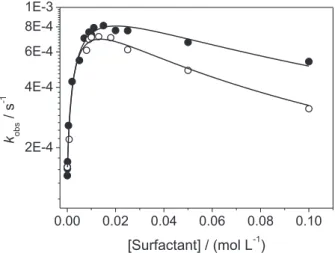
Figure 3 presents the effect of surfactant concentration on kobs in the reactions studied, and the observed profiles are fully consistent with the experimental pH-rate constant profiles. In fact, the reaction of 0.01 mol L-1 of BIm with DEDNPP in the presence of both CTAB and SDS shows very similar rate constant-surfactant concentration profiles at pH 8.5 and 25 ºC.
In general for bimolecular reactions, catalysis by micelles is largely dependent on the incorporation of the
6 7 8 9 10
1E-5 1E-4 1E-3
kob
s
/
s
-1
pH
Figure 2. Plots of kobs as function of pH for the reactions of DEDNPP
(3.33 × 10⁻⁵ mol L-1) with () 0.01 mol L-1 BIm in 0.01 mol L-1 CTAB
and () 0.005 mol L-1 BIm in 0.04 mol L-1 SDS, both at 25 °C. Data
for the triester spontaneous hydrolysis () is included for comparison.
0.00 0.02 0.04 0.06 0.08 0.10 2E-4
4E-4 6E-4 8E-4 1E-3
k ob
s
/
s
-1
[Surfactant] / (mol L-1)
Figure 3. Plots of kobs as function of the surfactant concentration in the
reaction of BIm (0.01 mol L-1) with DEDNPP (3.33 × 10⁻⁵ mol L-1) in the
reactants. Thus, to fully understand the data, we treated them quantitatively in terms of the pseudophase model for micellar systems.
Quantitative treatment on the rate constant
Micellar effects upon bimolecular organic reactions are largely explained in terms of incorporation of the reactants in the micellar phase, followed by differential reactivity in the aqueous and micellar phases,23,24 as shown in Scheme 5.
The partitioning equilibria of substrate (S) DEDNPP and nucleophile (N) BIm can be described in terms of binding constants KDEDNPP and KBIm, respectively, and the overall reaction rate constant (kobs) can be described as the sum of the rates in each pseudophase, equation 2.
W W M M
obs 2W[BIm] BIm DEDNPP 2M[BIm] BIm DEDNPP/ (C V )d M
k =k χ χ +k χ χ (2)
The scripts M and W refer to the micellar and aqueous phases, respectively, and the terms k2M and k2W are second order rate constants, expressed in units of L mol-1 s-1, in the micellar and aqueous pseudophases, respectively. The term [BIm] represents the total concentration of the nucleophile and is corrected by the molar fraction in each pseudophase (χW
BIm and χMBIm) and each term of the equation is multiplied by the molar fraction of the substrate in each phase (χW
DEDNPP and χMDEDNPP). The term Cd is the concentration of micellized surfactant, and VM, the molar volume of the micelle in which the reaction takes place, which in general is considered either the micelle volume or that of the Stern layer.25 As usual, C
d is assumed to be CT-CMC, where CT is the stoichiometric surfactant concentration, and CMC, the critical micelle concentration. The fits of the rate-surfactant profiles for the nucleophilic reactions of BIm in CTAB and SDS were performed considering that the contributions of reactions with water and hydroxide ion are unimportant, except in very dilute surfactant. The kinetic fits to equation 2 are reasonable, and relate second-order rate constants to local molarities in the micellar pseudophase and k2M can be compared to second-order rate constant in the absence of surfactants (Table 2).
Values of CMC are lower under the reaction conditions than in water (CMCCTAB = 9 × 10⁻⁴ mol L-1 and CMCSDS = 8 × 10
-3 mol L-1).27 This behavior is probably
related to the effect of BIm in the aggregation properties of the surfactants.23 In fact, precipitation of SDS at lower pH values (using equimolar quantities) is strongly indicative of a system which spontaneously aggregates in aqueous solutions, and this allowed us to neglect CMC values in fitting data, since the stoichiometric surfactant is found almost exclusively in the form of micelles.
The magnitudes of the binding constants (KDEDNPP and
KBIm) are typical of moderately hydrophobic compounds, and the lower values of KBIm are indicative of greater incorporation of DEDNPP into both micelles compared to the nucleophile, which presents a slight preference for the anionic micelle. Note that at pH 8.5, DEDNPP seems to interact similarly with both micelles, while BIm apparently shows a slight preference for the anionic micelle.
Values of k2M are in the range 4-13-fold lower than
k2W for both micelles, and this relation (k2M < k2W) is commonly found in the literature. In fact, values of k2W and k2M depend upon the pseudophase model adopted, the equations derived and the parameters used in fitting data, and a great variety of values is reported.28,29 In our case, k
2M is about the same magnitude of k2W and the catalytic effect will increase significantly with higher BIm incorporation. The similarity between k2M and k2W indicates that the nucleophilic reaction itself has similar reactivity in both micellar media and the observed micellar effect is a result of concentrating the reactants in the micellar pseudophase. The results show that either cationic or anionic micelles behave as homogeneous nanoreactors in the dephosphorylation reaction, irrespective of the
Table 2. Rate and binding constants obtained for the reactions of BIm
with DEDNPP in CTAB and SDS aqueous micelles, at 25 °Ca,b
CTAB SDS
k2Wc / (L mol-1 s-1) 1.52 × 10⁻² 1.52 × 10⁻² k2M / (L mol-1 s-1) 3.35 × 10⁻³ 1.19 × 10⁻³
KDEDNPP / (L mol-1) 117 124
KBIm / (L mol-1) 17 34
aObtained by fitting the rate-surfactant profiles at pH 8.5 (Figure 3)to
equation 2; bin treating data, it was considered the molar fraction of neutral
BIm; values of pKa for the acid dissociation of the imidazole groups in
CTAB micellar medium (6.05 and 7.10) were equal to those obtained by potentiometric titration at 25 °C (see Supplementary Information), and values used in the fit for SDS micellar medium were the same as those of aqueous medium. Values used for VM were 0.37 and 0.25 L mol-1 for
CTAB and SDS, respectively, obtained from the literature;26cobtained by
fitting the pH-rate profile of reaction of BIm with DEDNPP in aqueous medium (Figure 1, Table 1).
+ KN
NM
k2M Aqueous
pseudophase
Micellar pseudophase
Products Products
k2W
SM KS
+ SW
NW
charge of the head group. This observation is unusual, since reactions catalyzed by cationic aggregates are typically inhibited by anionic ones and vice versa.29 In fact, the micellar effects in the dephosphorylation of DEDNPP by neutral BIm seem to be governed essentially by the hydrophobic character of the reactants. Thus, as a guide for prospective studies, the results show that rates of dephosphorylation of triesters by nucleophilic imidazole groups may be significantly optimized through the addition of cationic and anionic surfactants, whose aggregates act as homogeneous nanoreactors which concentrate the neutral, hydrophobic reactants.
Conclusions
The hydrolysis of phosphate triesters with good leaving groups in the presence of imidazole can a priori
be considered to occur via an associative mechanism.8 This conclusion should apply to the reaction of BIm with DEDNPP, where the results are consistent with an SN2(P) mechanism, with a zwitterionic delocalized transition state expected in the rate-limiting BIm attack. Interestingly, cationic and anionic micelles exert similar effects, which indicate that in the transition state a negative charge on the oxygen atoms and a positive charge on the nucleophilic imidazole group are developing. Thus, the rate enhancement may occur for this kind of reaction with both cationic and anionic head groups, in which both have a reasonable chance to interact with the transition state, and this interpretation is in agreement with our results.
In addition, notice that differences in reactant hydrophobicity may also promote micellar effects. Compare the reaction of the substrate with imidazole in CTAB (see Figure S6) to that obtained with BIm. In fact, the imidazole reaction is not catalyzed in CTAB medium, mainly because the nucleophile mostly remains in the aqueous phase. Thus, more hydrophobic BIm binds to the micelles more efficiently and supports the idea that hydrophobic effects also contribute to micellar effects. This is an important and useful guideline in planning mimics for biological reactions, because improving incorporation will effectively increase the quality of the biomimetic systems.
Supplementary Information
Supplementary information (procedures of BIm synthesis and its characterization data, and potentiometric titration and kinetic data) is available free of charge at http://jbcs.sbq.org.br as PDF file.
Acknowledgements
We thank INCT-Catálise and the Brazilian foundations FAPESC, CNPq and CAPES for financial assistance.
References
1. Breslow, R.; Dong, S. D.; Webb, Y.; Xu, R.; J. Am. Chem. Soc. 1996, 118, 6588.
2. Klumpp, S.; Krieglstein, J.; Eur. J. Biochem.2002, 269, 1067. 3. Breslow, R.; Acc. Chem. Res.1995, 28, 146.
4. Menger, F. M.; J. Am. Chem. Soc.1970, 92, 5965.
5. Brandão, T. A. S.; Orth, E. S.; Rocha, W. R.; Bortoluzzi, A. J.; Bunton, C. A.; Nome, F.; J. Org. Chem.2007, 72, 3800. 6. Orth, E. S.; Brandão, T. A. S.; Milagre, H. M. S.; Eberlin, M. N.;
Nome, F.; J. Am. Chem. Soc.2008, 130, 2436.
7. Orth, E. S.; Brandão, T. A. S.; Souza, B. S.; Pliego, J. R.; Vaz, B. G.; Eberlin, M. N.; Kirby, A. J.; Nome, F.; J. Am. Chem. Soc. 2010, 132, 8513.
8. Orth, E. S.; Wanderlind, E. H.; Medeiros, M.; Oliveira, P. S. M.; Vaz, B. G.; Eberlin, M. N.; Kirby, A. J.; Nome, F.; J. Org. Chem. 2011, 76, 8003.
9. Moss, R. A.; Kotchevar, A. T.; Park, B. D.; Scrimin, P.; Langmuir 1996, 12, 2200.
10. Ionescu, L. G.; Trindade, V. L.; De Souza, E. F.; Langmuir2000,
16, 988.
11. Kumar, V. P.; Ganguly, B.; Bhattacharya, S.; J. Org. Chem.
2004, 69, 8634.
12. Bhattacharya, S.; Vemula, P. K.; J. Org. Chem. 2005, 70, 9677. 13. Ghosh, K. K.; Kolay, S.; Bal, S.; Satnami, M. L.; Quagliotto, P.;
Dafonte, P. R.; Colloid Polym Sci. 2008, 286, 293.
14. Singh, N.; Ghosh, K. K.; Marek, J.; Kuca, K.; Int. J. Chem. Kinet.2011, 43, 569.
15. Bhattacharya, S.; Kumar, V. P.; Langmuir2005, 21, 71. 16. Singh, N.; Karpichev, Y.; Gupta, B.; Satnami, M. L.; Marek, J.;
Kuca, K.; Ghosh, K. K.; J. Phys. Chem. B. 2013, 117, 3806. 17. Moss, R. A.; Kanamathareddy, S.; Vijayaraghavan, S.; Langmuir
2001, 17, 6108.
18. Bhattacharya, S.; Kumari, N.; Coord. Chem. Rev.2009, 253, 2133.
19. Ghosh, K. K.; Sinha, D.; Satnami, M. L.; Dubey, D. K.; Rodriguez-Dafonte, P.; Mundhara, G. L.; Langmuir2005, 21, 8664.
20. Mello, R. S.; Orth, E. S.; Loh, W.; Fiedler, H. D.; Nome, F.;
Langmuir2011, 27, 15112.
21. Moss, R. A.; Ihara, Y.; J. Org. Chem.1983, 48, 588.
22. Perrin, D. D.; Armarego, W. L. F.; Purification of Laboratory Chemicals, 4th ed.; Butterworth-Heinemann: Cornwall, England,
1997.
24. Drinkel, E.; Souza, F. D.; Fiedler, H. D.; Nome, F.; Curr. Opin. Colloid Interface Sci. 2013, 18, 26.
25. Bunton, C. A.; ARKIVOC2011, 7, 490.
26. Corkill, J. M.; Goodman, J. F.; Walker, T.; Trans. Faraday Soc.
1967, 63, 768.
27. Baxter-Hammond, J.; Powley, C. R.; Cook, K. D.; Nieman, T. A.; J. Colloid Interface Sci.1980, 76, 434.
28. Taşcıoğlu, S.; Tetrahedron1996, 52, 11113.
29. Bunton, C. A.; Adv. Colloid Interface Sci.2006, 123-126, 333.
Submitted: August 25, 2014