Letter
J. Braz. Chem. Soc., Vol. 25, No. 12, 2137-2139, 2014. Printed in Brazil - ©2014 Sociedade Brasileira de Química
0103 - 5053 $6.00+0.00
L
e
http://dx.doi.org/10.5935/0103-5053.20140219*e-mail: [email protected] †In memorian
Proposal of a Standard Unit for Turnover Frequencies: Hz
José R. Gregório,* Bauer C. Ferrera, Rodrigo dos S. Fuscaldo and Roberto F. de Souza
†Instituto de Química, Universidade Federal do Rio Grande do Sul,
Av. Bento Gonçalves, 9500, 91501-970 Porto Alegre-RS, Brazil
Os autores deste manuscrito propõem que frequências de rotação sejam expressas em uma unidade do Sistema Internacional de Unidades já existente (Hz), facilitando a comparação entre diferentes sistemas catalíticos.
The authors of this manuscript propose turnover frequencies to be expressed in an International System of Units existing unit (Hz), facilitating the comparison between different catalytic systems.
Keywords: heterogeneous catalysis, homogeneous catalysis, kinetics, turnover frequency, units
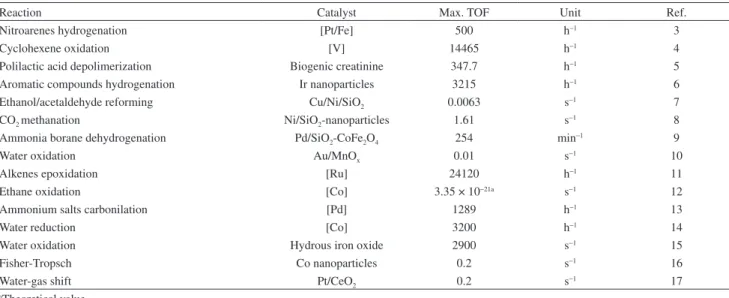
Table 1. Data collected from the 15 most recent papers on ISI database (May 5th, 2014) having “turnover frequency” as a topic
Reaction Catalyst Max. TOF Unit Ref.
Nitroarenes hydrogenation [Pt/Fe] 500 h−1 3
Cyclohexene oxidation [V] 14465 h−1 4
Polilactic acid depolimerization Biogenic creatinine 347.7 h−1 5
Aromatic compounds hydrogenation Ir nanoparticles 3215 h−1 6
Ethanol/acetaldehyde reforming Cu/Ni/SiO2 0.0063 s−1 7
CO2 methanation Ni/SiO2-nanoparticles 1.61 s−1 8
Ammonia borane dehydrogenation Pd/SiO2-CoFe2O4 254 min−1 9
Water oxidation Au/MnOx 0.01 s−1 10
Alkenes epoxidation [Ru] 24120 h−1 11
Ethane oxidation [Co] 3.35 × 10⁻²¹a s−1 12
Ammonium salts carbonilation [Pd] 1289 h−1 13
Water reduction [Co] 3200 h−1 14
Water oxidation Hydrous iron oxide 2900 s−1 15
Fisher-Tropsch Co nanoparticles 0.2 s−1 16
Water-gas shift Pt/CeO2 0.2 s−1 17
aTheoretical value.
Since the Greek civilization, humanity has been dealing
with measurement as a science. Originally, measures were
taken as multiples of a known object like a foot or an
inch. After the French revolution, the French government
imposed the metric system as an attempt to standardize
measurements, although its use is not yet spread all over the
world, especially in countries originated from the former
British Empire. Nevertheless, throughout the 20
thcentury,
the metric system has established itself as the International
System of Units incorporated it and some other basic units
to allow the measurement of virtually all magnitudes on
nature.
1Derived units such as joule, watt and hertz (Hz)
are used to make simpler the expression of quantities,
facilitating their use and comparison.
In catalysis, even in present days, we also face a lack
of uniformity when expressing a very useful parameter for
the efficiency of a catalytic system: turnover frequencies
(TOFs). This parameter is also sometimes called “activity”,
especially in polymerization and is used to refer to the
number of moles of substrate that can be converted
per
mole of catalyst
per
unit of time. In the literature, we
Proposal of a Standard Unit for Turnover Frequencies: Hz J. Braz. Chem. Soc. 2138
the unit of time is not standardized. A search performed on
ISI database
2tagging “turnover frequencies” and retaining
the 15 most recent papers listed serves as a sample of this
non-uniformity, as shown in Table 1.
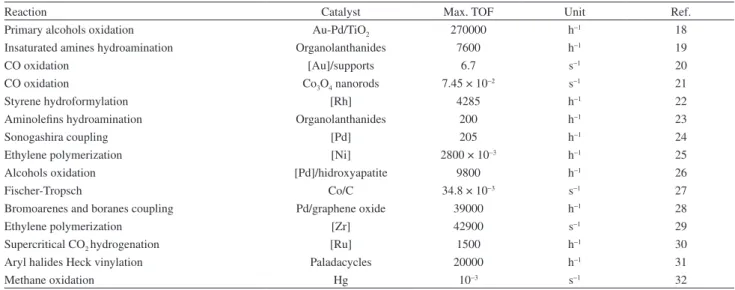
In order to show that this is not only a recent
discrepancy, we also performed a research considering the
15 most cited papers on ISI database using the same tag,
on the same day (Table 2).
It becomes then unnatural for a researcher to compare
different catalytic systems without calculations. By using
Hz, an existing unit which expresses cycles
per
second,
this comparison becomes immediate, as shown in Table 3,
where reactions were grouped and TOFs recalculated
having Hz as unit.
The use of Hz to express TOFs is not only a more elegant
alternative, but it allows an immediate comparison of different
catalytic systems under different conditions. It is also possible
to use multiplicative prefixes. For example, for many relevant
industrial applications, the turnover frequency varies between
10
−2-10
2s
−1, while it is in the range of 10
3-10
7s
−1for enzymes,
33and these two data could be classified into mHz, Hz, kHz or
MHz, highlighting distinct activities.
Thus, we propose the use of the standard unit of
frequency hertz whenever TOFs and activities are referred,
in order to facilitate comparison of scientific work and
didactically consolidate even further the image of the
catalytic cycle and the International System of Units.
Acknowlegments
This work is issued from an original idea of Prof Roberto
F. de Souza. We had then selected data to translate his purpose
Table 2. Data collected from the 15 most cited papers (May 5th, 2014) on ISI database which have “turnover frequency” as a topic. TOF presented is the
highest reported
Reaction Catalyst Max. TOF Unit Ref.
Primary alcohols oxidation Au-Pd/TiO2 270000 h−1 18
Insaturated amines hydroamination Organolanthanides 7600 h−1 19
CO oxidation [Au]/supports 6.7 s−1 20
CO oxidation Co3O4 nanorods 7.45 × 10⁻² s−1 21
Styrene hydroformylation [Rh] 4285 h−1 22
Aminolefins hydroamination Organolanthanides 200 h−1 23
Sonogashira coupling [Pd] 205 h−1 24
Ethylene polymerization [Ni] 2800 × 10−3 h−1 25
Alcohols oxidation [Pd]/hidroxyapatite 9800 h−1 26
Fischer-Tropsch Co/C 34.8 × 10⁻³ s−1 27
Bromoarenes and boranes coupling Pd/graphene oxide 39000 h−1 28
Ethylene polymerization [Zr] 42900 s−1 29
Supercritical CO2 hydrogenation [Ru] 1500 h−1 30
Aryl halides Heck vinylation Paladacycles 20000 h−1 31
Methane oxidation Hg 10−3 s−1 32
Table 3. Compared turnover frequencies expressed in Hz
Reaction type Catalyst Max. TOF / Hz Ref.
Carbonylation [Pd] 8.03 × 10⁻² 13
Cross-coupling [Pd] 5.69 × 10⁻² 24
Pd-graphene oxide 1.08 × 10 28
Dehydrogenation Pd/SiO2-CoFe2O4 4.23 9
Depolymerization Biogenic creatinine 9.66 × 10⁻² 5
Epoxidation [Ru] 6.70 11
Fischer-Tropsch Co nanoparticles 2.00 × 10⁻¹ 16
Co/C 3.48 × 10⁻³ 27
Heck vinylation Paladacycles 5.56 31
Hydroamination Organolanthanides 2.11 19
Organolanthanides 5.50 × 10⁻² 23
Hydroformylation [Rh] 1.19 22
Hydrogenation [Pt/Fe] 1.39 × 10⁻¹ 3
Ir nanoparticles 8.93 × 10⁻¹ 6
[Ru] 4.17 × 10⁻² 30
Methanation Ni/SiO2
-nanoparticles
1.61 8
Oxidation [V] 4.02 4
Au/MnOx 1.00 × 10⁻² 10
[Co] 3.35 × 10⁻²¹ 12
Hydrous Fe oxide 2.90 × 10³ 15
Au-Pd/TiO2 7.5 × 10 18
[Au] supported 6.70 20
Co3O4 nanorods 7.45 × 10⁻² 21
[Pd]/hydroxyapatite 2.72 26
Hg 1.00 × 10⁻³ 32
Polymerization [Ni] 7.80 × 10⁻⁴ 25
[Zr] 4.29 × 10⁴ 29
Reduction [Co] 8.89 × 10⁻¹ 14
Reforming Cu/Ni/SiO2 6.30 × 10⁻³ 7
Gregório et al. 2139 Vol. 25, No. 12, 2014
into a manuscript, but he left us in November 2013, leaving
an enormous sensation of emptiness. Without him, we
selected new data and to him we dedicate the development
of his proposal. We hope to have honored his memory.
The authors acknowledge PRONEX/CNPq/FAPERGS
(Project 04/0887-0) and CNPq (projects 474050/2007-6
and 310967/2009-0) for their financial support and
fellowships for RSF.
References
1. do Brasil, N. I.; Sistema Internacional de Unidades, 2nd ed.;
Editora Interciência: Rio de Janeiro, Brazil, 2013. 2. http://www.isiknowledge.com, accessed in May 2014.
3. Fan, G. Y.; Wang, Y. H.; Synth. React. Inorg., Met.-Org., Nano-Met. Chem.2014, 44, 967.
4. von Willingh, G.; Abbo, H. S.; Titinchi, S. J. J.; Catal. Today
2014, 227, 96.
5. Huang, W.; Qi, Y. B.; Cheng, N.; Zong, X. P.; Zhang, T. R.; Jiang, W.; Li, H.; Zhang, Q. X.; Polym. Degrad. Stab. 2014, 101, 18.
6. Tonbul, Y.; Zahmakiran, M.; Ozkar, S.; Appl. Catal., B2014, 148, 466.
7. Chen, L. C.; Lin, S. D.; Appl. Catal., B2014, 148, 509. 8. Aziz, M. A. A.; Jalil, A. A.; Triwahyono, S.; Mukti, R. R.;
Taufiq-Yap, Y. H.; Sazegar, M. R.; Appl. Catal., B2014, 147, 359.
9. Akbayrak, S.; Kaya, M.; Volkan, M.; Ozkar, S.; Appl. Catal., B
2014, 147, 387.
10. Gorlin, Y.; Chung, C. J.; Benck, J. D.; Nordlund, D.; Seitz, L.; Weng, T. C.; Sokaras, D.; Clemens, B. M.; Jaramillo, T. F.; J. Am. Chem. Soc.2014, 136, 13.
11. Di Giovanni, C.; Poater, A.; Benet-Buchholz, J.; Cavallo, L.; Sola, M.; Llobet, A.; Chem. - Eur. J. 2014, 20, 3898. 12. Wu, J. J.; Wang, Y. C.; Cai, J.; Jin, Y. Z.; Wang, H. J.; Gan, Y. Z.;
Chin. J. Catal. 2014, 35, 579.
13. Lei, Y. Z.; Zhang, R.; Wu, L. J.; Wu, Q.; Mei, H.; Li, G. X.; Appl. Organomet. Chem. 2014, 28, 310.
14. Khnayzer, R. S.; Thoi, V. S.; Nippe, M.; King, A. E.; Jurss, J. W.; El Roz, K. A.; Long, J. R.; Chang, C. J.; Castellano, F. N.; Energy Environ. Sci. 2014, 7, 1477.
15. Doyle, R. L.; Lyons, M. E. G.; Electrocatalysis2014, 5, 114.
16. Melaet, G.; Lindeman, A. E.; Somorjai, G. A.; Top. Catal. 2014, 57, 500.
17. Aranifard, S.; Ammal, S. C.; Heyden, A.; J. Phys. Chem. C
2014, 118, 6314.
18. Enache, D. I.; Edwards, J. K.; Landon, P.; Solsona-Espriu, B.; Carley, A. F.; Herzing, A. A.; Watanabe, M.; Kiely, C. J.; Knight, D. W.; Hutchings, G. J.; Science2006, 311, 362. 19. Hong, S.; Marks, T. J.; Acc. Chem. Res. 2004, 37, 673. 20. Schubert, M. M.; Hackenberg, S.; van Veen, A. C.; Muhler, M.;
Plzak, V.; Behm, R. J.; J. Catal. 2001, 197, 113.
21. Xie, X. W.; Li, Y.; Liu, Z. Q.; Haruta, M.; Shen, W. J.; Nature
2009, 458, 746.
22. Kranenburg, M.; van der Burgt, Y. E. M.; Kamer, P. C. J.; van Leeuwen, P. W. N. M.; Goubitz, K.; Fraanje, J.; Organometallics
1995, 14, 3081.
23. Gagne, M. R.; Stern, C. L.; Marks, T. J.; J. Am. Chem. Soc.
1992, 114, 275.
24. Choudary, B. M.; Madhi, S.; Chowdari, N. S.; Kantam, M. L.; Sreedhar, B.; J. Am. Chem. Soc. 2002, 124, 14127.
25. Gates, D. P.; Svejda, S. K.; Onate, E.; Killian, C. M.; Johnson, L. K.; White, P. S.; Brookhart, M.; Macromolecules2000, 33, 2320.
26. Mori, K.; Hara, T.; Mizugaki, T.; Ebitani, K.; Kaneda, K.; J. Am. Chem. Soc.2004, 126, 10657.
27. Bezemer, G. L.; Bitter, J. H.; Kuipers, H. P. C. E.; Oosterbeek, H.; Holewijn, J. E.; Xu, X. D.; Kapteijn, F.; van Dillen, A. J.; de Jong, K. P.; J. Am. Chem. Soc.2006, 128, 3956.
28. Scheuermann, G. M.; Rumi, L.; Steurer, P.; Bannwarth, W.; Mulhaupt, R.; J. Am. Chem. Soc.2009, 131, 8262.
29. Matsui, S.; Mitani, M.; Saito, J.; Tohi, Y.; Makio, H.; Matsukawa, N.; Takagi, Y.; Tsuru, K.; Nitabaru, M.; Nakano, T.; Tanaka, H.; Kashiwa, N.; Fujita, T.; J. Am. Chem. Soc.2001, 123, 6847.
30. Jessop, P. G.; Hsiao, Y.; Ikariya, T.; Noyori, R.; J. Am. Chem. Soc.1996, 118, 344.
31. Herrmann, W. A.; Brossmer, C.; Reisinger, C. P.; Riermeier, T. H.; Ofele, K.; Beller, M.; Chem. - Eur. J. 1997, 3, 1357. 32. Periana, R. A.; Taube, D. J.; Evitt, E. R.; Loffler, D. G.;
Wentrcek, P. R.; Voss, G.; Masuda, T.; Science1993, 259, 340. 33. Hagen, J.; Industrial Catalysis: A Practical Approach, 2nd ed.;
Wiley: Mannheim, Germany, 2005.
Submitted on: July 21, 2014