Relevant variables of Class II malocclusion
treatment
Guilherme Janson*, Sérgio Estelita Cavalcante Barros**, Tassiana Mesquita Simão***, Marcos Roberto de Freitas****
Results of orthodontic Class II malocclusion treatment can be influenced by inherent char-acteristics such as patient age, malocclusion severity and degree of compliance, or even by factors regarding the orthodontist’s subjective preference such as the treatment protocol. Basically, Class II treatment protocols involve nonextraction or extraction of two or four premolars. However, a greater treatment success rate can be expected with the extraction protocol of two maxillary premolars, regardless of the skeletal pattern or the amount of max-illomandibular anteroposterior discrepancy. According to this review, it was concluded that Class II malocclusion treatment results are strongly influenced by the treatment protocol, while skeletal characteristics do not seem to exert significant influence.
Abstract
Keywords: Malocclusion. Class II. Cephalometry. Tooth extraction.
* Full Professor of Orthodontics at the Bauru School of Dentistry – São Paulo University (FOB-USP). Head of the department of Pediatric Dentistry, Ortho-dontics and Collective Health.
** Post-Doctoral Orthodontics candidate at the Bauru School of Dentistry - São Paulo University (FOB-USP). *** Post-Doctoral Orthodontics candidate at the Bauru School of Dentistry - São Paulo University (FOB-USP). **** Full Professor of Orthodontics at the Bauru School of Dentistry - São Paulo University (FOB-USP).
INTRODUCTION
Success rate in Class II malocclusion treatment can be significantly influenced by factors such as
treatment protocol1,11, malocclusion severity3,7,
patient age23 and degree of patient compliance15.
Since malocclusion severity and age are inher-ent patiinher-ent characteristics which are, therefore, defined ahead of time, these variables are be-yond professional control. It has been shown that patient compliance is hard to predict by means of simple anamnestic methods of psychiatric or
behavioral evaluation2. Although unpredictable,
degree of compliance is one of the key variables
affecting orthodontic treatment success22, notably
when the treatment plan involves the use of
re-movable appliances9, whose effectiveness relies
considerably on patient compliance. In light of the treatment protocols currently available, Class II malocclusion can be treated with or without extractions. The extraction protocol consists basi-cally in extracting either four or two premolars in the upper arch whereas nonextraction treat-ment can be performed using extraoral anchor-age9, functional orthopedic appliances17, Class II
elastics combined with fixed appliances11 or, more
recently, intraoral distalizing appliances10 (Fig. 1).
malocclusion treatment protocol with the extrac-tion of two upper premolars provides superior ef-ficiency than the protocols involving extraction of
four premolars5,8 or nonextraction14. Therefore, it
is safe to assert that the choice of a treatment pro-tocol to correct Class II malocclusion constitutes one of the few approaches – if not the only one – professionals can resort to in order to influence the success rate of treatments.
Although the treatment protocol involving the extraction of two upper premolars is more efficient than the Class II malocclusion protocol entailing four premolar extraction or no extractions, it is a known fact that the mechanism of malocclusion correction involves predominantly dentoalveolar changes, irrespective of the treatment protocol
or the orthodontic appliance used4.
Neverthe-less, it has been speculated that patient skeletal features – such as facial pattern and jaw-to-jaw relationship – can impact orthodontic treatment
success8. Thus, this review article aims to establish
evidence regarding the impact of cephalometric features on the success rate of Class II malocclu-sion treatment.
LITERATURE REVIEW
Cephalometric features of Class II malocclusion
The concern with determining the craniofacial features of Class II malocclusions has long exist-ed12. It underscores the need to learn about the
dentoskeletal changes which characterize maloc-clusion, thus enabling the orthodontic treatment to target the correction of pre-existing dysplasias. Although a greater vertical development and transverse narrowing of the maxilla can be asso-ciated with the development of Class II
maloc-clusion28. Hunter13 points out that the dysplasias
most often associated with Class II malocclu-sion occur on the sagittal plane and, according to
Vargervik and Harvold28, can be caused by: (1)
anterior displacement of the maxilla or the maxil-lary alveolar process; (2) a small mandible or
low-WITH EXTRACTION
symmetric
intermaxillary elastics
removable functional appliances
fixed functional appliances
extraoral headgear 3
premolars 1
premolar 4
premolars 2
premolars
asymmetric
distalization
appliances functional mechanics Orthodontics Orthopedics
NONEXTRACTION
CLASS II MALOCCLUSION TREATMENT
er teeth positioned in the posterior region of its base; (3) posterior position of the temporoman-dibular joint; and (4) any combination of these factors. Additionally, most cephalometric studies show that, among the sagittal alterations of Class II malocclusion, a smaller mandible positioned in
the posterior region is found most often13 (Fig. 2).
Impact of Class II malocclusion treatment extraction protocols
Basically, a Class II malocclusion treatment can be implemented without any extractions or with the extraction of either two or four premolars. Nevertheless, not all of these protocols yield the same treatment success rate.
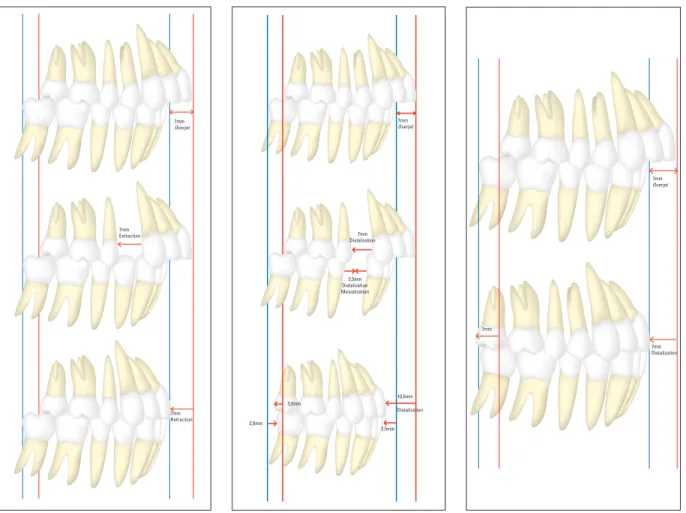
Whenever the treatment of a complete Class II case, in the absence of crowding, is performed by extracting two upper premolars, the anterior seg-ment of the upper arch is distalized to the extent of a premolar width (7 mm) so that cuspids can es-tablish a Class I relationship while molars remain
in Class II (Fig. 3). When the same malocclusion is treated with the extraction of four premolars and the posteroinferior segments can mesialize half the space left by the extraction (3.5 mm), the pos-terosuperior segments must be distalized by 3.5 mm while the anteroposterior segment must be distalized by 10.5 mm so that molars and cuspids can establish a Class I relationship, totaling 14 mm of upper arch distalization (Fig. 4). On the other hand, should this same malocclusion be treated without extractions, the postero and anterosupe-rior segments must be distalized by 7 mm each so that molars and cuspids establish a Class I rela-tionship upon treatment completion, totaling 14 mm of upper arch distalization (Fig. 5). Therefore, it is possible to conclude that in comparison with the treatment protocol involving the extraction of two premolars the complete Class II treatment with four extractions or no extraction requires a greater amount of upper tooth distalization in addition to requiring greater patient compliance
through the use of anchorage reinforcement ap-pliances. Accordingly, a higher success rate in Class II treatment can be achieved with only two upper extractions. However, in spite of the fact that a Class II malocclusion treatment protocol with two upper extractions has proved more ef-ficient5,14,15 and more likely to provide a Class I
cuspid relationship6,15 by affording an adequate
anterior guide and a reasonable posterior occlu-sal relationship, some authors still persist in the mistaken belief that finishing a treatment with a complete Class II molar relationship can be
detri-mental to a functional occlusion21.
Impact of facial pattern on Class II malocclusion treatment
Although a handful of authors have strived to make a cephalometric characterization of Class II
malocclusion, Keeling et al.18 have demonstrated
that there is a weak correlation between occlu-sal characteristics and the craniofacial morphol-ogy observed in head films. Therefore, if the same type of malocclusion can develop within a wide range of craniofacial morphologies, it was be-lieved that these different facial patterns might influence in distinct ways the results of an orth-odontic treatment.
FIGURE 4 - Diagram showing the amount of movement required to correct a complete Class II malocclusion (7 mm overjet) with a 3.5 mm lower incisors protrusion or 3.5 mm crowding per quadrant, treated with the extraction of four premolars.
FIGURE 3 - Diagram showing the amount of movement required to correct a complete Class II malocclusion (7 mm overjet) treated with the extraction of two upper premolars.
FIGURE 5 - Diagram showing the amount of movement required to correct a complete Class II malocclusion (7 mm overjet) treated with no extractions.
7mm Distalization
7mm Overjet
3,5mm Distalization Mesialization
3,5mm
3,5mm
10,5mm Distalization
3,5mm 7mm
Overjet
7mm Extraction
7mm Retraction
7mm Overjet
7mm
One of the first researchers to associate facial pattern with orthodontic treatment results was
Charles Tweed26,27, when he perceived that in
or-der to attain a harmonious profile and pleasant fa-cial aesthetics the position of the lower incisors at the end of treatment should vary according to the different facial patterns. Patients with a vertical pattern, for instance, should yield lower incisors which are more vertically positioned in relation to the bone base whereas patients with a more hori-zontal pattern should have their lower incisors positioned more buccally in relation to the man-dibular plane26,27. In this manner, a relationship
began to be established between facial pattern and an indication to have teeth extracted since the tendency towards more vertical lower incisors for patients presenting with a more vertical facial patterns would encourage professionals to extract lower incisors more often in this group. There-fore, extractions in the lower arch were aimed not just at correcting crowding but also cephalomet-ric discrepancy by means of repositioning lower incisors in their bone base. However, lower inci-sor position was considered of such paramount importance that many extractions performed in the lower arch had the sole purpose of correcting
cephalometric discrepancy11,23,26,27.
In keeping with the concepts underlying Tweed’s orthodontic mechanics cephalometric discrepancy continued to be viewed as a treat-ment goal to be achieved regardless of the
maloc-clusion type. In 1953, Cecil Steiner25 developed a
diagnostic and planning method which took into account not just the influence of facial pattern but also the impact of anteroposterior discrep-ancy between bone bases on the final treatment result. Although facial pattern and discrepancy between bone bases did influence extraction di-agnosis, Steiner was unable to forecast the poten-tial difficulties aroused by lower arch extractions associated with Class II malocclusion correction. This limitation was due to the fact that his diag-nostic method only took into consideration the
complexities of lower arch treatment but not the difficulty in correcting anteroposterior discrep-ancy in both arches. Therefore, in Class II cases where the correction of cephalometric discrepan-cy required extractions, the repositioning of lower incisors towards the lingual region ultimately in-creased anteroposterior discrepancy between the lower segments of the arches, sometimes
com-promising treatment results25. As a matter of fact,
subsequent studies have shed light on the diffi-culties that arise in trying to balance the Class II anteroposterior relationship when extractions are
made in the lower arch6,15. As a result, extractions
performed with the sole purpose of correcting cephalometric discrepancy have been questioned in Class II treatment, and even more so in the presence of an excellent dental alignment.
As well as a tool used in helping to correct cephalometric discrepancy, tooth extractions
can also aid in controlling vertical dimension20.
Assuming that lower incisors are more verti-cally positioned and that facial height control is more crucial for patients who have a vertical facial pattern, the indication to perform extrac-tions in the lower arch of this patient group can be considered stronger than in patients whose facial pattern is either horizontal or balanced26.
Regardless of the facial pattern, however, lower arch extractions should not be performed when treating Class II if the sole purpose is to correct cephalometric discrepancy or to control vertical dimension since the difficulty in correcting an-teroposterior discrepancy between the arches is compounded in comparison with the treatment protocol involving the extraction of two upper
premolars5,6,15,16. On the other hand, if the
treat-ment protocol is conducted with no extractions the need to move upper molars towards distal not
only undermines vertical dimension control20, but
it also makes it harder to accomplish the correc-tion of anteroposterior discrepancy between the arches than would be the case if the treatment
Therefore, Class II treatment with the extraction of two upper premolars both enables a greater
vertical dimension control20 – since it does not
require upper molars to be moved distally – and favors the correction of anteroposterior discrep-ancy between the arches, compared with Class II treatment without extractions or with four
ex-tractions8,14. Thus, it could be conjectured that
the occlusal results of Class II treatment involving two upper premolar extractions will tend to be less influenced by facial pattern since it would al-low for a higher success rate even in vertical facial pattern cases. It should also be noted that studies of Class II treatment with vertical facial pattern have demonstrated that the use of headgear with cervically or occipitally oriented forces does not bring about significantly different changes in the vertical dimensions of the face.
Although Class II malocclusion treatment with the extraction of two upper premolars does yield a greater success rate5,8,15, the belief that a vertical
facial pattern has a negative bearing on the treat-ment results might indicate that the four-extrac-tion protocol would be preferable in such cases. It was then speculated that the less-than-satisfactory results achieved with the Class II four-premolar extraction treatment might be more due to the deleterious influence of an unfavorable facial pat-tern than to a difficulty in correcting Class II mo-lar relationship, as required by this treatment pro-tocol. To investigate this hypothesis, Janson16
as-sessed patients presenting with complete Class II malocclusion and treated with two and four molar extractions. The results of this study showed that, on average, patients treated with two extractions yield a more vertical facial pattern compared with patients treated with two upper extractions. Nev-ertheless, facial pattern did not show a significant correlation with occlusal results, which proved more satisfactory for the group subjected to the protocol comprising the extraction of two upper premolars. This study confirms the hypothesis that the quality of the occlusal results attained with
Class II malocclusion treatment involving extrac-tions is more influenced by the type of protocol used than by the patient’s facial pattern. Thus, excellent occlusal results can be accomplished in treating Class II malocclusion of patients who present with discrepant facial patterns, provided that an extraction protocol is used which enhanc-es the correction efficiency of the Class II antero-posterior relationship (Fig. 6).
It could therefore be assumed that if occlu-sal results are not significantly influenced by the patient’s facial patters, this parameter should not be employed to justify any lower arch extraction since the four-premolar extraction protocol makes the correction of Class II anteroposterior
relation-ship significantly harder5,8,15, thereby decreasing
this malocclusion’s treatment success rate as it
re-quires considerable patient compliance3,7.
When Class II malocclusion is treated without extractions or with the extraction of the two upper premolars, the absence of extraction in the lower arch suggests that similar degrees of crowding and discrepancy may be present. However, the goal of tooth movement in the upper arch is substantially
different in these two treatment protocols14 since
a nonextraction treatment involves moving the en-tire upper arch distally, which consequently entails
less facial height control29, unlike treatment with
two upper extractions, which is likely to keep the upper molars in the same position, thus allowing for greater facial height control29. Therefore,
pa-tients with a Class II malocclusion who are treated with no extractions would be expected to display a more horizontal pattern than patients treated with two upper extractions. Although facial pat-tern does not seem to exert a significant impact
on the occlusal results of the treatment16, Simão24
in-FIGURE 6 - Differences in facial pattern do not significantly influence the quality of treatment results, whereas a protocol involving the extraction of two upper premolars allows for improved occlusal results. Figure 6D comprises a head film showing a skeletal Class II malocclusion with a vertical growth
pattern and significant skeletal deficiency in the mandible. The head film in figure 6H shows a Class II malocclusion with a balanced growth pattern and
no mandibular deficiency. Despite a discrepancy in the facial pattern in both cases the extraction of two premolars made for excellent occlusal results.
A
D
B C
E
H
Submited: abril de 2009
Reviewed and accepted: maio de 2009 it can therefore be concluded that cephalometric pattern does not constitute a reliable parameter in
predicting treatment results19,30. In fact, from the
standpoint of occlusal relationships the treatment protocol can significantly influence Class II cor-rection results while cephalometric pattern does not yield a significant association with result qual-ity. Seen from this angle, the choice of a Class II treatment protocol should not be made under the influence of the patient’s cephalometric pattern but rather based on the efficiency of the protocol in correcting the anteroposterior relationship be-tween the arches.
CONCLUSION
The occlusal results of Class II malocclusion treatment are significantly influenced by the choice of treatment protocol. Although Class II treatment results can be affected by other vari-ables – such as malocclusion severity, patient com-pliance and patient age – the facial pattern does not exert any significant influence. Therefore, the choice of a Class II malocclusion treatment proto-col – mainly in terms of deciding whether or not tooth extractions are performed – should be based more on the severity of the occlusal relationship present in the malocclusion than on the patient’s facial pattern.
fluence on the occlusal results accomplished with the two aforementioned treatment protocols. On the other hand, the type of treatment protocol used to correct Class II malocclusion was the only single factor which significantly influenced occlu-sal result quality. Patients who were treated with the extraction of two upper premolars showed better results than nonextraction patients. This
conclusion supports Janson’s et al.14 study, which
demonstrated that a more efficient Class II treat-ment was achieved with the extraction of two pre-molars than with a nonextraction protocol. In this manner, excellent occlusal results can be accom-plished in treating the Class II malocclusion of pa-tients who present with discrepant facial patterns, provided that a treatment protocol is used which enhances the correction efficiency of the Class II anteroposterior relationship (Fig. 6).
Cephalometric forecast of Class II malocclusion treatment results
The forecast of orthodontic treatment re-sults based on cephalometric variables has not proved a very promising prognostic tool. When the cephalometric variables which define the fa-cial pattern were used to predict Class II maloc-clusion treatment results, only 18% of treatment results variation could be explained by means of
these cephalometric variables19. In a similar study,
Zentner et al.30 concluded that the cephalometric
Contact Guilherme Janson
Departamento de Ortodontia - FOB/USP Alameda Octávio Pinheiro Brisolla 9-75 CEP: 17.012-901 - Bauru / SP E-mail: [email protected]
1. ANGLE, E. H. The latest and best in orthodontic mechanism.
Dent. Cosm., Philadelphia, v. 70, no. 12, p. 1143-1158, Dec. 1928.
2. BARTSCH, A. et al. The clinical and psychological indicators of behavior in wearing a removable appliance. Fortschr Kieferor-thop., München, v. 54, no. 3, p. 119-128, June 1993. 3. BISHARA, S. E.; CUMMINS, D. M.; JAKOBSEN, J. R. The
mor-phologic basis for the extraction decision in Class II, division 1 malocclusions: a comparative study. Am. J. Orthod. Dentofa-cial Orthop., St. Louis, v. 107, no. 2, p. 129-135, Feb. 1995. 4. BISHARA, S. E.; ZIAJA, R. R. Functional appliances: a review.
Am. J. Orthod. Dentofacial Orthop., St. Louis, v. 95, no. 3, p. 250-258, Mar. 1989.
5. BRAMBILLA, A. C. Comparação dos resultados oclusais do tratamento da Classe II tratada com extrações de dois pré-molarescom a terapêutica utilizando as extrações de quatro pré-molares. 2002. Dissertação (Mestrado)-Faculdade de Odontologia de Bauru, Universidade de São Paulo, Bauru, 2002. 6. BRYK, C.; WHITE, L. W. The geometry of Class II correction with extractions. J. Clin. Orthod., Boulder, v. 35, no. 9, p. 570-579, Sept. 2001.
7. BUCHIN, I. D. Facial esthetics and cephalometric criteria as the determinants in the extraction decision. J. Clin. Orthod., Boulder, v. 5, no. 8, p. 421-434, Aug. 1971.
8. DE FREITAS, M. R. et al. Long-term stability of anterior open bite extraction treatment in the permanent dentition. Am. J. Orthod. Dentofacial Orthop., St. Louis, v. 125, no. 1, p. 78-87, Jan. 2004.
9. DRAKER, H. L. Handicapping labio-lingual deviations: a pro-posed index for public health purposes. Am. J. Orthod., St. Louis, v. 46, no. 4, p. 295-305, Apr. 1960.
10. FORTINI, A. et al. Dentoskeletal effects induced by rapid molar distalization with the first class appliance. Am. J. Orthod. Den-tofacial Orthop., St. Louis, v. 125, no. 6, p. 697-704, June 2004. 11. GRABER, T. M. Current orthodontic concepts and techniques.
Philadelphia: W. B. Saunders, 1969. v. 1, p. 482-483, 527-584. 12. HELLMAN, M. Growth of the facial and occlusion of teeth in
relation to orthodontic treatment. Int. J. Orthod., Milwaukee, v. 19, p. 1116-1147, 1922.
13. HUNTER, W. S. The vertical dimensions of the face and skeleto-dental retrognathism. Am. J. Orthod., St. Louis, v. 53, no. 8, p. 586-595, Aug. 1967.
14. JANSON, G. et al. Class II treatment efficiency in maxillary pre-molar extraction and nonextraction protocols. Am. J. Orthod. Dentofacial Orthop., St. Louis, v. 132, no. 4, p. 490-498, Oct. 2007.
15. JANSON, G. et al. Class II treatment success rate in 2- and 4-premolar extraction protocols. Am. J. Orthod. Dentofacial Orthop., St. Louis, v. 125, no. 4, p. 472-479, Apr. 2004. 16. JANSON, M. R. P. Influência das características
cefalomé-tricas na proporção de sucesso do tratamento da Classe II com extrações de dois e de quatro pré-molares. 2004. 131 f. Dissertação (Mestrado)-Faculdade de Odontologia de Bauru, Universidade de São Paulo, Bauru, 2004.
17. JASPER, J. J.; McNAMARA JR., J. A. The correction of interarch malocclusions using a fixed force module. Am. J. Orthod. Den-tofacial Orthop., St. Louis, v. 108, no. 6, p. 641-550, Dec. 1995. 18. KEELING, S. D. et al. A multivariate approach to analyzing the
relation between occlusion and craniofacial morphology. Am. J. Orthod. Dentofacial Orthop., St. Louis, v. 95, no. 4, p. 297-305, Apr. 1989.
19. KIM, J. C. et al. Cephalometric variables as predictors of Class II treatment outcome. Am. J. Orthod. Dentofacial Orthop., St. Louis, v. 118, no. 6, p. 636-640, Dec. 2000.
20. KLAPPER, L. et al. The influence of extraction and nonextraction orthodontic treatment on brachyfacial and dolichofacial growth patterns. Am. J. Orthod. Dentofacial Orthop., St. Louis, v. 101, no. 5, p. 425-430, May 1992.
21. MAILANKODY, J. Enigma of Class II molar finishing. Am. J. Orthod. Dentofacial Orthop., St. Louis, v. 126, no. 6, p. 15-16, Dec. 2004.
22. NANDA, R. S.; KIERL, M. J. Prediction of cooperation in orth-odontic treatment. Am. J. Orthod. Dentofacial Orthop., St. Louis, v. 102, no. 1, p. 15-21, July 1992.
REFERENCES
23. SALZMANN, J. A. Practice of Orthodontics. Philadelphia: J. B. Lippincott, 1966. v. 2, p. 701-724.
24. SIMÃO, T. M. Influência das características cefalométricas na proporção de sucesso do tratamento da Classe II sem extrações e com extrações de dois pré-molares superiores. 2006. 152 f. Dissertação (Mestrado)-Faculdade de Odontologia de Bauru, Universidade de São Paulo, Bauru, 2006.
25. STEINER, C. Cephalometrics for you and me. Am. J. Orthod., St. Louis, v. 39, no. 10, p. 729-755, Oct. 1953.
26. TWEED, C. H. Indication for the extraction of teeth in orthodon-tic procedures. Am. J. Orthod. Dentofacial Orthop., St. Louis, v. 30, no. 8, p. 405-428, 1944.
27. TWEED, C. H. Why I extract teeth in the treatment of certain types of malocclusion? Alpha Omegan, New York, v. 46, p. 93-104, 1952.
28. VARGERVIK, K.; HARVOLD, E. P. Response to activator treat-ment in Class II malocclusions. Am. J. Orthod., St. Louis, v. 88, no. 3, p. 242-251, Sept. 1985.
29. YAMAGUCHI, K.; NANDA, R. S. The effects of extraction and nonextraction treatment on the mandibular position. Am. J. Orthod. Dentofacial Orthop., St. Louis, v. 100, no. 5, p. 443-452, Nov. 1991.