Communication
A Theoretical Study of Alkane Protonation in HF/SbF
5Superacid System
Pierre M. Estevesa, Alejandro Ramírez-Solísb and Claudio J. A. Motaa*
a
Instituto de Química, Dept. Química Orgânica, Universidade Federal do Rio de Janeiro, Cidade Universitária CT Bloco A, 21949-900, Rio de Janeiro – RJ, Brazil.
b
Facultad de Ciencias, Universidad Autónoma del Estado de Morelos, Cuernavaca, Morelos 62210, Mexico.
Foram realizados cálculos ab initio para a protonação de ligações C-H e C-C do metano, etano, propano e isobutano com um agregado representando a estrutura de um superácido. Para a protonação na ligação C-H (troca H/H) o estado de transição se parece com um íon H-carbônio coordenado com o superácido. A energia de ativação para a troca H/H foi cerca de 16 kcal.mol-1 em nível
B3LYP/6-31++G** + RECP (Sb), independentemente do tipo de ligação C-H sendo protonada. Para a protonação de ligações C-C a energia de ativação depende da estrutura do hidrocarboneto e foi sempre maior que a energia de ativação para a protonação na ligação C-H, indicando uma maior repulsão estérica.
Ab initio calculations for the protonation of the C-H and C-C bonds of methane, ethane, propane and isobutane by a superacid moiety was carried out. For the C-H protonation (H/H exchange) the transition state resembles an H-carbonium ion coordinated with the superacid. The activation energy for the H/H exchange was about 16 kcal.mol-1, at B3LYP/6-31++G** + RECP (Sb) level,
regard-less the type of C-H bond being protonated. For the C-C protonation the activation energy depends on the structure of the hydrocarbon and was always higher than the activation energy for C-H protonation, indicating a higher steric demand.
Keywords: superacid, carbonium ions, alkane, DFT
J. Braz. Chem. Soc., Vol. 11, No. 4, 345-348, 2000.
Printed in Brazil
c 2000 Soc. Bras. Química 0103 - 5053 $6.00+0.00
*e-mail: [email protected]
The protonation of alkanes in superacids was indepen-dently studied by Olah1 and Hogeveen2 during the late
60’s. The proton transfer to a σ bond forms a pentacoordi-nated carbonium ion3, which contains a two electron three
center bond. Based on product distribution analysis Olah proposed4 the following order of σ bond reactivity in
superacids: tert-C-H > C-C > sec-C-H > prim-C-H > CH4. Nevertheless, this order is roughly qualitative, and depen-dent on the steric hindrance of the hydrocarbon and the superacid system. In a recent theoretical study on the ener-getics of the butonium5 cations, we have found that the
C-butonium ions, hypothetically formed through the proto-nation of the C-C bonds of isobutane and n-butane, are significantly lower in energy than the H-butonium ions, formed upon protonation of the C-H bonds of isobutane and n-butane. The calculations are in agreement with gas phase results6, where protonation of the C-C bond of
isobutane prevails over protonation in the tert-C-H bond. Previous calculations also indicated7 that some higher
car-bonium ions cannot be considered discrete intermediates,
as they spontaneously decompose into a carbenium ion and methane or hydrogen. An interesting reaction accom-panying alkane ionization in superacid is the H/D ex-change8. The exchange9 of propane and isobutane with
superacids occurs faster than ionization to carbenium ions and is generally used as an evidence for the intermediation of pentacoordinated carbonium ions in alkane reactions in superacids. In this communication we wish to report prelimi-nary theoretical results of σ bond protonation in a series of alkanes by a cluster representing the superacid moiety.
A cluster comprising an HF molecule and SbF5 was used to represent the superacid moiety. The transition states (TS) for the H/H exchange and C-C protonation (Scheme 1) were fully optimized using the Berny algorithm and characterized, by vibrational analysis, as having only one imaginary frequency, which corresponds to the reaction mode. A relativistic effec-tive core potential (RECP) was used to describe the antimony atom10 in the SbF
5 molecule. All the calculations involving
the H/H exchange and the C-C protonation were performed at B3LYP/6-31++G** + RECP(Sb) level using the GAUSSIAN 94 package11. All energies corresponding to the optimized
346 Esteves et al. J. Braz. Chem. Soc.
energy. Unless otherwise stated all reported energies refer to enthalpy12 differences between the transition states and the
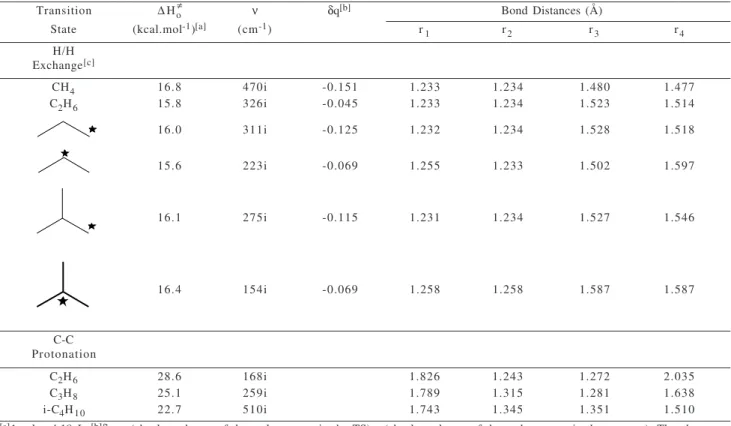
separate alkane and HSbF6 moiety at 298.15 K and 1 atm. Table 1 shows the activation parameters at 298.15 K and the main geometric data for the transition states of H/H ex-change and C-C protonation of several alkanes by the superacid cluster model. It can be observed that the enthalpy of activation for the H/H exchange is around 16 kcal.mol-1
for all C-H bonds investigated. All the transition states have an approximate symmetric structure (Cs). While one hydro-gen atom is being transferred to the hydrocarbon, the other is being transferred back to the superacid. Hence, no discrete
pentacoordinated carbonium ion seems to be formed as inter-mediate, but the TS closely resembles the calculated struc-ture of the isolated methonium13, ethonium14, proponium15
and isobutonium7 cations. The C-H distance in the three
cen-ter bond does not differ significantly within the series, rang-ing from 1.23 Å, for exchange with methane, to approxi-mately 1.28 Å for exchange of the tertiary C-H of isobutane. On the other hand the F-H distance shows a significant varia-tion, ranging from 1.477 Å, for exchange with methane, to 1.587 Å, for exchange of the methine hydrogen of isobutane. These results suggest that steric repulsion, associated with the hydrocarbon substituent groups, plays an important role.
Table 1. Activation enthalpy, main geometric parameters and charge variation at the exchanging carbon atom for the H/H exchange and C-C protonation of alkanes calculated at the B3LYP/6-31++G** + RECP (Sb) level.
Transition ∆Ho ν δq[b] Bond Distances (Å)
State (kcal.mol-1)[a] (cm-1) r
1 r2 r3 r4
H/H Exchange[c]
CH4 16.8 470i -0.151 1.233 1.234 1.480 1.477
C2H6 15.8 326i -0.045 1.233 1.234 1.523 1.514
16.0 311i -0.125 1.232 1.234 1.528 1.518
15.6 223i -0.069 1.255 1.233 1.502 1.597
16.1 275i -0.115 1.231 1.234 1.527 1.546
16.4 154i -0.069 1.258 1.258 1.587 1.587
C-C Protonation
C2H6 28.6 168i 1.826 1.243 1.272 2.035
C3H8 25.1 259i 1.789 1.315 1.281 1.638
i-C4H10 22.7 510i 1.743 1.345 1.351 1.510
[a]1 cal = 4.18 J; [b]δq = (absolute charge of the carbon atom in the TS) - (absolute charge of the carbon atom in the reactant). The charges were calculated using the ChelpG scheme19; [c]The indicates the hydrogen atom being exchanged.
≠
r1
r2
r3
r4
r4
r3
r2
r1
F
Sb
F
F F
F F Ha H3Ca
Cb R3
R1
R2
δ- F
Sb
F
F F
F F H
H C
R1
R3
R2
(a) (b)
Vol. 11 No. 4, 2000 A Theoretical Study of Alkane Protonation in Hf/SbF5Superacid System 347
The calculated activation enthalpy for H/H exchange of methane (16.8 kcal.mol-1) and ethane (15.8 kcal.mol-1)
correlates well with the reported experimental ∆H‡ for
H/D exchange in DF/SbF5 solutions. The exchange with methane and ethane involves activation enthalpies of 18 and 16.6 kcal.mol-1, respectively16. For propane and
isobutane the exchange is always accompanied by ioniza-tion. Hence, precise measurements of activation enthalpy are not available. Nevertheless, a reported17 activation
enthalpy of 18.3 kcal.mol-1 for isobutane ionization is in
fairly good agreement with the calculated ∆H‡ for exchange
of the methine hydrogen, indicating that H/D exchange and ionization to tertiary carbenium ions are related reactions. We are investigating the use of larger superacid cluster in the ∆H‡ of H/H exchange and ionization of alkanes.
The calculated TS geometries for the H/H exchange of alkanes in the superacid cluster model used in this study are similar to the calculated18 TS for the H/H exchange in
zeolites. However, the calculated activation energy for exchange in zeolites is about 30 kcal.mol-1, regardless of
the type of C-H bond being exchanged.
Table 1 also shows that the exchanging carbon atom bears a small negative charge variation, when going from the ground to the transition state. This reflects the almost constant activation enthalpy for the H/H exchange, as the substitution of alkyl groups in the exchanging carbon atom would barely stabilize the TS. The same trend was ob-served for the calculated H/H exchange in zeolites.
For the C-C protonation the calculations showed a dif-ferent picture. The calculated activation enthalpy is sig-nificantly higher for C-C protonation than for H/H ex-change, ranging from 22.6 kcal/mol, for isobutane, to 29 kcal.mol-1 for ethane. This is in agreement with the
ex-perimental results of alkane protonation in superacid, where H/D exchange occurs much faster than ionization8,9.
The reason for the higher activation energy for the C-C protonation in superacids is associated to the steric hin-drance in protonating the inner, and less accessible, C-C bonds. The C-H distance in the TS for C-C protonation of isobutane is about 1.34 Å. This value is about 0.1 Å longer than the C-H distance for H/H exchange of the tertiary hydrogen atom of isobutane. The same trend is observed for propane and ethane.
The low imaginary frequencies observed for the C-H and C-C protonation indicates that the carbonium ions and the anion moiety are loosely bounded in the TS. Hence, explaining the experimental results in terms of carbonium ion formation is a good approximation, although free car-bonium ions do not seem to be formed in these reactions. As we have recently shown5, the experimental order of
σ bond reactivity in superacid, observed by Olah, reflects
the kinetics of σ bond protonation in these media, rather than the intrinsic basicity of the σ bonds. Hence, the bar-rier for attacking the outer, and more accessible C-H bonds, is lower than the activation energy for protonating the C-C bonds, which are more difficult to be reached by bulky electrophiles. It should be noticed however that, rearrange-ment of carbonium ions is an easy process. Calculations indicated7 that protonation at the primary C-H bond of
isobutane would, straightforwardly, give methane plus iso-propyl cation, the products arising from C-C protonation. The fact that discrete carbonium ion intermediates are not involved in H/H exchange and C-C protonation reactions might give a clue to understand the σ bond protonation in zeolites20 and enzymes21. We are presently investigating
the effect of using larger superacid cluster models in acid strength and the energetics of σ bond protonation for vari-ous alkane molecules.
Acknowledgements
This work was supported by FINEP/PRONEX, CNPq, FAPERJ and CONACYT (México). Authors also thank the Ibero-American Program of Science and Technology (CYTED) for partial support.
Electronic supplementary information
Main geometric parameters for the HSbF6 and the TS for H/H exchange and C-C protonation. Available at: http://www.sbq.org.br/jbcs/2000/vol11_n4/indice.
References
1. Olah, G. A.;. Schlosberg, R. H. J. Am. Chem. Soc.
1968, 90, 2726.
2. Hogeveen, H.; Bickel A. F. Rec. Trav. Chim. Pays-Bas
1967, 86, 1313.
3. Olah, G. A. J. Am. Chem. Soc.1972, 94, 807.
4. Olah, G. A. Angew. Chem., Inter. Ed. Engl.1973, 12, 173.
5. Esteves, P. M.; Alberto, G. G. P.; Ramirez, A.; Mota, C. J. A. J. Am. Chem. Soc.1999, 121, 7345.
6. Aquilanti, V.; Galli, A.; Giardini-Guidoni, A.; Volpi,G. G. J. Chem. Phys.1968, 48, 4310.
7. (a) Mota, C. J. A. ; Esteves, P. M.; Ramírez, A.; Hernández, R. J. Am. Chem. Soc.1997, 119, 5193. (b)
Esteves, P. M.; Mota, C. J. A.; Ramírez, A.; Hernández, R. Topics in Catal. 1998, 6, 163
8. Olah, G. A.; Halpern, Y.; Shen, J.; Mo, Y. K. J. Am. Chem. Soc.1973, 95, 4960.
348 Esteves et al. J. Braz. Chem. Soc.
Bukala, J.; Hauchomy, M.; Jost, R. J. Am. Chem. Soc.
1997, 119, 3274.
10. Bergner, A.; Dolg, M.; Kueche, W.; Stoll, H.; Preuss, H. Mol. Phys.1993, 80, 1431.
11. Frisch, M. J.; Trucks, G. W.; Schlegel, H. B.; Gill, P. M. W.; Johnson, B. G.; Robb, M. A.; Cheeseman, J. R.; Keith, T.; Petersson, G. A.; Montgomery, J. A.; Raghavachari, K.; Al-Laham, M. A.; Zakrzewski, V. G.; Ortiz, J. V.; Foresman, J. B.; Cioslowski, J.; Stefanov, B. B.; Nanayakkara, A.; Challacombe, M.; Peng, C. Y.; Ayala, P. Y.; Chen, W.; Wong, M. W.; Andres, J. L.; Replogle, E. S.; Gomperts, R.; Martin, R. L.; Fox, D. J.; Binkley, J. S.; Defrees, D. J.; Baker, J.; Stewart, J. P.; Head-gordon, M.; Gonzalez, C.; Pople, J. A. Gaussian 94, Revision C.3, 1995, Gaussian Inc., Pittsburgh, PA. 12. Enthalpy is calculated according to: H(T) = [U + ZPE]
+ Evib(T) + Erot(T) + Etrans(T) + RT.
13. (a) Dyczmons, V.; Staemmler, V.; Kutzelnigg, W. Chem. Phys. Lett. 1970, 5, 361. (b) Raghavachari, K.; Whiteside,
R. A.; Pople, J. A.; Schleyer, P. v. R. J. Am. Chem. Soc.
1981, 103, 5649. (c) Schleyer, P. v. R.; Carneiro, J. W. M. J. Comput. Chem.1992, 13, 997. (d) Kim, S. J.; Schreiner,
P. R.; Schlyer, P. v. R.; Schaefer III, H. F. J. Phys. Chem. 1993, 97, 12232. (e) Schreiner, P. R.; Kim, S, J.;
Scaefer III, H. F.; Schleyer, P. v. R. J. Chem. Phys. 1993,
99, 3716. (f) Scuseria, G. E. Nature1993, 366, 512. (g)
Marx, D.; Parrinello, M. Nature1995, 375, 216. (h)
Kolbuszewski, M.; Bunker, P. R. J. Chem. Phys.1996,
105, 3649. (i) Müller, H.; Kutzelnigg, W.; Noga, J.;
Klopper, W. J. Chem. Phys. 1997, 106, 1863. (j) Olah, G.
A.; Rasul, G. Acc. Chem. Res.1997, 30, 245.
14. (a) Bischof, P. K.; Dewar, M. J. S. J. Am. Chem. Soc.
1975, 97, 2278. (b) Köhler, H. J.; Lischka, H. Chem. Phys. Lett. 1978, 58, 175. (c) Raghavachari, K.;
Whiteside, R. A.; Pople, J. A.; Schleyer, P. v. R. J. Am. Chem. Soc. 1981, 103, 5649. (d) Poirier, R. A.;
Constantin, E.; Abbé, J. C.; Peterson, M. R.; Csizmadia, I. G. J. Mol. Struct. (THEOCHEM)1982,
88, 343. (e) Hirao, K.; Yamabe, S. Chem. Phys. 1984,
89, 237. (f) Carneiro, J. W. M.; Schleyer, P. v. R.;
Saunders, M.; Remington, R.; Schaefer III, H. F.; Rauk, A.; Sorensen, T. S. J. Am. Chem. Soc.1994, 116, 3483.
15. (a) Collins, S. J.; O’Malley, P. J. Chem. Phys. Lett.
1994, 228, 246. (b) Collins, S. J.; O‘Malley, P. J. J. Chem. Soc., Faraday Trans. 1996, 92, 4347.
(c) Esteves, P. M.; Mota, C. J. A.; Ramírez, A.; Hernández, R. J. Am. Chem. Soc.1998, 120, 3213.
16. Hogeveen, H.; Bickel, A. F. Rec. Trav. Chim. Pay-Bas
1969, 88, 371.
17. Hogeveen, H.; Gaasbeck, C. J.; Bickel, A. F. Rec. Trav. Chim. Pay-Bas1969, 88, 703.
18. Esteves, P. M.; Nascimento, M. A. C.; Mota, C. J. A.
J. Phys. Chem. B1999, 103, 10417.
19. (a) Chirlian, L. E.; Franci, M. M. J. Comput. Chem.
1987, 8, 894. (b) Breneman, C. M.; Wiberg, K. B. J. Comput. Chem.1990, 11, 361.
20. (a) Mota, C. J. A.; Nogueira, L.; Kover, W. B. J. Am. Chem. Soc.1992, 104, 1121. (b) Sommer, J.; Hachoumy, M.; Garin,
F.; Barthomeuf, D. J. Am. Chem. Soc.1994, 116, 5491.
21. (a) Berkessel, A.; Thauer, R. K. Angew. Chem., Int. Ed. Engl.1995, 34, 2247. (b) Thauer, R. K.; Klein, A. R.;
Hartmann, G. C. Chem. Rev.1996, 96, 3031.