Diversity analysis of
Bemisia tabaci
biotypes: RAPD, PCR-RFLP
and sequencing of the ITS1 rDNA region
Aline R. Rabello
1,2, Paulo R. Queiroz
1,2, Kenya C.C. Simões
1,2, Cássia O. Hiragi
1,2, Luzia H.C. Lima
2,
Maria Regina V. Oliveira
2and Angela Mehta
21
Universidade de Brasília, Brasília, DF, Brazil.
2
Embrapa Recursos Genéticos e Biotecnologia, Brasília, DF, Brazil.
Abstract
TheBemisia tabaci complex is formed by approximately 41 biotypes, two of which (B and BR) occur in Brazil. In this work we aimed at obtaining genetic markers to assess the genetic diversity of the different biotypes. In order to do that we analyzedBemisia tabaci biotypes B, BR, Q and Cassava using molecular techniques including RAPD, PCR-RFLP and sequencing of the ITS1 rDNA region. The analyses revealed a high similarity between the individu-als of the B and Q biotypes, which could be distinguished from the BR individuindividu-als. A phylogenetic tree based on ITS1 rDNA sequence was constructed. This is the first report of the ITS1 rDNA sequence ofBemisia tuberculata and of the BR biotype ofB. tabaci.
Key words:whitefly, ITS rDNA, genetic diversity, phylogenetic analysis.
Received: June 18, 2007; Accepted: January 16, 2008.
Bemisia tabaci (Gennadius) (Hemiptera, Aleyrodidae) is considered one of the most destructive pests in agriculture, causing severe losses in crops around the world, including tropical and subtropical regions. The
B. tabacicomplex is formed by approximately 41 morpho-logically indistinguishable biotypes (De Barroet al., 2005). Brazilian populations ofB. tabaciwere first reported in Bahia in 1929 and by the early 1960s they had become a pest of important cultures (Limaet al., 2002). Further stud-ies, using molecular analyses, were performed and the Bra-zilian population was designated the BR biotype (Limaet al., 2000). The B biotype was first detected in the USA in the beginning of the 1980’s (Costa and Brown, 1990, 1991) and it was introduced in Brazil in the beginning of the 1990’s (Lourenção and Nagai, 1994). In the last few years, this biotype has spread to several states in Brazil, causing severe losses (Limaet al., 2002). Another biotype which is attracting an increasing interest worldwide is the Q biotype. This biotype is exotic to Brazil and is of extreme impor-tance due to its similarity to the B biotype. These biotypes coexist in some areas around the world (Moyaet al., 2001), which raises some interesting questions regarding their bio-logical and phylogenetic relationships and the possibility of viable hybrids.
Due to limitations in morphological traits for the identification of the diverse biotypes ofB. tabaci, the clas-sification of the populations ofB. tabacicomplex is still controversial and molecular techniques have been em-ployed. Initially, esterase locus polymorphisms were used as molecular markers (Brownet al., 1995) and more re-cently DNA-based techniques such as DNA:DNA hybrid-ization and PCR provided new prospects (Khasdanet al., 2005). RAPD-PCR analysis has been considered a useful technique for the distinction of closely related populations, especially to detect inter and intraspecific differences amongBemisiaspp. (Gawell and Bartlett, 1993; Perringet al., 1993; De Barro and Driver, 1997; Khasdan et al., 2005). Other techniques, such as AFLP and RFLP, have also been used to successfully distinguish populations ofB. tabaci(Cerveraet al., 2000). Analyses of the conserved ri-bosomal and mitochondrial DNA have also been used to in-fer phylogenetic relationships among B. tabaci biotypes (De Barroet al., 2000; Abdullahiet al., 2004).
Studies of the native BrazilianB. tabacibiotype (BR) are scarce and only a few molecular analyses have been performed (Lima et al., 2002). In the present study, we evaluated the genetic diversity of exotic and native Brazil-ian biotypes in an attempt to establish methods to help to control the arrival of new biotypes.
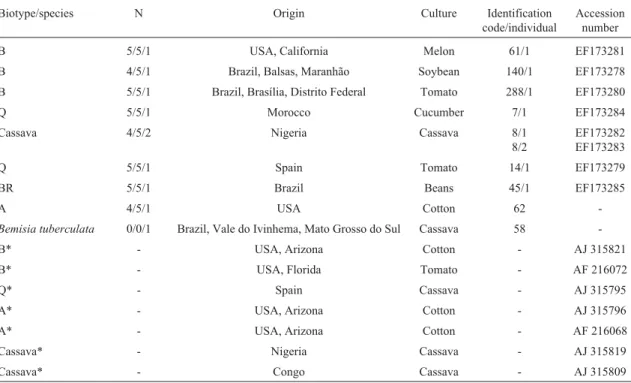
Seven different populations ofBemisia tabaci, repre-senting the B, BR, Q and Cassava biotypes were analyzed (Table 1). The BR population was pre-classified based on
www.sbg.org.br
RAPD primers, as previously described by Lima et al.
(2002). The A biotype (population code 62) was included in the RAPD analysis for comparison, since in previous stud-ies this biotype was shown to be closely related to the BR biotype (Limaet al., 2000). The Q and Cassava biotypes were provided by Dr. José Luis Caris (Murcia, Spain) and Dr. Ismail Abdullahi (University of Ibadan, Nigeria), re-spectively. For comparison purposes, one individual of
Bemisia tuberculata(population code 58) was included in the sequencing analysis of the ITS1 rDNA region and was used as the outgroup in the phylogenetic analysis. The indi-viduals of each population were named with the identifica-tion code followed by the numbers 1 through 5.
The populations were first sexed for the selection of female individuals and the DNA was extracted using the method described by Limaet al.(2000). Briefly, the sam-ples were macerated in lysis buffer containing Tris-HCl 10 mM pH 8.0, EDTA 1 mM, Triton X-100 0,30%, proteinase K 60µg mL-1, and were incubated at 65 °C for 30 min and at 95 °C for 10 min. The samples were then stored at -20 °C until use.
For the RAPD-PCR analysis, a total of 33 individuals were used including four individuals of the biotypes B (140) and Cassava (8) and five individuals of the biotypes BR (45), B (61), B (288), Q (7) and Q (14). Four individuals of the biotype A (62) were also included for comparison. The amplifications were performed in a total volume of 30µL containing 0.4µM of primer, 0.2 mM dNTP, 1 UTaq
DNA polymerase and 20 ng of DNA. The primers OPA04, OPA10, OPA11 and OPA15 (Operon Technologies, Inc.)
were used in this study. The amplification reactions were performed with an initial denaturation at 94 °C for 3 min, followed by 45 cycles at 93 °C for 1 min, 35 °C for 1 min and 72 °C for 2 min. The RAPD amplification products were separated in 1.5% agarose gels in TBE 1X (Tris-borate 90 mM and EDTA 1 mM). The gels were stained with 5µg mL-1 ethidium bromide and the bands were visualized under UV using the EagleEye II still video system™ (Stratagene). The molecular marker Ladder 100 bp (Invitrogen) was used. At least three replicates were performed for each primer used.
The banding patterns observed were used to construct a dendrogram based on a similarity matrix obtained by the Jaccard’s coefficient using the UPGMA (unweighted pair-group method analysis) program. The dendrogram was constructed with the NTSYS (Numerical Taxonomy and Multivariate Analysis System) program version 2.02 pc (Rohlf, 1993).
For the PCR-RFLP analysis of the ITS1 rDNA re-gion, five individuals of each population of the biotypes B (61, 140 and 288), BR (45), Q (7 and 14) and Cassava (8) were used. The amplification of the ITS1 rDNA region was performed using the primers TW81 (Brustet al., 1998) and 5.8R (De Barroet al., 2000) as described by De Barroet al.
(2003), with some modifications. The final volume of the reaction was 30µL containing 2µL of DMSO, MgCl250
mM, 5µL of each primer TW81 and 5.8R (2 mM), dNTP 10 mM and 1U ofTaqPolymerase (Pharmacia). The ampli-fications were performed with an initial denaturation at 94 °C for 5 min followed by the addition ofTaq
Polymer-Table 1-Bemisia tabacipopulations used in this study.
Biotype/species N Origin Culture Identification code/individual
Accession number B 5/5/1 USA, California Melon 61/1 EF173281 B 4/5/1 Brazil, Balsas, Maranhão Soybean 140/1 EF173278 B 5/5/1 Brazil, Brasília, Distrito Federal Tomato 288/1 EF173280
Q 5/5/1 Morocco Cucumber 7/1 EF173284
Cassava 4/5/2 Nigeria Cassava 8/1
8/2
EF173282 EF173283
Q 5/5/1 Spain Tomato 14/1 EF173279
BR 5/5/1 Brazil Beans 45/1 EF173285
A 4/5/1 USA Cotton 62
-Bemisia tuberculata 0/0/1 Brazil, Vale do Ivinhema, Mato Grosso do Sul Cassava 58
-B* - USA, Arizona Cotton - AJ 315821
B* - USA, Florida Tomato - AF 216072
Q* - Spain Cassava - AJ 315795
A* - USA, Arizona Cotton - AJ 315796
A* - USA, Arizona Cotton - AF 216068
Cassava* - Nigeria Cassava - AJ 315819
Cassava* - Congo Cassava - AJ 315809
ase. The samples were incubated at 72 °C for 5 min and de-natured at 95 °C for 3 min. A 30 cycle amplification was performed with an initial denaturation at 95 °C for 30 s, an-nealing at 54 °C for 1 min and extension at 72 °C for 1 min. The amplification product was electrophoresed in a 1.5% agarose gel and visualized after ethidium bromide staining (0,5µL mL-1). Ladder 100 pb (Invitrogen) was used as a molecular marker.
The amplified ITS1 rDNA region was digested with the restriction enzymesXhoI, BamHI, EcoRI,PstI, AvaI, DdeI andSau3A. The digestions were performed according to the manufacturers instructions. The fragments obtained were separated by electrophoresis in a 2% agarose gel and visualized after ethidium bromide staining (0,5µL mL-1). Bands under 100 bp were not considered in the analyses.
The ITS1 rDNA of individuals representing each population (61, 140, 288, 7, 8, 14 e 45) and profile obtained by PCR-RFLP (61/1, 140/1, 288/1, 7/1, 8/1, 8/2, 14/1, 45/1), as well as of one individual ofBemisia tuberculata, were cloned in pGem T-Easy (Promega) and sequenced in an automatic sequencer ABI Prism 3700 DNA Analyser
(Applied Biosystems Inc.). Both strands were sequenced and the sequences were deposited in GenBank (Table 1). The alignment of the sequences was performed using the Clustal W program (Higginset al., 1994). A phylogenetic tree was constructed using the MEGA program version 3.0 (Kumaret al., 2004), with the p-distance and the Neigh-bor-joining method. Bootstrap analysis was performed with 250 replications. Besides the sequences determined in this study, sequences of the ITS1 rDNA region of some bio-types available in GenBank were also included for compar-ison (Table 1). TheB. tuberculatasequence obtained in this study was used as the outgroup.
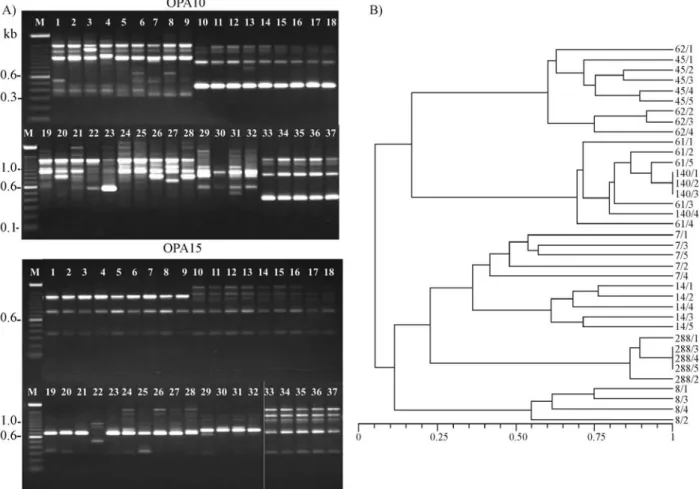
The analysis of the amplicons generated by the RAPD reactions revealed that the biotypes ofB. tabaci pro-duced different molecular patterns (Figure 1A). The band-ing patterns of the A and BR biotypes were very similar, with several common bands when the four RAPD primers were used. These results agree with previous studies re-ported by Lima et al. (2002). When using the primer OPA04, for example, it was observed that the A and BR biotypes had a common fragment of 950 pb. However, the presence of an additional 800 pb RAPD fragment allowed
to discriminate the BR biotype. Moreover, the B and Q bio-types had a similar 700 pb fragment but two bands, one with 550 pb and another with 900 pb, were only present in the Q biotype. The amplified fragments can be further ex-plored to develop specific primers which can be used as molecular markers for a rapid and accurate identification of
B. tabacibiotypes.
Variation in the RAPD profiles was found among the B biotype from different hosts using the OPA04, OPA10 and OPA11 primers. A higher level of diversity was found within the populations of the Q and Cassava biotypes when the OPA10 and OPA11 primers were used. On the other hand, the OPA15 primer revealed a lower level of diversity among theB. tabacipopulations.
The combined data sets obtained with the four prim-ers were used to construct a dendrogram, which showed a high level of diversity among theB. tabacibiotypes and al-lowed the distinction of seven major clusters (Figure 1B). The first group (group I) was composed by the Brazilian biotype (BR) and the American biotype (A) populations. These populations showed 15% similarity in relation to group II, formed by the B biotype populations of soybean and melon. The third group (group III) was composed of Q biotype individuals from Morocco. Unexpectedly, one in-dividual (7/4) formed a separate group (group IV) distantly related to the other Q biotype individuals from Morocco and presented a very distinct RAPD profile with the OPA15 primer. A high level of diversity has been previously re-ported in Q biotype populations (Moyaet al., 2001).
Group V was formed by Q biotype individuals from Spain. Interestingly, one B biotype population ofB. tabaci
(288) collected from tomato in Brazil (group VI) showed a higher similarity to Cassava and Q biotypes from Spain. Another intriguing result was that population 288 did not group with the other B biotype populations (61 and 140). It is possible that population 288 is older and had more time to differentiate from the originally introduced population from the USA. Some authors suggest that isolation is the key mechanism that leads to genetic diversity (De Barroet al., 2005). Group VII was composed by the Cassava biotype ofB. tabaci, which differs from the other biotypes in its host specificity (Abdullahiet al., 2003, 2004).
Overall, the populations analyzed in this study were grouped according to their biotypes, showing that RAPD was useful to distinguish the biotypes that occur in Brazil as well as the exotic ones. This technique can be further ex-plored in order to design specific primers to rapidly identify new biotypes, which can be very useful as an identification tool to be used for quarantine and phytosanitary purposes.
The analysis of the ITS rDNA region was performed in an attempt to obtain another method for the identification ofB. tabacibiotypes. The ITS rDNA is a conserved region and is useful in distinguishing recently divergent taxa (De Barroet al., 2003). The amplification of the ITS1 rDNA re-gion of theB. tabacipopulations revealed one band of
ap-proximately 550 bp for all the individuals analyzed. The amplification product was digested with seven restriction enzymes. No digestion was observed when the enzymes
XhoI, BamHI, EcoRI and PstI were used and different banding patterns were observed after digestion withDdeI, AvaI andSau3A (Figure 2A).
The individuals of the B biotype populations from the USA and Brazil, as well as those of the Q biotype popula-tions from Morocco and Spain showed identical banding patterns with the three enzymes (Figure 2A). An intrapopulation variation was observed in the Cassava biotype from Nigeria (Figure 2A). One of the five analyzed individuals from this population (8/1) presented a banding pattern identical to that of the B and Q biotypes from Spain and Morocco, while the other four individuals revealed a unique profile for the three enzymes used. The ITS rDNA region of these four individuals did not present a restriction site for theDdeIenzyme. The native Brazilian BR biotype also showed the same restriction pattern observed for the B and Q biotype populations with the three enzymes used (Figure 2A).
For a more detailed analysis of the divergence level of the ITS1 rDNA region between the populations and bio-types, the sequence of the ITS1 rDNA of one individual representing the populations and groups obtained by the PCR-RFLP analysis was determined. Sequences varying between 542 and 555 bp were obtained and aligned using the Clustal W program (Higginset al., 1994). The align-ment of the sequences revealed a high similarity between the individuals of the different biotypes which ranged be-tween 100% and 93,8%. The individuals of the B biotype presented almost identical sequences, differing only in po-sitions 219 and 414. The BR biotype presented approxi-mately 95% similarity with the other biotypes, including biotype B, which is dominant in Brazil. The individual 8/2 of the Cassava biotype from Nigeria presented the most di-vergent ITS1 rDNA sequence. Unexpectedly, the se-quences of the BR and Cassava (8/2) biotypes presented a six-base insertion at position 239 of the ITS rDNA se-quence. This region may be used to design specific primers that distinguish these biotypes. The ITS rDNA region of oneB. tuberculataindividual (58/1) (EF173286) was also determined and showed low similarity with the sequences ofB. tabacibiotypes (66% to 64%). Interestingly, theB. tuberculataITS rDNA sequence presented a 17-base dele-tion at posidele-tion 89 and this region can also be used to design specific primers to rapidly identifyB. tuberculata.
of the Cassava biotype from Nigeria (individual 8/2) (Fig-ure 2B). Interestingly, the individual 8/1 of the Cassava biotype grouped with the Q biotype indicating that these biotypes possibly coexist and were therefore collected to-gether from the same host plant. In general, thebootstrap
values were high, mostly above 98%, indicating a high reli-ability in the obtained grouping. Similar results were ob-served by De Barroet al.(2000) when analyzing the ITS1 rDNA region of different biotypes. These authors reported that the populations of America (biotype A) formed a group closely related to the B biotype and to the biotypes from Northern Africa.
The results obtained herein showed that the analysis of the ITS1 rDNA region constitutes a valuable method, complementary to RAPD-PCR, that allows the inference of the relationships between species and biotypes ofB. tabaci. Moreover, several differential bands detected in the RAPD-PCR and specific sequences of the ITS rDNA can be further explored to develop specific primers to rapidly and efficiently distinguish theB. tabacibiotypes.The use of specific primers represents an important tool as it may help to avoid the introduction of exotic biotypes of B. tabaciin Brazil. This is of interest because invasive alien
species or biotypes may cause a severe economic, environ-mental and social impact in agricultural crops.
Acknowledgments
We thank Dr. Ismail Abdullahi from the Department of Plant Protection and Environmental Biology of the Uni-versity of Ibadan, Nigeria, and Dr. José Luis Caris, Murcia, Spain, for providing theB. tabaciCassava and Q biotype samples.
References
Abdullahi I, Winter S, Atiri GI and Thottappilly G (2003) Molec-ular characterization of whitefly, Bemisia tabaci
(Hemiptera, Aleyrodidae) populations infesting cassava. Bull Entomol Res 93:97-106.
Abdullahi I, Atiri GI, Thottappilly G and Winter S (2004) Dis-crimination of cassava-associatedBemisia tabaciin Africa from polyphagous populations, by PCR-RFLP of internal transcribed spacer regions of ribossomal DNA. J Appl Entomol 128:81-87.
(Genn.) (Homoptera, Aleyrodidae). Biochem Genet 33:205-214.
Brust RA, Ballard JWO, Driver F, Hartley DM, Galway NJ and Curran J (1998) Molecular systematics, morphological anal-ysis, and hybrid crossing identify a third taxon, Aedes
(Halaedes)wardandensissp. nov., of theAedes(Halaedes)
australis species-group (Diptera, Culicidae). Can J Zool 76:1236-1246.
Cervera MT, Cabezas JA, Simon B, Martinez-Zapater JM, Beitia F and Cenis JL (2000) Molecular characterization of whitefly,Bemisia tabaci(Hemiptera, Aleyrodidae) popula-tion infesting cassava. Bull Entomol Res 90:91-396. Costa HS and Brown JK (1990) Variability in biological
charac-teristic isozyme patterns and virus transmission among pop-ulations of Bemisia tabaci Genn. in Arizona. Phytopathology 80:888.
Costa HS and Brown JK (1991) Variation in biological character-istics and esterase patterns among populations ofBemisia tabaci,and the association of one population with silverleaf symptom induction. Entomol Exp Appl 61:211-219. De Barro PJ and Driver F (1997) Use of RAPD PCR to distinguish
the B biotype from other biotypes of Bemisia tabaci
(Gennadius) (Hemiptera, Aleyrodidae). Austr J Entomol 36:149-152.
De Barro PJ, Driver F, Trueman JWH and Curran J (2000) Phylo-genetic relationships of world populations ofBemisia tabaci
(Gennadius) using ribosomal ITS1. Mol Phylogenet Evol 16:29-36.
De Barro PJ, Scott KD, Graham GC, Lange CL and Schutze MK (2003) Isolation and characterization of microsatellite loci in
Bemisia tabaci. Mol Ecol Notes 3:40-43.
De Barro PJ, Trueman JWH and Frohlich DR (2005)Bemisia argentifoliiis a race ofB. tabaci: The molecular genetic dif-ferentiation ofB. tabacipopulations around the world. Bull Entomol Res 95:193-203.
Gawell NJ and Bartlett AC (1993) Characterization of differences between whiteflies using RAPD-PCR. Insect Mol Biol 2:33-38.
Higgins D, Thompson J, Gibson T, Thompson JD, Higgins DG and Gibson TJ (1994) CLUSTAL W: Improving the sensi-tivity of progressive multiple sequence alignment through sequence weighting, position-specific gap penalties and weight matrix choice. Nucleic Acids Res 22:4673-4680. Khasdan V, Levin I, Rosner A, Morin S, Kontsedalov S, Maslenin
L and Horowitz AR (2005) DNA markers for identifying biotypes B and Q of Bemisia tabaci (Hemiptera, Aleyrodidae) and studying population dynamics. Bull Entomol Res 95:605-613.
Kumar S, Tamura K and Nei M (2004) MEGA3: Integrated soft-ware for molecular evolutionary genetics analysis and se-quence alignment. Brief Bioinform 5:150-163.
Lima LHC, Návia D, Inglis PW and Oliveira MRV (2000) Survey of Bemisia tabaci (Gennadius) (Hemiptera, Aleyrodidae) biotypes in Brazil using RAPD markers. Genet Mol Biol 23:1-5.
Lima LHC, Campos L, Moretzsohn MC, Návia D and Oliveira MRV (2002) Genetic diversity of Bemisia tabaci(Genn.) populations in Brazil revealed by RAPD markers. Genet Mol Biol 25:217-223.
Lourenção AL and Nagai H (1994) Surtos populacionais de
Bemisia tabacino Estado de São Paulo. Bragantia 53:53-59 (Abstract in English).
Moya A, Guirão P, Cifuentes D, Beitia F and Cenis JL (2001) Ge-netic diversity of Iberian populations of Bemisia tabaci
(Hemiptera, Aleyrodidae) based on random amplified poly-morphic DNA-polymerase chain reaction. Mol Ecol 10:891-897.
Perring TM, Cooper AD, Rodriguez RJ, Farrar CA and Bellows Jr. TS (1993) Identification of a whitefly species by genomic and behavioural studies. Science 259:74-77.
Rohlf FJ (1993) NTSYS-pc, numerical taxonomy and multivariate analysis system. v. 1.80. Appl Biostatistics Inc., NY.
Associate Editor: Louis Bernard Klaczko