Effect of alcohols on filamentation, growth, viability and biofilm development
in
Candida albicans
Nitin M Chauhan, Ravikumar B Shinde, S. Mohan Karuppayil
DST-FIST and UGC-SAP Sponsored School of Life Sciences, SRTM University, Nanded, M.S, India.
Submitted: August 2, 2012; Approved: April 4, 2013.
Abstract
In this study we report the potential of alcohols as morphogenetic regulators inCandida albicans. All the alcohols tested influenced various modes of growth like planktonic as well as biofilm forms. Via-bility was affected at high concentrations. Among the alcohols, the response ofC. albicansto amyl alcohol (pentanol) was noteworthy. Amyl alcohol at a concentration 0.5% which was not inhibitory to growth and viability specifically inhibited morphogenetic switching from yeast to hyphal forms. It also inhibited normal biofilm development favoring yeast dominated biofilms. Based on this study we hypothesize that alcohols produced under anaerobic conditions may not favor biofilm develop-ment and support dissemination of yeast cells. Since anaerobic conditions are not found to favor pro-duction of quorum sensing molecules like farnesol, the alcohols may play a role in morphogenetic regulation.
Key words:alcohols, signalling, morphogenesis, biofilms, yeast metabolism,Candida albicans.
Introduction
Candida albicansis considered as a serious pathogen in immunocompromised patients causing high mortality rate (Fridkin and Irwin, 1983; Jean-Marcel, 1998; Virudes et al., 2003; Parahym et al., 2009). Several studies have shown that inC. albicans, filamentation is a virulence fac-tor (Loet al., 1997; Savilleet al., 2003; Yang, 2003). It also plays a critical role in biofilm formation (Baillie and Dou-glas, 1999). Thus, inhibition of filamentation may reduce pathogenesis and biofilm formation inC. albicans(Loet al., 1997; Baillie and Douglas, 1999; Lopez-Ribot, 2005).
Metabolites produced under different environmental conditions are reported as virulence molecules in microbes (Dufour and Rao, 2011). Different alcohols are produced by the yeastSaccharomyces cerevisiaeandC. albicans in vitro(Ghoshet al., 2008; Hazelwoodet al., 2008). For ex-ample in presence of leucine, valine, phenylalanine, tyro-sine, and tryptophan as nitrogen sources,Saccharomyces cerevisiaeproduces isoamyl alcohol, isobutanol, tyrosol, phenylethanol, and tryptophol respectively (Dickinson, 2008; Hazelwoodet al., 2008). Alcohols such as ethanol, propanol, isopropanol, 1-butanol, 2-butanol, isoamyl alco-hol, and tert-amyl alcohol are reported to induce
fila-mentation in S. cerevisiae(Lorenz et al., 2000). Attach-ment to tissue culture dishes and polystyrene dishes in Pseudomonas species is affected by methanol, ethanol, propanol, and butanol (Fletcher, 1983).C. albicansin pres-ence ethyl alcohol, dodecanol, isoamyl alcohol, and nero-lidol failed to switch from yeast to hyphae under standard induction conditions (Martinset al., 2007; Davis-Hannaet al., 2008; Chauhanet al., 2010). Short chain n-alkanols are reported to affect the morphogenesis in the dimorphic fun-gus, Aureobasidium pullulans (Moragues et al., 1998). Studies are lacking on the effect of propanol, butanol, isopropanol, pentanol and isobutanol inC. albicans. In this paper we report for the first time the effect of short chain al-cohols on induced morphogenesis, growth, and biofilm for-mation inC. albicans.
Materials and Methods
Organism, media and culture conditions
Candida albicansATCC 90028 (MTCC 3017) was used throughout the study. The culture was maintained on Peptone-Dextrose (YPD) agar slants at 4 °C. Yeast-Peptone-Dextrose medium (YPD) was prepared by dissolv-ing individual components (Yeast extract 1%, Peptone 2%
Send correspondence to S.M. Karuppayil. School of Life Sciences, SRTM University, Nanded, 431606 MS, India. E-mail: [email protected].
and Dextrose 2%) in distilled water. pH was adjusted to 6.5. Solid medium was prepared by adding 2.5% agar powder to YPD broth. Two inducersi.e.10% horse serum was pre-pared in deionized distilled water while, RPMI -1640 me-dium with L-glutamine w/o some-dium bicarbonate buffered with 165 mM MOPS (3-[N-morpholine] propane sulphonic acid) was added in sterilized distilled water and pH was ad-justed to 7. All the media components and chemicals were from Hi-Media Laboratories Ltd. Mumbai, India. For cul-ture activation, a single colony from the YPD plates was in-oculated in 50 mL of YPD broth, in a 250 mL conical flask and incubated at 30 °C on an orbital shaker at 120 rpm for 24 h. Cells from the activated culture were harvested by centrifugation for 5 min at 2000 g speed and washed three times with PBS (10 mM Phosphate buffer, 2.7 mM Potas-sium chloride and 137 mM Sodium chloride pH 7.4) and re-suspended in PBS.
Filamentation assay
Filament formation was studied using microtiter plate assay in 96 -well microtiter plates as described previously (Chauhanet al., 2010). Briefly, cells from stock were inoc-ulated in various inducer media to get 1 x 10⁶cells ml-1. Various concentrations of butanol, isobutanol, tertiary-bu-tanol, propanol, isopropanol and pentanol to give final con-centrations of 0.06, 0.12, 0.25, 0.5, 1, 2, and 4% (v/v) were added. Wells without alcohol were kept as control. Final volume of assay system in each well was kept 200mL. The plates were incubated at 37 °C at 200 rpm on an orbital shaker for 4 to 8 h. After incubation, cells were observed microscopically. Every time, 100 cells were counted and the numbers of yeast and germ tube forms were noted. Per-centage of germ tube formation in each well was calculated compared to that of control with the following formula:
% formation no. treatment no. control
= ´100
where % formation = percentage of germ tube formation, no. treatment = no. of germ tubes in treatment and no. con-trol = no. of germ tubes in concon-trol.
Growth and viability assay
Effect of alcohols on growth of C. albicans yeast phase cells was determined by standard CLSI M27-A microbroth dilution method (NCCLS, 1997). Various con-centrations of butanol, isobutanol, tertiary-butanol, propanol, isopropanol, and pentanol (amyl alcohol) ranging from 0.025 to 4% v/v were added to RPMI 1640 medium in 96-well microtiter plates. Each well was inoculated with 1 x 10³ cells mL-1. Final volume in each well was kept as 200mL. Plates were incubated at 35 °C on an orbital shaker for 24 h. Optical density was measured at 620 nm wave-length using a 96-well microplate reader (Multiscan Ex-Thermo Electron Corp. USA) and absorbance of alco-hols treated wells were compared with that of control. Plate count was done to see the effect on viability (Chauhanet
al., 2010). Cells from the respective wells were diluted to get 300 to 400 colonies and an aliquot of the sample was spread on YPD agar plates. The plates were incubated at 30 °C for 24 h and colony count was done. Percentage of vi-ability of treated cells was calculated by comparing with the colony count of control wells.
Biofilm formation and MTT assay
To see the effect of various alcohols on biofilm devel-opment,Candidabiofilms were developed on polystyrene surface of 96-well plates(Chauhanet al., 2010). A cell sus-pension of 1 x 10⁷ cells mL-1 was prepared in PBS and 100mL was inoculated in each well. The plates were incu-bated at 37 °C at 50 rpm for 90 min for adhesion of cells on the surfaces. Non-adhered cells were removed by washing the wells, 2-3 times with PBS after 90 min. 200 mL of RPMI-1640 medium along with various concentrations of butanol, isobutanol, tertiary-butanol, propanol, isopro-panol, and pentanol ranging from 0.025 to 4% v/v and one control without alcohols was added to each well. The plates were incubated at 37 °C for 24 h to allow biofilm formation. After incubation, wells were washed to remove any plank-tonic cells and biofilms were observed under an inverted light microscope (Metzer, India). Measurement of meta-bolic activity of biofilm was done by MTT assay with little modification (Hawser and Douglas, 1997). The tetrazolium salt 3-[4, 5-dimethylthiazol-2-yl]-2, 5-diphenyltetrazolium bromide (MTT, Hi-media, Mumbai, India) was used in an assay. 50mL of MTT solution (stock solution containing 5 mg MTT-mlof PBS, diluted 1:5 in prewarmed 0.15 M PBS prior to addition) was added in each well. The plate was in-cubated for 5 h at 37 °C. Dimethyl sulfoxide (200mL) was added to each well to solubilise MTT formazan product and optical density was measured at 450 nm using a 96-well microplate reader (Multiscan Ex-Thermo Electron Corp. USA). Percentage of metabolic activity in biofilm forma-tion was calculated compared to that of control (without al-cohol).
Statistical analysis
All the experiments were done in triplicates and stan-dard deviation from the mean was calculated. Effect of al-cohols on biofilm formation was analyzed using Two-way Anova (Bonferroni posttests) by GraphPad Prism 5 soft-ware. P < 0.05 was considered statistically significant.
Results
Effect of various alcohols on induced morphogenesis
com-plete inhibition of filamentation, while 1% of butanol and propanol completely blocked hyphae. Isobutanol, isopro-panol and tertiary-butanol at 2% completely halted yeast to hyphal form transitions (Figure 3). The efficacy of alcohols towards induced morphogenesis is as follows:
Pentanol < Butanol, Propanol < Isobutanol, Isopropanol, Tertiary-Butanol
Growth and viability ofC. albicanscells in presence of alcohols
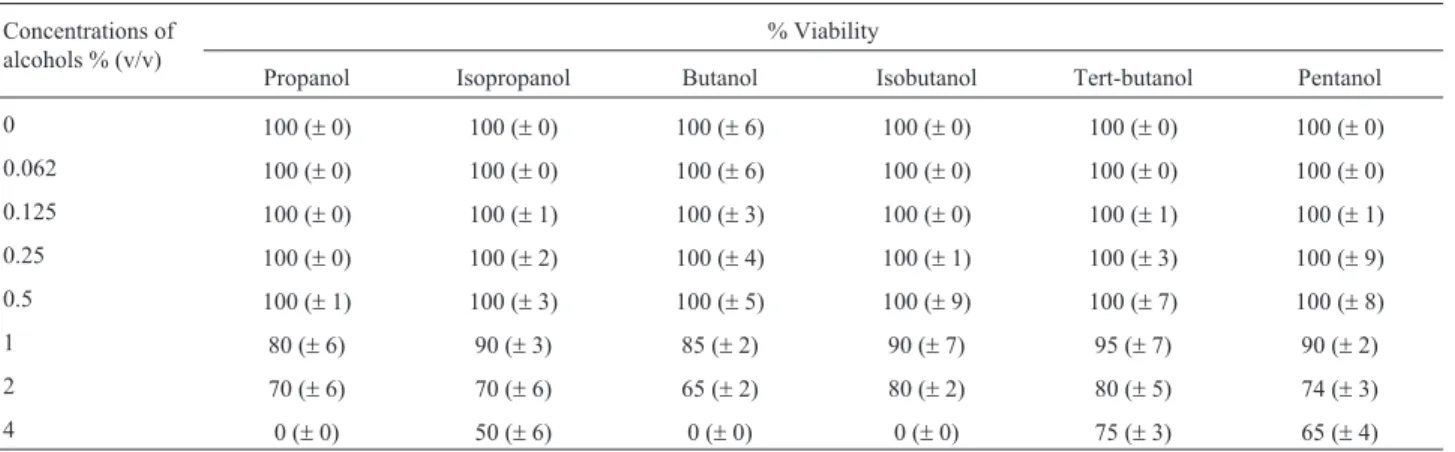
Alcohols upto 0.5% of concentration did not cause any effect on viability. Addition of 4% of various alcohols inhibited growth by 60-80%. 2% of butanol, isobutanol, tertiary-butanol, and pentanol reduced growth by 15-20%, whereas propanol and isopropanol at the same concentra-tion inhibited growth by 20-25%. 4% of butanol, isobu-tanol, and propanol were found to be toxic toCandidacells, while isopropanol, tertiary-butanol, and pentanol caused 35-50% reduction in viability at 4% (Table 1). The sensitiv-ity ofCandidacells for alcohols is as follows:
Butanol < Propanol < Isobutanol < Isopropanol < Pentanol < Tertiary-butanol
Candidabiofilms in presence of various alcohols
All the alcohols studied significantly (p = 0.0005) in-hibited biofilm formation in a concentration dependent manner. Treatment with 4% of alcohols caused 50-60% re-duction in metabolic activity inCandidabiofilm (Figure 2). Addition of 2% of butanol, isobutanol, tertiary-butanol, propanol, and isopropanol after adhesion phase inhibited biofilm development and patches of few adhered yeast cells were observed, whereas similar effect was seen at 1% of pentanol (Figure 4). 1% of butanol, isobutanol, tertiary-butanol, propanol, and isopropanol inhibited filamentation in biofilms and favoured `yeast only’ biofilm. Pentanol caused considerable inhibition of biofilm at 0.5% concen-tration leading to yeast only biofilm formation.
Discussion
The behavior and production of metabolites by Candida albicans in vivomay greatly vary depending on the niches it colonizes in the human body like gastrointesti-nal tract, vagigastrointesti-nal, or oral cavities (Ghoshet al., 2008). In deep seated mycosis or in biofilms on prosthetic devices it may live in a polymicrobial environment and may be sub-ject to anaerobic conditions or exposed to the metabolites its own or that of other organisms (Dumitruet al., 2004; Dufour and Rao, 2011). In gastrointestinal tract, deep
Figure 1-Candida albicansyeast to hyphal form transition in presence of various alcohols induced by two standard inducers. A) Serum; B) RPMI-1640 medium. The cells were incubated at 37 °C in respective me-dium for 4 h and morphology was assessed after incubation.
Table 1- Viability ofCandida albicansyeast phase cells grown in presence of alcohols
Concentrations of alcohols % (v/v)
% Viability
Propanol Isopropanol Butanol Isobutanol Tert-butanol Pentanol
0 100 (±0) 100 (±0) 100 (±6) 100 (±0) 100 (±0) 100 (±0)
0.062 100 (±0) 100 (±0) 100 (±6) 100 (±0) 100 (±0) 100 (±0)
0.125 100 (±0) 100 (±1) 100 (±3) 100 (±0) 100 (±1) 100 (±1)
0.25 100 (±0) 100 (±2) 100 (±4) 100 (±1) 100 (±3) 100 (±9)
0.5 100 (±1) 100 (±3) 100 (±5) 100 (±9) 100 (±7) 100 (±8)
1 80 (±6) 90 (±3) 85 (±2) 90 (±7) 95 (±7) 90 (±2)
2 70 (±6) 70 (±6) 65 (±2) 80 (±2) 80 (±5) 74 (±3)
4 0 (±0) 50 (±6) 0 (±0) 0 (±0) 75 (±3) 65 (±4)
seated mycosis, and biofilms it may produce considerable amount of alcohols, because of the anaerobic conditions. The quorum sensing molecule, farnesol is undetectable un-der anaerobic conditions of growth, suggesting signalling roles for other metabolites (Hornbyet al., 2011). Alcohols are very common metabolites produced by yeast under an-aerobic conditions. Interestingly, the concentrations of
al-Figure 2- Effect of various alcohols on biofilm formation byCandida albicans.In vitrobiofilm development in the presence of alcohols was quantified by using MTT assay. RPMI-1640 medium containing various concentrations of respective alcohols and one control without alcohol was incubated at 37 °C for 24 h.
Figure 3- Morphology ofCandida albicanscells in presence of pentanol. Briefly cells were incubated in serum at 37 °C for 4, 6, and 8 h respectively and morphology was assessed after incubation and photographs were taken by Labomed imaging device. (Magnification x100).
cohols produced under anaerobic conditions are more in comparison to yeast cells produced under aerobic growth (Ghoshet al., 2008). Most of the alcohols tested by us in-hibited yeast to hyphal form switching.
We have earlier reported the morphogenetic regula-tory properties of ethyl alcohol (Chauhanet al., 2010) and its oxidative product, acetaldehyde in C. albicans (Chauhanet al., 2011). In this paper we report for the first time the effect of pentanol, butanol, propanol, isobutanol, isopropanol, and tertiary-butanol on morphogenetic switching, biofilm formation, growth, and viability inC. albicans. Among the various alcohols studied, pentanol (amyl alcohol) was found to be very effective. 0.5% of pen-tanol completely blocked induced morphogenesis without affecting viability of C. albicans. The hyphal inhibitory concentration of pentanol did not alter growth and viability of Candida cells. The same concentration of pentanol showed around 50% reduction in metabolic activity in biofilm development (Figure 2). While for other alcohols the hyphal inhibitory concentration showed 10-30% reduc-tion in viability and 35-45% decreased in metabolic activity was observed inCandidabiofilms compared to that of con-trol (Table 2). Based on our results, we have proposed a model for the role of alcohols inC. albicansbiofilms (Fig-ure 5).
Deeper regions of mature biofilms may produce an-aerobic conditions (Dumitruet al., 2004). Anaerobic condi-tions also persist in deep seated mycosis. The type of alcohol produced may vary depending on the amino acid availability. For example, availability of leucine, isoleu-cine, valine, and threonine may favor the production of amyl alcohol, isoamyl alcohol, butanol, and propanol re-spectively (Dickinson et al., 1998; Lorenz et al., 2000; Hazelwoodet al., 2008). The alcohols may exert effects
de-pending on its concentrations. At lower concentrations like 0.5% in case of amyl alcohol it may inhibit morphogenetic switching and support yeast phase growth. While at high concentrations it may slow down the growth rate. Most of the alcohols may exert similar effect like ethyl alcohol, amyl alcohol, isoamyl alcohol, etc. Favoring of yeast phase growth may support disseminative mode of growth and also aid to escape from the alcohol poisoned environment. It may also offer ecological advantages forC. albicansover other competing organisms which are more susceptible to alcohols thanCandidaunder mixed species of populations.
Acknowledgments
The authors thank Prof. S. B. Nimse, Honourable Vice Chancellor, SRTM University, Nanded (M.S), India, for encouragement and motivation.
References
Baillie GS, Douglas LJ (1999) Role of dimorphism in the devel-opment of Candida albicans biofilms. J Med Microbiol 48:671-679.
Chauhan NM, Raut JS, Karuppayil SM (2010) A morphogenetic regulatory role for ethyl alcohol in Candida albicans. Mycoses 54:e697-703.
Chauhan NM, Raut JS, Karuppayil SM (2011) Acetaldehyde in-hibits the yeast-to-hypha conversion and biofilm formation inCandida albicans. Mycoscience 52:356-360.
Davis-Hanna A, Piispanen AE, Staeva II, Hogan DA (2008) Far-nesol and dodecanol effects on theCandida albicans Ras-cAMP signaling pathway, and the regulation of morpho-genesis. Mol Biol 67:47-62.
Dickinson JR (2008) Filament formation in Saccharomyces cerevisiae- a Review. Folia Microbiol 53:03-14.
Dickinson JR, Harrison SJ, Hewlins JE (1998) An investigation of the metabolism of valine to isobutyl alcohol in Saccharomyces cerevisiae. The J Biol Chem 273:25751-25756.
Dufour N, Rao RP (2011) Secondary metabolites and other small molecules as intercellular pathogenic signals. FEMS Microbiol Letters 314:10-17.
Dumitru R, Hornby JN, Nickerson KW (2004) Defined anaerobic growth medium for studyingCandida albicansbasic biol-ogy and resistance to eight antifungal drugs. Antimicrob Agents Chemother 48:2350-2354.
Fletcher M (1983) Effects of methanol, ethanol, propanol, and butanol on bacterial attachment to surfaces. J Gen Microbiol 129:633-641.
Fridkin SK, Irwin MY (1983) Epidemiology of nosocomial fungal infections. Clin Microbiol Reviews 09:499-511.
Ghosh S, Kebaara BW, Atkin AA, Nickerson KW (2008) Regula-tion of Aromatic alcohol producRegula-tion inCandida albicans. Appl Environ Microbiol. 74:7211-7218.
Hawser SP, Douglas LJ (1994) Biofilm formation byCandida species on the surface of catheter materialsin vitro. Infect Immun 62:915-921.
Hazelwood LA, Daran JM, Maris JA, Pronk JT, Dickinson JR (2008) The Ehrlich pathway for fusel alcohol production: a
century of research onSaccharomyces cerevisiae. Appl En-viron Microbiol 74:2259-2266.
Hornby JB, Jensen EC, Lisec AD, Tasto JJ, Jahnke B, Shoemaker R, Dussualt P, Nickerson KW (2001) Quorum sensing in the dimorphic fungusCandida albicansis mediated by farnesol. Appl Environ Microbiol.67:2982-2992.
Jean-Marcel S (1998) Candida adherence phenomena, from com-mensalism to pathogenecity. Int Microbiol 1:117-122.
Lo HJ, Kohler JR, DiDomencia B, Loebenberg D, Fink GR (1997) Nonfilamentous Candida albicans are avirulent. Cell 90:939-949.
Lopez-Ribot JL (2005) Candida albicans Biofilms: More Than Filamentation. Current Biol 15:R453-R455.
Lorenz MC, Cutler NS, Heitman J (2000) Characterization of al-cohol-induced filamentous growth in Saccharomyces cerevisiae. Mol Biol Cell 11:183-199.
Martins M, Henriques M, Azeredo J, Rocha SM, Coimbra MA, Oliveira R (2007) Morphogenesis control in Candida albicans andCandida dubliniensisthrough signaling mole-cules produced by planktonic and biofilm cells. Eukaryo Cell 6:2429-2436.
Moragues MD, Asturias JA, Sevilla M (1998) Morphogenetic po-tency of short-chain n-alkanols related to Aureobasidium pullulans. Current Microbiol 16:243-245.
National Committee for Clinical Laboratory Standards. Reference method for broth dilution antifungal susceptibility testing of yeast (1997) Approved standard NCCLS M27-A. National Committee for Clinical Laboratory Standards, Wayne, Pa. Parahym AMR, Melo LRB, Morais VLL, Neves RP (2009)
Candidiasis in pediatric patients with cancer interned in uni-versity hospital. Braz J Microbiol 40:321-324.
Saville SP, Lazzell AL, Monteagudo C, Lopez-Ribot JL (2003) Engineered control of cell morphologyin vivoreveals dis-tinct roles for yeast and filamentous forms of Candida albicansduring infection. Eukary Cell 02:1053-1060. Virudes A, Peman J, Canton E, Ubeda P, Lopez-Ribot JL,
Go-berando L (2003) Candidemia at a tertiary care hospital: epi-demiology, treatment, clinical outcome, and risk factors for death. Eur J Clin Microbiol Infect Dis 01:767-774. Yang Y (2003) Virulence factors ofCandidaspecies. J Microbiol
Immunol Infect 36:223-228.