AR
TICLE
1 Laboratório de Inovações em Terapias, Ensino e Bioprodutos, Instituto Oswaldo Cruz (IOC), Fiocruz. Av. Brasil 4365/ Pavilhão Lauro Travassos/ Térreo, Manguinhos. 21040-900 Rio de Janeiro RJ Brasil. [email protected] 2 Assessoria de Planejamento Estratégico, IOC, Fiocruz. Rio de Janeiro RJ Brasil.
Evaluation matrix for health promotion programs
in socially vulnerable territories
Abstract Health promotion has a set of strate-gies for advancing health and reducing inequal-ities. However, evaluating the effectiveness of health promotion programs has been a challenge. This paper shows the development and applica-tion of the Evaluaapplica-tion Matrix, constructed with qualitative-quantitative and multidimensional indicators supported by public policies targeting socially vulnerable territories. This is a cross-sec-tional study with the implementation of a health promotion program in order to develop an Eval-uation Matrix to be applied in two distinct so-cio-environmentally vulnerable areas. The Eval-uation Matrix proved to be easily applicable and enabled the detection of strengths and weaknesses of health promotion programs applied in different territories. The participation of managers, teams, population and multiple sectors of society was de-cisive for the success of the program. Furthermore, community health workers stood out as essential stakeholders due to their linkages with the popu-lation. Contributions include a tool and method-ology for evaluating health promotion programs to be applied in different territories and modified according to the territory.
Key words Primary Health Care, Inequities,
Ter-ritory Rosana Therezinha Queiroz de Oliveira 1
Caroline Ferraz Ignacio 1
Antonio Henrique Almeida de Moraes Neto 1
O
liv
eir
Introduction
In 1946, Sigerist referred to the term “health pro-motion” in defining essential medical tasks such as health promotion, disease prevention, patient recovery and rehabilitation1.
In the 1970s, with the revival of nine-teenth-century social medical thinking, the term health promotion was once again used mainly in Canada and in Western European countries, from the discussion about effective high-level curative health care technology, increasing health medicalization and the need to reduce the cost of the current biomedical model2.
In the 1980s, the International Conferences of Ottawa (1986), Adelaide (1988) and Sunds-vall (1991) initiated the global health promo-tion movement and brought to the discussion the concepts of health, risk, social vulnerability, territory, intersectoriality, participation and sur-veillance, as well as the current conceptual and political bases for health promotion3.
In Brazil, this discussion was inspired by the progressive model, with a scientific stance and critical analysis of the relationship between health and society. Thus, there was an extensive production of papers aimed at understanding this relationship and the origin of the different epidemiological profiles found in our society, characterized by inequality. Therefore, health promotion began being perceived through its determinants and the understanding of the health-disease process was expanded3.
In the last two decades, some Latin American and Caribbean countries have implemented re-forms in their health systems that have fostered inclusion, citizen participation and equitable ac-cess to health care4. Despite these initiatives, huge inequalities in the coverage of health interven-tions persist in most countries of the region.
In Brazil, the economic advances observed during the military regime have disproportion-ately benefited the privileged segments of society and the movements for democracy provided a broad discussion on the needs of the population, thus catalyzing the Health Reform5. The con-struction of the Unified Health System (SUS), based on the principles of universalization, eq-uity and integrality was a commitment of the State to comply with its duty to provide health promotion policies. It is in this context that Pri-mary Health Care of SUS, primarily through the Family Health Strategy (FHS), acquired the im-portant role of responsible for providing human-ized access, coordinated care, comprehensive
ser-vices and equity in its actions6. Health promotion programs have been implemented by SUS with the aim of reducing inequalities in different ter-ritories7, but there is no evidence of an evaluation tool that originates in territorialized social reali-ties8,9 that considers the participation of societal sectors and stakeholders7.
The need to follow-up on the quality of health systems through monitoring and systematic eval-uations has been emphasized by the World Health Organization (WHO)10, but they generally use disease outcomes such as mortality and mor-bidity. Previous studies have shown that health promotion has the potential to act effectively in the health-disease process in a way consistent with the reality of each territory2,3,7; but evalu-ating health promotion programs is a challenge, since health promotion has a differentiated vision based on territoriality and is unrelated to the ex-clusively biomedical vision of disease. In collab-oration with WHO, since 2002, the Internation-al Union for HeInternation-alth Promotion and Education (IUHPE) has started to support initiatives to as-sess and show the effectiveness of health promo-tion to health system managers10. In 2004, the Pan American Health Organization (PAHO) engaged in this debate, which emphasized the importance of establishing health promotion policies and/ or programs built on participatory methodology and agreement of guiding values and principles for the evaluation of health promotion10.
At the national level, SUS’ performance is evaluated with PROADESS11 and the quality of Primary Health Care services is evaluated with the PMAQ12. However, SUS does not have a tool that evaluates its proposal for the qualification of health promotion actions.
Academia is also addressing this challenge. Restrepo13 considers that the evaluation of health promotion should be part of planning and de-veloped through social participation and sustain-able actions. Pedrosa7 stresses this characteristic of health promotion evaluation when affirming that it has to be participatory, where stakeholders negotiate, agree and decide collectively in order to achieve the desired changes. According to the author7, evaluation thought of in this form acts between the established and the transformative, and is transdisciplinary and multicultural, high-lighting the need to be institutionalized in order to be effective, since issues, criteria and evalua-tion parameters are built from the articulaevalua-tion of the evaluation and its object.
e C
ole
tiv
a,
22(12):3915-3932,
2017
Model” proposed by Donabedian14,15, which is composed of the analysis of the realms: struc-ture, process and results. For each realm several indicators are selected and used jointly with the intention of enabling stakeholders involved in producing health to appropriate the methods and tools both to make a diagnosis about the organization and operation of services and prac-tices and to build intervention projects for the identified challenges.
The challenge of evaluating health promo-tion programs is even greater when consider-ing the complex health-disease process in areas of socio-environmental vulnerability, where poverty-related diseases coexist with chronic non-communicable diseases, external causes of injury, inadequate sanitation conditions and dif-ficult access to prophylactic measures, including treatment and educational measures16-20. In this context, intestinal parasitic infections (IPI) per-petuate the disease-poverty-disease cycle18 by impairing cognitive function and school per-formance and, consequently, employability con-ditions6,21. The impact of IPIs has been largely ignored in Brazil and in other developing coun-tries, neglecting these diseases even more18,22,23.
This study builds on the hypothesis that qual-itative-quantitative and multidimensional health indicators contribute to the evaluation of the ef-fectiveness of health promotion programs based on public policies, the promotion of perceived health from its determinants and the expanded conception of the health-disease process3.
Thus, this study aimed to develop an Evalu-ation Matrix based on the implementEvalu-ation of a health promotion program, with the theme of confronting intestinal parasites (IPs) in vulner-able territories, using the theoretical bases of health promotion, the quality assessment mod-el14,15, health planning8,13 and evaluation7 for its construction.
Methodology
This cross-sectional qualitative-quantitative study was carried out through the implementa-tion of a health promoimplementa-tion program in the peri-od of 2013-2015, using participant observation, interviews and census in the 559 households en-rolled in the Family Health Strategy (FHS) of the municipality of Laje do Muriaé, RJ, aiming at the construction of the Evaluation Matrix and sub-sequent testing of its applicability in territories with different realities. Program implementation
counted on the partnership of the Municipal Health Secretariat (SMS) and adherence of FHS and Endemic teams of the Municipal Culture and Education Secretariats. Secondary school students from the municipality, members of Sci-entific Pre-Initiation Program for Young Science Talents, from the Foundation for Research Sup-port of the State of Rio de Janeiro (FAPERJ) also participated in the initiative.
Study areas
The health promotion program was devel-oped in the municipality of Laje do Muriaé, which is located in the northeast of Rio de Janeiro, Brazil (21°12’24’’S, 42°7’57’’O). It has the second high-est Social Vulnerability Index (IVSop = 0.82, 1 being the most vulnerable)24, the highest rate of declining population in the State (-0.53% per year)25, the second lowest GDP of the State25 and a large force enrolled in the Bolsa Família (Family Grant) Program (4.208 inhabitants, 60.0%)25.
Laje Muriaé has a total area of 250 km2 and a population of 7,487 inhabitants25; 3,126 (42%) have some occupation, of which only 940 (30%) have a formal employment relationship. The mu-nicipality has poor sanitation conditions, piped sewage, but which is exhausted in natura in the River Muriaé that traverses all its urban area.
The Matrix was later applied to the Manguin-hos Complex of Favelas located in the northern part of the city of Rio de Janeiro (22°52’47.04”S, 43°14’57.18”W), with approximately 40,000 peo-ple26. The Complex is composed mostly of sala-ried, underemployed and/or unemployed work-ers, poor sanitation and water supply conditions and defective public services27. Since Manguinhos is not a municipality and does not fit into district boundaries, the Manguinhos Complex of Favel-as hFavel-as limited official population data. However, it is a region with issues related to poverty and increasing violence28. Communities also coexist with air, water and soil contamination resulting from polluting industries, namely, the Manguin-hos refinery.
Both locations have determinant envi-ronmental conditions in the development of health-disease processes.
Stages of the Health Promotion Program
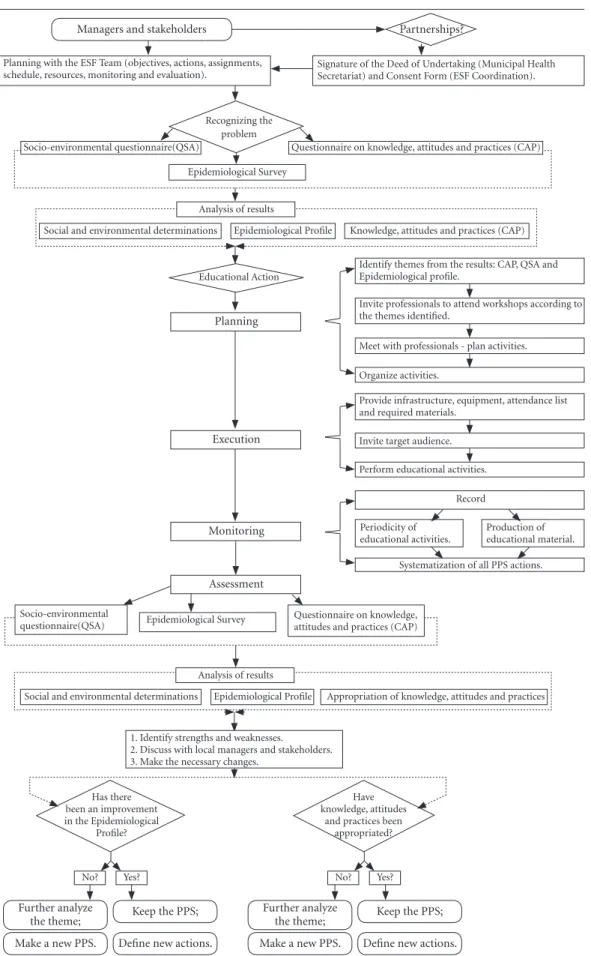
The program carried out in Laje do Muriaé was structured in three stages (Figure 1):
O
liv
eir
Figure 1. Flowchart Model of the Health Promotion Program developed in the municipality of Laje do Muriaé, Rio de Janeiro, 2013-2015.
Managers and stakeholders Partnerships?
Planning with the ESF Team (objectives, actions, assignments,
schedule, resources, monitoring and evaluation). Signature of the Deed of Undertaking (Municipal Health Secretariat) and Consent Form (ESF Coordination).
Epidemiological Survey
Educational Action
Epidemiological Profile Knowledge, attitudes and practices (CAP) Social and environmental determinations
Analysis of results
Identify themes from the results: CAP, QSA and Epidemiological profile.
Invite professionals to attend workshops according to the themes identified.
Meet with professionals - plan activities.
Organize activities.
Record
Periodicity of educational activities.
Production of educational material.
Systematization of all PPS actions.
Planning
Execution
Monitoring
Assessment
Questionnaire on knowledge, attitudes and practices (CAP) Socio-environmental
questionnaire(QSA) Epidemiological Survey Socio-environmental questionnaire(QSA)
Recognizing the problem
Questionnaire on knowledge, attitudes and practices (CAP)
Provide infrastructure, equipment, attendance list and required materials.
Invite target audience.
Perform educational activities.
Epidemiological Profile Appropriation of knowledge, attitudes and practices Social and environmental determinations
Analysis of results
1. Identify strengths and weaknesses. 2. Discuss with local managers and stakeholders. 3. Make the necessary changes.
Has there been an improvement in the Epidemiological
Profile?
Have knowledge, attitudes
and practices been appropriated?
No? Yes? No? Yes?
Further analyze
the theme; Keep the PPS; Make a new PPS. Define new actions.
Further analyze
e C
ole
tiv
a,
22(12):3915-3932,
2017
parasitoses; knowledge, attitudes and practices about IPs and socio-environmental conditions29.
2. Educational intervention: health education actions with the population based on the identi-fied problem situation, using integrative practic-es that consider local culture and knowledge and continuing education actions.
3. Epidemiological, socio-environmental and educational re-evaluation (post-test)29 and the evaluation of the quality of drinking water and peridomiciliar soil30; with distribution of edu-cational material on the proper care of drinking water, water reservoirs and filters.
At all stages, observations made with the pop-ulation and the FHS team were recorded28, aim-ing to identify qualitative-quantitative indicators in a multidimensional participatory perspective for the construction of an Evaluation Matrix.
All stages were also carried out in partner-ship with community health workers. Partici-pants were enrolled through Informed Consent Form (ICF) signed by the legal representative of the family. The partnership with the SMS started after program objectives were agreed, when the Deed of Undertaking and Terms of Agreement were signed with the managers and the FHS team, respectively.
Building the Evaluation Matrix
Monitoring of the health promotion program adapted from Moraes Neto et al.29 allowed for the categorization of the program’s stages in the fol-lowing realms: structure, processes and results14,15, and the identification of the need to map the work processes of each realm14,15. The analysis of this mapping allowed us to outline the flowchart of the stages of the aforementioned program31 (Figure 1) and to identify the efficiency and effec-tiveness32 of each realm (strengths and weakness-es)31,32, thus making the necessary adjustments. These results allowed to evaluate the articulation between structure, processes and results32 and to identify the two additional realms not proposed by the systemic model of Donabedian14,15:
1. Context, since the program started with negotiation and agreement with the FHS team and stakeholders;
2. Continuity, due to the discontinuity of the program and its non-inclusion in the Municipal Health Plan of Laje do Muriaé.
It also allowed for the realization that the program considered nine principles of the PNPS6 and, therefore, that the construction of research descriptors should be bound to these principles.
Evaluation tool (questionnaire)
The evaluation tool (questionnaire) was pre-pared through the following:
1. Identification of 23 evaluation descriptors linked to the principles of the policy (Chart 1);
2. Allocation of questions for each descriptor; 3. Establishing the typology of these ques-tions:
- Closed with scale: Yes, No, I don’t know; - Semi-open that allow for the addition of comments and;
- Developed from some important issues in order to obtain better information quality32.
Validation of applicability
The validation process of the evaluation tool (questionnaire) used micro and macro analyses based on its applicability. The tool was evaluated through the adapted Delphi Technique, with the collaboration of specialists in education, health promotion and health services using face-to-face meetings33 (Figure 2).
Submission to the Delphi Technique gener-ated reformulations of the evaluation question-naire33, with each specialist contributing to im-prove the tool’s applicability:
1. The Education specialist carried out an in-depth analysis of the tool by broadening its qual-itative character;
2. The health promotion specialist shortened the questionnaire, implementing improvements in the statement and reducing the application time to approximately 15 minutes;
3. The health service specialist stimulated the scope of the issues in order to adapt the instru-ment according to the needs of different territo-ries with varying epidemiological profiles.
The differences in focus of analyses were not stimulated and emerged spontaneously from the evaluators. After obtaining the consensus of ex-perts, the questionnaire that composed the Eval-uation Matrix was established.
Then, questions received scores:
1. Closed questions with scale: yes = 2, no = 1, I don’t know = 0;
2. Developing questions, one (1) point for each selected option;
3. Semi-open questions: one (1) point for each element added;
O
liv
eir
Score Time
1 point Less than 6 months
2 points 6 months
3 points 6 months to 1 year
4 points 1 to 2 years
5 points Over 2 years16
Intervals and the classification of scores ob-tained with the application of the Evaluation
Matrix (Chart 2) were established following the assignment of scores.
Theoretical and potential alignment of the Evaluation Matrix Intervention
The Evaluation Matrix’s potential for in-tervention and alignment with the theoretical foundations was discussed and evaluated in three workshops, which included the participation of
Chart 1. Principles of the National Health Promotion Policy (2015) and descriptors that meet these principles, 2013-2015.
PNPS principles Descriptors
Sustainability D.1. Requires permanent and continuous actions and interventions, taking into account the political, economic, social, cultural and environmental realms.
Intrasectoriality D.2. Adherence of local health managers in the planning, development, control and evaluation process.
Intrasectoriality D.3. Participation of other sectors linked to health promotion, aiming at the construction of cooperative and resolutive networks.
Intersectoriality and social participation
D.4. Participation of different stakeholders in the planning, development, control and evaluation process.
Intersectoriality D.5. Partnerships with other municipal, state and federal institutions.
Sustainability D.6. Adequate space to carry out the different actions of the Health Promotion Program.
D.7. Allocation of specific financial resources to carry out the PPS.
D.8. Training and adherence of the team to carry out the Health Promotion Program. Territoriality D.9. Recognizing the knowledge, attitudes and practices of the population.
Territoriality D.10. Recognizing socio-environmental determinants.
Territoriality D.11. Recognizing the epidemiological profile of the population.
Equity D.12. Recognition of vulnerable situations (complexity and uniqueness) of individuals and groups.
Empowerment D.13. Intervention encourages subjects to seize control of decision-making and lifestyle choices (self-care).
Territoriality D.14. Valuing popular and traditional knowledge and integrative and complementary practices.
Integrality D.15. Considering the complexities, singularities and specificities of individuals and groups in the territory.
Social participation D.16. Equitable participation of the population. Intersectoriality D.17. Participation of different professionals.
Territoriality D.18. Monitoring and comparison of socio-environmental determinants of health. Territoriality D.19. Monitoring and comparison of knowledge, attitudes and practices of the population. Territoriality D.20. Monitoring and comparison of the epidemiological profile of the population. Autonomy D.21. Individuals may choose priorities consciously, considering the group. Sustainability D.22. Recognition of results by local team, managers and population.
e C
ole
tiv
a,
22(12):3915-3932,
2017
public health researchers, FHS health profession-als and municipal health managers.
Workshop 1: Theoretical alignment * The Relevance of Evaluation and Monitor-ing of Health Promotion Programs, within the framework of the IOC/FIOCRUZ Study Center: with the presentation of three lectures and dis-cussion by the plenary.
- Health promotion and creativity.
- The evaluation and monitoring of health program and the management of cities.
- National Program for Improving Access and Quality of Primary Health Care (PMAQ).
Workshops 2 and 3: Potential for interven-tion
* Health promotion programs: relevance of evaluation and monitoring for public manage-ment.
* Health promotion programs: relevance of evaluation and monitoring for the population.
Workshops 2 and 3 were recorded and sug-gestions were registered by two rapporteurs and
Figure 2. Process of construction and validation of health promotion programs evaluation tools.
Foundations:
•Theoreticalbasis; •Values; •Principles.
Involvement with the territory:
•SpproachthepopulationandFHSteams; •Experiencethehealthcareprocesses;
•Epidemiologicalandsocio-environmentalanalysis; •identiicationofproblemasituations;
•Planoterapêuticoindividualecomunitário.
Elaboration of tools Identifying descriptors from:
•Territorializedreality;
•NationalHealthPromotionPolicy; •Donabedian’sSystemicModel(1997).
Aplicability:
•Clarity; •Applicationtime;
•Structure.
Can respondents understand and answer the tool?
WHO?
Alignment with foundations:
•Theoreticalbasis(Policies); •Values; •Principles.
Is the evaluation guided by theory reflecting its values and
principles? WHAT FOR? Potential intervention:
•Engagementofthevarious
stakeholders and their moments of participation;
•Governability/Continuity; •Relevance;
•Politicalopportunityforintervention.
Does the evaluation allow identifying problem situations within the scope of
the respondents’ resolution? WHAT?
PROCESS OF VALIDATION OF HEALTH PROMOTION PROGRAMS EVALUATION TOOLS PROCESS OF CONSTRUCTION OF HEALTH PROMOTION PROGRAMS EVALUATION TOOLS
We used sessions with specialists in Health Services, Health Promotion and Education (Delphi Technique)
O
liv
eir
read at the end of the plenary. They were then incorporated into the Evaluation Matrix (Chart 2) following the participants’ approval.
The Evaluation Matrix was then applied to the coordinator and to the health workers who participated in the programs carried out in Laje do Muriaé and the Manguinhos Complex of Favelas, the latter by free choice of the FHS team of the Victor Valla Family Clinic, with authori-zation from the Education and Research Coor-dination of the Germano Sinval Faria School Health Center, National School of Public Health, Fiocruz, RJ. The results of these applications were submitted to a descriptive analysis (distribution of variables’ frequencies).
Chart 2. Health promotion program evaluation matrix.
HEALTH PROMOTION PROGRAM EVALUATION MATRIX
Realms Questions Qualitative Indicator Quantitative
Indicator Pontos
Context 1. Is the Health Promotion Program included in the report of the Municipal Health Conference and the Municipal Health Plan?
( ) Yes ( ) No ( ) Don’t know
-2. Did local managers participate in the Health Promotion Program?
( ) Yes ( ) No ( ) Don’t know
-2.1. When did this participation occur? - Select all that
apply.
( ) Planning ( ) Execution ( ) Monitoring ( ) Assessment 3. Has the Health Promotion Program
counted on the participation of other sectors linked to health promotion (education, social welfare, environment, others)?
( ) Yes ( ) No ( ) Don’t know
-3.1. Which were these sectors? - Select all that
apply.
( ) Education ( ) Social welfare ( ) Environment ( ) Other:
3.2. When did these sectors participate? Select all that
apply.
( ) Planning ( ) Execution ( ) Monitoring ( ) Assessment
it continues
Ethical Considerations
The Fiocruz Ethics Committee on Human Research: CEP/IOC/Fiocruz 2013 approved this study in the Plataforma Brasil Platform.
Results
mem-e C
ole
tiv
a,
22(12):3915-3932,
2017
HEALTH PROMOTION PROGRAM EVALUATION MATRIX
Realms Questions Qualitative Indicator Quantitative
Indicator Pontos
Context 4. Has the Health Promotion Program counted on the participation of different stakeholders?
( ) Yes ( ) No ( ) Don’t know
-4.1. Which were these stakeholders? - Select all that
apply.
( ) Individuals ( ) Press ( ) Institutions ( ) Organized groups ( ) Councils ( ) Entities ( ) Trade Unions ( ) Churches ( ) Political parties ( ) Other:
4.2. When did they participate? - Select all that
apply.
( ) Planning ( ) Execution ( ) Monitoring ( ) Assessment 5. Has the Health Promotion Program
counted on the partnerships of municipal, state and federal institutions?
( ) Yes ( ) No ( ) Don’t know
-5.1. Which were these partnerships? - Select all that
apply.
( ) Municipal ( ) Federal ( ) State ( ) Other:
5.2. When did they participate? Select all that
apply.
( ) Planning ( ) Execution ( ) Monitoring ( ) Assessment
Chart 2. continuation
it continues
bers of the health team adhered to the program; however, they remained within the health facility, providing support for health promotion actions directed by community health workers. In 2015, endemic disease agents joined the FHS34 team and, therefore, joined the program in stage two, participating in health education and continuing education actions, and stage three (in the post-test), in the collection of drinking water and
peridomicile soil for physical-chemical and cho-limetric analyses.
O
liv
eir
Chart 2. continuation
HEALTH PROMOTION PROGRAM EVALUATION MATRIX
Realms Questions Qualitative Indicator Quantitative
Indicator Pontos
Structure 6. Was the space available to carry out the Health Promotion Program adequate?
( ) Yes ( ) No ( ) Don’t know
-7. Has the Health Promotion Program obtained the necessary financial resources for its own implementation?
( ) Yes ( ) No ( ) Don’t know
-8. Has the team adhered to perform the Health Promotion Program?
( ) Yes ( ) No ( ) Don’t know
-8.1. Was the team trained to carry out the Health Promotion Program?
( ) Yes ( ) No ( ) Don’t know
-Process 9. Was a survey conducted on the knowledge, attitudes and practices of the population?
( ) Yes ( ) No ( ) Don’t know
-Result 9.1. Did the ESF team identify the knowledge, attitudes and practices of the population?
( ) Yes ( ) No ( ) Don’t know
-Process 10. Was a socio-environmental survey conducted on the population?
( ) Yes ( ) No ( ) Don’t know
-Result 10.1 Did the ESF team identify the socio-environmental profile of the population?
( ) Yes ( ) No ( ) Don’t know
-Process 11. Was an epidemiological survey conducted on the population?
( ) Yes ( ) No ( ) Don’t know
-Result 11.1. Did the ESF team identify the epidemiological profile of the population?
( ) Yes ( ) No ( ) Don’t know
-Process 12. When identifying situations of
vulnerability (complex and/or unique cases) of individuals or groups, was the team capable of producing responses?
( ) Yes ( ) No ( ) Don’t know
-13. Was the “Educational Action” performed?
( ) Yes ( ) No ( ) Don’t know
-13.1. Has the methodology used led to the questioning of the topics covered?
( ) Yes ( ) No ( ) Don’t know
-13.2. Did it favor the collective construction of new strategies?
(( ) Yes ( ) No ( ) Don’t know
-13.3. Did it change the lifestyles / habits (self-care)?
( ) Yes ( ) No ( ) Don’t know
-it continues
program, participating in the planned activities and seeking continuity with the health workers. The inclusion of secondary school students of the Pre-Scientific Initiation Program favored the population’s adherence, since they were FHS us-ers.
The fact that the educational activities de-pended on the participation of the population, managers and stakeholders and reflected the spe-cific characteristics of the study area, facilitated the construction of knowledge by all stakehold-ers and favored the joint identification of
mech-anisms for the promotion, prevention and con-trol of the positive association between A. lum-bricoides and Taenia sp (2/11 (18.2%) vs. 5/764 (0.7%), p = 0.003 (Fisher’s exact test).
e C
ole
tiv
a,
22(12):3915-3932,
2017
HEALTH PROMOTION PROGRAM EVALUATION MATRIX
Realms Questions Qualitative Indicator Quantitative
Indicator Pontos
Process 14. What were the activities performed in the “Educational Action”?
- Select all that apply.
( ) Workshops ( ) Creation of sentences (slogan) ( ) Educational games
( ) Conversation rounds
( ) Guides or manuals ( ) Role play ( ) Posters ( ) Lectures ( ) Other: 15. Was "Education Action" planned from
the identified problem situation?
( ) Yes ( ) No ( ) Don’t know
-15.1. Was educational material distributed? ( ) Yes ( ) No ( ) Don’t know
-15.2. Was the language used in the educational material adequate to the socio-cultural reality and knowledge of the population?
(( ) Yes ( ) No ( ) Don’t know
-16. Has the population adhered to the “Educational Action” performed?
( ) Yes ( ) No ( ) Don’t know
-16.1. What means of dissemination were used to invite the population to the "Educational Action"?
- Select all that apply.
( ) Home visit ( ) Car audio messaging ( ) Flyers
( ) Social networks ( ) Electronic mail ( ) Other: 17. Have professionals from other areas
participated in the initiative?
( ) Yes ( ) No ( ) Don’t know
-Process 18. Was a socio-environmental survey conducted after the “Educational Action”?
( ) Yes ( ) No ( ) Don’t know
-18.1. How long after the “Educational Action”?
- ( ) Below 6 months
( ) 6 months ( ) Between 6 months and 1 year ( ) Between 1 and 2 years
( ) Over 2 years. Result 18.2. Has the ESF team identified
improvements in the socio-environmental conditions?
( ) Yes ( ) No ( ) Don’t know
-Chart 2. continuation
O
liv
eir
HEALTH PROMOTION PROGRAM EVALUATION MATRIX
Realms Questions Qualitative Indicator Quantitative
Indicator Pontos
Process 19. Was a survey on the knowledge, attitudes and practices of the population conducted after the “Educational Action”?
( ) Yes ( ) No ( ) Don’t know
-19.1. How long after the “Educational Action”?
- ( ) Below 6 months
( ) 6 months ( ) Between 6 months and 1 year ( ) Between 1 and 2 years
( ) Over 2 years. Result 19.2. Has the ESF team identified the
appropriation of knowledge, attitudes and practices by the population?
( ) Yes ( ) No ( ) Don’t know
-Process 20. Was a survey on the epidemiological profile of the population conducted after the “Educational Action”?
( ) Yes ( ) No ( ) Don’t know
-20.1. How long after the “Educational Action”?
- ( ) Below 6 months
( ) 6 months ( ) Between 6 months and 1 year ( ) Between 1 and 2 years
( ) Over 2 years. Result 20.2. Has the ESF team identified
improvements in epidemiological profile?
( ) Yes ( ) No ( ) Don’t know
-Process 21. Did the population and the stakeholders participate in defining the priority themes of “Educational Action”?
( ) Yes ( ) No ( ) Don’t know
-22. Were the results discussed by local staff and managers?
( ) Yes ( ) No ( ) Don’t know
-22.1. Were the results disseminated to the population?
( ) Yes ( ) No ( ) Don’t know
-22.2. What were the dissemination strategies?
Select all that apply.
( ) Periodic meeting of the ESF team
( ) Meeting of the Municipal Health Council
( ) Web page ( ) Social network ( ) Form for suggestions, criticisms and comments ( ) Other:
it continues
e C
ole
tiv
a,
22(12):3915-3932,
2017
HEALTH PROMOTION PROGRAM EVALUATION MATRIX
Realms Questions Qualitative Indicator Quantitative
Indicator Pontos
Continuity
23. Was there an indication of development and / or further analysis of the themes based on the evaluation of the results of the Health Promotion Program?
( ) Yes ( ) No ( ) Don’t know
-23.1. Was there an indication of permanence, aiming at the institutionalization of the Health Promotion Program?
( ) Yes ( ) No ( ) Don’t know
-23.2. Has the Health Promotion Program been maintained in the report of the Municipal Health Conference and the Municipal Health Plan?
( ) Yes ( ) No ( ) Don’t know
TOTAL Matrix Score
Intervals
104 to 130 77 to 103 50 to 76 23 to 49 0 to 22
Classification
Excelent Very good Good Bad Very bad
Chart 2. continuation
parasites (A. lumbricoides and Taenia sp) was ob-served.
However, although 99.3% of the households received treated water, participant observa-tion revealed that the populaobserva-tion had a habit of drinking water from a well or a mine, and there-fore, the post-test drinking water and peridomi-cile soil sample analysis was performed, showing that 84.2% of the water collected in households, water mines and wells were unfit for human con-sumption due to evidence of fecal coliforms E. coli and/or Salmonella sp. The prevalence of IPs in the soil was 82.7%.
The Evaluation Matrix proved to be easy to apply and facilitated the detection of strengths and weaknesses of health promotion programs carried out in territories with different charac-teristics: Laje do Muriaé and the Manguinhos Complex of Favelas.
The main strengths and weaknesses identi-fied in the evaluation carried out by the Laje do Muriaé team were:
The Evaluation Matrix’s application time with the Laje do Muriaé team averaged 15 min-utes. The mean score was 102 (78.5%), corre-sponding to the classification “Very good”.
The main strengths and weaknesses identified in the evaluation carried out by the Manguinhos Complex of Favelas team were:
The Evaluation Matrix’s application time with the Manguinhos Complex of Favelas team averaged 13 minutes. The mean score was 75 (57.7%), corresponding to the classification “Good”.
Discussion
The elaboration of the Evaluation Matrix built on the hypotheses that qualitative-quantitative and multidimensional health indicators contrib-ute to the evaluation of the effectiveness of health promotion programs and that these programs are effective in the promotion, prevention and control of poverty-related diseases. It also con-sidered that the construction of health indicators should be based on social reality8, participation and negotiation among stakeholders as suggested by Pedrosa7 and Restrepo13.
O
liv
eir
health promotion programs. The results of the application of the Evaluation Matrix in the two locations also showed the importance of the ad-herence of health managers and stakeholders to the negotiations, but also the need for their in-clusion in the Municipal Health Plan in order to ensure their sustainability and consequent insti-tutionalization.
Pedrosa7 argues that the lack of institutional-ization occurs because municipal managers fail to consider health promotion as a public policy, since they believe that treatment is what matters, understanding health promotion as a chrono-logically anticipated prevention35. Felisberto36 says that institutionalizing evaluations should be understood as contributing to the quality of Primary Health Care. It helps to trigger a process for building knowledge and better practices, pro-moting the construction of structured and sys-tematic processes consistent with the principles of SUS, in its various realms of management, care and intervention in the territory.
The proposal of a Health Promotion Evalu-ation Matrix has been discussed by WHO and authors such as Pedrosa7, who, in his proposed health promotion evaluation, identified the con-struction of three major matrices: health promo-tion linked to the conceppromo-tion of epidemiological and social risk, health promotion articulated to broad proposals for sustainable development, and
a third, intermediate matrix focused on actions of intersectoriality, active participation of the popu-lation with a priority for local development7. The Evaluation Matrix shown in this paper synthesiz-es the three strands of the proposed Matricsynthesiz-es.
It also is in line with the discussion estab-lished by Carvalho et al.35 based on the challenges
associated with the conceptual field of Health Pro-motion and the requirements of evidence of effec-tiveness and efficiency faced by managers, evalua-tors and agents in the development of intersectoral health actions. These authors understand that the need for evidence in public policies can lead to an increased gap between complex health pro-motion interventions and their conceptions, and that the determination of changes in this area requires collaborative processes that consider the stakeholders involved in the implementation and evaluation of interventions.
Thus, the evaluation cannot be a purely tech-nical procedure, it must have a methodological design which aims for social stakeholders to par-ticipate with decision-making power and for the evaluation results to be incorporated into man-agement37,38, allowing managers to get acquainted with different problem situations and contribute to the well-being and improvement of the quality of life of the population. The second stage of the program (educational intervention) held in Laje do Muriaé, with workshops and round tables
Realm Strengths
Context
Adherence of managers, staff, population, the various sectors involved in health promotion and stakeholders.
Partnership with FIOCRUZ.
Structure
Physical space and adequate financial resources, training of health and endemic workers.
Processes
Performing pre-test, educational and post-test actions with participation of the population, stakeholders and other sectors linked to health promotion. Dissemination of results.
Results Treatment and follow-up of the parasitized individuals.
Realm Weaknesses
Continuity Lack of sustainability.
Realms Strengths
Structure Team adherence.
Continuity
Signs of in-depth analysis of themes development.
Program remained in the report of the Municipal Health Conference and the Municipal Health Plan.
Realms Weaknesses
Context Lack of engagement of stakeholders and other sectors linked to health promotion.
Processes
“Not knowing" whether a survey on KAP; socio-environmental conditions and epidemiological profile after the educational actions was performed.
“Not knowing” whether results were disseminated to the population.
Chart 3. The main strengths and weaknesses identified in the Laje do Muriaé team.
e C
ole
tiv
a,
22(12):3915-3932,
2017
with the population, stakeholders, health manag-ers and the FHS team brought to the forefront the need to outline the methodological design of the program in order to consolidate the results and favor the identification of qualitative-quan-titative and multidimensional indicators for the Evaluation Matrix37,39.
We could also observe that the three stages of the program carried out in Laje do Muriaé, in addition to contributing to the epidemiological diagnosis in the six micro areas covered by the lo-cal Primary Health Care services, the educational intervention, treatment and follow-up, further strengthened interactions between the popula-tion and the FHS team, as well as those with the local managers. In considering the results of the socio-environmental, educational and epidemio-logical surveys in the shared construction of ed-ucational actions, the program linked the specific characteristics of the territory to health educa-tion and to the preparaeduca-tion of the teams to en-gage in health education activities during home visits and throughout the entire process of care23.
Besen et al.40 say that the FHS does not yet include health education as a major focus, since managers are unaware of the health promotion rationale and most have vertical educational practices, in a short-sighted and curativist rela-tionship with the population, still inserted in the biomedical model.
Rootman et al.41 stressed that there is a need to use multiple strategies to promote health and it would be necessary to be supported by prin-ciples of empowerment, integrality, participa-tion, intersectoriality, equity and sustainability, principles found in the 2006 National Health Promotion Policy, which were extended with the introduction of intrasectoriality, territoriali-ty and autonomy principles when reformulated in 20156. This need to have the policy’s princi-ples as a strategic basis in the determination of evaluation indicators was identified at the end of the implementation of the program carried out in a participatory manner with all the segments involved in local Primary Health Care and facil-itated the establishment of the Evaluation Ma-trix based on 23 descriptors elaborated from the nine principles of said Policy6 and linked to the
realms of the expanded systemic model of Don-abedian14,15, aiming to enable the use of multiple strategies required to meet the characteristics of each territory, integrated by different vulnerable groups.
Thus, the Evaluation Matrix was estab-lished, corroborating the hypothesis that quali-tative-quantitative and multidimensional health indicators contribute to the evaluation of the effectiveness of health promotion programs and that the participatory and integrated evaluation process has the potential to boost the manage-ment of quality and to promote the internaliza-tion of good public management practices and the continuous improvement of the teams’ work processes8, aiming at confronting situations of exclusion and inequities, based on the establish-ment of the determinants of the disease-health process.
Conclusion
The rapid urbanization of cities evidences im-portant situations of exclusion and great ineq-uities. The development of health promotion programs and evaluation of its effectiveness are essential strategies for the promotion of equity and the right to the city.
Thus, contributions of this work include a health promotion program model and an evalua-tion methodology, namely, the Evaluaevalua-tion Matrix, built from a case study in a municipality with high socio-environmental vulnerability and which has been shown to be applicable in both territories with different characteristics by favoring:
- Self-assessment by teams and identification of weaknesses in their work processes;
- The identification of individual and collec-tive health problems and the consequent need to act with integrity and equity;
O
liv
eir
Collaborations
RTQ Oliveira, CF Ignacio, AHA Moraes Neto and MML Barata contributed equally to the paper.
Acknowledgments
e C
ole
tiv
a,
22(12):3915-3932,
2017
References
1. Sigerist HE. The University at the Crossroads. Addresses
and Essays. Nova Iorque: Henry Schuman;1946.
2. Buss PM, Carvalho AI. Desenvolvimento da Promoção da Saúde no Brasil nos últimos vinte anos (1988-2008).
Cien Saude Colet 2009; 14(6):2305-2316.
3. Czeresnia D, Freitas, CM, organizadores. Promoção da
Saúde: conceitos, reflexões, tendências. 2ª ed. rev. e amp.
Rio de Janeiro: Fiocruz; 2009.
4. United Nations Children’s Fund Health (Unicef). Equi-ty Report: Analysis of reproductive, maternal, newborn, child and adolescent health inequities in Latin America
and the Caribbean to inform policymaking. Panama
City: Unicef; 2016.
5. Paim J, Travassos C, Almeida C, Bahia L, Macinko J. O Sistema de Saúde Brasileiro: histórias, avanços e desa-fios. Lancet 2011; 377 (9779):1778-1797.
6. Brasil. Ministério da Saúde (MS). Secretaria de Vigilân-cia em Saúde. Secretaria de Atenção à Saúde. Política Nacional de Promoção da Saúde (PNPS):revisão da
Por-taria MS/GM nº 687, de 30 de março de 2006. Brasília:
MS; 2015.
7. Pedrosa PIS. Perspectivas na avaliação em Promoção da Saúde: uma abordagem institucional. Cien Saude Colet
2004; 9(3):617-626.
8. Minayo MCS. Saúde e Ambiente Sustentável: estreitando nós. Rio de Janeiro: Fiocruz; 2011.
9. Kusma SZ, Moysés ST, Moysés SJ. Promoção da saú-de: perspectivas avaliativas para a saúde bucal na
atenção primária em saúde.Cad Saude Publica 2012;
28(Supl.):S9-S19.
10. World Health Organ (WHO). The World Health Report
2008: Primary Health Care. Geneva: WHO. [acessado
2015 Maio 8]. Disponível em: http://www.who.int/ whr/2008/en/
11. Brasil. Ministério da Saúde (MS). Departamento de Monitoramento e Avaliação do SUS. O Programa de Avaliação para a Qualificação do SUS (PROADESS). Proposta de Avaliação de Desempenho do Sistema de
Saúde: indicadores para monitoramento. [relatório
fi-nal]. Rio de Janeiro: LISIC/ICT/Fiocruz; 2011. 12. Brasil. Ministério da Saúde (MS). Programa Nacional
de Melhoria do Acesso e da Qualidade da Atenção Básica
(PMAQ). Brasília: MS; 2011.
13. Restrepo H. Generalidades sobre evaluación de
experi-ênciasyproyectosdepromocióndelasalud.In:Restre
-poH,MálagaH,organizadores.Promoción de la salud:
como construir vida saludable. Bogotá:EditorialMédica
Panamericana; 2001. p. 212-217.
14. Donabedian A. The quality of care: How can it be as-sessed? Arch Pathol Lab Med 1997; 121(11): 1145-1150. 15. Donabedian A. La calidad de la atención médica:
defin-ición y métodos de evaluación. México: La Prensa
Mex-icana; 1984.
16. Prata PR. The Epidemiologic Transition in Brazil. Cad
Saude Publica 1992; 8(2):168-175.
17. Omram AR. The epidemiologic transition: a theory of the epidemiology of population change. Bulletin of the
World Health Organization 2001; 79(2):161-170.
18. Araújo-Jorge T. Embasamento técnico e sugestões para ações de controle das Doenças da Pobreza no Programa
de Erradicação da Pobreza Extrema no Brasil. Rio de
Janeiro: Instituto Oswaldo Cruz 2011. [Nota Técnica N. 1/2011/IOC-FIOCRUZ/ Diretoria] . [acessado 2017 Ago 30]. Disponível em: http://www.fiocruz.br/ioc/ media/NotaTecnica_1_2011_IOC.pdf.
19. Malta DC, SilvaJúnior BJ. O Plano de Ações Estratégi-cas para o Enfrentamento das Doenças CrôniEstratégi-cas Não Transmissíveis no Brasil e a definição das metas globais para o enfrentamento dessas doenças até 2025: uma re-visão. Epidemiol. Serv. Saúde 2013; 22(1):151-164. 20. United Nations Children’s Fund (Unicef). Health
Equi-ty Report. Analysis of reproductive, maternal, newborn, child and adolescent health inequities in Latin America and the Caribbean to inform policymaking. Summary.
Report. New York: Unicef; 2016.
21. Mello Jorge MHP, Koizumi MS, Tono VL. External causes: what they are, how they affect the health sector, how they can be measured, and a few subsidies to pre-vent them. Revista Saúde UNG 2008; 1(1):37-47. 22. Cordón JA. Dificuldades, Contradições e Avanços, na
Inserção da Odontologia no SUS. Divulg. saúde debate
1996; 13:44.
23. Smeke ELM, Oliveira NLS. Educação em saúde e con-cepções de sujeito. In: Vasconcelos EM. A saúde nas pa-lavras e nos gestos: reflexões da rede educação popular e
saúde. São Paulo: Hucitec; 2001. p. 115-136.
24. Barata MML, Confalonieri UEC, Lima ACLL, Marinho DP, Luigi G, De Simone GC, Ferreira IB, Pinto IV. Vul-nerability map of the state’s population of Rio de Janeiro
to the impacts of climate Buss. [S.l.] :[s.n.]; 2011.
25. Brasil. Instituto Brasileiro de Geografia e Estatística (IBGE). Censo 2010, 2011, 2015. [acessado 2017 Ago 30]. Disponível em: www.ibge.gov.br
26. Ignacio FC, Silva MEC, Handam NB, Alencar MFL, Sotero-Martins A, Barata MML, Moraes Neto AHA. Socioenvironmental conditions and intestinal parasitic infections in Brazilian urban slums: a cross-sectional study. Rev Inst Med Trop São Paulo 2017; 59:e56. 27. Matos M, Bruno P. Programa de Controle da Dengue
em Manguinhos (PCDM): reflexões sobre uma
experi-ênciacoletivanocampodasaúde.In:MatosM,Bruno
P. Território, participação popular e saúde: Manguinhos
em debate. Rio de Janeiro: Fiocruz; 2010.
28. Lima CM, Bueno LB, organizadores. Território,
parti-cipação popular e saúde: Manguinhos em debate. Rio de
Janeiro: Fiocruz; 2010. p. 51-60.
29. Moraes Neto AHA, Pereira APMF, Alencar MFL, Sou-za-Júnior PRB, Dias RC, Fonseca JG, Santos CP, Al-meida JCA. Prevalence of intestinal parasites versus knowledge, attitudes, and practices of inhabitants of low-income communities of Campos dos Goytacazes,
RJ. Parasitol Res 2010; 107(2):295-307.
30. Sotero-Martins A, Duarte NA, Carvajal E, Sarquis MIM, Fernandes OCC. Microbiological and Quality Control of Recreation Areas. Rev. Eletrônica Gestão &
O
liv
eir
31. Bethlem AS. Estratégia Empresarial: conceitos, processo e
Administração Estratégica. 4ª ed. São Paulo: Atlas; 2002.
32. Lima GBA, Carvalho NC, Herkenhoff DA. Avaliação de desempenho baseada na ISO 9004:2000: Estudo de caso em uma empresa de manutenção. INGEPRO –
Inovação, Gestão e Produção 2010; 2(6)97-107.
33. Pinheiro R, Silva Júnior AG. Práticas avaliativas e as
mediações com a integralidade na saúde: uma proposta
paraestudosdeprocessosavaliativosnaatençãobásica.
In: Pinheiro R, Silva Júnior AG, Mattos RA, organiza-dores. Atenção básica e integralidade: contribuições para
estudos de práticas avaliativas em saúde. Rio de Janeiro:
CEPESC; 2008. p. 17-42.
34. Brasil.PresidênciadaRepública.CasaCivil.Decretonº
8474, de 22 de junho de 2015. Dispõe sobre as
ativida-des deAgente Comunitário de Saúde e deAgente de
Combate às Endemias. Diário Oficial da União 2015; 24 jun.
35. Carvalho AI, Bodstein RC, Hartz Z, Matida AH. Con-cepções e abordagens na avaliação em promoção da saúde. Cien Saude Colet 2004; 9(3):521-529.
36. Felisberto E. Monitoramento e avaliação na atenção
básica:novoshorizontes.Rev. Brasileira de Saúde
Ma-terno Infantil 2004; 4(3):317-321.
37. Brousselle A, Champagne F, Contandriopoulos AP, Hartz Z. Avaliação: conceitos e métodos. Rio de Janeiro: Editora Fiocruz; 2011.
38. Akerman M, Mendes R, Bógus CM. É possível avaliar um imperativo ético? Cien Saude Colet 2004; 9(3):605-615.
39. Thiollent M. Pesquisa-ação nas organizações. 2ª ed. São Paulo: Atlas; 2009.
40. Besen CB, Souza Netto M, Ros MA, Silva FW, Pires MF. The Family Health Strategy as an object of Health Edu-cation. Saúde Soc 2007; 16(1):57-68.
41. Rootman I, Goodstadt M, Hyndman B, McQueen DV, Potvin L, Springett J, Ziglio E. Evaluation in Health
Pro-motion: Principles and Perspectives. Copenhagen: World
Health Organization; 2001.
Article submitted 30/08/2017 Approved 04/09/2017