TEMAS LIVRES FREE THEMES
1 Departamento de Saúde Pública,Universidade Federal de Mato Grosso do Sul. Cidade Universitária, Universitário. 79070-900 Campo Grande MS Brasil. [email protected] 2 Escola Nacional de Saúde Pública, Fiocruz. 3 Universidade Federal do Piauí.
The context of leprosy in Brazil-Paraguay border
O contexto da hanseníase na fronteira Brasil/Paraguai
Resumo A hanseníase no Brasil é endêmica em três regiões: norte, nordeste e centro-oeste. As ci-dades com áreas urbanas contíguas entre o Brasil e Paraguai têm como característica intenso fluxo de pessoas, bens e serviços, cuja mobilidade fa-vorece a transmissão de doenças e influencia no perfil epidemiológico da hanseníase. O objetivo do estudo é analisar as diferenças territoriais rela-cionadas aos casos de hanseníase, considerando os municípios da linha de fronteira com e sem áreas urbanas contiguas e demais municípios de Mato Grosso do Sul. Cada município foi tratado como unidade de informação para os casos de hansenía-se notificados no período de 2001 a 2011, hansenía-sendo os dados obtidos a partir da base de dados composta pelas fichas de notificação originais da Secretaria de Estado de Saúde. Em municípios com áreas ur-banas contiguas, a detecção de casos mostra ten-dência de aumento, maior coeficientes da forma clínica virchowiana e grau de incapacidade II, em relação aos grupos II e III, que apresentaram 0,64 e 0,54/100.000 da forma clínica virchowiana, respectivamente, e 0,14 e 0,27/100.000, respecti-vamente, para o grau II de incapacidade. Situa-ção que implica no aumento da transmissão da doença e configura o território de fronteira como cidade urbana contigua importante na manuten-ção da hanseníase como endêmica.
Palavras-chave Hanseníase, Doença de área de fronteira, Epidemiologia
Abstract In Brazil, leprosy is endemic in three regions: the North, Northeast, and Mid-West. Counties with contiguous binational urban ar-eas are characterized by a constant flow of people, goods, and services, which facilitates the transmis-sion of diseases and influences the epidemiological profile of leprosy. The purpose of this study was to examine territorial differences in relation to the incidence of leprosy, focusing on border counties with contiguous binational urban areas or other-wise. Each county was taken as an information unit for leprosy cases reported during 2001-2011, based on data from original notification records of the state’s Department of Health. In counties with contiguous binational urban areas detection rates showed tendency to increase, Virchowian (lepromatous) disease and disability grade II pre-dominated when compared with Groups II and III: 0.64 and 0.54/100,000 inhabitants for Vir-chowian desease and 0.14 and 0.27/100,000 in-habitants for disability grade II respectively, and were associated with higher transmission rates. The findings demonstrate the role of border areas in maintaining the endemicity of leprosy.
Key words Leprosy, Border area disease, Epide-miology
Maria Elizabeth Araujo Ajalla 1 Sonia Maria Oliveira de Andrade 1
Edson Mamoru Tamaki 1
William Waissmann 2
A
jal
la MEA
Introduction
In Brazil, the burden of both infectious and par-asitic diseases concomitant with non-communi-cable illnesses complicates the Brazilian health scenario. Nonetheless, the reduction and even eradication of some infectious and parasitic dis-eases, achieved through immunization programs, vector-control initiatives, and environmental sanitation, have proven insufficient to ensure the
expected epidemiological transition1.
This situation, which stems from factors such as the occupation of urban areas and production processes aimed at the accumulation of capital at the expense of environmental preservation, is marked by the emergence of new illnesses and changes in the epidemiological behavior of
long-known ailments1,2.
As a result of the prevailing social inequality and paucity of welfare measures, the disease bur-den has grown in the country, calling for increas-ingly more accurate and well-delimited epidemi-ological analyses to describe the living conditions
of a given population in a given territory2.
Brazil’s huge territorial diversity and its 15 000 km–long border with ten countries translate into a wide range of local features, often unique,
that directly shape disease transmission3-5.
In Mato Grosso do Sul state, in the Mid-West region, 11 counties border Paraguay and one shares a border with Bolivia. With a total popu-lation of 308 909 in 2011, most of these counties have small areas and low demographic density, the exception being Corumbá, with 100 000 res-idents. Binational urban areas are contiguous in six counties (dry borders in four; fluvial borders in two) and near-contiguous in three counties. The remaining three counties do not adjoin
for-eign urban areas6.
In Coronel Sapucaia, Paranhos, Ponta Porã, and Sete Quedas, urban contiguity and porous dry borders encourage intense cross-national flows of people, goods, and services. This fact impacts local healthcare services, both in man-agerial terms and by providing an environment that facilitates the dissemination of infectious and parasitic diseases, including leprosy.
According to the Ministry of Social Integra-tion, the economic basis of border counties in Mato Grosso do Sul is livestock production and the extraction of natural resources, while pro-ductive diversity and agricultural value remain low. Lack of livestock-related production chains constitutes a major hindrance to the region’s de-velopment. Tourism in the border region is
pro-posed by the Ministry of Social Integration as an
alternative for boosting development7.
The Mid-West Development
Superintenden-cy (Sudeco)8, a former governmental agency
rein-stituted to promote development while reducing inequalities, now places border counties among its priorities, since their agricultural production, including cattle-raising, are important contribu-tors to gross domestic product (GDP). In border counties located in Mato Grosso do Sul and Mato Grosso states, commerce was the productive sec-tor that most contributed (59%) to GDP in 2009. In Group I, commerce represented over 64% of GDP in 2009 (range: 64.23% for Ponta Porã; 68.63% for Coronel Sapucaia).
In Group I counties, the human development index (HDI) ranges from a low of 0.588 in Para-nhos and Coronel Sapucaia to a high of 0.701 in Ponta Porã (Sete Quedas, with 0.614, is close to the average index value). Despite increases in the last three annual censuses, the education index (one of the components of the HDI) remained the greatest contributor to the low or medium HDI values assigned to Group I counties. Pon-ta Porã, for insPon-tance, had an education index of only 0.444 in 2010, despite its high HDI. In all counties in Group I, HDI is lower than that
cal-culated for the state as a whole9.
In the World Health Organization (WHO) report of August 2012 on the global situation of leprosy, Brazil accounted for 16% of new cases worldwide. In conjunction with India (58%) and Indonesia (9%), the three countries represent 83% of new cases detected in 2011. These num-bers indicate the current level of activity of the disease in Brazil10.
However, the overall number of new cases has fallen by 41.5% across all Brazilian regions from 2003 to 2012, yet detection rates remains high in the North and Mid-West regions, maintaining
the chain of transmission11. In Mato Grosso do
Sul, the detection rate was 29.5 per 100 000 in 2011, ranking as very high (20- to 39-per-100 000 range)12.
immu-e C
ole
tiv
a,
21(1):225-232,
2016
nization is the most used by foreign residents,
giv-en the permangiv-ent risk of cross-border infection13.
Epidemiological surveillance services en-counter difficulties following up patients with leprosy who live across the border, as well as their close contacts, undermining the monitoring ef-forts aimed at ensuring cure and interrupting the
chain of transmission13,14.
The purpose of this study was to understand the epidemiological profile of leprosy cases, focus-ing on counties with contiguous binational urban areas delimited by dry borders between Brazil and Paraguay and comparing these with other border and non-border counties in Mato Grosso do Sul.
Method
In this descriptive study conducted in Mato Grosso do Sul state, counties with contiguous binational urban areas were defined as the infor-mation units for new leprosy cases reported from 2001 to 2011. The data were collected from the original notification reports retrieved from the Mato Grosso do Sul State Department of Health and entered into spreadsheets. Inconsistent re-cords (duplicate cases or unidentified county of residence) were excluded.
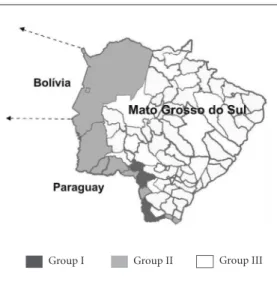
To analyze the effect of territory on detection rates, the 79 counties in the state were categorized into three groups: I: border counties with contig-uous binational urban areas; II: border counties without contiguous binational urban areas; III:
other counties in the state (Figure 1)15.
The variables considered were sex, age range, educational level, clinical presentation of the disease, operational classification, number of lesions, and degree of disability. Calculation of detection coefficients was based on demographic
data from the IBGE. The z-test for proportions
was applied to analyze the following variables: clinical presentation, WHO operational classi-fication, and degree of disability. A significance
level of 5% (p ≤ 0.05) was adopted. Statistical
analyses were made with the 12.5 version of Sig-maPlot program.
The research was approved by the Univer-sidade Federal de Mato Grosso do Sul research ethics committee.
Results
From 2001 to 2011, 7299 new cases of leprosy were reported in Mato Grosso do Sul. Of these,
849 (11.6%) occurred in border counties (ap-proximately 77 cases per year on average). Of the 7299 records, 25 lacked information on the county of residence and in 10 of these the place of residence was Paraguayan or Bolivian, demon-strating that patients living across the border seek healthcare services in Brazil.
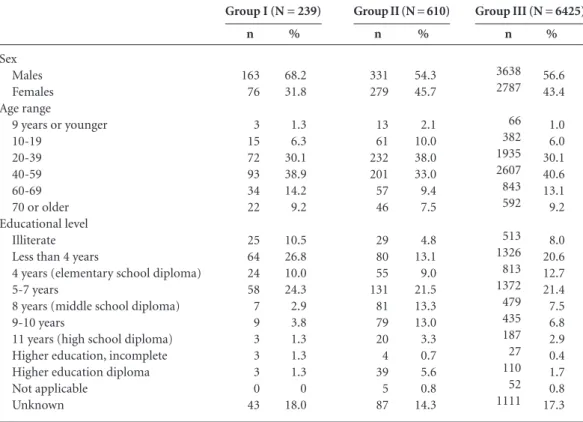
Males predominated in all three groups, par-ticularly in Group I (68.2%) (Table 1). Adults aged 40 years and older (38.9% in the 40- to 59-year range) predominated in Group I. Similar
results were found by Scheelbeek et al.16 for
en-demic areas in Cebu, Philippines, with 3288 cases in the 2000-2010 period, 69.4% involving males. Males also predominated (63.7%) in a study con-ducted by Guerrero in Colombia during the same period12,17.
In the present investigation, patients with low educational level predominated in Group I, with 37.3% either illiterate or having less than four years of formal education (Table 1), while in Group II this rate was 17.9%.
Annual detection range of new cases of lepro-sy per 100000 inhabitants shows tendency to in-crease in Group I (24- to 36-per-100000 range), while in Group II shows tendency to decrease (32- to 23-per-100000 range). In Group III there was no difference in the range (Graphic 1).
Figure 1. Map of Mato Grosso do Sul state-Paraguay
border and non-border.
Group I: border counties with contiguous binational urban areas. Group II: border counties without contiguous binational urban areas. Group III: other counties in Mato Grosso do Sul state.
A
jal
la MEA
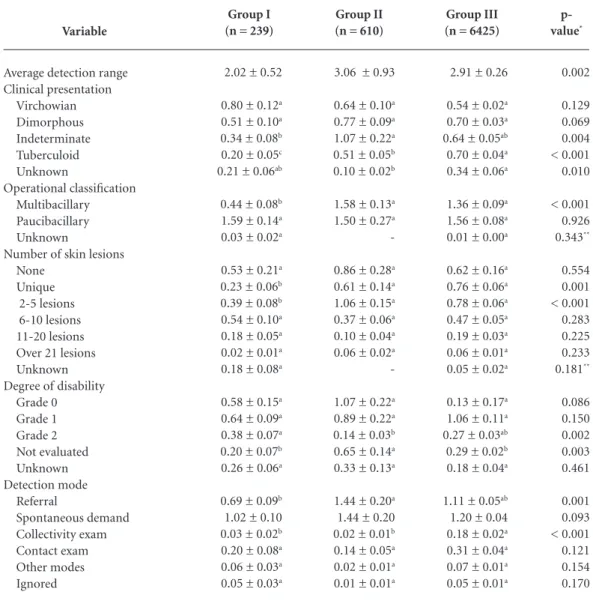
Statistical analysis of average detection ranges during the period, showed significant differences between Group I and Groups II and III, Group I presents a lower average when compared with
Groups II and III. Significant differences (p <
0.05) were found between Group I and the other groups for tuberculoid clinical presentation of leprosy. No significant differences (p > 0.05) were found for dimorphous disease (Table 2).
As presented in Table 2, significant differenc-es were not found between the Groups for Grade
0 and 1 (p > 0.05). For Grade 2 there was
signifi-cant differences between all the groups.
Discussion
In Brazil, border counties tend to be viewed as territories of degradation, as they are often marked by organized crime, human trafficking, and smuggling, which ultimately hamper eco-nomic development and the improvement of the social structure, exacerbating inequalities. This
Graphic 1. Leprosy detection range, per 100000
inhabitants, distributed in border and non-border counties, Mato Grosso do Sul state, Brazil, 2001-2011.
Group I: border counties with contiguous binational urban areas. Group II: border counties without contiguous binational urban areas. Group III: other counties in Mato Grosso do Sul state.
2001 2002 2003 2004 2005 2006 2007 2009 2010 2011 2012
0 1 2 3 5 4 6 D et ec tio n r ang e, p
er 100000 inhab
itant
Grupo I Grupo II Grupo III
Linear (Grupo I) Linear (Grupo II) Linear (Grupo III) Sex
Males Females Age range
9 years or younger 10-19
20-39 40-59 60-69 70 or older Educational level
Illiterate Less than 4 years
4 years (elementary school diploma) 5-7 years
8 years (middle school diploma) 9-10 years
11 years (high school diploma) Higher education, incomplete Higher education diploma Not applicable
Unknown
Table 1. Leprosy cases detected in Groups I, II and III of counties, distributed by sex, age range, and number of skin
lesions. Mato Grosso do Sul state, Brazil, 2001-2011.
Source: Original records from the Mato Grosso do Sul State Department of Health. Group I: border counties with contiguous binational urban areas. Group II: border counties without contiguous binational urban areas. Group III: other counties in Mato Grosso do Sul state.
n 163 76 3 15 72 93 34 22 25 64 24 58 7 9 3 3 3 0 43 % 68.2 31.8 1.3 6.3 30.1 38.9 14.2 9.2 10.5 26.8 10.0 24.3 2.9 3.8 1.3 1.3 1.3 0 18.0
Group I (N = 239)
n 331 279 13 61 232 201 57 46 29 80 55 131 81 79 20 4 39 5 87 % 54.3 45.7 2.1 10.0 38.0 33.0 9.4 7.5 4.8 13.1 9.0 21.5 13.3 13.0 3.3 0.7 5.6 0.8 14.3
Group II (N = 610)
n 3638 2787 66 382 1935 2607 843 592 513 1326 813 1372 479 435 187 27 110 52 1111 % 56.6 43.4 1.0 6.0 30.1 40.6 13.1 9.2 8.0 20.6 12.7 21.4 7.5 6.8 2.9 0.4 1.7 0.8 17.3
e C ole tiv a, 21(1):225-232, 2016
view, however, is being re-evaluated, and political and administrative efforts are being made against this situation, with a focus on economic develop-ment. Nonetheless, economic development may not in itself prove sufficient to reduce inequali-ties, improve the provision of essential services, including healthcare, and promote
empower-ment towards full citizenship18-20.
All counties in Group I are small and have healthcare structures of low to mid-level
com-plexity, which assist not only Brazilian citizens living in Brazil and Paraguay, but also foreigners. The highest demand is for primary care services. Difficulties arise, however, when the assistance provided to foreign patients requires referral to
higher-complexity services13.
The growth trend in new case detection in Group I is probably related more to the endem-ic expansion than to diagnostendem-ic and treatment quality. One example is the higher number of
Variable
Average detection range Clinical presentation Virchowian Dimorphous Indeterminate Tuberculoid Unknown Operational classification Multibacillary Paucibacillary Unknown
Number of skin lesions None
Unique 2-5 lesions 6-10 lesions 11-20 lesions Over 21 lesions Unknown Degree of disability
Grade 0 Grade 1 Grade 2 Not evaluated Unknown Detection mode Referral Spontaneous demand Collectivity exam Contact exam Other modes Ignored
Tabela 2. Leprosy average detection range per 100000 inhabitants in Groups I, II and III of counties, distributed by
disability grade, detection mode, clinical presentation, WHO operational classification and number of skin lesions. Mato Grosso do Sul state, Brazil, 2001-2011.
The results are presented in average ± standard average error. *P-value in one-way ANOVA. **P-value in student’s t-test. Different letters indicate significant difference between the groups (Tukey post test, p< 0.05). Group I: border counties with contiguous binational urban areas. Group II: border counties without contiguous binational urban areas. Group III: other counties in Mato Grosso do Sul state.
Group I (n = 239)
2.02 ± 0.52
0.80 ± 0.12a 0.51 ± 0.10a 0.34 ± 0.08b 0.20 ± 0.05c 0.21 ± 0.06ab
0.44 ± 0.08b 1.59 ± 0.14a 0.03 ± 0.02a
0.53 ± 0.21a 0.23 ± 0.06b 0.39 ± 0.08b 0.54 ± 0.10a 0.18 ± 0.05a 0.02 ± 0.01a 0.18 ± 0.08a
0.58 ± 0.15a 0.64 ± 0.09a 0.38 ± 0.07a 0.20 ± 0.07b 0.26 ± 0.06a
0.69 ± 0.09b 1.02 ± 0.10 0.03 ± 0.02b 0.20 ± 0.08a 0.06 ± 0.03a 0.05 ± 0.03a
Group II (n = 610)
3.06 ± 0.93
0.64 ± 0.10a 0.77 ± 0.09a 1.07 ± 0.22a 0.51 ± 0.05b 0.10 ± 0.02b
1.58 ± 0.13a 1.50 ± 0.27a
-0.86 ± 0.28a 0.61 ± 0.14a 1.06 ± 0.15a 0.37 ± 0.06a 0.10 ± 0.04a 0.06 ± 0.02a
-1.07 ± 0.22a 0.89 ± 0.22a 0.14 ± 0.03b 0.65 ± 0.14a 0.33 ± 0.13a
1.44 ± 0.20a 1.44 ± 0.20 0.02 ± 0.01b 0.14 ± 0.05a 0.02 ± 0.01a 0.01 ± 0.01a
Group III (n = 6425)
2.91 ± 0.26
0.54 ± 0.02a 0.70 ± 0.03a 0.64 ± 0.05ab 0.70 ± 0.04a 0.34 ± 0.06a
1.36 ± 0.09a 1.56 ± 0.08a 0.01 ± 0.00a
0.62 ± 0.16a 0.76 ± 0.06a 0.78 ± 0.06a 0.47 ± 0.05a 0.19 ± 0.03a 0.06 ± 0.01a 0.05 ± 0.02a
0.13 ± 0.17a 1.06 ± 0.11a 0.27 ± 0.03ab 0.29 ± 0.02b 0.18 ± 0.04a
1.11 ± 0.05ab 1.20 ± 0.04 0.18 ± 0.02a 0.31 ± 0.04a 0.07 ± 0.01a 0.05 ± 0.01a
A
jal
la MEA
new cases in grade 2 of disability in Group I than Group II and III, showing late diagnosis.
The study results show that detection average coefficients indicate similarity between Groups II and III. Group II counties have commercial, cultural and healthcare relationships with other counties in Mato Grosso do Sul state.
Educational level also translates into inferior working conditions and lower income. In Group I counties, 37.5% of patients were illiterate or had not completed elementary school. This rate was 17.9% for Group II and 28.6% for Group III. In Group I, the severity of clinical presentation (mostly Virchowian) adds to the already high so-cial vulnerability stemming from the low educa-tional level.
The economy, HDI, and healthcare struc-ture of Group I counties were similar to those of Group II, yet insufficient to explain the differ-ences found among the three groups. One reason for the higher flow of people, goods, and services in Group I counties is the fact that many Brazil-ian citizens choose to live in Paraguay because of the lower cost of housing. Conversely, many Paraguayan citizens seek jobs, often menial, in Brazil21.
The presence of a political-administrative border that officially delimits, but is ignored in everyday life, has been a historical trait of these counties, ensuring a continuous cultural ex-change that makes these territories unique urban centers, blending characteristics from both coun-tries22-24.
In these counties, leprosy has a profile shaped not only by the etiological agent, but also by fea-tures pertaining to patient and territory. Of the ten patients who resided in Paraguay but were reported and treated in Brazil, six had the Vir-chowian presentation. Although this number is too low for conclusive analysis, it draws attention to the preoccupation about the proximity of the two countries. The fact that Paraguayan patients were diagnosed in Brazil can be explained by their easier access to diagnosis and treatment in Brazilian territory.
According to the Paraguayan Ministry of
Public Health and Social Welfare25, the rates of
leprosy prevalence in the departments of Amam-bay and Canindeyú were 0.7 and 0.8 per 10 000 in 2009, respectively, while the national rate was 0.6. These are the departments that share a border with Brazil. Rates calculated at departmental lev-el, however, may mask extreme values, although Paraguay has attained the WHO goal of less than one case per 10 000 population, making leprosy a
less relevant public health problem than in coun-ties within Mato Grosso do Sul.
Conclusion
Males with low educational level and aged 40 years or older predominated in new cases of leprosy occurring in Mato Grosso do Sul state counties with contiguous binational urban areas delimited by a dry border (Group I).
Leprosy case detection in Group I showed tendency to increase, implying greater trans-mission of the disease and characterizing it as endemic, posing difficulties for compliance with WHO’s resolution on the eradication of leprosy by 2015 (prevalence of less than 1 case per 10 000 population). The WHO advocates action to improve the access of vulnerable populations to healthcare services where coverage is low, as is the case with the counties investigated in the present study26,27.
The detection of grade II disability at the time of diagnosis indicates that the disease is often diagnosed late, revealing a pressing need to improve the quality of healthcare services in Brazilian counties along the Paraguayan border, particularly those with contiguous binational urban areas, as well as the need to improve the socioeconomic status of this territory.
Leprosy surveillance hinges on two key ac-tions: timely detection of new cases and treat-ment until a cure is attained. Improving the quality of healthcare services is also crucial for effective monitoring of new cases in the coun-ties investigated. This qualitative improvement requires greater knowledge of the population dy-namics in this territory, including flows motivat-ed by demands for goods and services, healthcare services included.
Limitations of this study
e C
ole
tiv
a,
21(1):225-232,
2016
Collaborations
MEA Ajalla worked in the research conception, data gathering, database organization and anal-ysis. SMO Andrade worked in the research con-ception and methodology. SHC Diettrich worked in the research methodology and discussion. W Waissmann worked in the research conception, data analysis and conclusions. BAK Silva worked in the database organization and statistical anal-ysis. EM Tamaki worked in the database organi-zation and discussion.
References
Barata RdCB. O desafio das doenças emergentes e a revalorização da epidemiologia descritiva. Rev Saude
Publica 1997; 31(5):531-537.
Cesse EAP. Epidemiologia e determinantes sociais das doenças crônicas não transmissíveis no Brasil [tese]. Re-cife: Fundação Oswaldo Cruz; 2007.
Peiter P, Machado LO, Rojas LI. Saúde e vulnerabilida-de na faixa vulnerabilida-de fronteira In: Barcellos C, editor. A geogra-fia e o contexto dos problemas de saúde. Rio de Janeiro: Abrasco; 2008. p. 263-278.
Brasil. Ministério da Integração Nacional (MI). Se-cretaria de Programas Regionais. Faixa de fronteira: programa de promoção do desenvolvimento da faixa de fronteira – PDFF. Brasília: MI; 2009.
Castro JMd, Rodrigues-Júnior AL. A influência da mortalidade por causas externas no desenvolvimento humano na faixa de fronteira brasileira. Cad Saude Pu-blica 2012; 28(1):195-200.
Tamaki EM, Ferraz AF, Pontes ERJC, Cazola LHdO, Ajalla ME, Picoli RP. O Projeto SIS-fronteira no estado de Mato Grosso do Sul. In: Souza MdLd, Ferreira LAP, Rezende VM, Branco ML, editores. A Saúde e a inclusão
social nas fronteiras. Florianópolis: Fundação Boiteux;
2008. p. 177-208.
Imbiriba EB, Basta PC, Pereira EdS, Levino A, Garnelo L. Hanseníase em populações indígenas do Amazonas, Brasil: um estudo epidemiológico nos municípios de Autazes, Eirunepé e São Gabriel da Cachoeira (2000 a 2005). Cad Saude Publica 2009; 25(5):972-984. Brasil. Superintendência de Desenvolvimento do Cen-tro-Oeste (SUDECO). Municípios pertencentes a Faixa de Fronteira do Centro-Oeste [homepage na internet]. Brasília: SUDECO; [acessado 2014 feb 1]. Disponível em: http://www.sudeco.gov.br/municipios-faixa-de-fronteira Organização Mundial da Saúde. Programa das nações Unidas para o desenvolvimento. Atlas Brasil 2013 [base de dados na internet ]. Brasília (DF). PNUD. [acessado 2013 out 14]. Disponível em: http://www.pnud.org.br/ idh/atlas2013.aspx?indiceaccordion=1&li=li_atlas2013 World Health Organization (WHO). Leprosy: update
on the 2012 situation: WHO. Weekly epidemiological
record. Geneve: WHO; 2012.
Brasil. Ministério da Saúde (MS). Secretaria de Vi-gilância em Saúde. Boletim Epidemiológico: situação epidemiológica da hanseníase no Brasil – análise de in-dicadores selecionados na última década e desafios para eliminação. Brasília: MS; 2013.
Departamento de informática do Sistema Único de Saúde. Informações de Saúde: taxa de incidência da hanseníase [base de dados na internet]. Brasília: Mi-nistério da Saúde; 2012 [acessado 2014 fev 16]. Dispo-nível em: http://tabnet.datasus.gov.br/cgi/tabcgi.exe?i-db2012/d0206.def
Cazola LHdO, Pícoli RP, Tamaki EM, Pontes ERJC, Ajalla MEA. Atendimento a brasileiros residentes na fronteira Brasil-Paraguai pelo Sistema Único de Saúde.
Rev. Panam Salud Publica 2011; 29(3):185-190.
Silva-Sobrinho RA, Andrade RLP, Ponce MAZ, Wy-socki AD, Brunello ME, Scatena LM, et al. Retardo no diagnóstico da tuberculose em município da tríplice fronteira Brasil, Paraguai e Argentina. Rev. Panam
Sa-lud Publica 2012; 31(6):461-468.
1.
2.
3.
4.
5.
6.
7.
8.
9.
10.
11.
12.
13.
A
jal
la MEA
Cidades. [homepage na internet]. Brasília (DF):Institu-to Brasileiro de Geografia e Estatística; [acessado 2014 mar 29]. Disponível em: http://www.cidades.ibge.gov. br/xtras/uf.php?lang=&coduf=50&search=mato-gros-so-do-sul.
Scheelbeek PFD, Balagon MVF, Orcullo FM, Maghanoy AA, Abellana J, Saunderson PR. A Retrospective Study of the Epidemiology of Leprosy in Cebu: An Eleven-Ye-ar Profile. Plos Negl Trop Dis 2013; 7(9):1-12. Guerrero MI, Muvdi S, León CI. Retroso en el diagnós-tico de lepra como factor pronósdiagnós-tico de discapacidad en una chorte de pacientes en Colombia, 2000-2010.
Rev Panam Salud Publica 2013; 33(2):137-143.
Rodrigues-Júnior AL, Castilho EA. A AIDS nas regiões de fronteira no Brasil de 1990 a 2003. Rev Panam Salud
Publica 2009; 25(1):31-38.
Rodrigues-Júnior AL, Castilho EA. AIDS e doenças oportunistas transmissíveis na faixa de fronteira brasi-leira. Rev Soc Bras Med Trop 2010; 43(5):542-547. Castro JMd, Junior ALR-. A influência da mortalidade por causas externas no desenvolvimento humano na faixa de Fronteira brasileira. Cad Saude Publica 2012; 28(1):195-200.
Oliveira TCMd. Tipologia das relações fronteiriças: elementos para o debate teórico-práticos. In: Oliveira TCMd, editor. Território sem limites: estudo sobre
fron-teira. Campo Grande: UFMS ed; 2005. p. 377-408.
Levino A, Carvalho EFd. Análise comparativa dos sis-temas de saúde da tríplice fronteira: Brasil/Colômbia/ Peru. Rev Panam Salud Publica 2011; 30(5):490-500. Fedatto NASF. Educação em Mato Grosso do Sul: li-mitações da escola brasileira numa divisa sem limites na fronteira Brasil-Paraguai. In: Oliveira TCM, orga-nizador. Território sem limites: estudos sobre fronteiras. Campo Grande: UFMS Ed; 2005. p. 491-510.
15.
16.
17.
18.
19.
20.
21.
22.
23.
Dorfman A. A cultura do contrabando e a fronteira como um lugar de memória. Estud. Hist. [periódico na internet]. 2009 maio [acessado 2014 jan 11]; (1):[apro-ximadamente 10 p.]. Disponível em: http://www.retis. igeo.ufrj.br/index.php/producao/artigos/a-cultura-do- contrabando-e-a-fronteira-como-um-lugar-de-me-moria/.
Paraguay. Ministerio de Salud Pública y Bienestar So-cial. Dirección Geral de Información Estratégica em salud. Dirección de Bioestadística. Indicadores básicos
de salud. Assunção: Ministerio de Salud Pública y
Bien-estar Social; 2010.
Brasil. Ministério da Saúde (MS). Secretaria de Vigi-lância em Saúde. Plano integrado de ações estratégicas de eliminação da hanseníase, filariose, esquistossomose e oncocercose como problema de saúde pública, tracoma como causa de cegueira e controle das geohelmintíases:
plano de ação 2011-2015. Brasília: MS; 2010.
Lockwood DNJ. Leprosy elimination a virtual pheno-menon or a reality? Br Med J 2002; 324(22):1516-1518.
Artigo apresentado em 16/04/2014 Aprovado em 18/04/2014
Versão final apresentada em 30/06/2014 24.
25.
26.