Original Article
Artigo Original
Portal of the elderly: development and
evaluation of the website with information
about the aging process and the main
speech, language and hearing disorders
that affect the elderly
Portal dos idosos: desenvolvimento e
avaliação de um website com informações
sobre o processo de envelhecimento e as
principais alterações fonoaudiológicas que
acometem os idosos
Natalia Caroline Favoretto1Natalia Gutierrez Carleto1
Aline Megumi Arakawa1
Murilo Priori Alcalde1
José Roberto Magalhães Bastos1
Magali de Lourdes Caldana1
Keywords
Aging Speech, Language and Hearing
Sciences Caregivers Telemedicine Health Education
Descritores
Envelhecimento Fonoaudiologia Cuidadores Telessaúde Educação em Saúde
Endereço para correspondência: Natalia Caroline Favoretto
Alameda Dr. Octávio Pinheiro Brisolla, 9-75, Jardim Brasil, Bauru (SP), Brazil, CEP:17012-901.
E-mail: [email protected]
Received: September 08, 2016
Accepted: June 08, 2017
Study carried out at Departamento de Odontopediatria, Ortodontia e Saúde Coletiva, Faculdade de Odontologia de Bauru, Universidade de São Paulo - USP - Bauru (SP), Brazil.
1 Faculdade de Odontologia de Bauru, Universidade de São Paulo – USP - Bauru (SP), Brazil.
Financial support: The project was made possible by the regular aid under process number 2013/08749-0 and a master’s scholarship under process number 2013/08758-0, both approved by the Fundação de Amparo à Pesquisa do Estado de São Paulo (FAPESP).
Conlict of interests: nothing to declare.
ABSTRACT
Purpose: This research aimed to develop and evaluate a website with information on Speech-language therapy area with focus on the aging process. A website containing information with simple language, clear purpose and
concise content was designed based on scientiic evidence. Methods: The Flesch Index was used to check the material readability, with 50% of the content corresponding to “easy” and 50% of the content corresponding to
“dificult”. The website development followed the steps: analysis and planning, modeling, implementation and
evaluation. Evaluators invited to participate were part of the following categories: elderly people, caregivers and speech-language therapists. The sample consisted of 10 elderly, 8 caregivers and 10 speech-language therapists. Most individuals (89.28%) were females, who often accessed the Internet (78.57%) and had different educational levels. Results: Statistical analyses were performed using the Kruskal-Wallis test and Spearman
correlation coeficient. The website’s content was classiied as “adequate” and the website’s technical quality as “excellent”. There was no statistically signiicant difference between the categories and subscales or the
overall score. Conclusion: The website can be considered an accessible material, and a source of consultation and complementation of information about the theme, as well as an important tool for effecting the information transmission process.
RESUMO
Objetivo: o estudo teve como objetivo desenvolver e avaliar um website com informações na área de Fonoaudiologia com enfoque no processo de envelhecimento. Método: foi elaborado um website contendo informações com
linguagem simples, objetivo claro e conteúdo conciso, baseado em evidências cientíicas. Utilizou-se o índice de Flesch para veriicar a legibilidade do material, encontrando-se, em 50% do conteúdo, o correspondente a
“fácil” e, em 50% do conteúdo, o correspondente a “difícil”. A elaboração do website seguiu as etapas: análise
e planejamento, modelagem, implementação e avaliação. Foram convidados avaliadores que izeram parte das
categorias: idoso, cuidador de idoso e fonoaudiólogo. A amostra foi composta por 10 idosos, 8 cuidadores de
idosos e 10 fonoaudiólogos. A análise estatística foi realizada por meio do teste Kruskal-Wallis e Coeiciente
INTRODUCTION
Aging is considered a progressive phenomenon that, besides organic wearing, causes to cultural, emotional and social changes. This process begins at birth and persists throughout life, with each individual aging in a unique way, due to intrinsic and environmental conditions. Thus, aging is a variable process followed by changes in the composition, structure and physiology of the human body(1).
Aging is often associated with illnesses, decrepitude, disorientation and regression. Although biological, economic, social and psychological losses take place in fact, such associations may not always be true; if the elderly remain physically active and have interesting social and family life, aging can be healthy. For this reason, it is necessary to distinguish senescence from senility. Senescence is the natural process of aging and senility is the pathological state of this process. Both cases require
interventions from health professionals focusing speciically on
this segment of the population(1). In this cases, speech-language
therapists must make use of their knowledge of communication, mainly in terms of voice, hearing, dysphagia, orofacial motricity and language.
The process of aging voice is called presbyphonia, and its characteristics are hoarse, shimmering, weak, breathy voice, with reduced maximum phonation time and phonation range, among others, which may lead to a change in the intelligibility of speech and a negative impact on quality of life(2). Another aspect
that affects the majority of the elderly is presbycusis, deined
as hearing loss due to the aging process and characterized by reduced auditory sensitivity, speech intelligibility, and ability to recall long sentences, compromising the process of verbal communication, due to the symmetrical bilateral neurosensorial
high-frequency audiometric proile that progresses with age(3).
As for the orofacial motricity, some changes involving the stomatognathic system take place, particularly speech, chewing, deglutition and breathing aspects. Changes related to deglutition are among the most critical. It is important to differentiate between adaptation and alteration when it comes to deglutition;
the irst one consists in presbifagia, inherent to the aging process,
and the second corresponds to dysphagia, which is associated
with pathologies(4). As for cognitive abilities, changes related
to selective attention functions, sensory and motor functions, memory, reasoning, problem solving and oral language may occur. Because of these changes, the elderly commonly develop
communication disorders(5).
The current scenario indicates that attention is needed to issues related to the promotion, education and health of the elderly. It is important to consider the possibility that many individuals do not have easy access to health care professionals as well as to the reliable information about the health in this life stage. In this sense, Telehealth can be considered a support tool, since it helps overcoming the distance and supporting the health care process by means of communication and technologies for information transfer(6).
Considering the above, a survey was carried out based on
scientiic material on the aging process and speech and language
changes in the elderly for the development and subsequent
evaluation of the contents and the website on the subject.
Objective
To develop and evaluate a website in the ield of Speech-Language
therapy and Audiology, focusing on the Aging Process and the main speech-language disorders that affect the elderly.
METHODS
The project was approved by the Ethics Committee on Research involving Human Beings of the Institution of Origin under CAAE number 20836813.0.0000.5417. We emphasize that all individuals agreed to participate and signed the Informed Consent Form.
The production of the material followed the development stages of instructional design proposed in 2004 by Filatro and Piconez: analysis and planning, modeling, implementation and evaluation(7).
In the stage of analysis and planning, information was
collected from scientiic articles indexed in the Lilacs, Medline,
PubMed, Cochrane and Scielo databases, using the following descriptors: Aging, Population Aging, Presbycusis, Presbyphonia, Presbyphagia, Cognitive Abilities, Language, Memory, Stomatognathic System and Speech. Information collected in
books, theses, dissertations and oficial websites related to the
topic was also used. The search for data was directed to feed the submenus of the website, namely: natural aging process; presbycusis; presbyophonia; presbifagia; stomatognathic system in aging; and cognitive abilities in aging.
The themes of the submenus were deined based on the clinical
experiences of the research group “Aging and quality of life: from promotion to rehabilitation” (GREPEN), registered in the
Conselho Nacional de Desenvolvimento Cientíico e Tecnológico
(CNPq); on the care provided to the adult and elderly population in the Speech-Language therapy and Audiology Clinic service, Adult Language stage; and on the discussions that took place in the outreach course (process nº 12.1.06450.25.7) offered by the Faculdade de Odontologia de Bauru, Universidade de São Paulo (FOB-USP).
In the stage of modeling, the technique for construction
was deined to facilitate the usability and comprehension of the
website, based on aspects that facilitate the use by the target public, and included the use of three criteria: conceptual, in which the form of presentation of the content was established; navigation, in which the mode of access to the content was
deined; and interface, regarding the choice of the layout of the screens.
In the stage of implementation, the website domain was registered in an electronic environment. In this phase, eight ethical
aspects deined in the HONcode code of conduct established by
the Swiss organization Health on the Net Foundation (HON),
committed to maintaining self-regulation of health websites for
Internet providers (Chart 1)(8), were considered.
After the organization of the material, the information was selected, adjusting the intelligibility of the text and illustrating the contents with static images. This textual analysis was
performed using the Microsoft Word® tool with the Flesch
Reading Ease formula, which has an intelligibility metric
adapted to Portuguese(9). All content was reviewed with the
Ten elderly, speech-language therapists and eight caregivers of elderly participated in the evaluation of the website contents. Three instruments were used: protocol of characterization of the sample (Chart 2), prepared by the authors to collect
information on identiication and frequency of use of Internet;
an instrument based on a questionnaire to evaluate a
Speech-Language therapy and Pediatrics blog (Chart 3)(10) for content
evaluation; the adapted questionnaire Health-Related Web Site
Evaluation Form Emory(11,12) for evaluation of the technical
quality of the website which addresses topics related to
content, accuracy, authors, updates, public, navigation, links
and structure.
Chart 1. Principles followed by HONcode
Authorship All medical or health guidance provided and hosted on the website shall be given only by trained and qualified professionals.
Complementarity The information available on the website is designed to support, not replace, the relationship between patient and health care provider.
Confidentiality The confidentiality of data of patients and visitors must be respected.
Assignments
If necessary, the information contained in the website shall be backed by clear references to the sources and, whenever possible, will have HTML links to these sources. The date of modification of the information should be clearly displayed.
Justification Any statements made about the benefits and performance of a specific treatment, commercial product or service should be supported by scientific evidence.
Transparency Website designers shall strive to provide the information as clearly as possible and provide contact addresses for visitors seeking more information or support.
Financing Commercial and non-commercial organizations that have contributed to the financing of the website shall be
disclosed.
Advertising Policy A brief description of the advertising policy adopted by the owners will be displayed on the website. Advertising and other promotional materials will differ from editorial content.
Chart 2. Sample characterization protocol 1. How old are you?
2. Gender: ( ) female ( ) male 3. Name of the city where you live: 4. Name of the city where you work: 5. What is your educational level:
Old nomenclature Current Nomenclature Specify
Illiterate/Incomplete primary school Illiterate/Up to 3rd grade of fundamental school/Up to 3rd
grade of basic school
Complete primary school/ Incomplete secondary school Up to 4th grade of fundamental school/Up to 4th grade of basic school
Complete secondary school /Incomplete high school Complete fundamental school/Complete basic school
Complete high School/Incomplete Superior education Complete high school
Superior education Superior education
6. Only for speech language therapists, if you are not a professional in this area, skip to question 7. 6.a What is your field of activity?
( ) Voice ( )Language ( ) Orofacial motricity ( ) Audiology ( ) Disphagia ( ) Educational phonoaudiology ( ) Collective health 6.b What is your target audience?
( ) neonates ( ) children ( ) adolescents ( ) adults ( ) elderly 6.c How long have you been working in this area?
( ) less than one year ( ) from 1 year and one month to 5 years ( ) from 5 years and one month to 10 years ( ) more than 10 years 7. How often do you access the Internet?
( ) rarely ( ) sometimes ( ) often
8. Where do you go to the Internet most often? ( ) home ( ) work ( ) cyber cafes ( ) other
Chart 3. Content evaluation protocol
Very bad Bad Regular Good Very good I did not access it
a. Aging process b. Presbycusis c. Presbyphonia d. Presbyphagia
Data were treated using descriptive and inferential statistics. Statistical analyses were performed using the Statistica 7.0 software,
adopting a signiicance level of 5% (p<0.05). The Kruskal-Wallis
test was used to compare the categories with the overall score of the questionnaires evaluating the content and the technical quality
of the website, as well as the scores of the submenus, followed
by the Dunn test to determine which categories signiicantly differed from each other. The Spearman’s correlation coeficient
was used to test the correlation between the frequency of use of the Internet and age, schooling and frequency of Internet use, and schooling with the overall score of the questionnaire .
RESULTS
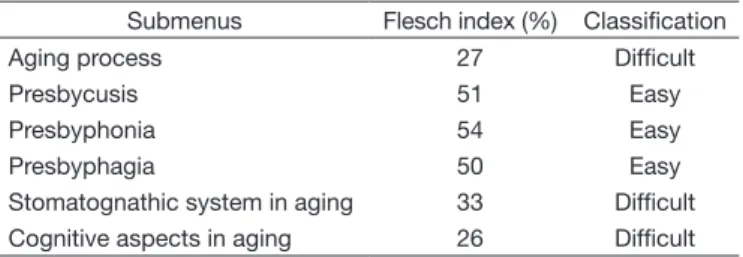
The website named Portal of the Elderly was designed with a responsive layout allowing access through tablets, cell phones with access to the Internet and/or desktop or notebook computers, regardless of the operating system, using the main browsers available in the market (Internet Explorer, Mozilla Firefox, Google Chrome, and Apple Safari) without losing functionality. There are nine items that make up its main menu, one of which is the item “Aging”, which has six submenus: natural aging process, presbycusis, presbyphonia, presbyphagia, stomatognathic system in aging, and cognitive aspects of the elderly. Other items on the website also have aspects related to aging, such as “News”, “Videos”, “Interesting Links” and “Downloads”. In addition, in order to establish a link with the community that visits the website, an email was created in the “Contact” menu. The material inserted in the category “Aging” was analyzed by the author regarding the level of textual
intelligibility, with a score ranging from easy to dificult (Table 1). The material contains scroll bars on the sides of the navigation pages that help users to explore the content according to
their needs and also has lags that highlight the selected tab.
The structure of the website has a reading wizard that allows users to increase the font size of the text.
In the Speech-Language therapist category, 60% of the professionals worked in the language area, 20% in dysphagia, and 20% in collective health, 60% of whom worked with elderly, 10% with adults and 30% with children. As for time of professional practice, this varied from less than one year
(30%), one year and one month to ive years (40%), ive years
and one month to 10 years (20%) and more than 10 years (10%). There was a prevalence of the female gender in all categories studied. As for the instructional level of the Elderly category, 60% of this population had incomplete High School/Superior education, or 11 to 14 years of schooling.
As for the Internet access proile, 70% of the elderly and
caregivers and 100% of the speech-language therapists frequently access it, with 100% of the elderly and 87.5% of caregivers using the Internet at home, while Speech-language therapists used to access it preferentially at work.
When correlating the frequency of access to the Internet with age and schooling through the Spearman Correlation Test,
a statistically signiicant difference was obtained with p<0.05, where p = -0.58. However, there was no statistically signiicant
difference when we analyzed the frequency of use of the Internet by the participants according to schooling.
Regarding the classiication of the content of the submenus
on Aging according to each category, “adequate” was the
predominant classiication among the elderly evaluators,
“adequate” and “excellent” among caregivers and “excellent” among speech-language therapists.
When comparing the overall score of the evaluation of the
content of the questionnaire, a statistically signiicant difference
was found only between caregivers and speech-language therapists according to the Kruskal-Wallis and Dunn post-hoc test, with p = 0.017. As for the submenus, there was a statistical difference in the submenus 1 and 5, and also among caregivers and speech-language therapists, with p = 0.001 and p = 0.019, respectively.
“Excellent” quality of the website prevailed among all categories according to the subscales of the Emory questionnaire. Statistical analyses of subscales of the Emory questionnaire and
categories did not present statistically signiicant differences.
DISCUSSION
The development of the website sought to adapt the presentation of the material mainly to the elderly public. Designs particularly targeting the elderly represent a research area poorly investigated, under-explored and neglected. There is therefore a need for social inclusion of this population through the creation of devices to help the elderly to live in society and interact with
their environment(13). The way in which the information is made
available, the typography, the colors and the composition of the visual elements in the Portal of the Elderly were carefully structured to facilitate the intelligibility of the content.
The Flesch index has been used by some authors in order to adapt the readability of content of websites, blogs, cyber tutors, among others(14,15). Thus, this index was used to this end
in the present study; 50% of the texts were considered “easy”
and 50% “dificult”. The “dificult” classiication was related
to the contents “Natural Process of Aging”, “Stomatognathic System” and “Cognitive Aspects”. This must have happened
due to the presence of scientiic terms that were explained in
sequence, as well as the structuring of the content in topics in the submenu “Stomatognathic System”, which possibly
inluenced the calculation based on sentences and words. As for the classiication of Aging data according to each category, “adequate” was the classiication attributed by the elderly
evaluators, “adequate” and “excellent” by the caregivers and “excellent” by the speech-language therapists, reinforcing that the readability of the material was adequate to the public. Table 1. Flesch index values for each topic
Submenus Flesch index (%) Classification
Aging process 27 Difficult
Presbycusis 51 Easy
Presbyphonia 54 Easy
Presbyphagia 50 Easy
Stomatognathic system in aging 33 Difficult
The scientiic literature does not report studies with websites
related to the theme addressed by the Portal of the Elderly,
making it dificult to compare and discuss these results, and
suggesting the need for further research on the theme. Considering the decline in ocular function, commonly altered with aging, adjustments were made, according to the criteria of visual ergonomics, in order to provide the reader with a graphic
eficient representation, organized by ergonomic principles
and aimed at solving acuity and readability problems. Some impacts of visual aging must be highlighted: a) reduction of visual acuity; b) decreased peripheral vision and presbyopia
(tired sight); c) dificulty with lighting (need of environments with greater illumination); d) dificulty to distinguish colors (soft colors with similar intensities are very dificult to distinguish); e) dificulty to read (need to use larger fonts, with more contrasting
background color)(16). Thus, there is a need to compose visual
elements to illustrate these actions, associated with short texts organized in blocks for better learning and storage of content(17).
A study on visual communication of medicine instructions with elderlies revealed that 100% of the interviewees opted for
the Arial font instead of Times New Roman, which has serifs.
The most readable source was Arial, body 8 (1.8 mm height), line length 50 mm, word spacing 1.6 mm, line spacing 3 mm, and text alignment on the left. This research indicates that the use of non-serif fonts and the correct spacing between lines and words makes reading easier(18). In addition, the colors in which
the material is presented can inluence the receptivity of the
public by triggering feelings and sensations, focusing on the productivity and quality of the activities developed, because they may call attention depending on visibility, contrast and purity(19). Notably, the written material was prepared following
the formatting indicated as the most readable, with a reading wizard to increase the font size, absence of abbreviations and paying attention to the colors used in the website, which are combinations between green and white, black and white, white and green, corresponding to the letters and the background, respectively.
Researchers have proposed a checklist to evaluate web accessibility for the elderly through topics such as: presence of textual descriptions of images and videos, absence of intermittent images and auxiliary windows, presentation of search functions,
plain and clear language texts, concise content, identiication of titles and headings, igure captions, deinition of a standard layout,
bibliographic references, absence of advertisements (advertising and marketing), presence of authorship and possibility of making contact with authors on all pages(20). It should be noted that the
Portal for the Elderly presents characteristics that are in line with this proposal.
With regard to access to the Internet, this has been intensiied
in Brazil. The proportion of people who use the Internet in daily
basis grew from 53% in 2008 to 71% in 2013(21). These data
corroborate the statistical results found, as the majority of the sample reported to make frequent use of the Internet. Authors have pointed to age and educational level as the two main barriers to
use of Internet, which is in agreement with the present indings on the statistically signiicant results found when correlating
age, schooling and Internet access(22).
The evaluation of the website was carried out by three categories: Caregivers, the Elderly and Speech-Language therapists. It is recommendable to check the opinion of other evaluators, so as to verify the quality of the tool made available online(23).
It was for this reason that caregivers of the elderly and elderly participants were included as evaluators. Ten speech-language therapists, 10 elderly and eight elderly caregivers participated in this study, totaling 28 evaluators. This sample is ideal for evaluation of the website, considering that at least three experts
in each group are recommended, with a scale of up to 10(24).
Regarding the access to Internet, we observed that the category Caregivers presented a higher frequency of access, followed by the Elderly and Speech-language therapists. However, the categories presented similar values, pointing to frequent use of the Internet by the population in general and calling attention to the growing interest of the elderly population on the use of the Internet(25).
Home access to the Internet was prevalent among the Elderly and Caregiver categories, while Speech-language therapists
prefer to access it in the work environment. This is justiied
by the characteristics of the populations: the workplace of caregivers do not allow them to access to the Internet, and the elderly usually spend much of their time in their homes, while speech-language therapists continuously use the Internet in their work environment. Consistent with such indications, it is noteworthy that in Brazil, the number of computers connected to the Internet in homes and workplaces, as well as access to
through cell phones, is signiicant(21).
In this study, women prevailed among participants. Among the elderly, this predominance is a result of the geographic
aging pattern where women normally live more than the men(26).
The prevalence of women in the Caregiver category can be justiied
by the characteristics of caregivers of Brazilian elderly, who are usually family members of the female gender living in the same household who become the caregivers of their husbands, parents and even children, as in our society, caregiving is considered a feminine role(27). In the Speech-language therapist category, the
higher number of women is explained by the prevalence of the female gender in the profession. This prevalence is also found in Europe, where speech-language therapists are approximately 95% women. In the United States, only 4.2% of males make up the speech-language therapy profession and 18.6% to audiology
profession, with 26.7% working in both areas(28).
CONCLUSION
ACKNOWLEDGEMENTS
Special thanks to the Fundação de Amparo à Pesquisa do Estado de São Paulo (FAPESP) for having made possible the realization of the project through the regular aid under process number 2013/08749-0 and a master’s scholarship under process number 2013/08758-0, and to the Faculdade de odontologia de Bauru, Universidade de São Paulo, host institution of the respective study.
REFERENCES
1. Ciosak SI, Braz E, Costa MFBNA, Nakano NGS, Rodrigues J, Alencar RA, et al. Senescência e senilidade: novo paradigma na atenção básica de saúde. Rev Esc Enferm USP. 2011;45(2):1763-68. http://dx.doi.org/10.1590/ S0080-62342011000800022.
2. Pontes P, Brasolotto A, Behlau M. Glottic characteristics and voice complaint in the elderly. J Voice. 2005;19(1):84-94. PMID: 15766853. http://dx.doi. org/10.1016/j.jvoice.2004.09.002.
3. Arakawa AM, Sitta EI, Caldana ML, Sales-Peres SHC. Análise de diferentes estudos epidemiológicos em audiologia realizados no Brasil. Rev CEFAC. 2011;13(1):152-8. http://dx.doi.org/10.1590/S1516-18462010005000089.
4. Lima RMF, Amaral AKFJ, Aroucha EBL, Vasconcelos TMJ, Silva HJ, Cunha DAA. Adaptações na mastigação, deglutição e fonoarticulação em idosos de instituição de longa permanência. Rev CEFAC. 2009;11(3):405-22. http://dx.doi.org/10.1590/S1516-18462009000700017.
5. Caldana ML. Análise da qualidade de vida de idosos de periferia da cidade de Bauru/SP em 2010 [tese]. Bauru (SP): Faculdade de Odontologia de Bauru, Universidade de São Paulo; 2010. 197 p.
6. Sood S, Mbarika V, Jugoo S, Dookhy R, Doarn CR, Prakash N, et al. What is telemedicine? A collection of 104 peer-reviewd perspectives and theorical underpinnings. Telemed J E Health. 2007;13(5):575-90. PMID: 17999619. http://dx.doi.org/10.1089/tmj.2006.0073.
7. Filatro A, Piconez SCB. Design instrucional contextualizado: planejamento, elaboração e avaliação de materiais didáticos para educação a distância [Internet]. São Paulo: ABED; 2004 [citado em 2013 Abr 27]. Disponível em: www.abed.org.br/congresso2004/por/pdf/049-TC-B2.pdf
8. HON: Health on the Net Foundation [Internet]. Switzerland: HON; 1995 [citado em 2014 Jun 25]. Disponível em: http://www.hon.ch/HONselect/ Selection/L01.700.html
9. Scarton CE, Aluísio SM. Análise da Inteligibilidade de textos via ferramentas de Processamento de Língua Natural: adaptando as métricas do Coh-Metrix para o Português. Linguamática, 2010;2(1):45-62.
10. Martins A. Telessaúde: ambiente virtual de aprendizagem em aquisição e desenvolvimento da linguagem infantil [dissertação]. Bauru (SP): Faculdade de Odontologia de Bauru, Universidade de São Paulo; 2013.
11. University Rollins School of Public Health. Emory. Health-Related Web Site Evaluation Form [Internet]. 1998 [citado em 2012 Ago 10]. Disponível em: http://www.sph.emory.edu/WELLNESS/instrument.html
12. Bastos BG. Telessaúde: avaliação de um website como ferramenta de auxílio e aconselhamento de pais e crianças usuárias de aparelho de amplificação sonora individual [dissertação]. Bauru (SP): Faculdade de Odontologia de Bauru, Universidade de São Paulo; 2011.
13. Andrade ML No, Eishima RS, Bazán AA, Landim PC. Design para a longevidade: evidências no P&D Design. In: 9º Congresso Brasileiro de
Pesquisa e Desenvolvimento em Design; 2010; São Paulo. Anais. São Paulo: Universidade Anhembi Morumbi; 2010.
14. Corrêa CC, Martins A, Pardo-Fanton CS, Silva ASC, Barros GTT. Ações de teleducação interativa em saúde vocal baseadas na dinâmica do projeto jovem doutor. Distúrb Comun. 2012;24(3):359-68.
15. Corrêa CC, Pauleto ARC, Ferrari DV, Berretin-Felix G. Website Babies Portal: development and evaluation of the contents regarding orofacial functions. J Appl Oral Sci. 2013;21(6):581-9. PMid:24473726. http:// dx.doi.org/10.1590/1679-775720130267.
16. Rodrigues OIS. Ergonomia e Gerontologia face à redução da acuidade visual em idosos [dissertação]. Covilhã: Universidade da Beira Interior; 2011. 52 p.
17. Alban A, Marchi ACB, Scortegagna AS, Leguisamo CP. Ampliando a usabilidade de interfaces web para idosos em dispositivos móveis: uma proposta utilizando design. CINTED-UFRGS. 2012;10(3):1-10. 18. Fujita PTL. A comunicação visual de bulas de remédios: análise ergonômica
da diagramação e forma tipográfica com pessoas de terceira idade. Infodesign - Revista Brasileira de Design da Informação. 2004;1(1):61-4.
19. Farina M, Perez C, Bastos D. Psicodinâmica das cores em comunicação. 5 ed. São Paulo: Edgard Blücher; 2006.
20. Sales MB, Cybis WA. Checklist para avaliação de acessibilidade da web para usuários idosos [Internet]. Florianópolis: LabIUtil; 2002 [citado em 2015 jan 9]. Disponível em: http://www.labiutil.inf.ufsc.br/acessibilidade/ compatibilidade.htm
21. CETIC: Centro de Estudos sobre as Tecnologias da Informação e da Comunicação. Pesquisa sobre o uso de tecnologias de informação e comunicação no Brasil: TIC Domicílios e Empresas 2013 [Internet]. São Paulo: CETIC; 2014 [citado em 2013 out 4]. Disponível em: http://cetic. br/media/docs/publicacoes/2/TIC_DOM_EMP_2013_livro_eletronico.pdf 22. Gracia E, Herrero J. Internet use and selfrated health among older people: a national survey. J Med Internet Res. 2009;11(4):e49. PMid:19955041. http://dx.doi.org/10.2196/jmir.1311.
23. Breckons M, Jones R, Morris J, Richardson J. What do evolution instruments tell us about the quality of complementary medicine information on the internet? J Med Internet Res. 2008;10(1):22. PMid:18244894. http://dx.doi. org/10.2196/jmir.961.
24. Rubio DM, Berg-Weger M, Tebb SS, Lee ES, Rauch S. Objectifying content validity: conducting a content validity study in social work research. Social Work Res. 2003;27(2):94-104.
25. Verona SM, Cunha C, Pimenta GC, Buriti MA. Percepção do idoso em relação à Internet. Temas Psicol. 2006;14(2):189-97.
26. Soares C. Envelhecimento populacional e as condições de rendimento das idosas no Brasil. Genero. 2012;12(2):167-85.
27. Karsch U. Idosos dependentes: famílias e cuidadores. Cad Saude Publica. 2003;19(3):861-6. PMid:12806489. http://dx.doi.org/10.1590/S0102-311X2003000300019.
28. ASHA : American Speech Hearing Language Association. Membership profile: highlights and trends [Internet]. 2009 [citado em 2014 jun 18]. Disponível em: http://www.asha.org/research/ memberdata/.
Author contributions