FREE THEMES
1 Departamento de Odontologia Preventiva e Social, Faculdade de Odontologia de Araçatuba, Universidade Estadual Paulista. R. José Bonifácio 1193, Vila Mendonça. 16015-050 Araçatuba SP Brasil. daniellebordin@ hotmail.com 2 Departamento de Odontologia, Universidade Estadual de Ponta Grossa. Ponta Grossa PR Brasil.
Comparative study of satisfaction of users and health
profession-als with the public dental service
Abstract The objective was to confront the view of users and health professionals about the sat-isfaction with the public dental service. Inter-views were conducted with users, professionals considered directly (ESB) and indirectly (ACS) involved in oral health. Variables were evaluated individually and grouped into domains. A score
was created for the analysis and the
Kruskal-Wal-lis test was applied. The respondents positively
assessed the quality of the dental services. The ACS demonstrated less satisfaction compared to users regarding general satisfaction in the Physi-cal Structure and MediPhysi-cal Care domains and the variables: quality of clinical care; guidance to the patient after treatment performed in the specialty; and period of dental care. The ESB professionals expressed greater satisfaction than the users in the Medical Care domain and in the variables related to the provision of guidance, answering questions, attention solvability and consultation schedul-ing. It is concluded that the ESB professionals demonstrated a high degree of similarity to the satisfaction displayed by users, although positively expanded, and the ACS expressed more critically
discrepant opinions in relation to users.
Key words Evaluation of health services, Health staff, Patient satisfaction, Primary Health Care, Oral health
B
or
Introduction
The evaluation of health services has been a widely discussed necessity for global health poli-cies, considered one of the paths for management to pursue the quality of services provided1-6. An
important component of this evaluation pro-cess is the apprehension of user satisfaction. It offers support for the reorganization of ser-vices through relevant and reliable information, as well as being a popular participation tool in health management7,8.
Despite the increasing use of user satisfaction as a sensitive indicator of quality of health ser-vices2,4, it is accessed concisely and in isolation,
without the desired articulation between the opinions of those involved in the production of care.
To seize and expand the understanding of the multiplicity of factors affecting user satisfaction, it is necessary to initially have a thorough under-standing of their needs. Studies have shown dis-crepancies between analyses of users and profes-sionals regarding the quality and prioritization of health services2,8,9. While users tend to value
rela-tional aspects of the work process, health work-ers attach more importance to the technical skills of health care10 and tend to present, in different
evaluative contexts, higher satisfaction levels2,8,9.
Therefore, it is important to develop listening strategies, integrated or minimally, for a gradual approximation between the different opinions. The first step in this direction is the promotion of innovative assessment practices within teams and government health management2. The
pres-ent study provides an opportunity to align the expression of workers and users on the same study subject: the satisfaction with public dental services, believing that their results can drive im-provements in labor relations, in decision-mak-ing and exercisdecision-mak-ing control of public health man-agement.
Based the above, the present study sought to compare the user view with the professionals in-volved directly or indirectly with oral health with regards to satisfaction with aspects related to the public dental service.
Methodology
Type of study, sample and sampling
The present is a transversal research, devel-oped in the urban area of a medium-sized
munic-ipality in Paraná, with an estimated population of 311,611 inhabitants, predominantly urban and of a young adult profile11. The study
popu-lation was composed of users and dental service professionals in the field of primary health care, distributed in 27 regular health clinics in the ur-ban area of the city, divided into 14 basic health units and 13 family health units.
In the field of professionals, the total of sub-jects in the working hours during this evaluated period were included, linked to the study scenar-ios, namely: 40 dentists, 06 technicians in oral health, 21 auxiliary oral health care assistants and 159 community health workers. For the purpos-es of the survey, all categoripurpos-es mentioned above were considered to be “involved directly or indi-rectly with oral health”.
Faced with the infeasibility of collecting in-formation together from the total number of users ascribed in the study areas, a sample cal-culation was performed. A representative sample was then given with the use of the Epi.Info 7.1.4 software, considering the estimated adult popu-lation in the city studied (172, 600 inhabitants) with an accuracy of 5%, confidence interval of 95% and design effect 1 , for a prevalence of 50% of adults satisfied with the quality of dental ser-vices. This prevalence was used in an attempt to get the highest possible sample. The calculated total (384) was increased by 20% in order to en-hance the results, resulting in a final sample of 461 adults.
Users were randomly selected and stratified in the various health units in the days and alter-nating periods of operation in order to access the multitude of views and enhance the representa-tiveness of the sample.
The eligibility criteria for users were: user of Brazilian public dental network of the primary health care; have received dental care in a refer-ral center for a maximum of one year from the interview; present an age less than 18 years; or the under-aged were accompanied to the dental appointment on the day of the interview.
The professional eligibility criteria were: be part of the framework of the previously guid-ed professions and health units involvguid-ed in the study, and being in the profession.
Data collection
e C
ole
tiv
a,
22(1):151-160,
2017
shown in Chart 01, with response patterns: hap-py, more or less satisfied and dissatisfied. Note that both forms investigated the same variables, but with a written arrangement appropriate for each research group.
The forms were adapted from protocols for assessing user satisfaction of the PNASS (Na-tional Program for Health Services Review)12
and PMAQ (National Program for Improving Access and Quality of Primary Care)13, nationally
based instruments proposed by the Ministry of Health to evaluate the quality of health services and support for SUS management (Health Sys-tem). The adjustment was made in order to adapt these instruments which are essentially aimed at the medical health field to tackle specific aspects of dental reality. To ensure the understanding of the instrument regarding the text, the vocabulary used and the sensitivity of the responses, a pilot study was carried out to quantify the internal consistency among the questions through the Cronbach’s α (α = 0.70), with users from the ur-ban area and professionals from the health units in the rural area of the municipality. The data ob-tained in this stage were not part of the sample.
Data collection was conducted through indi-vidual interviews, conducted by a trained inves-tigator to gather the necessary information and welcome any questions without influencing the answers. This step took place in a private envi-ronment within the health units. The average time of the interview lasted fifteen minutes and, at its end, the respondent received oral hygiene kits and a printed information sheet, designed specifically for the study, containing informa-tion on the rights and duties of the SUS and oral health care for the different life cycles.
Processing and data analysis
Prior to the actual examination, the sample of professionals was divided into two groups: group of professionals considered “indirectly in-volved with oral health”, made up of community health agents (CHA); and the group of profes-sionals “directly involved with oral health”, made up of dentists, oral health technicians and oral health assistants, which together make up an oral health team (OHT).
For the first analysis, the variables of inter-est were grouped into domains. The formation of these areas was initially decided by the use of factor analysis, through diagnosis with orthogo-nal rotation, which seeks to identify similarities between variables that allow the grouping,
usual-ly by a linear relationship of the responses of in-dividuals with latent traits14. However, the factor
analysis creates some strong postulations that do not always match the reality of the facts14,
espe-cially when it comes to a very homogeneous sam-ple, similar to those studied. In applying the test, one group was proposed, thus opting for the use of conceptual analysis for creating the domains, which took place from a literature review and in-depth analysis about the dimensional concepts routinely used in the evaluation of health ser-vices15.
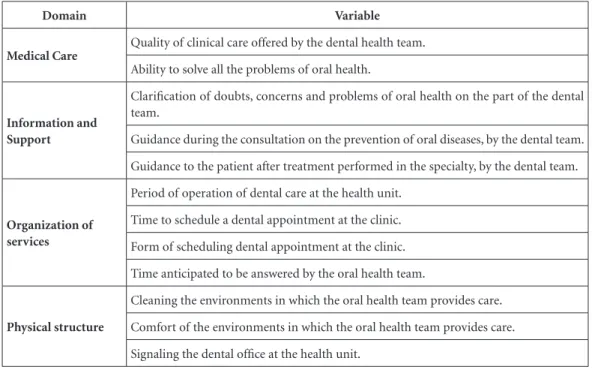
The variables were then grouped by the re-searchers according to proximity to the basic di-mensions of evaluation of public health services in Brazil, namely: Medical Care, Information and Support, Organization of Services and Physical Structure, which proved to be in line with the groupings adopted in equivalent studies7,16-18
(Chart 1).
To obtain the overall satisfaction level in ev-ery domain, a 0-1 index was created, calculated by using the average of their forming variables, assigning values to possible answers, namely: satisfied (value 1), more or less (value 0.5) and dissatisfied (value 0).
In order to better exploit the results, as well as the analysis by areas, a second analysis was conducted, where the forming variables in each domain were evaluated individually. Only the number of individuals satisfied in each evalua-tive variable was considered in the data exposure. The percentage content was calculated according to the total number of individuals responding to each variable, because some evaluative variables were different from the total number of the study sample.
The normality test (Kolmogorov-Smirn-ov) was used to define the use of parametric or non-parametric analyses. The data were not nor-mally distributed, thus the nonparametric Krus-kal-Wallis with the post Dunn’s test at a signifi-cance level of 5% were applied.
Research ethics
re-B
or
specting the dictates of Resolution 466/12 of the Brazilian National Council of Health.
Results
The final sample was consisted of 461 mem-bers, 133 professionals indirectly involved with oral health (CHA) and 52 professionals directly involved with oral health (30 dentists, five oral health technicians and 17 oral health assistants). The loss of subjects occurred by the absence of the professional in the days of the interview, be-cause of vacation or sick leave. Figure 1 shows the evaluation results of the users and professionals by dissociation in domains.
The overall satisfaction rate of users was 0.8 and the CHA was 0.75, with a significant dif-ference (p < 0.05). The overall satisfaction ex-pressed by the OHT (0.80) showed no significant difference when compared to the user group (p > 0.05).
Individually analyzing the fields, the CHA group had values of satisfaction below those ex-pressed by users in all domains evaluated, with a significant difference for the Physical Structure (p < 0.05) and Medical Care (p < 0.05). When comparing the OHT to the users, greater satis-faction was presented by the OHT group in all
domains, with significant differences only for the Medical Care (p < 0.05). All categories of the subjects investigated attributed the Service Organization domain as the lowest level of satis-faction, however, the values were not significantly different (p > 0.05).
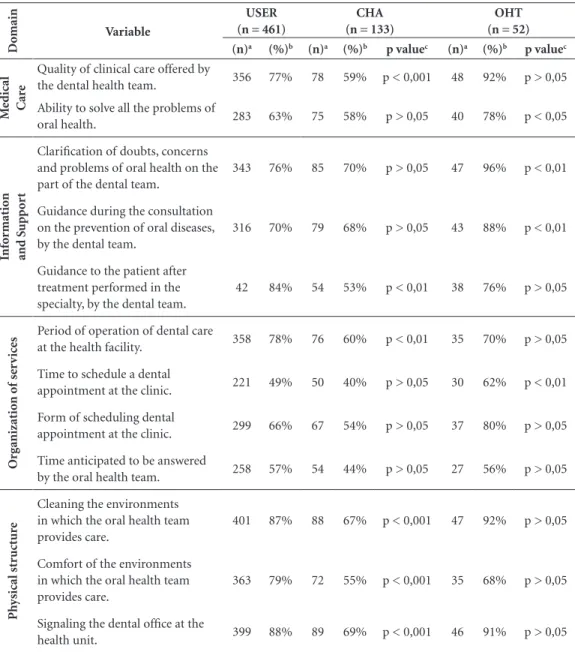
Table 1 shows the percentage of the satisfac-tion of users and professionals in each variable formed by the domains, and the statistical values resulting from the comparison of satisfaction among users and the CHA and between users and the OHT.
Overall, users reported being satisfied with the public dental services offered. The CHA group exhibited lower satisfaction than the us-ers, presenting a significant difference for the variables: “quality of clinical care offered by the oral health team” (p < 0.001); “orientation to the patient after treatment used in the specialty” (p < 0.01); “dental care period at the clinic unit” (p < 0.01); and for all the variables of the Physical Structure domain (p < 0.001).
Professionals in the OHT expressed high sat-isfaction, statistically higher than that of users for the variables “capacity to resolve all oral health problems” (p < 0.05); “answering questions, oral health concerns and problems by the dental team” (p < 0.01); “guidance during the
consul-Chart 1. Evaluative domains of satisfaction with public dental services and their forming variables.
Domain Variable
Medical Care Quality of clinical care offered by the dental health team.
Ability to solve all the problems of oral health.
Information and Support
Clarification of doubts, concerns and problems of oral health on the part of the dental team.
Guidance during the consultation on the prevention of oral diseases, by the dental team.
Guidance to the patient after treatment performed in the specialty, by the dental team.
Organization of services
Period of operation of dental care at the health unit.
Time to schedule a dental appointment at the clinic.
Form of scheduling dental appointment at the clinic.
Time anticipated to be answered by the oral health team.
Physical structure
Cleaning the environments in which the oral health team provides care.
Comfort of the environments in which the oral health team provides care.
e C
ole
tiv
a,
22(1):151-160,
2017
tation on the prevention of oral diseases by the dental team” (p < 0.01); and “time to schedule a dental appointment at the health clinic” (p < 0.01).
Discussion
The first aspect to be highlighted from the results of the present study was the high degree of sat-isfaction indicated by users in relation to public dental services investigated. This finding corrob-orates satisfaction surveys found in the national and international literature4,7,8,18,19.
However, these results should be analyzed with caution, since Brazilian health users tend to exhibit some conformity in relation to serviçes², low critical content and vindicating2,7 and even a
mistaken view in the recognition of health care as a benefit and not as a right, which may lead to a false high quality of health services researched7.
In this sense, it is important to build a space in which users can understand their rights and feel encouraged to develop a critical and reflective vi-sion about their needs and the work process in the health units20.
Despite the close proximity to the user and indirect involvement in oral health, community health workers, when compared to users, showed greater dissatisfaction with the public dental ser-vices. These findings reflect the importance of rethinking of the managers and trainers of eval-uation policies on the inclusion of this group of professionals in the planning of health services,
a fact which would allow the view of the same object under investigation by another lens and certainly the enrichment of the whole process.
The fact that community health workers do not act directly in dental services, one can get them to present a more critical view, demand-ing and less prone to conflicts of interest than those directly involved subjects (OHT), expos-ing a larger perception of rights and duties of citizenship, fundamental conditions for there to be progress in action planning and improve-ments in the quality of health services. Another proposition is the close relationship established between the CHA and users with alleged appre-hension and exposure of yearnings and aspira-tions of users, which remain often veiled when investigated by researchers. It is inferred that the reasons that lead users to not express themselves properly may be related to users’ fear of losing the right to service and being perceived negative-ly by professionals4.
Studies show a recurring factor of dissatis-faction among users and health professionals is the precariousness of the physical structure of the health units4,21. However, for users of the
present study, these conditions were quite satis-factory, a result that diverges significantly from the perception of the investigated CHA. This dis-crepancy of opinions may suggest different levels of expectations among subjects8, considering the
various aspects of the physical area and the reg-ulatory systems of health units, and even a sup-posed lack of user knowledge about the technical aspects (hard technology) of services20, causing
Figure 1. Average index of satisfaction of users and professionals of public dental services according to the
domains fields. Ponta Grossa/PR, 2014.
Do
mains
Overall satisfaction
Physical structure
Organization of services
Information and support
Medical Care
0 0.2 0.4 0.6 0.8 1
0.9 0.9 0.78
0.84 0.72 0.7
0.92 0.79 0.77
0.93 0.79 0.76
0.81 0.8 0.74
B
or
them to more positively evaluate the structure of the units.
The domain holder of criticism among users and health professionals is the Organization of Services4,7,8,20-22, which reached the lowest level of
satisfaction among the investigated. Studies have reported high dissatisfaction with the long wait-ing time to schedule a consultation, inefficient organization of the flow for the host and also the insufficient period of dental services4,7,8,20-22.
These factors constitute a challenge in the search
for completeness and solvability of attention re-garding the approach of the relationship between the actions of network services at different levels of complexity and skills. Reorganization initia-tives of work processes as well as optimization of internal flows can also contribute to improve the quality of services and thus the satisfaction of users7 and should, therefore, enable the
organiza-tion of services and health practices to carry out an expanded grasp of the needs of the population under their responsibility.
Table 1. Frequency and comparison of user satisfaction, CHA and OHT with dental public service, according
evaluative variable. Ponta Grossa/PR, 2014.
Do
main Variable
USER (n = 461)
CHA (n = 133)
OHT (n = 52)
(n)a (%)b (n)a (%)b p valuec (n)a (%)b p valuec
M
edical Care
Quality of clinical care offered by
the dental health team. 356 77% 78 59% p < 0,001 48 92% p > 0,05 Ability to solve all the problems of
oral health. 283 63% 75 58% p > 0,05 40 78% p < 0,05
Inf
o
rmat
io
n
and S
up
p
o
rt
Clarification of doubts, concerns and problems of oral health on the part of the dental team.
343 76% 85 70% p > 0,05 47 96% p < 0,01
Guidance during the consultation on the prevention of oral diseases, by the dental team.
316 70% 79 68% p > 0,05 43 88% p < 0,01
Guidance to the patient after treatment performed in the specialty, by the dental team.
42 84% 54 53% p < 0,01 38 76% p > 0,05
Or
g
anizat
io
n o
f se
rv
ic
es Period of operation of dental care at the health facility. 358 78% 76 60% p < 0,01 35 70% p > 0,05
Time to schedule a dental
appointment at the clinic. 221 49% 50 40% p > 0,05 30 62% p < 0,01
Form of scheduling dental
appointment at the clinic. 299 66% 67 54% p > 0,05 37 80% p > 0,05
Time anticipated to be answered
by the oral health team. 258 57% 54 44% p > 0,05 27 56% p > 0,05
P
h
ysical st
ructur
e
Cleaning the environments in which the oral health team provides care.
401 87% 88 67% p < 0,001 47 92% p > 0,05
Comfort of the environments in which the oral health team provides care.
363 79% 72 55% p < 0,001 35 68% p > 0,05
Signaling the dental office at the
health unit. 399 88% 89 69% p < 0,001 46 91% p > 0,05
e C
ole
tiv
a,
22(1):151-160,
2017
In the Medical Care domain, the opinion among the OHT and CHA users was divergent. The CHA presented lower satisfaction and pro-fessionals in the OHT, the highest satisfaction when compared to users, both with significant values. This difference of opinion suggests the need for closer ties between professionals and us-ers, as well as strengthening monitoring and site assessment activities so that weaknesses and new possibilities in the production process of public health services are identified20.
To individually analyze the evaluative vari-ables, differences were also observed among the views of users and the OHT group of profession-als for the variable “quality of clinical care offered by the oral health team”. The study by Reis et al.20
converges with the present study, since the pro-fessionals investigated in these studies were more likely to positively evaluate the quality of services in health when confronted by users.
The variable “orientation to the patient after treatment performed in the specialty” was as-sessed by the CHA group with satisfaction values significantly below those expressed by users. This low satisfaction may be related to the interpreta-tion of professionals to consider the existing bar-riers in the process of referrals and counter-refer-ences, which hinder the return of the user and its access to guidelines. Examples of these obstacles are the difficulties encountered in many services in the scheduling of consultations for specialized care, non-cordial treatment in reference services and the absence of counter references4. Still, the
significant dissatisfaction expressed by the CHA, when compared to users, may be related to the development of numerous extra functional ac-tivities performed by this category, such as sched-uling outpatient visits to the clinic, which would give them an even closer look at the existing dif-ficulties.
Still confronting the opinions of users and the CHA, the satisfaction in relation to the dental care period at the clinic was significantly lower for the CHA. It is possible that this more criti-cal view from the CHA is related to the fact that they know the community’s desires as a whole, especially the formal workers, who often have difficulties in gaining access to the units and health services due to the layout of their work schedules23, and that at the time of the interview,
these aspects were taken into consideration. The expansion of the health unit service office hours beyond the working hours and weekends might be a strategy for facilitating access to the use of health services20.
In the comparison of opinions between the users and OHT, it was verified that professionals showed significantly greater satisfaction in the variables related to the provision of guidance, doubts clarification and attention resolution. The most favorable view of the OHT in relation to these labor factors, which directly reflect the activities that are developed at the facility lev-el, can be explained by the natural tendency of individuals to issue a favorable value judgment of their relationship with their own actions and behaviors. Moreover, it can be related to a low criticality and high receptivity expressed by users for the provision of public services and non-per-forming formal complaints10.
The time to schedule an appointment at the health center is a source of high dissatisfaction for users of the health service in general4,7,8,20-22.
This finding converges with the data expressed by the users of the present study, albeit on a less stricter view of the OHT. In the study by Reis et al.20, a more condescending perception by
profes-sionals regarding the scheduling of time was ver-ified. This vision of professionals draws attention to the need for active categories in services, being more attentive to the barriers of the public health system and community aspirations.
Sonneveld et al.9 also found significant
dif-ferences between the views of users and pro-fessionals in various organizational aspects of dental services. The findings also showed that oral health professionals were able to correctly estimate the user´s point of view only half the time they were questioned. The authors suggest greater attention to the priorities of users and the channels of communication with the team.
With the findings herein, emerge the appre-ciation of different subjects involved in the health production process, with a view for the execution and expansion of humanization in public ser-vices. Thus, the present study contributes to the understanding of satisfaction with public dental services, through the perspective of users and dif-ferent health professionals, an approach not yet sufficiently explored in the scientific field.
ser-B
or
vices. As suggestions, in addition to the inclusion of community workers in the evaluation process, the use of concomitant qualitative methods with quantitative methods may be a useful strategy to managers because it allows for the deeper issues and points more clearly to the reasons that infer the quality of services.
Final considerations
The results presented by users revealed high lev-els of satisfaction with the various aspects related to public dental services. Overall, the CHA ex-posed the most critical views on these services,
compared to users. The professionals directly in-volved with oral health (OHT), for the most part, expressed satisfaction similar to the users, and in a few situations, expressed a positively larger view.
e C
ole
tiv
a,
22(1):151-160,
2017
References
1. Brasil. Ministério da Saúde (MS). Portaria nº 1.654, de 19 de julho de 2011. Institui, no âmbito do Sistema Único de Saúde, o Programa Nacional de Melhoria do Acesso e da Qualidade da Atenção Básica (PMAQ-AB) e o Incentivo Financeiro do PMAQ-AB, denominado Componente de Qualidade do Piso de Atenção Básica Variável - PAB Variável.Diário Oficial da União 2011; 20 jul.
2. Serapioni M, Silva MGC. Evaluation of the quality of Family Healthcare program in municipalities of Ceará: a multidimensional approach. Cien Saude Colet 2011; 16(11):4315-4326.
3. Bjertnaes OA, Sjetne IS, Iversen HH. Overall patient satisfaction with hospitals: effects of patient-reported experiences and fulfilment of expectations. BMJ Qual Saf 2012; 21(1):39-46.
4. Sobreira PGP, Vasconcellos MTL, Portela MC. Avalia-ção do processo de aconselhamento pré-teste nos Cen-tros de Testagem e Aconselhamento (CTA) no Estado do Rio de Janeiro: a percepção dos usuários e profis-sionais de saúde. Cien Saude Colet 2012; 17(11):3099-3113.
5. Saliba NA, Nayme JGR, Moimaz SAS, Cecilio LPP, Garbin CAS. Organization of the demand for a Cen-tre of Dental Specialties. Rev Odontol UNESP 2013; 42(5):317-323.
6. Paddison CAM, Abel GD, Roland MO, Elliott MN, Lyratzopoulos G, Campbell JL. Drivers of overall sat-isfaction with primary care: evidence from the English General Practice Patient Survey. Health Expect 2015; 18(5):1081-1092.
7. Brandão ALRBS, Giovanella L, Campos CEA. Avaliação da atenção básica pela perspectiva dos usuários: adap-tação do instrumento EUROPEP para grandes centros urbanos brasileiros. Cien Saude Colet 2013; 18(1):103-114.
8. Perez LG, Sheridan JD, Nicholls AY, Mues KE, Saleme PS, Resende JC, Ferreira JAG, Leon JS. Professional and community satisfaction with the Brazilian family health strategy. Rev Saude Publica 2013; 47(2):403-413. 9. Sonneveld RE, Wensing M, Bronkhorst EM, Truin GJ, Brands WG. The estimation of patients’ views on orga-nizational aspects of a general dental practice by gen-eral dental practitioners: a survey study. BMC Health Services Research 2011; 11:263.
10. Ronzani TM, Silva CM. O Programa Saúde da Famí-lia segundo profissionais de saúde, gestores e usuários. Cien Saude Colet 2008; 13(1):23-34.
11. Instituto Brasileiro de Geografia e Estatística (IBGE). Dados censitários de 2011. [acessado 2013 nov 10]. Disponível em: http://cidades.ibge.gov.br/xtras/perfil. php?lang=&codmun=411990
12. Brasil. Ministério da Saúde (MS). Programa Nacional de Avaliação de Serviços de Saúde: Edição 2004-2005. Brasília: MS; 2004.
13. Brasil. Ministério da Saúde (MS). Instrumento De Ava-liação Externa Do Saúde Mais Perto De Você – Acesso E Qualidade Programa Nacional De Melhoria Do Acesso E Da Qualidade Da Atenção Básica (PMAQ). Brasília: MS; 2012. Série A. Normas e Manuais Técnicos. 14. Pasquali L. Psicometria. Rev Esc Enferm USP 2009;
43(Spec.):992-999. Collaborations
D Bordin prepared the collection instrument, carried out the collection and tab the data, tried the information collected and wrote the article. CB Fadel prepared the collection instrument, such as treated information collected and wrote the article. SAS Moimaz, CAS Garbin outlined the study, designed the collection tool and wrote the article. NA Saliba wrote and review critical the article.
Acknowledgements
B
or
15. Fernandes MGM, Nóbrega MML, Garcia TR, Macêdo-Costa KNF. Análise Conceitual: Considerações Meto-dológicas. Rev Bras Enferm 2011; 64(6):1150-1156. 16. Donabedian A. The quality of care: how can it be
as-sessed? JAMA 1988; 260(12):1743-1748.
17. Wensing M, Baker R, Vedsted P, Heje H, Klingenberg A, Broge B, Kersnik J, Seuntjens L, Künzi B, Milano M, Mola E, Elwyn G, Gro R. Revised Europep instru-ment and user manual 2006. [acessado 2013 nov 10]. Disponível em: http://www.topaseurope.eu/files/Euro-pep%202006rapport_0.pdf
18. Priporas CV, Laspa C, Kamenidou I. Patient satisfac-tion measurement for in-hospital services: a pilot study in Greece. J Med Mark 2008; 8(4):325-340.
19. Goetz K, Szecsenyi J, Klingenberg A, Brodowski M, Wensing M, Campbell SM. Evaluation of patient per-spective on quality of oral health care in Germany – an exploratory study. Int Dent J 2013; 63(6):317-323. 20. Reis RS, Coimbra LC, Silva AAM, Santos AM, Alves
MTSS, Lamy ZC, Ribeiro SVO, Dias MSA, Silva RA. Acesso e utilização dos serviços na Estratégia Saúde da Família na perspectiva dos gestores, profissionais e usuários. Cien Saude Colet 2013; 18(11):3321-3331. 21. Nora CRD, Jungles JR. Política de humanização na
atenção básica: revisão sistemática. Rev Saude Publica 2013; 47(6):1186-1200.
22. Van Stralen CJ, Belisário SA, Van Stralen TBS, Lima AMD, Massote AW, Oliveira CL. Perceptions of prima-ry health care among users and health professionals: a comparison of units with and without family health care in Central-West Brazil. Cad Saude Publica 2008; 24(Supl. 1):148-158.
23. Castro RCL, Knauth DR, Harzheim E, Hauser L, Dun-can BB. Avaliação da qualidade da atenção primária pe-los profissionais de saúde: comparação entre diferentes tipos de serviços. Cad Saude Publica 2012; 28(9):1772-1784.
24. Trad LAD, Bastos ACS, Santana EM, Nunes MO. Estu-do etnográfico da satisfação Estu-do usuário Estu-do Programa de Saúde da Família (PSF) na Bahia. Cien Saude Colet 2002; 7(3):581-589.
Article submitted 30/11/2014 Approved 14/09/2015