DOI: 10.1590/0004-282X20160030 ARTICLE
Validation of the Brazilian version of the
neurological fatigue index for multiple sclerosis
Validação da versão brasileira do índice neurológico de fadiga na esclerose múltipla
Josiane Lopes1, Edson Lopes Lavado2, Damacio Ramón Kaimen-Maciel3
Fatigue is the most frequent and severe of symptoms causing morbidity and disability in multiple sclerosis (MS)
patients. However, measuring fatigue is a diicult task. here is no clear deinition; it is complex and multidimensional,
and is a highly subjective symptom with many uncertainties regarding its pathophysiology. No biological or neuroimaging
markers for fatigue are currently known1.
he lack of standardization for fatigue measurement has re -sulted in development of several assessment instruments, but
none of them is universally accepted. he Fatigue Severity Scale
(FSS)2 and Modiied Fatigue Impact Scale (MFIS)3 are the most widely used instruments for measuring MS fatigue, although limitations regarding their development and measurement
properties have been reported. Moreover, they were not
spe-ciically developed for MS patients4,5,6. Studies using the Rasch
measurement model have identiied a need for certain items to be removed from the FSS [4] and MFIS [6] so that their mea -surements can be considered valid and reliable.
In Brazil, FSS7 and MFIS8 have been widely used, despite the failings of their design and psychometric properties in
Brazilian cross-cultural adaptation studies. hese Brazilian versions did not fulill the criteria for adequate sample size
and design. Moreover, the psychometric properties of the
Brazilian FSS adaptation were not assessed. herefore, there are no Brazilian MS-speciic instrument for assessing fatigue
with reported methodological and psychometric properties
1Universidade Estadual de Londrina, Programa de Pós Graduação em Ciências da Saúde, Londrina PR, Brazil; 2Universidade Estadual de Londrina, Departamento de Fisioterapia, Londrina PR, Brazil;
3Universidade Estadual de Londrina, Departamento de Clínica Médica, Londrina PR, Brazil.
Correspondence: Josiane Lopes; Avenida Inglaterra, 155; 86046-000 Londrina PR, Brasil; E-mail: [email protected]
Conflict of interest: There is no conlict to interest to declare.
Received 26 October 2015; Received in inal form 26 October 2015; Accepted 05 January 2016.
ABSTRACT
The Neurological Fatigue Index for Multiple Sclerosis (NFI-MS) is a new fatigue assessment instrument. The aim of this study was to cross-culturally adapt and assess the psychometric properties of the Brazilian version of the NFI-MS (NFI-MS/BR). Method: Two hundred and forty subjects with MS were recruited for this study. The adaptation of the NFI-MS was performed by translation and back translation methodology. In psychometric analysis was performed the administration of the questionnaires Epworth Sleep Scale, Fatigue Severity Scale, Modiied Fatigue Impact Scale, Multiple Sclerosis Impact Scale-29, NFI-MS/BR and Pittsburgh Sleep Quality Index with retest of the NFI-MS/BR after 7 days. Results: Reliability was assessed (intraclass correlation coeficients between 0.77 and 0.86), and validity by testing 41 hypotheses about expected correlations between subscales and conirmed 36. The majority of correlations were demonstrated.
Conclusion: The NFI-MS/BR is a cross-culturally adapted, valid, and reliable instrument for assessing MS fatigue among Brazilian subjects.
Keywords: multiple sclerosis; fatigue; assessment; validation studies; psychometrics.
RESUMO
O índice neurológico de fadiga na esclerose múltipla (EM) (NFI-MS) é um novo instrumento de avaliação da fadiga. O objetivo deste estudo foi adaptar transculturalmente e avaliar as propriedades psicométricas da versão Brasileira do NFI-MS (NFI-MS/BR). Método: Duzentos e quarenta indivíduos com EM participaram deste estudo. A adaptação do NFI-MS/BR foi feita por meio de tradução e retrotradução. Na análise psicométrica foi realizada administração dos questionários Escala de Sono de Epworth, Escala de Severidade de Fadiga, Escala Modiicada de Impacto de Fadiga, Escala de Impacto de EM, NFI-MS/BR e Índice de Qualidade de Sono de Pittsburgh com reteste do NFI-MS/BR em 7 dias. Resultados: A coniabilidade foi avaliada (coeiciente de correlação intraclasse entre 0,77 e 0,86), e a validade foi avaliada testando 41 hipóteses sobre as correlações esperadas com conirmação de 36 hipóteses. A maioria das correlações da validade de constructo foi demonstrada. Conclusão: O NFI-MS/BR é um instrumento adaptado transculturalmente, válido e coniável para avaliar fadiga em indivíduos brasileiros com EM.
of design and administration that can satisfy the current standards for outcome measurements.
Concerns regarding the quality of existing measurements
led Mills et al.5 to develop the ‘Neurological Fatigue Index
for MS’ (NFI-MS), with rigorous methodology that fulills
current scale development criteria and has the
psychomet-ric properties satisfying Rasch measurement model expec
-tations. his instrument provides a potential guide for MS
fatigue assessment that can be used in research and clini-cal practice9,10,11,12. However, it has limited worldwide
appli-cability, with published adaptation only for British English5 and Dutch13, although it has been simply adapted into many
languages for clinical trial purposes. he aim of the present
study was to cross-culturally adapt and assess the
psycho-metric properties of a Brazilian version of the NFI-MS.
METHOD
Subjects
Brazilians subjects were recruited with MS, diagnosed in
accordance with the revised McDonald criteria14, no
relaps-es during the last 90 days and Expanded Disability Status Scale (EDSS)15 ≤ 7.5 points. Subjects with other neurological,
cardiac or pulmonary diseases were excluded. he sample size of 240 subjects was estimated in accordance with the
criteria recommended for adaptation (30 subjects) and for validation study design (210 subjects)16. he study was ap
-proved by the Institutional Research Ethic Committee of
State University of Londrina (code 211/ 2011). All subjects were informed about the objectives of the study and signed the informed consent statement.
Instrument
Neurological Fatigue Index-MS
he NFI-MS5 is a questionnaire that comprises 23 items
on four diferent unidimensional subscales: physical (eight
items), cognitive ( four items), relief through diurnal sleep
or rest (six items) and abnormal nocturnal sleep and sleepi
-ness ( ive items). All the items are worded such that they are scored in the same direction with Likert responses
(‘strongly disagree’, ‘disagree’, ‘agree’ and ‘strongly agree’) scored from 0 to 3, giving a variable score range for each of the subscales. A higher score implies greater physical or
cognitive fatigue. A summary NFI-MS score can be calcu -lated containing 10 items from both domains (items 1 to 7 from physical subscale and items 9, 11, and 12 from
cog-nitive subscale). Both sleep domains were only regarded as
provisional in the original publication5.
Procedures
he subjects were assessed using a socio-clinical ques
-tionnaire, and the EDSS15, which were administered by the
same neurologist. Following this, they were included either in Phase 1 or in Phase 2 of the study, according to the sequence of recruitment.
Phase 1: Cross-cultural adaptation of the NFI-MS he NFI-MS was culturally adapted from English to Brazilian Portuguese language in accordance with the guidelines proposed by Beaton et al.16. he translations were performed by two native Portuguese translators
inde-pendently. he translations were synthesized into a single
Portuguese version by the translators and a third person (a healthcare professional). Subsequently, this Portuguese
version was back-translated into English independently by two British native translators. he backward translations were synthesized by the translators and compared with the NFI-MS. he forward and backward translations were submitted to a bilingual expert committee (biostatistician,
epidemiologist, linguist, neurologists, nurse, psychologist,
physiotherapist and the translators) to analyze the equiv -alences. Subsequently, a trained interviewer administered
the Brazilian version of the NFI-MS (NFI-MS/BR) to 30 MS
subjects to verify their comprehension of the instrument. At
the end of this process, the NFI-MS/BR was ready for psy
-chometric testing [Additional ile 1].
he content validity was assessed by the expert commit -tee, by verifying the conceptual, cultural, idiomatic and
se-mantic equivalences between the NFI-MS/BR and NFI-MS5.
he group of 30 patients enrolled into cross-cultural adap
-tation only answered whether understand the items.his is
only a small part of content validity that also includes face
validity and extends to the degree to which the content of
a questionnaire is adequate to be measured16,17. Besides this stage, additional testing for all psychometric properties is highly recommended.
Phase 2: Assessment of psychometric properties In this phase, 210 MS subjects were assessed. Testing-retesting was applied to the irst 30 subjects by means of phone calls: interviewers A and B administered the NFI-MS/BR separately with a one-hour interval between
them and then, seven days later, interviewer A performed the retesting to 30 subjects.
A questionnaire pack was applied to the remaining 180 MS subjects, and included the Epworth Sleepiness scale (ESS)17; FSS7; MFIS8; Multiple Sclerosis Impact Scale
(MSIS-29)18; NFI-MS/BR and the Pittsburgh Sleep Quality
Index (PSQUI)19. his was done by interviewer B in a sep -arate room on the day of the subjects’ consultation in the
hospital-based outpatient clinic. he subjects were in -structed that they should answer the questionnaires
Statistical analysis
he statistical analysis was performed using the Statistical Package for the Social Sciences (SPSS®, Release 20.0), and MedCalc® (Release 11.1.1.0). he nor
-mality of data distribution was checked by means of the Shapiro-Wilk test. he data were described as medians with
the interquartile range [25%–75%].
Based on the Instrument Review Criteria20, the
psy-chometric properties of the NFI-MS/BR were analyzed. he data quality was accepted if the proportion of missing data was < 20%. he time taken to apply the NFI-MS/BR and the score distributions of loor and ceiling efects were also taken into consideration in assessing the acceptability.
he reliability was examined by the reproducibility and measurement error. he reproducibility was tested by means of testing-retesting using the intraclass correlation coeicient (ICC) and the Bland-Altman method with mean diferences. he ICC was calculated in two-way random efects mod
-el for agreement with optimal values were taken ICC ≥ 0.70.
Measurement error was assessed by calculating the standard
error of the measurement (SEM). SEM agreementwas derived
from the error variance in the ICC formula [21].
he construct validity was tested through correlations be
-tween the NFI-MS/BR and subscale scores of other instruments, taking the following deined hypotheses into consideration:
• Similar subscales of the instruments that measure
the same construct show high correlations (NFI-MS physi
-cal and MFIS physi-cal, NFI-MS physi-cal and MSIS-29 phys
-ical, NFI-MS physical and FSS, NFI-MS physical and EDSS, NFI-MS cognitive and MFIS cognitive, NFI-MS cognitive and MSIS-29 Psychological, NFI-MS diurnal sleep and ESS, NFI-MS diurnal sleep and PSQUI, NFI-MS nocturnal sleep and ESS, NFI-MS nocturnal sleep and PSQUI).
• Non-similar subscales of the instruments that mea-sure the same construct show low or moderate correlations
(NFI-MS subscales and MFIS subscales or FSS, MSIS-29, ESS, PSQUI, EDSS).
Correlations were estimated using Spearman’s
cor-relation coeicients (rho) (0.25 ≤ rho < 0.50 = low; 0.50 ≤ rho ≤0.75 = moderate; and rho > 0.75 = high correlation)21. A receiver operating characteristic (ROC) curve was
drawn to provide a sensitivity, speciicity ratio and accura
-cy of NFI-MS/BR. Accura-cy test of a instrument can be de
-termined from sensitivity and speciicity with the presence of prevalence, expressed as a proportion of correctly classi
-ied subjects. For this method it was used the data of all sub
-jects. It was considered FSS ≥ 28 as cut-of point to indicate
fatigued subjects7.
RESULTS
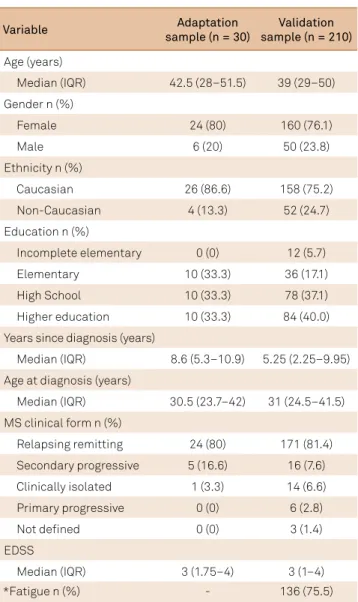
Table 1 shows characteristics of the 240 MS subjects.
In Table 2, the distribution of scores on the scales is described.
Cross-cultural adaptation of the NFI-MS to the Portuguese language
he translation and back-translation versions were sim
-ilar to the NFI-MS. Only three items were changed. Items
13 and 14 showed the Portuguese translation of the verb “to need” as “precisar” and it was changed to “necessitar”
due to express a better context. Item 16, “O descanso permite continuar minhas atividades”, was changed to “Eu necessito
descansar para continuar minhas atividades”.
Use of the word ‘fatigue’ was avoided because of seman-tic ambiguity. After these changes, full equivalences of the
NFI-MS/BR were achieved. In pretesting, no subject dem -onstrated any problem in understanding the instrument, and thus the instrument showed content and face validity.
he NFI-MS/BR kept the same number and allocation of items,
domains, format and response patterns as original version9.
Table 1. Study sample characteristics in cross-cultural adaptation and psychometric property phases.
Variable Adaptation
sample (n = 30)
Validation sample (n = 210)
Age (years)
Median (IQR) 42.5 (28–51.5) 39 (29–50)
Gender n (%)
Female 24 (80) 160 (76.1)
Male 6 (20) 50 (23.8)
Ethnicity n (%)
Caucasian 26 (86.6) 158 (75.2)
Non-Caucasian 4 (13.3) 52 (24.7)
Education n (%)
Incomplete elementary 0 (0) 12 (5.7)
Elementary 10 (33.3) 36 (17.1)
High School 10 (33.3) 78 (37.1)
Higher education 10 (33.3) 84 (40.0)
Years since diagnosis (years)
Median (IQR) 8.6 (5.3–10.9) 5.25 (2.25–9.95)
Age at diagnosis (years)
Median (IQR) 30.5 (23.7–42) 31 (24.5–41.5)
MS clinical form n (%)
Relapsing remitting 24 (80) 171 (81.4)
Secondary progressive 5 (16.6) 16 (7.6)
Clinically isolated 1 (3.3) 14 (6.6)
Primary progressive 0 (0) 6 (2.8)
Not deined 0 (0) 3 (1.4)
EDSS
Median (IQR) 3 (1.75–4) 3 (1–4)
*Fatigue n (%) - 136 (75.5)
Psychometric characteristics of the NFI-MS/BR
he NFI-MS/BR was completed in a median time of 3’56” (3.1–4.3). here were no missing data, ceiling (4.28% – irst interview, 5.17% – retest), and nor loor efects (4.76% – irst
interview, 8.04% – retest). Good reliability was demonstrated.
here was high agreement and small mean intra and interob
-server diferences (Table 3).
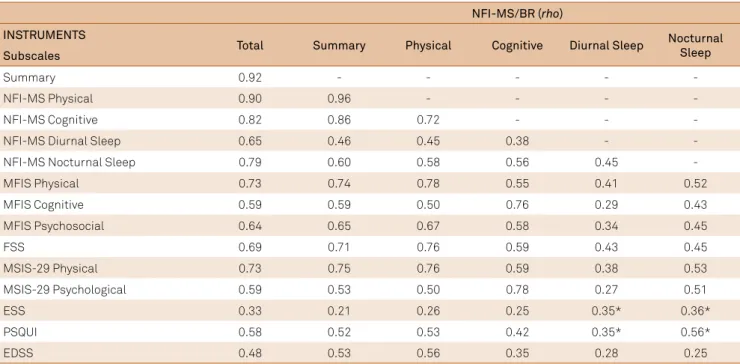
Based on prior hypotheses 41 were tested. All of them were conirmed except 5 out of 10 expected hypotheses
about similar subscales (Table 4).
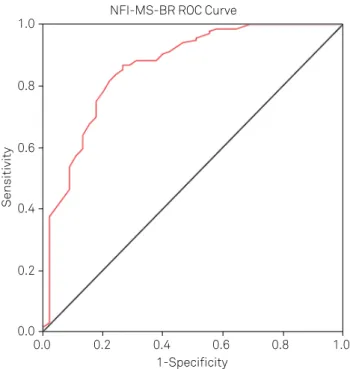
Analysis on ROC curve revealed the NFI-MS/BR ≥ 30 points as cut-of point to indicate fatigued subjects with value of ac
-curacy of 0.86 [0.79; 0.92] (P < 0.001) (Figure).
DISCUSSION
he available existing instruments only provided a lim
-ited understanding of the level of fatigue experienced by Brazilians with MS. hus, gaining the ability to measure this
symptom using a cross-culturally adapted instrument with acceptable psychometric properties has important implica-tions for clinical trials and epidemiological studies.
he demographic and clinical characteristics of the sam
-ple were consistent with data in previous studies. he age of onset has unimodal distribution with a peak at between 20 and 30 years of age. he incidence of MS is around two to three
times greater among women than men. Correlation studies
on racial diferences in the MS prevalence rates worldwide
have revealed that the Caucasians appears to have a higher
risk than other populations22. he majority of the subjects in the present study showed the RRMS clinical form as in
previ-ous reports, which have shown approximately 80% of the pa -tients will initially present this form11. he sample exhibited
low disability. his can be explained due to inclusion criteria,
given that all of the MS patients were in clinical remission and most of them presented the RRMS clinical form
charac-terized by lower severity and less disease progression than in
other clinical forms.
he frequency of fatigue in this study conirmed the high
prevalence demonstrated in various studies, with world-wide rates of up to 90%1 and Brazilian rates of around 67.4% to 86.7%23,24. his is a subjective inding, and hence there is considerable variability in the description of fatigue. Common
deinitions include a sense of exhaustion or a subjective lack
of physical and/or mental energy that is perceived by the in-dividual or caregiver to interfere with usual or desired
activ-ity. However, these terms may be diferently interpreted de
-pending on subject’s cultural background25.
Sensitivity
1-Specificity 1.0
0.8
0.6
0.4
0.2
0.0
0.0 0.2 0.4 0.6 0.8 1.0
NFI-MS-BR ROC Curve
NFI-MS/BR: Neurological Fatigue Index for Multiple Sclerosis; MS: multiple sclerosis.
Figure. Receiver operating characteristic (ROC) curve and the cut-off point for NFI-MS/BR to detect fatigue in MS subjects (n = 210). Sensitivity = 86.8%; 1-Speciicity = 28.9%; Standard erro r = 0.03; Accuracy = 0.86 [0.79–0.92].
Table 2. Distribution of scores from instruments in psychometric analysis (n = 210).
Instruments Scale range Median (IQR)
NFI-MS-BR
Summary 0–30 19 (11.5–23)
Physical 0–24 15 (9–19)
Cognitive 0–12 6 (3–9)
Diurnal Sleep 0–18 10 (7–12)
Nocturnal Sleep 0–15 8 (5–11)
Total 0–69 40 (26.5–49)
FSS 9–63 41 (27–52)
MFIS
Physical 0–36 11 (7–17)
Cognitive 0–40 7 (2–13.5)
Total 0–84 22 (12–32.5)
MSIS-29
Physical 0–100 20 (9–37)
Psychological 0–45 8 (4–15)
Total 0–145 30 (13–51)
ESS 0–24 5 (2–10)
PSQUI 0–21 5 (3–9)
EDSS 0–10 3 (1–4)
n: number of subjects; IQR: interquartile range 25%–75%; NFI-MS-BR: Neurological Fatigue Index for Multiple Sclerosis (Brazilian version); FSS: Fatigue Severity Scale, ≥ 28 = presence of MS fatigue symptom7;
MFIS: Modiied Fatigue Impact Scale, ≥ 38 = presence of MS fatigue symptom8;
MSIS-29: Multiple Sclerosis Impact Scale; ESS: Epworth Sleepiness Scale, ≥ 10 points indicates bad sleepiness17; PSQUI: Pittsburgh Sleep Quality
Each society has its own beliefs, attitudes, customs and
behavior and, in the cross-cultural adaptation process,
the particularities of each country need to be taken into con -sideration25. he steps for the cross-cultural adaptation pro -cess pro posed16 were followed: all the equivalences between
the NFI-MS and NFI-MS/BR were investigated within the
context of Brazilian culture, and content and face validity were achieved. he meticulous process used in this study was
important for identifying potential problems with the
instru-ment content. hrough assuring these equivalences, it was expected to maintain the psychometric properties of the NFI-MS/BR as properly docu mented in prior studies5,11,12,13. Table 3. Reproducibility of the NFI-MS/BR.
NFI-MS/BR (sub)scale ICC [95%CI] SEM agreement Bland-Altman 95%LC
d 95%CI of`d SD of`d Summary
Intra-observer 0.83 [0.74–0.89] 2.2 -0.81 -2.34–0.71 3.24 -10.91–7.64
Interobserver 0.79 [0.71–0.86] 1.7 0.88 -2.67–2.82 3.31 -8.44–10.67
Physical
Intra-observer 0.86 [0.77–0.93] 1.3 -0.83 -1.37–2.41 4.30 -12.03–9.11
Interobserver 0.84 [0.74–0.91] 1.4 0.87 -0.57–2.25 3.80 -9.27–11.03
Cognitive
Intra-observer 0.82 [0.73–0.95] 2.5 -0.80 -2.39–0.71 3.47 -10.33–7.65
Interobserver 0.77 [0.72–0.90] 2.1 0.76 -0.31–2.27 2.87 -8.41–9.73
Diurnal sleep and rest
Intra-observer 0.87 [0.83–0.94] 1.1 -0.57 -2.10–0.63 2.33 -11.07–9.32
Interobserver 0.85 [0.75–0.92] 1.0 0.54 -0.30–2.27 3.10 -7.43–18.34
Nocturnal sleep and sleppiness
Intra-observer 0.85 [0.81–0.97] 1.8 -0.62 -1.45–2.18 3.32 -11.13–9.67
Interobserver 0.82 [0.75–0.86] 1.4 0.80 -0.47–2.15 2.41 -9.30–12.12
NFI-MS/BR: Neurological Fatigue Index for Multiple Sclerosis (Brazilian version); ICC: Intraclass correlation coefficient; CI: confidence interval; d:mean difference; SD: standard deviation; LC: limits of agreement; SEM: standard error of measurement.
Table 4. Spearman’s correlation coefficients (rho) between individual subscales of the NFI-MS/BR and other instruments (n = 180).
NFI-MS/BR (rho)
INSTRUMENTS
Total Summary Physical Cognitive Diurnal Sleep Nocturnal Sleep Subscales
Summary 0.92 - - - -
-NFI-MS Physical 0.90 0.96 - - -
-NFI-MS Cognitive 0.82 0.86 0.72 - -
-NFI-MS Diurnal Sleep 0.65 0.46 0.45 0.38 -
-NFI-MS Nocturnal Sleep 0.79 0.60 0.58 0.56 0.45
-MFIS Physical 0.73 0.74 0.78 0.55 0.41 0.52
MFIS Cognitive 0.59 0.59 0.50 0.76 0.29 0.43
MFIS Psychosocial 0.64 0.65 0.67 0.58 0.34 0.45
FSS 0.69 0.71 0.76 0.59 0.43 0.45
MSIS-29 Physical 0.73 0.75 0.76 0.59 0.38 0.53
MSIS-29 Psychological 0.59 0.53 0.50 0.78 0.27 0.51
ESS 0.33 0.21 0.26 0.25 0.35* 0.36*
PSQUI 0.58 0.52 0.53 0.42 0.35* 0.56*
EDSS 0.48 0.53 0.56 0.35 0.28 0.25
It has been recognized that for such an instrument to be
clinically useful, it needs to be validated, appropriate for the
disease in question, reliable and easy to interpret and illed
out25. he NFI-MS/BR showed a good level of patient accept -ability and required only a few minutes to complete, as seen in previous studies5,13. Acceptability is supported when the scores observed are also well distributed20.
Measurements of reproducibility are indicators of good
reliability. he reproducibility of the NFI-MS/BR was as good
as the original version5 (ICC = 0.79 to 0.86) and the Dutch ver
-sion (ICC = 0.75 to 0.83) and showed small SEM on all (sub)
scales as the Dutch version13. he SEM allows one to make
statements about the precision of test scores of individual ex
-aminees and to interpret score diferences on instruments. he lower diference, the better is an instrument to obtain
more realistic scores21.
he Bland-Altman analysis demonstrated that there was
low individual variability with satisfactory limits of agree-ment, such that the subjects answered the items similarly
seven days later. hese results suggest that the NFI-MS/BR
is a stable instrument, similar to its Dutch version13, which
demonstrated low systematic diference (d = -0.07).
Investigating the validity of MS fatigue instruments is not a simple task because of the unclear definition, com
-plexity and multidimensional factors of fatigue, with many possibilities of expected associations. When an instru -ment is valid, it truly reflects the concept that it should measure17. There are three main different aspects of
va-lidity: content validity, criterion validity and construct va -lidity10. Content validity has already been commented on, in describing the stage of cross-cultural adaptation. Since
no gold standard exists for fatigue instruments, criterion
validity was not evaluated.
Construct validity was deined as the degree to which
scores of a questionnaire are consistent with the hypoth-esis17. Considering limitations relating to the most wide-ly used instruments for assessing MS fatigue (FSS and
MFIS)4,6,12, hypotheses were made to include other
instru-ments, so as to attribute more evidence for checking the construct validity of the NFI-MS/BR. Even though the cor -relation scores turned out to be very low between the non-similar subscales of the instruments that measure the same
construct all the hypotheses were conirmed. However between the similar subscales the correlations of NFI-MS physical and EDSS and NFI-MS subscales related to sleep conditions and ESS and PSQUI were not conirmed. hese
results are consistent with the majority of similar
correla-tions in previous studies on NFI-MS validation5,13.
he physical subscales of the NFI-MS/BR, MFIS and FSS demonstrated the highest values. his inding is supported
by evidence that relates fatigue as a primarily physical symp-tom2,12. he physical component of fatigue has been shown in many studies as a factor that interferes with activities of daily living and has an impact on quality of life5,11.
Studies on the NFI-MS5,11,12 have required comparisons
between the NFI-MS and sleep scales, thus suggesting that
MS fatigue is probably associated with low sleep quality during the night and sleepiness during the day. These
as-sociations were not confirmed in this study. As an unex -pected result, there were low or moderate correlations
between the NFI-MS/BR subscales relating to sleep and
specific instruments that measure sleep, although there is no other evidence to compare with this data. One possible
explanation might be that the NFI-MS/BR is a specific in
-strument for measuring MS fatigue, while ESS and PSQUI
are generic for MS subjects. On the other hand, there is agreement that fatigue and sleepiness, which are both sub-jective phenomena, should be measured as two indepen-dent constructs, in order to avoid confusion26. The correla-tions that were found provided convincing evidence that
supported the construct validity of the NFI-MS/BR, as also seen with the original NFI-MS5 and its Dutch version13.
Before the present study, no cut-of point for the NFI-MS
had been reported. Sensitivity is an important psychometric property that helps to enable interpretation of clinical impli-cations because it allows questionnaires to be used as diag-nostic or predictive instruments20.
The limitations for the results need to be consid-ered. With regard to the assessment of reliability, and the difference from the original5 and the Dutch version of
NFI-MS13, the mode of administration (mailed question-naires) may have influenced, whereas the current study
was administered by interviewers. This could be an ex
-planation why the ICCs found in this study were high -er than in the oth-er studies. Anoth-er limitation is that
FSS and MFIS were used as comparator instruments de -spite their problems regarding reliability and validity4,6. These were administered in the present study because
there were no other Brazilian specific instrument for as -sessing MS fatigue. With regard to use of the sleep
instru-ments, it is important to emphasize that these are ge -neric measurements, and may fail to address important areas of impact that are disease-specific.
Further research is required in order to be able to
ad-minister the NFI-MS/BR. Future studies could correlated it with imaging examinations and with other samples such
as patients in hospital, with the progressive clinical form,
with higher EDSS, or during MS relapses. A longitudinal study with a greater length of follow-up among those ex -pected to change could determine the responsiveness of
the NFI-MS/BR.
In conclusion the NFI-MS/BR is the first specific ques
-tionnaire available in Brazil that satisfies the modern stan -dards for outcome measurements relating to the symptom
of fatigue in MS. It is a valid and reliable instrument that
can be administered rapidly and is easily comprehended.
It can be used in clinical settings as well as in any design
References
1. Induruwa I, Constantinescu CS, Gran B. Fatigue in multiple sclerosis: a brief review. J Neurol Sci. 2012;323(1-2):9-15. doi:10.1016/j.jns.2012.08.007
2. Krupp LB, LaRocca NG, Muir-Nash J, Steinberg AD. The fatigue severity scale. Application to patients with multiple sclerosis and systemic lupus erythematosus. Arch Neurol. 1989; 46(10):1121-3. doi:10.1001/archneur.1989.00520460115022
3. Fischer JS, LaRocca NG, Miller DM, Ritvo P.G, Andrews H, Paty D. Recent developments in the assessment of quality of life in multiple sclerosis (MS). Mult Scler. 1999;5(4):251-9. doi:10.1177/135245859900500410
4. Mills R, Young C, Nicholas R, Pallant J, Tennant A. Rasch analysis of the Fatigue Severity Scale in multiple sclerosis. Mult Scler. 2009;15(1):81-7. doi:10.1177/1352458508096215
5. Mills RJ, Young CA, Pallant J.F, Tennant A. Development of a patient reported outcome scale for fatigue in multiple sclerosis: The Neurological Fatigue Index (NFI-MS). Health Qual Life Outcomes. 2010;8:22. doi:10.1186/1477-7525-8-22
6. Mills RJ, Young CA, Pallant J, Tennant A. Rasch analysis of the Modified Fatigue Impact Scale (MFIS) in multiple sclerosis. J Neurol Neurosurg Psychiatry. 2010;81(9):1049-51. doi:10.1136/jnnp.2008.151340
7. Mendes MF, Tilbery CP, Felipe E. [Fatigue and multiple sclerosis: preliminary study of 15 patients with self-reported scales]. Arq Neuropsiquiatr. 2000;58(2B):467-70. Portuguese. doi:10.1590/S0004-282X2000000300011
8. Pavan K, Schmidt K, Marangoni B, Mendes MF, Tilbery CP, Lianza S. [Multiple sclerosis: cross-cultural adaptation and validation of the modified fatigue impact scale]. Arq Neuropsiquiatr. 2007;65(3A):669-73. Portuguese. doi:10.1590/S0004-282X2007000400024
9. Cook KF, Bamer AM, Roddey TS, Kraft GH, Kim J, Amtmann D. A PROMIS fatigue short form for use by individuals who have multiple sclerosis. Qual Life Res. 2012;21(6):1021-30. doi:10.1007/s11136-011-0011-8
10. Elbers RY, Rietberg MB, van Wegen EE, Verhoef J, Kramer SF, Terwee CB et al. Self-report fatigue questionnaires in multiple sclerosis, Parkinson’s disease and stroke: a systematic review of measurement properties. Qual Life Res. 2012;21(6):925-44. doi:10.1007/s11136-011-0009-2
11. Mills RJ, Young CA. The relationship between fatigue and other clinical features of multiple sclerosis. Mult Scler. 2011;17(5):604-12. doi:10.1177/1352458510392262
12. Mills RJ, Calabresi M, Tennant A, Young CA. Perceived changes and minimum clinically important difference of the Neurological Fatigue Index for multiple sclerosis (NFI-MS). Mult Scler.; 2013;19(4):502-5. doi:10.1177/1352458512457840
13. Derksen A, Mokkink LB, Rietberg MB, Knol DL, Ostelo RWJG, Uitdehaag BMJ. Validation of a Dutch version of the Neurological
Fatigue Index (NFI-MS) for patients with multiple sclerosis in the Netherlands. Qual Life Res. 2013;22(9):2435-41. doi:10.1007/s11136-013-0375-z
14. Polman CH, Reingold SC, Banwell B, Clanet M, Cohen JA, Filippi M et al. Diagnostic criteria for multiple sclerosis: 2010 revisions to the McDonald criteria. Ann Neurol. 2011;69(2):292-302. doi:10.1002/ana.2236
15. Kurtzke JF. Rating neurologic impairment in multiple sclerosis: an expanded disability status scale (EDSS). Neurology. 1983;33(11):1444-52. doi:10.1212/WNL.33.11.1444
16. Beaton DE, Bombardier C, Guillemin F, Ferraz MB. Guidelines for the process of cross-cultural adaptation of self-report measures. Spine. 2000;25(24):3186-91. doi:10.1097/00007632-200012150-00014 17. Mokkink LB, Terwee CB, Patrick DL, Alonso J, Stratford PW, Knol DL et al. The COSMIN study reached international consensus on taxonomy, terminology, and definitions of measurement properties for health-related patient-reported outcomes. J Clin Epidemiol. 2010;63(7):737-45. doi:10.1016/j.jclinepi.2010.02.006
18. Lopes J, Kaimen-Maciel DR, Matsuo T. [Cross-cultural adaptation and validation of multiple sclerosis impact scale]. Rev Neurocien. 2011;19(3):433-40.
19. Bertolazi NA. Tradução, adaptação cultural e validação de dois instrumentos de avaliação do sono: Escala de sonolência de Epworth e Índice de qualidade de sono de Pittsburgh [thesis]. Porto Alegre: Universidade Federal do Rio Grande do Sul; 2008.
20. Scientific Advisory Committee of the Medical Outcomes Trust. Instrument review criteria. Washington, DC: Scientific Advisory Committee; 1995.
21. Terwee CB, Bot SD, De Boer MR, van der Windt DA, Knol DL, Dekker J et al. Quality criteria were proposed for measurement properties of health status questionnaires. J Clin Epidemiol. 2007;60(1):34-42. doi:10.1016/j.jclinepi.2006.03.012
22. Sospedra M, Martin R: Immunology of multiple sclerosis. Annu Rev Immunol. 2005;23(1):683-747. doi:10.1146/annurev.immunol.23.021704.11570
23. Mendes MF, Tilbery HP, Balsimell S, Felipe E, Moreira MA, Barão-Cruz AM. [Fatigue in multiple sclerosis relapsing-remitting form]. Arq Neuropsiquiatr. 2000;58(2B):471-5. Portuguese. doi:10.1590/S0004-282X2000000300012
24. Lopes KN, Nogueira LAC, Nóbrega FR, Alvarenga-Filho H, Alvarenga RMP. [Impairment, fatigue, and quality of life in progressive primary form of Multiple Sclerosis]. Rev Neurocien. 2010;18(1):13-7. Portuguese.
25. Weeks A, Swerissen H, Belfrage J: Issues, challenges, and solutions in translating study instruments. Eval Rev. 2007;31(2):153-65. doi:10.1177/0193841X06294184
Additional file 1
NFI-MS/BR
ÍNDICE NEUROLÓGICO DE FADIGA PARA ESCLEROSE MÚLTIPLA (NFI-MS/BR)
Instruções: Para cada airmação, responda como você tem se sentido no último mês.
1. Eu fico cansado facilmente.
□
Discordo totalmente□
Discordo□
Concordo□
Concordo totalmente2. Às vezes sinto meu corpo fraco.
□
Discordo totalmente□
Discordo□
Concordo□
Concordo totalmente3. Meus braços e/ou pernas podem se tornar muito pesados.
□
Discordo totalmente□
Discordo□
Concordo□
Concordo totalmente4. Meu corpo não consegue acompanhar o que eu tenho vontade de fazer.
□
Discordo totalmente□
Discordo□
Concordo□
Concordo totalmente5. Quanto mais tempo eu levo fazendo alguma coisa, mais difícil ela fica.
□
Discordo totalmente□
Discordo□
Concordo□
Concordo totalmente6.Às vezes eu não tenho escolha a não ser parar o que estou fazendo.
□
Discordo totalmente□
Discordo□
Concordo□
Concordo totalmente7. Eu fico cansado quase todos os dias.
□
Discordo totalmente□
Discordo□
Concordo□
Concordo totalmente8. Eu me sinto fraco mesmo sem ter feito nada.
□
Discordo totalmente□
Discordo□
Concordo□
Concordo totalmente9. Às vezes eu tenho que me concentrar muito para fazer coisas simples.
□
Discordo totalmente□
Discordo□
Concordo□
Concordo totalmente10. É mais difícil falar quando estou cansado.
□
Discordo totalmente□
Discordo□
Concordo□
Concordo totalmente11. Conforme o dia passa, fica mais difícil organizar e realizar minhas atividades.
□
Discordo totalmente□
Discordo□
Concordo□
Concordo totalmente12. Esforço mental realmente exige muito de mim.
□
Discordo totalmente□
Discordo□
Concordo□
Concordo totalmente13. Eu necessito descansar durante o dia.
□
Discordo totalmente□
Discordo□
Concordo□
Concordo totalmente14. Eu necessito dormir durante o dia.
□
Discordo totalmente□
Discordo□
Concordo□
Concordo totalmente15. Dormir durante o dia realmente me ajuda.
16. Eu necessito descansar para continuar minhas atividades.
□
Discordo totalmente□
Discordo□
Concordo□
Concordo totalmente17. Eu tento fazer todas as minhas atividades durante a manhã.
□
Discordo totalmente□
Discordo□
Concordo□
Concordo totalmente18. Quando vou fazer alguma atividade que exija muito esforço, eu tento descansar ou dormir antes.
□
Discordo totalmente□
Discordo□
Concordo□
Concordo totalmente19. Eu sinto como se estivesse há algumas noites sem dormir.
□
Discordo totalmente□
Discordo□
Concordo□
Concordo totalmente20. Eu bocejo muito (abro muito a boca quando estou com sono ou cansado).
□
Discordo totalmente□
Discordo□
Concordo□
Concordo totalmente21. Às vezes eu acordo durante à noite sem nenhum motivo.
□
Discordo totalmente□
Discordo□
Concordo□
Concordo totalmente22. Quando eu acordo de manhã, sinto que não descansei.
□
Discordo totalmente□
Discordo□
Concordo□
Concordo totalmente23. Frequentemente de manhã, eu não sinto vontade de levantar da cama porque estou com muito sono ou cansaço.
□
Discordo totalmente□
Discordo□
Concordo□
Concordo totalmenteÍndice Neurológico de Fadiga, © 2013