S
Y
S
TEMA
TIC
RE
VIE
W
Correspondence to: Josiane Lopes – Avenida Inglaterra, 155 – Igapo – CEP: 86046-000 – Londrina (PR), Brasil – E-mail: [email protected] Presentantion: Dec. 2013 – Accepted for publication: Sep. 2014 – Financing source: none – Conflict of interests: nothing to declare.
ABSTRACT | Assessment of fatigue in multiple sclerosis
is a difficult task and its instruments have no uniformity regarding the methodological evaluation parameters to ensure validity and reliability of its inferences. The objective of this study was to analyze the methodological quality of development, cross-cultural adaptation to Portuguese lan-guage (Brazil), and psychometric properties of self-report instruments that assess fatigue in multiple sclerosis and are available in Brazil. A search was conducted in the elec-tronic databases LILACS, MEDLINE, Embase, PsycINFO, CINAHL, SciELO and SPORTDiscus with analysis of the selected instruments by consensus-based standards for the selection of health measurement instruments. It was included 10 articles and presented the instruments Fatigue Severity Scale (FSS), Modified Fatigue Impact Scale (MFIS), Cognitive and Physical Fatigue in Multiple Sclerosis Scale (CPF-MS), Guy’s Neurological Disability Scale (GNDS), Functional Assessment of Multiple Sclerosis (FAMS), and their adapted versions in Brazil. Most instru-ments present a multidimensional structure with docu-mented cross-cultural adaptation in Brazil and empha-size the physical domain and adequate reliability. There is difficulty in identifying a self-report instrument to ade-quately assess fatigue in multiple sclerosis and that is an example of methodological and psychometric standards in their design and management.
Keywords | Fatigue; Multiple Sclerosis; Psychometrics; Self Report.
Assessment of fatigue in multiple sclerosis:
methodological quality of adapted original versions
available in Brazil of self-report instruments
Avaliação da fadiga na esclerose múltipla: qualidade metodológica das versões
originais adaptadas no Brasil dos instrumentos de autorrelato
Evaluación de fatiga en la esclerosis múltiple: cualidad metodológica de las
versiones originales ajustadas en Brasil de los instrumentos de autoinforme
Josiane Lopes1, Edson Lopes Lavado2, Ana Paula Kallaur3, Sayonara Rangel de Oliveira3,
Edna Maria Vissoci Reiche4,Damacio Ramón Kaimen-Maciel5
Study conducted at the Graduate Program in Health Sciences, Universidade Estadual de Londrina (UEL) – Londrina (PR), Brazil.
1Physical Therapy Department, Faculdade de Apucarana (FAP) – Apucarana (PR), Brazil. 2Physical Therapy Department, UEL – Londrina (PR), Brazil.
3Graduate Program in Health Sciences, UEL – Londrina (PR), Brazil.
4Pathology, Clinical and Toxicological Analysis Department, UEL – Londrina (PR), Brazil. 5Medical Clinic Department, UEL – Londrina (PR), Brazil.
RESUMO | A avaliação da fadiga na esclerose múltipla é uma tarefa difícil e seus instrumentos não dispõem de uniformi-dade quanto aos parâmetros de avaliação metodológica para assegurar validade e confiabilidade de suas inferências. O objetivo deste estudo foi analisar a qualidade metodológica do desenvolvimento, da adaptação transcultural para a língua portuguesa (Brasil) e das propriedades psicométricas dos ins-trumentos de autorrelato que avaliam a fadiga na esclerose múltipla e estão disponíveis no Brasil. Foi realizada uma busca eletrônica nas bases de dados LILACS, MEDLINE, Embase, PsycINFO, CINAHL, SciELO e SPORTDiscus, com análise dos instrumentos selecionados pelo consenso de parâmetros para selecionar instrumentos na área da saúde. Foram incluídos dez artigos e apresentados os instrumentos Fatigue Severity Scale
(FSS), Modified Fatigue Impact Scale (MFIS), escala de fadiga cognitiva e física na esclerose múltipla (CPF-MS), escala de incapacidade neurológica de Guy (GNDS),
Functional Assessment of Multiple Sclerosis (FAMS) e suas respectivas versões adaptadas no Brasil. A maioria dos ins-trumentos é multidimensional, específica, com documen-tada adaptação transcultural e predomínio de avaliação do domínio físico da fadiga e evidência de confiabilidade ade-quada. Houve dificuldade em se identificar um instrumento de autorrelato, que avalie adequadamente a fadiga na escle-rose múltipla e seja exemplo de padrões metodológicos e psicométricos em sua concepção e administração.
INTRODUCTION
Fatigue is the most incapacitating and common symp-tom of multiple sclerosis (MS)1,2. Studies show that 75 to
96% of people with MS have such condition3. In Brazil,
fatigue in MS is estimated between 66.7 to 86.7%4. he
frequency and impact of this symptom emphasize the importance of its assessment and diagnosis5.
he assessment of fatigue in MS is a diicult task. he lack of a deinition and consensus on its dimensions constitute the greater challenge at hand5,6. he MS Board
for Guidelines on Clinical Practice7 deines fatigue as a
subjective lack of physical or mental energy perceived by the individual or by the caretaker and which interferes in daily life activities. he British society, on the other hand, deines it as a great sensation of tiredness without any apparent reason1.
he fatigue in MS has a multidimensional nature due to a complex multifactorial interaction2,8. Kos et al.9
related it to primary mechanisms related to the inlamma-tory process, to the disfunção do eixo neuroimunoendó-crino, to alteration on the cerebral cortex activation and to secondary mechanisms such as sleep, activity reduc-tion, depression, anxiety, psychological alterations, pain and use of medication.
Over the last 20 years, approximately 30 self-report instruments assessing fatigue in MS have been devel-oped2. In Brazil, only ive of those are available4,10-12. he
assessment of fatigue in Brazilian individuals who have MS is made through the use of self-report instruments: he fatigue severity scale (FSS)4, the modiied fatigue
impact in MS scale (MFIS)11, the cognitive and
physi-cal fatigue in multiple sclerosis sphysi-cale (CPF-MS)12, the
Guy’s neurological disability scale (GNDS)10 and the
functional assessment of multiple sclerosis (FAMS)13.
he wide scope of fatigue in MS may justify the exis-tence of a great number of instruments intending to assess it, contemplating objective and subjective parameters with uni or multidimensional focus between speciic or generic types2,8,14-17. However, according to evidence, the
subjective methods, specially self-report instruments, are best suited in order to assess the fatigue17.
he validity of the inferences of the studies depend directly on the quality of the measurement instruments18.
hus, the adoption of parameters and the analysis of psy-chometric properties in the development and validation of an instrument is essential, in order to ensure it really assesses that which is proposed and demonstrate reliability10,19,20.
he Brazilian studies which adapted the self-report instruments assessing fatigue in MS are not uniform as for their parameters for the analysis of methodological quality, ensuring the reliability of its inferences. hus, this study aims at analyzing the methodological quality of the development, the transcultural adaptation into the Portuguese language (Brazil) and the psychometric prop-erties of the self-report instrument assessing the fatigue in MS available in Brazil.
METHODOLOGY
An electronic search was conducted in the virtual data bases of LILACS (1986-2013), MEDLINE (1966-2013), Embase (1974-2013), PsycINFO (1806-2013), Cinahl (1981-2013), SciELO (1998-2013) and SPORTDiscus (1985-2013), using the keywords “esclerose múltipla”, “fadiga”, “adaptação transcultural”, “psicometria” and their respective terms in English cross-crossing them with the Boolean operator “and”. Studies presenting the development
RESUMEN | La evaluación de fatiga en la esclerosis múltiple es
una tarea difícil y sus instrumentos no disponen de uniformi-dad cuanto a los parámetros de evaluación metodológica para garantir la validad y confiabilidad de sus inferencias. El obje-tivo de eso estudio fue analizar la cualidad metodológica del desarrollo, de la adaptación transcultural para el idioma portu-gués (Brasil) y de las propiedades psicométricas de los instru-mentos de autoinforme que evalúan la fatiga en la esclerosis múltiple y están disponibles en Brasil. Se realizó una búsqueda electrónica en las bases de datos LILACS, MEDLINE, Embase, PsycINFO, CINAHL, SciELO e SPORTDiscus, con un análisis de los instrumentos seleccionados por el consenso de parámetros para seleccionar instrumentos en el área de la salud. Fueron inclusos diez artículos y presentados la Fatigue Severity Scale
(FSS),la Modified Fatigue Impact Scale (MFIS), la escala de fatiga cognitiva y física en la esclerosis múltiple (CPF-MS), la escala de incapacidad neurológica de Guy (GNDS), la
Functional Assessment of Multiple Sclerosis (FAMS) y sus res-pectivas versiones ajustadas en Brasil. La mayoría de los ins-trumentos es multidimensional, específica, con documentada adaptación transcultural y predominio de la evaluación del domi-nio físico de la fatiga y evidencia de la confiabilidad adecuada. Hubo dificultad en identificarse un instrumento de autoinforme, que haga una evaluación adecuada de la fatiga en la esclerosis múltiple y sea ejemplo de los estándares metodológicos y psi-cométricos en su concepción y administración.
of original versions of the self-report instruments were included here, in order to assess the fatigue in MS available in Brazil, and the transcultural adaptation studies and psy-chometric analysis of the Brazilian versions. We excluded editorials, letters, guidelines and reviews.
In the search, 51 studies were found and 10 of them were selected. Out of the 41 excluded ones, 32 inves-tigations presented transcultural adaptations to other languages diferent from the original one in which the instrument was developed, six studies presented review design and three of them investigated, at the same time, the fatigue in individuals with MS or Parkinson disease or stroke and presented the data all together.
Among the tem selected ones for this review, ive of them approached the development and psychometric analysis of the original self-report instruments which assess the fatigue in MS and ive of them are about the adaptation processes and the psychometric analysis of their Brazilian versions. The original versions of the instruments are Fatigue Severity Scale (FSS)15, Modiied
Fatigue Impact Scale (MFIS)19, CPF-MS)20, GNDS21,
Functional Assessment of Multiple Sclerosis (FAMS)22
and their respective adapted Brazilian versions, ESF/BR4,
MFIS/BR11, CPF-MS/BR12, GNDS/BR10 and DEFU13.
Two independent authors performed the analysis of meth-odological quality of the articles according to the Consensus-based Standards for the selection of health Measurement Instruments (COSMIN)23, which is based on the
proto-col of Beaton et al.24, and the Instrument Review Criteria
(1995)25. he texts were analyzed as for the way their
instru-ments were developed, to the description of transcultural adaptation of the Brazilian versions and to the analysis of psychometric properties. In order to assess the development of the instruments, we considered they have been pre-tested in individuals with MS in an open interview system, in which the interviewee may suggest changes and comment how he feels concerning the item asked25.
he transcultural adaptation analysis of the instru-ments was based on the steps proposed by Beaton et al.24:
translation into the language in which it will be used, consensual analysis of the translation, back translation to the original language of the instrument, consensual analysis of the back translation, review by a commit-tee of specialists in the assesses phenomenon and test-ing of the pre-inal version in individuals who have the condition. In the psychometric analysis, we considered as acceptable what is recommended by the Instrument Review Criteria (1995)25: reliability (0.70≤internal
con-sistency≤0.90, reproducibility>0.80), validity (correlation
coeicient>0.75), sensitivity (determining the cut-of point
of the instrument), responsiveness (efect size assessment), quality of the data (proportion higher than 15% of the respondents who reach the highest score (ceiling efect) or lower instrument score (loor efect)). In relation to practicality, the time and easiness of administration of the instrument were analyzed. As for its representative-ness, it is recommended the selection of between 5 and 10 individuals per item of the instrument being assessed26.
he adjustment to the item response theory (IRT) refers to the absence of biases between the items27.
RESULTS
he main characteristics of the studies included are in Table 1. Although the instruments present a wide range of fatigue dimensions, the physical domain prevailed. here was limitation in the development of versions CPF-MS, CPF-MS/BR, ESF and ESF/BR, since they were not pre-tested in individuals with MS. he instru-ments DEFU and GNDS and their versions in Portuguese were introduced as indirect assessment of fatigue, because they present domains related to this symptom.
he representativeness of the sample was acceptable only for versions DEFU, GNDS/BR and MFIS. On the other hand, FSS and MFIS are generic instruments, however the ESF/BR and MFIS/BR were adapted for individuals with MS.
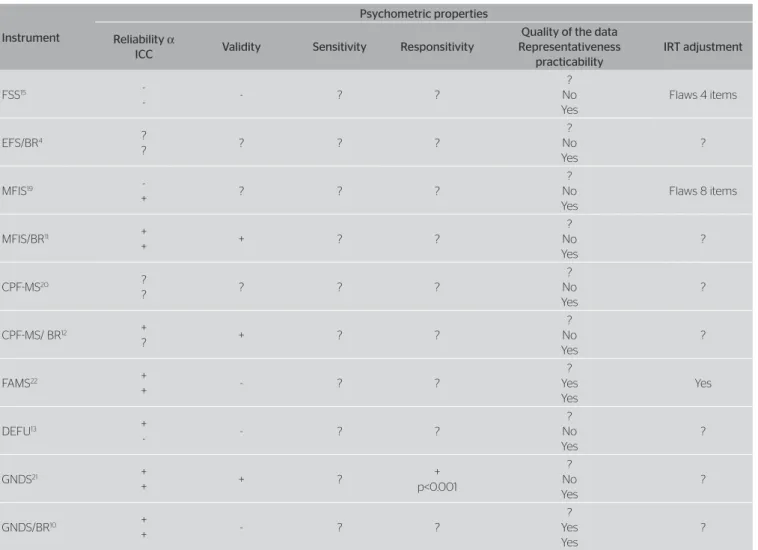
here is scarce information on the psychometric prop-erties of the instruments (Table 2). No study demon-strated an assessment of all the proposed psychometric properties. he reliability was the most assessed property and the one with the most adequate values. here is no information on the sensitivity level of the instruments and the quality of the data, though there is the determi-nation of the cut-of point.
DISCUSSION
his study is the irst one to analyze the evidences as for the psychometric properties of the self-report instruments which assess the fatigue in Brazilian individuals with MS.
Table 1. Characteristics of the included studies
Instrument of the
sample Construction Population Domains (items)
Score (cut-of point)
Brazilian version (transcultural adaptation) of the sample
FSS15
MS: 25/ LES: 29/ Controls: 20
Severity of the fatigue
MS
LES Physical (9)
1–7 (≥28)
ESF/BR4
(No) MS:15/ Controls:15
MFIS19
MS:151
Impact of the fatigue
Chronic diseases
Physical (9) Cognitive (10)
Social (2)
0–4 (≥38)
MFIS/BR11
(Yes) MS: 57/ Controls: 45
CPF-MS20
MS: 39/ Controls: 19
Physical and
cognitive fatigue MS
Physical (8) Cognitive (7)
1–5 (No)
CPF-MS/BR12
(Yes) MS: 34/ Controls: 24
FAMS22
EM: 433 Quality of life MS
Mobility (7) Symptoms (7) Emotional state (7) Personal satisfaction (7)
Thought/fatigue (9) Social situation/family (7)
0–4 (No)
FAMS13
(Yes) MS: 143
GNDS21
MS: 50 Function MS
Cognitive, humor, sight, speech, deglution, function of the UL, function of the LL, vesicle control, intestines control, sexual
function, fatigue and others (1 each)
0–5 (No)
GNDS/BR10
(Yes) MS: 62
FSS: Fatigue Severity Scale; MS: mutilpe sclerosis; LES: lúpus eritematoso sistêmico; ESF/BR: Fatigue Severity Scale (Brazilian version); MFIS: Modified Fatigue Impact Scale; MFIS-BR: Modified Fatigue Impact Scale (Brazilian version); CPF-MS: functional assessment of multiple sclerosis; CPF-MS/BR Brazilian version; FAMS: Functional Assessment Multiple Sclerosis; DEFU: functional assessment multiple sclerosis; GNDS: Guy’s neurological disability scale; UL: upper limbs; LL: lower limbs; GNDS/BR: Brazilian version
Table 2. Characteristics of the psychometric properties of the instruments included
Instrument
Psychometric properties
Reliability α
ICC Validity Sensitivity Responsitivity
Quality of the data Representativeness
practicability
IRT adjustment
FSS15
-- - ? ?
? No Yes
Flaws 4 items
EFS/BR4 ?
? ? ? ?
? No Yes
?
MFIS19
-+ ? ? ?
? No Yes
Flaws 8 items
MFIS/BR11 +
+ + ? ?
? No Yes
?
CPF-MS20 ?
? ? ? ?
? No Yes
?
CPF-MS/ BR12 +
? + ? ?
? No Yes
?
FAMS22 +
+ - ? ?
? Yes Yes
Yes
DEFU13 +
- - ? ?
? No Yes
?
GNDS21 +
+ + ?
+ p<0.001
? No Yes
?
GNDS/BR10 +
+ - ? ?
? Yes Yes
?
due to its complexity1,28,29. he fatigue is a complaint,
essentially, subjective and heterogeneous, that varies among individuals due to frequency, severity, the onset ways and psychosocial conditions2,30-32.
All analyzed instruments were developed in English and, therefore, need to be transculturally adapted so they are available in Brazil. his process allows changes in the structure of the items of an instrument and in the mod-eling of their domains, preserving the original hypoth-esis, besides solving diference on language and concept perception between countries and cultures18,22. All steps
of such process were identiied in most of the studies, except for ESF/BR and CPF-MS/BR. hus, such instru-ments are more likely to have psychometric laws and conlicting results, due to limitations as for the obtain-ing of equivalences in their original versions.
he representativeness of the sample as for the target population is fundamental for the quality of the instrument, for its adequate size allows generalization for the popula-tion5,19. Small samples in the studies of versions FSS, ESF/
BR, MFIS/BR, DEFU, GNDS, CPF-MS and CPF-MS/ BR impair references for comparisons on their performance. Considering the subjective nature of the fatigue, an assessment instrument must represent what the individual really does experience, i.e., speciically for the MS27. Most
of the analyzed instruments here developed are exclusive for individuals with MS; however, they emphasize, spe-cially, physical and cognitive dimensions of the fatigue over other also relevant factors. Speciic questionnaires must include items created clearly to qualify, deine and describe fatigue within the context of similar symptoms (depression, sleep disorders, motor and cognitive perfor-mance and impact in the quality of life)5,31-33.
he psychometric properties are criteria necessary in order to determine the methodological quality of the instruments. In order to address the basic psychometrics, an instrument must, at least, reunite evidences of reliabil-ity and acceptable validreliabil-ity18. here was little information
on most properties of the instruments. he laws in the original versions are also evident in the Brazilian ones. Despite some studies documenting this assessment, they did not meet the scientiically accepted methodological criteria in most properties, considering there is, most of the time, an ignorance of knowledge, especially in sen-sitivity, responsiveness and adjustment to IRT.
Reliability, validity and practicality were the most evidenced psychometric properties in the analyzed versions. he reliability was the most demonstrated one, justiied by its relevance to psychometrics, for it refers to the quality of the scores of the test, suggesting how much it is free of measurement mistakes
for a reproducible result18,33. Within the validity aspects, the
construct one prevails in the versions. It constitutes a valuable way of assessing the instrument, being the conirmation that the instrument measures what it really proposes18,19,33. All
ver-sions have acceptable practicality verver-sions, because they are instruments of easy and quick use.
he instruments FSS and MFIS have been the most used ones worldwide in order to assess fatigue in MS7. However,
some limitation and psychometric laws were identiied in these instruments. hey are generic instruments, con-sidering only overall aspects of the fatigue. Studies using the statistical model of Rasch demonstrated that the FSS presented four items34 and the MFIS, eight28, incompatible
with the fatigue measure in MS. It was reported, in this study, that the FSS instrument and its adapted version, , ESF/BR, had more laws in demonstrating measure pat-terns which are acceptable among them all. Considering the current psychometric Standards, in this study, the ver-sion MFIS/BR constitutes the most recommended instru-ment in order to assess fatigue in MS.
he choice of an instrument depends, specially, on its purpose9. Given the psychometric laws of the analyzed
instruments, it is important to consider which of them have a target-dimension aimed at being assessed and the most pertinent psychometric property for such. here was a diiculty in identifying a self-report instrument, avail-able in Brazil, which properly assesses the fatigue of MS and is an example of methodological and psychometric Standards in its conception and use. In order to assess fatigue in MS, the combined use of instruments is the best option for assessment purposes that considers dif-ferent factors and psychometric adequacy.
Given the above, it is suggested that the conduction of more studies on the development or transcultural adaptation and psychometric approach of the self-report instruments are speciic, multidimensional and that they address the psychometrics criteria in order to assess the fatigue in Brazilian individuals with MS.
CONCLUSION
he instrument CPF-MS/BR presents adequate construct validity, but with partial reliability. he GNDS/BR on the other hand is reliable in its assessment, however it does not have adequate validity parameters. he FAMS presents restriction on assessing the fatigue with partial reliability. In turn, the instrument EFS/BR should not be used to evaluate fatigue in MS, since it does not have transcultural adaptation in Brazil and the assessment of psychometric properties recognized in the literature.
REFERENCES
1. Induruwa I, Constantinescu CS, Gran B. Fatigue in multiple sclerosis: a brief review. J Neurol Sci. 2012;323(1-2):9-15.
2. Penner IK, Calabrese P. Managing fatigue: clinical correlates, assessment procedures and therapeutic strategies. International MS J. 2010;17(1):28-34.
3. Cook KF, Bamer AM, Roddey TS, Kraft GH, Kim J, Amtmann D. A PROMIS fatigue short form for use by individuals who have multiple sclerosis. Qual Life Res. 2012;21(6):1021-30.
4. Mendes MF, Tilbery CP, Balsimelli S, Felipe E, Moreira MA, Barão-Cruz AM. Fadiga na forma remitente recorrente da esclerose múltipla. Arq Neuropsiquiatr. 2000;58(2-B):471-5.
5. Elbers RY, Rietberg MB, Van Wegen EE, Verhoef J, Kramer SF, Terwee CB, et al. Self-report fatigue questionnaires in multiple sclerosis, Parkinson’s disease and stroke: a systematic review of measurement properties. Qual Life Res. 2012;21(6):925-44.
6. Morgante F, Dattola V, Crupi D, Russo M, Rizzo V, Ghilardi MF, et al. Is central fatigue in multiple sclerosis a disorder of movement preparation? J Neurol. 2011;258:263-72.
7. Multiple Sclerosis Council for Clinical Practice Guidelines. Fatigue and multiple sclerosis: evidenced-based management strategies for fatigue in multiple sclerosis. Washington, DC: Paralyzed Veterans of America; 1998.
8. Ben-Zacharia AB. Therapeutics for multiple sclerosis symptoms. Mt Sinai J Med. 2011;78(2):176-91.
9. Kos D, Kerckhofs E, Nagels G, D’hooghe B, Ilsbroukx S. Origin of fatigue in multiple sclerosis: Review of the literature. Neurorehabil Neural Repair. 2008;22(1):91-100.
10. Araujo CR, Simão LM, Ybarra MI, Faria NV, Botelho CM, Moreira MA, Teixeira AL, Lana-Peixoto MA. Validation of the Brazilian version of Guy’s neurological disability scale. Arq Neuropsiquiatr. 2007;65(3A):615-8.
11. Pavan K, Schmidt K, Marangoni B, Mendes MF, Tilber CP, Lianza S. Esclerose múltipla. Adaptação transcultural e validação da escala modificada de impacto de fadiga. Arq Neuropsiquiatr. 2007;65(3-A):669-73.
12. Haase VG, Lacerda SS, Lima Ede P, Corrêa TD, Brito DC, Lana-Peixoto MA. Assessment of psychosocial functioning in multiple sclerosis: psychometric characteristics of four self-report measures. Arq Neuropsiquiatria. 2004;62(2-A):282-90.
13. Mendes MF, Balsimelli S, Stangehaus G, Tilbery CP. Validação de escala de determinação funcional da qualidade de vida na esclerose múltipla para a língua portuguesa. Arq Neuropsiquiatr. 2004;62(1):108-13.
14. Alvarenga Filho H, Carvalho SR, Dias RD, Alvarenga RM. Principais testes utilizados na avaliação de fadiga na esclerose múltipla. Rev Bras Neurol. 2010;46(2):37-43.
15. Krupp LB. The fatigue severity scale. Application to patients with multiple sclerosis and systemic lupus erythematosus. Arch Neurol. 1989;46(10):1121-3.
16. Pasquali L. Psicometria. Rev Escola Enferm USP. 2009;43:992-9.
17. Beaton DE, Bombardier C, Guillemin F, Ferraz MB. Recommendations for the cross-cultural adaptation of Health Status Measures. Institute for Work & Health; 2007. [citado 11 jul. 2013]. Disponível em: http:// www.dash.iwh.on.ca/system/files/X-Cultural Adaptation-2007.pdf.
18. Hobart JC. Improving the evaluation of therapeutic interventions in multiple sclerosis: development of a patient-based measure of outcome. Health Technol Assess. 2004;8(9):1-48.
19. Fischer JS, Larocca NG, Miller DM, Ritvo PG, Andrews H, Paty D. Recent developments in the assessment of quality of life in multiple sclerosis (MS). Mult Scler. 1999;5(4):251-9.
20. Paul RH, Beatty WW, Schneider R, Blanco CR, Hames KA. Cognitive and physical fatigue in multiple sclerosis: relations between self-report and objective performance. Appl Neuropsychol. 1998;5(3):143-8.
21. Sharrack B, Hughes RA. The Guy’s Neurological Disability Scale (GNDS): a new disability measure for multiple sclerosis. Mult Scler. 1999;5(5):223-33.
22. Cella DF, Dineen K, Arnason B, Reder A, Webster KA, Karabatsos G, et al. Validation of the functional assessment of multiple sclerosis (FAMS): quality of life instrument. Neurology. 1996;47(1):129-39.
23. Mokkink L, Terwee C, Patrick D, Alonso J, Stratford P, Knol D, et al. The COSMIN checklist for assessing the methodological quality of studies on measurement properties of health status measurement instruments: an international Delphi study. Qual Life Res. 2010;19(4):539-49.
24. Beaton DE, Bombardier C, Guillemin F, Ferraz MB. Guidelines for the process of cross-cultural adaptation of self-report measures. Spine. 2000;25(24):3186-91.
25. Scientific Advisory Committee of the Medical Outcomes Trust. SAC: Instrument. Rev Criteria. 1995;3:4.
26. Hair JF, Tatham RL, Anderson RE, Black W. Análise multivariada de dados. Porto Alegre: Bookman; 2005.
27. Marrie RA, Cutter G, Tyry T, Hadjimichael O, Campagnolo D, Vollmer T. Validation of the NARCOMS Registry: fatigue assessment. Mult Scler. 2005;11(5):583-4.
28. Mills RJ, Young CA, Pallant J, Tennant A. Rasch analysis of the Modified Fatigue Impact Scale (MFIS) in multiple sclerosis. J Neurol Neurosurg Psychiatry. 2010; 81(9):1049-51.
29. Leocani L, Colombo B, Comi G. Physiopathology of fatigue in multiple sclerosis. Neurol Sci. 2008;29:S241-3.
30. Krupp LB, Serafin DJ, Christodoulou C. Multiple sclerosis associated fatigue. Expert Rev Neurother. 2010;10(9):1437-47.
31. Paul A, Lewis M, Shadforth MF, Croft PR, Van Der Windt DA, Hay EM. A comparison of four shoulder-specific questionnaires in primary care. Ann Rheum Dis. 2004;63(10):1293-4.
32. Urbina S. Fundamentos de testagem psicológica. Porto Alegre: Artmed; 2007.
33. Pilatti LA, Pedroso B, Gutierrez GL. Propriedades psicométricas de instrumentos de avaliação: um debate necessário. RBECT. 2010;3(1):81-91.