ARQGA/1856
COMUNICAÇÃO BREVE / BRIEF COMMUNICA
TION
v. 53 no. 3 - jul./set. 2016 Arq Gastroenterol 203
DOI: 10.1590/S0004-28032016000300015
INTRODUCTION
Fatigue is a common complaint in individuals with chronic liver disease and may be considered a disabling symptom. Its pathogenesis is generally multifactorial. Patients with cirrhosis often undergo psychologi-cal stress and potentially debilitating complications such as hepatic encephalopathy(4), hepatocellular
carcinoma or malnutrition can lead to physical and cognitive weakness. Numerous instruments have been used for evaluation and impact of fatigue in patients with liver disease, but research on the etiology and treatment of fatigue has been hampered by the lack of relevant measures, reproducible severity of fatigue. The Fatigue Severity Scale was initially developed for evaluation of fatigue in multiple sclerosis(3). Validated
in Brazil(5,6), the instrument evaluates the effects of
fa-tigue on motivation, exercise and physical functioning of the individual as well as its interference in work, family and social life. It has shown sensitivity in the evaluation of different aspects regarding the severity
RELIABILITY OF THE FATIGUE SEVERITY
SCALE IN CIRRHOTIC AND CORRELATION
WITH DEPRESSION AND QUALITY OF LIFE:
preliminary assessment
Danusa
ROSSI
1, Lucas Homercher
GALANT
1and Claudio Augusto
MARRONI
1,2Received 16/1/2016 Accepted 15/3/2016
ABSTRACT - Background - Fatigue is a common complaint in patients with liver disease and may be considered a disabling symptom, affecting their quality of life and mental health. The Brazilian version of the Fatigue Severity Scale showed sensitivity to assess fatigue in some populations, but has not been tested in cirrhotic individuals.Objective- The aim of this study was to evaluate the reliability of the Fatigue Severity Scale and association with depression and quality of life in patients with liver cirrhosis.
Methods - A prospective cohort study where the same interviewer applied to 25 patients Fatigue Severity Scale questionnaires, Brazilian version of the Beck Depression Inventory II (BDI- II) and Brazilian version of the Short Form Health Survey II (SF-36 v.II). Evaluating the reliability of the Fatigue Severity Scale through internal consistency and reproducibility was conducted.
Results - Statistical analysis showed strong internal consistency (Cronbach’s alpha = 0.917) and intraobserver reproducibility test, there was no signiicant difference between both moments (P=0.828). Fatigue Severity Scale was signiicantly associated with BDI- II (r=0.478;
P=0.016) and quality of life in areas PF (r=-0.484; P=0.014), BP (r=-0.402; P=0.046) and GH (r=-0.406; P=0.044) and SF (r=-0.520; P=0.008).
Conclusion - The Fatigue Severity Scale showed satisfactory reliability in evaluation of fatigue in cirrhotic and can be used as a tool for this purpose. Fatigue is related to depression and quality of life in the physical aspects domains, pain, general health and social aspects.
HEADINGS - Reproducibility of results. Fatigue. Liver cirrhosis. Depression. Quality of life.
Declared conflict of interest of all authors: none Disclosure of funding: no funding received
Support: Higher Education Personnel Improvement Coordination (CAPES).
1 Pós-graduação em Hepatologia, Universidade Federal de Ciências da Saúde de Porto Alegre, RS, Brasil; 2 Serviço de Transplante Hepático, Hospital Dom Vicente Scherer, Irmandade Santa Casa de Misericórdia de Porto Alegre, RS, Brasil.
Correspondence: Danusa Rossi. Valentim Pasquali,44/502 – CEP 95110-199 – Caxias do Sul, RS Brazil Email: [email protected]
and intensity of fatigue, such as social, physical or cog-nitive, but has not been tested in cirrhotic individuals. The aim of this study was to evaluate the reliability of the FSS and correlation with depression and qual-ity of life in patients with liver cirrhosis.
METHODS
Rossi D, Galant LH, Marroni CA. Reliability of the fatigue severity scale in cirrhotic and correlation with depression and quality of life: preliminary assessment
204 Arq Gastroenterol v. 53 no. 3 - jul./set. 2016
performing the reading of questions and the interviewee pointing responses. Depression was assessed by the Brazilian version of the Beck Depression Inventory-II (BDI- II) with 21 items and a 4-point scale response, ranging from 0 (lowest) to 3 (severe). The total score ranges from 0 to 63. Cutting pat-tern for the general population are: 0-9: minimum depression; 10-18: mild depression; 19-29: moderate depression; 30-63: severe depression(2). The Brazilian Portuguese version of the
36-item Medical Outcomes Study Short-Form Health Survey version II (SF-36 v.II) was used to assess quality of life(1).
The same consists of eight ields, punctuated 0-100 (physical functioning, physical role, bodily pain, general health, vitality, social functioning, emotional, mental health). Higher scores indicate better physical, emotional and social functioning. The Brazilian version of the Fatigue Severity Scale was used to assess fatigue and consists of nine statements that assess the overall effect of fatigue on motivation, physical function-ing and interference with socioeconomic factors. Each item is rated on a Likert 7-point scale: 1 (strongly disagree) to 7 (strongly agree). The total score ranges from 1 to 7 and is cal-culated as the mean response for all questions(3). To determine
the reproducibility of the FSS, the scale was applied at two times the same patient by the same person, with a maximum interval of 2 months between assessments (test and retest). Data analysis was performed using the Statistical Package for Social Sciences, version 16.0. Descriptive statistical analysis was used to characterize the demographic, anthropometric and clinical patients, depending on the type of variable distribution and data. The intraclass correlation coeficient (ICC), with its 95%, and paired t-test were used to assess the reproducibility of the two-step evaluation of the patient. The relationship between the FSS, depression and quality of life, the Pearson correlation coeficients were used. The level of statistical signiicance was P<0.05. Internal consistency was assessed by Cronbach’s alpha.
RESULTS
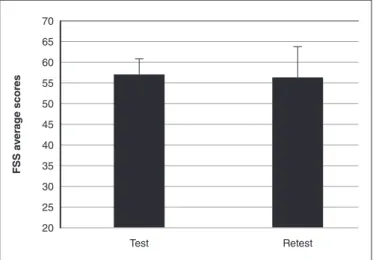
Of the thirty-four patients were enrolled in the study, 25 met the inclusion criteria. Six patients were excluded because they presented interval greater than 2 months to re-test and three were still without deinite diagnosis awaiting tests. The mean age was 55.4±7.1 years and 68% were male. Regarding education, 48% had not completed elementary school. The etiologies, 40% was for HCV and 24% alcoholic cirrhosis. The mean MELD score was 14.2±3.2. Child B represented 61.5% of the sample. They made use of antidepressants 24% of patients, and patients enrolled, 4% were already transplanted. Statistical analysis showed good internal con-sistency (Cronbach’s alpha=0.917). As for reproducibility, there was no signiicant difference between the times D1 and D2 (P=0.828) as Figure 1. The study found an association of FSS with SF 36 v.II in physical functioning (PF) areas (r=-0.484, P=0.014), bodily pain (BP) (r=-0.402, P=0.046), general health (GH) (r=-0.406, P=0.044) and social func-tioning (SF) (r=-0.520 P=0.008) with the BDI-II (r=0.478;
P=0.016) as shown in Table 1.
DISCUSSION
Fatigue is often associated with a degree of persistent failure and although its measurement is performed fre-quently, the lack of appropriate tools makes it dificult to review. These instruments can be single or multiple dimensions. The one-dimensional scales provide a global measurement of the intensity of fatigue, such as FSS. Multidimensional scales provide more information on the characteristics of fatigue or of its impact. For instruments considered suitable for clinical or research use in countries where these have not been developed, it is necessary to assess the reproducibility(7), which is deined as the
abil-ity of an instrument to present little or no variabilabil-ity to be used at different times. Internal consistency, measured
TABLE 1. Construct validity
Scales n = 25
FSS
Correlation coeficient (P-value)
BDI 0.478 (0.016)*
SF-36
PF -0.484 (0.014)*
RP -0.298 (0.148)
BP -0.402 (0.046)*
GH -0.406 (0.044)*
VT -0.340 (0.096)
SF -0.520 (0.008)*
RE -0.279 (0.177)
MH -0.265 (0.200)
* P<0.05. FSS: Brazilian Portuguese version of the Fatigue Severity Scale; BDI: Beck Depression
Inventory; SF-36: Short Form -36; PF: physical functioning; RP: role physical; BP: bodily pain; GH: general health; VT: vitality; SF: social functioning; RE: role emotional; MH: mental health.
FIGURE 1. Reproducibility
Test: a irst assessment; Retest: a second evaluation held variable period but not exceeding 60 days.
70
60
50
40
30 65
55
45
35
25
20
FSS a
v
er
a
g
e scor
es
Rossi D, Galant LH, Marroni CA. Reliability of the fatigue severity scale in cirrhotic and correlation with depression and quality of life: preliminary assessment
v. 53 no. 3 - jul./set. 2016 Arq Gastroenterol 205
by Cronbach’s alpha coeficient revealed that the level of reliability of the collected values is high, demonstrating good reliability for this version of the scale in the assess-ment of fatigue in patients with cirrhosis. The fact that there was no statistical difference in scores between test and retest, shows that the FSS has good reproducibility in this population. The FSS correlated strongly with depres-sion, indicating that the higher the degree of fatigue, the greater the chance the patient has this symptom. Similarly, FSS correlates with the quality of life, suggesting that the more severe fatigue, greater impact on quality of life. In this pilot study, this impact was more pronounced in rela-tion to funcrela-tionality, pain, overall health and social aspect. Twenty-ive patients were included in the study, most with Child B. Some of the patients were using antidepressants, and have not been excluded. These results are preliminary and will be applied other tests to conirm the validity and reliability. With larger sample, patients will be classiied according to clinical categorization through the MELD
and Child. It is expected that there are other combinations of those observed in this study.
CONCLUSION
The preliminary evaluation suggests that the FSS has a satisfactory reliability in evaluation of fatigue in cirrhotic and can be used as a tool for this purpose. This study also found strong association of fatigue with depression and impaired quality of life and physical functioning, bodily pain, general health and social function.
Authors’ contributions
Rossi D: acquisition of data; drafting the article and inal approval of the version to be published. Galant LH: conception and design, drafting the article and inal ap-proval of the version to be published. Marroni CA: con-ception and supervision, inal approved. All contributed equally to this work.
Rossi D, Galant LH, Marroni CA. Coniabilidade da escala de gravidade de fadiga em cirróticos e correlação com depressão e qualidade de vida: avaliação preliminar. Arq Gastroenterol. 2016,53(3):203-5.
RESUMO - Contexto - A fadiga é uma queixa comum em indivíduos com doença hepática e pode ser considerado um sintoma incapacitante, afetando sua qualidade de vida e saúde mental. A versão brasileira da Fatigue Severity Scale mostrou sensibilidade para avaliar a fadiga em algumas populações, mas ainda não foi testada no indivíduo cirrótico. Objetivo - Avaliar a coniabilidade da Fatigue Severity Scale e correlação com a depressão e qualidade de vida em indivíduos com cirrose hepática. Métodos - Estudo prospectivo de coorte, onde o mesmo entrevistador aplicou a 25 pacientes os questionários Fatigue Severity Scale, versão brasileira do Beck Depression Inventory II (BDI- II) e versão brasileira do The Short Form Health Survey II (SF-36 v.II). Foi realizada a avaliação da coniabilidade da Fatigue Severity Scale através da consistência interna e reprodutibilidade.
Resultados - A análise estatística mostrou forte consistência interna (alfa de Cronbach = 0,917) e no teste de reprodutibilidade intraexaminador, não houve diferença signiicativa entre os dois momentos avaliados (P=0,828). Fatigue Severity Scale mostrou associação signiicativa com BDI- II (r=0,478;
P=0,016) e qualidade de vida nos domínios PF (r=-0,484; P=0,014), BP (r=-0,402; P=0,046) e GH (r=-0,406; P=0,044) e SF (r=-0,520; P=0,008).
Conclusão - A Fatigue Severity Scale apresentou coniabilidade satisfatória na avaliação de fadiga em cirróticos e pode ser utilizada como ferramenta para esta inalidade. A fadiga se correlacionou com depressão e qualidade de vida nos domínios aspectos físicos, dor, estado geral de saúde e aspectos sociais.
DESCRITORES - Coniabilidade dos testes. Fadiga. Cirrose hepática. Depressão.
REFERENCES
1. Ciconelli RM, Ferraz MB, Santos W, Meinão I, Quaresma MR. Tradução para língua portuguesa e validação do questionário genérico de avaliação da qualidade de vida SF- 36 (Brasil SF-36). Rev Bras Reumatol. 1999;39:143-50.
2. Gomes-Oliveira MH, Gorenstein C, Lotufo Neto F, Andrade LH, Wang YP. Val-idation of the Brazilian Portuguese version of the Beck Depression Inventory-II in a community sample. Rev Bras Psiquiatr. 2012;34:389-94.
3. Krupp LB, La Rocca NG, Muir-Nash J, Steinberg AD. The fatigue severity scale: Application to patients with multiple sclerosis and systemic lupus erythematosus. Arch Neurol. 1989;46:1121–3.
4. Les I, Doval E, Flavia M, Jacas C, Cárdenas G, Esteban R, Guardia J, Córdoba J. Quality of life in cirrhosis is related to potentially treatable factors. Eur J Gas-troenterol Hepatol. 2010;22:221-7.
5. Mendes MF, Moreira MA, Tilbery CP, Felipe. Escalas de auto-avaliação para fadiga: adaptação para a língua portuguesa. Arq Neuropsiquiatr 1998;56:160. 6. Mendes MF, Pavan K, Marangoni BE, Schimidt KB. Adaptação transcultural da