DOI: 10.1590/0004-282X20150084 ARTICLE
Cross-cultural adaptation and validation of
the episodic autobiographic memory interview
for Brazilian Portuguese
Validação e adaptação transcultural da entrevista para avaliação da memória episódica
autobiográfica para o português brasileiro
Guilherme R. Rodrigues, Daniel S. Oliveira, Maria P. Foss, Osvaldo M. Takayanagui
Memory is deined as the ability to archive information and make it available for later retrieval, which allows the mind to draw upon previous experiences during decision-making1.
here are several memory systems, classiied in accor-dance with clinical and neuroanatomical features that have become known in recent decades. Working memory refers to the ability to consciously retain information for about 60 sec-onds2
. Procedural memory enables connections to be made between complex stimuli and motor responses, such as the ability to play the piano or play tennis, for example3
. Semantic memory is the ability to archive general information, allow-ing an individual to build mental models of the world, such as
knowing the face of a former president or remembering the capital city of a given country4
. Episodic memory allows for the storage of personally experienced events, with their spe-ciic temporal and spatial occurrences5
and subsequent recall through a sensory experience, usually visual, which is called autonoetic consciousness5.
he way that declarative memories (i.e. semantic memories and episodic memories) are stored in the brain is still under de-bate. he “Standard Model of Memory Consolidation” airms that memories are initially stored in the hippocampus and, over time, are transferred to the cerebral cortex. Consequently, patients with hippocampal injury would lose only the most
Universidade de São Paulo, Faculdade de Medicina de Ribeirão Preto, Departamento de Neurociências e Ciências Comportamental, Ribeirao Preto SP, Brazil.
Correspondence: Guilherme R. Rodrigues; Hospital das Clínicas de Ribeirão Preto; Campus Universitário s/n; 14048-900 Ribeirão Preto SP, Brasil; E-mail: [email protected]
Conflict of interest: There is no conlict of interest to declare.
Received 26 November 2014; Received in inal form 15 February 2015; Accepted 06 March 2015. ABSTRACT
Episodic memory enables the storage of personal events with speciic temporal and spatial details, and their retrieval through a sensory experience, usually visual, which is called autonoetic consciousness. While, in Brazil, several scales for the evaluation of anterograde episodic memory have been validated, there is not yet an instrument to assess the episodic autobiographical memory. The aim of this study is thus to make a cross-cultural adaptation and validation of the Episodic Autobiographic Memory Interview (EAMI) for Brazilian Portuguese. Altogether, 11 patients with Alzheimer’s disease (AD) and 10 healthy controls (CTs) were evaluated. EAMI scores for AD patients were lower than those of CTs, and these scores also correlated positively with the Remember-Know coeficient. The intraclass correlation coeficient indicated a good inter-rater reliability. The Portuguese version of EAMI showed a good reliability and validity, which suggests that it is a useful tool for evaluation of autobiographical memory in Brazilian patients.
Keywords: episodic memory, autobiographical memory, Alzheimer’s disease.
RESUMO
recent declarative memory, leaving long-term memories in-tact6. However, overwhelming evidence suggests that patients
with hippocampal lesions experience a predominant loss of episodic memory with little involvement of semantic memo-ries7
, which has led Nadel and Moscovitch8
to develop a new model for memory consolidation, known as the “Multiple Trace heory” (MTT). According to the MTT, semantic memo-ries are progressively transferred to the neocortex and episodic memories are always stored in the hippocampus.
Although further studies corroborate the anatomical dis-tribution advocated by the MTT9
, this theory cannot yet ex-plain how episodic memories are stored in the hippocampus. For example, anterograde episodic memories and episodic autobiographical memories may be stored diferently.
Newly amnestic syndromes in epileptic patients have revealed a dissociation between anterograde and auto-biographical episodic memories, namely in Accelerated Long-term Forgetting10 and Transient Epileptic Amnesia10. In both these conditions, patients often have normal antero-grade episodic memory with frequent impairment of auto-biographical memory10,11. Recently, Coras et al.12
have dem-onstrated that hippocampal sclerosis patients with greater neuronal loss in CA3, CA4 and the dentate gyrus have a pre-dominant loss of anterograde memory, and that, conversely, those with predominant neuronal loss in CA1 generally have normal anterograde memory. hese indings suggest that intra-hippocampal anatomical regions may be associated with speciic subtypes of episodic memory.
In Brazil, there are several tests to assess anterograde episod-ic memory, such as the Rey Auditory Verbal Learning Test13
, and the Memory of Figures Test (MFT) 14
. However, there is not yet a validated instrument for the study of episodic autobiographi-cal memory. he aim of this work is therefore to translate, adapt and validate the Autobiographic Episodic Memory Interview (EAMI)15
in a population of Brazilian amnestic patients.
METHOD
Selection of patients
Participants were healthy controls or patients with AD, diagnosed according to the National Institute on Ageing and Alzheimer’s Association Criteria16 who attended the
Behavioral Neurology Service of the Hospital das Clinicas de Ribeirao Preto. Participants who fulilled one or more of the following items were excluded from this study: 1) Presence of depressive symptoms, characterized by a score of ive or more on Geriatric Depression Scale17
; 2) evidence of cerebro-vascular disease, conirmed by a score of four or more in the Hachinski Ischemic Score18
or neuroimaging suggestive of cerebrovascular damage; 3) history of excessive alcohol in-take; 4) presence of Parkinsonism; 5) age lower than 65 years; 6) schooling of less than 2 years; and 7) use of medications that could potentially interfere with cognitive abilities.
Neuropsychological assessment
Participants global cognitive status was assessed us-ing the Mini-Mental State Examination19
. Anterograde epi-sodic memory was estimated using the MFT14
. he seman-tic verbal luency test and clock drawing test20 were used to
evaluate executive function/language and visuospatial abili-ties, respectively. Direct and backward digit span tests were used to assess attention and working memory. he Geriatric Depression Scale17
was employed to assess the presence of de-pressive symptoms. he Functional Activities Questionnaire (FAQ)21
and AD-822
were completed by a caregiver, and the re-sults were used to quantify functional impairment and assess their perception of patients’ cognitive status. Finally, we ap-plied an adapted version of the Remember-Know paradigm5.
Briely, we presented a sequence of 20 pairs of words constituted of a target and its categorical classiication (e.g. Saturn-Planet), and asked participants to memorize the tar-get for a subsequent test. hese dyads were presented one by one, each for a duration on 5 seconds using an automatic projection of PowerPoint®. Using the clock drawing test as a distractor, participants were asked to freely recall the target words (spontaneous recall). After each answer, participants were asked if they remembered the exact moment that the word was presented (a Remember answer) or simply knew that the word was that (a Know answer). Following this, par-ticipants were presented with categorical words only, and were encouraged to say the associated target word (assisted recall). Again, this was followed by a Remember-Know ques-tion procedure. We calculated the Remember-Know coei-cient (RKc) by subtracting the wrong “Remember” responses by the correct “Remember” answers and dividing this igure by the total number of words presented.
EAMI adaptation and validation process
he EAMI15
to what extent do you feel you are re-experiencing the mem-ory? 0%; 25%; 50%; 75%; 100%).
he EAMI is scored according to memories provided by the patient across the lifespan, from Childhood (0-15 years), to Early Adulthood (16-30 years), to Middle Adulthood (31-45 years), to Later Adulthood (46 years, up to 5 years ago) to Recent memory (in the last 5 years). he EAMI score is the sum of Personal Semantics and Autobiographical Events points, and the maximum score is 105.
he process of translation and cultural adaptation of the EAMI was prepared according to the recommendations pro-vided by Beaton et al.23
Two native Portuguese speakers with English luency independently translated the EAMI. hrough a comparison of both versions, a consensual version was cre-ated. his version was then back-translated into English by two English teachers, who then created a consensual English version that was re-evaluated with the authors of the irst translation to achieve a inal version in English. Next, this was sent to the author of the scale (Muireann Irish, PhD), who suggested some changes and ratiied the inal version.
he inter-rater reliability of EAMI was measured by a second evaluation of 15 randomly selected individuals, us-ing audio recordus-ings of the original interviews. he second examiner was unaware of the patients’ diagnosis and re-ceived only written instructions of the scale. he intraclass correlation coeicient was employed to measure the degree of agreement between the scores.he reliability coeicient Cronbach’s α was used to measure the internal consistency of the EAMI. he RKc was used as the main measure of con-struct validation, since it has been considered the best way to classify memories as episodic or semantic5.
Statistical analysis
It is necessary to obtain data from 9 participants on each arm in order to achieve a 1.5 standard deviation diference between amnestic and control scores on the EAMI, with a type 1 error of 5% and type 2 error of 20%.
All results were analyzed for normality of distribution by the Shapiro-Wilk test. he presentation of data was per-formed using the mean and standard deviation if normally distributed, and using the median with interquartile range if non-normally distributed. Continuous variables were com-pared using the Student’s t-Test if data was normally distrib-uted or the Mann-Whitney test if non-normally distribdistrib-uted. To evaluate the inluence of age and schooling on the inal EAMI scores, an analysis of covariance (ANCOVA) with these items as covariates was performed. he analysis of categori-cal data from the Autonoetic Awareness Assessment was made using the Fisher’s exact test. he degree of correlation among EAMI, RKc, and MFT were estimated by the Pearson’s or Spearman’s correlation coeicient, depending on normal or non-normal distribution of data, respectively. In tests in which multiple comparisons were performed, the Bonferroni correction was applied. Statistical tests were executed with
R (http://www.R-project.org) and Wizard Statistic Package (http://www.wizardmac.com) programs.
Ethics
he ethical board of the Hospital das Clinicas de Ribeirao Preto approved the research protocol (n. 1155/2012). All pa-tients provided informed consent for participation in this study.
RESULTS
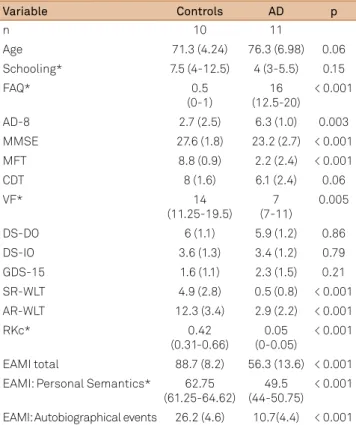
he demographic and neuropsychological data of partici-pants are summarized in Table 1. he EAMI scores presented a good discrimination between patients and controls (Figure 1). Education and Age did not signiicantly inluence the inal EAMI score (F = 3.47, p = 0.08 and F = 0.7, p = 0.4, respectively).
Control subjects also had superior performance to AD patients in all memory tests performed.
he Pearson’s correlation coeicient between EAMI scores and delayed recall of the MFT was 0.84 (p < 0.001); between EAMI and spontaneous and assisted recall of word list test was 0.73 and 0.83 respectively (both p < 0.001); Spearman’s correlation coeicient between EAMI and RKc was 0.71 (p < 0.001) (Figure 2).
Table 1. Demographic and neuropsychological characteristics.
Variable Controls AD p
n 10 11
Age 71.3 (4.24) 76.3 (6.98) 0.06
Schooling* 7.5 (4-12.5) 4 (3-5.5) 0.15
FAQ* 0.5
(0-1)
16 (12.5-20)
< 0.001
AD-8 2.7 (2.5) 6.3 (1.0) 0.003
MMSE 27.6 (1.8) 23.2 (2.7) < 0.001
MFT 8.8 (0.9) 2.2 (2.4) < 0.001
CDT 8 (1.6) 6.1 (2.4) 0.06
VF* 14
(11.25-19.5) 7 (7-11)
0.005
DS-DO 6 (1.1) 5.9 (1.2) 0.86
DS-IO 3.6 (1.3) 3.4 (1.2) 0.79
GDS-15 1.6 (1.1) 2.3 (1.5) 0.21
SR-WLT 4.9 (2.8) 0.5 (0.8) < 0.001
AR-WLT 12.3 (3.4) 2.9 (2.2) < 0.001
RKc* 0.42
(0.31-0.66)
0.05 (0-0.05)
< 0.001 EAMI total 88.7 (8.2) 56.3 (13.6) < 0.001 EAMI: Personal Semantics* 62.75
(61.25-64.62)
49.5 (44-50.75)
For the measures of reliability, the intraclass correlation coeicient was 0.99 on the subscale of Personal Semantics, and 0.98 in Autobiographical Event Recall. Internal consisten-cy, measured by Cronbach’s α, was 0.73 and 0.86 respectively. Some items of the Autonoetic Awareness Assessment sub-scale were also able to discriminate between AD patients and controls, especially in items related to the formation of visual imagery and sense of reliving the remembered event (Table 2).
DISCUSSION
his study carried out the cultural adaptation and valida-tion of a Brazilian Portuguese version of the EAMI. We com-pared the performance in the EAMI with other measures of episodic memory, such as the delayed recall of the MFT, the subtests of spontaneous and assisted recall of the word list, and the RKc, from the Remember-Know paradigm. here was a strong correlation between EAMI and the episodic memory scores derived from these tests, which supports the construct validity of our Portuguese version of the EAMI.
he EAMI was able to diferentiate healthy subjects from AD patients, both in the Personal Semantics and Autobiographical Events subscales. his inding is consistent with previous AD pa-tient studies that have used other instruments for assessing au-tobiographical memory24,25,26,27. Despite the fact that AD patients
in the current study were older and less educated than control group, these variables had little inluence on the inal EAMI score.
he ability to discriminate controls from AD patients was also observed in the Autonoetic Awareness Assessment sec-tion of the EAMI, in the items related to the formasec-tion of visual imagery and to the feeling of reliving the event remembered. In this study, no diference was observed between AD patients and controls regarding the emotional association with the re-called memory. As several studies suggest there to be a strong relationship between memory and emotion28
, it is likely that
the EAMI is not an adequately sensitive tool for assessing emo-tional responses to the act of remembering an episodic mem-ory. It is noteworthy that this pattern of responses is in agree-ment with previously published EAMI data from patients with Mild Cognitive Impairment29
and AD30.
here was a high internal consistency among the EAMI items, observed in both the Autobiographical Events and Personal Semantics subscales. We found there to be high inter-rater reliability, as revealed by strong correlations be-tween the scores of the two examiners in both the Personal Semantics and Autobiographical Events subscales, a inding that well relects the original publication of the EAMI15
. It is important to note that the analysis of the inter-rater reliabil-ity of an instrument that assesses the occurrence of sponta-neous memories requires a speciic methodology, especially considering that a participants may recall diferent memo-ries in diferent interviews and therefore receive diferent scores in each. With this in mind, Irish et al.15
chose for a irst examiner to write the answers of each patient and for a sec-ond examiner, independent of the original session, to score these written responses. However, it is possible that, while EAMI: Episodic Autobiographic Memory Interview; RKc: Remember-Know.
Figure 2. Correlation between EAMI and RKc.
EAMI
Remember-Know coefficient Correlation between EAMI and RKc
100
80
60
40
20
0.0 0.2 0.4 0.6 0.8
100
80
60
40
20
Alz Control
EAMI: Episodic Autobiographic Memory Interview.
Figure 1. The EAMI scores in Alzheimer’s disease patients and
healthy controls.
Table 2. Results from the Autonoetic Awareness Assessment
EAMI subscale.
Controls AD p
Own eyes Perspective 42 (84%) 12 (21.8%) p < 0.001
No image 7 (14%) 43 (78.1%) p < 0.001
See the memory with no gaps like a video
34 (68%) 8 (14.5%) p < 0.001 Frequently or occasionally
think about this memory
11 (22%) 13 (23.6%) p = 1 Frequently or occasionally
speak about this memory
8 (16%) 5 (9%) p = 0.38 Emotional Connection when
remembering this memory
10 (20%) 11 (20%) p = 1 Participant feel that he is
reliving this memory
writing down the responses, the irst examiner may have giv-en a subliminal indication of an item’s score. For this reason, we chose to record the interview and deliver full, unedited audio to the second examiner. Additionally, this second ex-aminer was given only written instructions on how to apply the scale, which also allowed us to test their intelligibility; the high correlation between the two examiners’ thus also
demonstrates that the written instructions on how to apply the scale are adequate.
In conclusion, our data suggest that the Brazilian Portuguese version of the EAMI is a valid and reliable instru-ment for the assessinstru-ment of autobiographical episodic mem-ory, and may be a useful tool in the evaluation of amnestic syndromes, notably those of hippocampal origin.
References
1. Tulving, E. How many memory systems are there? Am Psychol. 1985;40(4):385-98. http://dx.doi.org/10.1037/0003-066X.40.4.385
2. Baddeley AD, Warrington EK. Amnesia and the distinction between long- and short-term memory. J Verbal Learn Verbal Behav. 1970;9(2):176-89. http://dx.doi.org/10.1016/S0022-5371(70)80048-2
3. Cohen NJ, Squire LR. Preserved learning and retention of pattern-analyzing skill in amnesia: dissociation of knowing how and knowing that. Science. 1980;210(4466):207-10. http://dx.doi.org/10.1126/science.7414331
4. Quillian MR. Word concepts: a theory and simulation of some basic semantic capabilities. Behav Sci. 1967;12(5):410-30. http://dx.doi.org/10.1002/bs.3830120511
5. Tulving E. Memory and consciousness. CanPsychol. 1985; 26(1):1-12. http://dx.doi.org/10.1037/h0080017
6. Alvarez P, Squire LR. Memory consolidation and the medial temporal lobe: a simple network model. Proc Natl Acad Sci USA. 1994;91(15):7041-5. http://dx.doi.org/10.1073/pnas.91.15.7041
7. Damasio AR, Eslinger PJ, Damasio H, Van Hoesen GW, Cornell S. Multimodal amnesic syndrome following bilateral temporal and basal forebrain damage. Arch Neurol. 1985;42(3):252-9. http://dx.doi.org/10.1001/archneur.1985.04060030070012
8. Nadel L, Moscovitch M. Memory consolidation, retrograde amnesia and the hippocampal complex. Curr Opin Neurobiol. 1997;7(2):217-27. http://dx.doi.org/10.1016/S0959-4388(97)80010-4
9. Piolino P, Desgranges B, Belliard S, Matuszewski V, Lalevée C, De la Sayette V et al. Autobiographical memory and autonoetic consciousness: triple dissociation in neurodegenerative diseases. Brain. 2003;126(10):2203-19. http://dx.doi.org/10.1093/brain/awg222
10. Butler CR, Zeman AZ. Recent insights into the impairment of memory in epilepsy: transient epileptic amnesia, accelerated long-term forgetting and remote memory impairment. Brain. 2008;131(9):2243-63. http://dx.doi.org/10.1093/brain/awn127
11. Milton F, Muhlert N, Pindus DM, Butler CR, Kapur N, Graham KS et al. Remote memory deicits in transient epileptic amnesia. Brain. 2010;133(5):1368-79. http://dx.doi.org/10.1093/brain/awq055
12. Coras R, Pauli E, Li J, Schwarz M, Rössler K, Buchfelder M et al. Differential inluence of hippocampal subields to memory formation: insights from patients with temporal lobe epilepsy. Brain. 2014;137(7):1945-57. http://dx.doi.org/10.1093/brain/awu100
13. Malloy-Diniz LF, Cruz MF, Torres V, Cosenza R. O teste de
Aprendizagem Auditivo-Verbal de Rey: normas para uma população brasileira. Rev Bras Neurol. 2000;36(3):79-83.
14. Nitrini R, Lefèvre BH, Mathias SC, Caramelli P, Carrilho PE, Sauaia N et al. [Neuropsychological tests of simple application for diagnosing dementia]. Arq Neuropsiquiatr. 1994;52(4):457-65. Portuguese. http://dx.doi.org/10.1590/S0004-282X1994000400001
15. Irish M, Lawlor BA, O’Mara SM, Coen RF. Assessment of behavioural markers of autonoetic consciousness during episodic autobiographical memory retrieval: a preliminary analysis. Behav Neurol. 2008;19(1-2):3-6. http://dx.doi.org/10.1155/2008/691925
16. McKhann GM, Knopman DS, Chertkow H, Hyman BT, Jack CR Jr, Kawas CH et al. The diagnosis of dementia due to Alzheimer’s disease: recommendations from the National Institute on
Aging-Alzheimer’s Association workgroups on diagnostic guidelines for Alzheimer’s disease. Alzheimers Dement. 2011;7(3):263-9. http://dx.doi.org/10.1016/j.jalz.2011.03.005
17. D’Ath P, Katona P, Mullan E, Evans S, Katona C. Screening, detection and management of depression in elderly primary care attenders. I: the acceptability and performance of the 15 item Geriatric Depression Scale (GDS15) and the development of short versions. Fam Pract. 1994;11(3):260-6. http://dx.doi.org/10.1093/fampra/11.3.260
18. Hachinski VC, Iliff LD, Zilhka E, Du Boulay GH, McAllister VL, Marshall J et al. Cerebral blood low in dementia. Arch Neurol. 1975;32(9):632-7. http://dx.doi.org/10.1001/archneur.1975.00490510088009
19. Brucki SM, Nitrini R, Caramelli P, Bertolucci PH, Okamoto IH. [Suggestions for utilization of the mini-mental state examination in Brazil]. Arq Neuropsiquiatr. 2003;61(3B):777-81. Portuguese. http://dx.doi.org/10.1590/S0004-282X2003000500014
20. Sunderland T, Hill JL, Mellow AM, Lower BA, Gundersheimer J, Newhouse PA. Clock drawing in Alzheimer’s disease: a novel measure of dementia severity. J Am Geriatr Soc. 1989;37(8):725-9.
21. Pfeffer RI, Kurosaki TT, Harrah CH Jr, Chance JM, Filos S. Measurement of functional activities in older adults in the community. J Gerontol. 1982;37(3):323-9. http://dx.doi.org/10.1093/geronj/37.3.323
22. Correia CC, Lima F, Junqueira F, Campos MS, Bastos O, Petribú K et al. AD8-Brazil: cross-cultural validation of the ascertaining dementia interview in Portuguese. J Alzheimers Dis. 2011;27(1):177-85. http://dx.doi.org/10.3233/JAD-2011-100915
23. Beaton DE, Bombardier C, Guillemin F, Ferraz MB. Guidelines for the process of cross-cultural adaptation of self-report measures. Spine. 2000; 25(24):3186-91. http://dx.doi.org/10.1097/00007632-200012150-00014
24. Dall’Ora P, Della Sala S, Spinnler H. Autobiographical memory: its impairment in amnesic syndromes. Cortex. 1989;25(2):197-217. http://dx.doi.org/10.1016/S0010-9452(89)80037-1
25. Greene JDW, Hodges JR, Baddeley AD. Autobiographical memory and executive function in early dementia of Alzheimer type. Neuropsychologia. 1995;33:1647-70.
26. Graham KS, Hodges JR. Differentiating the roles of the hippocampal complex and the neocortex in long-term memory storage: evidence from the study of semantic dementia and Alzheimer’s disease. Neuropsychology. 1997;11(1):77-89. http://dx.doi.org/10.1037/0894-4105.11.1.77
27. Hou CE, Miller BL, Kramer JH. Patterns of autobiographical memory loss in dementia. Int J Geriatr Psychiatry. 2005;20(9):809-15. http://dx.doi.org/10.1002/gps.1361
28. Phelps EA. Human emotion and memory: interactions of the amygdala and hippocampal complex. Curr Opin Neurobiol. 2004;14(2):198-202. http://dx.doi.org/10.1016/j.conb.2004.03.015
29. Irish M, Lawlor BA, O’Mara SM, Coen RF. Exploring the recollective experience during autobiographical memory retrieval in amnestic mild cognitive impairment. J Int Neuropsychol Soc. 2010;16(3):546-55. http://dx.doi.org/10.1017/S1355617710000172