Atrial Fibrillation and Dementia: Results from the São Paulo Ageing
& Health Study
Liz Andrea Kawabata-Yoshihara
1, Márcia Scazufca
2,3, Itamar de Souza Santos
2, Aristarcho Whitaker
1, Vitor Sérgio
Kawabata
1, Isabela Martins Benseñor
1,2, Paulo Rossi Menezes
2, Paulo Andrade Lotufo
1,2Hospital Universitário da Universidade de São Paulo1; Faculdade de Medicina da Universidade de São Paulo2; Hospital das Clínicas da Faculdade de Medicina da Universidade de São Paulo3, São Paulo, SP – Brazil
Mailling Address: Itamar de Souza Santos • Center for Clinical and Epidemiological Research
Av. Prof. Lineu Prestes, 2565, Cidade Universitária. Postal Code 05508-000, São Paulo, SP – Brazil
E-mail: [email protected], [email protected]
Manuscritp received April 10, 2012; manuscript revised April 12, 2012; accepted August 1, 2012.
Abstract
Background: Atrial fibrillation (AF) is a controversial risk factor for dementia.
Objective: The objective of this study was to assess the association between AF and dementia in the “Sao Paulo Ageing & Health” (SPAH) study participants.
Methods: SPAH is a cross-sectional, population-based study of elderly people living in a deprived neighborhood in Sao Paulo, Brazil. Dementia diagnosis was performed according to the 10/66 study group protocol based on Diagnostic and Statistical Manual of Mental Disorders (DSM-IV) criteria. Diagnosis of AF was made using a 12-lead electrocardiogram (ECG) recording, which was assessed by two cardiologists. Data on demographics and cardiovascular risk factors were also obtained.
Results: Dementia was diagnosed in 66 (4.3%) and AF in 36 (2.4%) of 1,524 participants with a valid ECG. The crude odds ratio (OR) for dementia in participants with AF was 2.8 (95% confidence interval [CI]: 1.0–8.1; p=0.06) compared with individuals without AF. When analyzing data according to sex, a positive relationship was found in women (OR 4.2; 95% CI: 1.24–15.1; p=0.03). After age-adjustment, however, this association was no longer significant (OR 2.2; 95% CI: 0.6–8.9; p=0.26).
Conclusion: There was no independent association between AF and dementia in this sample. The prevalence of AF may be low in this population owing to premature cardiovascular death. (Arq Bras Cardiol 2012;99(6):1108-1114)
Keywords: Atrial fibrillation; cardiovascular disease; dementia.
5 years (but not after 10 years) of follow-up4. Forti et al.5, studying individuals with mild cognitive impairment (MCI), found a 10.5/100 person-years conversion rate to dementia in this setting. The presence of AF was associated with a 4.6-fold higher risk in this group compared with individuals without AF (95% CI: 1.7–12.5).
On the other hand, Park et al. found no difference in cognitive function in individuals aged 60 years or older in the Cognition and Atrial Fibrillation Evaluation (CAFE) study at baseline6 or after a three-year follow-up7. The Vantaa 85+Study8 included residents aged 85 years or older (N=553) and found no difference in the frequency of dementia in subjects with and without AF at baseline (41.0% vs. 38.1%) and no difference in dementia incidence in individuals with AF after a mean follow-up of 3.5 years.
There is conflicting data about this subject in medical literature. In addition to recent reports on AF prevalence in the elderly9, there is no information on the association between AF and dementia in the Brazilian population. The objective of this study was to assess a possible association between AF and dementia in a population of elderly people living in a deprived neighborhood in a metropolitan area of the city of São Paulo.
Introduction
It is estimated that most people with dementia already live in low- and middle-income nations1. However, there is very little data about risk factors for dementia in these populations2.
Methods
The “São Paulo Ageing & Health” (SPAH) Study included a cross-sectional, one-phase, population-based study carried out in all residents aged 65 years or older living in an economically-deprived area of São Paulo, Brazil. The main objective of the SPAH Study was to evaluate the prevalence of dementia as part of a collaborative program developed by the 10/66 Dementia Research Group. The study protocol is detailed elsewhere10,11. A substudy addressing ECG patterns was published previously9.
Population and sample
SPAH focused on all residents aged 65 years and older in 66 census sectors (smallest administrative areas) in the district of Butanta. The selected sectors were the most deprived ones in the district, including slums. Identification and recruitment was made by systematic knocking on doors of all households. Eligibility was based exclusively on age at time of recruitment. With the exception of institutionalized individuals, who were not included, all were invited to join the study. Whenever a census sector was selected, all residents were invited to participate in the study.
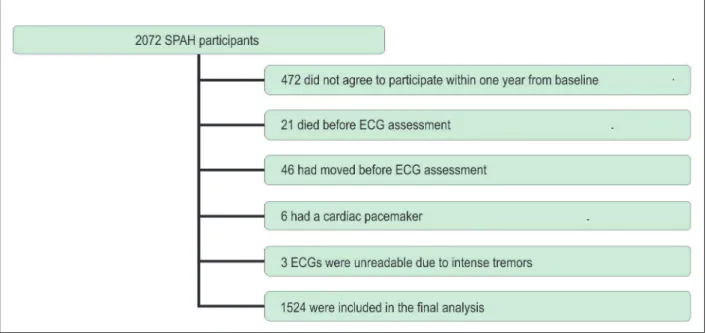
Of 2,266 eligible participants aged 65 years and older, 2,072 (91.4%) consented to participate and were assessed for dementia by trained mental health professionals. The investigation for ECG changes started when the baseline assessment of SPAH was already underway. To minimize the influence of time elapsed from baseline data collection and ECG recording, individuals in whom an ECG recording was not obtained up to one year after SPAH inclusion were excluded from the analysis. Reasons for exclusion are shown in Figure 1. Cases excluded from the analysis did not significantly differ from those with a valid ECG according to age, sex, or ethnicity.
SPAH protocol
Subjects who agreed to participate were invited to participate in a 90-minute interview carried out at the participant’s home, approximately one week after recruitment by eight trained mental health workers. A caregiver was also identified for each participant 10. Information about age, ethnicity, education, socioeconomic status, medical history, and cognitive and daily-life function was collected using a standardized questionnaire. A nurse assistant performed anthropometric assessments and blood pressure measurements at the participants’ homes two to 15 days after the assessment interview. A venous blood sample was obtained after an overnight fast for fasting blood glucose and total and HDL-cholesterol measurement.
Diagnosis of dementia
Dementia diagnosis was based on DSM-IV criteria12. The presence of dementia was assessed using a dementia diagnostic tool developed by the 10/66 Dementia Research Group and validated for use in population-based studies of low and middle-income countries13. Information regarding cognitive impairment, with a detailed assessment of the onset and course of the dementia syndrome, was collected from both the participants and their caregivers. Diagnostic tools included the Community Screening Instrument for Dementia (CSI-D)14, a modified version of the CERAD ten-word list learning task with delayed recall; the animal naming verbal fluency task from the
Consortium to Establish a Registry for Alzheimer’s Disease
(CERAD)15, a community-directed version of the Geriatric
Mental State, (GMS) a semi-structured clinical interview for the assessment of mental status16,17 and a structured neurological assessment to ascertain the presence of lateralizing signs, Parkinsonism, ataxia, apraxia, and primitive reflexes. The interview with caregivers consisted
of inquiries about the participant’s functional and cognitive performance according to the CSI-D and a brief history of the participant’s functioning and cognitive decline based on the History and Aetiology Schedule Dementia Diagnosis and Subtype (HAS-DDS)18, which was applied when CSI-D pointed towards dysfunction. The HAS-DDS was also used to define probable dementia subtypes such as Alzheimer’s disease, vascular dementia, or mixed dementia. The latter was defined as the presence of characteristics from either previous subtypes or a previous history of Parkinsonism.
Diagnosis of atrial ibrillation
The 12-lead resting electrocardiogram recordings were obtained at home. Recordings were independently analyzed by two cardiologists (A.W. and V.S.K.) using the Minnesota code. Agreement on the ECG diagnosis occurred in 92.9% of cases. When a disagreement occurred, a new analysis was done by both cardiologists. A consensus was reached in all cases.
Other variables
Age, education and monthly income were categorized for analysis. High blood pressure was defined as a positive medical history of high blood pressure, current treatment for high blood pressure, or systolic blood pressure ≥140 mmHg and/or diastolic blood pressure ≥90 mmHg. Diabetes mellitus was defined as a positive medical history of diabetes, current use of insulin or hypoglycemic oral drug treatment, or a fasting blood glucose level ≥126 mg/dl.
Ethical considerations
The study was approved by the Institutional Review Board, and all participants provided signed informed consent. If they were unable to provide consent because of mental or physical incapacities, a signed agreement from the caregiver was obtained. When subjects were illiterate, the information sheet and consent form were read aloud and verbally-witnessed consent was acquired.
Statistical analysis
Data entry was carried out twice using the program EPIDATA 3.0, and a validity check was carried out to identify and correct data entry errors. Data was analyzed using SPSS 16.0. Pearson’s Chi-square test and Fisher’s exact test were used to compare categorical variables when appropriate. We also performed binary logistic regressions to evaluate the relationship between the presence of AF in ECG recordings and the diagnosis of dementia (all types), Alzheimer’s disease, and vascular dementia. We used three models of inclusion for these analyses. In Model 1, all participants with a valid ECG recording were included. In Model 2, we excluded those individuals without AF in the ECG recording, but were using amiodarone and/or warfarin, as this could be evidence of paroxysmal AF. In Model 3, we considered the subgroup of participants receiving amiodarone and/or warfarin as individuals with AF. Data were analyzed as crude ratios and after age-adjustment. Point estimates as well as 95% CIs are shown. P-values less than 0.05 were considered statistically significant.
Results
Electrocardiogram recordings were obtained from 1,524 (73.6%) individuals. Table 1 shows the baseline characteristics of the SPAH participants. Individuals with a valid ECG were then stratified by the presence of AF in the recording. AF was found in 37 (2,4%) subjects; 19/603 (3,2%) men and 18/921 (2,0%) women. Individuals with AF were older than those without AF (mean age, 77.7 ± 7.9 years vs. 72.1 ± 6.2 years; p<0.01). Of the individuals with AF, 19 (51.4%) received antiplatelet or anticoagulant therapy, 10 (27.0%) received aspirin, 8 (21.6%) received warfarin, and 1 (2.7%) received ticlopidine. Fifteen (40.5%) individuals received rate- and/or rhythm-control medication; 8 (21.6%) received digoxin, 3 (8.1%) received beta-blockers, 2 (5.4%) received amiodarone, 1 (2.7%) received calcium-channel blockers, and 1 (2.7%) received beta-blockers and calcium-channel blockers.
Of the sample with an ECG recording, 66 (4.3%) had a dementia diagnosis, including 44 of 921 women (4.8%) and 22 of 603 men (3.6%). In this ancillary study, 25 (37.9%) individuals had Alzheimer’s disease, 25 (37,9%) had vascular dementia, and 16 (24.2%) had mixed dementia. Table 2 shows the odds ratio (crude and age-adjusted) for dementia (all subtypes), Alzheimer’s disease, and vascular dementia comparing individuals with and without AF (Model 1). Data are also stratified by sex. Excluding the participants who did not present with AF in the ECG recording, but were receiving amiodarone and/or warfarin (Model 2) at the time of evaluation did not materially alter the results. When we considered participants on amiodarone and/or warfarin treatment as individuals with AF (Model 3), no association reached statistical significance.
Discussion
AF and dementia are chronic disorders associated with high morbidity, mortality, and disability19,20,21. In our study, we found an association between AF and dementia in women, but the association vanished after adjustment for age, suggesting that there is no independent correlation between these two conditions. No association was found for men or when analyzing dementia subtypes.
It is difficult to establish direct comparisons among studies that address the relationship between AF and dementia because of methodological differences. One of the main barriers is the fact that instruments used to diagnose dementia and/or cognitive impairment vary widely. In low-income populations, education and cultural differences may also influence the results22. In this population-based study, we used a validated algorithm specifically developed for dementia diagnosis in low- and middle-income populations based on DSM-IV criteria that consists of multiple diagnostic tools and is corroborated by earlier studies13.
impairment5,23. In this type of setting, a higher conversion to dementia is expected, favoring positive results. Moreover, supposing a true association between AF and dementia exists only in a subgroup of individuals, this approach may “select” individuals in whom this process has already started, which also favors a positive result, leading to mistaken conclusions for the whole population.
Our results contrast with the findings of the Rotterdam Study3, which included younger individuals (inclusion started at age 55 years). Moreover, their results pointed to a stronger association between AF and dementia in younger individuals (aged <75 years). This is a possible explanation for differences observed in their study when compared with ours. As age advances, other mechanisms of disease may become prominent and an association with AF will be weakened. In a low-income sample such as the one in the present study, a survival bias due to premature all-cause24 and cardiovascular25 deaths is also expected. This may be at least
partially responsible for the smaller rates of AF observed in our study (AF prevalence 2.0% in women and 3.2% in men), compared to the Cardiovascular Health Study (4.8% in women and 6.2% in men)26 and Rotterdam Study (7.5% in women and 9.7% in men)27. This lower prevalence may make it difficult to observe an association between dementia and AF.
Our study has some limitations. The small number of individuals with concomitant AF and dementia impaired the analysis by dementia subtypes. A cross-sectional design is not sufficient to establish a causal relationship between two conditions. However, a lack of association in this kind of study could indicate that a causal relationship may not exist. A single electrocardiogram, utilized for the diagnosis of AF, does not allow the diagnosis of paroxysmal AF and does not identify individuals successfully treated with rhythm control treatment strategies. However, excluding those patients with normal sinus rhythm who were receiving treatment potentially directed to paroxysmal AF (Model 2), as well as considering them as AF Table 1 - Baseline characteristics of study participants (n=1.524)
Characteristics With AF (n=37) Without AF (n=1.487) p
Age group (years) n (%) n (%)
65 – 69 5 (13.5) 656 (44.1) < 0.001
70 – 74 10 (27.0) 384 (25.8)
75 – 79 8 (21.6) 261 (17.6)
≥80 14 (37.8) 186 (12.5)
Gender
Female 18 (48.6) 903 (60.7) 0.14
Ethnicity
White 22 (59.5) 782 (52.6) 0.77
Mixed 12 (32.4) 447 (30.1)
Black 3 (8.1) 205 (13.8)
Asian 0 44 (3.0)
Native Brazilian 0 1 (0.1)
Others 0 8 (0.5)
Educational level
No formal education 14 (37.8) 488 (32.8) 0.27
1 – 3 years 22 (59.5) 836 (56.2)
4 or more years 1 (2.7) 163 (11.0)
Monthly income (US$)
≤ 85 10 (27.0) 361 (24.3) 0.21
86 –127 11 (29.7) 312 (21.0)
128 – 246 11 (29.7) 389 (26.2)
≥ 247 5 (13.5) 425 (28.6)
High blood pressure 27 (73.0) 1163 (79.7) 0.32
Diabetes 9 (24.3) 333 (23.2) 0.87
Dementia 4 (10.8) 62 (4.2) 0.07
Table 2 - Crude and age-adjusted odds ratio (OR) and 95% conidence interval (95% CI) for the association between atrial ibrillation (AF) and
dementia, Alzheimer’s disease, and vascular dementia in SPAH (n=1,524)
Condition Crude OR (95% CI) Age-adjusted OR(95% CI)
All
Without dementia (n = 1,458) 1.0
(Reference)
1.0 (Reference)
Dementia (all types) (n = 66) 2.8 (1.0 – 8.1)p
= 0.06
1.2 (0.4 – 4.0)
p = 0.73
Alzheimer’s disease (n = 25) 3.8 (0.9 – 16.6)p
= 0.08
1.6 (0.3 – 7.9)
p = 0.59
Vascular dementia (n = 25) 1.8 (0.2 – 13.7)p
= 0.57
1.0 (0.1 – 7.8)
p = 0.98
Women
Without dementia (n = 877) (Reference)1.0 (Reference)1.0
Dementia (all types) (n = 44) 4.2 (1.2 – 15.1)p
= 0.03
2.2 (0.6 – 8.9)
p = 0.26
Alzheimer’s disease (n = 20) 3.0 (0.4 – 24.1)p
= 0.30
1.6 (0.2 – 13.9)
p = 0.67
Vascular dementia (n = 12) 5.2 (0.6 – 43.1)p
= 0.13
2.4 (0.3 – 22.9)
p =0.43
Men
Without dementia (n = 581) 1.0
(Reference)
1.0 (Reference)
Dementia (all types) (n = 22) 1.5 (0.2 – 11.7)p = 0.71 0.5 (0.1 – 5.1)p = 0.55
Alzheimer’s disease (n = 5) 7.8 (0.8 – 73.5)p = 0.07 2.2 (0.1 – 33.9)p = 0.57
Vascular dementia (n = 13) * *
* None of the 13 men with vascular dementia had concomitant AF
patients (Model 3) did not significantly alter the results.
Conclusion
Our study did not find an independent association between AF and dementia in a population-based sample living in a low-income area in Brazil. The prevalence of AF may be low in this population owing to premature death, especially by cardiovascular disease.
Acknowledgements
This study was supported by the Wellcome Trust and FAPESP
(Fundação de Apoio à Pesquisa do Estado de São Paulo). Potential Conflict of Interest
No potential conflict of interest relevant to this article was reported.
Sources of Funding
This study was funded by FAPESP and Wellcome Trust.
Study Association
This article is part of the thesis of doctoral submitted by Liz
1. Ferri CP, Prince M, Brayne C, Brodaty H, Fratiglioni L, Ganguli M, et al. Global prevalence of dementia: a Delphi consensus study. Lancet. 2005;366(9503):2112-7.
2. Newman AB, Fritzpatrick AL, Lopez O, Jackson S, Lyketsos C, Jagust W, et al. Dementia and Alzheimer’s disease incidence in relationship to
cardiovascular disease in the Cardiovascular Health Study cohort. J Am Geriatr Soc. 2005;53(7):1101-7.
3. Ott A, Breteler M, de Bruyne M, Harskamp F, Grobbee DE, Hofman A. Atrial fibrillation and dementia in a population-based study: The Rotterdam Study. Stroke. 1997;28(2):316-21.
4. Tilvis RJ, Kahonen-Vare MH, Jolkkonen J, Valvanne J, Pitkala KH, Strandberg TE. Predictors of cognitive decline and mortality of aged people over a 10-year period. J Gerontol. 2004;59(3):268-74.
5. Forti P, Maioli F, Pisacane N, Rietti E, Montesi F, Ravaglia G. Atrial fibrillation and risk of dementia in non-demented elderly subjects with and without mild cognitive impairment. Neurol R. 2006;28(6):625-9.
6. Park H, Hildreth A, Thomson R, O’Connell J. Non-valvular atrial fibrillation and cognitive function–baseline results of a longitudinal cohort study. Age Ageing. 2005;34(4):392-5.
7. Park H, Hildreth A, Thomson R, O’Connell J. Non-valvular atrial fibrillation and cognitive decline: a longitudinal cohort study. Age Ageing. 2007;36(2):157-63.
8. Rastas S, Verkkoniemi A, Polvikoski T, Juva K, Niinistö L, Mattila K, et al. Atrial fibrillation, stroke, and cognition: a longitudinal population-based study of people aged 85 and older. Stroke. 2007;38(5):1454-60.
9. Kawabata-Yoshihara LA, Benseñor IM, Kawabata VS, Menezes PR, Scazufca M, Lotufo PA. Prevalence of electrocardiographic findings in elderly individuals: the São Paulo Ageing & Health Study. Arq Bras Cardiol. 2009;93(6):602-7.
10. Scazufca M, Menezes PR, Vallada HP, Crepaldi AL, Pastor-Valero M, Coutinho LMS, et al. High prevalence of dementia among older adults from poor socioeconomic backgrounds in São Paulo, Brazil. Int Psychogeriatr. 2008;20(2):394-405.
11. Santos IS, Scazufca M, Menezes PR, Lotufo PA, Benseñor IM. Anemia and dementia among the elderly: the São Paulo Ageing & Health Study. Int Psychogeriatr. 2012;24(1):74-81.
12. American Psychiatry Association. Diagnostic and Statistical Manual of Mental Disorders. 4. Washington: American Psychiatry Association; 1994.
13. Prince M. Methodological issues for population-based research into dementia in developing countries: a position paper from the 10/66 Dementia Research Group. Int J Geriatr Psychiatry. 2000;15(1):21-30.
14. Hall KS, Gao S, Emsley CL, Ogunniyi AO, Morgan O, Hendrie HC. Community screening interview for dementia (CSI´D´); performance in five disparate study sites. Int J Geriatr Psychiatry. 2000;15(6):521-31.
15. Welsh KA, Butters N, Mohs RC, Beekly D, Edland S, Fillenbaum G, et al. The consortium to establish a registry for Alzheimer’s disease (CERAD). Part V. A normative study of the neuropsychological battery. Neurology. 1994;44(4) 609-14.
16. Copeland JR, Dewey ME, Griffiths-Jones HM. A computerized psychiatric diagnostic system and case nomenclature for elderly subjects: GMS and AGECAT. Psychol Med. 1986;16(1):89-99.
17. Prince M, Acosta D, Chiu H, Copeland J, Dewey M, Scazufca M, et al. Effects of education and culture on the validity of the Geriatric Mental State and its AGECAT algorithm. Br J Psychiatry. 2004;185:429-36.
18. Dewey ME, Copeland JRM. Diagnosis of dementia from the history and aetiology schedule. Int J Geriatr Psychiatry. 2001;16(9):912-7.
19. Agüerro-Torres H, Fratiglioni L, Guo Z, Viitanen M, Winblad B. Mortality from dementia in advanced age: a 5-year follow-up study of incident dementia cases. J Clin Epidemiol. 1999;52(8):737-43.
20. Griffiths RA, Good WR, Watson NP, O’Donnell HF, Fell PJ, Shakespeare JM. Depression, dementia and disability in the elderly. Br J Psychiatry. 1987;150:482-93.
21. Wolf PA, Mitchell JB, Baker CS, Kannel WB, D’Agostino RB. Impact of atrial fibrillation on mortality, stroke, and medical costs. Arch Intern Med. 1998;158(3):229-34.
22. Nielsen TR, Andersen BB, Kastrup M, Phung TK, Waldemar G. Quality of dementia diagnostic evaluation for ethnic minority patients: a Nationwide Study. Dement Geriatr Cogn Disord. 2011;31(5):388-96.
23. Ravaglia G, Forti P, Maioli F, Martelli M, Servadei L, Brunetti N, et al. Conversion of mild cognitive impairment to dementia: predictive role of mild cognitive impairment subtypes and vascular risk factors. Dement Geriatr Cogn Disord. 2006;21(1):51-8.
24. Pappas G, Queen S, Hadden W, Fisher G. The increasing disparity in mortality between socioeconomic groups in the United States, 1960 and 1986. N Engl J Med. 1993;329(2):103-9.
25. Rose G, Marmot MG. Social class and coronary heart disease. Br Heart J. 1981;45(1):13-9.
26. Furberg CD, Psaty BM, Manolio TA, Gardin JM, Smith VE, Rautaharju PM. Prevalence of atrial fibrillation in elderly subjects [the Cardiovascular Health Study]. Am J Cardiol. 1994;74(3):236-41.