Instituto Dante Pazzanese de Cardiologia de São Paulo e Hospital Universitário Pedro Ernesto - Rio de Janeiro
Correspondência: Michel Batlouni – Instituto Dante Pazzanese de Cardiologia – Av. Dr. Dante Pazzanese, 500 – 04012-180 – São Paulo, SP
Michel Batlouni, Denilson Campos de Albuquerque
São Paulo, SP – Rio de Janeiro, RJ - Brazil
Beta-Adrenergic Blocking Agents in Heart Failure
Cardiac dysfunction in heart failure is widely recog-nized as a progressive process, regardless of the clinical signs and symptoms. An increase in cardiac sympathetic drive is one of the earliest neurohormonal responses oc-curring in patients with heart failure and may be one of the major causes of the progressive remodeling leading to the decline in myocardial function, and responsible for the po-or prognosis of patients with heart failure. Therefpo-ore, re-cent data provided by several appropriately designed cli-nical trials clearly indicate the benefits of β-adrenoceptor blocking agents, combined with diuretics, ACE inhibitors, and digoxin in chronic heart failure class II to IV due to systolic ventricular dysfunction. The benefits are related to symptoms, functional capacity, remodeling, and improve-ment in left ventricular function, reduction in cardiovascu-lar hospitalization, a decrease in the overall and sudden car-diac death rate, and are similar in patients with ischemic or nonischemic cardiomyopathy, independent of age, gender, or functional class. In this review we describe the cardiovascular effects of the increase in sympathetic drive, the pharmacolo-gical properties of the beta-blockers most evaluated in heart failure therapy (metoprolol, bisoprolol, and carvedilol), the major clinical trials related to these agents in heart failure, the recommendations for their appropriate use in clinical practice, the precautions to be adopted, and how to handle the more common adverse reactions.
For the last few years, β-adrenergic blocking agents have been contraindicated in the presence of overt heart fai-lure or systolic ventricular dysfunction, even though pati-ents were asymptomatic. Such contraindication was based on inotropic and chronotropic negative activity of β-blo-cking drugs and their adverse acute hemodynamic effects. As the failing heart depends on β-adrenergic support to maintain its performance, acute pharmacological effects of any antiadrenergic compound may induce myocardial de-pression and a decrease in cardiac output. Although such effects may be counteracted by the vasodilatory properties of some β-blocking drugs, which by reducing systemic vascular resistance could counteract myocardial
depres-sion, an abrupt suppression of adrenergic support may ini-tially precipitate a clinical worsening of heart failure. Never-theless, this negative pharmacological response is transi-tory and manageable by administration of initial low doses and gradual dosage increase 1. Additionally, chronic effects
of β-blocking agents differ from the acute effects because they result essentially from the inhibition of neurohormonal responses that aggravate heart failure, favorably changing myocardium biology 2.
For many years, the purely hemodynamic concept of heart failure has prevailed, with reflex vasoconstriction yiel-ding a pre- and afterload increase, resulting in additional he-modynamic worsening. Based on this concept, it has been recognized that the effective therapy for heart failure sho-uld be based on positive inotropic agents and reduction in excessive overload, with vasodilating and diuretic agents. This strategy, intended only to correct hemodynamic dis-turbances, may improve symptoms, functional capacity, and quality of life, but neither prevents long-term pro-gression of heart failure nor decreases mortality.
It has been recently hypothesized that heart failure is an entity with a progressive decline in ventricular function due to progressive myocyte dysfunction (caused by gene expression changes), loss of cells (due to necrosis and apoptosis), and subsequent cell and cardiac chamber remo-deling 3. The remodeling process results in ventricular
enlar-gement, an increase in wall stress, relative myocardial ische-mia, energy depletion, progressive interstitial fibrosis, and additional activation of sympathetic nervous and renin-an-giotensin-aldosterone sytems 3.
This sequence of events is essentially mediated by ac-tivation of neurohormonal and autocrine/paracrine sys-tems that provoke vasoconstriction, sodium and water re-tention, and stimulate growth promotion pathways. Of these, the sympathetic nervous system and the renin-angio-tensin-aldosterone system play a crucial role. The knowled-ge of these data led to a chanknowled-ge in the paradigm of exclusi-vely hemodynamic and symptomatic control to the treat-ment of subsequent remodeling pathophysiological pro-cesses, which aggravate myocyte biology and heart failure evolution.
Effects of sympathetic hyperactivity
plasma norepinephrine levels are reactions that occur early in heart failure patients. They may be already detected in asymptomatic left ventricular dysfunction4 and increase as
the syndrome progresses 5-8. At the same time, myocardial
catecholamines become depleted due to norepinephrine synthesis and the captation defect.
Sympathetic activation leads to an increase in heart rate, arteriolar vasoconstriction, and peripheral vascular re-sistance and to a decrease in blood flow and sodium excre-tion, consequently increasing ventricular volume and pres-sure. Cardiac work and oxygen consumption increase. No-repinephrine may induce myocardial hypertrophy, but re-duces coronary circulation’s ability to adequately supply blood to an enlarged ventricular wall, leading to myocardial ischemia 9. Sympathetic activation may also provoke
arrhy-thmias by enhancing cardiac automaticity and β2-mediated
ischemia and hypocalemia 10. Additionally, norepinephrine
exerts direct toxic effects on the myocardium, causing myo-cyte dysfunction and necrosis by several mechanisms. β1 -and β2-receptor stimulation provokes cyclic adenosine
mo-nophosphate (cAMP)-mediated calcium overload in cardiac myocytes, and activates calcium-dependent ATPases, de-creasing the availability of highly energetic phosphates, further worsening mitochondrial function 11. In addition, by
stimulating growth and oxidative stress in terminally diffe-rentiated cells, norepinephrine can trigger apoptosis 12, 13.
Several studies have demonstrated that elevated car-diac sympathetic activity is one of the leading causes of the progressive decline in myocardial function and of a poor prognosis in heart failure patients 8, 14. Plasma
norepine-phrine levels have a high prognostic value, independent of other variables related to left ventricular function 14, 15.
Finally, β1-receptor activation stimulates renin secretion
by nephron juxtaglomerular cells and augments angiotensin II synthesis, which is also toxic to cardiac myocytes 16,
besides causing venous and arterial vasoconstriction, so-dium and water retention, and pre- and afterload increase 17.
On the other hand, the activated renin-angiotensin-aldoste-rone system further stimulates norepinephrine release, esta-blishing a vicious circle that adversely affects hemodynamic parameters and enhances remodeling 18.
The recognition of deleterious effects provoked by the sympathetic nervous system in left ventricular systolic function and the potential inhibition of sympathetic-adre-nergic stimulation by chronic therapy with β-blocking drugs led to an increased administration of such drugs in heart failure management.
βββββ1-adrenergic receptor selectivity and regulation Approximately 80% of adrenergic receptors in normal myocardium are subtype β1. Their stimulation regulates the
activity of adenylate cyclase via G proteins, increasing intracellular concentration of cyclic adenosine monophos-phate (cAMP), responsible for most effects of beta-adre-nergic hyperactivity. In heart failure, chronic sympathetic activation leads to a down-regulation of β1-receptors,
ac-companied by a proportional reduction in agonist-induced
adenylate cyclase activity and myocardial contraction, whereas the density of β2-receptors remains constant 19-21.
Consequently, in the failing heart, the proportion of β2 -receptors increases up to 40% 22.
The density of β1-receptors increases with the use of selective agents, but does not change with carvedilol 23. The
up-regulation of β1-adrenergic receptors observed with me-toprolol may allow the persistence of sufficient sensitivity to sympathetic stimulation, when increased (e.g. during maximum exercise). However, it can diminish cardiac pro-tection to the undesirable effects of such stimulation 22.
Pa-thophysiological evidence indicates that β2- and α1 -adre-nergic receptors also play an important role in the pathoge-nesis of heart failure.
βββββ2- and ααααα1-adrenergic receptor blockade
Adrenergic receptor subtype β2 may represent up to 40% of the total adrenergic receptors in the failing heart se-condary to β1-receptor down-regulation. In addition, these receptors may mediate all cAMP-dependent sympathetic stimulation effects, generally attributable only to β1 -re-ceptors 22. Presynaptic β
2-receptors facilitate
norepine-phrine release 24. Thus, nonselective agents, which
pri-marily block presynaptic β2-receptors, may decrease cardiac release of norepinephrine 23 and plasma norepinephrine
levels, not observed with selective agents. β2-adrenergic re-ceptors may be responsible for arrhythmogenic effects of sympathetic stimulation, as well as by facilitating secondary hypocalemia due to potassium deviation into cells 22.
The stimulation of α1-receptors, which represent the
near totality of α-receptors in the myocardium, induces phosphatidylinositide hydrolysis, resulting in inositol tri-phosphate formation and calcium release from intracellular deposits 23,24. The percentage of α
1-receptors in the heart’s
total population of adrenergic receptors ranges from 2% to 23% and increases in heart failure, although it remains much lower than the β-receptor percentage.
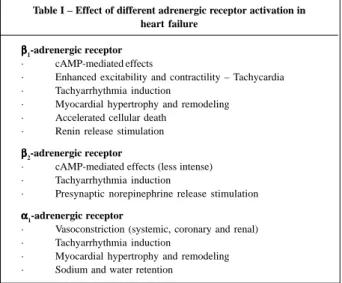
Deleterious effects of sympathetic hyperactivity mediated by β1-, β2- and α1-receptors are summarized in Table I.
Classification of b-blocking agents
β-blocking drugs constitute a heterogeneous class of agents. The most important differences are related to the degree of selectivity of β1-adrenergic receptors and the
presence of additional properties. Based on these characte-ristics, β-blocking agents have been categorized into three classes 24a. First generation agents, such as propranolol
and timolol, block both β1- and β2-receptors and do not
exhi-bit any particular property. These agents are not well tole-rated in heart failure because they exhibit negative inotropic effects associated with an increase in peripheral vascular resistance, secondary to β2-blockade
24a. Second
genera-tion agents, such as metoprolol, atenolol, and bisoprolol
produce a selective β1-blockade and do not have additional
Ho-wever, acute administration may produce a decline in car-diac output and an increase in ventricular filling pressure due to negative inotropic effects 24b. Third generation
agents, such as bucindolol and carvedilol, are not selective
but exhibit ancillary properties, which may be important to their tolerability and efficacy in heart failure patients 24a.
Mechanism of action of b-blocking agents
The potential benefit of β-blocking agents as a group in heart failure results from their hemodynamic, electrophy-siological, and most of all, neurohormonal action.
Hemodynamic effects during chronic administration differ in many aspects from the acute effects. A reduction in myocardial oxygen consumption associated with a decrea-se in heart rate may prolong coronary perfusion time by pro-longing diastole, with favorable effects on myocardial is-chemia. Initially, systolic blood pressure tends to fall, but subsequently stabilizes 25.
By preventing an increase in cAMP and calcium myo-cardial overload, as well as calcium-dependent ATPases activation, and consequently, the reduction in highly ener-getic phosphates resulting from receptor activation, β-blocking agents may preserve myocardial structure and function. These benefits are probably independent of the hemodynamic effects and occur after chronic administra-tion, so clinical benefits may take weeks or even months to become apparent. β-adrenergic blockade may, in addition, reduce cardiac arrhythmias, by reducing heart rate, impro-ving ventricular function and through electrophysiological effects (automaticity reduction), besides preventing the oc-currence of hypocalemia 10.
Long-term administration of β-blocking agents in heart failure determines an increase in left ventricle ejection fraction 1,26-35, the magnitude of which is greater than that
observed with any other drug, progressive reduction in left ventricular volumes 26-30 and myocardial mass 1,27, further
im-proving left ventricular geometry, which becomes less sphe-rical in shape, and decreasing mitral regurgitation 36. In this
way, β-blocking agents may reverse all ventricular remode-ling-associated changes 37. In general, such a process
begins two months after the introduction of therapy and continues for 12 to 18 months 38. Some authors have
pos-tulated that β-blocking agents reverse intrinsic systolic dysfunction through time-dependent biological effects in cardiac myocytes 2,3.
Parasympathetic activity is reduced in heart failure. β-adrenergic blocking agents reset baroreceptor sensitivity, increasing parasympathetic tonus 38, reducing tachycardia and
arrhythmias, and improving the energy reserve of the heart. The blockade of β1-adrenergic receptors inhibits renin formation and renin-angiotensin-aldosterone system activity, partly counteracting its deleterious effect in heart failure 17. Angiotensin-converting enzyme inhibitors and
β-blocking agents act synergically.
In the Caribe Study 38a the carvedilol effects on
adre-nergic neuronal function were investigated in 30 patients with congestive heart failure (functional class II/III) due to dilated cardiomyopathy. The adrenergic neuronal function was evaluated by iodine-123 metaiodobenzylguanidine (norepinephrine analogue) myocardial scintigraphy (MI-BG) with early and delayed uptakes to determine the early heart to mediastinum (H/M) activity ratio. The beneficial ef-fects on left ventricular ejection fraction with carvedilol we-re observed in early (2 or 3 months) and late follow-up (6 months); however, increments in cardiac MIBG uptake were found only in late follow-up. Carvedilol treatment is associa-ted with changes in cardiac adrenergic neuronal function in congestive heart failure.
Pharmacological properties of the most
common b-blocking agents used in heart
failure therapy
Relevant pharmacological properties of the most com-monly used β-blocking agents in the management of heart failure are summarized in Table 2. These properties may be important in the beginning of therapy, as well as in long-term treatment.
βββββ1 selectivity – In usual dosages, β1 selective agents
do not block peripheral β2-receptors (vasodilators) and do
not increase peripheral vascular resistance, representing a favorable property in heart failure. However, as up to 40%
Table I – Effect of different adrenergic receptor activation in heart failure
βββββ1-adrenergic receptor
· cAMP-mediated effects
· Enhanced excitability and contractility – Tachycardia · Tachyarrhythmia induction
· Myocardial hypertrophy and remodeling · Accelerated cellular death
· Renin release stimulation
βββββ2-adrenergic receptor
· cAMP-mediated effects (less intense) · Tachyarrhythmia induction
· Presynaptic norepinephrine release stimulation
α αα
αα1-adrenergic receptor
· Vasoconstriction (systemic, coronary and renal) · Tachyarrhythmia induction
· Myocardial hypertrophy and remodeling · Sodium and water retention
Table II - Pharmacological properties of most used b-blocking agents in heart failure therapy
β1-blockade β2-blockade α1-blockade Antioxidative
vasodilation activity
Metoprolol ++ _ _ _
Bisoprolol ++ _ _ _
Bucindolol ++ + + (dv) _
Carvedilol ++ ++ + (α1) +
of receptors in the failing myocardium are subtype β2, it has been proposed that blockade of β2-receptors may be im-portant in the management of heart failure and that non-selective compounds are more effective 39.
α αα
αα1-adrenergic receptor blockade – Blockade of α1 -re-ceptors in the systemic vascular bed produces vasodila-tion, reduces preload, afterload, and myocardium oxygen consumption. As α1-receptors’ proportion in the human heart, even though failing, is small, α1-blockade may reduce cardiac overload without causing significant inotropic or chronotropic effects 40. At the beginning of therapy,
peri-pheral vasodilation is important, because it may counteract the negative inotropic effect of β-blockade. Such an effect may explain why, contrary to second generation agents, the acute administration of carvedilol does not produce a de-crease in cardiac output 41. At the level of the coronary bed,
stimulation of α1-receptors induces vasoconstriction; blo-ckade of those receptors induce vasodilation and may coun-teract vasoconstriction provoked by chronic sympathetic activation, improving coronary blood flow.
Chronic α1-receptor stimulation results in cardiac myocyte hypertrophy and may contribute to the develop-ment of catecholamine-induced cardiomyopathy 42.
Fin-dings of recent studies in cultured myocytes of newborn rats have shown that carvedilol may prevent the develop-ment of phenylephrine-induced hypertrophy, most proba-bly because of its antagonist effect at the level of α-adre-nergic receptors 43. In the kidney, stimulation of α
1
-recep-tors may increase tubular reabsorption of sodium and pro-voke ion retention. It has been shown in a double-blind study that carvedilol increases blood flow and improves renal hemodynamics, not observed with placebo or meto-prolol 44. These data suggest that agents that are able to
block both β2- and α1-receptors may have an additional
ad-vantage for the management of heart failure and may exert greater protection against toxic and arrhythmogenic effects of catecholamines 37.
Antiproliferative activity - Both carvedilol and pro-pranolol inhibit vascular smooth muscle cell proliferation in the rat aorta, both in baseline conditions and after endo-thelin-1 stimulation 45. In vitro, carvedilol inhibits human
vascular smooth muscle cell proliferation 46. The
observa-tion that some β-blocking agents, but not others, have anti-proliferative activity suggests that such property is inde-pendent of β-blockade.
Antioxidative activity – Although the precise mecha-nism of cardiac alteration caused by an increased produc-tion of free radicals of oxygen have not been fully clarified, increasing data point to the role of oxidative stress in heart failure 43. Free radicals of oxygen have been involved in
myocardial injury that occurs during ischemia and reperfu-sion 47, but may be important in heart failure even in the
absence of myocardial ischemia 48. A possible effect of
oxi-dative stress is the induction of apoptosis, which may
fur-ther deteriorate structure and cardiac function. Experimen-tally, several studies have reported increased apoptosis in myocardial infarction, cardiomyopathy, and advanced heart failure, through an up-regulation of different genes, like p53, Fas, or p38 MAP kinase 49,50. Mitochondria, as the main
source of free radicals of oxygen in every cell, may cause apoptosis via caspase-activating protein release, particu-larly C-cytochrome and associated-cytosolic factors 51.
Endothelium is a particularly susceptible structure in heart failure. Oxidative stress-mediated apoptosis may play a role in the pathogenesis of endothelial dysfunction, al-though it may also be related to many other causes, such as abnormal regional blood flow, cytokines, and neurohormo-nal activation 52, 53.
Carvedilol is a potent antioxidative agent, with a 10-fold greater activity than vitamin E; this property derives from the carbazole portion of its chemical structure. Some carvedilol metabolites found in human plasma exhibit an antioxidative activity approximately 50- to 100-fold greater to inhibit LDL-oxidation by macrophages 53,54.
Physicoche-mical, biochePhysicoche-mical, and cellular studies and in vivo experi-mental models have established the antioxidative ability of carvedilol that may be summarized as follows: 43,55.
1) Based on paramagnetic electron resonance studies, carvedilol, directly and in a dose-dependent mode, removes free radicals of oxygen and protects cardiac membranes from lipid peroxidation induced by them, both in vivo and in
vitro 56.
2) Carvedilol prevents vitamin E, gluthation and SH protein depletion induced by oxidative stress, the main defense mechanisms against tissue injury caused by free radicals 57.
3) In equivalent concentrations to those obtained from plasma with therapeutic doses, 25 to 50mg OD, this compo-und may block bovine and human endothelial cell injury and death, caused by exposure to hydroxide and hydrogen pe-roxide radicals 55.
4) Carvedilol also exerts cardioprotective effects during ischemia-reperfusion injury, with marked inhibition of apoptosis in several experimental models 55. However, it
must be noted that the clinical importance of antiprolife-rative and antioxidative properties of carvedilol have not been demonstrated yet.
These unique properties of carvedilol, a third genera-tion agent, which causes multiple adrenergic (β1, β2 and α1)
blockade, besides its antioxidative and antiproliferative ef-fects, may be important in preventing progressive deterio-ration of left ventricular dysfunction and heart failure.
Heart failure clinical trials
The favorable clinical effects of β-adrenergic blo-ckade in heart failure were initially reported by Waagstein et al 58 and Swedberg et al 59, 60 in patients with dilated
hemodynamic concept still predominated over the impor-tance of sympathetic activity to maintain cardiac function in heart failure. However, beneficial effects obtained throu-gh β-blockade in postmyocardial infarction, including pa-tients with left ventricular dysfunction, have encouraged researchers to carry out multiple double-blind, randomized, controlled trials in heart failure, some of them small, others involving great numbers of patients, mainly in the last decade. These studies have consistently shown that the chronic addition of a β-blocking agent to the standard heart failure therapy with diuretics, ACE inhibitors, and digoxin leads to improvement in symptoms, functional class, and left ventricular function. The increase in left ventricular ejection fraction after long-term β-blockade is greater than that observed with any other drug used in heart failure therapy 3,8.
Moreover, despite an initial clinical worsening, in a few cases, probably because of withdrawal of adrenergic support, the studies demonstrate long-term clinical improvement in the course of heart failure, with a reduction in worsening episo-des and need of hospitalization in patients treated with β-blocking agents 3,8. Subsequently, a significant reduction in
mortality rates has also been demonstrated after the intro-duction of β-blocking therapy.
The most commonly used drugs in such trials, which included around 10,000 patients, were metoprolol, bisopro-lol, and carvedilol. We will only describe trials with the greatest number of patients and of clinical relevance.
Metoprolol trials
The, Metoprolol in Dilated Cardiomyopathy study (MDC) 28, included 383 patients with nonischemic dilated
cardiomyopathy and mild-to-moderate heart failure, rando-mized to receive either placebo or metoprolol in addition to standard therapy during 12-18 months. The initial dosage of metoprolol was 5mg BID, gradually increased up to 50-75mg BID. The primary endpoint in this study was combined risk of death and worsening heart failure sufficient enough to refer these patients for heart transplantation. The percen-tage of patients that reached the combined objective was lower in the metoprolol group (13% vs. 20%), i.e., risk re-duction of 34% with a boundary significance (p=0.058). The overall mortality between groups was not different.
The Metoprolol CR/XL Randomized Intervention Trial in Heart Failure (MERIT-HF) 61 involved 3,991 heart failure
patients predominantly with New York Heart Association functional class II-III and a few with functional class IV, of both ischemic and nonischemic etiology. Subjects were ran-domized to receive either placebo or metoprolol (increasing dosages up to a maximum of 200mg daily), in addition to standard therapy during 6 to 20 months. All-cause morta-lity, the primary endpoint of the study, was reduced by 34% in the metoprolol group (p=0.00015).
Bisoprolol trials
The efficacy of bisoprolol, a selective β1-adrenergic
receptor blocker for the treatment of heart failure, has been evaluated in two major trials. The first one, Cardiac
Insuf-ficiency Bisoprolol Study (CIBIS I) 62, included 641 patients
with ischemic or nonischemic, mild-to-moderate heart fai-lure, randomized to receive either placebo or bisoprolol (1.25mg daily up to 5.0mg daily) in addition to standard the-rapy for a period of 4 to 44 months (mean 23 months). The treatment with bisoprolol was associated with a 20% re-duction (p=0.22) in all-cause mortality, the primary endpoint of the study, and to a 34% reduction (p<0.01) in hospitali-zation risk due to heart failure, an important secondary endpoint.
The second Cardiac Insufficiency Bisoprolol Study (CIBIS II) 63, included 2,647 patients with left ventricular
ejection fraction ≤0.35 and moderate-to-severe heart failure (most functional class III) due to ischemic cardiomyopathy or not. Patients were randomly assigned to either placebo or bisoprolol (1.25mg up to a maximum of 10mg daily) in addi-tion to standard therapy. The mean follow-up period was 1.3 years. Therapy with bisoprolol was associated with a 34% reduction in all-cause mortality (11.8% vs. 17.3%, p<0.0001); 44% reduction in sudden death (3.6% vs. 6.3%, p=0.0011); and 32% risk reduction in hospitalization for worsening heart failure (p<0.0001). The study was terminated early after a second interim analysis.
Carvedilol trials
Many studies have been conducted with carvedilol, but we will report results of only five prospective, randomi-zed, controlled trials with adequate numbers of subjects. The Australia New Zealand Heart Failure Research (ANZ) 34
involved 415 patients with mild-to-moderate heart failure of ischemic etiology. Placebo or carvedilol (3.125 mg BID up to 25 mg BID) were administered concomitantly with the standard therapy for a 15- to 24-month period (mean 19 months). The primary objective of the study was to evaluate the efficacy of therapy in clinical progression of the syndro-me, as defined by combined risk of all-cause mortality and need of hospitalization. In the carvedilol group, clinical pro-gression was reduced by 26% (p=0.02) and hospitalization risk by 23% (p=0.05).
A multicenter program conducted in the United States – US Heart Failure Study 64 – included 1,094 patients with
overall mortality (p=0.048).
The PRECISE trial – Prospective Randomized Eva-luation of Carvedilol on Symptoms and Exercise 31 –
invol-ved 278 patients with moderate-to-severe heart failure (6-minute walk test, 150 to 450m). Patients were randomly assigned to receive either placebo or carvedilol, added to the standard therapy, during a 6-month period. Compared with placebo, carvedilol-treated patients demonstrated higher symptomatic improvement rates and lower risk of clinical worsening, as assessed by functional class shift (p=0.014). In addition, therapy with carvedilol was associa-ted with a significant increase in ejection fraction (p<0.001) and to a significant reduction in the combined endpoint of morbidity and mortality (p= 0.029), with a small increase in exercise tolerance, but no differences in quality of life scores. Effects were similar in patients with both ischemic and idiopathic dilated cardiomyopathy.
In another moderate-to-severe heart failure study, Multicenter Oral Carvedilol Heart Failure Assessment (MO-CHA) 33, 345 patients with both ischemic and non-ischemic
cardiomyopathy were randomly assigned to either placebo or carvedilol (6.25mg, 12.5mg, or 25mg BID) for a 6-month treatment period. Results demonstrated that carvedilol did not exert a significant effect on submaximal exercise (primary endpoint). However, it was associated to with a dose-dependent increase in ejection fraction (5, 6, and 8 units in low, medium, and high dosages, respectively, compared with 2 units in the placebo group; p<0.001 for a dose-dependent response) and survival rates (mortality rates 6.0%, 6.7%, and 1.1% with increasing carvedilol dosage vs. 15.5% in the placebo group; p<0.001). For the three combined carvedilol groups, all-cause mortality risk was reduced by 73% (p<0.001) and hospitalization risk by 58% to 64% (p=0.01).
In a severe heart failure66 study (6-minute walk test less
than 145m), 105 patients were randomly assigned to either placebo or carvedilol (up to 25mg BID), added to the stan-dard therapy for up to an 8-month treatment period (mean 3 months). Carvedilol therapy was associated with a lower risk of worsening heart failure, but the number of deaths and hospitalizations was too small to allow an expressive ana-lysis in this class IV group.
Results of combined data derived from these four multi-center studies that involved 1,094 patients with chronic HF have shown that the overall mortality rate was 7.8% in the placebo group and 3.2% in the carvedilol group (a 65% risk reduction; 95% CI, 39-80; p<0.001) 64. Moreover, carvedilol treatment was
associated with a 27% reduction in hospitalization risk for car-diovascular cause (p=0.036) and to a 38% reduction in the com-bined risk of death and hospitalization (p<0.001). Analysis of these data led to an early termination of the study. Subsequently, the Food and Drug Administration approved the drug for use in chronic heart failure.
Bucindolol trial
The Beta-Blocking Evaluation of Survival Trial – BEST has evaluated bucindolol’s efficacy in reducing mortality in chronic heart failure patients. The study was interrupted
early because bucindolol did not show a beneficial effect compared with placebo. Although bucindolol exhibits both β1- and β2-adrenergic blocking and vasodilating effects, it seems to also exhibit intrinsic sympathomimetic activity, which could be responsible for the absence of a mortality benefit in the BEST trial.
b-blocking agents in clinical practice
Patients with chronic stable class II or III heart failure (EF <35-45%) due to left ventricular systolic dysfunction should receive a β-adrenergic blocking agent, additionally to diuretics and ACE inhibitors, with or without digoxin, except if unable to tolerate the drug or in the presence of a contraindication to its use 6, 67. Therapy with β-blocking
agents must not be delayed until patients develop resis-tance to standard drugs because such patients may die du-ring this delay period, and mortality could be reduced if treatment were introduced early 6.
Carvedilol’s efficacy and tolerability were both asses-sed in another study in 63 heart failure patients in NYHA class IV compared with 167 patients with other functional classes. Although class IV patients experienced more ad-verse effects during the initial and dose titration period, they also experienced long-term symptom improvement as well as a significant improvement in left ventricular function and measurements 68. However, the number of NYHA class
IV patients included in major trials until recently was too small to permit any conclusion or recommendation.
The Carvedilol Prospective Randomized Cumulative Survival Trial (COPERNICUS) included 2,200 patients and evaluated carvedilol’s comparative efficacy versus placebo on mortality in class IV heart failure patients. Its results were expected in 2001. However, on March 2000, the Data and Safety Monitoring Board of the COPERNICUS study re-commended the termination of the trial because of overw-helming evidence of a favorable effect on survival. Prelimi-nary estimates suggest that the magnitude of the survival effect is larger than that reported in other beta-blocker survival trials, exceeded the prespecified boundaries that were set up at the start of the study, and was similar across all predefined subgroups (www.the heart.org/documents, March 21, 2000).
Nevertheless, the use of a beta-blocker in such pa-tients should be done carefully and restricted to physicians with sufficient experience in heart failure management, preferably initiated during an in-hospital stay.
Although some hypoglycemia signs may be blunted by β-adrenergic blocking agents, patients with diabetes mellitus have also demonstrated a significant reduction in morbidity and mortality67.
especially acute or that requiring treatment with i.v. β-agonist inotropic agents, to support circulatory function.
Dosage
Therapy with β-blocking agents should be introduced in very low doses: carvedilol, 3.125mg BID; metoprolol extended release, 12.5mg once daily; bisoprolol, 1.25mg once daily. Dosage increase should be performed gradually, doubling dose (if well tolerated) every 2 to 4 weeks. Should any adverse effect occur, dosage increase must be post-poned until the side effects have disappeared. Maximum daily doses are: carvedilol, 25mg BID; however, in some studies the target dose was 50mg BID in patients above 85kg in weight; metoprolol ER 200mg OD; bisoprolol, 10mg OD 66,69.
It is advisable to follow up patients for up to two hours after the initial dose has been administered and at each dosage increase. Alternatively, administration of a β-blo-cking agent may be at bedtime.
The patients must be strictly monitored for blood pressure, heart rate, fluid retention (body weight), or wor-sening heart failure, during initial and titration periods. As fluid depletion may potentiate the risk of hypotension and fluid retention may enhance the possibility of worsening heart failure, diuretic doses (as well as ACE inhibitor and digoxin) must be optimized before and during treatment with a β-blocking agent. Compliance with these items permits early management of β-blocking-associated adverse ef-fects while maintaining its administration 66. In major
carve-dilol trials, approximately 90% of patients have tolerated both short- and long-term treatment 64. Therefore, after the
maximum individual dose has been achieved, patients may be kept on long-term treatment without difficulty.
Similarly to ACE inhibitor trials, in β-adrenergic blocking drugs trials, the dose has not been defined by the patient’s therapeutic response, but has been increased up to a predetermined target dose, except in cases in which lower doses have not been well tolerated. Although in the MOCHA 33 study, the target dose of carvedilol (25mg BID)
was more effective than lower doses, the latter were also as-sociated with significant benefit in left ventricular function, morbidity, and mortality. Therefore, if the patient cannot achieve the target dose, lower doses of carvedilol, 6.25 or 12.5mg BID, have been demonstrated to be effective and should be maintained if higher doses are not tolerated.
Two relevant aspects of therapy with β-blocking agents in heart failure must be emphasized and told to patients: 1) initial adverse effects are usually transitory and in general do not lead to treatment interruption; 2) cli-nical response may take weeks or up to 2-3 months to be-come apparent 1. Although patients’ symptoms do not
im-prove over a short-term period, therapy should be conti-nuously maintained to reduce the risk of important clinical events. Therapy with β-blocking agents must not be abruptly interrupted in patients with ischemic cardiomyo-pathy.
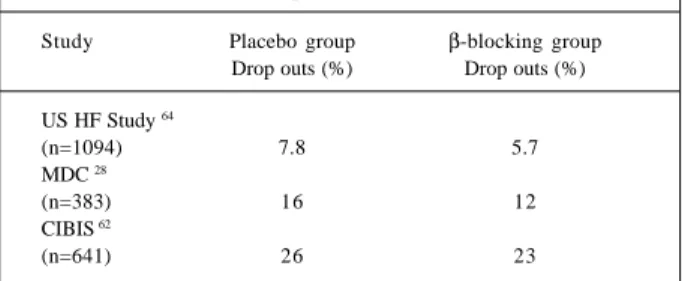
In major controlled trials, the proportion of patients
who withdraw from studies of β-blocking agents was simi-lar or even lower than in placebo groups (Table III).
These data demonstrate that if initial therapy and titration, as well as other usage recommendations, are strictly observed, these drugs are much better tolerated than once supposed.
Management of adverse effects and warnings
Most common adverse effects, especially during the initial therapy or titration period, which require careful attention and appropriate management, are: hypotension, bradycardia and AV block, fluid retention, and worsening heart failure.
Hypotension – Hypotension, especially orthostatic,
may occur during β-blocking therapy, mainly with agents that also block α1-adrenergic receptors, like carvedilol, or if blood pressure is already low. This effect may occur with ini-tial dosage administration or during dosage increase and tends to disappear after multiple doses, between 1 and 5 days, not requiring dose reduction or subsequent medicati-on adjustment. In the US Carvedilol Heart Failure Study 64,
less than 1% of patients required interruption of carvedilol therapy due to hypotension or dizziness. The risk of hypo-tension may be lessened by administering vasodilatory drugs in a different hour and the β-blocking agent after meals to delay absorption and reduce maximum plasma peak concentration. Occasionally, a temporary reduction in ACE inhibitor and vasodilatory agent doses may be necessary. Eventually diuretics may be reduced with caution, as fluid retention must be avoided.
Bradycardia and AV block – Amongst
pharmacolo-gical effects of β-blocking agents are a decrease in heart rate and a delay in atrioventricular (AV) conduction, which may induce bradycardia and AV block. Such changes rarely occur with lower doses and usually do not cause symptoms, but the risk increases to 5-10% with increasing doses 64. If
the heart rate falls to less than 55-60 bpm or a 2nd or 3rd AV
blo-ck develops, β-bloblo-cking dosage must be reduced. Additio-nally, drugs that may potentially induce bradycardia or cardiac block, like digitalis and amiodarone, must be disconti-nued or the dose must be reduced. Bradycardia as a cause for discontinuation of therapy is uncommon (less than 1%) 64.
Fluid retention and worsening heart failure – The
introduction of a β-blocking agent or an inappropriate
dosa-Table III – Percentage of drop out patients from placebo and b-blocking groups due to adverse effects
Study Placebo group β-blocking group Drop outs (%) Drop outs (%)
US HF Study 64
(n=1094) 7.8 5.7
MDC 28
(n=383) 16 12
CIBIS 62
ge increase may transitorily worsen heart failure symptoms, indicated by fluid retention, pulmonary or peripheral congestion, and body weight increase. Patients should be instructed to weigh themselves daily and to correct any eventual increase in body weight by increasing diuretic dose intake until weight returns to pretreatment levels. As this risk is greater in patients who have already experienced fluid retention before treatment, diuretic dosage must be optimized prior to the introduction of a β-blocking agent. By acting in α1-adrenergic receptors, carvedilol causes systemic and renal vasodilation, increasing kidney blood flow 44. However, it remains unknown whether this property
may reduce the risk of fluid retention. Approximately 1.6% of patients have been withdrew from carvedilol therapy versus 2.3% in placebo groups, because of worsening heart failure in the US Carvedilol Heart Failure Study 64.
The effective and safe use of b-adrenergic blocking drugs in heart failure requires insight into the selection of patients, the potential benefits of treatment, and recogni-tion and management of side effects. Such insight can be gained by any physician who is interested in the care of patients with heart failure and is willing to commit him/ herself to the monitoring that such patients require. These physicians need not be cardiovascular specialists. The ease and success of initiating and titrating b-blockers to target doses increase with experience
Topics to be elucidated
The role of b-adrenergic blocking drugs in reducing morbidity and mortality in heart failure patients with functional class II and III has been consistently demonstra-ted recently in major published trials. However, many ques-tions remain to be better clarified: 1) Are the effects of all β-blocking agents similar in heart failure? 2) What are the real benefits of these drugs in severe heart failure (class IIIB-IV)? 3) Are β-blocking agents beneficial (when used in addition to ACE inhibitors) in patients with systolic left ventricular dysfunction when administered in the immediate post-MI period?
Are all βββββ-blocking agents similar in heart failure? Both selective – metoprolol and bisoprolol – and nonselective – carvedilol - β-adrenergic blocking agents have demonstrated beneficial effects in heart failure. Howe-ver, β-blocking agents differ in the magnitude in which they interfere with effects of the sympathetic nervous system on the heart and circulation 70-72. In heart failure, the number
of β1-receptors is decreased, but the number of β2
-recep-tors is increased 22. Multiple blockade of adrenergic
recep-tors, at least in theory, would be favorable because if excess catecholamines contribute to the progressive ventricular remodeling, complete blockade of these adrenergic recep-tors may be necessary for the maximum benefit of sympa-thetic blockade. Moreover, contrary to that which occurs with selective β1-adrenergic receptors, carvedilol does not
promote an up-regulation of b-adrenergic receptors 73,74.
Such properties, besides the peculiar effects of carvedilol, as α1-blockade and antioxidative and antiproliferative effects, could explain the better results obtained with this drug compared with selective β1-adrenergic blocking agents.
Overall mortality reduction in the US Carvedilol Heart Failure Study 64 (65%) was greater than reduction obtained
in MERIT-HF 61 with metoprolol (34%) and in CIBIS-II 63
with bisoprolol (34%). However, no direct comparison between these drugs has been made. In a recent trial invol-ving a selected population of patients with idiopathic dila-ted cardiomyopathy who had not adequately responded to optimal long-term heart failure treatment, including meto-prolol, therapy with carvedilol was associated with favo-rable effects on left ventricular function, ventricular remo-deling, and arrhythmia, although with a negative effect on maximum oxygen consumption 75.
Direct Prospective comparions conceaning the diffe-rent beta-blochers apents effects on heart failure are scance, with small number of patients and also evaluating only survogate end points.
In one study 76, 67 patients with heart-failure class II/IV
were randomly assigned to receive either carvedilol or meto-prolol in addition to standard therapy for congestive heart failure. Measured variables included symptoms, exercise, ejection fraction, and thiobarbituric acid-reactive subs-tances (TBARS) as an indirect marker of free-radical acti-vity. Metoprolol and carvedilol were well tolerated, and both patient groups showed significant beneficial effects of β-blocker therapy in each of the measured parameters with no between-group differences over 6 months of follow-up. In another study 77, 51 patients with chronic heart
failure and mean left ventricular ejection fraction of 26% ± 1.8% were randomly assigned treatment with metoprolol 50mg twice daily or carvedilol 25mg twice daily, in addition to standard therapy, after a four-week dose titration period for a total of 12 weeks. Both carvedilol and metoprolol produced highly significant improvement in symptoms (p<0.001), exercise capacity (p<0.05), and left ventricular ejection fraction (p<0.001), and no significant differences existed between the two groups. Carvedilol had a signifi-cantly greater effect on sitting and standing blood pressure, left ventricular end-diastolic dimension, and normalization of the mitral E-wave deceleration time.
The hypothesis that multiple adrenergic blockade is more effective than selective β1-adrenergic blockade is now
being prospectively evaluated in a clinical trial – Carvedilol and Metoprolol European Trial (COMET) – which will directly assess survival efficacy of both drugs in 3,000 patients with heart failure in a 4-year treatment period.
Are βββββ-blocking agents beneficial in severe heart failure therapy (class IIIB/IV)?
tolera-bility, worsening heart failure, hypotension, and brady-cardia. Considering the limited life expectancy in this func-tional class, it is genuine to call into question the time interval usually necessary to achieve β-blockade related benefits.
Data provided by use of β-blocking agents in heart failure class IV was limited until recently. In the US Heart Failure Study,64 105 out of 1,094 (9.6%) patients had severe
heart failure and in the CIBIS-II 63 study, 445 out of 2,647
(17%) did. Although these subgroups of patients had shown a trend in symptom and ejection fraction improve-ment, the results could not allow drawing any conclusion about morbidity and mortality. However, meta-analysis data 78 have shown that class IV heart failure patients
adequately selected may benefit from β-blockade. In our country, the effects of carvedilol were evaluated in 21 patients with refractory heart failure, in functional class IV or III (intermittently with functional class IV), and mean left ventricular ejection fraction of 0.22±0.06, under optimized conventional treatment 79. Carvedilol was well
tolerated by 16 patients, with a mean dose of 42±11mg. After 196±60 days of follow-up significant improvement occurred in functional class, left ventricular end diastolic diameter reduced from 73±13 to 66±12mm (p<0.009), and left ventri-cular ejection fraction increased from 0.21±0.06 to 0.34±0.12 (p< 0.0003).
As mentioned before, the COPERNICUS study enrol-ling 2,200 patients with functional class IV heart failure, was terminated early due to the significant survival benefit shown with carvedilol.
Systolic ventricular dysfunction in immediate post-myocardial infarction
It is well established that ACE inhibitors are beneficial in treating post-myocardial infarction (MI) systolic ventri-cular dysfunction both in symptomatic (AIRE study) 80 and
asymptomatic (SAVE 81, TRACE 82) patients. β-blocking
agents are known to prevent sudden death and post-MI reinfarction 83. The presence of post-MI ventricular
dys-function has been previously considered a contraindication to their use. Nevertheless, a retrospective analysis of post-MI studies where β-blocking agents have been used (before the ACE inhibitor era) suggests that β-blocking’s beneficial effects remain or are even greater in such cir-cumstances 84. The ongoing study CAPRICORN –
Carve-dilol Post-Infarction Survival Control in Left Ventricular Dysfunction – has been designed to test the hypothesis that carvedilol is superior to placebo when added to ACE inhibitors in patients with post-MI ventricular dysfunction.
Conclusion
Data provided by several appropriately designed cli-nical trials involving approximately 10,000 patients clearly indicate the benefits of β-blocking agents in chronic heart failure functional class II to IV due to systolic ventricular dysfunction, combined with diuretics, ACE inhibitor, and digoxin. The benefits are related to symptoms, functional capacity, remodeling, and left ventricular function improve-ment, cardiovascular hospitalization reduction, overall and cardiac sudden death rate decrease, and are similar in patients with cardiomyopathy of any etiology, independent of age, gender, functional class, left ventricular ejection fraction, or exercise tolerance. It should be noted, however, that the clinical experience with these drugs in heart failure due to Chagas’ disease is limited 85.
Despite the Consensus for Treatment of Heart Fai-lure’s recommendation that every patient with heart failure class II and III due to left ventricular systolic dysfunction should receive a β-adrenergic blocking agent, except if the drug is not tolerated or in the presence of a contraindication, less than 10% of eligible patients are receiving such drugs. Therefore, a need exists to further disseminate this new con-cept to cardiologist and general practice professionals.
Referências
1. Hall S, Cigarroa CG, Marxoux L, et al. Time course of improvement in left ventri-cular function, mass and geometry in patients with congestive heart failure treated with b-adrenergic blockade. J Am Coll Cardiol 1995; 25: 1154-61. 2. Bristow MR, Gilbert EM. Improvement in cardiac myocyte function by
biolo-gical effects of medical therapy: a new concept in the treatment of heart failure. Eur Heart J 1995; 16(suppl F): 20-31.
3. Eichorn EJ, Bristow MR. Medical therapy can improve the biological properties of chronically failure heart. A new era in the treatment of heart failure. Circulation 1996; 94: 2285-96.
4. Rendqvist B, Elam M, Bergmann-Sverrisdottir Y, Eisenhofer G, Friberg P. Increa-sed cardiac adrenergic drive precedes generalized sympathetic activation in hu-man heart failure. Circulation 1997; 95: 169-75.
5. Levine TB, Francis GS, Goldsmith SR, Simon A, Cohn JN. Activity of the sympa-thetic nervous sistem and renin-angiotensin system assessed by plasma hormo-ne levels and their relationship to hemodynamic abnormalities in congestive heart failure. Am J Cardiol 1982; 49: 1659-66.
6. Viquerat CE, Daly P, Swedberg K. Endogenous catecholamine levels in conges-tive heart failure: Relation to severity of hemodynamic abnormality. Am J Med 1985; 78: 455-60.
7. Bristow MR. The adrenergic nervous system in heart failure. N Engl J Med 1984; 311: 850-1.
8. Bristow MR. Pathophysiologic and pharmacologic rationales for clinical mana-gement of chronic heart failure with beta-blocking agents. Am J Cardiol 1993; 71: 12C-22C.
9. Anversa P, Ricci R, Olivetti G. Quantitative structural analysis of the myocar-dium during physiologic growth and induced cardiac hypertrophy: a review. J Am Coll Cardiol 1986; 7: 1140-9.
10. Cleland JGF, Dargie HJ. Arrhythmias, catecholamines and electrolytes. Am J Cardiol 1988; 62: 55A-9A.
11. Mann DL, Kent RL, Pardons B, Cooper IV. Adrenergic effects on the biology of the adult mammalian cardiocyte. Circulation 1992; 85: 790-804.
12. Kanai AJ, Mesaros S, Finkel MS, et al. Beta-adrenergic regulation of constitutive nitric oxide synthase in cardiac myocytes. Am J Physiol 1997; 273: C1371-C7. 13. Communal C, Singh K, Pimentel DR, Collucci WS. Norepinephrine stimulates apoptosis in adult rat ventricular myocytes by activation of the b-adrenergic pathway. Circulation 1998; 98: 1329-34.
prog-nosis in patients with chronic congestive heart failure. N Engl J Med 1984; 311: 819-23.
15. Kaye DM, Lefkowitz J, Jennings GL, Broughton A, Esler MD. Adverse conse-quences of high sympathetic nervous activity in the failing human heart. J Am Coll Cardiol 1995; 26: 1257-63.
16. Tan LB, Jalil JE, Pick R, et al. Cardiac myocyte necrosis induced by angiotensin II. Circ Res 1991; 69: 1185-95.
17. Sackner-Bernstein JD, Mancini DM. Rationale for treatment of patients with chronic heart failure with adrenergic blockade. JAMA 1995; 274: 1462-7. 18. Feuerstein GZ, Weck OK. Cardiac remodeling: from concepts to therapeutics.
Heart Failure Reviews 1999; 4: 7-19.
19. Bristow MR, Grinberg R, Minobe W, et al. Decreased catecholamine sensitivity and b-adrenergic receptor density in failure human hearts. N Engl J Med 1982; 307: 205-11.
20. Fowler MB, Laser JA, Hopkins GL, et al. Assessment of the b-adrenergic pathway in the intact failing human heart: Progressive receptor down-regulation and sub-sensitivity agonist response. Circulation 1986; 74: 1290-1301.
21. Bristow MR, Hershberger RE, Port JD, et al. b-adrenergic pathways in non-fai-ling and fainon-fai-ling human ventricular myocardium. Circulation 1990; 82(suppl I): 12-25.
22. Bristow MR, Ginsberg R, Fowler M, et al. b
1 and b2 adrenergic receptor subtype
population in normal and failing human ventricular myocardium. Circ Res 1986; 59: 297-309.
23. Gilbert EM, Abraham WT, Olsen S, et al. Comparative hemodynamic, left ventri-cular functional, and antiadrenergic effects of chronic treatment with metoprolol versus carvedilol in the failing human heart. Circulation 1996; 94: 2817-25. 24. Boudreau G, Peronne TF, De Chaplain Y, Nadeau R. Presynaptic effects of
epine-phrine on norepineepine-phrine release from cardiac nerves in the dogs. Am J Physiol 1993; 265: H205-H11.
24a. Bristow MR. Mechanism of action of beta-blocking agents in heart failure. Am J Cardiol 1997; 80: 26L-40L.
24b. Waagstein F, Caidahek K, Wallentin I, Berg LC, Hjalmarson A. Long-term beta-blockade in dilated cardiomyopathy. Effects of short- and long-term metoprolol treatment followed by withdrawal and readministration of metoprolol. Circu-lation 1989; 80: 551-63.
25. Currie PJ, Kelly MJ, Mckenzie A, et al. Oral beta-adrenergic blockade with meto-prolol in chronic severe cardiomyopathy. J Am Coll Cardiol 1984; 3: 203-9. 26. Sabbah HN, Shimoyama H, Kono T, et al. Effects of long-term monotherapy with
enalapril, metoprolol and digoxin on the progression of left ventricular dysfunction and dilation in dogs with reduced ejection fraction. Circulation 1994; 89: 2852-9.
27. McDonald KM, Rector R, Carlyle PF, Francis GS, Cohn JN. Angiotensin-converting enzyme inhibition and beta-adrenoceptor blockade regress established ventricular remodeling in a canine model of discrete myocardial damage. J Am Coll Cardiol 1994; 24: 1762-8.
28. Waagstein F, Bristow MR, Swedberg, et al, for the Metoprolol in Dilated Cardiomyopathy (MDC) Trial Study Group. Beneficial effects of metoprolol in idiopathic dilated cardiomyopathy. Lancet 1993; 342: 1141-6.
29. Doughty RN, Mac-Mahon S, Sharpe N. Beta-blockers in heart failure. Promising or proved? J Am Coll Cardiol 1994; 23: 814-21.
30. Krum H, Sackner-Bernstein JD, Goldsmith RL, et al. Double-blind, placebo controlled study of the long-term efficacy of carvedilol in patients with severe chronic heart failure. Circulation 1995; 92: 1499-506.
31. Packer M, Collucci WS, Sackner-Bernstein JD, et al, for the PRECISE Study Group. Double-blind, placebo-controlled study of the effects of carvedilol in patients with moderate to severe heart failure: The PRECISE trial. Circulation 1996; 94: 2793-9.
32. Colucci WS, Packer M, Bristow MR, et al, for the US Carvedilol Study Group. Carvedilol inhibits clinical progression in patients with mild symptoms of heart failure. Circulation 1996; 94: 2800-6.
33. Bristow MR, Gilbert EM, Abraham WT, et al, for the MOCHA Investigators. Carvedilol produces dose-related improvements in left ventricular function and survival in subjects with chronic heart failure. Circulation 1996; 94: 2807-16. 34. Doughty RN, Whalley GA, Gamble G, McMahon S, Sharpe N, on behalf of the Australia New Zealand Heart Failure Research Collaborative Group. Left ventri-cular remodeling with carvedilol in patients with congestive heart failure due to ischemic heart disease. J Am Coll Cardiol 1997; 29: 1060-6.
35. Lechat PP, Packer M, Chalon S, Cucherat M, Arab T, Boissel JP. Clinical effects of beta-adrenergic blockade in chronic heart failure. Meta-analysis of double-blind, placebo controlled, randomized trials. Circulation 1998; 98: 1184-91. 36. Lowes BD, Gill EA, Abraham WT, et al. Effects of carvedilol on left venticular
mass, chamber geometria, and mitral regurgitation in chronic heart failure. Am J Cardiol 1999; 83: 1201-5.
37. Metra M, Nodari S, D’Aloia A, et al. Beta-blockers in heart failure: Issues in the management of individual patients. Heart Failure Reviews 1999; 4: 65-77.
38. Hjalmarson A, Kneider M, Waagstein E. The role of b-blockers in left ventricular dysfunction and heart failure. Drugs 1997; 54: 501-10.
38a. Chizzola PR, Marinho NVS, Moraes RF, et al. The beneficial effects of carvedilol on heart failure is associated to changes in adrenergic neurohormonal functional. Preliminary results of a randomized double-blind study (Caribe Study). Circu-lation 1998; 98(suppl I): I-365.
39. Eichorn EJ, Bedotto JB, Malloy CR, et al. Effect of B-adrenergic blockade on myocardial function and energetics in congestive heart failure. Circulation 1990; 82: 473-83.
40. Bristow MR, Minobe W, Rasmussen R, et al. Alpha-1 adrenergic receptors in the non failing and failing human heart. J Pharmacol Exp Ther 1988; 247: 1939-45. 41. Metra M, Nardi M, Giubbini R, Dei Cas L. Effects of short- and long-term carve-dilol administration on rest and exercise hemodynamic variables, exercise capa-city and clinical conditions in patients with dilated cardiomyopathy. J Am Coll Cardiol 1995; 25: 1225-31.
42. Morgan HE, Baker KM. Cardiac hypertrophy – Mechanical, neural, and endocri-ne dependence. Circulation 1991; 83: 13-25.
43. Gout B, Feuerstein GZ, Bril A. Mechanisms involved in the cardiac protection ef-ficacy of carvedilol. Heart Failure Reviews 1999; 4: 29-37.
44. Abraham WT, Tsevtkova T, Lowes BD, Ferguson DA, Gilbert EM, Bristow MR. Carvedilol improves renal hemodynamics in patients with chronic heart failure. Circulation 1998; 98(suppl 1): 378-9.
45. Sung CP, Arleth AJ, Ohlstein EH. Carvedilol inhibits vascular smooth muscle cell and proliferation. J Cardiovasc Pharmacol 1993; 21: 221-7.
46. Patel MK, Chan P, Betteridge LJ, et al. Inhibition of vascular smooth muscle cell proliferation by the novel multiple-action antihypertensive agent carvedilol. J Cardiovasc Pharmacol 1995; 25: 652-7.
47. Downey JM. Free radicals and other involvement during long-term myocardial ischemia and reperfusion. Ann Rev Physiol 1990; 24: 156-64.
48. Belch JJF, Budges AB, Scott N, Chopra M. Oxygen free radicals and congestive heart failure. Br Heart J 1991; 65: 245-8.
49. Leri A, Liu Y, Malhotra A, et al. Pacing-induced heart failure in dogs enhances the expression of p 53-dependent genes in ventricular myocites. Ano, Vol. Pág.
50. Wang Y, Huang S, Sah VP, et al. Cardiac muscle cell hyperthrophy and apoptosis induced by distinct members of the p 38 mitogen-activated protein kinase family. J Biol Chem 1998; 273: 2161-8.
51. Liu X, Naekyung K, Yang J, Yemmerson R, Wang X. Induction of apoptotic prog-ram in cell-free extracts: Requirement for dATP and cytochrome C. CELL 1996; 86: 147-57.
52. Ferrari R, Agnoletti L, Comini L, et al. Oxidation stress during myocardial ische-mia and heart failure. Eur Heart J 1998; 19: B2-B11.
53. Ferrari R, Agnoletti L, Ceconi C, Curello S, Nesta F, Manfredini R. Endothelial dysfunction in congestive heart failure: Effects of carvedilol. Heart Failure Re-views 1999; 4: 53-63.
54. Yue TL, McKenna PJ, Lysko PG, et al. SB 211475, a metabolite of carvedilol, a novel antihypertensive agent, is a potent antioxidant. Eur J Pharmacol 1994; 251: 237-43.
55. Yue TL, Ruffolo RR Jr, Feuerstein G. Antioxidant action of carvedilol: A potential role in treatment of heart failure. Heart Failure Reviews 1999; 4: 39-51. 56. Yue TL, Cheng HY, Lysko PG, et al. Carvedilol, a new vasodilator and beta
adrenoceptor antagonist, is an antioxidant and free radical scavenger. J Pharma-col Exp Ther 1992; 263: 92-8.
57. Yue TL, McKenna PJ, Gu JL, Cheng HY, Ruffolo RR Jr, Feuerstein GZ. Carvedilol, a new vasodilating b-adrenoceptor blocker antihypertensive drug, protects en-dothelial cells from damage initiated by xanthine-xanthine oxidase and neutro-phils. Cardiovasc Res 1994; 28: 400-6.
58. Waagstein F, Hjalmarson A, Varnauskas E, et al. Effect of chronic beta adrenergic receptor blockade in congestive cardiomyopathy. Br Heart J 1975; 37: 1022-6.
59. Swedberg K, Hjalmarson A, Waagstein F, et al. Prolongation of survival in con-gestive cardiomyopathy by receptor beta-blockade. Lancet 1979; i: 1374-6. 60. Swedberg K. Initial experience with beta blockers in dilated cardiomyopathy.
Am J Cardiol 1993; 71: 30C-8C.
61. MERIT-HF Study Group. Effect of metoprolol CR/XL in chronic heart failure: Metoprolol CR/XL Randomized Intervention Trial in Congestive Heart Failure (MERIT-HF). Lancet 1999; 353: 2001-7.
62. CIBIS Investigators and Committees. A randomized trial of b-blockade in heart failure: The Cardiac Insufficiency Bisoprolol Study (CIBIS). Circulation 1994; 90: 1765-73.
63. CIBIS-II Investigators and Committees. The Cardiac Insufficiency Bisoprolol Study (CIBIS II): A randomized trial. Lancet 1999; 353: 9-13.
65. Cohn JN, Fowler MB, Bristow MR, et al, for the US Carvedilol Heart Failure Study Group. Safety and efficacy of carvedilol in severe heart failure. J Card Failure 1997; 3: 173-9.
66. Packer M, Cohn JN, on behalf of the Steering Committee and Membership of the Advisory Council to Improve Outcomes Nationwide in Heart Failure. Consen-sus Recommendations for the Management of Chronic Heart Failure. Am J Cardiol 1999; 83(2A): 1A-38A.
67. Bristow MR, Roden R, Lowes BD, Gilbert EM, Eichorn EJ. The role of third-generation beta-blocking agents in chronic heart failure. Clin Cardiol 1988; 21(supl I): I3-I13.
68. Mcdonald PS, Keogg AM, Aboyoun CL, Lund M, Amor R, McCaffrey DJ. Tole-rability and efficacy of carvedilol in patients with New York Heart Association Class IV heart failure. J Am Coll Cardiol 1999; 33: 924-31.
69. Eichorn EJ, Bristow MR. Practical guidelines for initiation of b-adrenergic blo-ckade in patients with chronic heart failure. Am J Cardiol 1997; 79: 794-8. 70. Mann DL, Kent RL, Parsons B, Cooper G. Adrenergic effects on the biology of the
mammalian cardiocyte. Circulation 1992; 85: 790-804.
71. Feuerstein G, Yue TL. Novel mechanisms in the treatment of heart failure: inhibi-tion of oxygen radicals and apoptoses by carvedilol. Prog Cardiovasc Dis 1998; 48(suppl 1): 17-24.
72. Metra M, Nodari S, Aloia A, et al. Effects of chronic b-blockade on the hemodyna-mics and functional capacity of patients with heart failure: a randomized com-parison between metoprolol and carvedilol (Abstr). Eur Heart J 1998; 19(sup-pl): 307.
73. Bristow MR, Larabee P, Muller-Beckmann, et al. Effect of carvedilol in human ventricular myocardium and lymphocytes. Clin Invest 1992; 70: S105-S13. 74. Yoshikawa T, Port JD, Asano K, et al. Cardiac adrenergic receptors effects of
car-vedilol. Eur Heart J 1996; 17(suppl B): 8-16.
75. Di Lenarda A, Sabbadini G, Salvatore L, et al, for the Heart-Muscle Disease Study Group. Long-term effects of carvedilol in idiopathic dilated
cardiomyo-pathy with persistent left ventricular dysfunction despite chronic metoprolol. J Am Coll Cardiol 1999; 33: 1926-34.
76. Kukin ML, Kalman J, Charney RH et al. Prospective, randomized comparison of effect of long-term treatment with metoprolol or carvedilol on symptoms, exercise, ejection fraction and oxidative stress in heart failure. Circulation 1999; 99: 2645-61.
77. Anderson JE, Chan SKW, Yip G, et al. Beta-blockade in heart failure. A compari-son of carvedilol with metoprolol. J Am Coll Cardiol 1999; 34: 1522-8. 78. Krum H. β-blockers in heart failure. The “new wave” of clinical trials. Drugs
1999; 58: 203-10.
79. Bocchi EA, Bacal F, Bellotti G, Carrara D, Ramires JAF. Effects of carvedilol (b
1, b2, α1-blocker) on refractory congestive heart failure. Arq Bras Cardiol 1998; 71:
169-73.
80. AIRE (Acute Infarction Ramipril Efficacy) study investigators. Effect of ramipril on mortality and morbidity of survivors of acute myocardial infarction with clini-cal evidence of heart failure. Lancet 1993; 342: 821-8.
81. Pfeffer MA, Braunwald E, Moyé LA, et al. Effect of captopril on mortality and mor-bidity in patients with left ventricular dysfunction after myocardial infarction: results of the survival and ventricular enlargement trial (SAVE). N Engl J Med 1992; 327: 669-77.
82. Kober L, Top-Pedersen C, Carlsen JE, et al. Effects on mortality by trandolapril after myocardial infarction. N Engl J Med 1995; 333: 1670-6.
83. Yusuf S, Peto R, Lewis J, et al. Beta-blockade during and after myocardial infarction: an overview of the randomized trials. Progr Cardiovasc Dis 1985; 27: 335-71. 84. Chadda K, Goldstein CK, Byington R, et al. Effect of propranolol after acute
myo-cardial infarction in patients with heart failure. Circulation 1986; 73: 503-10. 85. Freitas H, Solatino G, Chizzola P, et al. b-blockers for Chagas’ heart disease: