Head circumference growth of exclusively breastfed infants during
the irst six months of life
Crescimento do perímetro cefálico nos primeiros seis meses em crianças em aleitamento materno exclusivo
Crecimiento del perímetro cefálico en los primeros 6 meses en niños en lactancia materna exclusiva
Maria da Graça M. Jaldin1, Feliciana Santos Pinheiro2, Alcione Miranda dos Santos3, Nivaldo Costa Muniz4, Luciane Maria O. Brito5
Instituição: Banco de Leite Humano do Hospital Universitário Materno-Infantil, São Luís, MA, Brasil
1Mestre em Saúde Materno Infantil pela Universidade Federal do Maranhão (UFMA); Professora Assistente do Departamento de Medicina III da UFMA, São Luís, MA, Brasil
2Doutora em Pediatria pela Faculdade de Medicina de Ribeirão Preto da Universidade de São Paulo (USP); Professora Associada do Departamento de Medicina III da UFMA, São Luís, MA, Brasil
3Doutora em Engenharia de Produção pela Universidade Federal do Rio de Janeiro (UFRJ); Professora Adjunta do Departamento de Saúde Pública da UFMA, São Luís, MA, Brasil
4Doutor em Matemática pelo Instituto de Matemática Pura e Aplicada (IMPA); Professor Adjunto do Departamento de Matemática da UFMA, São Luís, MA, Brasil
5Doutora em Medicina pela UFRJ; Professora Associada do Departamento
ABSTRACT
Objective: To analyze the head circumference growth of exclusively breastfed children from birth to the sixth month of life using, as references, the National Center for Health Statistics (NCHS/1977) as well as the World Health Organization/2006 international standard (WHO/2006).
Methods: A longitudinal research carried out at the Mother and Child University Hospital of the Federal University of Maranhão (Northeast Brazil), from October 2007 to Novem-ber 2008. A non-probabilistic sample of 328 singleton full
term neonates, with birthweight ≥2500g and ≤4000g was
enrolled, being all neonates exclusively breastfed from birth to the sixth month of life; 181 children (95 females and 86 males) completed the follow-up. The head circumference was estimated by average, standard deviation and percentiles 5, 50 and 95. Percentile results were compared taking as references the NCHS/1977 and the WHO/2006 standards.
Results: There was an average of 1.5cm in head circumfer-ence growth for males and 1.4cm for females per month during the irst six months of life. Head circumference followed the
50th percentile of the WHO/2006 standard for both genders.
Regarding the NCHS/1977 standard, males presented head
circumference following the 50th percentile throughout the
six months, except at birth, and females followed the 50th percentile from birth until six months of life.
Conclusions: Exclusively breastfed children presented a satisfactory head circumference growth up to the sixth month
of life, in accordance with the 50th percentile of WHO/2006
and NCHS/1977 standards.
Key-words: breast feeding; cephalometry; growth; an-thropometry.
RESUMO
Objetivo: Analisar o perímetro cefálico de crianças amamentadas exclusivamente do nascimento ao sexto mês com relação à referência National Center for Health
Statis-tics (NCHS/1977) e ao padrão internacional World Health
Organization/2006 (WHO/2006).
Métodos: Estudo longitudinal realizado no Banco de Leite Humano do Hospital Universitário Materno-Infantil, São Luís (MA), entre outubro de 2007 e novembro de 2008. Amostra não probabilística de 328 crianças nascidas a termo, parto
único, peso ao nascer ≥ 2500g e ≤ 4000g, em aleitamento
exclusivo do nascimento ao sexto mês. Finalizaram o estudo 181 crianças (95 meninas e 86 meninos). Avaliou-se o perí-metro cefálico por meio de média, desvio padrão e percentis 5, 50 e 95. Os resultados em percentis foram comparados aos da referência NCHS/1977 e do padrão WHO/2006.
Resultados: Nos primeiros seis meses, houve um aumento do perímetro cefálico, em média, de 1,5cm por mês nos meninos e de 1,4cm nas meninas. O crescimento do perímetro cefálico, em ambos os sexos, acompanhou o percentil 50 do padrão WHO/2006. Nos meninos, exceto ao nascer, o percentil 50 do perímetro cefálico foi equivalente ao da referência NCHS/1977; nas meninas, situou-se próximo desde o nascimento.
Conclusões: As crianças em aleitamento materno exclusi-vo até o sexto mês de vida apresentaram crescimento
satisfa-Endereço para correspondência: Maria da Graça M. Jaldin
Rua Alcântara, Q-08, C-12 – Parque Pindorama CEP 65040-080 – São Luís/MA
E-mail: [email protected]
Fonte financiadora: Fundação de Amparo à Pesquisa e ao Desenvolvimento Científico e Tecnológico do Maranhão (Fapema)
Conflito de interesse: nada a declarar
tório do perímetro cefálico, em conformidade com o percentil 50 do padrão WHO/2006 e da referência NCHS/1977.
Palavras-chave: aleitamento materno; circunferência craniana; crescimento; antropometria.
RESUMEN
Objetivo: Analizar el perímetro cefálico de niños ama-mantados exclusivamente, desde el nacimiento hasta el
sexto mes, respecto a la referencia National Center for Health
Statistics (NCHS/1977) y al estándar internacional World Health Organization/2006 (WHO/2006).
Métodos: Estudio longitudinal realizado en el Banco de Leche Humana del Hospital Universitario Materno-Infantil, São Luís, Maranhão, Brasil, entre octubre de 2007 y noviem-bre de 2008. Muestra no probabilística con 328 niños nacidos a término, parto único, peso al nacer igual o superior a 2,5kg e inferior o igual a 4,0kg y en lactancia exclusiva, desde el nacimiento hasta el sexto mes. Finalizaron el estudio 181 niños (95 niñas y 86 niños). Se evaluó el perímetro cefálico mediante promedio, desviación estándar y percentiles 5, 50 y 95. Los resultados en percentiles fueron comparados a los de la referencia NCHS/1977 y al estándar WHO/2006.
Resultados: En los primeros seis meses hubo un aumento del perímetro cefálico promedio de 1,5cm al mes en los niños y de 1,4cm en las niñas. El crecimiento del perímetro cefálico, en am-bos sexos, acompañó el percentil 50 del estándar WHO/2006. En los niños, excepto al nacer, el percentil 50 del perímetro cefálico fue equivalente al de la referencia NCHS/1977; en las niñas, se situó cerca desde el nacimiento.
Conclusiones: Los niños en lactancia materna exclusiva hasta el sexto mes de vida presentaron crecimiento satisfacto-rio del perímetro cefálico, en conformidad con el percentil 50 del estándar WHO/2006 y de la referencia NCHS/1977.
Palabras clave: lactancia materna; perímetro cefálico; crecimiento; antropometría.
Introduction
Breastmilk is the most important source of nutrients for children during their irst 6 months of life(1). The World Health Organization (WHO) recommends exclusive breast-feeding (EBF) throughout this period as the ideal nutrition
for child development and growth(2).
Monitoring children’s growth in terms of head circumfer-ence at regular intervals makes it possible to determine wheth-er cwheth-erebral development is within normal limits, since thwheth-ere
is a strong correlation between head circumference growth
and cerebral development(3-6). Studies support the hypothesis
that human milk can make a difference to head circumference growth, due to the nutrients it contains, including iron and polyunsaturated long chain fatty acids which contribute to
brain development(3,7). Head circumference growth in children
breastfed for long periods may be associated with improved
psychomotor and mental development(3).
The World Health Organization recommends that child
growth be monitored using anthropometry(8) and that anthro-pometric measurements should be compared to a reference
standard, using growth curves(9). Until recently, the growth
curves recommended by the WHO for international use were those produced by the National Center for Health Statistics
(NCHS)(10). However, over the years a series of limitations
were identiied and they are now considered inadequate for
breastfed children(11,12). These limitations include the fact
that they were based on anthropometric data taken from infants predominantly fed on infant formulas and meas-ured at birth, during the irst month and every 3 months
thereafter(11). As a result, between 1997 and 2003, the WHO
conducted a multicenter study designed to produce new curves for assessing the growth and development of children from zero to 5 years all over the world, irrespective of ethnic,
cultural and socioeconomic factors or the type of feeding
(13-15). Among other characteristics, that study was based on observations of healthy babies on exclusive or predominant
breastfeeding and whose mothers were not smokers(13,14,16).
This standard was based on the assumption that breastfeed-ing is the norm for ideal growth and the curves are recom-mended for all children, irrespective of whether or not they were breastfed(16).
This study analyzes head circumference growth of breast-fed children aged less than 6 months by comparing them to
the 50th percentiles of the NCHS/1977 reference and of the
new WHO/2006 standard.
Method
This was a longitudinal study conducted at the Human
Milk Bank (HMB) at the Hospital Universitário Materno
Infantil (HUMI), in São Luís, MA, Brazil, from October 2007 to November 2008. The HMB has been a state-level center of excellence on breastfeeding since 2004 and is part of the HUMI, which has been recognized as a Baby Friendly Hospital since 1998 and whose objective is fulillment of the ten steps for successful breastfeeding.
estimates (mean and standard deviation) of the parameters under investigation and the sampling error. For all calcula-tions, a 95% conidence interval and statistical power of 80% were assumed. Allowing for a 10% loss, the minimum estimated sample size was 185 children.
Inclusion criteria were as follows: full term children,
single births, 5-minute Apgar ≥7, birth weight ≥2500g and
≤4000g and EBF since birth. All infants were born at the
HUMI and were kept with their mothers while in hospital. Exclusive breastfeeding was deined according to the 1991
WHO criteria(17). An additional 27 children who were
oc-casionally given water or teas because of colic while less than 1 month old were also included, but the children of smoking mothers and those who were unable to exclusively breastfeed for 6 months were not included in the study sample.
Children were selected by non-probabilistic sampling be-tween October 2007 and June 2008 at their irst consultation and at 1 month of age. At this point, mothers and children who fulilled the study criteria were identiied and the impor-tance of the research and its inclusion criteria were explained to them. Mothers who agreed to take part signed free and informed consent forms and answered a questionnaire on identiication, sociodemographic conditions, obstetric his-tory, breastfeeding and details about their children.
Two nursing technicians were recruited from the HMB to conduct the head circumference measurements, together with the lead author. Team members were calibrated during a pilot study involving 30 children. Anthropometry was conducted according to standardized techniques and there was periodic cross-checking between the different professionals involved(18). The measurements at the time of birth were acquired from the children’s medical records of from the live births register. Head circumference was measured using an inelastic measuring tape(3,19). Children were followed-up monthly from their irst to their sixth months. The maximum interval allowed between
each monthly anniversary and the follow-up consultation was ±
1 week for the irst 4 months(20,21) and ± 2 weeks after the ifth month(20). Each child was seen individually for anthropometry, to observe a breastfeed and for a clinical assessment by a pedia-trician, always preceded by a lecture including information, encouragement and support for EBF. Family members were both allowed and encouraged to be present.
At each consultation, the mothers were asked what they fed their children, the number of breastfeeds every 24 hours, whether they were having any problems breastfeeding or any other health problems and what their vaccination status was. Ex-clusive breastfeeding was conirmed on the basis of information provided by the mothers and by observing correct technique when breastfeeding. Successive consultations were booked in
advance, but mothers were at liberty to return before the ap-pointed dates if their children suffered any clinical conditions. Children were discharged from the study at 6 months of age and their mothers were told about complementary feeding and about maintaining breastfeeding until at least 2 years of age.
Children were excluded from the study if they did not at-tend the monthly appointments or if they were given other foods before 6 months. The research project was analyzed and approved by the Research Ethics Committee at the HUMI.
Head circumference measurements were expressed as means, standard deviations and the 5th, 50th and 95th percen-tiles. For the purposes of comparison, data were compared to
the WHO/2006 standard, from birth up to 6 months(22) and
the NCHS/1977 reference, at birth and at the irst, third and
sixth months(23). Statistics were produced using STATA 9.0
and a database stored in Epi INFO 2006, version 3.3.2.
Results
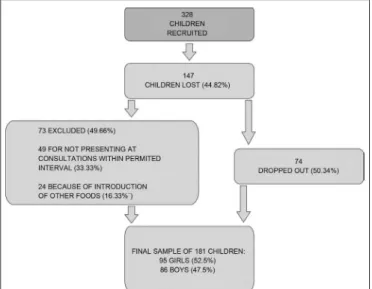
A total of 328 children on EBF were recruited, but just 181 of them, 95 (52.5%) girls and 86 (47.5%) boys, re-mained on the study until the end of their sixth month of life. The causes of the losses of 147 children from the sample are described in Figure 1.
Mean head circumference was larger for boys, from birth to 6 months, with a statistically signiicant difference at all ages (p<0.05) (Table 1). Mean monthly increase in head circumference was 1.5cm for the boys and 1.4cm for the girls over the 6 months (data not shown). Table 2 lists the mothers’ characteristics.
The 5th, 50th and 95th percentiles for the head circumfer-ence measurements for the children studied here were com-pared to the WHO/2006 standard and to the NCHS/1977
Discussion
Head circumference measurements are very important during the irst year of life because they are an
anthropomet-ric parameter that is highly correlated with brain size(4,6,24)
and should therefore be routinely used for individual follow-up of children from zero to 24 months, which is the period of greatest postnatal growth(4,25).
When mean head circumference was compared by sex, it was found that the boys had larger measurements throughout
the irst 6 months(24), but that the difference between means
did not exceed 1cm, which is similar to what is described
in the literature about the age group being studied here(25).
This result is in line with what was observed by Donma and
Donma(3), in a study conducted in Turkey to determine the
effect of type of feeding on head circumference in children over the irst 6 months of life. The mean increases in head circumference over the irst 6 months of 1.5cm per month for the boys and 1.4cm per month for girls was similar to
the igures reported by Araújo(14).
In both sexes, head circumference growth was compa-rable to the 50th percentile of the WHO/2006 standard and the NCHS/1977 reference. There was practically no variation between the head circumference results for the children studied here and the WHO/2006 standard and the NCHS/1977 reference. This result is in line with what has been reported, which is that head circumference is a measurement that varies little in any age group and that there is almost no variation associated with race, population or genetic factors(25).
In order to trace the velocity of head growth in early childhood, it is necessary to conduct systematic head cir-cumference measurements and record them on a graph to produce a growth curve. This curve relects the dynamics of overall growth of the skull and its internal structures. Serial measurements obviously make it easier to recognize disorders related to the speed of head growth as early as possible(4,26). It must be stressed that at this age monitoring this particular anthropometric measurement is, in a wider sense, an accessible, simple and easy method of evaluating
the normality of central nervous system development(5,26).
In the current study, there was a progressive increase in the ratio of head circumference to age, in both sexes, over the entire irst semester, which is an observation that has been reported in other studies of exclusively breastfed children(18,19).
Growth in head circumference is fastest during the irst 6 months of life, reaching a mean of 1.6cm/month(18,19,27). It has been widely reported that at this age the nutrients present
Table 2 - Socioeconomic characteristics of the mothers of chil-dren on exclusive breastfeeding for the irst 6 months of life. São Luís, MA, Brazil, 2008
Variables number %
Age group (years)
<20 23 12.7
20 to 35 144 79.6
>35 14 7.7
Marital status
Single 41 22.7
Married 67 37.0
Widowed 1 0.5
In a steady relationship 72 39.8
Educational level (years’ study)
≤8 32 17.7
9–11 132 72.9
≥12 17 9.4
Occupation
Housewife 116 64.1
Domestic worker 9 5.0
Student 16 8.8
Others 40 22.1
Family income (minimum wage)
up to 1 42 23.2
>1 to 4 98 54.1
>4 33 18.2
Did not know 8 4.4
Total 181 100.0
Table 1 - Mean head circumference measurements for children on exclusive breastfeeding, by sex and age, São Luís, MA, Brazil, 2008
Age
Boys (n=86) Girls (n=95)
p Head
circumference (cm)
Head circumference
(cm) Mean±SD Mean±SD
At birth 34.4±1.3 34.0±1.2 0.034
1 month 37.4±1.0 36.8±1.1 <0.001 2 months 39.2±1.0 38.6±1.0 <0.001 3 months 40.6±1.0 39.9±1.1 <0.001 4 months 41.7±0.9 40.9±1.1 <0.001 5 months 42.6±1.0 41.8±1.2 <0.001 6 months 43.4±1.1 42.6±1.2 <0.001
SD: standard deviation
reference (graph 1a-b and 2a-b). It was observed that head
circumference for both sexes followed the 50th percentile of
the WHO/2006 standard for the irst semester, with the girls slightly ahead of the reference curve after birth. For boys,
the 50th percentile for head circumference was equivalent
in human milk, including phospholipids, polyunsaturated long chain fatty acids, iron and lactose, in addition to hor-mones and growth factors, are important for both cerebral growth(3,7,28) and neuropsychomotor development(28,29). In addition to nutrition, physical activity and stimulation
also promote cerebral development(28). The study conducted
by Donma and Donma(3) suggests that dietary proile has
an effect on head circumference growth. That study was conducted with groups of Turkish children on exclusive breastfeeding, fed on formula or on mixed feeding during their irst 6 months of life and found that, at the end of the sixth month, head circumference measurements were signiicantly larger for exclusively breastfed children than those on other types of feeding.
Graph 1 a-b – 5th, 50th and 95th percentiles for head circumference of 86 boys, by age, compared with WHO/2006 standard (A)
and NCHS/1977 reference (B) 30
32 34 36 38 40 42 44 46 48
0 1 2 3 4 5 6
Age (months)
Head circumference (cm) 5th perc. pres. study
5th perc. WHO
50th perc. pres. study
50th perc. WHO
95th perc. pres. study
95th perc. pres. WHO
5th perc. pres. study
5th perc. NCHS
50th perc. pres. study
50th perc. NCHS
95th perc. pres. study
95th perc. pres. NCHS 30
32 34 36 38 40 42 44 46 48
0 1 2 3 4 5 6
Age (months)
Head circumference (cm)
A B
30 32 34 36 38 40 42 44 46
0 1 2 3 4 5 6
5th perc. pres. study
5th perc. WHO
50th perc. pres. study
50th perc. WHO
95th perc. pres. study
95th perc. pres. WHO
5th perc. pres. study
5th perc. NCHS
50th perc. pres. study
50th perc. NCHS
95th perc. pres. study
95th perc. pres. NCHS
30 32 34 36 38 40 42 44 46
0 1 2 3 4 5 6
A B
Age (months)
Head circumference (cm)
Age (months)
Head circumference (cm)
Graph 2 a-b - 5th, 50th and 95th percentiles for head circumference of 95 girls, by age, compared with WHO/2006 standard (A)
Irrespective of the fact that the children in this study met their expected growth velocity, it is necessary to bear in mind that this study has certain methodological limitations. The most important is, undoubtedly, the selection bias resulting from the non-probabilistic, sample recruited at a service that is a breastfeeding center of excellence, which means that, however encouraging the results, they cannot be generalized externally. Another limitation is the encouragement that mothers were given to take part in the study and to follow the exclusive breastfeeding recommendations, with positive implications for the study outcome.
It is concluded that boys exhibited greater head circumfer-ence growth than girls. The head circumfercircumfer-ence of these
chil-dren grew in line with the 50th percentile of the WHO/2006
standard and of the NCHS/1977 reference. These results support the claim that breastmilk as the only source of nu-trition for the irst 6 months of life promotes adequate head
circumference growth. It is important to adopt measures to support nursing mothers to guarantee exclusive breastfeed-ing for the irst 6 months of life. Children’s growth should be fully monitored from birth onwards, longitudinally and using a reference standard for the purposes of evaluation.
Acknowledements
We would like to thank Ana Caroline Fonseca Alves, Caroline Almeida Oliveira, Juliana Lacerda Cavalcante, Ta-ciana Gabrielle Pinheiro de Moura and Thalitta Vieira Silva Ferreira, all medical students from UFMA, and Jandira Silva Santos Alves and Jacqueline Martins Cantanhêde, nursing
professionals from the Hospital Universitário Materno Infantil
human milk bank, for the major contribution they made to data collection. We are also grateful to all of the mothers and children who took part in this research.
Reference
1. Spyrides MH, Struchiner CJ, Barbosa MT, Kac G. Efeito da duração da amamentação predominante no crescimento infantil: um estudo prospectivo com modelos não lineares de efeitos mistos. J Pediatr (Rio J) 2008; 84:237-43.
2. Fewtrell MS, Morgan JB, Duggan C, Gunnlaugsson G, Hibberd PL, Lucas
A et al. Optimal duration of exclusive breastfeeding: what is the evidence to
support current recommendations? Am J Clin Nutr 2007;85:635-8. 3. Donma MM, Donma O. The influence of feeding patterns on head
circumference among Turkish infants during the irst 6 months of life. Brain Dev 1997;19:393-7.
4. DeMyer W. Small, large, or abnormally shaped head. In: Maria BL, editor. Current management in child neurology. 3th ed. London: BC Decker; 2005.
p. 338-41.
5. Bartholomeusz HH, Courchesne E, Karns CM. Relationship between head
circumference and brain volume in healthy normal toddlers, children, and
adults. Neuropediatrics 2002;33:239-41.
6. Viana MR, Alves CL, Alvim CG, Junqueira HS, Goulart LM, Dias LS et al. Atenção à saúde da criança. Belo Horizonte: SAS/DNAS; 2004.
7. Clandinin MT, Jumpsen J, Suh M. Relationships between fatty acid accretion, membrane composition, and biologic functions. J Pediatr 1994;125:S25-32. 8. Zeferino AM, Barros-Filho AA, Bettiol H, Barbieri MA. Acompanhamento do
crescimento. J Pediatr (Rio J) 2003;79 (Suppl 1):S23-32.
9. Sociedade de Pediatria do Rio Grande do Sul. A atenção à saúde da criança de zero a cinco anos de idade. Rio Grande do Sul: SPRS; 2004.
10. Soares NT. Um novo referencial antropométrico de crescimento: signiicados e implicações. Rev Nutr 2003;16:93-104.
11. World Health Organization. An evaluation of infant growth: the use and interpretation of anthropometry. Bull World Health Organ 1995;73:165-74. 12. de Onis M, Garza C, Habichit JP. Time for a new growth reference. Pediatrics
1997;100:e8.
13. de Onis M, Garza C, Victora CG, Onyango AW, Frongillo EA, Martines J. The WHO Multicentre Growth Reference Study: planning, study design, and methodology. Food Nutr Bull 2004;25 (Suppl 1):S15-26.
14. Araújo CL. Avaliação nutricional de crianças. In: Kag G, Sichieri R, Gigante DP. Epidemiologia nutricional. Rio de Janeiro: Fiocruz/Atheneu; 2007. p. 49-781. 15. Lozano de la Torre MJ. Nuevo patrón de crecimiento infantil de la Organización
Mundial de la Salud basado en lactantes amamantados. An Pediatr (Barc) 2007;66:177-83.
16. Victora CG, Araújo CL, Onis M [homepage on the Internet]. Uma nova curva de crescimento para o século XXI [cited 2007 mar 20]. Available from: http://189.28.128.100/nutricao/docs/geral/nova_curva_cresc_sec_xxi.pdf 17. Giugliani ER. O aleitamento materno na prática clínica. J Pediatr (Rio J)
2000;76 (Suppl 3):S238-52.
18. Díaz S, Herreros C, Aravena R, Casado ME, Reyes MV, Schiappacasse V.
Breast-feeding duration and growth of fully breast-fed infants in a poor urban
Chilean population. Am J Clin Nutr 1995;62:371-6.
19. Otaigbe BE, Alikor EA, Nkanginieme KE. Growth pattern of exclusively breastfed infants in the irst six months of life: a study of babies delivered at the University of Port Harcourt Teaching Hospital, Rivers State, Nigeria. Niger J Med 2005;14:137-45.
20. Agostoni C, Grandi F, Giannì ML, Silano M, Torcoletti M, Giovannini M et al. Growth patterns of breast fed and formula fed infants in the irst 12 months of life: an Italian study. Arch Dis Child 1999;81:395-9.
21. Gökçay G, Turan JM, Partalci A, Neyzi O. Growth of infants during the irst year of life according to feeding regimen in the irst 4 months. J Trop Pediatr 2003;49:6-12.
22. World Health Organization [homepage on the Internet]. The WHO child growth standards [cited 2007 Jun 8]. Available from: http://www.who.int/childgrowth/ standards/en
23. Hamill PV, Drizd TA, Johnson CL, Reed RB, Roche AF. NCHS growth curves for children birth-18 years. United States. Vital Health Stat 11 1977;1-74. 24. Macchiaverni LM, Barros-Filho AA. Perímetro cefálico: por que medir sempre.
Medicina, Ribeirão Preto 1998;31:595-609.
25. Brasil - Ministério da Saúde. Secretaria de Políticas da Saúde. Saúde da criança: acompanhamento do crescimento e desenvolvimento infantil. Normas e manuais técnicos. Brasília: Ministério da Saúde, 2002.
26. García-Alix A, Sáenz-de Pipaón M, Martínez M, Salas-Hernández S, Quero J. Utilidad del perímetro cefálico en el recién nacido para anticipar problemas en el neurodesarrollo. Rev Neurol 2004;39:548-54.
27. Fujimura M, Seryu JI. Velocity of head growth during the perinatal period. Arch Dis Child 1977;52:105-12.
28. Singh M. Nutrition, brain and environment: how to have smarter babies? Indian Pediatr 2003;40:213-20.