Official Journal of the Brazilian Psychiatric Association Volume 34 • Number 2 • June/2012
Psychiatry
Revista Brasileira de Psiquiatria
Abstract
Objective: To evaluate the factor structure ofthe Brazilian Portuguese version of the Post-Traumatic Stress Disorder Checklist – civilian version(PCL-C), in order to complement its validation process in Brazil. Method: An exploratory factor analysis with promax rotation was conducted in 175 ambulance workers of the Emergence Rescue Group (GSE from Portuguese) of the Rio de
Janeiro ire brigade and 343 military police oficers (MP) (150 from an elite unit of the state of
Goiás). Results: The results revealed a two-factor solution: re-experience/avoidance, numbing/ hyperarousal. All variables loaded highly in at least one factor, except for one; variable 16. This item may have had a bad performance because the analysis was based on a sample of police
oficers, whose professional activity demands hypervigilance as one of its basic characteristics.
Internal consistency values were acceptable. Conclusions: Avoidance and numbing seem to be
independent dimensions, differently from what is expected according to the DSM-IV. Therefore,
new trials should be carried out in other populations, with victims of different kinds of trauma,
and including females, to verify these indings.
Exploratory factor analysis of the Brazilian version of the
Post-Traumatic Stress Disorder Checklist – Civilian Version (PCL-C)
Roberta Benitez Freitas Passos,
1Ivan Figueira,
2Mauro Vítor Mendlowicz,
3Claudia Leite Moraes,
1Evandro Silva Freire Coutinho
1,41 Departament of Epidemiology, Instituto de Medicina Social of the Universidade de Estado do Rio de Janeiro (UERJ), Brazil 2 Departament of Psychiatry and Mental Health, Faculdade de Medicina of
the Universidade Federal do Rio de Janeiro (UFRJ), Brazil
3 Departament of Psychiatry and Mental Health, Centro de Ciências Médicas of
the Universidade Federal Fluminense, Niterói (RJ), Brazil
4 Department of Epidemiology, Escola Nacional de Saúde Pública, Fundação Oswaldo Cruz, Brazil
Received on June 4, 2011; accepted on June 11, 2011
DESCRIPTORS Factor Analysis,
Statistical;
Validation Studies;
Stress Disorders; Post Traumatic; Stress.
ORIGINAL ARTICLE
Corresponding author: Roberta Benitez Freitas Passos; Rua Ribeiro Guimarães, 220/1204; 20511-070, Rio de Janeiro, RJ, Brazil;
E-mail: [email protected]
Análise fatorial exploratória da versão brasileira da Post-Traumatic Stress Disorder
Checklist – versão civil(PCL-C)
Resumo
Objetivo: Avaliar a estrutura de fatores da versão brasileira em português da Post-Traumatic Stress Disorder Checklist – versão civil (PCL-C) - para complementar seu processo de validação
no Brasil. Método: Uma análise fatorial exploratória com rotação promax foi realizada em 175 funcionários de ambulâncias do Grupo de Socorro de Emergência (GSE) dos bombeiros da cidade do Rio de Janeiro e em 343 soldados da polícia militar (PM) (150 dos quais de uma unidade de
elite do estado de Goiás). Resultados: Os resultados revelaram uma solução com dois fatores: revivência/evitação e embotamento/hiperativação. Todas as variáveis apresentaram uma carga
elevada em pelo menos um fator, exceto pela variável 16. Esse item pode ter tido um desempenho
fraco pela análise ter sido baseada em uma amostra de policiais, cuja atividade proissional exige a hipervigilância como uma de suas características básicas. Os valores de consistência interna
foram aceitáveis. Conclusões: A evitação e o embotamento parecem ser dimensões independentes, diferentemente do que era esperado de acordo com a DSM-IV. Portanto, novos ensaios clínicos devem ser realizados em outras populações, com vítimas de diferentes tipos de trauma e incluindo
mulheres, para se comprovar esses achados.
DESCRITORES: Análise Fatorial,
Estatística;
Estudos de Validação;
Transtornos de Estresse;
Pós-Traumático;
Estresse.
Introduction
Post-traumatic stress disorder (PTSD) is classiied in the Diagnostic and Statistical Manual of Mental Disorders – 4th
Edition (DSM-IV) - as an anxiety disorder characterized by three symptom dimensions: re-experience; avoidance/emo-tional numbing, and hyperarousal.1
Structured clinical interviews are the gold standard for evaluating PTSD.2 However, these measures are unfeasible
in many health services, as they are time-consuming and require expert interviewers. The self-reported scales are an alternative to deal with these limitations.
The Post-Traumatic Stress Disorder Checklist – civilian version (PCL-C) - is a self-report scale that is used to evaluate symptoms related to nonmilitary traumas.3 The instrument
comprises 17 items based on the diagnostic criteria of the DSM-IV-TR for PTSD. Thus, the irst 5 items refer to the re-experience symptoms group (criterion B), the next 7 items refer to the emotional avoidance/numbing (criterion C), and the last 5 items address hyperarousal (criterion D). In the illing-in instructions of the PCL-C, the patient is asked to report how much he/she has been bothered by the listed problems and complaints in the past month (not at all, a little bit, moderately, quite a bit, or extremely).
The PCL-C may be preferred over other self-report measures because (a) its items evaluate the symptoms that are part of the DSM-IV diagnostic criteria, (b) its items may concern speciic traumatic events, and (c) it addresses both the occurrence and the severity of symptoms. This is one of a few instruments for tracking PTSD that was adapted to the Portuguese language.4,5 Although the semantic equivalence of
this PCL was demonstrated, the other stages in the process of cross-cultural adaptation have not yet been performed.6
This study was designed to evaluate the factor analysis of the Brazilian version of the Post Traumatic Stress Disorder Checklist – civilian version (PCL-C) - in order to contribute to its validation process in Brazil.
Method
Studied population
This investigation used the scales of the Portuguese ver-sion of the PCL-C as applied in 3 cross-sectional studies. The irst of these evaluated the prevalence of PTSD among ambulance workers of the Emergency Rescue Group (GSE from Portuguese) of the Rio de Janeiro ire brigade.7 It was
carried out between October 2003 and December 2004. All volunteers were personally contacted by research assistants in their working places.The total number of volunteers was 265. There were no refusals to participate in the study, but 36 cases were excluded due to incompletely collected data. Thus, data were complete for 229 volunteers (men = 175, women = 54). Considering that there were very few women and that gender has an important impact on PTSD, it was decided to analyze only the subsample of male ambulance workers.
The second study estimated the prevalence of PTSD among police oficers of an elite unit of the Military Police (MP) of the state of Goiás.8 All participants were male, as
this elite unit does not recruit females. A cross-sectional survey was carried out with the full contingent of police oficers from this unit, in April and May 2004. This specially trained team is deployed only in critical situations such as large-scale armed confrontations, prison riots or criminal situations involving hostage-taking. Volunteers were asked to ill out a questionnaire. The total number of surveyed oficers was 157. There were no refusals to participate in the study. Seven respondents were excluded due to missing data. Only oficers on vacation or on leave (including those on sick leave) were not assessed.
The third study (unpublished data) that evaluated risk factors for PTSD symptoms was performed in 2005.9 An inquiry
the state of Goiás. The participants comprise a convenience sample of 300 active male duty police oficers participating in a specialization course in December 2005. Participants were invited to respond to a self-report questionnaire. Seventy-nine oficers (26%) declined to participate in the study. Moreover, twenty eight participants were excluded due to missing data. Thus, the inal sample comprised 193 police oficers.
Factor Analysis
Before starting the factor analysis, we checked for the pres-ence of suficient correlation between the variables, so as to warrant proceeding to the proper analysis. Partial correlation is the one between two variables that persists when the effect of other variables is considered. Therefore, in the presence of true factors, partial correlation must be low (under 0.70).10 Another
test was also used to assess the viability of factor analysis: the Kaiser-Meyer-Olkin. This test measures the sampling adequacy through the comparison between the magnitudes of the cal-culated correlation coeficients and the partial correlation coeficients. Values close to 1 are the most suitable.
To evaluate the scale’s structure we performed an explor-atory factor analysis through the method of main components analysis with Promax rotation, considering κ = 4. At irst the analyses were conducted separately in two groups: GSE and MP. Next, the three databanks were treated in conjunction. We chose to perform the analysis in independent fashion in order to ensure the homogeneity of the sample concerning its underlying factor structure and to allow the comparison of factor solutions.
In order to choose the number of factors to be extracted, three criteria were used: latent root, which selects factors with self-values above 1, scree plot,10 and analysis with one
more and one less factor than that deined through the latter, in order to compare the different solutions.
The best factor solution was the one with the following features: (i) smaller number of items with low factor loading; (ii) smaller number of items loading in more than one factor; (iii) larger number of items with communality greater than 50%. Moreover, it was pre-established that the factors to be se -lected should present at least three signiicant factorial loads. Considering a statistical power of 80% and a level of signiicance of 0.05, the factorial load was considered as statistically signiicant when it was equal or greater than 0.45 for sample size between 150 and 200 (GSE), equal or greater than 0.35 for sample size between 250 and 350 (MP), and equal or greater than 0.30 for sample size greater than 350 (joint analysis).10
Data analysis was carried out using statistical software Stata 9.0.11
Results
With the exclusion of questionnaires which had some missing response item, the number of questionnaires included in the analysis of the GSE group was 175, while the analysis of the MP group included 343 males (150 men from the elite unit of Goiás and another 193 who were military police oficers). All samples showed adequate partial correlations as well as
good performance in the Kaiser-Meyer-Olkin index (KMO). The overall KMO was 0.87 for GSE group and 0.93 for MP group and joint dataset (GSE and MP).
Mean age group was 32.4 years old (SD = 7.6) for GSE, 32.9 years old (SD = 5.5) for the elite unit of Goiás and 34.8 years (SD = 5.7) for other military police officers. About 56% of GSE group, 72% of the elite unit of Goiás and 75% of other military police officers were married. Seventy-five percent of military police officers and 76% of elite unit of Goiás group had more than 8 years of formal education. In GSE, more than 95% had at least some college education; over 46% had more than 12 years of education.
Factor analysis of PCL-C applied to ambulance
workers of emergency rescue (GSE) of the ire
brigade of Rio de Janeiro
According to the latent root and scree plot criteria, only the irst three factors should be retained. However, as discussed in the methods section, solutions with one more and one less value were also considered.
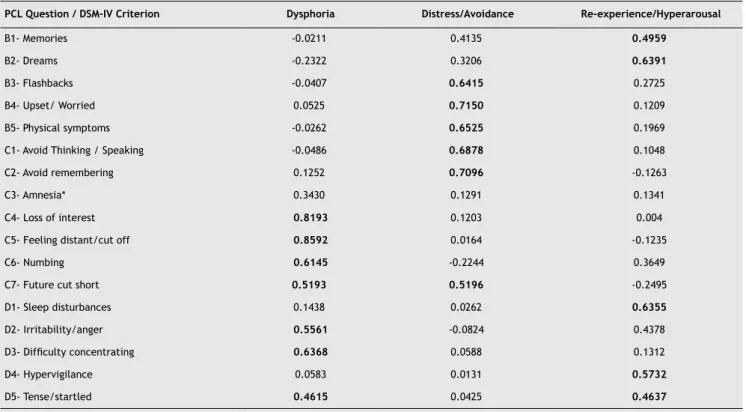
In the solution with 2 factors, the symptoms of re-experience and avoidance were loaded in one factor, and the symptoms of numbing and hyperarousal were loaded in another. The inclusion of a third factor separated some symptoms of hyperarousal and re-experience into a third factor. In the four factors solution the hyperarousal items that loaded together some re-experience symptoms (sleep disturbances, hypervigilance, tense/startled) started to load into a new factor. Furthermore, variable C3 (amnesia) came to exhibit a signiicant factor load, something that did not occur in the 2- or 3-factor solutions. Table 1shows the most adequate factorial or the GSE group:
Factor analysis of PCL-C applied to police oficers
By using the latent root criterion, the program retained three factors, which seems to be a solution that is similar to the one pointed by the scree plot.As it was done with the GSE databank, we chose to ana-lyze not only the suggested solution by the latent root and scree plot (three factors), but also solutions with one more and one less factor.
The 2- and 3-factor solutions were very similar, evi-dencing two mains factors: re-experience/avoidance and numbing/hyperarousal. As a 4th factor was added, some
symptoms of re-experience (memories, dreams, flash-backs) eventually constituted a separate factor. Table 2 presents the most appropriate factor solution for the MP sample.
Joint factor analysis of PCL-C
A factor analysis was performed of a inal bank resulting from the addition of the two MP banks to the GSE bank, involving a total of 518 individuals.
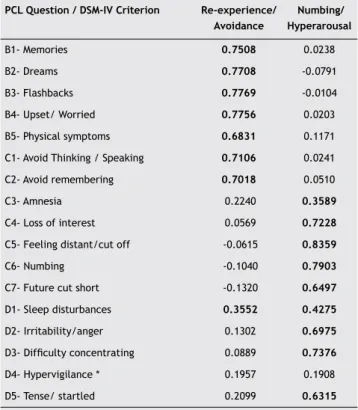
Just like it happened in the MP databank, the 2- and 3-factor solutions were very similar, evidencing two main factors: re-experience/avoidance and numbing/hyper-arousal. As a fourth factor was added, some symptoms of re-experience (memories, dreams) coupled with sleep disturbances ended up constituting a separate factor. Table 3 presents the best factor solution in the databank comprising all individuals (GSE and MP).
Comparison of factor solutions
Table 4 shows that in the 2-factor solution, the re-experience symptoms load with the avoidance symptoms, with no dif-ference across the groups (GSE, MP and joint/total analysis). The 3-factor solution is the same for the MP group and joint analysis, revealing a factor for re-experience and avoidance, and a second factor for numbing and hyperarousal, according to the 2-factor solution, with the third factor composed of only item 16 of the PCL-C (D4-hypervigilance).
In the 3-factor solution for the GSE, some symptoms of hyperarousal (sleep disturbances, hypervigilance, tense/ startled) and re-experience (memories and dreams) load together.
The 4-factor solution differs slightly across the groups. As a whole, there is a re-experience factor, a second factor with re-experience and avoidance symptoms, a third factor of numbing and hyperarousal, and a fourth factor in the MP bank and in the total bank (MP and GSE) composed solely of question 16 of the questionnaire (D4 = hypervigilance), while in the GSE bank this factor is represented by questions 13, Table 1 Factor solution for the GSE according to DSM-IV criteria
PCL Question / DSM-IV Criterion Dysphoria Distress/Avoidance Re-experience/Hyperarousal
B1- Memories -0.0211 0.4135 0.4959
B2- Dreams -0.2322 0.3206 0.6391
B3- Flashbacks -0.0407 0.6415 0.2725
B4- Upset/ Worried 0.0525 0.7150 0.1209
B5- Physical symptoms -0.0262 0.6525 0.1969 C1- Avoid Thinking / Speaking -0.0486 0.6878 0.1048 C2- Avoid remembering 0.1252 0.7096 -0.1263 C3- Amnesia* 0.3430 0.1291 0.1341 C4- Loss of interest 0.8193 0.1203 0.004
C5- Feeling distant/cut off 0.8592 0.0164 -0.1235
C6- Numbing 0.6145 -0.2244 0.3649
C7- Future cut short 0.5193 0.5196 -0.2495
D1- Sleep disturbances 0.1438 0.0262 0.6355
D2- Irritability/anger 0.5561 -0.0824 0.4378
D3- Dificulty concentrating 0.6368 0.0588 0.1312
D4- Hypervigilance 0.0583 0.0131 0.5732
D5- Tense/startled 0.4615 0.0425 0.4637
*Does not load signiicantly in any factor.
Table 2 Factor solution for MP according to DSM-IV criteria
PCL Question / DSM-IV Criterion
Re-experience/ Avoidance
Numbing/ Hyperarousal
B1- Memories 0.7808 -0.0056 B2- Dreams 0.8207 -0.1267
B3- Flashbacks 0.7671 0.0187
B4- Upset/ Worried 0.7685 0.0426 B5- Physical symptoms 0.6692 0.1483 C1- Avoid Thinking / Speaking 0.6574 0.1097 C2- Avoid remembering 0.6955 0.0958 C3- Amnesia* 0.2494 0.3363 C4- Loss of interest 0.1209 0.6532
C5- Feeling distant/cut off 0.0018 0.8015
C6- Numbing -0.0875 0.7764
C7- Future cut short -0.2446 0.7396
D1- Sleep disturbances 0.3882 0.4285
D2- Irritability/anger 0.1793 0.6609
D3- Dificulty concentrating 0.1272 0.7280
D4- Hypervigilance * 0.2054 0.1095 D5- Tense/ startled 0.2402 0.6068
16 and 17 (D1 = sleep disturbances, D3 = hypervigilance and D4 = tense/startled). In GSE dataset, question 16 (amnesia) loaded with some re-experience items.
Discussion
According to the criteria described in the methods section, the 2-factor solution was the chosen one in the MP bank and in the banks joint analysis. The factors were: re-experience/ avoidance and numbing/hyperarousal. The GSE bank led to the 3-factor solution: dysphoria, distress/avoidance, and re-experience/hyperarousal. Dysphoria comprises numbing and some arousal symptoms. Thus, the most consistent inding here is that avoidance and numbing constitute independent dimensions.
Except for the item 16 of the questionnaire (hypervigi-lance), every other one loaded signiicantly in some factor. We found that the factor solutions for the total bank were more similar to the factor solutions for the MP bank, pos -sibly due to a greater proportion of individuals from the MP group composing the total bank. At any rate, the 2-factor solution did not differ across the groups. The 3- and 4-factor solutions were slightly different between the MP bank and the GSE bank. Possibly the differences between the results of factor analysis for the two banks are due to the type of violence experienced by the individuals. Although both groups of workers are exposed to traumatic events, this occurs in different ways. The military police are more likely to be Table3 Factor solution of PCL-C according to DSM-IV criteria
PCL Question / DSM-IV Criterion Re-experience/ Avoidance
Numbing/ Hyperarousal
B1- Memories 0.7508 0.0238
B2- Dreams 0.7708 -0.0791
B3- Flashbacks 0.7769 -0.0104
B4- Upset/ Worried 0.7756 0.0203 B5- Physical symptoms 0.6831 0.1171 C1- Avoid Thinking / Speaking 0.7106 0.0241 C2- Avoid remembering 0.7018 0.0510 C3- Amnesia 0.2240 0.3589
C4- Loss of interest 0.0569 0.7228
C5- Feeling distant/cut off -0.0615 0.8359
C6- Numbing -0.1040 0.7903
C7- Future cut short -0.1320 0.6497
D1- Sleep disturbances 0.3552 0.4275
D2- Irritability/anger 0.1302 0.6975
D3- Dificulty concentrating 0.0889 0.7376
D4- Hypervigilance * 0.1957 0.1908 D5- Tense/ startled 0.2099 0.6315
*Does not load signiicantly in any factor.
Table 4 Results of factor analysis in the 3 databanks
2-factor solution 3-factor solution 4-factor solution
GSE
N = 175
- No signiicant factor load: C3, C7, D1, D4 - Single variance greater than 50%: B2, C1, C2, C3,
C7, D1, D4
- More than one signiicant factor load: ɸ
Factors:
1. B1-C2 (re-experience + avoidance)
2. C4,C5, C6, D2, D3. D5 (numbing + hyperarousal)
- No signiicant factor load: C3 - Single variance greater than 50%: C3, D4 - More than one signiicant factor load:, C7, D5
Factors:
1. B1, B2, D1, D4, D5 (re-experience + hyperarousal) 2. B3-C2, C7 ( distress + avoidance t)
3. C4-C6, D2-D3 (Dysphoria)
- No signiicant factor load: ɸ
- Single variance greater than 50%: ɸ
- More than one signiicant factor load: C7, D5
Factors:
1. B1, B2, C3 (re-experience +amnesia) 2. B3-C2, C7 re-experience + avoidance +
future cut short)
3. C4-C6, D2, D3 (numbing + hyperarousal) 4. D1, D4, D5 (hyperarousal)
MP N = 343
- No signiicant factor load: C3, D4 - Single variance greater than 50%: C3, C7, D4 - More than one signiicant factor load: D1
Factors:
1. B1-C2 (re-experience + avoidance) 2. C4-D5 [except D4] (numbing + hyperarousal)
- No signiicant factor load: C3
- Single variance greater than 50%: C3, C7 - More than one signiicant factor load: D1
Factors:
1. B1-C2 (re-experience + avoidance) 2. C4-D5 [except D4] (numbing + hyperarousal) 3. D4 (hypervigilance)
- No signiicant factor load: ɸ
- Single variance greater than 50%: C3, C7 - More than one signiicant factor load: C7,D1
Factors:
1. B1-B3 (re-experience)
2. B4-B5, C1-C3 (avoidance + re-experience) 3. C4-D5 [except D4] (numbing + hyperarousal) 4. D4 (hypervigilance)
Total
N = 518
- No signiicant factor load: D4
- Single variance greater than 50%: C3, C7, D1, D4 - More than one signiicant factor load: D1
Factors:
1. B1-C2 (re-experience + avoidance) 2. C3-D5 [except D4] (numbing + hyperarousal)
- No signiicant factor load: ɸ
- Single variance greater than 50%: C3, C7, D1 - More than one signiicant factor load: D1, D5
Factors:
1. B1-C2 (re-experience + avoidance) 2. C3-D5 [except D4] (numbing + hyperarousal) 3. D4 (hypervigilance)
- No signiicant factor load: ɸ
- Single variance greater than 50%: C3 - More than one signiicant factor load: B1,
B3, B5, C3, C7, D5
Factors:
1. B1-B2 + D1 (re-experience + sleep disturbance)
2. B3-B5, C1-C2 (avoidance + re-experience) 3. C3-C7, D2-D5 [except D4] (numbing +
primary victims, i.e., to experience themselves the trauma. The rescue team, on the other hand, most often work as a “secondary victim”, i.e., they just witness the traumatic event. Moreover, differences between the samples and in -stitutional organization must also be considered. In general, the GSE bank is more heterogeneous than the MP bank. In addition, it is known that the prevalence of the disorder in the two groups is different. Concerning item 16, it should be emphasized that the translation of the question (Estar “superalerta”, vigilante ou “em guarda”) may not have been the most adequate one for the assessed population. Probably due to the policemen’s occupation, most individuals gave a clinically signiicant response (score ≥ 3; Total bank = 53.71%, PM = 59.76%; GSE = 46.29%).
By comparing the results of this study with those from the other research on the theme, we notice some discrepancy. Whereas here the best factor solution was composed of 2 factors, the literature review showed that 8 out of 9 pub-lished studies12-20 found 4-factor solutions.12,14-20 The reasons
for this divergence merits consideration. Only two of these studies performed an exploratory analysis as they assessed samples of patients with cancer.19,20 Thus, the difference in
the population studied may explain the discrepancy between their solutions and ours. If we consider the four studies with greatest sample size, we observe that all four found a 4-fac-tor solution.15-18
On the other hand, the one study that evaluated a population that is more closely similar to ours, a UN peace troop, performed a conirmatory factor analysis of PCL-M and found, too, a 2-factor solution (re-experience/avoid-ance; numbing/ hyperarousal). This inding corroborates the best choice found in our study for the joint analysis and military policemen.21 It should be mentioned that the
PCL-M differs from the PCL-C solely because it refers strictly to military events.
Although literature proposes a new criterion – dysphoria-based on conirmatory factor analysis, our study did not comprise it, since its exploratory proile. Nevertheless, it is important to evaluate this factor in further conirmatory studies.22
Contrary to the most consistent inding of the present study, i.e. that avoidance and numbing constitute different dimensions, behavioral theory suggests that numbing is trig-gered by avoidance of reactions and memories of the trau-matic event.23 However, supportive of our indings, results
from several studies show that the dimensions of avoidance and numbing are statistically independent.24,25 Indeed, it
has been shown that avoidance and numbing correlate dif-ferently with depression.26,27 Moreover, although numbing
and avoidance can be functionally similar in that they both relieve emotional distress, the underlying mechanisms are different.28
Some theoretical studies propose that the avoid-ance symptoms evolve as a defense mechanism to the re-experience symptoms and thus are interrelated, while numbing symptoms evolve from hyperarousal symptoms.29-31
Posttraumatic stress disorder is thought to arise from fear-ful memory resulting from an associative conditioning and a non-associative sensitization.32,33 According to this theory,
PTSD symptoms are divided into those clearly related to memory of the trauma (re-experience and avoidance) and
others in which this association is not present (hyperarousal and numbing). The two memory processes appear to in-volve different neurobiological substrates, corroborating the distinction between conditioning-related symptoms and sensitization-related symptoms.33 Thus, the 2-factor
solu-tion (re-experience/avoidance, numbing/hyperarousal) is in keeping with this theory.
Further support for the indings of the present study, where numbing and hyperarousal constitute the only dimen-sion, comes from a study by Litz et al., who studied a sample of Vietnam War veterans and concluded that hyperarousal symptoms are the best predictors of numbing.25
It is noteworthy that in the DSM-IV-TR, the symptoms of numbing and avoidance compose the same diagnostic cluster, which is considered positive when the patient presents 3 of any of the 7 symptoms described (5 of numbing and only 2 of avoidance). Therefore, the individual can fulill criterion C even though avoidance symptoms are absent. If future stud-ies conirm that avoidance and numbing constitute different dimensions, this may have repercussions in the diagnostic system, with inclusion of more avoidance symptoms being indicated and positivity in this dimension being required for a PTSD diagnosis. Furthermore, the separation of avoidance and numbing has therapeutic implications. Different treat-ments are likely to be recommended according to the group of symptoms displayed (avoidance/numbing). Keane et al. reported that behavioral cognitive therapy improved avoid-ance symptoms, but not numbing, sense of disconnection from others, and restricted range of affect.34
The main limitations of our study are related to the characteristics of the sample. It evaluated men from a spe-ciic occupational group that can be related to a particular trauma proile.
Conclusion
The generalization of these indings from the two samples must be made with caution. Research in other populations of victims of distinct traumas, involving females and with greater samples, are important for conirmation of the indings. The performance of conirmatory factor analyses completes the picture of studies aimed at elucidating the factor structure of PCL-C.
Disclosures
Roberta Benitez Freitas Passos
Employment: Instituto de Medicina Social of the Universidade de Estado do Rio de Janeiro (UERJ), Brazil.
Ivan Figueira
Employment: Faculdade de Medicina of the Universidade Federal do Rio de Janeiro (UFRJ), Brazil.
Mauro Vítor Mendlowicz
Employment: Centro de Ciências Médicas da Universidade Federal Fluminense, Niterói (RJ), Brazil.
Claudia Leite Moraes
Employment: Instituto de Medicina Social of the Universidade de Estado do Rio de Janeiro (UERJ), Brazil.
Evandro Silva Freire Coutinho
Employment: Instituto de Medicina Social of the Universidade de Estado do Rio de Janeiro (UERJ); Department of Epidemiology, Escola Nacional de Saúde Pública, Fundação Oswaldo Cruz, Brazil.
This study was supported by the Conselho Nacional de Desenvolvimento
Cientíico e Tecnológico (CNPQ), Brazil.
* Modest
** Signiicant
*** Signiicant: Amounts given to the author’s institution or to a colleague for
References
1. American Psychiatry Association. Diagnostic and statistical manual for mental disorders. Washington: American Psychiatric Press; 1994.
2. Blake DD, Weathers FW, Nagy LM, Kaloupek DG, Gusman FD, Charney DS, Keane TM. The development of a
Clinician-Administered PTSD Scale. J Trauma Stress. 1995;8(1):75-90. 3. Weathers FW, Litz BT, Herman DS, Huska JA, Keane TM, editors.
The PTSD checklist: reliability, validity, and diagnostic utility. Annual meeting of the International Society for Traumatic Stress Studies 1993; San Antonio, CA.
4. Caiuby AVS, Lacerda SS, Quintana MI, Andreoli SB. Adaptação transcultural da versão brasileira da Escala do Impacto do Evento - Revisada (Impact of Event Scale-Revised). Cad Saúde Pública [In press]. 2011.
5. Kristensen CH. Estresse Pós-Traumático: Sintomatologia e Funcionamento Cognitivo. [Thesis] Porto Alegre: Universidade Federal do Rio Grande do Sul; 2005.
6. Berger W, Mendlowicz MV, Souza WF, Figueira I. Equivalência semântica da versão em português da Post-Traumatic Stress Disorder Checklist - Civilian Version (PCL-C) para rastreamento do transtorno de estresse pós-traumático. R Psiquiatr RS. 2004;26(2):167-75.
7. Berger W, Figueira I, Maurat AM, Bucassio EP, Vieira I, Jardim SR, Coutinho ES, Mari JJ, Mendlowicz MV. Partial and full PTSD
in Brazilian ambulance workers: prevalence and impact on health and on quality of life. J Trauma Stress. 2007;20(4):637-42 [Epub Aug 2007].
8. Maia DB, Marmar CR, Metzler T, Nobrega A, Berger W, Mendlowicz MV, Coutinho ES, Figueira I. Post-traumatic stress symptoms in an elite unit of Brazilian police oficers: prevalence and impact
on psychosocial functioning and on physical and mental health. J Affect Disord. 2007;97(1-3):241-5 [Epub Jul 2006].
9. Maia D, Marmar C, Henn-Haase C, Nóbrega A, Fiszman A, Portella C, Coutinho ES, Figueira I. Predictors of PTSD symptoms in brazilian police oficers: The synergy of negative affect and
peritraumatic dissociation. Rev Bras Psiquiatr. 2011;33(4):362-6. 10. Hair JF (editor). Multivariate data analysis. New Jersey: Pearson
Prentice Hall; 2006.
11. Stata Statistical Software Release 9 ed. Texas: College Stations, Stata Corporation; 2005.
12. Asmundson GJ, Frombach I, McQuaid J, Pedrelli P, Lenox R, Stein MB. Dimensionality of posttraumatic stress symptoms: a conirmatory factor analysis of DSM-IV symptom clusters and
other symptom models. Behav Res Ther. 2000;38(2):203-14. 13. Cordova MJ, Studts JL, Hann DM, Jacobsen PB, Andrykowski MA.
Symptom structure of PTSD following breast cancer. J Trauma Stress. 2000;13(2):301-19.
14. DuHamel KN, Ostrof J, Ashman T, Winkel G, Mundy EA, Keane TM, Morasco BJ, Vickberg SM, Hurley K, Burkhalter J, Chhabra R, Scigliano E, Papadopoulos E, Moskowitz C, Redd W. Construct
validity of the posttraumatic stress disorder checklist in cancer survivors: analyses based on two samples. Psychol Assess. 2004;16(3):255-66.
15. Marshall GN. Posttraumatic Stress Disorder Symptom Checklist:
factor structure and English-Spanish measurement invariance. J Trauma Stress. 2004;17(3):223-30.
16. Palmieri PA, Weathers FW, Difede J, King DW. Conirmatory factor
analysis of the PTSD Checklist and the Clinician-Administered PTSD Scale in disaster workers exposed to the World Trade Center Ground Zero. J Abnorm Psychol. 2007;116(2):329-41.
17. Krause ED, Kaltman S, Goodman LA, Dutton MA. Longitudinal
factor structure of posttraumatic stress symptoms related to intimate partner violence. Psychol Assess. 2007;19(2):165-75. 18. Schinka JA, Brown LM, Borenstein AR, Mortimer JA. Conirmatory
factor analysis of the PTSD checklist in the elderly. J Trauma Stress. 2007;20(3):281-9.
19. Smith MY, Redd W, DuHamel K, Vickberg SJ, Ricketts P. Validation of the PTSD Checklist-Civilian Version in
survivors of bone marrow transplantation. J Trauma Stress. 1999;12(3):485-99.
20. Shelby RA, Golden-Kreutz DM, Andersen BL. Mismatch of posttraumatic stress disorder (PTSD) symptoms and DSM-IV
symptom clusters in a cancer sample: exploratory factor
analysis of the PTSD Checklist-Civilian Version. J Trauma Stress.
2005;18(4):347-57.
21. Asmundson GJ, Wright KD, McCreary DR, Pedlar D. Post-traumatic stress disorder symptoms in United Nations peacekeepers: an
examination of factor structure in peacekeepers with and without chronic pain. Cogn Behav Ther. 2003;32(1):26-37 [Epub
Nov 2005].
22. Elklit A, Armour C, Shevlin M. Testing alternative factor models
of PTSD and the robustness of the dysphoria factor. Journal of anxiety disorders. 2010;24(1):147-54.
23. Figley CR, editor. Trauma and its Wake. New York: Brunner/ Mazel; 1985.
24. Foa EB, Riggs DS, Gershuny BS. Arousal, numbing, and intrusion:
symptom structure of PTSD following assault. Am J Psychiatry. 1995;152(1):116-20.
25. Litz BT, Schlenger WE, Weathers FW, Caddell JM, Fairbank JA, LaVange LM. Predictors of emotional numbing in posttraumatic
stress disorder. J Trauma Stress. 1997;10(4):607-18.
26. Asmundson GJ, Coons MJ, Taylor S, Katz J. PTSD and the
experience of pain: research and clinical implications of shared vulnerability and mutual maintenance models. Can J Psychiatry. 2002;47(10):930-7 [Epub Jan 2003].
27. Taylor S, Fedoroff IC, Koch WJ, Thordarson DS, Fecteau G, Nicki RM. Posttraumatic stress disorder arising after road trafic
collisions: patterns of response to cognitive-behavior therapy. J Consult Clin Psychol. 2001;69(3):541-51 [Epub Aug 2001]. 28. Oldham JM, Riba MB, Tasman A, editors. Posttraumatic stress
disorder and rape, in American Psychiatric Press Review of Psychiatry. Washington, DC: American Psychiatric Press; 1993. 29. McFarlane AC. Avoidance and intrusion in posttraumatic stress
disorder. J Nerv Ment Dis. 1992;180(7):439-45 [Epub Jul 1992].
30. Perry S, Difede J, Musngi G, Frances AJ, Jacobsberg L. Predictors
of posttraumatic stress disorder after burn injury. Am J Psychiatry. 1992;149(7):931-5 [Epub Jul 1992].
31. Shalev AY, Peri T, Canetti L, Schreiber S. Predictors of PTSD in
injured trauma survivors: a prospective study. Am J Psychiatry.
1996;153(2):219-25 [Epub Feb 1996].
32. Foa EB, Zinbarg R, Rothbaum BO. Uncontrollability and
unpredictability in post-traumatic stress disorder: an animal model. Psychol Bull. 1992;112(2):218-38 [Epub Sep 1992]. 33. Gewirtz JC, McNish KA, Davis M. Lesions of the bed nucleus
of the stria terminalis block sensitization of the acoustic
startle relex produced by repeated stress, but not fear-potentiated startle. Prog Neuropsychopharmacol Biol Psychiatry.
1998;22(4):625-48 [Epub Jul 1998].
34. Keane TM. Post-traumatic stress disorder: current status and