(1) Universidade Federal da Paraíba (UFPB),
João Pessoa, Paraíba, Brasil;
(2) Departamento de Psicologia da
Universidade Federal da Paraíba e do PPgNeC/UFPB, João Pessoa, Paraíba, Brasil;
(3) Departamento de Fonoaudiologia da
Universidade Federal da Paraíba e do PPgNeC/UFPB, João Pessoa, Paraíba, Brasil.
Laboratório Integrado de Estudos da Voz (LIEV) do Departamento de Fonoaudiologia da Universidade Federal da Paraíba.
Conlict of interest: non-existent
Effectiveness and limitations of vocal therapy in Parkinson’s
disease: a literature review
Eficácia e limitação da terapia vocal na doença de Parkinson:
revisão de literatura
Renata Serrano de Andrade Pinheiro(1) Nelson Torro Alves(2) Anna Alice Figueirêdo de Almeida(3)
Received on: May 05, 2015 Accepted on: March 30, 2016
Mailing address:
Anna Alice Figueirêdo de Almeida Departamento de Fonoaudiologia da Universidade Federal da Paraíba Centro de Ciências da Saúde Cidade Universitária Campus I. Castelo Branco I João Pessoa – PB – Brasil
CEP: 58051-900
E-mail: [email protected]
ABSTRACT
The aim of this review was to assess the scientiic evidence and restrictions of different kinds of treat-ments for voice in Parkinson’s disease. The survey was conducted of articles in the databases PubMed / MEDLINE, SciELO and Lilacs. It was used as search strategy combinations with the following descriptors: “Parkinson’s disease therapy and vocal”; “Parkinson’s disease and acoustic speech”; “Parkinson’s dise-ase and voice”. Inclusion criteria were: language Portuguese or English; articles the years 2003-2013; and intervention studies. It was adopted as exclusion criteria: repeated in the databases; animal research. During the search were found 351 articles, of which only 18 of them met the inclusion criteria in the study. The results were presented considering the various types of processing for voice in Parkinson’s disease, according to technical intervention: pharmacological, surgical and rehabilitation, identifying authors and the year of publication, the sample characteristics, the type of treatment, method and completion of the study. In this study we observed reduced scientiic output in the voice treatment of Parkinson’s disease. Most articles have addressed the treatment techniques for high-cost voice, or in need of qualiication / certiication in the method for carrying out the speech therapy.
Keywords: Parkinson Disease; Voice; Voice Disorders; Dysphonia; Speech therapy; Rehabilitation
RESUMO
O objetivo desta revisão de literatura foi veriicar as evidências cientíicas e restrições dos diferentes tipos de tratamentos para voz na Doença de Parkinson. O levantamento dos artigos foi realizado nas bases de dados PubMed/MEDLINE, SciELO e Lilacs. Utilizou-se como estratégia de busca as combinações com os seguintes Descritores: “Parkinson disease and vocal therapy”; “Parkinson disease and speech acoustic”;
“Parkinson disease and voice”. Os critérios de inclusão foram: idioma em português ou inglês; artigos dos anos 2003-2013; e estudos de intervenção. Adotou-se como critérios de exclusão: os repetidos nas bases de dados; pesquisas com animais. Durante a busca foram localizados 351 artigos, dos quais apenas 18 deles preenchiam os critérios de inclusão adotados no estudo. Os resultados foram apresen-tados considerando os diferentes tipos de tratamento para a voz na Doença de Parkinson, de acordo com a técnica de intervenção: medicamentoso, cirúrgico e reabilitação, identiicando os autores e ano de publicação, características da amostra, o tipo de tratamento, o método utilizado e a conclusão do estudo. Nesta pesquisa observou-se reduzida produção cientíica no tratamento da voz na doença de Parkinson. A maioria dos artigos abordou as técnicas de tratamento para a voz de alto custo, ou que necessitam de habilitação/certiicação no método para a realização da terapia de voz.
INTRODUCTION
Parkinson’s disease (PD) occurs as a result of a degeneration of neurons located in the substantia nigra of the midbrain. This degeneration causes the decrease of the release of the neurotransmitter dopamine in the striatal area (caudate nucleus and putamen)1.
Clinical symptoms of PD include: tremor, rigidity,
bradykinesia and change of the postural relexes. The
disease usually begins after the age of 50, although there may occur forms with early onset. The table presents a slow and gradual onset, with clinical manifestations limited to one half of the body. Over time, symptoms are manifested bilaterally. The patient tends to assume a posture bent forward and the gait tends to manifest itself with short steps, dragging the
heels on the loor2.
Since 1960, there has been an increased interest in research on the impairment of oral communication in patients with Parkinson’s disease.
The changes in speech articulation are charac-terized by hypokinetic dysarthria, with reduced vocal intensity, imprecise articulation, change in the speed of speech, rush and inappropriate articulatory pauses and monotony of the frequency and intensity of voice3.
These dificulties in the communication of PD
patients are attributed to the presence of signs and motor symptoms, described above, but mainly akinesia has been considered to cause reduction in the speed of phonoarticulatory movements, a process which can
also undergo the inluence of rigidity. With the evolution
of PD, the entire aero-digestive tract is impaired, affecting in different ways the respiratory, articulatory, resonance and digestive systems4.
The effects of PD on vocal production are charac-terized by the following features: reduced intensity and mono intensity, mono height, hoarse, breathy, slightly tense vocal quality, with phonatory instability, irregular speed, imprecise articulation, phoneme repetition, and varying degrees of intelligibility reduction. The change
in the low of speech is manifested in the sudden accel -eration of speech, which takes place in small groups, as rush speech, hesitations and inadequate pauses at the beginning of sentences and words3.
Laryngeal abnormalities seen in PD are: reduced movements of vocal folds, mucosa with large movements, fusiform-type cleft, tremor of aritenoids,
The literature discloses the use of different methods and techniques for treating PD and the dysphonia related to PD, the most used being: the Surgical, referring to Thalamotomy; the Transplantation of adrenal gland cells or fetal cells; the Pallidotomy; and the Deep Brain Stimulation, with the last two as the most appropriate treatment options for individuals with Parkinson’s disease; still, the Pharmacological, which uses dopamine precursors (levodopa) or agonists (bromocriptine or pergolide mesylate), obtaining, with the use of levodopa, positive functional results, but still with no consistent response in speech, although the body motor symptoms present reduction; and, for Dysphonia, Vocal Rehabilitation, in which the most recent approaches have emphasized the delayed auditory feedback, proprioceptive techniques, the prosodic method, visual and auditory monitoring and the Lee Silverman method, which shows a promising approach, aiming to stimulate the glottal closure, as in PD patients, during phonation, there is no complete glottal coaptation, therefore, this glottal closure will provide an increase of vocal intensity, and even with
the exclusive focus on the voice, the improvement of
this intensity will also bring an improved articulatory pattern3.
The overall objective of this review is to conduct the
search for scientiic articles in the database through the
descriptors selected for the preparation of a systematic review about the methods and techniques for voice treatment in Parkinson’s disease patients. Having as
speciic objectives: 1) To point the indication criteria of
voice treatment in patients with Parkinson’s disease; 2) To analyze the different types of voice treatment in
Parkinson’s disease; 3) To check scientiic evidences
and restrictions on the most commonly used methods and techniques of voice treatment for individuals with Parkinson’s disease.
METHODS
The articles selected for this review are indexed in
the PubMed/MEDLINE and LILACS databases and in
the Scientiic Electronic Online Library – Scielo. It were
used the descriptors of the Medical Subject Heading Terms (MeSH) “Parkinson disease”, “Vocal therapy”, “Speech acoustic” and “Voice”. They were combined in each database, using the following strategy: “Parkinson
Intervention studies were included, either longitudinal or of immediate effect, which addressed the treatment for the voice of individuals with Parkinson’s disease. The inclusion criteria for the search were: journal articles available through PubMed/MEDLINE, SciELO
and Lilacs databases, with full text or abstract; in
Portuguese, English or Spanish; published in the years (2003-2013); and constituting intervention research. It
were excluded studies that did not meet the selected
inclusion criteria; those repeated; those who did not contemplate the use of vocal treatment in humans; and the studies that, although having the review descriptors, did not contemplate the issue which is the object of
study. It were considered the full articles available for free, or the full articles available online through the IP of the Higher Education Institution, with free access to the “CAPES journals”.
The selection of items for exclusion was initially
carried out by the search of the combined terms “Parkinson’s disease”, “Vocal therapy”, “Speech
acoustic” and “Voice”, then, the exclusion criterion was
the language, being considered those in Portuguese,
English or Spanish and inally the maximum period of
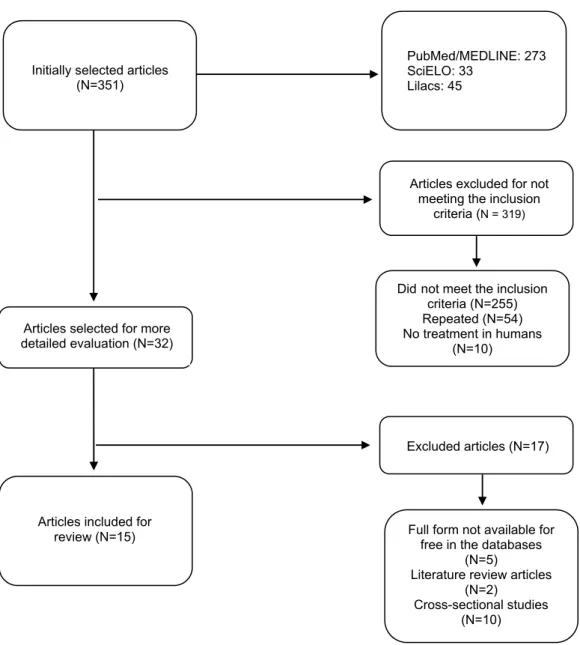
ten years since the publication. These data are seen in
the lowchart (Figure 1).
Initially selected articles (N=351)
PubMed/MEDLINE: 273 SciELO: 33
Lilacs: 45
Articles excluded for not meeting the inclusion
criteria (N = 319)
Articles selected for more detailed evaluation (N=32)
Excluded articles (N=17)
Articles included for
review (N=15) Full form not available for free in the databases
(N=5)
Literature review articles (N=2)
Cross-sectional studies (N=10) Didnot meet the inclusion
criteria (N=255) Repeated (N=54) No treatment in humans
(N=10)
for not being full available in the free form neither in international databases nor in CAPES journals, two for being literature review articles and ten for being cross-sectional studies. Thus, 15 studies were included for
inal analysis, according to Figure 1.
Table 1 shows the literature selected for this review, referring to treatments that interfere with the voice, of pharmacological and surgical type, in Parkinson’s disease, identifying authors and the year of publication, the sample characteristics, the treatment technique, the method used and the conclusion of the study.
LITERATURE REVIEW
351 articles were found in the initial selection, through search with combined terms. After analyzing
the titles and abstracts, 319 items were excluded for
being repeated in the databases, for using animal research and for being systematic reviews, case studies and accuracy studies.
Subsequent to this analysis, 32 relevant studies
were identiied, which were selected for full analysis of the articles. Of these, seventeen were excluded by not meeting the following criteria: ive were excluded
Table 1. Description of the types of voice treatment for Parkinson’s disease: pharmacological and surgical
AUTHORS/YEAR SAMPLE TREATMENT
TECHNIQUE MÉTHOD CONCLUSION
Azevedo, Cardoso, Reis (2003)
16 women 8 with PD
8 control Making use of
LEVODOPA
A.PHARMACOLOGICAL Prosody in the use of
LEVODOPA
It was carried out a comparison between groups of PD patients with and without
the use of LEVODOPA
Changes in voice, characterized by varying the fundamental frequency (higher at ON) and the intensity (lower
at ON), are part of the luctuations associated with the use of LEVODOPA .
Moreau, Ployart et al. (2011)
11 individuals with idiopathic PD
30 controls 15 men 15 women Submitted to STN DBS
B.SURGICAL Subthalamic Nucleus Deep Brain Stimulation
The STN DBS was applied in patients with PD and compared to the control
group
The improvement of gait and dysarthria at low-frequency STN DBS supports the hypothesis that the high frequency
diffuses the tension of the cerebellar pathways.
Xie, Zhang, Zheng, Liu et al. (2011)
11 indivíduals with PD 5 men 6 women Submited to bilateral
STN DBS
Subthalamic Nucleus Deep Brain Stimulation
1.Pre-surgery (meds ON) 2.Pre-surgery (meds OFF) 3.Post-surgery (meds ON/ stim OFF) 4.Post-surgery (meds OFF/ stim OFF) 5.Post-surgery (meds ON/ stim ON) 6.Post-surgery (meds OFF/ stim ON)
The main indings of the research on the effects of STN DBS on hypokinetic dysarthria in PD are: 1- the
continuous high-frequency bilateral STN DBS is an effective treatment in advanced PD; 2- speech improvement
is less noticeable than the motor symptoms; 3- the vowel /i/ is a sensitive
parameter of changes in PD dysarthria; 4- there was no gender difference in HNR, F0, F2 and F3 when pronounced
the vowel /i/.
Hammer, Barlow, Lyons and Pahwa
(2010)
18 individuals with PD 15 men 3 women Submitted to STN DBS
Subthalamic Nucleus Deep Brain Stimulation
The test was performed 12 hours since the last dose of anti-PD medication with DBS ON. 1 hour after the DBS was
turned OFF, aerodynamic measures were veriied during the production of
syllables.
The high-frequency STN DBS has lower beneits related to the control of the larynx than to the motor control of the
limbs.
Mourão, Aguiar, Ferraz, Behlau, Ferraz
(2005)
12 individuals 7 men 5 women Submitted to posteroventral
pallidotomy
Posteroventral pallidotomy
The degree of dysarthrophonia was assessed and compared in the pre-surgery, in the 1st month of post-surgery
and in the 3rd month of post-surgery.
This study showed improvement in some parameters related to phonation,
but the procedure did not cause any improvement in dysarthrophonia. Recent
studies have shown that changes in voice and speech satisfactorily respond
to therapy.
Legend of acronyms:PD - Parkinson’s Disease STN DBS - Subthalamic Nucleus Deep Brain Stimulation HNR - Harmonic-to-Noise Ratio F0 - fundamental frequency
F2 - frequency 2 F3 - frequency 3.
Table 2 describes the publications that refer to the types of voice treatment in Parkinson’s disease
Table 2. Description of the types of voice rehabilitation in Parkinson’s disease
AUTHORS/YEAR SAMPLE TREATMENT TECHNIQUE MÉTHOD CONCLUSION
Hartelius, Svantesson, Hedlund, Holmberg,
Revesz (2010)
10 individuals with PD 6 men 4 women Stimulated with rTMS
Estimulação Magnética Transcraniana
rTMS ACTIVE Stimulus rTMS PLACEBO Stimulus 2 treatment sessions (1 week interval)
The drugs were withdrawn 12 hours before each session. The placebo application took place at the opening
session.
There were no signiicant effects of rTMS on the speech and voice of patients included in the study, but no impairment. As the STN DBS, the effects
of treatments on voice and speech are reduced compared to the overall motor
function.
Cannito, Suiter, Beverly, Chorna, Wolf, Pteiffer
(2012)
8 individuals with idiopathic PD 5 men 3 women Lee Silverman LSVT LSVT method
16 sessions, 4 days per week for 4 weeks.
Increase vocal loudness, breathing and phonation.
In conclusion, the results of using the LSVT method are positive as a means of increasing the intelligibility of individuals with idiopathic Parkinson’s disease (in addition to increasing the voice intensity
and quality).
Searl, Wilson, Haring, Dietsch, Lyons, Pahwa
(2011) 15 individuals with PD
Lee Silverman LSVT
LSVT method adapted 15 patients with PD
90 min 1 x per week 8 consecutive weeks
One can carry out the LSVT method in the group format, performing some
modiications. The vocal behaviors (dB, voice and loudness) had favorable
changes.
Sapir, Spielman, Ramig, Story, Fox
(2007)
43 participants 29 individuals with PD 14 healthy individuals
Lee Silverman LSVT
Healthy individuals did not had intervention, a PD group received treatment with LSVT and the other did not. A comparison was made between
the three groups.
The variables vocal sound pressure level, F2 of vowel /u/ and F2 /i/ : F2 /u/ ratio, along with the perceptual classiication of vowels, showed
signiicant improvement in the group with LSVT. This highlights the
widespread impact of the intensive therapeutic treatment of voice also in orofacial functions (speech, swallowing, facial expression), respiratory functions
and larynx functions in individuals with PD.
Silveira, Brasolotto (2005)
5 individuals with PD 4 men 1 woman
Lee Silverman LSVT
PD patients submitted to audiologic evaluation, videonasoendoscopy. Vocal
assessment pre-and post-treatment by LSVT.
GRBAS, TMF, Loudness, Tonal Range, Articulatory Type.
There was improvement in the parameters of voice quality, articulation
and increase in the vocal intensity for speech in general. This improvement allowed greater adequacy of oral communication for the subjects.
Dias, Limongi (2003)
28 individuals with PD 21 men 7 women
Lee Silverman LSVT
Pretreatment (LSVT) Post-treatment (LSVT) up to 24 hours
Acoustic evaluation Intensity TMF (sec)
F0 (Hz) GRBAS
The beneits in quality and, above all, in vocal intensity affected the oral communication favorably, reduced negative symptoms and have adapted the vocal quality to personal and social
needs. The Lee Silverman method is effective in the treatment of voice in PD.
Coutinho, Diaféria, Oliveira, Behlau
(2009)
26 individuals with PD 15 men 11 women
Modiied Auditory Monitoring
The groups were submitted to 20-0 count under the following types of hearing: habitual, ampliied, delayed and
masked.
Evaluation: GRBAS, Acoustic (F0, Int., TMF).
The masking situation can provide immediate beneits to these individuals
and be used in speech therapy, producing stronger voice and more precise articulation. On the other hand,
the ampliication and delay situations presented modiications that do not contribute to minimize the deviations
observed in these patients.
Quedas, Duprat, Gasparini
(2007)
33 participants 17 patients with PD
8 men 9 women 16 healthy individuals
8 men 8 women
Modiied Auditory Monitoring
The study groups were submitted to auditory masking.
Evaluation of parameters: vocal intensity, stability of vocal intensity, frequency of vocal emission, stability of frequency of
vocal emission.
The Lombard effect (masking) promotes signiicant increase in the intensity and fundamental frequency of vocal emission in individuals with PD. The results also suggest an improvement in the stability of the vocal emission, both
Of the articles analyzed in this review, it was observed a pharmacological treatment method for PD, presenting interference with the voice signals. The pharmacological method was the use of levodopa, an antiparkinsonian drug that acts restoring the normal motor function by increasing the concentration of dopamine destroyed by Parkinson’s disease. Authors
showed in their study5 with a group of 16 women,
eight with PD and eight without PD, after the use of
medication in the group with PD, that luctuations occur
in the fundamental frequency and intensity of voice depending on the medication effect stage (ON/OFF).
Other studies have shown that the surgical inter-vention for treating PD shows alteration in the voice6-9, addressing mainly two techniques: the posteroventral pallidotomy, which is the formation of a lesion in the posteroventral region of the medial globus pallidus for treating PD6; and the subthalamic nucleus deep brain stimulation (STN DBS)7-9. The latter is a neurosurgical technique that consists of electrical stimulation of certain subcortical areas through electrodes surgi-cally implanted, whose aim is to rebalance damaged neuronal circuits7.
Although deep brain stimulation is currently the treatment of choice, pallidotomy continues to be performed worldwide as a treatment option for patients with PD. However, a limitation of these surgical inter-ventions is that, for being invasive methods, they are
and three studies on STN DBS7-9, with groups separated
by sex and with pre-and post-surgical evaluation,
showed that the positive results of these techniques were more observed in the global motor performance and in the control of limb movements than in the vocal production and improved dysarthrophonia.
Regarding the use of methods and techniques of rehabilitation for the treatment of voice in PD, only one study10, of 10 patients with PD, of both sexes, using 2 stimuli, one active and one placebo, on the application sessions with the use of repetitive transcranial magnetic stimulation (rTMS). This stimulation is based on the principle of electromagnetic induction, where a small coil receives a powerful electric current and is applied
on the skull in the cerebral cortex. This induced current
can depolarize neurons that are in a proper
orien-tation to the magnetic ield and thus generate action
potentials.
The effects of the treatment with rTMS are similar to those of the STN DBS, demonstrating that the results in the voice are reduced in comparison to the overall motor function. Hence, one can see that these methods do not have very promising results regarding voice.
Four studies11-15 with difference in the sample refer
the Lee Silverman Voice Treatment (LSVT)® method
as with excellence in the management of voice for
patients with Parkinson, using the application of the method for 16 sessions, with 4 consecutive sessions,
AUTHORS/YEAR SAMPLE TREATMENT TECHNIQUE MÉTHOD CONCLUSION
Rosa, Cielo, Cechella
(2008) 1 woman with PD1 man with PD Wind Instrument
Therapy for 12 weeks, with 1 session per week, lasting 40 min. - Body and manual preparation - Breath exercise with instrument (sweet
lute) 8 series / 8 repetitions
The therapy performed with wind instruments can provide greater eficiency in the glottal adduction, and greater movement and breath control, providing the most effective use of air for phonation with improved voice quality expressed by the reduction of noise measurements, higher phonatory
stability and increased vocal intensity.
Cochavit, Felicity, Meir, Kragstie, Olve
(2012) 10 individuals with PD Music Therapy
Intervention of 60 min, 1 x per week 20 consecutive weeks Speech and singing acoustically analyzed and depressive symptoms
analyzed by the Montgomery-Åsberg Rating Scale (MADRS) with measurements at baseline (T1), after 10 sessions (T2) and after 20 sessions
(T3).
Signiicant improvements in the quality of singing and in the voice range, along with the absence of decline in the quality
of speech and singing in the group, is a promising intervention for people with
PD.
Legend of acronyms:PD - Parkinson’s Disease rTMS - repetitive Transcranial Magnetic Stimulation STN DBS - Subthalamic Nucleus Deep
Brain Stimulation LSVT - Lee Silverman Voice Treatment MPT - Maximum phonation time F0 - fundamental frequency GRBAS - overall
quality, especially in vocal intensity, providing better communication by reducing the vocal symptoms of the disease and adjusting the voice quality to personal and social needs. This method has proven to be effective
in presenting Level I Scientiic Evidence, and for years
it has been the treatment of choice for patients with Parkinson.
Modiied Auditory Monitoring was reported as a
therapeutic technique or strategy for voice rehabilitation in PD in two studies16,17, with two groups divided by sex
and demonstrating the immediate beneits of masking,
which aims to increase the volume of the voice. This
artiice is called Lombard effect, a natural tendency of
the individual to increase the volume of his/her voice,
when, by exposure to noise, he/her is prevented from
hearing it properly. Thus, the masking has been used in speech therapy in order to promote a stronger voice and more precise articulation. Notwithstanding,
one dificulty of this technique is the continuity of the beneits obtained at the time of masking, requiring the
individual to be trained to maintain the high intensity even without the use of masking. The masking situation
offers PD individuals immediate beneits and can be
used in speech therapy, producing stronger voice and more precise articulation.
The use of wind instruments in speech therapy in PD was investigated by a study18 with a man and a woman with PD for 12 sessions of 40 minutes using breath
exercises with sweet lute, and showed an improvement in the eficiency of the glottal adduction, with greater
breath control, which provides the most effective use
of air for phonation, with beneicial and positive effects
on voice quality, showing a reduction of the voice noise, greater phonatory stability and increased vocal intensity.
The effect of the wind instruments can be compared to the physiological mechanism involved in
semi-occluded vocal tract exercises (SOVTE), which results in improved eficiency of the glottal adduction, and will promote the vocal economy and eficiency19. Nonetheless, it was found no study of this type of inter-vention in patients with PD.
And inally, the Music Therapy was approached in a
study20 who trained 10 individuals with PD for 20 weeks, with a weekly meeting, being carried out the acoustic analysis of speech and singing and the application of a questionnaire on depression (at three times). This method can be considered as promising and enjoyable, since it promotes a better quality of singing and larger
voice range, bringing beneits in the communication of
individuals with PD.
Given the above, it was observed a predominance of studies using the LSVT® method for the treatment of voice in PD. It were found studies which suggested the use of other therapeutic strategies that might have an
impact on the modiication of the voice of PD patients,
including: auditory monitoring, the use of wind instru-ments and music therapy.
These articles16-18,20 showed strategies with positive repercussions for the voice of PD patients, but showed sample size limitations, absence of control group and randomization of groups, and do not make it clear whether the changes that occurred in the voice can be maintained for a certain time, as is the case of LSVT. Among the studies presented, only those using the
LSVT have their effectiveness scientiically proven, since it is a method with Level I Scientiic Evidence, a reliable
methodology with effective therapeutic approach for
voice, however, it requires qualiication/certiication in
the method for performing the voice therapy.
Thus, it shows the importance of further studies to evaluate the effectiveness of methods/techniques
and their beneits to the voice of this population, with
greater methodological rigor in the design of the studies. One should think of strategies that are feasible and accessible to all levels of Attention to the Elderly Health, in order to promote the prevention of the effects of the disease on their communication, focusing on
better expressiveness, longevity of voice quality and
promoting vocal health.
CONCLUSION
The Lee Silverman Voice Treatment method is considered the “gold standard” in the rehabilitation of voice for patients with Parkinson’s disease. Other thera-peutic strategies are recommended for vocal treatment in PD, but the proposals have methodological limita-tions that prevent the inference of their effectiveness for people with PD.
The scientiic literature on voice addressing
Parkinson’s disease and its treatment is not much
explored. There are studies testing techniques and
REFERENCES
1. Lent R. Cem bilhões de neurônios: conceitos
fundamentais de neurociências.São Paulo: Editora
Atheneu, 2005.
2. Bear M, Connors B, Paradiso M. Neurociências:
desvendando o Sistema Nervoso. 3. Ed. Porto
Alegre: Artmed, 2008.
3. Behlau M, Azevedo R, Pontes P. Voz: O livro do especialista v.II. Rio de Janeiro: Revinter, 2005. 4. Ferraz HB, Mourão LF. Doença de Parkinson.
In: Chiappetta ALML. Conhecimentos essenciais para atender bem o paciente com doenças neuromusculares, Parkinson e Alzheimer. São José dos Campos: Pulso; 2003. p.45-54.
5. Azevedo LL, Cardoso F, Reis C. Acoustic analysis of prosody in females with Parkinson’s disease: Comparison with normal controls. Arq Neuropsiquiatr. 2003;61(4):999-1003.
6. Mourão LF, Aguiar PM, Ferraz FA, Behlau MS, Ferraz HB. Acoustic voice assessment in Parkinson’s disease patients submitted to posteroventral pallidotomy. Arq Neuropsiquiatr. 2005;63(1):20-5.
7. Moreau C, Pennel-Ployart O, Pinto S, Plachez A Modulation of dysarthropneumophonia by low-frequency STN DBS in advanced Parkinson’s disease. Mov Disord. 2011;26(4):659-63.
8. Xie Y, Zhang Y, Zheng Z, Liu A. Changes in speech characters of patients with Parkinson’s disease after bilateral subthalamic nucleus stimulation. J Voice. 2011;25(6):751-8.
9. Hammer MJ, Barlow SM. Subthalamic nucleus
deep brain stimulation changes speech respiratory and laryngeal control in Parkinson’s disease. J Neurol. 2010;257(10):692-702.
10. Hartelius L, Svantesson P, Hedlund P. Short-Term Effects of Repetitive Transcranial Magnetic Stimulation on Speech and Voice in Individuals
with Parkinson’s Disease. Folia Phoniatr Logop.
2010;62(2):104-9.
11. Dias AE, Limongi JCP. Tratamento dos distúrbios da voz na doença de Parkinson: O método Lee Silverman. Arq Neuropsiquiatr. 2003;61(1):61-6. 12. Silveira DN; Brasolotto AG. Vocal rehabilitation in
patients with Parkinson disease: interfering factors.
Pró-Fono R Atual Cient. 2005;17(2):241-50.
Searl J, Wilson K, Haring K. Feasibility of group
14. Cannito M. Sentence Intelligibility Before and
After Voice Treatment in Speakers With Idiopathic
Parkinson’s Disease.J Voice. 2012;26(2):214-9. 15. Sapir S, Spielman JL, Ramig LO, Story BH,
Fox C. Effects of intensive voice treatment (the
Lee Silverman Voice Treatment [LSVT]) on vowel articulation in dysarthric individuals with idiopathic Parkinson disease: acoustic and
perceptual indings. J Speech Lang Hear Res. 2007;50(4):899-912.
16. Coutinho SB, Diaféria G, Oliveira G, Behlau M. Voice and speech of individuals with Parkinson’s Disease
during ampliication, delay and masking situations.
Pró-Fono R Atual Cient. 2009;21(3):219-24.
17. Quedas A, Duprat AC, Gasparini G. Implicações
do efeito Lombard sobre a intensidade, frequência fundamental e estabilidade da voz de
indivíduos com doença de Parkinson. Rev Bras
Otorrinolaringol. 2007;73(5):675-683.
18. Rosa JC, Cielo CA, Cechella C. Função fonatória em pacientes com doença de parkinson:
uso de instrumento de sopro. Rev CEFAC.
2009;11(2):305-13.
19. Siracusa MGP; Oliveira G; Madazio G; Behlau M.
Efeito imediato do exercício de sopro sonorizado
na voz do idoso. J Soc Bras Fonoaudiol. 2011;23(1):27-31.